Spain’s Andalusia solar power station produces electricity day and night
Solar power station in Spain works at night Yahoo Finance 19 Mar 12, A unique thermosolar power station in southern Spain can shrug off cloudy days: energy stored when the sun shines lets it produce electricity even during the night.
The Gemasolar station, up and running since last May, stands out in the plains of Andalusia.
From the road between Seville and Cordoba, one can see its central tower lit up like a beacon by 2,600 solar mirrors, each 120 square metres (28,500 square feet), that surround it in an immense 195-hectare (480-acre) circle.
“It is the first station in the world that works 24 hours a day, a solar power station that works day and night!” said Santago Arias, technical director of Torresol Energy, which runs the station. The mechanism is “very easy to explain,” he said: the panels reflect the suns rays on to the tower, transmitting energy at an intensity 1,000 times higher than that of the sun’s rays reaching the earth.
Energy is stored in a vat filled with molten salts at a temperature of more than 500 degrees C (930 F). Those salts are used to produce steam to turn the turbines and produce electricity.
It is the station’s capacity to store energy that makes Gemasolar so different because it allows the plant to transmit power during the night, relying on energy it has accumulated during the day.
“I use that energy as I see fit, and not as the sun dictates,” Arias explained.
As a result, the plant produces 60 percent more energy than a station without storage capacity because it can work 6,400 hours a year compared to 1,200-2,000 hours for other solar power stations, he said.
“The amount of energy we produce a year is equal to the consumption of 30,000 Spanish households,” Arias said, an annual saving of 30,000 tonnes of CO2.
Helped by generous state aid, renewable energies have enjoyed a boom in Spain, the world number two in solar energy and the biggest wind power producer in Europe, ahead of Germany. … http://au.finance.yahoo.com/news/solar-power-station-spain-works-020347254.html
In UK, 102 business leaders urge government to back renewable energy

 Sir Branson and fellow entrepreneurs ask Cameron to back renewables http://www.eaem.co.uk/news/sir-branson-and-fellow-entrepreneurs-ask-cameron-back-renewables Energy and Envronment Magazine 16 March 2012
Sir Richard Branson is one of 102 top business signatories of an open letter to David Cameron urging him to back wind and other renewable forms of power generation.
“March’s budget provides one of the biggest opportunities to tackle climate change in the UK,” the Virgin tycoon says. “We must ensure it encourages investment rather than creates uncertainty and delays further serious investment in the renewable sector. As a country we need to be better prepared to deal with rising energy prices.”
The so-called ‘102 letter’ is conceived partly as a response to the actions of 101 backbenchers who last month wrote to the Prime Minister attacking wind power, and a call to the Treasury to re-establish a stable investment platform for renewable energy as a driver of the recovery out of the recession.
It is published on the website of the Entrepreneurs’ Organisation (EO), the global network of more than 7,500 business owners in 38 countries.
“Cutting support for green energy is a false economy,” comments Dale Vince, Founder and CEO of Ecotricity, one of Britain’s most successful new energy companies trying to muscle in on the territory controlled by the Big Six.
His angle is energy security. “Britain needs to become energy independent once more, and with the North Sea all but depleted of fossil fuels we need to look to other forms of indigenous energy. We have them in abundance, in the wind the sun and the sea, enough to power our country many times over.
“While Britain remains dependent on global energy markets, our bills can only go one way: upwards.”
His analysis is that the level of current support for green energy sources is relatively small in comparison to that for oil and gas.
In the last 12 months roughly £30 of our household energy bills has been spent on green energy support. Of this, the Renewables Obligation (RO) added just £15.15 to the annual energy bill of the United Kingdom’s 26.3 million households, with onshore wind power adding only £4.68, according to Ofgem’s recently published RO annual report for 2010/11and Ecotricity’s analysis.
The RO is the main support mechanism for encouraging the growth of renewable energy in the UK.
Meanwhile, the rising cost of imported gas added around £120 to energy bills last year, according to Ofgem’s Electricity and Gas Supply Market Report.
“We need to reverse those proportions; it’s an incredible false economy to throw money at energy market speculators while penny pinching over the one thing we can do to solve the problem long term: make our own energy,” concludes Mr Vince.
The letter says that “as entrepreneurs, investors, economists, scientists, engineers, energy providers, community builders and Members of Parliaments, we are increasingly concerned about the lack of clarity around the future of government support for land-based renewables, such as solar, wind and biogas.”

Letter to UK Prime Minister David Cameron on renewable energy
Richard Branson letter to David Cameron on renewable energy http://www.guardian.co.uk/environment/2012/mar/16/renewableenergy-energy
The letter in full from Dale Vince, Juliet Davenport and Caroline Lucas and other signatories backing green power, in response toa recent letter in which 101 Conservative backbenchers rubbished wind power
Dear David Cameron,
As entrepreneurs, investors, economists, scientists, engineers, energyproviders, community builders and Members of Parliament, we are increasingly concerned about the lack of clarity around the future of government support for land based renewables, such as solar, wind and biogas. Continue reading
With or without tax credits, renewable energy is set to grow
 renewable energy production will more than double by 2035 even without federal tax credits.
Renewable Energy Industry Poised for Growth Regardless of Tax Credits Market Watch, , NEW YORK, NY, Mar 08, 2012 –– Clean energy stocks have struggled considerably over the last month as concerns about a loss of subsidies and tax credits have led to growth concerns. The PowerShares Wilderhill Clean Energy Portfolio (PBW) is down more than 13 percent over the last month.
Despite the downswing, a recent report from the Energy Information Agency argues that renewable energy production is poised for growth regardless of tax credits. Continue reading
Fukushima to get off shore wind farm

 Mixed Greens: Offshore wind for Fukushima REnew economy, By Sophie Vorrath 7 March 2012 Almost one year after an earthquake and tsunami hit Fukushima and sent three out of six of its nuclear reactors into meltdown, the Japanese government has announced plans to install two Mitsubishi Heavy 7MW turbines, and a 2MW turbine made by Fuji Heavy, at a floating wind farm off the coast of the devastated prefecture. Recharge News reports that the estimated ¥12.5 billion project is part of a government plan to kick-start the country’s offshore wind sector and rejuvenate the Fukushima region. Tokyo has flagged plans to install 1GW of offshore wind power in the Fukushima region, and Japan’s Wind Power Association estimates potential for 519GW of floating offshore wind capacity in Japan. “The Tokyo area has good potential for offshore. It’s easy to get grid connections. The Fukushima nuclear power plants will never operate again so there’s a vacant grid line there,” says Yoshinori Ueda, assistant general manager at MHI.
The floating wind farm will be located between 20-40km offshore, where ocean depths range from 100-150 metres, the average wind speed is more than 7-metres per second and wave heights are 10-15 metres. It will be built by a consortium including Japanese trading house Marubeni, MHI, Mitsubishi Corp, IHI Marine United, Mitsui Engineering & Shipbuilding, Nippon Steel, Hitachi, Furukawa Electric and Shimizu; with consultation from the University of Tokyo and Mizuho Information & Research Institute. The first phase of the project, due to be completed by March 2013, will see the installation one of Fuji Heavy’s Subaru80 2MW turbines with a four-column, semi-submarine type floater and a 66kV floating offshore substation. In the second phase, from 2013-15, Mitsubishi Heavy will install two of its new 7MW turbines, with a three-column, semi-submarine type floater.
Mitsubishi Heavy’s 7MW turbine, known as the ‘SeaAngel’ and developed with about ¥5 billion in backing from the Japanese government, uses a hydraulic transmission system to eliminate the need for a gearbox. The first prototype is set to be installed onshore in the UK next year, ahead of the Fukushima offshore project…. http://reneweconomy.com.au/2012/mixed-greens-offshore-wind-for-fukushima-64769
25 renewable energy projects getting underway in New Zealand
Several New Zealand Renewable Power Projects Scheduled to Begin Construction in 2012-13, an Industrial Info News Alert Market Watch, PERTH, AUSTRALIA, Mar 06, 2012 — Researched by Industrial Info Resources Australia — Industrial Info is currently tracking 25 New Zealand renewable energy projects in the planning and engineering phase that are scheduled to begin construction from 2012 onward. The projects total more than US$4.87 billion in investment value and indicate that New Zealand is predominately investing in wind, geothermal and hydro generation projects…..http://www.marketwatch.com/story/several-new-zealand-renewable-power-projects-scheduled-to-begin-construction-in-2012-13-an-industrial-info-news-alert-2012-03-06?reflink=MW_news_stmp
Solar industry’s bright prospects in Japan
 New Tariff, Nuclear Halt May Fuel Japan Solar Demand By MARI IWATA, March 5, 2012, TOKYO—Japan may become a bright spot for the solar industry due to regulatory changes and its nuclear power crisis, which equipment makers from home and abroad hope will help offset a profit outlook clouded by oversupply, falling prices and shrinking demand elsewhere.
A new feed-in tariff designed to boost industrial use of renewable energy will come into force this summer, with the government likely to recommend Tuesday rates that utilities should pay for renewable energy-sourced electricity and periods during which they should buy it.
Around the same time, the last of the country’s fleet of 54 reactors will be shut pending government decisions on Japan’s nuclear future.
The new feed-in tariff and the vacuum left by idled nuclear capacity are contributing factors to a European Photovoltaic Industry Association forecast of a 50% rise in Japanese solar panel demand in 2012, to 1.5 gigawatts.
Several foreign solar panel and component makers have already set up shop in Japan, putting them head-to-head with big local producers such as Sharp Corp. and Kyocera Corp., who have benefited from local consumers’ faith in locally made products.Kyocera said Monday that it and partner Softbank have been selected by Kyoto City to build and operate two 2.1-megawatt utility-scale solar power plants that together will be able to supply enough power for 1,000 households. They will be the largest such installations in the prefecture, and are due to be operational by July, when the new feed-in tariff takes effect.
SB Energy, a renewable energy unit of Softbank Corp., said separately Monday that it will build two solar farms, one in Gumma and the other in Kyoto…. http://online.wsj.com/article/SB10001424052970204276304577262781511394776.html
Scotland’s renewable energy will mean cheaper electricity by 2020
 Renewable energy cheaper, Scotland says, Outcome, March 5, 2012, EDINBURGH, Scotland, March 5 (UPI) — Energy bills for consumers in Scotland could be as much 7 percent higher if the government didn’t pursue its renewable energy strategy, a minister said.
Scotland has some of the most ambitious renewable energy targets in Europe. The government aims to meet 100 percent of the electricity demand through renewable energy resources by 2020.
A report from the Scottish government concludes that consumers would pay around $2,035 per year for energy bills by 2020 under the low-carbon policies. If the government pursues a “business as usual” model, bills would be around $2,182 per year.
Scottish Energy Minister Fergus Ewing said there are some doubts as to whether the government can meet its renewable energy targets but they are achievable. “We know there is doubt and skepticism about our 100 percent renewables target and the financial and engineering challenges required to meet it,” he said in a statement.
“But we will meet these challenges. I want to debate, engage and cooperate with every knowledgeable, interested and concerned party to ensure we achieve our goals.” Ewing added renewable energy targets would be met without the need for new nuclear power stations. http://outcomemag.com/science/2012/03/05/renewable-energy-cheaper-scotland-says/
Rapid growth of renewable energy finally recognised by International Energy Agency
Renewable energy is now the fastest growing sector of the energy mix and accounts for almost one-fifth of all electricity produced worldwide.
International Energy Agency (Finally) Acknowledges Ascent of Renewable Energy Market Forbes, Erica Giles 29 Feb 2012, The International Energy Agency (IEA) announced last week that it will begin publishing an annual market forecast of renewable energy, starting in July. Continue reading
Phenomenal growth in wind energy in 2011
Global Wind Energy Powered Ahead In 2011,by Energy Matters, 24 Feb 12, This month saw the release of the Global Wind Energy Council’s wrap-up of 2011, and the figures show wind power continued to surge ahead in a global climate of political and economic uncertainty.
Today, around 75 countries worldwide have commercial scale wind power installations, with 22 of them already passing the 1 GW level. In 2011, just over 41,000 MW of new wind power was installed worldwide, bringing the total installed capacity globally to more than 238,000 MW. This represents an increase of 21%, with an increase in the size of the annual global market of just over 6%…… http://www.energymatters.com.au/index.php?main_page=news_article&article_id=3069
Tonga aiming for 50% renewable energy by 2015
Tonga has set its renewable energy target at 50% by 2015, and already has a plan
(the Tonga Energy Roadmap) for how it will achieve this lofty figure.
Tonga is receiving financial support from New Zealand and technical support from the Renewable Energy & Efficiency Program (REEP) in the development of its renewable energy projects
Tonga Starts on its Plan to Achieve 50% Renewable Energy by 2015, Oil Price, By Charles Kennedy , 24 February 2012 As oil prices increase, steady oil supplies become more uncertain, and CO2 emissions continue to increase, many countries around the world are trying to invest in renewable energy sources. Continue reading
Europe’s clean energy firms get together to lobby EU
Progressive energy firms launch new climate alliance EurActve 23 Feb 12, Eight of Europe’s largest energy companies have launched a clean energy alliance with a call for the EU to set legally enforceable targets for 2030 in emissions reductions, renewable energy and energy efficiency.
The informal alliance describes itself as “a loosely-founded coalition of progressive energy companies [that] share the same views on accelerated transformation of the energy system”.
Its members are Acciona (Spain), DONG Energy (Denmark), EDP (Portugal), Eneco (the Netherlands), EWE (Germany), Public Power Corporation (Greece), Sorgenia (Italy) and SSE (UK).
“The lack of binding targets post-2020, an ETS failing to stimulate investment in renewables, and an outdated energy infrastructure, severely threaten to wreck the needed modernisation and decarbonisation of the European energy sector,” the group says in a strongly worded open letter to the European Commission.
“We call on the Commission and the Presidency of the Council to… decide on legal mandates for binding 2030 renewables, CO2, and energy efficiency targets,” the letter continues….
http://www.euractiv.com/climate-environment/progressive-energy-firms-launch-new-climate-alliance-news-511048
Asia and Pacific powering ahead with decentralised renewable eneergy
The Asian Development Bank (ADB), United Nations Economic and Social Commission for Asia and the Pacific (ESCAP) and the United Nations Environment Program (UNEP) released the report “Green Growth, Resources, and Resilience” this week.
 On the road to green economies, Malaya Business Insights, 24 Feb12, Net metering is empowering electric consumers in the Philippines. The scheme is embodied in the Philippines’ Renewable Energy Act of 2008 – considered to be the most comprehensive renewable energy law in Southeast Asia.
It allows electric consumers to sell power to the grid at an approved feed-in tariff and buy power as necessary at the normal retail tariff. The feed-in tariff will provide a guaranteed fixed price for at least 12 years for electricity produced from emerging renewable resources: wind, solar power, ocean, run-of-river hydropower, and biomass.
With net metering, the consumer generates electricity at the point of use, and is able to supply excess electricity generated into the grid, either earning revenue or reducing net payable consumption.
Net metering provides a regulatory basis for distributed and decentralized energy systems and at the same time provides a powerful incentive for end-use efficiency improvements. Net metering can be combined with feed-in-tariffs to promote renewable energy generation in decentralized applications. Continue reading
Growing number of small decentralised renewable energy projects
Smaller, renewable energy projects setting roots across west central Minnesota It’s hard to miss the development of renewable energy at the University of Minnesota campus in Morris. What can be more difficult to see, but no less significant, is the growing number and variety of smaller renewable energy projects setting roots all around the region. Morris Sun Tribune, By: Tom Cherveny, West Central Tribune WILLMAR, Minn. 21 Feb 12, – It’s hard to miss the development of renewable energy at the University of Minnesota campus in Morris.
There are now two, 1.6-megawatt wind generators towering over the prairie and cranking out enough kilowatts to provide 60 percent of the electrical needs on campus. A heating system utilizing locally harvested biomass produces 25 percent of the thermal energy required on campus, with expectations of meeting 50 percent of needs next year.
What can be more difficult to see, but no less significant, is the growing number and variety of smaller renewable energy projects setting roots all around the region. In recent years 17 different “net metering” projects have been added by customers on the Kandiyohi Power Cooperative’s distribution grid, for example. Using small wind generators or solar photovoltaic panels, customers are producing a portion of their own electricity and selling any excess back to the grid.
Renewable energy systems of all types — from small wind generators to methane digesters — are being installed on farms, homes and businesses throughout southwestern Minnesota. Participants from throughout western Minnesota gathered recently at the Prairie Woods Environmental Learning Center to identify the projects and to help chart the way for more….. http://www.morrissuntribune.com/event/article/id/27223/
Decentralised renewable energy taking off in Britain’s small businesses
London Small and Medium Enterprises plan to generate their own renewable energy – and one in eight already do London Loves Business 20 February 2012 A number of London’s SMEs have invested in generating their own energy and even more plan to follow within the next five years, according to a survey.
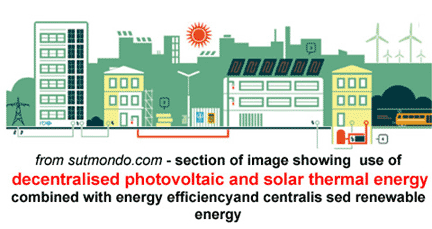
About 13 per cent of the capital’s small and medium-sized firms now generate at least some of their own energy, higher than the national average of six per cent, Opus Energy’s research found.
The amount of SMEs based in London that could be producing their own energy by 2017 is set to rise to 38 per cent, if they carry out investment plans. One in 10 of London’s firms said they hoped to start generating renewable power on their business’ premises within the next
12 months…. http://www.londonlovesbusiness.com/news/london-firms-plan-to-generate-renewable-power/1737.article
1 This Month
26 September – International Day for the Total Elimination of Nuclear Weapons





PLEASE OPPOSE HR 8255 AND S.3639 – bills would accelerate satellite deployment, with no environmental review or safeguards – https://ncstd5li.quorum.us/campaign/169331/
To see nuclear-related stories in greater depth and intensity – go to https://nuclearinformation.wordpress.com
-
Archives
- September 2026 (313)
- August 2026 (330)
- July 2026 (355)
- June 2026 (287)
- May 2026 (306)
- April 2026 (356)
- March 2026 (251)
- February 2026 (267)
- January 2026 (308)
- December 2025 (358)
- November 2025 (359)
- October 2025 (375)
-
Categories
- 1
- 1 NUCLEAR ISSUES
- business and costs
- climate change
- culture and arts
- ENERGY
- environment
- health
- history
- indigenous issues
- Legal
- marketing of nuclear
- media
- opposition to nuclear
- PERSONAL STORIES
- politics
- politics international
- Religion and ethics
- safety
- secrets,lies and civil liberties
- spinbuster
- technology
- Uranium
- wastes
- weapons and war
- Women
- 2 WORLD
- ACTION
- AFRICA
- Atrocities
- AUSTRALIA
- Christina's notes
- Christina's themes
- culture and arts
- Events
- Fuk 2022
- Fuk 2023
- Fukushima 2017
- Fukushima 2018
- fukushima 2019
- Fukushima 2020
- Fukushima 2021
- general
- global warming
- Humour (God we need it)
- Nuclear
- RARE EARTHS
- Reference
- resources – print
- Resources -audiovicual
- Weekly Newsletter
- World
- World Nuclear
- YouTube
-
RSS
Entries RSS
Comments RSS

