It’s already happening – solar hot water, and solar energy cooling systems
According to the International Energy Agency, solar heating and cooling (SHC) could make a dramatic impact on the world’s electricity grids, providing 17 per cent of all energy required for heating in buildings, industrial processes, swimming pools, and 17 per cent of cooling needs.
 Solar cooling technologies are relatively new, and not widely deployed – only 711 systems were deployed in the world in 2011, according to the IEA …..The IEA suggests that solar cooling particularly useful in handling electricity peaks, because it produces at the time of highest demand. It says the technology is already competitive in tropical regions with high electricity costs, including a 1.47MW capacity installation installed at a college in Singapore, was reportedly fully cost competitive without subsidies.
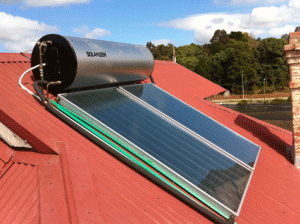 Solar Insights: Is solar hot water (and cooling) the next big thing? REneweconomy, By Giles Parkinson 19 July 2012 Amid the dramatic cost reductions and soaring demand for solar PV (photovoltaic) technologies in Australia and across the world, the long established idea of using the sun to heat water has taken a back seat. In Australia, where SHW once dominated the local rooftop industry, installations were outpointed by rooftop PV by a factor of 5 in the last year.
But now SHW it is tipped to make a return to centre stage, along with relatively new solar thermal technologies that use the sun to provide heating and cooling for office and building spaces, district heating and under-floor heating in cooler climates, as well as for industrial processes and in hybrid systems with solar PV (known at PV-T). At a larger scale, it could one day be used for water treatment and desalination. Continue reading
Renewable energy more efficient than gas, coal, nuclear
 Study Finds Renewable Energy Sources are more Efficient than Traditional Ones Oil Price. com By Climate Progress By. Zoë Casey, 17 July 2012 Wind energy opponents who say that producing electricity using the power of the wind is not efficient would do well to take a look at a new graphic published on the Guardian’s data blog using UK Government data. ‘Up in smoke: how energy efficient is electricity produced in the UK?’ shows that thermal sources of electricity – gas, coal, nuclear, waste/biomass, oil and other – lose massive amounts of energy as waste heat, compared to almost 0% for renewables.
Gas accounts for 48% of the UK’s electricity supply and, of the 372 Terra-Watt hours of electricity it produces per year, 54% of this is lost as heat. Coal, meanwhile, accounts for 28% producing 297 TWh, loses an even higher proportion – 66%. Nuclear – accounting for 16% of the energy supply with 162 TWh, loses 65% and oil – 3% of the supply with 51 TWh – loses 77%.
Contrast these figures with renewable energy – which all together account for 4% of the UK’s electricity supply producing 14 TWh – they lose less than one percent. So, under this measure, renewable energy is 100% efficient.
Wind energy opponents centre their arguments on the ‘capacity factor’ of a wind farm. The capacity factor of any power plant is a measure of the amount of energy it actually generates compared to its theoretical maximum output in a given time. No power plant operates at 100% of its capacity….. http://oilprice.com/Alternative-Energy/Renewable-Energy/Study-Finds-Renewable-Energy-Sources-are-more-Efficient-than-Traditional-Ones.html
Japan moving towards renewable energy
the Japanese Wind Power Association has put the longer-term wind potential at over 200 GW, on and offshore, even taking account of locational constraints. That is similar to Japans total present energy generating capacity.
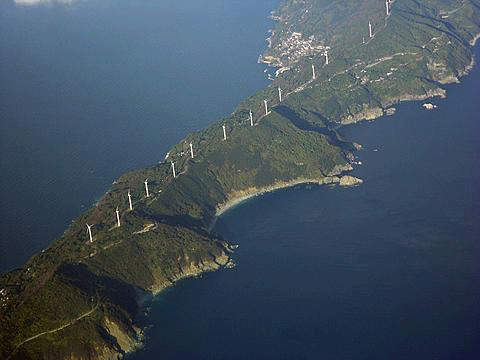
the aim would be to create a 50 trillion yen ($628 billion) green energy market by 2020 through deregulation and subsidies to promote development of renewable energy and low-emission cars.
Greening Japan’s energy http://environmentalresearchweb.org/blog/2012/07/greening-japans-energy.html 15 July 12 As part of its policy of moving away from nuclear power, the Japanese government is pushing ahead with renewables and improved energy efficiency. Given the urgent need to cut energy demand, following the shut down of all its nuclear plants in May, it encouraged voluntary energy saving initiatives, with some success. Continue reading
Morocco’s ambitious renewable energy plan
Morocco plans to become 40% renewable by 2020 http://www.evwind.es/noticias.php?id_not=19690 July 16, 2012 The 160-megawatt project is part of the larger, 500 megawatt Concentrating Solar Power Ouarzazate site. Morocco starts an ambitious plan to build out 6 gigawatts of renewable energy by 2020, along with a variety of technologies, including wind power, solar energy, biomass, hydro and other technologies as the country currently imports
90 percent of its energy. Continue reading
Decentralised renewable energy is the answer to USA electricity outages
Renewable energy sources are the answer to power outages.
http://www.baltimoresun.com/news/opinion/readersrespond/bs-ed-power-outages-20120713,0,5572931.story Brent Flickinger Much has been said about the power outages caused by recent storms, but one thing rarely mentioned is the importance of getting people off the electrical grid.
It’s a national security issue when so many people are rendered helpless in a neighborhoods because their electrical power all comes from the local utility. The government should continue to offer incentives for households to install solar panels, wind turbines or geothermal systems of whatever size. It would help if even one or two people on a block had an energy
source besides the grid.
Generators are one option, though they are noisy and still depend on fossil fuel. But renewable energy sources such as solar and wind give communities a measure of both energy independence and resilience. Our future depends on as swift a transition to renewables as possible.
Rapid growth of China’s solar sector as solar panel prices plummet
The global solar sector has witnessed some extraordinary growth in the past couple of years. According to Bloomberg New Energy Finance, the prices of solar panels have fallen by almost 42% in a single year to $0.87 per watt.

 CHINA SETS 2015 SOLAR ENERGY TARGET AT 21GW Solar PV Investor, BY SARFARAZ KHAN | 12 JULY 2012 Although the massive target might seem overly ambitious to some, most of the industry analysts believe that it is still very modest. China’s local media has revealed that the National Energy Administration (NEA) has decided to quadruple the country’s 2015 solar energy target to 21GW. Continue reading
An community solar energy scheme is paying off
 How a community solar scheme is turning sunshine into dollars REneweconomy, By Kelly Vaughn on 11 July 2012 Rocky Mountain Institute Years ago, a Basalt native Paul Spencer set out to build an off-grid home not far from RMI’s Snowmass office. Through the process of designing and building his house, he developed a passion for real estate, and became well versed in renewable energy technologies. He began looking into the option of a green development in the Roaring Fork Valley: super-efficient homes powered by renewable energy.
But, due to trees shading the proposed building sites, rooftop solar didn’t work. Instead, Spencer proposed to build a shared solar array that would power the neighborhood. While the development didn’t go through, the community solar concept remained.
Now, Spencer is the president and founder of Carbondale-based Clean Energy Collective (CEC) an LLC that builds, operates, and maintains community-based clean energy facilities, currently all solar PV……..
Tsunami affected areas can redevelop with renewable energy
The goal of the Kesen project is to generate at least 50 percent of the region’s electricity through solar and other renewable-energy sources
Rice paddies that were inundated with seawater in March 2011 can yield more profit if they’re covered with solar panels than if they’re rehabilitated as agricultural land.
 Tsunami Cities Fight Nuclear Elites To Create Green Jobs By Stuart Biggs – Jul 10, 2012 Bloomberg Rikuzentakata, like many cities on Japan ’s rugged northeast Pacific coast, was in decline even before last year’s tsunami killed 1,700 of its 24,000 inhabitants and destroyed most of its downtown buildings.
With two-thirds of the remaining residents homeless, Mayor Futoshi Toba questioned whether the city could recover, Bloomberg Markets magazine reports in its August issue. Damage to infrastructure and the economy, he said, would force people to move away to find jobs. Sixteen months later, the city is trying to rebuild in a way that Toba says would reinvent the region and provide a model to overcome obstacles that have hobbled the Japanese economy for more than 20 years: the fastest-aging population in the developed world, loss of manufacturing competitiveness toChina and South Korea and reliance on imported fossil fuels.
Rikuzentakata is part of a government program to create one of the country’s first so-called ecocities.
They would be smaller and more self-sufficient and would lower costs through technology and create new jobs in renewable energy to replace those lost to the decline of agriculture and fisheries……. Continue reading
Clean Coal? Carbon Capture and Storage is a Dud
 CCS? We Don’t Need No Stinkin’ CCS, by Energy Matters, 9 July 12, While the Carbon Capture and Storage boffins struggle to make CCS commercially viable and environmentally safe – a goal that may never eventuate in time – the key to a low carbon energy future is already here.
A report released last month by the National Renewable Energy Laboratory (NREL) has determined renewable electricity generation using currently available technologies such a wind, solar PV, concentrating solar power (CSP), hydropower, geothermal, and biomass; combined with better electricity infrastructure, could supply 80% of total U.S. electricity generation in 2050.
The NREL says electricity supply and demand can be balanced in every hour of the year in this scenario, including nearly 50% from variable renewable generation.
The Renewable Electricity Futures Study (RE Futures) states U.S. renewable energy resources “can support multiple combinations of renewable technologies that will slash not only electric sector greenhouse gas emissions, but also water use“…..
The four-volume Renewable Electricity Futures Study can be downloaded here.
Established over 35 years ago, the NREL is the principal research laboratory for the U.S. Department of Energy’s (DOE) Office of Energy Efficiency and Renewable Energy (EERE). The organisation is solely focused on advancing renewable energy and energy efficiency technologies; from concept to commercial application. http://www.energymatters.com.au/index.php?main_page=news_article&article_id=3287
Solar Centre opens in western Japan, many more to come
JAPAN OPENS SOLAR ENERGY PARKS 7 News, July 2, 2012 TOKYO (AFP) – Japan opened several solar energy
parks on Sunday as a new law came into force requiring companies to purchase renewable energy at a fixed price in a push for alternatives to nuclear power…. A new solar centre opened in Kyoto in western Japan, while various municipalities also started up installations able to provide energy for hundreds of thousands of households.
Japanese telecommunications Softbank chief Masayoshi Son, opposed to nuclear energy since a powerful earthquake and tsunami last year that crippled reactor cooling systems, said it had plans for 11 solar or windpower centres in Japan.
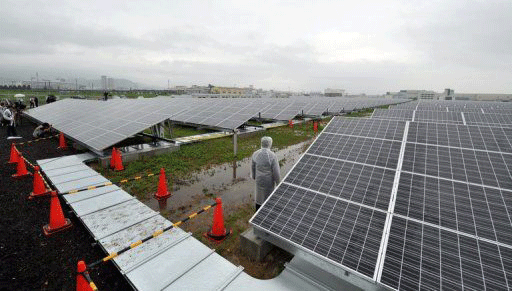
The push to invest in renewable energy resources is a mark of Japan’s search for alternatives to nuclear power, as 49 reactors out of 50 in the country have been shut down for safety checks and amid growing public protests. The new law that took effect on Sunday requiring power companies to purchase all renewable energy at a fixed tariff is aimed at encouraging firms to pursue sustainable initiatives. The government estimates the power provided by renewable energy this
year in Japan will attain 2,500 megawatts, the equivalent of two medium-sized nuclear reactors.
http://au.news.yahoo.com/world/a/-/world/14100878/japan-opens-solar-energy-parks/
Distributed renewable energy is now a mainstream commercial factor in USA
 The data submission forms the EIA uses do not catch every last TWh, and indeed, don’t include solar photovoltaic generation from systems less than 1 megawatt in size. This smaller capacity segment includes most residential and commercial distributed PV systems.
renewable energy is clearly moving beyond “niche” status. It’s a mainstream source that will increasingly challenge existing electricity generation and provision business models, particularly as distributed solutions (electric vehicles, demand response, PV, etc.) take off
 Renewable Energy Supplies 7% US Electricity, Has Anyone Noticed? SustainableBusiness.com News, by Dan Seif, Rocky Mountain Institute, 29 June 12, Between April 2011 and March 2012, the US generated 5% of its annual electricity from renewable sources, according to the Energy Information Administration (EIA).
To be exact, the US generated 204 terawatt-hours (TWh) out of 4,070 TWh from non-hydro renewables – solar, wind, geothermal, biomass and small hydro.
Putting this annual total of non-hydro renewable generation in context, this is:
More than the total electrical use of 197 nations (92% of all nations), including Indonesia, Mexico, Turkey, and Thailand.
More than the combined electrical use of the Philippines, Switzerland, and Malaysia.
Enough electrical energy to power about 16 million American homes, deducting about 10% for transmission and distribution losses. Continue reading
USA’s Federal Energy Regulatory Commission gives a big boost to solar energy to
 Big News for Renewable Energy: FERC Rules for Wind, Solar, Storage, Forbes, 29 June 12 “.…. A year ago, Wellinghoff told me: “[North American Electric Reliability Corporation] projects in its 2010 Long-Term Reliability Assessment that approximately 60 percent of all new resources expected to be added to the bulk power system by 2019 will be new wind and solar resources.”
The FERC aims to remove regulatory barriers to ensure that all of these resources can get access the grid and play a competitive role in the energy markets.
To that end, the Federal Energy Regulatory Commission passed a rule last week to make it easier for solar and wind providers to distribute their power to the grid…. FERC says the ruling also benefits electric consumers by ensuring that services are provided at
reasonable rates. Continue reading
Scotland’s renewable energy success
About 35% of Scotland’s electricity needs would have come from renewables last year – assuming consumption levels were similar to 2010. This would exceed the Scottish Government’s interim target of 31%….. ”particularly encouraging when you consider that 2011 saw the highest output from renewable energy to date”.
The sector also already employs 11,000 people in Scotland
 Renewable energy production doubles http://www.strathearnherald.co.uk/strathearn-news/scottish-news/2012/06/28/renewable-energy-production-doubles-64054-31281154/ Jun 28 2012 Scotland produced a record amount of renewable energy last year, almost double the total from five years ago, according to UK Government figures. Continue reading
Southern California’s electrical grid might not need nuclear power – ever!
 San Onofre: Do we really need it? UT San Diego, 28 June 12, This summer may be just a test run for operating Southern California’s electrical grid without a nuclear plant.
The latest report on the outage at the San Onofre Nuclear Generating Station shows the replacement of four massive steam generators was accompanied by serious design flaws, with no clear solution in sight.
Both stakeholders in San Onofre and critics of nuclear power say the start of a summer without the twin-reactor plant has forced a new accounting for its costs and benefits.
The utility industry and the state’s main grid operator are “considering a range of existing and new alternatives for mitigating the impacts of a long-term or permanent shutdown at San Onofre,” said Stephanie McCorkle, a spokeswoman for the California Independent System Operator….. the grid operator foresees only the remote chance of rolling outages during hot weather in the next three months — when San Onofre is needed the most.
That assessment alone has changed perceptions of the plant as indispensable, said Dan Sullivan, president of San Diego-based Sullivan Solar Power, which employs 65 workers designing and installing solar arrays.
The plant shutdown — along with California’s aggressive renewable-energy policies and a newly completed transmission line into San Diego — have shifted the conversation about nuclear power. The day is coming, Sullivan said, when “we can just say, ‘We’re done.
We don’t need it anymore.’ ”….
Affordable solar energy racing ahead in Californian homes and businesses
This list shows undeniable solar growth in a diverse range of cities, debunking the common misconception that solar is only for the wealthy,” notes Stephen Torres, founder and managing director of PV
Solar Report. “Key to this diversification is third-party-owned solar, which makes solar affordable for a wider range of homeowners.”
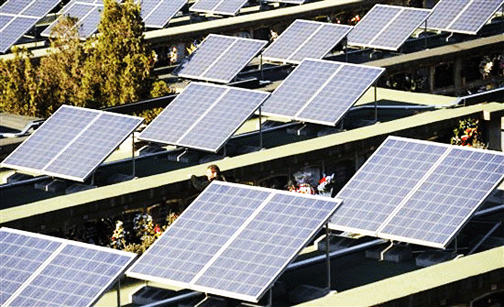
California Residential Solar Market Has Grown 80% So Far This Year http://solarindustrymag.com/e107_plugins/content/content.php?content.10611 27 June 2012 Thirteen cities helped the California residential solar market grow 80% so far this year, according to a new report from SunRun.
According to the report, the top cities reflect solar adoption in median-income communities rather than in the wealthiest areas of the state.
The high-growth cities were evaluated by percent growth through May 31 as compared to the same time frame last year. While solar adoption continues to surge in traditional solar hot beds like Fresno and Bakersfield, new solar leaders like Santa Clarita, Castaic and Palmdale are also leading the charge.
The top California cities for home solar installations were as follows: Continue reading
1 This Month
To see nuclear-related stories in greater depth and intensity – go to https://nuclearinformation.wordpress.com/
31st January – Challenging the War Machine – a DECLASSIFIED UK SUMMIT




Website of the Week
Now until to February 10, 2026 Radioactive waste storage in France: the debate is finally open! How to participate?
-
Archives
- January 2026 (306)
- December 2025 (358)
- November 2025 (359)
- October 2025 (376)
- September 2025 (258)
- August 2025 (319)
- July 2025 (230)
- June 2025 (348)
- May 2025 (261)
- April 2025 (305)
- March 2025 (319)
- February 2025 (234)
-
Categories
- 1
- 1 NUCLEAR ISSUES
- business and costs
- climate change
- culture and arts
- ENERGY
- environment
- health
- history
- indigenous issues
- Legal
- marketing of nuclear
- media
- opposition to nuclear
- PERSONAL STORIES
- politics
- politics international
- Religion and ethics
- safety
- secrets,lies and civil liberties
- spinbuster
- technology
- Uranium
- wastes
- weapons and war
- Women
- 2 WORLD
- ACTION
- AFRICA
- Atrocities
- AUSTRALIA
- Christina's notes
- Christina's themes
- culture and arts
- Events
- Fuk 2022
- Fuk 2023
- Fukushima 2017
- Fukushima 2018
- fukushima 2019
- Fukushima 2020
- Fukushima 2021
- general
- global warming
- Humour (God we need it)
- Nuclear
- RARE EARTHS
- Reference
- resources – print
- Resources -audiovicual
- Weekly Newsletter
- World
- World Nuclear
- YouTube
-
RSS
Entries RSS
Comments RSS
 nuclear-news