New fast Lithium Ion Battery for electric cars
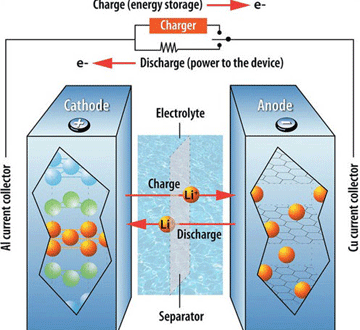 New Korean Lithium Ion Battery for EVs Charges in Under 1 Minute http://www.greenoptimistic.com/2012/08/21/korean-lithium-ion-carbonized-battery/?utm_source=feedburner&utm_medium=email&utm_campaign=Feed%3A+TheGreenOptimistic+%28The+Green+Optimistic%29#.UDbvH8FlT4Y By Ovidiu Sandru August 21, 2012 A new lithium ion battery developed in Korea could make those long waiting times for an electric car to charge become history. A team of researchers at the Ulsan National Institute of Science and Technology (UNIST) claim they can build a battery that can charge in less than a minute, 30 to 120 times faster than a classic Li-Ion battery. Continue reading
Huge solar rooftop system completed in Denmark
Largest N. Europe Rooftop Solar Power System Using REC Panels by Energy Matters, 24 Aug 12, Renewable Energy Corporation (REC) has announced completion of the largest rooftop solar panel system in Northern Europe.
The system sits atop the headquarters of insurance company Topdanmark in Ballerup, near Copenhagen in Denmark. Completed last week, the system features 3,042 REC Peak Energy Series solar panels and has an annual production capacity of 752,000 kWh – enough to meet the needs of almost 200 households.
600 tonnes of electricity generation related carbon emissions will be avoided through the system each year…. http://www.energymatters.com.au/index.php?main_page=news_article&article_id=3353
Decentralised solar energy for a billion Indian villagers

 Solar energy offers a ray of hope http://www.thehindu.com/news/cities/Visakhapatnam/article3806664.ece RAVI P BENJAMIN TERI is engaged in setting up solar charging stations in rural and Agency areas
With a view to easing the power situation, The Energy and Resources Institute (TERI), a global NGO, is engaged in setting up Solar Charging Stations in the rural and Agency areas in collaboration with the Union Ministry of New and Renewable Energy.
As part of the MNRE mandate to popularise the tapping of solar power, TERI has been introducing solar appliances, including home lighting systems, individual lanterns, and task lights, etc, in the villages which are experiencing long hours of power-cut. TERI State coordinator V. Murthy told The Hindu that nearly 100 SCSs were being set up in rural areas in the State. Solar lights and other appliances were being supplied to every home so that villages can overcome total darkness at the time of power interruption.
The objective of SCSs is mainly to recharge batteries which can be used for four to six hours every day. TERI is engaged in supply of solar lights as well as in opening charging stations manned by a single person. The stations can charge up to 50 lights at a time. Every village will have a local entrepreneur who will supply and maintain the solar lamps.
Every nine villages will have a technical resource person who will ensure smooth functioning of the SCSs. As many as 11 stations are operating in the district and 46 more are in the process of being set up. Thirty stations are operating in Srikakulam district, four in East Godavari district, and 40 are being established. Nine stations are running in Guntur, 12 in Karimnagar, and two in Adilabad. The local people in every village take care of the entrepreneur’s salary by paying for battery recharge.
Also, the nine villages contribute Rs.300 each to take care of the technician’s salary. Local NGOs engaged in Maa Thota and coffee plantations are working with TERI. TERI, Nabard, Vikasa, Kovel Foundation, and a host of NGOs are engaged
in the solar mission of lighting a billion lives.
Australians lead the world in distributed solar energy on housetops
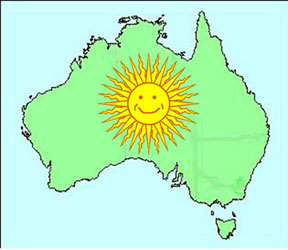 Australians lead in fitting solar panels on homes, SMH, August 18, 2012 Ben Cubby AUSTRALIANS put more household solar panel systems on their roofs than anyone else in the world last year, new data from the Clean Energy Regulator and the International Energy Agency show. The statistic astonished many in the solar industry, given Australia’s small population compared with renewable energy market leaders such as European Union countries, China, Japan and the United States. Continue reading
3 out of 4 Americans want clean, renewable, energy
U.S., Facing Drought, Wants More Clean Energy, Poll Says By Bloomberg – Aug 17, 2012 Three out of four Americans think the U.S. needs “to start focusing more” on clean-energy sources like wind and solar that require less water than conventional power generation as the country faces its most widespread drought since 1956, according to a think-tank survey.
The concern about water and its use is shared by 61 percent of Republicans, 84 percent of Democrats and 80 percent of independents, the Newton, Massachusetts-based, non-partisan Civil Society Institute said yesterday in a statement.
The Palmer Drought Index reported on Aug. 15 that drought covered 57.2 percent of the contiguous 48 states in July, the worst since December 1956, when 57.6 percent of the country was dry. About 50 percent of U.S. water withdrawn on average is used to cool and make steam at power plants, Seth Sheldon, an analyst at the institute, said in the statement…. http://www.bloomberg.com/news/2012-08-16/u-s-facing-drought-wants-more-clean-energy-poll-says.html
Direct Investments in Renewable Energy Increasingly Attractive to Pension Funds, Insurers Triple Pundit, By Andrew Burger | August 17th, 2012 Institutional investors, such as pension funds and insurance companies, are increasingly investing directly in wind, solar and other renewable energy projects, providing much needed capital to companies in the fast-growing clean energy sector even as banks, still suffering from accumulated bad loans and high debt levels, have tightened lending standards and struggle to raise capital to shore up their finances.
This is particularly true in Europe, where banks find themselves caught in a web of bad debts accumulated from prior their own housing and property lending and investments and subsequent government efforts to bail them out with sovereign debt, which has led them to purchase large amounts of euro zone treasury securities. Multinational insurer Munich Re’s bought three UK wind farms with a combined 102-MW capacity, boosting the total amount it’s invested in renewable energy projects to more than €600 million ($737 million), Bloomberg News reported on Aug. 12 . Looking to reduce its reliance on bank loans, Swedish renewable energy project developer Arise Windpower AB is turning to pension funds and other institutional investors to help finance its new projects …. http://www.triplepundit.com/2012/08/renewable-energy-pension-funds/
Pacific islands Tonga and Tokelau moving to 100% solar energy
Tonga joins Pacific solar drive to cheaper, safer, cleaner power REneweconomy By Sophie Vorrath 17 August 2012 Last week, New Zealand-based Powersmart Solar officially switched on the first of three solar power systems being installed on the South Pacific archipelago of Tokelau. As reported on RenewEconomy earlier this month, Tokelau is replacing the diesel electricity systems that have powered its three atolls with solar power systems and battery storage.
But Tokelau is not the the only South Pacific nation currently undergoing a solar transformation. The Kingdom of Tonga switched on its own maiden solar plant at the end of last month – another New Zealand-funded project that, along with the plant at Tokelau’s Fakaofo atoll, are set to be the first of many to come in the region, according to NZ Foreign Affairs Minister Murray McCully.
As is the case in Tokelau, the Tongan solar plant – Ma’ama Mai, which means “Let there be Light” – is part of a scheme to reduce the island nation’s dependence on fossil fuels and, in particular, diesel. According to reports, Tonga was consuming about 30 million litres of diesel a year; an average of about one litre every two seconds.
A collaborative effort between Tonga Power and NSW-based Meridian Energy, Ma’ama Mai’s nearly 6,000 solar panels will generate around 1MW a year, which equates to 4 per cent of electricity used on the main island of Tongatapu. For such a seemingly small amount, this will help Tonga save an estimated 470,000 litres of diesel – $NZ15 million-worth – over the 25-year-life of the plant.
According to an ABC News report, the plant was originally going to be funded by Tonga Power and the Tongan Government, but the World Bank would not loan Tonga any more funds, so New Zealand stepped in to cover the $7.9 million cost.
Already it is paying off, with the government announcing a reduction in the price Tongans pay for electricity from August 1. And this could just be the beginning – Tonga’s Minister for Public Enterprises, William Clive Edwards, says the aim is to have 50 per cent of the country’s energy to come from renewable sources by 2018; including solar, wind and biomass….. http://reneweconomy.com.au/2012/tonga-joins-pacific-solar-drive-to-cheaper-safer-cleaner-power-60042
Saudi Arabia to go solar energy in a big way
 Kingdom eyes 40 GW solar energy by 2032 Saudi Gazette, August 16, 2012 JEDDAH – Saudi Arabia has set an ambitious target of installing more than 40 GW of solar power capacity by 2032, of which 60 percent would be from concentrated solar power (CSP) and remaining from photovoltaics (PV). Continue reading
Developing storage systems for renewable energy
 Storage systems for renewable energy, Energy Harvesting Journal , 13 Aug 12, Energy storage systems are one of the key technologies for the energy turnaround. With their help, the fluctuating supply of electricity based on photovoltaics and wind power can be stored until the time of consumption.
At Karlsruhe Institute of Technology (KIT), several pilot plants of solar cells, small wind power plants, lithium-ion batteries, and power electronics are under construction to demonstrate how load peaks in the grid can be balanced and what regenerative power supply
by an isolated network may look like in the future.
“High-performance batteries on the basis of lithium ions can already be applied reasonably in the grid today,” says Dr. Andreas Gutsch, coordinator of the Competence E project. As stationary storage systems, they can store solar or wind power until it is retrieved by the grid. “When applied correctly, batteries can also balance higher load and production peaks and, hence, make sense from an economic point of view.”
The Competence E project is presently developing several pilot systems consisting of photovoltaics and wind power plants coupled to a lithium-ion battery. Over a development phase of two years, a worldwide battery screening was made. “Now, we know which lithium-ion cells are suited best for stationary storage systems,” says Gutsch.
The first stage of the modular systems will be constructed on KIT Campus North by the end of 2012. It will have a capacity of 50 kW…..
http://www.energyharvestingjournal.com/articles/storage-systems-for-renewable-energy-00004648.asp?sessionid=1
Up to 113,845 jobs in clean energy for Michigan
“It’s a job creating machine, with the added benefit of cleaner air, improved public health and healthier communities.”
All told, the initiative would create between 74,495 and 113,845 jobs in Michigan..

Renewable energy ballot measure called ‘job creating machine‘ By Karen Bouffard Detroit News Lansing Bureau, August 10, 2012 Lansing— At least 74,000 jobs would be created if voters approve a proposed ballot measure that requires 25 percent of energy to come
from renewable sources by 2025, according to a Michigan State University study released Friday.
Results of the study were announced by supporters of the Michigan Energy Michigan Jobs renewable energy ballot proposal, which is opposed by utility companies and business groups. The higher renewable electricity standard would create more than $10
billion in investments, according to the study. Continue reading
Scotland CAN get to %100 renewable energy
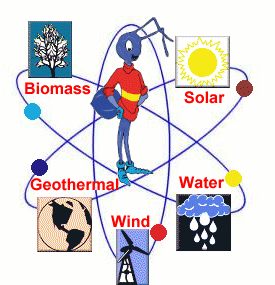
 100% renewable energy ‘attainable’
http://www.strathearnherald.co.uk/strathearn-news/scottish-news/2012/08/10/100-renewable-energy-attainable-64054-31597089/ Aug 10 2012 The ambition to generate 100% of Scotland’s electricity from renewable sources by 2020 could be within reach, a report has suggested.
Scotland’s Renewable Energy Sector In Numbers – an online portal by industry body Scottish Renewables which pulls together figures from a range of sources – shows figures on energy capacity, output, jobs and investment, and emissions which were buried away in dense government reports. Continue reading
Renewable energy – matching electricity supplies to demands
MATCHING SUPPLIES OF ELECTRICITY TO VARIABLE DEMANDS FOR ELECTRICITY, DESERTEC UK, 9 Aug 12 It is sometimes suggested that renewable sources of electricity cannot provide more than about 20% of our electricity supplies because they are intermittent or variable. But all sources of electricity are intermittent because they need to be taken out of service for scheduled maintenance and because, like any kind of equipment, they are liable to unscheduled breakdowns. With all sources of power, load factors are normally well short of 100%.
The variability of sources such as wind power is much less of an issue than is sometimes suggested, as described in Managing Variability (PDF, 402 KB, a report by independent consultant David Milborrow commissioned by Greenpeace, WWF, RSPB, Friends of the Earth, July 2009).
Not only are all sources of electricity intermittent, and many of them are variable, but the demand for electricity is variable too—and there can be quite large changes from one minute to the next. The often-quoted example is how there can be a sharp peak in demand for electricity when there is a commercial break in a popular TV programme and many people go and put the kettle on to make a cup of tea.
There is a range of techniques available for matching supplies with constantly varying demands. When electricity supply systems are properly engineered, they should be able to accommodate sources of electricity that are 100% renewable.
Any or all of the following techniques may be used:
Large-scale ‘HVDC’ transmission grids. In an area like Europe, there are several potential benefits from building a ‘supergrid’ of highly-efficient HVDC transmission lines to link existing HVAC transmission grids (see electricity transmission grids). One of the most important benefits is that this kind of large-scale grid can make it much easier to match variable supplies with variable demands. For example, the wind may stop blowing in any one spot but it almost never stops blowing everywhere across a wide area like Europe. If there is a peak in demand in any one area, it can almost always be met from spare capacity in one or more other areas. Large-scale storage facilities, such as pumped-storage systems in Norway and the Alps, may be widely shared. Submarine HVDC transmission lines that have been laid between Norway and Denmark and between Norway and the Netherlands enable both pairs of countries to benefit in this way.- Complementary sources of power……
- Power on demand. … . http://www.desertec-uk.org.uk/elec_eng/supply_demand.html
MATCHING SUPPLIES OF ELECTRICITY TO VARIABLE DEMANDS FOR ELECTRICITY
MATCHING SUPPLIES OF ELECTRICITY TO VARIABLE DEMANDS FOR ELECTRICITY, DESERTEC UK, August 12,
It is sometimes suggested that renewable sources of electricity cannot provide more than about 20% of our electricity supplies because they are intermittent or variable. But all sources of electricity are intermittent because they need to be taken out of service for scheduled maintenance and because, like any kind of equipment, they are liable to unscheduled breakdowns. With all sources of power, load factors are normally well short of 100%.
The variability of sources such as wind power is much less of an issue than is sometimes suggested, as described in Managing Variability (PDF, 402 KB, a report by independent consultant David Milborrow commissioned by Greenpeace, WWF, RSPB, Friends of the Earth, July 2009).
Not only are all sources of electricity intermittent, and many of them are variable, but the demand for electricity is variable too—and there can be quite large changes from one minute to the next. The often-quoted example is how there can be a sharp peak in demand for electricity when there is a commercial break in a popular TV programme and many people go and put the kettle on to make a cup of tea.
There is a range of techniques available for matching supplies with constantly varying demands. When electricity supply systems are properly engineered, they should be able to accommodate sources of electricity that are 100% renewable.
Any or all of the following techniques may be used:
Large-scale ‘HVDC’ transmission grids. In an area like Europe, there are several potential benefits from building a ‘supergrid’ of highly-efficient HVDC transmission lines to link existing HVAC transmission grids (see electricity transmission grids). One of the most important benefits is that this kind of large-scale grid can make it much easier to match variable supplies with variable demands. For example, the wind may stop blowing in any one spot but it almost never stops blowing everywhere across a wide area like Europe. If there is a peak in demand in any one area, it can almost always be met from spare capacity in one or more other areas. Large-scale storage facilities, such as pumped-storage systems in Norway and the Alps, may be widely shared. Submarine HVDC transmission lines that have been laid between Norway and Denmark and between Norway and the Netherlands enable both pairs of countries to benefit in this way.- Complementary sources of power. In load-balancing via the grid, it is helpful if different kinds of generators have complementary characteristics. For example, there is a good fit between solar power—which is strongest in the summer—and wind power—which is strongest in the winter (see, for example, Seasonal optimal mix of wind and solar power in a future, highly renewable Europe, Dominik Heide and others, Renewable Energy 35, 2483-2489, 2010).
- Power on demand. One of the most useful attributes in any source of electricity is the ability to respond quickly to peaks in demand. Sources of electricity such as coal-fired power stations or nuclear power cannot respond quickly in that way and are really only suitable for ‘base load’. Non-renewable sources that provide power on demand are gas-fired power stations and stand-by generators (See Emergency power systems to be worth £1.5bn by 2020, The Telegraph, 2011-11-09). Renewable sources of power that can provide power on demand include:…… http://www.desertec-uk.org.uk/elec_eng/supply_demand.html
US Power Company To Invest Another $883 Million In Solar by Energy Matters. 7 Aug 12,US utility Public Service Electric and Gas (PSE&G) recently announced it will request approval to invest up to USD$883 million to develop an additional 233 megawatts (MWs) of solar energy capacity.
The company made the announcement at an event marking the start of a renewable energy project that will transform a dormant brownfield in New Jersey into a solar farm. This will be the fifth PSE&G project that uses a brownfield or landfill site for energy production.
Brownfield sites are abandoned facilities often contaminated with materials that make them unsuitable for residential purposes.
“Every time we reclaim a landfill or brownfield site with solar panels, it’s a win for the people of New Jersey,” said PSEG chairman, president and CEO Ralph Izzo. “We are ready to do more of these projects and transform sites like this all over the state to generate more jobs along with clean renewable energy.”
The 1.06-MW PSE&G Hackensack Solar Farm is part of the utility’s Solar 4 All program. When the current phase of the program is complete early next year, PSE&G will have created about 175 direct jobs annually for the last three years and spent $300 million while developing 80 megawatts of solar capacity…. http://www.energymatters.com.au/index.php?main_page=news_article&article_id=3327
Siddharth Malik’s success story in solar power for India
 How seven young entrepreneurs defied hurdles to develop clean renewable energy http://economictimes.indiatimes.com/news/emerging-businesses/entrepreneurs/how-seven-young-entrepreneurs-defied-hurdles-to-develop-clean-renewable-energy/ 4 AUG, 2012, SHREYA JAI,ET BUREAU articleshow/15347643.cms Renewable energy in India has always been a risky business, be it due to high input cost, unsteady market or lack of government support. But these seven young entrepreneurs defied all this and much more.
At a time when even big companies are reluctant to enter the renewable energy market due to the huge costs involved, they have come up with innovative solutions to develop clean energy, which brings down the costs and is accessible by the commons, even village folks, reports ET.
‘SWADES’ STORY IN REAL Siddharth Malik, 30 Megawatt Solutions, Delhi
AN engineering and management degree fromUniversity of Pennsylvania, a flourishing career with energy-focused companies in the US where the base package is a sinful $1,00,0000 per annum. What more can you ask for?
Well, Siddharth Malik had ideas. This passionate 30-year old left all this to come back to India and start his own renewable energy venture amalgamating high-performing solar-thermal systems with fossil fuels.
He started Megawatts Solutions in 2010, which provides concentrated solar-thermal solutions. “At least when sun is shining, fossils need not be fired,” says Malik, adding, “this simple idea creates long-term economic value for industry owners.” Its 0.5-mw pilot project in Guragon provides a hybrid solution by integrating solarthermal with fossil fuel that offers considerably higher value than stand-alone solar thermal plants.” It has resulted in up to 25% more efficient performance than competing technologies , which makes a drastic improvement in economics of solar,” adds Malik.
MS’ solutions are based on home-grown concentrated solar thermal technology and its role ranges from designing to manufacturing, installing and commissioning industrial-scale solar thermal projects. It has four projects in the pipeline including a 3 mw solar thermal heating project in Gujarat – the largest ever in India.
1 This Month
26 September – International Day for the Total Elimination of Nuclear Weapons





PLEASE OPPOSE HR 8255 AND S.3639 – bills would accelerate satellite deployment, with no environmental review or safeguards – https://ncstd5li.quorum.us/campaign/169331/
To see nuclear-related stories in greater depth and intensity – go to https://nuclearinformation.wordpress.com
-
Archives
- September 2026 (305)
- August 2026 (330)
- July 2026 (355)
- June 2026 (287)
- May 2026 (306)
- April 2026 (356)
- March 2026 (251)
- February 2026 (267)
- January 2026 (308)
- December 2025 (358)
- November 2025 (359)
- October 2025 (375)
-
Categories
- 1
- 1 NUCLEAR ISSUES
- business and costs
- climate change
- culture and arts
- ENERGY
- environment
- health
- history
- indigenous issues
- Legal
- marketing of nuclear
- media
- opposition to nuclear
- PERSONAL STORIES
- politics
- politics international
- Religion and ethics
- safety
- secrets,lies and civil liberties
- spinbuster
- technology
- Uranium
- wastes
- weapons and war
- Women
- 2 WORLD
- ACTION
- AFRICA
- Atrocities
- AUSTRALIA
- Christina's notes
- Christina's themes
- culture and arts
- Events
- Fuk 2022
- Fuk 2023
- Fukushima 2017
- Fukushima 2018
- fukushima 2019
- Fukushima 2020
- Fukushima 2021
- general
- global warming
- Humour (God we need it)
- Nuclear
- RARE EARTHS
- Reference
- resources – print
- Resources -audiovicual
- Weekly Newsletter
- World
- World Nuclear
- YouTube
-
RSS
Entries RSS
Comments RSS

