US Power Company To Invest Another $883 Million In Solar by Energy Matters. 7 Aug 12,US utility Public Service Electric and Gas (PSE&G) recently announced it will request approval to invest up to USD$883 million to develop an additional 233 megawatts (MWs) of solar energy capacity.
The company made the announcement at an event marking the start of a renewable energy project that will transform a dormant brownfield in New Jersey into a solar farm. This will be the fifth PSE&G project that uses a brownfield or landfill site for energy production.
Brownfield sites are abandoned facilities often contaminated with materials that make them unsuitable for residential purposes.
“Every time we reclaim a landfill or brownfield site with solar panels, it’s a win for the people of New Jersey,” said PSEG chairman, president and CEO Ralph Izzo. “We are ready to do more of these projects and transform sites like this all over the state to generate more jobs along with clean renewable energy.”
The 1.06-MW PSE&G Hackensack Solar Farm is part of the utility’s Solar 4 All program. When the current phase of the program is complete early next year, PSE&G will have created about 175 direct jobs annually for the last three years and spent $300 million while developing 80 megawatts of solar capacity…. http://www.energymatters.com.au/index.php?main_page=news_article&article_id=3327
Siddharth Malik’s success story in solar power for India
 How seven young entrepreneurs defied hurdles to develop clean renewable energy http://economictimes.indiatimes.com/news/emerging-businesses/entrepreneurs/how-seven-young-entrepreneurs-defied-hurdles-to-develop-clean-renewable-energy/ 4 AUG, 2012, SHREYA JAI,ET BUREAU articleshow/15347643.cms Renewable energy in India has always been a risky business, be it due to high input cost, unsteady market or lack of government support. But these seven young entrepreneurs defied all this and much more.
At a time when even big companies are reluctant to enter the renewable energy market due to the huge costs involved, they have come up with innovative solutions to develop clean energy, which brings down the costs and is accessible by the commons, even village folks, reports ET.
‘SWADES’ STORY IN REAL Siddharth Malik, 30 Megawatt Solutions, Delhi
AN engineering and management degree fromUniversity of Pennsylvania, a flourishing career with energy-focused companies in the US where the base package is a sinful $1,00,0000 per annum. What more can you ask for?
Well, Siddharth Malik had ideas. This passionate 30-year old left all this to come back to India and start his own renewable energy venture amalgamating high-performing solar-thermal systems with fossil fuels.
He started Megawatts Solutions in 2010, which provides concentrated solar-thermal solutions. “At least when sun is shining, fossils need not be fired,” says Malik, adding, “this simple idea creates long-term economic value for industry owners.” Its 0.5-mw pilot project in Guragon provides a hybrid solution by integrating solarthermal with fossil fuel that offers considerably higher value than stand-alone solar thermal plants.” It has resulted in up to 25% more efficient performance than competing technologies , which makes a drastic improvement in economics of solar,” adds Malik.
MS’ solutions are based on home-grown concentrated solar thermal technology and its role ranges from designing to manufacturing, installing and commissioning industrial-scale solar thermal projects. It has four projects in the pipeline including a 3 mw solar thermal heating project in Gujarat – the largest ever in India.
Decentralised solar power made poor Indian villagers the winners!
 Solar Power Helped Keep the Lights On in India By David Biello | August 1, 2012 Every day, at least 400 million Indians lack access to electricity. Another nearly 700 million Indians joined their fellows inenergy poverty over the course of the last few days, or roughly 10 percent of the world’s population.
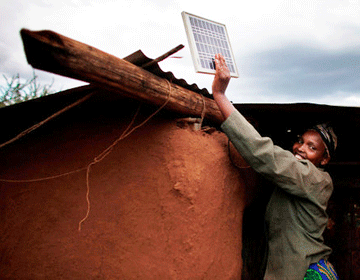
Oddly enough, some of the formerly energy poor—rural villagers throughout the subcontinent—found themselves better off than their middle-class compatriots during the recent blackouts, thanks to village homes outfitted with photovoltaic panels. In fact, solar power helped keep some electric pumps supplying water for fields parched by an erratic monsoon this year.
That monsoon is partly to blame for the blackouts as well. A lack of rain has meant a reduction in power from India’s hydroelectric dams. Pair that with problems with the supply of coal to burn and the northern half of India found itself with not enough electricity supply to meet demand. One ironic anecdote illustrates this conundrum nicely: coal miners in northern India were trapped when their electric lifts failed as a result of the blackout exacerbated by a lack of coal….. http://blogs.scientificamerican.com/observations/2012/08/01/solar-power-kept-the-lights-on-in-india/
Japan could become second biggest solar power nation New Scientist, 02 August 2012 by Rob Gilhooly WITH nuclear power on the ropes in Japan, it could be solar power’s time to shine. Minamisoma City in Fukushima prefecture has signed an agreement with Toshiba to build the country’s biggest solar park. The deal comes weeks after Japan introduced feed-in tariffs to subsidise renewable energy – a move that could see the nation become one of the world’s largest markets for solar power.
Parts of Minamisoma are around 10 kilometres from the Fukushima Daiichi nuclear power plant, and land there has been contaminated by radiation fallout. “Moving away from a dependency on nuclear is of course involved [with the agreement to build the solar park],” a city official said.
Both Minamisoma and neighbouring Namie have called for the cancellation of plans to build a nearby nuclear power plant – although Minamisoma has received $6.4 million over the past 25 years for initially agreeing to host the facility.
A number of Japanese municipalities have started solar projects in recent months. Plans have been drawn up for large-scale solar parks in Hokkaido and Kyushu, while SB Energy began operating two megasolar facilities, in Kyoto and Gunma, on 1 July.
“New solar projects are being generated day by day,” says Toshiba’s Yuji Shimada. Some estimates suggest the move could help Japan leapfrog Italy andbecome the second-biggest market for solar power after Germany… http://www.newscientist.com/article/mg21528764.800-japan-could-become-second-biggest-solar-power-nation.html
Solar power gives energy independence to Pacific Island Tokelau
Island nation of Tokelau gets ready to go solar Gizmag, By Antonio Pasolini, July 30, 2012 Adopting renewable energy sources such as solar and wind power is a great way to reduce emissions and produce energy locally.

In places like remote Pacific islands, however, those benefits are potentially a key to independence. For that reason Tokelau, a 10 sq. km. (3.86 sq. mi) island nation that lies around 500 km (311 mi) north of Samoa and which is a territory of New Zealand, is about to ditch diesel as a source of electricity and switch to solar power. Continue reading
National Renewable Energy Laboratory: Solar Has The Most Potential Of Any Renewable Energy Source Think Progress, Jul 30, 2012 A recently released study by the National Renewable Energy Laboratory, estimates that the technical potential of photovoltaic cells and concentrated solar power (CSP) in the United States is as much as 200,000 Gigawatts, enough to generate about400,000 TWh of energy annually.
The report dismisses economic and political impacts on the solar industry and focuses solely on the scientific and engineering limitations. The types of solar power studied in the report were Urban Utility-Scale Photovoltaics, Rural Utility-Scale Photovoltaics, Rooftop Photovoltaics, and Concentrated Solar Power, which is a utility-scale project “in which the solar heat energy is collected in a central location.”
The report broke down each type of solar array: Continue reading
Bangladesh goes solar
Bangladesh sees surge in use of solar energy , 31 Jul 2012 Alertnet By Syful Islam DHAKA, Bangladesh As costs fall and incomes rise, power-hungry Bangladesh is seeing a surge in the adaptation home solar energy systems.
Last year, close to 40,000 units a month were installed on average across the country; this year installations have surged to 55,000 a month, according to Ruhul Quddus, head of the Rural Services Foundation, a Bangladeshi charity. His charity is installing 11,000 solar power systems a month, up from 8,000 a month last year, he said.
Altogether, 30 percent more homes are using solar power in Bangladesh than a year ago – a change driven by a rise in purchasing capacity and falling prices.
“Rural people now want to improve their quality of life,” including by trading kerosene lamps for solar and using the latest electrical appliances, said Abser Kamal, chief executive office of Grameen Shakti, a pioneering organisation in renewable energy in Bangladesh.
Per capita income has been rising in Bangladesh in recent years as the country’s growth rate has improved. During the last fiscal year, per capita hit income hit $848 a year, up from $676 three years ago, according to government figures. The country’s growth rate during the last fiscal year was 6.32 percent, and this year the government is targeting growth of 7.2 percent.
Installing solar power in their homes helps families with a variety of tasks, Kamal said.
A RANGE OF BENEFITS….. http://www.trust.org/alertnet/news/bangladesh-sees-surge-in-use-of-solar-energy
Supercomputer Powered By Solar Panels, by Energy Matters, 31 July 12 A supercomputer used by Britain’s Met Office (the equivalent of Australia’s Bureau of Meteorology) is now powered by solar panels. The solar panel array will generate 221,000 kW hours of electricity per year – enough energy to power 67 UK households – and will avoid around 116 tonnes of carbon emissions annually.
Installed on the rooftop of the Met Office’s Exeter HQ Energy Centre, the array is linked to an electricity management system allowing for real-time monitoring of the panels’ performance The 250kW solar power system consists of 1,000 solar modules. The system was installed by UK company Sungift Solar.
Drawing on more than 10 million weather observations each 24 hours, an advanced atmospheric model and three high performance supercomputers are used to create 3,000 tailored forecasts and briefings a day.
Among the Met Office’s other sustainability efforts in relation to its supercomputers is a Direct Current (DC) power project; a system that is delivering a 10% power reduction and a £200,000 electricity cost saving per year.
The organisation has also invested in evaporative free cooling for its supercomputers. Large tanks installed on the roof of its headquarters in Exeter allow for cooling at ambient temperature outside the building for much of the time, rather than total reliance on mechanical cooling. …. http://www.energymatters.com.au/index.php?main_page=news_article&article_id=3318
Switzerland to switch from nuclear energy to renewables
 SWITZERLAND LOOKING TO REPLACE NUCLEAR ENERGY WITH SOLAR REVMODO, DAVID QUILTY | 24 JULY, 2012 In 2011, the Swiss parliament decided not to build any more nuclear power plants after the Fukushima disaster in Japan. As nuclear currently supplies some 40 percent of the country’s energy needs, they are in search of ways to replace the energy source with cleaner alternatives. Solar is being debated as the front-runner to use as a replacement and plans are in the works to use the technology to replace at least one half the nuclear power used now. Representatives from the solar and the electricity industries are at odds as to whether it is viable, with solar industry insiders saying they can meet 20 percent of needs by 2025 and electric companies saying gas-fired plants are the way to go. However, the government doesn’t want to go with gas-fired plants as it won’t allow it to meet carbon emission reduction goals.
Also up for debate is whether solar power should be fully subsidized by the government in order to expedite installations or if electricity providers should play a wait and watch game to see if prices of photovoltaics come down anytime soon. Germany is heavily subsidizing renewables and have so far succeeded in setting a world record for solar power production, generating nearly 50 percent of the nation’s midday electricity demand in May. That’s the energy equivalent of 20 nuclear power plants operating at full capacity…… it is some very welcome news that Switzerland wants to replace nuclear energy with clean renewables.
China Leads The World In Renewable Energy Investment Forbes, 27 July
12, According to a recently released United Nations report, global
investment in renewable energy reached a record $257 billion in 2011,
a 17 percent increase from the amount invested in 2010. Globally,
renewable energy covers approximately 16.7 percent of energy
consumption…. China was responsible for almost one-fifth of total
global investment, spending $52 billion on renewable energy last year.
The United States was close behind with investments of $51 billion, as
developers sought to benefit from government incentive programs before
they expired. Germany, Italy and India rounded out the list of the top
five countries.
According to China’s 12th Five-Year Plan for Economic and Social
Development (2011-2015), the country will spend $473.1 billion on
clean energy investments over the next five years. China’s goal is to
have 20 percent of its total energy demand sourced from renewable
energy by 2020.
In 2011, solar led the way as far as global investment in renewable
energy, with investment surging to $147 billion, a year-on-year
increase of 52 percent, due to strong demand for rooftop photovoltaic
installations in Germany, Italy, China and Britain. Large-scale solar
thermal installations in Spain and the United States also contributed
to growth during the year.
Japanese turning to clean energy, and energy efficiency, in a big way

 The World’s Next Hot Solar Power Market May
  Be Japan HUFFINGTON POST: 07/25/2012 With its nuclear power plants virtually shuttered since the Fukushima disaster in March 2011, Japan is starting to turn to clean energy in a big way.
On July 1, one of the world’s most aggressive examples of a feed-in tariff (FIT) — a key government incentive for renewable energy — took effect in Japan. A FIT essentially requires utilities to buy kilowatt-hours of electricity from clean, renewable sources like solar, wind, and geothermal at a rate prescribed by the government. Such policies have been behind the rapid growth of solar energy in countries like Spain, Italy, and Germany. No one thinks of Germany for its sunshine, but it’s actually the largest solar energy market in the world, with 25 gigawatts of solar capacity installed (output comparable to about 20 large nuclear reactors) at the end of 2011…..
Obama government’s solar energy project for public lands

 Roadmap for Solar Energy Development on Public Lands Released to Public Loan Safe.org, BY ALEX FERRERAS JULY 25, 2012 As part of President Obama’s all-of-the-above energy strategy, the Department of the Interior, in partnership with the Department of Energy, will publish the Final Programmatic Environmental Impact Statement (PEIS) for solar energy
development in six southwestern states—Arizona, California, Colorado, Nevada, New Mexico, and Utah.
The final Solar PEIS represents a major step forward in the permitting of utility-scale solar energy on public lands throughout the west. Continue reading
Japan Shifts from Nuclear Power to Renewable Power
International Support for Renewable Energy, Environmental Leader, Jeff Colton, 24 July 12, “……As a result of the vulnerability and global scrutiny of nuclear power following the March 2011 earthquake in Japan and the resulting Fukushima nuclear disaster, Japan recently approved incentives for renewable energy, which will help the country decrease its dependence on nuclear power and increase clean energy programs, such as offshore wind farms . These incentives could result in billions of dollars in clean energy investment, expanding revenue from renewable generation and equipment, including wind turbine components such as ultracapacitors, to more than $30 billion by 2016…….. Just 1 percent of Japan’s power supply comes from renewable energy sources, apart from hydro-electric dams which account for most of the rest of the electric power.
Despite the low starting point, Japan has the potential to generate cleaner and safer energy from renewable sources such as the sun, wind and geothermal. Over the past decade, Japan’s wind power capacity has multiplied to 2.5 million kilowatts, and the Japan Wind Power Association estimates the country can generate 740 million kilowatts of wind power on a commercial basis on land and offshore. With worldwide estimates suggesting 118,000 wind turbines installations through 2015 and nearly 75 percent of new turbines using electric pitch control systems, wind turbine design teams will turn to ultracapacitors as a reliable and cost-effective option. The newly approved incentives aim to spur growth in the renewable energy industry in Japan, just as subsidies have driven substantial renewable energy growth in Germany….. http://www.environmentalleader.com/2012/07/24/international-support-for-renewable-energy/
Solar energy panels designed specifically for Japanese roofs
Global Solar Energy Brings Powerful Building Integrated Solar to Japan’s Growing Renewable Energy Market, Clean Technica, JULY 24, 2012 BY NICHOLAS BROWN Global Solar Energy Incorporated, a manufacturer of flexible solar panels, has announced that it is entering the Japanese solar market with flexible solar panels that are designed specifically for Japanese roofs. Continue reading
International Energy Agency recognises increasing role of renewable energy
This is the first time the IEA has devoted a medium-term report to renewable power sources and the agency says this is “a recognition of the dynamic and increasing role of renewable energy
Wind energy will grow by 100 terawatt-hours per year reve, By Philippa Jones, 23 July 12, – IEA Wind power will be the second biggest contributor to global renewable electricity generation by 2017, according to a ground-breaking report by the International Energy Agency (IEA).
Despite economic uncertainties in many countries, global power generation from renewable sources including wind turbines will increase by more than 40% to almost 6,400 terawatt hours (TWh) – roughly the equivalent of one-and-a-half times current electricity production in the US, predicts the Medium-Term Renewable Energy Market Report 2012. Continue reading
1 This Month
To see nuclear-related stories in greater depth and intensity – go to https://nuclearinformation.wordpress.com/
31st January – Challenging the War Machine – a DECLASSIFIED UK SUMMIT





Website of the Week
Now until to February 10, 2026 Radioactive waste storage in France: the debate is finally open! How to participate?
-
Archives
- January 2026 (306)
- December 2025 (358)
- November 2025 (359)
- October 2025 (376)
- September 2025 (258)
- August 2025 (319)
- July 2025 (230)
- June 2025 (348)
- May 2025 (261)
- April 2025 (305)
- March 2025 (319)
- February 2025 (234)
-
Categories
- 1
- 1 NUCLEAR ISSUES
- business and costs
- climate change
- culture and arts
- ENERGY
- environment
- health
- history
- indigenous issues
- Legal
- marketing of nuclear
- media
- opposition to nuclear
- PERSONAL STORIES
- politics
- politics international
- Religion and ethics
- safety
- secrets,lies and civil liberties
- spinbuster
- technology
- Uranium
- wastes
- weapons and war
- Women
- 2 WORLD
- ACTION
- AFRICA
- Atrocities
- AUSTRALIA
- Christina's notes
- Christina's themes
- culture and arts
- Events
- Fuk 2022
- Fuk 2023
- Fukushima 2017
- Fukushima 2018
- fukushima 2019
- Fukushima 2020
- Fukushima 2021
- general
- global warming
- Humour (God we need it)
- Nuclear
- RARE EARTHS
- Reference
- resources – print
- Resources -audiovicual
- Weekly Newsletter
- World
- World Nuclear
- YouTube
-
RSS
Entries RSS
Comments RSS
 nuclear-news