US Department of Defense (DOD) world’s biggest consumer of solar energy

 US Military on Track to Reach 3 GW of Solar Energy by 2025, The Energy Collective, 20 May 13 The Army, Navy and Air Force are using more than 130 megawatts of solar for everything from powering remote special operations to air conditioning and lighting for U.S. base residences. And the forces intend to keep building toward 3 gigawatts of solar capacity by 2025 as part of a much bigger Department of Defense (DOD) commitment.
While detractors were declaring solar too intermittent to be reliable at home, U.S. Marines were successfully relying on it at battlefield sites in the Khyber Pass, according to Enlisting the Sun: Powering the U.S. Military with Solar Energy, a new report from the Solar Energy Industries Association (SEIA), released just in time for Armed Forces Day on May 18.
The DOD’s annual $20 billion energy budget makes it the biggest single energy consumer in the world……http://theenergycollective.com/hermantrabish/226186/us-military-3-gw-solar-energy
Printing solar photovoltaic cells – an Australian breakthrough
“We’re using the same techniques that you would use if you were screen printing an image on to a T-Shirt,” he says.
VIDEO Printing Australia’s Largest Solar Cells http://cleantechnica.com/2013/05/19/printing-australias-largest-solar-cells/#I2hPrL1dDL6WTXwD.99 20 May 13, Scientists have produced the largest flexible, plastic solar cells in Australia – 10 times the size of what they were previously able to – thanks to a new solar cell printer that has been installed at CSIRO. The printer has allowed researchers from the Victorian Organic Solar Cell Consortium (VICOSC) – a collaboration between CSIRO, The University of Melbourne, Monash University and industry partners – to print organic photovoltaic cells the size of an A3 sheet of paper.
According to CSIRO materials scientist Dr Scott Watkins, printing cells on such a large scale opens up a huge range of possibilities for pilot applications.
“There are so many things we can do with cells this size,” he says. “We can set them into advertising signage, powering lights and other interactive elements. We can even embed them into laptop cases to provide backup power for the machine inside.”….. Continue reading
Walmart going solar in a big way, in Massachusetts.
Walmart Adds More Solar In Massachusetts http://www.energymatters.com.au/index.php?main_page=news_article&article_id=3744 17 May 13, U.S. retail giant Walmart has taken another step towards its goal of becoming 100 percent supplied by renewable energy, announcing the completion of rooftop solar power systems on eight of its stores across Massachusetts.
The solar power generated by each system will provide an estimated 10 to 15 percent of each store’s electricity needs.
The announcement was made at the launch of the company’s Walpole store, which features a 374-kilowatt rooftop system, with 1337 solar panels generating 383,551 kilowatt hours of electricity per year.
The eight Walmart stores used almost 10,000 solar panels in their PV arrays, providing a combined 2.8 million kilowatt hours of solar electricity and avoiding almost 1,500 metric tons of carbon dioxide emissions; earning Walmart the Environment Protection Agency’s top ranking as number one on-site green power generator/consumer in the U.S in 2013.
“The stores in Massachusetts demonstrate our commitment to increasing the share of renewable energy that powers our stores and improving energy efficiency,” said David Ozment, senior director of energy at Walmart.
Massachusetts Department of Energy Resources Commissioner, Mark Sylvia said, “Investments from business leaders like Walmart have helped the Commonwealth meet our 250 megawatt solar goal four years early and earn the number one national ranking in energy efficiency two years in a row.”
Walmart used Connecticut solar installer Greenskies Renewable Energy to complete the project, and a power purchase agreement will see the company buy all the electricity generated by the system.
With a stated goal to source 100 percent of its power from renewables, Walmart now has 280 renewable energy projects in operation and under development worldwide, supplying one billion kilowatt hours of electricity to its stores annually. Onsite renewable projects such as solar, wind and fuel cell technology account for around four percent, while the company’s current total of 21 percent renewable electricity as of the end of 2012 is made up from grid-connected utility-scale renewable sources.
Enormous solar rooftop system for Hyundai, South Korea
Hyundai To Install 40,000 Solar Panels On South Korean Plant http://www.energymatters.com.au/index.php?main_page=news_article&article_id=3740 15 May 13, South Korea’s largest automaker, Hyundai, announced last week it will install the nation’s largest rooftop photovoltaic power plant at its manufacturing factory in Asan, Korea.
Hyundai says it plans to install 40,000 solar photovoltaic modules on the rooftops of Asan’s press, welding, assembly and engine buildings by the end of 2013.
In total, the panels will occupy just shy of 145,000 square meters (14.5 hectares) of the building’s massive 213,000 square metre rooftop area.
The 10MW rooftop solar power facility will generate approximately 11.5 million kilowatt-hours of electricity per year; enough to supply the power needs of 3,200 households. At that generation level, 5,600 tons of carbon dioxide emissions will be avoided annually.
The shading provided by the panels, plus the arrays’ sprinkler cooling systems will also help reduce the temperature in the plant below; offering some energy savings.
Korea Electric Power Corporation (KEPCO) will purchase the electricity produced by the solar modules.
The type of panels to be used on the facility is unknown and while it wouldn’t be unreasonable to assume Hyundai solar panels will be the choice; Hyundai Solar is a totally separate company run under different ownership – it is a subsidiary of Hyundai Heavy Industries.
Hyundai joins a growing list of automakers turning to solar energy for powering operations or providing an additional revenue stream.
While Hyundai’s Asan project is utility scale, commercial and manufacturing operations large and small can benefit from installing solar panels.
According to Australian commercial solar provider Energy Matters; which specialises in systems with a capacity of 20 kilowatts to 1 megawatt, if businesses are paying more than 20c/kWh for daytime electricity rates, a system sized to daytime load will provide a payback time of between 5 and 7 years – after which time, the electricity generated is essentially free.
Bloomington City goes for 100% renewable energy in electricity aggregation
City opts for renewable energy, civic fee in electric aggregation Pantagraph.com 13 May 13, BLOOMINGTON — The city’s electricity aggregation program will include 100 percent renewable energy and a fee to reimburse the city for administrative costs.
The City Council on Monday authorized Mayor Tari Renner and Deputy City Manager Barb Adkins to sign bid documents related to the program that will allow the city to bundle Ameren customers’ electricity needs to attract the lowest bid. The two city officials are expected to accept a bid on May 15.
With seven “yes” votes, aldermen approved the inclusion of 100 percent renewable energy at an expected cost of $0.0008 per kilowatt hour.
They also approved a civic contribution of $0.001 per kilowatt hour. The civic contribution would provide the city with up to about $250,000 in revenue.
Mayor Tari Renner said he sees the civic contribution as a “user fee” to cover administrative costs of implementing the program.
City Manager David Hales said he could not at this time provide an estimate of how much the city’s involvement in the program will cost, but the city could be involved in energy efficiency educational efforts going forward. He said staff involvement to date has been “considerable.”…… Bloomington voters in April approved a referendum allowing the city to enter into an electricity aggregation program…… http://www.pantagraph.com/news/local/city-opts-for-renewable-energy-civic-fee-in-electric-aggregation/article_211277e0-bc3d-11e2-bf0f-0019bb2963f4.html
Renewable energy forecasting technologies coming
Breakthrough Renewable Energy Forecasting Coming to Grid by 2015 The Energy Collective, Silvio Marcacci May 13, 2013 Breakthrough renewable energy forecasting technologies may be two years away from revolutionizing the efficiency of wind and solar generation on America’s grid. The National Center for Atmospheric Research (NCAR) is adding to its already impressive list of renewable energy innovations with a new two-year plan to develop custom forecasting systems for wind energy and solar power.
NCAR scientists and engineers will develop technology to improve wind power output by predicting sudden changes in wind speed, help wind farm operators avoid curtailment during icy conditions, and predict the amount of energy generated by small-scale solar energy installations…….
The new phase of renewable energy forecasting technology will provide “probabilistic forecasts,” meaning utility managers will be able to make decisions based on high-accuracy predictions of certain weather conditions at a wind farm on the next day. Forecasts will focus on wind “ramp” events, ice and extreme temperatures, and distributed solar.
Anticipating Wind Ramp Events
Of the three, predicting ramp events could mean the most for overall generation. Ramp events refer to sudden and significant changes in wind conditions over the span of a few hours due to passing weather fronts or atmospheric events. NCAR’s Variational Doppler Radar Analysis System (VDRAS) will combine radar data with computer simulations to create accurate forecasts for specific wind farms and reduce intermittency…….
Preventing Cold-Weather Effects On Turbines……
Predicting Small-Scale Solar Output…..
NCAR’s approach to renewable energy forecasting has already been proven to save millions. A wind forecasting system it developed for Xcel in 2010 saved utility customers over $6 million that year by developing 35% more accurate forecasts for wind farm output.
“By creating more detailed and accurate forecasts…we can produce a major return on investment,” said Thomas Bogdan, President of the University Corporation for Atmospheric Research. “This type of cutting-edge research helps make renewable energy more cost competitive.” http://theenergycollective.com/silviomarcacci/223186/breakthrough-renewable-energy-forecasting-coming-us-grid-2015
Small scale solar power to take off in a big way in Dubai
 Dubai looks to rooftop solar power revolution, The National, Florian Neuhof May 13, 2013 , Dubai is finalising legislation that will enable property owners to feed solar power into the grid and may even allow them to make money from it. The Government last year unveiled plans for a 1,000-megawatt solar park, but it believes that small-scale applications are important for meeting its renewable energy targets.
“In the near future we will have a legislative environment that allows for grid-connected solar power. There will be different approaches for different scales,” said Ivano Iannelli, the chief executive of the government-owned advisory company Dubai Carbon Centre of Excellence.
“In the next 12 months, we will see a constant increase of solar infrastructure. Not only standalone facilities such as solar pumps, but to actually power our villas, our parks, our residential communities.”
Industry sources say that encouraging the use of solar on rooftops is one of the pillars of Dubai’s plans to bring the technology to the emirate. Photovoltaic panels can be mounted on roofs of residential properties, office buildings or industrial facilities, providing electricity and creating a surplus that can be fed into the grid…… After decades of relying on fossil fuels, Dubai has now woken up to the potential of solar power.
The emirate seeks to generate 5 per cent of its electricity from the sun by 2030. Last year, the Dubai Supreme Council for Energy announced plans for the Mohammad bin Rashid Al Maktoum Solar Park, and Dewa awarded the contract for the first array in October.
While solar is a clean source of energy, it is also an increasingly viable alternative to scarce natural gas. http://www.thenational.ae/thenationalconversation/industry-insights/energy/dubai-looks-to-rooftop-solar-power-
Solar and Wind Energy Up – Nuclear and Coal dowm
 Wind, Solar, & Natural Gas Up In Europe — Coal & Nuclear Down http://cleantechnica.com/2013/05/13/wind-solar-natural-gas-up-in-europe-coal-nuclear-down/#xMfKPr55HOwV0sP4.99 (Good graphics in this article) May 13, 2013 Zachary Shahan Following up on the report I just published regarding EPIA’s 2012–2017 European and global solar PV report, below are some really interesting charts I wanted to highlight. Basically, they show that solar PV, wind power, and natural gas capacity has grown substantially in the EU while coal, nuclear, and oil capacity has fallen.
Compared to 2011, a shift has also occurred within the top three. More wind power came online in 2012 than in 2011, while the net increase in natural gas capacity was much smaller. (Notably, I noted back in December 2011 that wind power was pricing natural gas out of the market in Germany. I imagine the same thing was happening in other countries.) http://cleantechnica.com/2013/05/13/wind-solar-natural-gas-up-in-europe-coal-nuclear-down/#xMfKPr55HOwV0sP4.99
USA army going for renewable energy in a big way
US Army steamrolls $7bn in renewable energy projects REneweconomy, By Tina Casey 10 May 2013 CleanTechnica The U.S. Army has just launched the first in a series of renewable energy contracts that will eventually total $7 billion by the end of this year, using power purchase agreements along with a standard procurement tool that is expected to crush any obstacles that are put in its path. That includes the notorious budget sequester as well as any objections from the anti-renewable energy crowd in Congress, which has already used the budget as an excuse to sink the Navy’s biofuel initiatives. So, let’s see what kind of firepower the Army has on its side.
The Army Renewable Energy Initiative Continue reading
Japan’s “transition towns” go for renewable energy, not nuclear
 Energy transition: no longer why but how
Since the Fukushima nuclear disaster in 2011, Fujino’s popularity as a transition town has grown. Hide Enomoto, co-founder of the Fujino transition town initiative says people around Japan are realizing just how important it is to switch towards cleaner sources of energy. “The people are no longer asking ‘why do we need an energy transition?,” Enomoto said. “Rather ‘how are we going to do it?”……
Huge alternative energy potential
If some studies are to be believed, Japan could in future completely turn its back on fossil fuels and meets its entire energy needs through renewable energy by 2050
‘Transition Towns’ lead the way in low-carbon living, DW, 7 May 13 Following the Fukushima nuclear disaster in 2011, many in Japan are talking about switching to renewable energy for a cleaner future. The “Transition town” of Fujino has already made that a reality……. Following the catastrophe, the Japanese government led by Naoto Kan initially decided to phase out nuclear energy in Japan by 2040. Since summer 2012, all Japanese reactors – with the exception of two – have been taken off the grid. Instead, Tokyo plans to set up the world’s biggest offshore wind park along the Fukushima coast by 2020. The plan foresees installing 143 wind turbines with a total capacity of 1 gigawatts. Construction is expected to begin in July 2013……. Continue reading
Growing support in Britain for wind and solar energy
British Support For Renewable Energy Continues To Grow, Clean Technica May 8, 2013 Joshua S Hill A new survey conducted by the British Department of Energy and Climate Change (DECC) has found 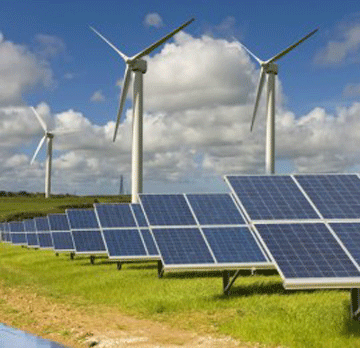 British support for renewable energies has grown in the past year.
The survey, DECC Public Attitudes Tracker, was run from early 2012 through to last March. There were four surveys — one longer survey and three shorter ones — concluded with a face-to-face in-home interview with a representative sample of 2,051 households.
Below are the key findings which were taken from the survey, as finalised after Wave 5. …….For a full comparison of wave 5 findings against the previous four waves, head on over to the DECC website and access the full questionnaire, the full wave 5 dataset, and more……
http://cleantechnica.com/2013/05/08/british-support-for-renewable-energy-continues-to-grow/#z0gMO5IZiK66ITLe.99
USA’s renewable energy under attack from Koch bros, Heartland Institute

Over the past two years, the Koch brothers and their proxies have worked to undermine Maine’s RPS through a campaign co-sponsored by the Heartland Institute and ALEC.
Koch Brothers, ALEC Attack Maine Renewable Energy Standards http://www.desmogblog.com/2013/05/03/koch-brothers-alec-attack-maine-renewable-energy-standards 3 May 13, Maine’s clean energy legislation has spurred more than $2 billion in local investment and created at least 2,500 jobs in the Pine Tree State. That isn’t stopping some state lawmakers from trying to weaken and kill these laws, as the local political puppets do the will of their fossil fuel masters, the Koch brothers.
A quick reminder: there’s a coordinated national campaign to dismantle renewable portfolio standards (RPS) at the state level. Behind the campaign is the American Legislative Exchange Council (ALEC), who we’ve covered quite a bit before. Behind ALEC is the Heartland Institute and the Koch brothers. Continue reading
Rapidly declining cost of solar energy
 The Falling Cost Of Solar Energy Is Surprising Everyone http://au.businessinsider.com/citi-the-solar-age-is-dawning-2013-5 Very good graphs ROB WILE Everyone’s talking about all the new oil and gas being produced thanks to new drilling methods.
But there’s another narrative nipping at the shale boom’s heels: solar energy. And it’s expanding just as fast.
It’s just that the scale is not quite the same. But that’s changing.
Citi has just named solar photovoltaics, which convert solar radiation into electric currents via semiconductors, to its list of 10 world-disrupting technologies.
In a note this week in advance of the disruption report, Citi’s Jason Channell said that in many cases, renewables are already at cost parity with established forms of electricity sources.
The biggest surprise in recent years has been the speed at which the price of solar panels has reduced, resulting in cost parity being achieved in certain areas much more quickly than was ever expected; the key point about the future is that these fast ‘learning rates’ are likely to continue, meaning that the technology just keeps getting cheaper.
………. so at peak solar exposure, parts of the southwest U.S. are now already capable of meeting their electricity needs via solar panels. …
Channell writes:
The rapidly expanding parity provides enormous scope for growth in the solar industry, driven by standalone economics as opposed to subsidies, which are becoming ever scarcer in an austerity-driven world.
As a previous Saudi oil minister once noted, “The stone age didn’t end for a lack of stones…”, and this substitutional process can be well demonstrated looking at the US energy mix over the longer term.
Gas isn’t going away, but renewables are coming on strong.
A community based approach for renewable energy in Japan
One possible way for Japan to approach the NIMBY problems on renewables, Aldrich said, would be to go bottom up — by trying to find communities that are excited about green energy and renewables, to start from the community side and use that initiative to find the locations for wind turbines and solar energy farms.
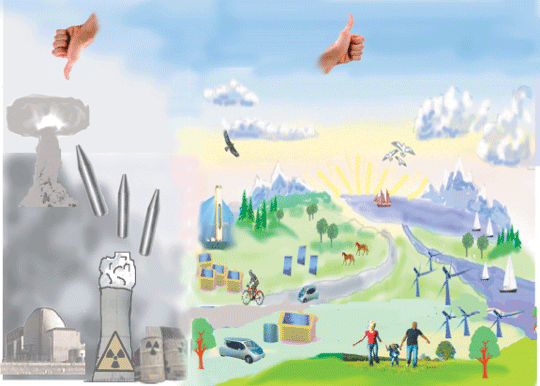
 Siting for renewables needs bottom-up approach http://www.japantimes.co.jp/news/2013/04/30/business/siting-for-renewables-needs-bottom-up-approach/#.UYGdFqJwpLs APR 30, 2013 If post-Fukushima nuclear disaster crisis Japan chooses to fill its energy needs with renewable energy sources, the nation will still face the same NIMBY (not-in-my-backyard) resistance to building large numbers of new facilities in the densely-populated country, an American expert said at a recent energy seminar in Tokyo.
The government is advised to take a bottom-up approach to find communities that are willing to accept wind turbines and solar power generation farms, rather than the top-down process that it used to convince farmers and fishermen into agreeing to the construction of nuclear power plants in their neighborhood over the past five decades, said Daniel P. Aldrich, an associate professor of political science at Purdue University and a Fulbright research fellow at the University of Tokyo. Continue reading
US Energy Information Administration (EIA) shows a way ahead for Renewable Energy
How renewable energy could beat natural gas to the future http://qz.com/79953/how-renewable-energy-could-beat-natural-gas-to-the-future/ By Todd Woody @greenwombat April 30, 2013 We’ve taken the US Energy Information Administration (EIA) to task for its projections of future energy production and consumption that assumes the nation’s fossil fuel addiction will continue until the dinosaur juice runs dry.
Well, today the agency threw caution to the wind and focused on an alternative reality as part of its Annual Energy Outlook, due to be released on May 2. In the latest chapter, EIA examined what the world might look like in 2040 if current renewable energy incentives do not end in 2014 and 2016 as scheduled.
Under that scenario, green energy production grows, accounting for around 23% of total electricity generation in 2040, compared to 16% if business as usual continues. Given the skyrocketing growth in solar and wind generation over the past several years—half of America’s solar capacity was installed just in 2012—that forecast still seems conservative.
It doesn’t take into account, for instance, the likelihood that renewable energy will become cost competitive with fossil fuels, even without subsidies, due to technological breakthroughs and economies of scale. In fact, in some areas of the US with high electricity costs, such as California, that’s already starting to happen.
 But here’s the interesting thing about even the EIA’s conservative forecast: The increase in renewable energy production starts to displace natural gas. (Nuclear power also takes a hit.) The agency estimates that electricity generation from natural gas-fired power plants would be 13% to 16% lower in 2040 compared to its standard forecasts. Not good news for all those investors betting on the shale gas boom. But good news for the planet. Carbon dioxide emissions from energy productions would declined between 1.7% and 2.8% compared to business as usual, according to the EIA. Electricity prices would also drop between 3.9% and 6.3%. (Good diagram)
1 This Month
29 Jan. Thursday 7-8 p.m. Webinar – World’s Largest Nuclear Station in Port Hope, ON?
To see nuclear-related stories in greater depth and intensity – go to https://nuclearinformation.wordpress.com/



31st January – Challenging the War Machine – a DECLASSIFIED UK SUMMIT


Website of the Week
Now until to February 10, 2026 Radioactive waste storage in France: the debate is finally open! How to participate?
-
Archives
- January 2026 (296)
- December 2025 (358)
- November 2025 (359)
- October 2025 (376)
- September 2025 (258)
- August 2025 (319)
- July 2025 (230)
- June 2025 (348)
- May 2025 (261)
- April 2025 (305)
- March 2025 (319)
- February 2025 (234)
-
Categories
- 1
- 1 NUCLEAR ISSUES
- business and costs
- climate change
- culture and arts
- ENERGY
- environment
- health
- history
- indigenous issues
- Legal
- marketing of nuclear
- media
- opposition to nuclear
- PERSONAL STORIES
- politics
- politics international
- Religion and ethics
- safety
- secrets,lies and civil liberties
- spinbuster
- technology
- Uranium
- wastes
- weapons and war
- Women
- 2 WORLD
- ACTION
- AFRICA
- Atrocities
- AUSTRALIA
- Christina's notes
- Christina's themes
- culture and arts
- Events
- Fuk 2022
- Fuk 2023
- Fukushima 2017
- Fukushima 2018
- fukushima 2019
- Fukushima 2020
- Fukushima 2021
- general
- global warming
- Humour (God we need it)
- Nuclear
- RARE EARTHS
- Reference
- resources – print
- Resources -audiovicual
- Weekly Newsletter
- World
- World Nuclear
- YouTube
-
RSS
Entries RSS
Comments RSS
 nuclear-news