Sweden heads for 100% renewable energy

 Sweden phases out fossil fuels in attempt to run completely off renewable energy Sweden’s prime minister announced his country will work towards becoming ‘one of the first fossil fuel-free welfare states of the world’, Independent, 25 May 16 Samuel Osborne @SamuelOsborne93 Renewables account for over half of Sweden’s energy, while the UK has one of the lowest renewable energy shares in Europe.
In 2015, Sweden’s prime minister announced his country will work towards becoming “one of the first fossil fuel-free welfare states of the world,” in a speech to the UN General Assembly.
Between 2013 and 2014, 51.1 per cent of Sweden’s energy needs were met by renewables, according to data from Eurostat and the Renewable Energy Directive.
As the chart by Statista shows, [on original] Sweden’s renewable energy share (RES) was larger than that of many other European nations. ……http://www.independent.co.uk/news/world/europe/sweden-phases-out-fossil-fuels-in-attempt-to-run-completely-off-renewable-energy-a7047306.html?utm_content=bufferb00d8&utm_medium=social&utm_source=twitter.com&utm_campaign=buffer
South Australia gets rid of coal power, runs over 50% on renewable energy
South Australia runs mainly on renewable energy following coal plant closure,The Independent, Gabriel Samuels 12 May 16 Majority of energy comes from solar and wind but the transition has been fraught with difficulties South Australia now gets the bulk of its electricity from wind and solar power, following the closure of its last coal-fired power station.
The state, which includes the city of Adelaide, exclusively has gas generators, solar panels and wind turbines serving a population of 1.7 million.
More than 50% of the region’s electricity stems from wind and solar with the remainder coming from energy efficient combined cycle gas plants.
The final coal station still in operation in Port Augusta closed down on May 9 after operating for 31 years. It generated 520 megawatts of power from coal but failed to compete with the falling price of clean renewable energy. Its closure produced a brief faltering in wholesale energy prices across the state.
The RenewablesSA transition initiative was established by the state govenment in late 2009 with a promise of $10 billion invested in low carbon generation by 2025…….
The state plans to become Australia’s wind and solar capital and is working towards complete reliance on natural sources
The state’s leading electricity provider, SA Power Networks, yesterday announced it will undertake Australia’s largest trial of storage batteries in solar homes in a bid to defer a $3 million network upgrade.
Meanwhile, last week Portugal ran entirely on renewable energy for four consecutive days between Saturday and Wednesday, in a bid to become completely reliant on natural resources.
The Independent has contacted RenewablesSA for comment. http://www.independent.co.uk/news/world/australasia/south-australia-runs-entirely-renewable-energy-following-coal-plant-closure-a7037646.html
Solar power for making fresh water
To Make Fresh Water without Warming the Planet, Countries Eye Solar Power https://www.technologyreview.com/s/601419/to-make-fresh-water-without-warming-the-planet-countries-eye-solar-power/ 20 may 16
In drought-ridden California, a $1 billion plant at Carlsbad, north of San Diego, will produce 54 million gallons of fresh water a day. The giant Sorek plant in Israel can crank out more than 160 million gallons a day (see “Megascale Desalination” and “Desalination Out of Desperation”). But these plants are a devil’s bargain; they use power from plants that, in most cases, emit greenhouse gases, ultimately worsening the problem of drought. Saudi Arabia, for instance, uses around 300,000 barrels of oil every day to desalinate seawater, providing some 60 percent of its fresh water supply. That’s not sustainable. Finding a way to produce fresh water without burning fossil fuels is critical not just for the desert countries of the Middle East but for a growing number of places around the world.
While the new solar-powered desalination plant in Dubai is quite small, next year a much larger one, at Al Khafji City in Saudi Arabia, is scheduled to come online. The Al Khafji plant will produce nearly 16 million gallons of fresh water a day, enough to supply the local population. The Spanish solar company Abengoa, which is building the plant along with the state-owned Saudi company Advanced Water Technology, calls it “the world’s first large-scale desalination plant to be powered by solar energy.”
Unfortunately, solar-powered desalination is expensive: as much as three times the cost of water from grid-powered plants, according to a World Bank report. Desalination plants need to run 24 hours a day, requiring expensive battery packs to supplement solar power when the sun’s not shining. Thanks to increased efficiency and the falling price of solar power, costs are expected to fall rapidly: from more than $50 per 1,000 gallons today, in the Middle East, to half of that by midcentury. But that’s still likely too much to make solar-powered desalination economically viable without government subsidies, even in places such as the Middle East that are optimal for solar power.
Another reason it’s so expensive is that big solar arrays need a lot of space. That means, though, that solar-powered desalination could be more economical in small settings. For example, in California’s drought-ridden Central Valley, the Water Technology Research Center at UCLA is building several solar-powered facilities that will desalinate brackish agricultural wastewater for towns that lack sufficient supplies of clean water. These facilities “are small enough for solar energy usage,” says UCLA professor Yoram Cohen, who heads the project. “You couldn’t do this in Carlsbad because real estate is too expensive.”
Advanced technologies could alter the equation as well. The Al Maktoum and Al Khafji plants simply substitute solar power for grid power in plants that use reverse osmosis, which pushes salt water through polymer membranes that trap salt ions while allowing water molecules to pass through. That’s an energy-intensive process. Plants that use heat generated by concentrated solar power arrays to distill seawater into fresh water could be comparable in cost and output to some grid-powered plants, according to the World Bank analysis.
Australian university team sets new world record set for converting sunlight to electricity
New world record set for converting sunlight to electricity http://www.gizmag.com/solar-cell-electricity-efficiency-world-record-unsw/43384/ Eric Mack May 17, 2016 An Australian team has set a new record for squeezing as much electricity as possible out of direct, unfocused sunlight via a new solar cell configuration. Engineers at the University of New South Wales (UNSW) achieved 34.5 percent sunlight-to-electricity conversion efficiency, a new mark that also comes closer than ever to the theoretical limits of such a system.
UNSW’s Dr. Mark Keevers and Professor Martin Green set the record with a 28 centimeter-square (4.3 sq in), four-junction mini-module embedded in a prism. This new configuration allows the sun’s rays to be split into four bands so that a higher amount of energy can be extracted from each beam.
The same team reached an even higher level of efficiency a few years back using mirrored concentrators that were able to convert 40 percent of incoming sunlight to electricity. However, this new record is the highest level achieved without the use of concentrators.
“What’s remarkable is that this level of efficiency had not been expected for many years,” said Green, citing a German study that set a goal of 35 percent efficiency to be reached by 2050.
The team does not expect that its record-breaking cell configuration will find its way on to home or office rooftops anytime soon, as they are more costly to manufacture. The group is working to reduce the complexity to make them cheaper to produce and sees a future for them on solar towers that make use of concentrating mirrors.
Meanwhile, efficiency gains are also being made in the development of organic solar cells that are cheaper and more flexible. There’s still a long way to go though, as the most recent record for organic photovoltaics set in February was 13.2 percent efficiency. Source: University of New South Wales
Revolutionary solar power: London Borough’s solar panels over marketplace
 London borough installs 6,000 solar panels over marketplace http://www.theguardian.com/environment/2016/may/19/london-borough-installs-6000-solar-panels-on-market £2m scheme by Hounslow council on Western International Market will be biggest solar scheme by any local authority, and use batteries to store energy. A London council is unveiling a vast installation of 6,000 solar panels on a wholesale market rooftop, which it says is the largest such array put up by a local authority.
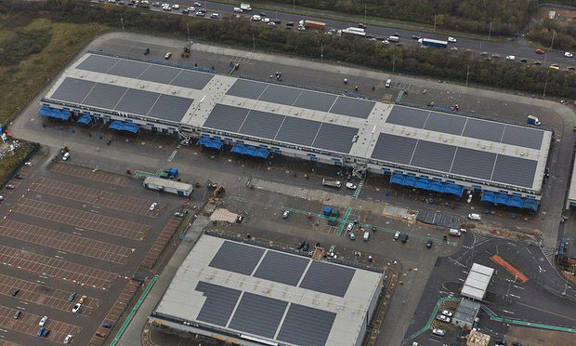
The London Borough of Hounslow says its £2m investment in solar, which has been installed on the roof of Western International Market, is also the first by a council to adopt battery storage to maximise the power from the panels.
The 1.73 megawatt (MW) array of 6,069 panels and four 60kW lithium batteries system now generates half the site’s required electricity.
The site is west London’s largest wholesale market for fresh produce and flowers, and uses around 3.5 megawatt hours (MWh) of electricity to provide climate controlled facilities to around 80 wholesalers and buyers – the equivalent of 1,750 homes a year.
Hounslow council, which owns the market near Heathrow Airport, says the solar system will contribute 2% of its carbon reduction target, cutting emissions by more than 780 tonnes a year.
It will also save £148,000 in energy costs which, along with £100,000 in generation tariff payments and £7,000 in export tariffs, means that the council expects to be £255,000 better off in the first year of operation.
Charles Pipe, energy manager at Hounslow, said: “From the very beginning, this project has been about reducing our carbon footprint and making an investment for the future. “But we have achieved so much more than that. Not only can we expect to see immediate savings on our electricity bills, but we are expecting to see a return on this investment in about five years.”
LG Electronics, one of Hounslow’s partners in the scheme, said it was the company’s largest solar panel installation in Europe and would deliver significant costs savings to the borough.
LG Solar’s UK senior solar sales manager Bob Mills said: “What’s more, the project has set the wheels in motion for further investment and research into the potential of battery storage, which is set to revolutionise the solar industry.
Berkely Lab finds that Solar Power brings Environmental and Public Health Benefits

 New Berkeley Lab Study Tallies Environmental and Public Health Benefits of Solar Power, Berkely Lab, Jon Weiner 510-486-4014 • MAY 18, 2016 Berkeley, CA — Solar power could deliver $400 billion in environmental and public health benefits throughout the United States by 2050, according to a study from the U.S. Department of Energy (DOE)’s Lawrence Berkeley National Laboratory (Berkeley Lab) and National Renewable Energy Laboratory (NREL).
“We find that a U.S. electric system in which solar plays a major role—supplying 14% of demand in 2030, and 27% in 2050—would result in enduring environmental and health benefits. Moreover, we find that the existing fleet of solar plants is already offering a down-payment towards those benefits, and that there are sizable regional differences in the benefits,” said Ryan Wiser of Berkeley Lab’s Energy Technologies Area.
The total monetary value of the greenhouse-gas and air pollution benefits of the high-penetration solar scenario exceeds $400 billion in present-value terms under central assumptions. Focusing on the existing end-of-2014 fleet of solar power projects, recent annual benefits equal more than $1.5 billion under central assumptions.
The report, The Environmental and Public Health Benefits of Achieving High Penetrations of Solar Energy in the United States, may be downloaded here. The report is part of a series of papers published as part of the U.S. Department of Energy’s On the Path to SunShot study. The DOE launched the SunShot Initiative in 2011, with the goal of driving down the cost of solar energy so that it was cost-competitive with other forms of electricity by the end of the decade. The new reports take stock of the progress already made, and highlight various barriers and opportunities that remain to achieving SunShot-level cost reductions. The full set of reports, including two others involving Berkeley Lab, can be found here…..http://newscenter.lbl.gov/2016/05/18/berkeley-lab-study-tallies-benefits-solar-power/
Republican U.S. Sen. Lamar Alexander opposes wind power
 Pro-Nuclear GOP Senator Urges Tennessee to Reject Wind Farm, abc news,By ERIK SCHELZIG, ASSOCIATED PRESS NASHVILLE, Tenn. — May 19, 2016, Republican U.S. Sen. Lamar Alexander is urging his fellow Tennesseans to oppose what he calls an “unsightly” wind farm near the Cumberland Mountain State Park.
The longtime supporter of nuclear power argued on the Senate floor this week that the 23 wind turbines Apex Clean Energy wants to install are “massive” and would spoil the “natural beauty of our state.”
“We should not allow anyone to destroy the environment in the name of saving it,” said Alexander, arguing that wind energy is being fueled by “billions in wasteful taxpayer subsidies” to out-of-state companies.
Apex countered that the $130 million project will emit no pollution and create no hazardous waste as it provides a safe energy alternative near wildlife and natural areas…….
The wind farm near Crossville, about 100 miles east of Nashville, is projected to power 20,000 homes. It is located on a privately-owned 1,800-acre site behind a limestone quarry, though the turbines would be visible from Interstate 40.
“This project will help bring about cleaner, healthier air, reduce pollution, and create economic growth and jobs in Cumberland County,” Chandler said……http://abcnews.go.com/US/wireStory/pro-nuclear-gop-senator-urges-tennessee-reject-wind-39229291
Solar energy jobs growing, as oil industry jobs decline
 There Will Be More New Jobs in Solar Than Oil by the End of the Year,Fortune by Jonathan Chew @sochews APRIL 20, 2016, Indeed just released this startling info on energy jobs.
The world’s biggest oil companies are slashing jobs to cope with decreasing revenues, and one knock-on effect has been the drop in oil job postings.
Conversely, however, if the current pace of postings hold, solar would become the largest market for energy jobs by the fourth quarter of 2016, according to numbers tabulated by Indeed, the world’s highest traffic job site…….
Tara Sinclair, chief economist at Indeed. “Whether or not solar overtakes oil on Indeed, energy workers would do well to position themselves for work in renewable fields such as solar, wind, and hydroelectricity.”
This corresponds with a recent report by The Solar Foundation that highlighted the rapid growth of the U.S. clean energy sector. By the end of this year, the solar sector should have 240,000 workers under its wings, and currently employs around 77% more workers than the coal mining industry……http://fortune.com/2016/04/20/solar-oil-jobs-indeed/
The role of renewable energy in slowing climate change
Surge in renewable energy stalls world greenhouse gas emissions Falling coal use in China and the US and a shift towards renewable energy globally saw energy emissions level for the second year running, says IEA, Guardian, John Vidal, 17 March 16, Falling coal use in China and the US and a worldwide shift towards renewable energy have kept greenhouse gas emissions level for a second year running, one of the world’s leading energy analysts has said.
Preliminary data for 2015 from the International Energy Agency (IEA) showed that carbon dioxide emissions from the energy sector have levelled off at 32.1bn tonnes even as the global economy grew over 3% .
Electricity generated by renewable sources played a critical role, having accounted for around 90% of new electricity generation in 2015. Wind power produced more than half of all new electricity generation, said the IEA.
The figures are significant because they prove to traditionally sceptical treasuries that it is possible to grow economies without increasing climate emissions.
“The new figures confirm last year’s surprising but welcome news: we now have seen two straight years of greenhouse gas emissions decoupling from economic growth. Coming just a few months after the landmark COP21 agreement in Paris, this is yet another boost to the global fight against climate changem” said IEA director, Fatih Birol…….
A seperate report by the European Environment agency (EEA) shows that the EU-wide share of renewable energy has increased from 14.3% in 2012 to 15% in 2013. This allowed the EU to cut its demand for fossil fuels by 110m tonnes of oil equivalent in 2013. This, said the EEA, is the equivalent of a gross reduction of CO2 emissions of 362m tonnes in 2013. http://www.theguardian.com/environment/2016/mar/16/surge-in-renewable-energy-stalls-world-greenhouse-gas-emissions?CMP=share_btn_tw
100% renewable energy powers Portugal for four days
Portugal runs for four days straight on renewable energy alone
Zero emission milestone reached as country is powered by just wind, solar and hydro-generated electricity for 107 hours, Guardian, Arthur Neslen, 19 May 16, Portugal kept its lights on with renewable energy alone for four consecutive days last week in a clean energy milestone revealed by data analysis of national energy network figures.
Electricity consumption in the country was fully covered by solar, wind and hydro power in an extraordinary 107-hour run that lasted from 6.45am on Saturday 7 May until 5.45pm the following Wednesday, the analysis says.
News of the zero emissions landmark comes just days after Germany announced that clean energy had powered almost all its electricity needs on Sunday 15 May, with power prices turning negative at several times in the day – effectively paying consumers to use it.
Oliver Joy, a spokesman for the Wind Europe trade association said: “We are seeing trends like this spread across Europe – last year with Denmark and now in Portugal. The Iberian peninsula is a great resource for renewables and wind energy, not just for the region but for the whole of Europe.”
James Watson, the CEO of SolarPower Europe said: “This is a significant achievement for a European country, but what seems extraordinary today will be commonplace in Europe in just a few years. The energy transition process is gathering momentum and records such as this will continue to be set and broken across Europe.”
Last year, wind providing 22% of electricity and all renewable sources together providing 48%, according to the Portuguese renewable energy association.
While Portugal’s clean energy surge has been spurred by the EU’s renewable targets for 2020, support schemes for new wind capacity were reduced in 2012.
Despite this, Portugal added 550MW of wind capacity between 2013 and 2016, and industry groups now have their sights firmly set on the green energy’s export potential, within Europe and without…….http://www.theguardian.com/environment/2016/may/18/portugal-runs-for-four-days-straight-on-renewable-energy-alone
From soldier to climate change fighter – Solar Ready Vets
Solar Ready Vets Transforms US Military Into Climate Change Fighters, Clean Technica, May 18th, 2016 by Tina Casey
At least 190,000 veterans are expected to transition out of the US military each year over the next several years, and the federal program Solar Ready Vets is gearing up to match them with solar jobs. The Energy Department has just announced that it is adding five more military bases to the program’s roster of solar training locations. The agency will also pour $10 million into 10 new training projects that will help rev up the solar industry’s ability to absorb new workers.
Solar Jobs And A Smooth Transition
Solar Ready Vets was launched in 2014 as a pilot program to help the rapidly growing US solar industry recruit enough skilled workers to meet the demand. The idea is to establish the training programs on bases and begin the training process before veterans end their military service, so they can enter the civilian workforce as seamlessly as possible.
Each base is paired with a local community college or other solar training provider, leveraging the existing framework of the GI Bill.
The training is available to active duty personnel who are within six months of leaving the service. To sweeten the pot, there is no charge to for the training program.
The program aims at all aspects of the solar industry, including sales and management as well as installation and other technical positions.
Apparently Solar Ready Vets was a success. It has already graduated 250 trainees and, from an initial five bases, this week it doubled in size to include 10 bases. The new ones are:
Camp Pendleton in California – U.S. Marine Corps
Fort Carson in Colorado – U.S. Army
Naval Station Norfolk in Virginia – U.S. Navy
Hill Air Force Base in Utah – U.S. Air Force
Fort Drum in New York – U.S. Army
These are the existing ones:
Joint Base McGuire-Dix-Lakehurst in New Jersey – U.S. Air Force, Army, and Navy
Eglin Air Force Base in Florida – U.S. Air Force
Marine Corps Base Hawaii – U.S. Marine Corps
Joint Base San Antonio in Texas – U.S. Air Force and Army
Fort Bragg in North Carolina – U.S. Army…….http://cleantechnica.com/2016/05/18/solar-ready-vets-transforms-us-military-climate-change-fighters/
Global solar power industry expanding at fast rate
Experts at industry summit say solar power expanding faster than ever CCTV America, May 11, 2016 [Good Graphs] Last week, the U.S. marked its one millionth solar panel installation, 40 years after solar energy was first developed. Analysts say it’ll only take two years to install another one million.
“By 2020, we’ll be generating enough electricity to power 20 million homes. So we are at the place where solar takes off,” Rhone Resch, president and chief executive of the Solar Energy Industry Association said……..
Renewable energy, energy efficiency cheaper options for South West England than Hinkley nuclear power
Alternatives to Hinkley nuClear News No 85 May 2016 If there is anywhere between 4 and 18 months before a final investment decision on Hinkley is made what alternative proposals can be promoted over that time? West England, published a study which showed how the South-west’s energy needs could be met with renewable energy. The report focussed on dealing with the baseload question and the economic impact of a renewable energy transition. It concluded that the South West has the renewable energy resources to meet more than 100% of its total energy needs, including replacement of liquid fuels and electrifying railways.
Koch brothers and power utilities connive to stop solar power
 The Koch Brothers’ Dirty War on Solar Power All over the country, the Kochs and utilities have been blocking solar initiatives — but nowhere more so than in Florida, Rolling Stone, By Tim Dickinson February 11, 2016 After decades of false starts, solar power in America is finally poised for its breakthrough moment. The price of solar panels has dropped by more than 80 percent since President Obama took office, and the industry is beginning to compete with coal and natural gas on economics alone.
South Africa: renewable energy growth, promise that nuclear development will be “corruption-free”
South Africa targets more renewable power, nuclear expansion to go ahead
*Renewable energy seen contributing 17,800 MW by 2030
* Nuclear expansion process to be affordable, above board
Africa’s most industrialised country has turned to solar and wind power to diversify its energy mix and help plug electricity shortages. The first 47 renewable energy independent power producers are due to be fully operational by July.
It also hopes to install 9,600 megawatts of nuclear power in the next 15 years to address chronic electricity shortages but the cost of the project estimated at about $100 billion has raised budgetary concerns.
Tina Joemat-Pettersson reaffirmed in parliament that the planned nuclear expansion would be “corruption free”, following concerns by opposition parties over the tender process and about the affordability of the project in a country whose economic growth has stagnated.
The department of energy would issue a request for proposal to confirm market appetite for the fleet of nuclear plants and help secure commercial and financial information for the government to make a final decision, she said.
“We will only implement what our country can afford,” Joemat-Pettersson said.
Forecasts for growth in South Africa have fallen to below 1 percent for 2016 as a global commodity slump drags on and rising inflation rates curb domestic spending.
1 This Month
Chernobyl: The Lost Tapes – A good documentary on Chernobyl on SBS available On Demand for the next 3 weeks– https://www.sbs.com.au/ondemand/tv-program/chernobyl-the-lost-tapes/2352741955560

of the week–London Campaign for Nuclear Disarmament

Tell the Ukrainian Government to Drop Prosecution of Peace Activist Yurii Sheliazhenko
To see nuclear-related stories in greater depth and intensity – go to https://nuclearinformation.wordpress.com
-
Archives
- April 2026 (126)
- March 2026 (251)
- February 2026 (268)
- January 2026 (308)
- December 2025 (358)
- November 2025 (359)
- October 2025 (376)
- September 2025 (257)
- August 2025 (319)
- July 2025 (230)
- June 2025 (348)
- May 2025 (261)
-
Categories
- 1
- 1 NUCLEAR ISSUES
- business and costs
- climate change
- culture and arts
- ENERGY
- environment
- health
- history
- indigenous issues
- Legal
- marketing of nuclear
- media
- opposition to nuclear
- PERSONAL STORIES
- politics
- politics international
- Religion and ethics
- safety
- secrets,lies and civil liberties
- spinbuster
- technology
- Uranium
- wastes
- weapons and war
- Women
- 2 WORLD
- ACTION
- AFRICA
- Atrocities
- AUSTRALIA
- Christina's notes
- Christina's themes
- culture and arts
- Events
- Fuk 2022
- Fuk 2023
- Fukushima 2017
- Fukushima 2018
- fukushima 2019
- Fukushima 2020
- Fukushima 2021
- general
- global warming
- Humour (God we need it)
- Nuclear
- RARE EARTHS
- Reference
- resources – print
- Resources -audiovicual
- Weekly Newsletter
- World
- World Nuclear
- YouTube
-
RSS
Entries RSS
Comments RSS
 nuclear-news