Germany Converts Coal Mine into Giant Battery to Store Renewable Energy for off-Hours EnviroNews World News on April 2, 2017 North Rhein Westphalia, Germany — The Prosper-Haniel hard coal mine, slated to be shut down in 2018 when government subsidies run out, is being repurposed to become a giant battery for excess power created by renewable energy sources. Located in North Rhein Westphalia, the coal mine’s conversion will allow Germany to store 200 MW of electricity for use during times when solar and wind are unavailable or unable to meet energy needs.
The storage is formed by a reservoir of water above the mine. The water can be released into the system when it is needed. As gravity pulls the water into the coal mine below, the water turns a turbine creating electricity. The water is then pumped back to the reservoir. This can be done when power prices are lower or when renewable energy sources are making more energy than people are using, as they did in Germany on May 12, 2016. This isn’t the first pumped hydroelectric storage station; however, it is the first one to use a coal mine for its lower reservoir.
According to Governor Hannelore Kraft, the miners of Bottrop will remain employed during the conversion process. Thus the plan addresses two concerns about which most opponents are vocal when it comes to energy sources like solar and wind. It creates a storage system, and it keeps people employed…….http://www.environews.tv/world-news/germany-converts-coal-mine-giant-battery-store-renewable-energy-off-hours/
April 3, 2017
Posted by Christina Macpherson |
energy storage, Germany |
Leave a comment
 Governor Cuomo and Governor Brown Reaffirm Commitment to Exceeding Targets of the Clean Power Plan, https://www.governor.ny.gov/news/governor-cuomo-and-governor-brown-reaffirm-commitment-exceeding-targets-clean-power-plan MARCH 28, 2017 Albany, NY, With the announcement that the United States will begin to dismantle the Clean Power Plan, New York Governor Andrew M. Cuomo and California Governor Edmund G. Brown Jr. today issued the following statement reaffirming their ongoing commitment to exceed the targets of the Clean Power Plan and curb carbon pollution:
“Dismantling the Clean Power Plan and other critical climate programs is profoundly misguided and shockingly ignores basic science. With this move, the Administration will endanger public health, our environment and our economic prosperity.
“Climate change is real and will not be wished away by rhetoric or denial. We stand together with a majority of the American people in supporting bold actions to protect our communities from the dire consequences of climate change.
“Together, California and New York represent approximately 60 million people – nearly one-in-five Americans – and 20 percent of the nation’s gross domestic product. With or without Washington, we will work with our partners throughout the world to aggressively fight climate change and protect our future.”
New York and California lead the nation in ground-breaking policies to combat climate change. Both states – which account for roughly 10 percent of greenhouse gas emissions in the United States – have adopted advanced energy efficiency and renewable energy programs to meet and exceed the requirements of the Clean Power Plan and have set some of the most aggressive greenhouse gas emission reduction targets in North America – 40 percent below 1990 levels by 2030 and 80 percent below 1990 levels by 2050. New York and California will continue to work closely together – and with other states – to help fill the void left by the federal government.
New York’s Climate Leadership
Greenhouse Gas Emission Reductions: Established ambitious greenhouse gas emission reduction targets to reduce emissions 40 percent below 1990 levels by 2030 and 80 percent by 2050. These targets have made New York a leader across the country in fighting climate change.
Regional Greenhouse Gas Initiative (RGGI): Spearheaded the formation of the successful RGGI cap-and-trade program between northeast and mid-Atlantic states, led effort to reduce RGGI’s carbon emission cap by 45 percent in 2014, and recently called for an additional cap reduction of at least 30 percent between 2020 and 2030.
Reforming the Energy Vision: Established a comprehensive energy strategy to make the vision for a clean, resilient, and affordable energy system a reality, while actively spurring energy innovation, attracting new jobs, and improving consumer choice.
Clean Energy Standard: Established the most comprehensive and ambitious clean energy mandate in the state’s history, requiring that 50 percent of electricity in New York come from renewable energy sources like wind and solar by 2030.
Clean Energy Fund: Established a $5 billion fund that is jump-starting clean-tech innovation, mobilizing private investment, capitalizing the nation’s largest Green Bank, and helping eliminate market barriers to make clean energy scalable and affordable for all New Yorkers.
Coal-Free New York: Committed to close or repower all coal-burning power plants in New York to cleaner fuel sources by 2020.
Offshore Wind: Approved the nation’s largest wind energy project off the Long Island coast in 2017 and made an unprecedented commitment to develop up to 2.4 gigawatts of offshore wind power by 2030.
California’s Climate Leadership
Greenhouse Gas Emission Reductions: Established ambitious greenhouse gas emission reduction targets to reduce emissions 40 percent below 1990 levels by 2030 and 80 percent by 2050. These targets have made California a leader across the country in fighting climate change.
Cap-and-Trade: Established the most comprehensive carbon market in North America, investing more than $2.6 billion from the Cap-and-Trade program in programs and projects that reduce emissions and support communities disadvantaged by pollution.
Renewable Energy: Established landmark targets that require at least 33 percent of California’s electricity comes from renewable energy sources by 2020, and 50 percent by 2030.
Energy Efficiency: Established targets that double the rate of energy efficiency savings in California buildings and require residential buildings to be Zero Net Energy by 2020, and all commercial buildings to be Zero Net Energy by 2030.
Super Pollutant Reduction: Established the nation’s toughest restrictions on destructive super pollutants, such as methane, black carbon, and hydrofluorocarbon gases.
Low Carbon Fuel Standard: Established requirements for producers of petroleum-based fuels to reduce the carbon intensity of their products, helping drive the replacement of fossil fuels with renewable natural gas and diesel, low-carbon ethanol, and clean electricity, giving consumers more clean fuel choices while driving significant clean fuel investment and creating new economic opportunities.
Zero Emission Vehicles: Established a program requiring increased sales of zero emission vehicles – a policy adopted by 10 states – resulting in more than 30 new models of clean and affordable vehicles that are reducing consumer gasoline and diesel costs. California also adopted North America’s first greenhouse gas emission car standards – later adopted as a national program – and adopted the nation’s first heavy-duty vehicle and trailer greenhouse gas emission reduction requirements, which led to similar national requirements.
These efforts complement New York and California’s ongoing efforts to broaden collaboration among subnational leaders on climate change, including through the Under2 Coalition – a pact among cities, states and countries around the world to limit the increase in global average temperature to below 2 degrees Celsius in order to avoid potentially catastrophic consequences. New York and California are among the Under2 Coalition’s 167 jurisdictions representing more than one billion people and $25.9 trillion in combined GDP – more than one-third of the global economy.
March 31, 2017
Posted by Christina Macpherson |
climate change, renewable, USA |
Leave a comment
 IRENA, IEA Study — 2˚C Scenario Possible With Renewable Energy, Clean Technica, March 27th, 2017 by Steve Hanley At the request of the German government, the International Renewable Energy Agency (IRENA) and the International Energy Agency (IEA) conducted a study to determine whether global economic growth is possible while honoring the pledge made by the world community in Paris to prevent average world temperatures from rising more than 2º Celsius.
The result? The study concludes that energy-related carbon dioxide emissions can be reduced by 70% by the year 2050 and eliminated entirely by 2060 without causing the global economy to shrink.
“The Paris Agreement reflected an unprecedented international determination to act on climate. The focus must be on the decarbonization of the global energy system as it accounts for almost two-thirds of greenhouse gas emissions. Critically, the economic case for the energy transition has never been stronger. Today around the world, new renewable power plants are being built that will generate electricity for less cost than fossil-fuel power plants. And through 2050, the decarbonization can fuel sustainable economic growth and create more new jobs in renewables.” — IRENA Director-General Adnan Z. Amin
The study is entitled “Perspectives for the Energy Transition: Investment Needs for a Low-Carbon Energy Transition.” Its thesis is that increasing the the deployment of renewable energy and energy efficiency globally can achieve the emissions reductions needed to prevent global temperature from rising more than 2º Celsius while permitting the global economy to grow.
Decarbonizing Is Essential……https://cleantechnica.com/2017/03/27/irena-iea-study-2%CB%9Ac-scenario-possible-renewable-energy/
March 29, 2017
Posted by Christina Macpherson |
2 WORLD, renewable |
Leave a comment
 25 Cities Now Committed to 100% Renewables, EcoWatch, http://www.ecowatch.com/cities-commit-renewable-energy-2324917492.html Lorraine Chow, 22 Mar 17, Madison, Wisconsin and Abita Springs, Louisiana are transitioning to 100 percent renewable energy following respective city council votes on Tuesday.
Madison and Abita Springs are the first cities in Wisconsin and Louisiana to make this commitment. They join 23 other cities across the United States—from large ones like San Diego, California and Salt Lake City, Utah to smaller ones like Georgetown, Texas and Greensburg, Kansas—that have declared similar goals.
Madison is the biggest city in the Midwest to establish 100 percent renewable energy and net-zero carbon emissions. The Madison Common Council unanimously approved a resolution to allocate $250,000 to develop a plan by January 18, 2018 that includes target dates for reaching these goals, interim milestones, budget estimates and estimated financial impacts.
Madison Common Council Alder Zach Wood said that his city is determined to “lead the way in moving beyond fossil fuels that threaten our health and environment.”
After a unanimous vote, Abita Springs is aiming to derive 100 percent of the town’s electricity from renewable energy sources by December 31, 2030.
The Sierra Club noted that Tuesday’s votes from the politically polar municipalities reflect the growing bipartisan support for alternative energy development. To illustrate, during the November election, more than 70 percent of Madison voters supported Hillary Clinton versus the 75 percent of voters in St. Tammany Parish, where Abita Springs is located, who supported Donald Trump.But as Abita Springs’ Republican mayor Greg Lemons said, “Transitioning to 100 percent renewable energy is a practical decision we’re making for our environment, our economy and for what our constituents want in Abita Springs.”
“Politics has nothing to do with it for me. Clean energy just makes good economic sense,” Lemons added. LeAnn Pinniger Magee, chair of Abita Committee for Energy Sustainability, had similar remarks.
“In a state dominated by oil interests, Abita Springs is a unique community that can be a leader on the path to renewable energy,” she said. “Our town already boasts the solar-powered Abita Brewery and we can see first-hand how clean energy benefits our businesses and our entire community. By transitioning to 100 percent renewable energy, we will save money on our utility bills and protect our legendary water and clean air in the process.”
Last year’s Gallup poll indicated for the first time that a majority of Republicans and Republican-leaning independents prefer an alternative energy strategy. Fifty-one percent of Republicans favor alternative energy, up from the previous high of 46 percent in 2011.
“Whether you’re Republican or a Democrat, from a liberal college city or a rural Louisiana town, clean energy is putting America back to work and benefiting communities across the country,” Jodie Van Horn, director of the Sierra Club’s Ready for 100 campaign, said. “That’s why Madison, Wisconsin and Abita Springs, Louisiana, today join the ranks of 23 other cities and towns across the United States that are going all-in on clean, renewable energy.”
Van Horn noted that local leaders and governments will be increasingly tasked to curb President Trump’s pro-fossil fuel policies and gutting of environmental regulations.
“As the Trump Administration turns its back on clean air and clean water, cities and local leaders will continue to step up to lead the transition towards healthy communities and a more vibrant economy powered by renewable energy,” she said.
March 27, 2017
Posted by Christina Macpherson |
renewable, USA |
Leave a comment
 Energy Costs http://www.no2nuclearpower.org.uk/news/energy-costs-25-3-17/ Molly Scott Cato, Green MEP for the South West, has accused the government of failing consumers and the environment over energy policy. The accusation follows new projections from the Department for Business, Energy and Industrial Strategy (BEIS) which estimate that onshore wind and solar will be as cheap or cheaper than gas by 2020 [1]. BEIS now acknowledge an increased role for renewables, particularly due to potential improvements in battery storage. Molly Scott Cato said:
“Having hammered the renewables sector for ideological reasons, the government now discovers that wind and solar are set to become the cheapest ways to generate electricity. Government energy policy supposedly seeks to deliver secure, affordable and low carbon energy. They have failed on all three counts. But in particular we now see that by failing to pursue a transition to renewable energy they have missed the opportunity to provide electricity for the consumer at the lowest cost.”
Green Party 23rd March 2017 read more »
A long-awaited report exploring the complex cost implications of different energy technologies has finally been released, offering a series of recommendations on how government should manage a grid that is transitioning to cleaner sources of power. The report from consultancy Frontier Economics was originally commissioned by former Energy and Climate Change Secretary Ed Davey in response to a wide-ranging debate about whether the government was accounting for the full cost of renewable energy technologies. Business Green 24th March 2017
March 27, 2017
Posted by Christina Macpherson |
ENERGY, politics |
Leave a comment
Tesla Powers Kauai With Solar Energy After Sunset, ENS, LIHUE, Kauai, Hawaii, March 23, 2017 Hawaii’s first utility-scale solar farm that stores solar energy in giant battery packs and delivers it to homes after sunset has opened on the island of Kauai.
The solar power array enables a Kauai utility to increase its renewable energy generation to more than 40 percent due to high-capacity Tesla storage batteries.
“Storage is a challenge for us here in Hawaii,” said Governor David Ige at the blessing ceremony earlier this month. “I want to congratulate the residents of Kauai. Renewable energy sources are the future and we’re committed to making that happen.” Dignitaries from throughout the state were on hand for the blessing ceremony.
The project, commissioned by Kauaʻi Island Utility Cooperative and owned by Tesla, Inc., is located on 50 acres of land north of Lihue in Kapaia owned by Grove Farm.
The Kauai Island Utility Cooperative increased its solar capacity by connecting Tesla lithium-ion battery storage systems called Powerpacks to the solar farm. Each Powerpack can store 52 megawatts of power.
The solar storage system will feed up to 13 megawatts of electricity into Kauai’s grid to meet peak demand in the evening hours.
The Powerpacks store enough energy to service 4,500 homes during peak night demand. Before this system was built, Kauai’s grid had reached the maximum amount of solar power it could handle……..
Tesla is diving into solar energy following its acquisition of SolarCity last November. The company also is powering nearly the entire island of Ta’u in American Samoa with solar power and its Powerpacks.http://ens-newswire.com/2017/03/23/tesla-powers-kauai-with-solar-energy-after-sunset/
March 25, 2017
Posted by Christina Macpherson |
renewable, USA |
Leave a comment
Two Australian states embrace grid-scale storage for power reliability, http://www.utilitydive.com/news/two-australian-states-embrace-grid-scale-storage-for-power-reliability/438073/ Peter Maloney@TopFloorPower, 15 Mar, 17 Dive Brief:
- Two Australian states are ramping up energy storage to address rising electricity costs and rolling blackouts, according to media reports.
- In South Australia, the government says it will hold a competitive solicitation for a 100 MW battery storage installation and construct a 250 MW gas plant, according to Energy Storage News reports.
- The state of Victoria is also investing $20 million in an effort to boost energy storage to 100 MW by the end of next year, ABC News reports.

Dive Insight:The government announcements come days after
Tesla told South Australia officials that it could install a 100 MW battery system in 100 days that would solve the state’s power problems.South Australia has been suffering from
rolling blackouts brought about by high heat and a lack of baseload power. The situation has attracted developers like
ZEN Energy and Tesla, who say that battery storage could go a long way toward integrating renewables into the state’s grid and solving grid instability problems.
South Australia officials also announced plans for a 250 MW gas-fired generator to act as backup for intermittent renewables.
Officials said the gas plant would be turned on only when power shortfalls are forecasted, according to ABC. A bill is reportedly in the works to give the state energy minister more control over power dispatch, after criticisms of the Australian grid operator stemming from the power outages.
Victoria, meanwhile, is looking at a range of energy storage solutions, including batteries, pumped hydro storage and solar thermal technology. The $20 million investment will come on top of a separate $5 million solicitation for a 20 MW energy storage system issued last month.
March 24, 2017
Posted by Christina Macpherson |
AUSTRALIA, energy storage |
Leave a comment
Environmentally friendly, almost electricity-free solar cooling https://www.sciencedaily.com/releases/2017/03/170313085606.htm
Also serves as a heat pump
- Date:
- March 13, 2017
- Source:
- Technical Research Centre of Finland (VTT)
- Summary:
- Demand and the need for cooling are growing as the effects of climate change intensify. An emission-free, solar-powered chiller has now been developed by scientists. The potential market is world-wide, particularly in warm countries.
-
Demand and the need for cooling are growing as the effects of climate change intensify. VTT Technical Research Centre of Finland and German company ZAE Bayern have built an emission-free, solar-powered chiller; a pilot system has been tested in Finland and Germany. The potential market is world-wide, particularly in warm countries.
The production and consumption of solar cooling are simultaneous. A property’s cooling needs are highest when the sun is shining.
VTT and German company ZAE Bayern have developed a solar-powered 10 kW chiller. This absorption chiller works in the same way as the gas refrigerators used in Finnish holiday cabins, for example. But in this case, a solar thermal collector is used instead of gas. The method requires electricity for the flow pumps only. If necessary, the chiller can also serve as a heat pump.
The results of the project showed that — to be used as a heating pump as well — an economically viable and competitive, solar-powered absorption chiller would need to be 50 kW or bigger.
Finnish company Savo-Solar Plc participated in both the planning phase and the practical tests. As a result, the company’s head office was successfully cooled using the pilot system built for the project. Savo-Solar and ZAE Bayern aim to develop a commercial product which enables users to cut their electricity bills through cooling with absolutely no need for electricity. This would also reduce emissions.
The chiller was tested as an air-conditioner for Savo-Solar’s office during the summer and for heating it during the winter. Solar collectors on the roof of the building were used to collect the required energy. If the collectors did not produce enough energy during, say, the winter, or on a cloudy day, a heat pump served as a substitute energy source. Other possible energy sources would be district heating, biofuel boilers or industrial process heat.
Examples of large, megawatt-class absorption chillers based on district heating can already be found in Helsinki and Turku in Finland.
Another practical test was performed using an absorption chiller based on a bio-boiler in ZAE Bayern’s laboratory in Munich, Germany. This system can also be supplemented with solar energy.
Learn more at: http://www.vtt.fi/inf/pdf/technology/2017/T287.pdf
March 15, 2017
Posted by Christina Macpherson |
Finland, renewable |
Leave a comment
Iran and Middle East could adopt fully renewable electricity systems http://www.enn.com/pollution/article/50746 Iran can transition to a fully renewable electricity system and financially benefit from it by 2030. Researchers at Lappeenranta University of Technology (LUT) show that major oil-producing countries in the Middle East and North Africa (MENA) region could turn their abundant renewable energy resources into lucrative business opportunities in less than two decades.
According to the study, a fully renewable electricity system (100% RE) is roughly 50-60 percent cheaper than other emission-free energy options for the MENA region. For example, new nuclear power costs around 110 euros per megawatt hour. Fossil-CCS option costs around 120 euros per megawatt hour. But the cost of the fully renewable energy electricity is around 60–40 euros per megawatt hour, based on financial and technical assumptions of the year 2030.
The cost of wind and solar electricity would reduce further to 37-55 euros per megawatt hour if different energy resources were connected with a super grid that allows the transmission of high volumes of electricity across longer distances. For Iran, the price could go as low as 40-45 euros per megawatt hour. Such low cost show that the transition of the current fossil-based electricity system towards a fully renewable electricity system can cover all electricity needs in the decades to come.
“The low cost renewable electricity system is a driver for growing standards of living, continued economic growth, in particular also for energy intensive products, and finally more peace,” emphasizes Professor Christian Breyer.
Read more at Lappeenranta University of Technology
March 11, 2017
Posted by Christina Macpherson |
Iraq, MIDDLE EAST, renewable |
Leave a comment
 Solar-powered everything, REneweconomy, By Owen Agnew on 9 March 2017 NexusMedia Solar power used to mean large, heavy panels mounted on a roof or spread across a field.
But the sun falls on everyone — and everything — and as materials have gotten lighter, cheaper and more flexible, photovoltaic cells are showing up in the most unlikely of places.
In bustling New York City, you can buy a sandwich at a solar-powered food cart, eat it while sitting at a solar-powered bus stop, all while charging your phone using your solar-powered jacket.
Solar power is becoming more distributed, generating power closer to where it’s needed. That can mean buildings with their own solar arrays, or, on a smaller scale, clothing that features solar panels.
Brooklyn-based solar company Pvilion is leading the charge to put solar everywhere. Their projects range from building covers to small consumer items. “We’re looking at solar as a building material that can be used in a lot of different contexts,” says CEO Colin Touhey.
Touhey and his partners have collaborated with Tommy Hilfiger to make solar-powered jackets, and now they’re working on a line of bags with built-in solar panels. While coats can’t generate nearly as much power as larger arrays, every person with a smartphone is a potential customer.
“It’s really cool to plug in your phone and charge it with the sun,” says Touhey.
Researchers are developing woven solar fabrics that have photoactive dyes coating individual threads, so each fiber is a miniature solar panel. But for now, flexible solar panels must be laminated on top of fabrics.
Pvilion has also designed building facades using heavy-duty solar fabrics. You can see their handiwork in a planned expansion at the Artists for Humanity Epicenter in Boston. The building’s photovoltaic facade will generate power and provide shade, helping to keep the interior cool. This and other energy-smart technologies will make the Epicenter the largest commercial building on the East Coast to produce more power than it consumes, according to Pvilion………http://reneweconomy.com.au/solar-powered-everything-40816/
March 11, 2017
Posted by Christina Macpherson |
decentralised, USA |
Leave a comment
-
Falling costs make offshore turbines increasingly attractive
-
Germany may see record low price bid in auction in April
-
Water and electric power plants don’t mix well naturally, unless you add some wind.
Water tends to corrode and short out circuits. So what’s happening in the the renewable energy industry, where developers are putting jumbo-jet sized wind turbines into stormy seas, is at the very least an engineering miracle.
What might be even more miraculous to skeptics like those populating Donald Trump’s administration is that these multi-billion-dollar mega projects make increasing economic sense, even compared to new coal and nuclear power.
“If you have a sufficiently large site with the right wind speeds, then I do believe you can build offshore wind at least at the same price as new build coal in many places around the world including the U.S.,” said Henrik Poulsen, chief executive officer of Dong Energy A/S, the Danish utility that has pioneered the technology and has become the world’s biggest installer of windmills at sea.
- Across Europe, the price of building an offshore wind farm has fallen 46 percent in the last five years — 22 percent last year alone. Erecting turbines in the seabed now costs an average $126 for each megawatt-hour of capacity, according to Bloomberg New Energy Finance. That’s below the $155 a megawatt-hour price for new nuclear developments in Europe and closing in on the $88 price tag on new coal plants, the London-based researcher estimates.
- As nuclear power costs spiral, prompting a $6.3 billion writedown at reactor maker Toshiba Corp. and delays at Electricite de France SA’s plant in Flamanville, the investment needed to build offshore wind capacity is plummeting.
In Denmark, where the government shoulders much of the development risk, Vattenfall AB last year agreed to supply power from turbines in the North Sea at 60 euros ($64) a megawatt-hour in 2020. Dutch and German auctions due this year provide “ample opportunity” to beat that record low price, says Gunnar Groebler, the utility’s head of wind.
The industry even is taking hold in the U.S., which for years shunned the technology as too costly for a place that historically enjoys lower power prices than Europe.
A federal auction in December for rights to develop wind farms off the coast of Long Island resulted in a bidding war. Rhode Island has commissioned one plant, and developers are also considering work in Maryland, New Jersey and North Carolina.
Although Trump said offshore wind was “monstrous” when it came into conflict with his golf course in Scotland, the U.S. government’s official goal for now is to install 86 gigawatts of turbines at sea by 2050. That’s six times the 14 gigawatts of capacity now in place worldwide, according to the Global Wind Energy Council.
- The strength of the wind off the coast makes the sea a natural place to anchor turbines. In European waters, breezes average 22 miles per hour about 360 feet (110 meters) off the surface, a good baseline for the scale of many installations, according to The Crown Estate, which leases out areas of U.K. seabed belonging to the Queen to wind farms. That’s almost triple the average wind speed onshore.
While more steady gusts mean each turbine will yield more electricity, fixing the machines to the seabed requires deep concrete footings cast in often turbulent seas.
The North Sea, the crucible of the modern offshore wind industry, suffers punishing storms and strong tides that batter turbines much of the year. Securing structures as tall as the Washington Monument in the ocean requires deep footings, specialized ships and cranes capable of lifting equipment that can weigh tons. Salt water eats away at machinery and fittings. Cables must be rugged enough for the worst weather. And if equipment breaks, it can take weeks before the seas are calm enough for a work vessel.
Oil majors that have spent decades building skills to work in those conditions are turning their attention to offshore wind as petroleum production subsides in the North Sea. Royal Dutch Shell Plc and Statoil ASAare among companies that won contracts to build offshore wind projects last year.
All told, a record $29.9 billion was invested in offshore wind in 2016, up 40 percent from the year before, according to Bloomberg New Energy Finance. It expects investment to grow to $115 billion by 2020. What’s driving installations is an expected 26 percent drop in the costs, making offshore wind increasingly competitive with land-based turbines and solar and nuclear power — even without subsidy.
In years past, grid managers were reluctant to rely on fickle winds for power that flows only about 45 percent of the year. That’s changing too. Batterycosts have fallen 40 percent since 2014, making them a realistic way to help balance fluctuating flows of renewable energy to the grid.
- Offshore wind projects coming online today are already delivering power at almost half the price of those finished in 2012 thanks to larger turbines and greater competition. That’s emboldening developers to promise supplying power for even less, suggesting the industry will break more records this year starting the a contest in Germany in April, said Deepa Venkateswaran, analyst at Sanford C. Bernstein Ltd.
Europe’s lingering low-interest environment may add downward pressure on bids in Germany’s offshore auctions, EON SE Chief Executive Officer Johannes Teyssen said on Jan., 25. The utility will join bidders as it seeks to add as much as 1.5 billion euros ($1.58 billion) a year to its clean energy portfolio.
The U.K. remains one of the hottest markets owing to the need to replace ageing power plants. Bids may reach as little as 80 euros a megawatt-hour in the next auction due to start in April, she said. That’s comparable to about 68 pounds a megawatt-hour for the global onshore wind average, and well below the government’s 2020 goal to bring costs below 100 pounds ($125.55) a megawatt-hour.
It’s also much cheaper than EDF’s new nuclear power program at Hinkley Point in Somerset, which last year won a 35-year contract to provide power at a cost of 92.50 pounds a megawatt hour once it begins generating. It’s currently due to come online in 2026, even though EDF originally planned it to be cooking Christmas turkeys for British households in 2017.
“In this auction it is possible that the price achieved could be below 90 pounds,” said Keith Anderson, chief corporate officer of Scottish Power Ltd., a unit of Spain’s Iberdrola SA.
March 11, 2017
Posted by Christina Macpherson |
EUROPE, renewable |
Leave a comment
Offshore windfarms set to become cheaper source of electricity than nuclear power stations
Government’s plan to turn UK into world leader in offshore wind energy receives boost as electricity price halves in five years The Independent, Ian Johnston Environment Correspondent @montaukian 9 Mar 17 Offshore windfarms are set to become a cheaper source of electricity than the Hinkley Point nuclear power plant and are also on track to undercut coal-fired power stations.

The Government, which has been trying to support offshore in the hope of turning the UK into a world-leader in the sector, plans to hold an auction next month in which generators will bid for a guaranteed price for their electricity, with the lowest offer declared the winner…….
March 11, 2017
Posted by Christina Macpherson |
renewable, UK |
Leave a comment
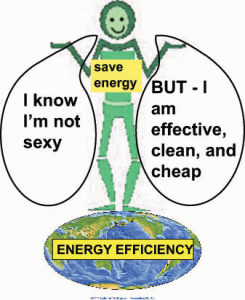 “Under aggressive but cost-effective and potentially attainable increases in energy efficiency beyond the levels assumed in the Clean Energy Standard, all of the consumption otherwise met with IPEC (Indian Point Energy Center) station output could be met by more efficient energy use alone by 2023…”
The report estimates that aggressive energy efficiency programs could produce savings equal to twice the power generated by the Indian Point plant. A New York Times piece by Patrick McGeehan discusses the report’s analysis of energy efficiency programs in Connecticut and Rhode Island; these two states provide incentives for the adoption of energy efficiency measures and are able to produce energy savings of about 3% a year.
Ultimately, we will need renewable energy to power our entire energy system, but in the short run, we waste so much energy that efficiency can be used to meet our energy needs without using nuclear power. …..
Using energy efficiency to replace nuclear power, as proposed by NRDC and Riverkeeper, is an elegant solution to a difficult problem. New York’s Public Service Commission should work harder to incentivize energy efficiency. Utilities should make more profit when they deliver on efficiency goals. Con Ed should make more money when they sell less electricity. Homeowners should receive tax credits for demonstrating reductions in energy use. Energy audits and the capital costs of retrofits should be provided at a discount. Businesses should receive free consulting services from utilities and the state on how to incorporate energy efficiency practices into routine organizational management. The goal is to grow the economy without building new power plants—to maintain, and even improve, our standard of living while reducing our use of energy.
The idea to replace nuclear power with energy efficiency was not invented in New York. Typical of many new energy and environmental programs, it began in California. In June 2016, Pacific Gas and Electric announced an agreement it had reached with labor unions and environmental groups to close the Diablo Canyon nuclear power plant by 2025 and replace it with energy efficiency and renewable energy. Writing in Scientific American, Debra Kahn reported that: “Environmentalists said other states could use the agreement as a template to replace other nuclear and fossil-fueled plants with renewables, especially distributed solar, in order to fight climate change.”
Renewables still require new technology to displace other sources of energy, but energy efficiency is here right now. Energy efficiency is an important source of energy because of the casual way we have treated the use of energy in the past. Energy is a central resource needed in nearly every aspect of modern life. Appliances such as refrigerators, air conditioners, heaters, vehicles, computers, smartphones, radios, cable boxes, televisions, stoves and coffee makers all require energy. In many cases these appliances have been built to ensure reliable performance, but until the past decade or two, efforts to deliver that performance did not focus on delivery with the least possible energy use. Once engineers turned their attention to energy efficiency they found they could produce new appliances that worked just as well as the old but required much less energy. Similarly, architects and real estate developers started to design structures and HVAC (heating, ventilation and air conditioning) systems that used less energy. Old structures could be retrofitted with better insulated windows, timers, and motion-sensitive lighting, along with LED light bulbs.
Industrial energy use in data farms and other locations provide large, new targets for energy efficiency. One of the chief advantages of energy efficiency is that it is difficult to argue against it. What is the counter-argument? Let’s waste as much energy as we can and spend lots of money on energy instead of saving it for better uses?
There are, however, obstacles to energy efficiency: capital costs, habit, inconvenience, risk due to reduced redundancy (eg. in information technology facilities), outmoded regulations, and so on. But there is undeniable momentum behind efficiency as a “source” of energy. It enables reductions in pollution and in the costs of energy without trading off any benefits…..
The contrast between these two states and the Trump Administration could not be sharper. California and New York are trying to make the transition to a renewable energy future. The Trump folks are trying to piece together the pipelines, oil rigs, and coal mines of our energy present and past. I, for one, am betting on the future.http://www.huffingtonpost.com/entry/replacing-the-indian-point-nuclear-power-plant-with_us_58b9e13de4b02eac8876ce6f
March 8, 2017
Posted by Christina Macpherson |
ENERGY, USA |
Leave a comment
 Tesla will begin selling its solar roof this year — here’s everything you need to know [excellent pictures] Business Insider DANIELLE MUOIO FEB 27, 2017, Tesla will begin selling and installing its solar roof later this year, the company wrote in its fourth-quarter investor letter.
March 6, 2017
Posted by Christina Macpherson |
decentralised, USA |
Leave a comment
 Electric Cars are the Missing Link to a Zero Carbon Energy Grid, Skeptical Science 2 March 2017 by Ryan Logtenberg, (good graphs) Since the start of the industrial revolution, humans have released hundreds of billions of tons of greenhouse gases into our atmosphere, acidifying oceans, increasing the frequency of extreme weather events, raising sea levels with the worst effects yet to come. The general consensus gleaned from the Paris Climate Summit in 2015 is that in order to halt the relentless march of climate change and its forecasted catastrophic consequences, one step we need to take is to transform our fossil fuel based economy to one powered by zero-emission renewable energy.
The good news is that investments in solar and wind generation have become competitive and in many cases cheaper and more profitable than similar investments in fossil fuels. The graphs below shows how solar and wind installations in the US have beaten fossil fuel installations for the past 3 years.
Globally, the conversation has shifted from “can renewables compete with fossil fuels?” to “how much intermittent renewable energy can our power grid handle?” Currently power grids rely on a steady and predictable stream of power generation. They can handle only so much of the fluctuation that comes from solar (surges during the day) and wind (surges when it’s windy).
The investment required in energy storage facilities to fulfill the needs of a 100% renewable energy grid is typically believed to be very high. Essentially millions of large industrial-scale batteries or creative energy storage solutions are needed to smooth out the surges. But what is often forgotten is that a creative solution is currently being built at an accelerating rate, in the form of vehicle batteries from the budding electric transportation system. Electric vehicles will herald in a new age of clean air on busy city streets, but they can also serve a secondary purpose of solving the energy storage issue of renewables.
Mass adoption of electric vehicles is coming. Many of the drawbacks of electric vehicles are quickly being addressed: From inexpensive vehicles with 200-335 miles of range, to the rapid expansion of ultra fast charging stations that can charge vehicles to 80% in 15 minutes or less. Several countries in Europe now see zero emission vehicles as the logical solution to addressing air pollution and are looking to implement bans on new fossil-fuel powered vehicles as early as 2025. Some major cities are even going a step further and will be banning all diesel powered vehicles from their cities. Clearly, the age of the fossil fuelled powered vehicle is quickly coming to an end. But, how big of an impact can an electrified transportation sector have in creating a green energy grid? Well let’s look at the numbers:……….
An Intensive peer reviewed study titled “Cost-minimized combinations of wind power, solar power and electrochemical storage, powering the grid up to 99.9% of the time” evaluated billions of 100% renewable energy grid scenarios using 4 years of real weather and grid load data. They concluded that with 15kWh set aside from each electric car for grid energy storage a 100% renewable energy grid could power 90%-99.9% of hours entirely on renewable electricity, at costs comparable to today’s prices. Something to note is that the study was done in 2013 before the second generation of electric vehicles like the Chevy Bolt, Tesla 3 and other large battery, mass market vehicles were introduced to the public. Using 45 kWh for battery storage from a Chevy Bolt instead of 15kWh that was used in the study would increase total storage capacity by 300% making it a whole lot easier and cheaper to run America’s grid on renewables.
V2G integration into our zero carbon energy grid makes sense because it eliminates the needs for investing in expensive energy storage since the vehicles we will be driving could already provide that service. It also allows a vehicle owner that participates in V2G services to generate revenue from their vehicle while they sleep…….
As the same factors hold true for electric vehicles, don’t be surprised when you see a substantial reduction in total US greenhouse gas emissions from a zero carbon energy and transportation sector occurring sooner than you think. You can help accelerate this transition by making a pledge that your next vehicle will be electric. https://www.skepticalscience.com/Electric_Cars_are_the_Missing_Link_to_a_Zero_Carbon_Energy_Grid.html
March 4, 2017
Posted by Christina Macpherson |
climate change, ENERGY, USA |
Leave a comment











 nuclear-news