-
Falling costs make offshore turbines increasingly attractive
-
Germany may see record low price bid in auction in April
-
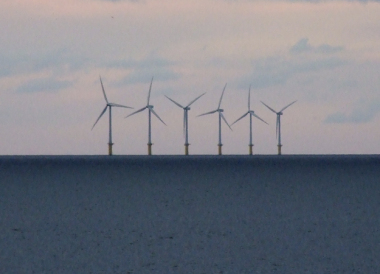
Water and electric power plants don’t mix well naturally, unless you add some wind.
Water tends to corrode and short out circuits. So what’s happening in the the renewable energy industry, where developers are putting jumbo-jet sized wind turbines into stormy seas, is at the very least an engineering miracle.
What might be even more miraculous to skeptics like those populating Donald Trump’s administration is that these multi-billion-dollar mega projects make increasing economic sense, even compared to new coal and nuclear power.
“If you have a sufficiently large site with the right wind speeds, then I do believe you can build offshore wind at least at the same price as new build coal in many places around the world including the U.S.,” said Henrik Poulsen, chief executive officer of Dong Energy A/S, the Danish utility that has pioneered the technology and has become the world’s biggest installer of windmills at sea.
- Across Europe, the price of building an offshore wind farm has fallen 46 percent in the last five years — 22 percent last year alone. Erecting turbines in the seabed now costs an average $126 for each megawatt-hour of capacity, according to Bloomberg New Energy Finance. That’s below the $155 a megawatt-hour price for new nuclear developments in Europe and closing in on the $88 price tag on new coal plants, the London-based researcher estimates.
- As nuclear power costs spiral, prompting a $6.3 billion writedown at reactor maker Toshiba Corp. and delays at Electricite de France SA’s plant in Flamanville, the investment needed to build offshore wind capacity is plummeting.
In Denmark, where the government shoulders much of the development risk, Vattenfall AB last year agreed to supply power from turbines in the North Sea at 60 euros ($64) a megawatt-hour in 2020. Dutch and German auctions due this year provide “ample opportunity” to beat that record low price, says Gunnar Groebler, the utility’s head of wind.
The industry even is taking hold in the U.S., which for years shunned the technology as too costly for a place that historically enjoys lower power prices than Europe.
A federal auction in December for rights to develop wind farms off the coast of Long Island resulted in a bidding war. Rhode Island has commissioned one plant, and developers are also considering work in Maryland, New Jersey and North Carolina.
Although Trump said offshore wind was “monstrous” when it came into conflict with his golf course in Scotland, the U.S. government’s official goal for now is to install 86 gigawatts of turbines at sea by 2050. That’s six times the 14 gigawatts of capacity now in place worldwide, according to the Global Wind Energy Council.
- The strength of the wind off the coast makes the sea a natural place to anchor turbines. In European waters, breezes average 22 miles per hour about 360 feet (110 meters) off the surface, a good baseline for the scale of many installations, according to The Crown Estate, which leases out areas of U.K. seabed belonging to the Queen to wind farms. That’s almost triple the average wind speed onshore.
While more steady gusts mean each turbine will yield more electricity, fixing the machines to the seabed requires deep concrete footings cast in often turbulent seas.
The North Sea, the crucible of the modern offshore wind industry, suffers punishing storms and strong tides that batter turbines much of the year. Securing structures as tall as the Washington Monument in the ocean requires deep footings, specialized ships and cranes capable of lifting equipment that can weigh tons. Salt water eats away at machinery and fittings. Cables must be rugged enough for the worst weather. And if equipment breaks, it can take weeks before the seas are calm enough for a work vessel.
Oil majors that have spent decades building skills to work in those conditions are turning their attention to offshore wind as petroleum production subsides in the North Sea. Royal Dutch Shell Plc and Statoil ASAare among companies that won contracts to build offshore wind projects last year.
All told, a record $29.9 billion was invested in offshore wind in 2016, up 40 percent from the year before, according to Bloomberg New Energy Finance. It expects investment to grow to $115 billion by 2020. What’s driving installations is an expected 26 percent drop in the costs, making offshore wind increasingly competitive with land-based turbines and solar and nuclear power — even without subsidy.
In years past, grid managers were reluctant to rely on fickle winds for power that flows only about 45 percent of the year. That’s changing too. Batterycosts have fallen 40 percent since 2014, making them a realistic way to help balance fluctuating flows of renewable energy to the grid.
- Offshore wind projects coming online today are already delivering power at almost half the price of those finished in 2012 thanks to larger turbines and greater competition. That’s emboldening developers to promise supplying power for even less, suggesting the industry will break more records this year starting the a contest in Germany in April, said Deepa Venkateswaran, analyst at Sanford C. Bernstein Ltd.
Europe’s lingering low-interest environment may add downward pressure on bids in Germany’s offshore auctions, EON SE Chief Executive Officer Johannes Teyssen said on Jan., 25. The utility will join bidders as it seeks to add as much as 1.5 billion euros ($1.58 billion) a year to its clean energy portfolio.
The U.K. remains one of the hottest markets owing to the need to replace ageing power plants. Bids may reach as little as 80 euros a megawatt-hour in the next auction due to start in April, she said. That’s comparable to about 68 pounds a megawatt-hour for the global onshore wind average, and well below the government’s 2020 goal to bring costs below 100 pounds ($125.55) a megawatt-hour.
It’s also much cheaper than EDF’s new nuclear power program at Hinkley Point in Somerset, which last year won a 35-year contract to provide power at a cost of 92.50 pounds a megawatt hour once it begins generating. It’s currently due to come online in 2026, even though EDF originally planned it to be cooking Christmas turkeys for British households in 2017.
“In this auction it is possible that the price achieved could be below 90 pounds,” said Keith Anderson, chief corporate officer of Scottish Power Ltd., a unit of Spain’s Iberdrola SA.
March 11, 2017
Posted by Christina Macpherson |
EUROPE, renewable |
Leave a comment
Offshore windfarms set to become cheaper source of electricity than nuclear power stations
Government’s plan to turn UK into world leader in offshore wind energy receives boost as electricity price halves in five years The Independent, Ian Johnston Environment Correspondent @montaukian 9 Mar 17 Offshore windfarms are set to become a cheaper source of electricity than the Hinkley Point nuclear power plant and are also on track to undercut coal-fired power stations.
The Government, which has been trying to support offshore in the hope of turning the UK into a world-leader in the sector, plans to hold an auction next month in which generators will bid for a guaranteed price for their electricity, with the lowest offer declared the winner…….
March 11, 2017
Posted by Christina Macpherson |
renewable, UK |
Leave a comment
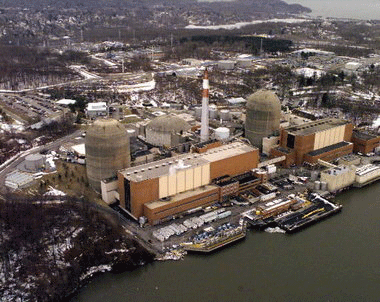
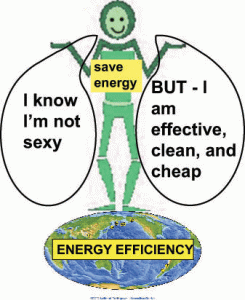 “Under aggressive but cost-effective and potentially attainable increases in energy efficiency beyond the levels assumed in the Clean Energy Standard, all of the consumption otherwise met with IPEC (Indian Point Energy Center) station output could be met by more efficient energy use alone by 2023…”
The report estimates that aggressive energy efficiency programs could produce savings equal to twice the power generated by the Indian Point plant. A New York Times piece by Patrick McGeehan discusses the report’s analysis of energy efficiency programs in Connecticut and Rhode Island; these two states provide incentives for the adoption of energy efficiency measures and are able to produce energy savings of about 3% a year.
Ultimately, we will need renewable energy to power our entire energy system, but in the short run, we waste so much energy that efficiency can be used to meet our energy needs without using nuclear power. …..
Using energy efficiency to replace nuclear power, as proposed by NRDC and Riverkeeper, is an elegant solution to a difficult problem. New York’s Public Service Commission should work harder to incentivize energy efficiency. Utilities should make more profit when they deliver on efficiency goals. Con Ed should make more money when they sell less electricity. Homeowners should receive tax credits for demonstrating reductions in energy use. Energy audits and the capital costs of retrofits should be provided at a discount. Businesses should receive free consulting services from utilities and the state on how to incorporate energy efficiency practices into routine organizational management. The goal is to grow the economy without building new power plants—to maintain, and even improve, our standard of living while reducing our use of energy.
The idea to replace nuclear power with energy efficiency was not invented in New York. Typical of many new energy and environmental programs, it began in California. In June 2016, Pacific Gas and Electric announced an agreement it had reached with labor unions and environmental groups to close the Diablo Canyon nuclear power plant by 2025 and replace it with energy efficiency and renewable energy. Writing in Scientific American, Debra Kahn reported that: “Environmentalists said other states could use the agreement as a template to replace other nuclear and fossil-fueled plants with renewables, especially distributed solar, in order to fight climate change.”
Renewables still require new technology to displace other sources of energy, but energy efficiency is here right now. Energy efficiency is an important source of energy because of the casual way we have treated the use of energy in the past. Energy is a central resource needed in nearly every aspect of modern life. Appliances such as refrigerators, air conditioners, heaters, vehicles, computers, smartphones, radios, cable boxes, televisions, stoves and coffee makers all require energy. In many cases these appliances have been built to ensure reliable performance, but until the past decade or two, efforts to deliver that performance did not focus on delivery with the least possible energy use. Once engineers turned their attention to energy efficiency they found they could produce new appliances that worked just as well as the old but required much less energy. Similarly, architects and real estate developers started to design structures and HVAC (heating, ventilation and air conditioning) systems that used less energy. Old structures could be retrofitted with better insulated windows, timers, and motion-sensitive lighting, along with LED light bulbs.
Industrial energy use in data farms and other locations provide large, new targets for energy efficiency. One of the chief advantages of energy efficiency is that it is difficult to argue against it. What is the counter-argument? Let’s waste as much energy as we can and spend lots of money on energy instead of saving it for better uses?
There are, however, obstacles to energy efficiency: capital costs, habit, inconvenience, risk due to reduced redundancy (eg. in information technology facilities), outmoded regulations, and so on. But there is undeniable momentum behind efficiency as a “source” of energy. It enables reductions in pollution and in the costs of energy without trading off any benefits…..
The contrast between these two states and the Trump Administration could not be sharper. California and New York are trying to make the transition to a renewable energy future. The Trump folks are trying to piece together the pipelines, oil rigs, and coal mines of our energy present and past. I, for one, am betting on the future.http://www.huffingtonpost.com/entry/replacing-the-indian-point-nuclear-power-plant-with_us_58b9e13de4b02eac8876ce6f
March 8, 2017
Posted by Christina Macpherson |
ENERGY, USA |
Leave a comment
 Tesla will begin selling its solar roof this year — here’s everything you need to know [excellent pictures] Business Insider DANIELLE MUOIO FEB 27, 2017, Tesla will begin selling and installing its solar roof later this year, the company wrote in its fourth-quarter investor letter.
March 6, 2017
Posted by Christina Macpherson |
decentralised, USA |
Leave a comment
 Electric Cars are the Missing Link to a Zero Carbon Energy Grid, Skeptical Science 2 March 2017 by Ryan Logtenberg, (good graphs) Since the start of the industrial revolution, humans have released hundreds of billions of tons of greenhouse gases into our atmosphere, acidifying oceans, increasing the frequency of extreme weather events, raising sea levels with the worst effects yet to come. The general consensus gleaned from the Paris Climate Summit in 2015 is that in order to halt the relentless march of climate change and its forecasted catastrophic consequences, one step we need to take is to transform our fossil fuel based economy to one powered by zero-emission renewable energy.
The good news is that investments in solar and wind generation have become competitive and in many cases cheaper and more profitable than similar investments in fossil fuels. The graphs below shows how solar and wind installations in the US have beaten fossil fuel installations for the past 3 years.
Globally, the conversation has shifted from “can renewables compete with fossil fuels?” to “how much intermittent renewable energy can our power grid handle?” Currently power grids rely on a steady and predictable stream of power generation. They can handle only so much of the fluctuation that comes from solar (surges during the day) and wind (surges when it’s windy).
The investment required in energy storage facilities to fulfill the needs of a 100% renewable energy grid is typically believed to be very high. Essentially millions of large industrial-scale batteries or creative energy storage solutions are needed to smooth out the surges. But what is often forgotten is that a creative solution is currently being built at an accelerating rate, in the form of vehicle batteries from the budding electric transportation system. Electric vehicles will herald in a new age of clean air on busy city streets, but they can also serve a secondary purpose of solving the energy storage issue of renewables.
Mass adoption of electric vehicles is coming. Many of the drawbacks of electric vehicles are quickly being addressed: From inexpensive vehicles with 200-335 miles of range, to the rapid expansion of ultra fast charging stations that can charge vehicles to 80% in 15 minutes or less. Several countries in Europe now see zero emission vehicles as the logical solution to addressing air pollution and are looking to implement bans on new fossil-fuel powered vehicles as early as 2025. Some major cities are even going a step further and will be banning all diesel powered vehicles from their cities. Clearly, the age of the fossil fuelled powered vehicle is quickly coming to an end. But, how big of an impact can an electrified transportation sector have in creating a green energy grid? Well let’s look at the numbers:……….
An Intensive peer reviewed study titled “Cost-minimized combinations of wind power, solar power and electrochemical storage, powering the grid up to 99.9% of the time” evaluated billions of 100% renewable energy grid scenarios using 4 years of real weather and grid load data. They concluded that with 15kWh set aside from each electric car for grid energy storage a 100% renewable energy grid could power 90%-99.9% of hours entirely on renewable electricity, at costs comparable to today’s prices. Something to note is that the study was done in 2013 before the second generation of electric vehicles like the Chevy Bolt, Tesla 3 and other large battery, mass market vehicles were introduced to the public. Using 45 kWh for battery storage from a Chevy Bolt instead of 15kWh that was used in the study would increase total storage capacity by 300% making it a whole lot easier and cheaper to run America’s grid on renewables.
V2G integration into our zero carbon energy grid makes sense because it eliminates the needs for investing in expensive energy storage since the vehicles we will be driving could already provide that service. It also allows a vehicle owner that participates in V2G services to generate revenue from their vehicle while they sleep…….
As the same factors hold true for electric vehicles, don’t be surprised when you see a substantial reduction in total US greenhouse gas emissions from a zero carbon energy and transportation sector occurring sooner than you think. You can help accelerate this transition by making a pledge that your next vehicle will be electric. https://www.skepticalscience.com/Electric_Cars_are_the_Missing_Link_to_a_Zero_Carbon_Energy_Grid.html
March 4, 2017
Posted by Christina Macpherson |
climate change, ENERGY, USA |
Leave a comment
 Green groups: Indian Point nuke can be replaced with carbon-free resources, Utility Dive, Robert Walton, 28 Feb 17
Dive Brief:
- Increased energy efficiency and transmission upgrades to bring in more renewable power can help replace a nuclear plant north of New York City, according to a new report released by two environmental groups.
- New analysis performed by Synapse Energy Economics shows that lower demand and more solar and wind energy can help the state replace the power from the Indian Point nuclear facility with clean energy options that will not raise consumer bills.
- Under an agreement between the state and plant operator Entergy, the Indian Point nuclear facility will shut down by 2021.
Dive Insight:Last month’s announcement that Entergy would shut down its Indian Point plant was a win for nuclear opponents, who for years have been wary of a plant within 30 miles of the nation’s largest metropolitan area.
The news, however, left open the question of how to continue to power the the city without turning to fossil fuels.
Now, green groups say they believe the city that never sleeps can keep the lights on — all night and every day — using only carbon.
New research from Synapse Energy, released by the Natural Resources Defense Council and Riverkeeper, finds additional solar and wind power, along with energy efficiency gains, can power the city. But that goal also depends on the construction of the Champlain Hudson Express transmission line, which would move 1,000 MW of hydropower from Quebec to the city.
“Recent transmission improvements — coupled with energy efficiency gains, cheaper renewables and lower demand estimates — show that New York is already on its way to a reliable, affordable, clean energy future,” Riverkeeper President Paul Gallay said in a statement.
He said the report shows that when Indian Point closes in 2021, “that power can be replaced entirely with clean sources as long as we take advantage of the additional renewable energy and efficiency options available to us.”
Key findings in the report show the Indian Point retirement will add less than 1% to overall wholesale electric system costs, and retail impacts will be even smaller. The state’s 50% renewables goal is expected to drive the addition of both utility-scale and distributed solar, as well as both offshore and traditional wind generation……. http://www.utilitydive.com/news/green-groups-indian-point-nuke-can-be-replaced-with-other-carbon-free-reso/436938/
March 1, 2017
Posted by Christina Macpherson |
renewable, USA |
Leave a comment

 California introduces its own 100% renewable energy bill, Inhabitat, 22 Feb 17, VIEW SLIDESHOW Massachusetts recently introduced a bill to derive 100 percent of the state’s energy from renewables, and now California is following suit. A new bill introduced by state Senate leader Kevin de León would require the state to obtain 100 percent of its electricity from renewable sources by 2045.
Under de León’s bill, SB 584, California would need to reach 50 percent renewable energy use by 2025, five years earlier than the state’s current target of 2030, and cease using fossil fuels completely by 2045.
Related: Massachusetts lawmakers sponsor 100% renewable energy bill
In 2016, the state obtained 27 percent of electricity via wind, solar, and other clean sources, and California’s deserts offer potential spaces for more renewable energy plants. The solar industry has created 100,000 jobs in California. Experts say the state could reach the 100 percent goal since costs for solar and wind power are falling – in many areas of the state solar is already the cheapest option, according to The Desert Sun………
Massachusetts recently introduced a similar bill, but it’s slightly more ambitious than California’s. Under the 100 Percent Renewable Energy Act, Massachusetts would transition to obtaining all their electricity from renewable energy by 2035, and would grant sectors like heating and transportation a 2050 deadline. The California bill gives its state’s electricity sector an extra ten years to reach that 100 percent target. http://inhabitat.com/california-introduces-its-own-100-renewable-energy-bill/
March 1, 2017
Posted by Christina Macpherson |
renewable, USA |
Leave a comment
Energy Innovation utilized the
Energy Policy Simulator (EPS) to analyze the effects of repealing the CPP. The EPS is an open-source computer model developed to estimate the economic and emissions effects of various combinations of energy and environmental policies using non-partisan, published data from the U.S. Energy Information Administration (EIA), U.S. EPA, Argonne National Laboratory, U.S. Forest Service, and U.S. Bureau of Transportation Statistics, among others. The EPS has been peer reviewed by experts at MIT, Stanford University, Argonne National Laboratory, Berkeley National Laboratory and the National Renewable Energy Laboratory. It is
freely available for public use through a user-friendly web interface or by downloading the full model and input dataset.
Our analysis compared a business-as-usual (BAU) scenario (based on existing policies as of mid-to-late 2016, not including the Clean Power Plan) to a scenario that includes a set of policies that narrowly achieve the Clean Power Plan’s mass-based emissions targets. Three important notes:
- First, the EPS works at national scale, so policies are represented as nationwide averages; that is, without individually modeling U.S. states.
- Second, a variety of different policies might be used to achieve the CPP targets. We analyzed a mixed package representative of how the EPA expects states to achieve their targets.
- Third, the EPS calculates results through 2050, but the CPP targets only extend through 2030. The policy package we use to represent the CPP includes continued policy improvement through 2050 at the same rate as in earlier years (that is, policies strengthen by the same amount each year from 2017 to 2050), rather than CPP policies becoming frozen at their 2030 levels.
We find that repealing the CPP would result in an increase of carbon dioxide equivalent (CO2e) emissions of more than 500 million metric tons (MMT) in 2030 and 1200 MMT in 2050, contributing to global warming and severe weather events, such as hurricanes, floods and droughts.
Nearly $600 Billion in Economy-Wide Costs
Cumulative net costs to the U.S. economy (in increased capital, fuel, and operations and maintenance (O&M) expenditures) would exceed $100 billion by 2030 and would reach nearly $600 billion by 2050.
It may seem ironic that removing regulations can result in increased costs to the economy, but regulations can help to overcome market barriers and similar problems that prevent certain economically-ideal outcomes from being achieved in a free market (for instance, under-investment in energy efficiency technologies).
120,000 New Premature Deaths
Although the CPP’s focus is on reducing carbon emissions, the same policies also reduce particulate pollution, which is responsible for thousands of heart attacks and respiratory diseases each year. Repealing the CPP would increase particulate emissions, causing more than 40,000 premature deaths in 2030 and more than 120,000 premature deaths in 2050.
Far More New Coal Capacity, Far Less New Renewables Capacity
Without the CPP, the U.S. electric grid would feature a larger capacity of coal power plants, while the capacity of wind and solar on the system would be smaller, as shown in the following table. [on original]
This finding is echoed by a new forecast from the U.S. Energy Information Administration, which predicts that without CPP implementation, coal will become America’s leading source of electricity generation by 2019.
This slow-down in the transition to clean energy would cost the U.S. technological leadership in the rapidly-growing solar and wind industries and would cost the U.S. many jobs. Even today, when wind makes up 6.6 percent and solar 1.8 percent of total U.S. installed capacity, the solar industry employs 374,000 people and wind industry 101,000 workers, roughly two and a half times the 187,000 combined workers in the coal, natural gas and oil industries.
The stellar contribution of renewables to the U.S. economy was recently highlighted as
an “American success story” by a group of 20 Republican and Democratic governors who urged Trump to support renewables.
Clean Power Plan Repeal A Terrible Mistake For America
Repealing the Clean Power Plan would be a terrible mistake. A repeal would increase costs to the U.S. economy by hundreds of billions of dollars, cut years off the lives of tens of thousands of Americans and sacrifice U.S. technological leadership and job creation. For the future prosperity and strength of the country, the CPP should be preserved, and its targets should continue to strengthen through 2050 and beyond.
February 27, 2017
Posted by Christina Macpherson |
business and costs, health, renewable, USA |
Leave a comment
7,000 Railways Stations In India To Go Solar https://cleantechnica.com/2017/02/21/7000-railways-stations-india-go-solar/ February 21st, 2017 by Saurabh Mahapatra Almost every railway station in India will soon be fed with solar power if the plans announced in India’s latest union budget are implemented.

The Indian Finance Minister Arun Jaitley announced that the 7,000 railway stations across the country will be fed with solar power as per the Indian Railways mission to implement 1,000 megawatts of solar power capacity. The minister made the announcement during the union budget speech on 1 February 2017.
The minister stated that work to set up rooftop solar power systems at 300 stations has already started, and soon this number will increase to 2,000 stations. According to data released by the Minister of Railways, India had 7,137 railway stations at the end of March 2015.
These rooftop solar power systems are expected to be implemented through developer mode, wherein the project developer will sign long-term power purchase agreement with Indian Railways.
In addition to rooftop solar power systems, the Indian Railways is expected to set up large-scale projects as well. Last year, it announced plans to launch a tender for 150 megawatts (MW) of rooftop systems. Late last year, it announced a partnership with the United Nations Development Programme (UNDP) to set up 5 gigawatts of solar power capacity.
The Indian Railways has managed to identify the solar power resource in two states so far — Gujarat and Rajasthan — where 25 MW of rooftop and 50 MW of ground-mounted capacity is to be commissioned in the first phase of the program. In the second phase, 60 MW of rooftop and 660 MW of ground-mounted capacity will be installed in nine other states. During the third phase, 400 MW of rooftop and 3,800 MW of ground-mounted capacity will be installed in the rest of the country.
February 25, 2017
Posted by Christina Macpherson |
decentralised, India |
Leave a comment
This non-toxic battery lasts a decade, could be renewable energy’s missing piece Anthropocene, by Prachi Patel | Feb 23, 2017 “……Researchers at Harvard University have developed a new kind of low-cost battery that can run for more than 10 years with no maintenance. It is also non-toxic and inexpensive, to boot. The technology could make grid-scale renewable energy storage a reality, the researchers say in a paper published in the journal ACS Energy Letters…….
The new battery should be cheaper to produce than today’s devices. “And since the medium is noncorrosive, you can use cheaper materials to build the components of the batteries, like the tanks and pumps,” Gordon said in a
press release.
February 25, 2017
Posted by Christina Macpherson |
energy storage, USA |
Leave a comment
 Karachi is unsafe with nuclear, solar better Pervez Hoodbhoy, Pakistan’s most renowned nuclear physicist, discusses the prospects of solar power, Chinese nuclear reactors and hopes and fears he has for Pakistan’s energy future., Eco Business, By Zofeen T. Ebrahim, 20 Feb 17, “………More nuclear plants don’t make economic sense to me. We are going for nuclear electricity because the Chinese badly want to sell their reactors to Pakistan – we are China’s only customer for nuclear power plants. China has loaned Pakistan 80 per cent of the amount needed for the Karachi Nuclear Power Plants (KANUPP)…..
After the tsunami initiated disaster at the plants in Fukushima, it became clear that having nuclear plants near any city was a bad idea. If something ever goes wrong with KANUPP, what will happen to Karachi defies the imagination. Fukushima was a small town of 80,000 disciplined people.
Karachi has 22 million people most of whom feel no twinge when going through a red light. Evacuating them in any disciplined manner would be impossible. And evacuate to where? A catastrophic disaster doesn’t have to be caused by a tsunami – an act of terrorism, sabotage, earthquakes, or operator error (as happened at Chernobyl in 1986) could all take us down that path…….
The global nuclear industry obviously aims to make safer reactors. But the problem is that no one can foresee all the ways in which things could go wrong. The fuel contained in a typical reactor core has more than a thousand atom bombs’ worth of fissile material.
And, even though a reactor cannot blow up in the same way as a bomb, it can release thousands of times more radioactivity than was released by the bomb explosions over Hiroshima and Nagasaki. As far as our options go, Pakistan does not make nuclear power reactors. These are beyond our technological capability. Making bombs is far easier and obviously we are making lots of them……
Climate change can be better fought by concentrating on solar and wind power, making more efficient electricity grids, and by cutting down on wastage. Also, if one looks into the carbon cost of making nuclear plants, the savings due to cheap nuclear fuel are much less.
How about if we use thorium fission reactors, or is this still an academic discussion?
PH: India has been planning on doing this for 40 years. There’s still no electricity being produced by thorium fuelled reactors. In any case, it’s not an option for Pakistan because we don’t have thorium deposits and do not have the capacity to make our own nuclear power plants. http://www.eco-business.com/news/karachi-is-unsafe-with-nuclear-solar-better/
February 22, 2017
Posted by Christina Macpherson |
Pakistan, renewable |
Leave a comment
China’s solar power capacity more than doubles in 2016 http://www.reuters.com/article/us-china-solar-idUSKBN15J0G7, 4 Feb 17, China’s installed photovoltaic (PV) capacity more than doubled last year, turning the country into the world’s biggest producer of solar energy by capacity, the National Energy Administration (NEA) said on Saturday.
Installed PV capacity rose to 77.42 gigawatts at the end of 2016, with the addition of 34.54 gigawatts over the course of the year, data from the energy agency showed.
Shandong, Xinjiang, Henan were among the provinces that saw the most capacity increase, while Xinjiang, Gansu, Qinghai and Inner Mongolia had the greatest overall capacity at the end of last year, according to the data.
China will add more than 110 gigawatts of capacity in the 2016-2020 period, according to the NEA’s solar power development plan.
Solar plants generated 66.2 billion kilowatt-hours of power last year, accounting for 1 percent of China’s total power generation, the NEA said.
The country aims to boost the mix of non-fossil fuel generated power to 20 percent by 2030 from 11 percent today.
China plans to plough 2.5 trillion yuan ($364 billion) into renewable power generation by 2020.
(Reporting by Ryan Woo; Editing by Helen Popper)
February 6, 2017
Posted by Christina Macpherson |
India, renewable |
Leave a comment
 Trump Is Foolish to Ignore the Flourishing Renewable Energy Sector http://www.truth-out.org/opinion/item/39306-trump-is-foolish-to-ignore-the-flourishing-renewable-energy-sector Sunday, February 05, 2017By Linda Pentz Gunter, Truthout | Op-Ed President Donald Trump claims to be focused on providing “jobs for all Americans,” but — in another example of his reliance on “alternative facts” — he has emphasized the fossil-fuel sector as the likeliest site to create those jobs. He is clearly not paying attention to the recently released figures from the US Department of Energy (DOE) that show soaring jobs growth in the US renewable energy sector.
Indeed, as Tomás Carbonell of Environmental Defense Fund wrote in December 2016, the clean energy sector “currently supports hundreds of thousands of manufacturing and construction jobs around the country, and employs far more people than the coal or oil and gas industries.”
Solar, already far outpacing fossil fuels and nuclear energy, jumped from 300,192 US jobs in 2015 to 373,807 in 2016. The industry anticipates further such growth in 2017. The wind energy sector, while smaller in actual job numbers at 101,738, nevertheless experienced even faster growth than solar, increasing by 32 percent over 2015 numbers.
According to the International Renewable Energy Agency’s 2016 Annual Review of Renewable Energy and Jobs, employment in the US solar industry “grew 12 times as fast as overall job creation in the US economy, and surpassed those in oil and gas extraction (187,200) or coal mining (67,929).”
The United States has been steadily increasing its investment in renewable energy, according to figures in the 2016 World Nuclear Industry Status Report, which compares the nuclear and renewable energy sectors in terms of growth, installed capacity, electricity generation and general trends. However, the US — while second in the world with $44.1 billion invested in renewable energy development in 2015 — still lags far behind China, which invested $102.9 billion that same year.
The US electricity sector is likely to see further shifts in employment as the country’s aging and perpetually more dangerous nuclear fleet continues to close in a declining industry that currently employs around 68,000. However, fears that a nuclear shutdown would boost fossil fuel use have proven unfounded. Nebraska and California have announced they will replace their shuttered or imminently closing nuclear plants with solar power, wind power and energy efficiency.
In New York, after announcing the planned shutdown of the Indian Point nuclear power plant by 2021, Gov. Andrew Cuomo released plans to build the nation’s largest offshore wind energy project off the Long Island coast.
Frustratingly, Cuomo also announced a $7.6 billion state subsidy to prop up three upstate nuclear power plants. One, the James A. FitzPatrick Nuclear Power Plant, is the same design as those that melted down in Japan. Even its owner, Entergy, which is selling the reactor to Exelon, wanted to close it. The state handout will make every nuclear job at the three plants — FitzPatrick, Nine Mile Point and Ginna — worth around $300,000 a year. Re-directing this money into the renewables sector would have created more, longer-term and safer jobs for the economically depressed region.
Globally, wind and solar are on a dramatic upward trajectory, while nuclear energy has been fundamentally flat lining since the start of the 21st century. A reduction, and eventual elimination of fossil fuel use is, of course, essential if the planet is to survive.
Sustainable new US jobs will not be created by building pipelines, sending working people back down collapsing coal mines or sending workers out to incendiary offshore oil rigs. If the Trump administration were serious about job growth, it would focus on renewable energy investment rather than make hollow promises to revive mining in declining communities where coal was once king.
February 6, 2017
Posted by Christina Macpherson |
politics, renewable, USA |
Leave a comment
 Not just Toshiba – the global nuclear industry is in crisis everywhere, Ecologist, Jim Green 3rd February 2017 “……..Global nuclear power
  capacity increased by 9.2 gigawatts (GW) in 2016. By contrast, renewable electricity capacity growth was 153 GW in 2015 and almost certainly greater in 2016.
In broad terms, nuclear power has been stagnant for the past 20 years. Using figures from the World Nuclear Association (WNA) and the International Atomic Energy Agency, global nuclear capacity has grown 12.7% over the past 20 years and 5.7% over the past decade. But those figures include idle reactors in Japan and the inclusion of those reactors is, as former WNA executive Steve Kidd states, “misleading” and “clearly ridiculous”.
The World Nuclear Industry Status Report (WNISR) excludes 34 idle reactors in Japan (and one each in Taiwan and Sweden) from its calculations of current nuclear capacity. Using WNISR figures, nuclear capacity has grown by 1.7% over the past 20 years and it has declined by 4.6% over the past decade.
| Year |
Global nuclear power capacity |
| Dec. 1996 |
347 GW |
| Dec. 2006 |
370 GW |
| Dec. 2016 |
391 GW (WNA – including reactors in long-term outage)
353 GW (WNISR – excluding reactors in long-term outage) |
If we look more closely at recent figures, the picture is a little confusing. Global nuclear power capacity increased “slightly” in 2016 according to the pro-nuclear WNA while the anti-nuclear WNISR said that a “significant” number of new reactors came online. If there’s some confusion now as to the trajectory of nuclear power, that confusion is likely to grow in the next few years.
To explain, let’s first look at WNA figures on reactor construction starts:
| Year |
Number of power reactors under construction |
| 2008 |
34 |
| 2011 |
63 |
| 2014 |
71 |
| 2017 |
60 |
The nuclear power ‘renaissance’ never materialised in the since that the number of ‘operable’ reactors has hovered between 430 and 450 for the past 20 years, with no clear trend in either direction. (The number of operating reactors is currently 406 according to the WNISR, which excludes reactors in long-term outage.).
But we can see the ‘renaissance’ manifest in the sharp increase in construction starts in the few years preceding the March 2011 Fukushima disaster. Those reactors are starting to come online, and more will come online in the next few years. Thus 10 reactors came online in both 2015 and 2016 (a number not previously reached since 1990). And the number of grid connections over the past five years (32 from 2012-2016) was considerably greater than during the five years before that (17 from 2007-2011).
How will this play out in the coming years? Here are predicted reactor start-up (grid connection) figures compiled by the WNA:
| Year |
Number of anticipated reactor start-ups |
| 2016 |
12 (but only 10 actual start-ups) |
| 2017 |
18 |
| 2018 |
10 |
| 2019 |
8 |
| 2020 |
7 |
We may have been premature in declaring the nuclear renaissance dead. Indeed we’re right in the middle of the renaissance. It will likely span around three years and it will be more a dead cat bounce than a renaissance. Last year, 10 reactors were grid connected and four were permanently shut down. In 2017-18, the WNA anticipates 28 grid connections; the true number will fall short of that figure but grid connections will exceed permanent shut-downs.
But that’s as good as it gets for the nuclear industry. In truth, the industry is in a world of pain.
The reactor fleet is ageing; most reactors are late middle-aged – the average age of the world’s nuclear reactor fleet is 29 years. The number of permanent shut-downs is on the rise and that trend is certain to continue:
Thus 6-10 reactors will need to be commissioned each year for the next 20-25 years just to maintain current nuclear capacity………..http://www.theecologist.org/News/news_analysis/2988607/not_just_toshiba_the_global_nuclear_industry_is_in_crisis_everywhere.html
February 4, 2017
Posted by Christina Macpherson |
2 WORLD, business and costs, ENERGY |
Leave a comment












 nuclear-news