 Independent 20th July 2017, The Government is planning to give some of the UK’s most polluting
industries a £130m exemption from helping to fund new renewable
technologies, which will “heap costs” onto small companies and households,
environmentalists have warned.
Subsidies for the two cheapest forms of green electricity, onshore wind and solar, have been respectively scrapped
and slashed to the bone, but financial support is still available for
offshore wind and other emerging technologies – to a large degree because
of the potential benefits to the economy.
This is funded by electricity bill payers and the Government has expressed concern about the effect on
“energy intensive industries”. According to the new plan, these companies
would be given an exemption because having to pay extra “can undermine
competitiveness”.
However Gareth Redmond-King, head of climate and energy
policy at WWF-UK, pointed out that this “disappointing decision” would mean
other bill payers would end up paying more and reward firms that are
contributing more than most to global warming.
http://www.independent.co.uk/environment/uk-energy-intensive-pollution-companies-climate-change-fund-exemption-targets-regulation-global-a7851331.html
July 22, 2017
Posted by Christina Macpherson |
politics, renewable, UK |
Leave a comment
Edie 20th July 2017, Businesses that invest in decentralised energy systems can enjoy the triple benefit of economic value, security of supply and “telling a good story”, the new chief executive of community energy supplier Mongoose Energy has told edie. In his previous role as head of international NGO the Climate Group, Mark Kenber led the RE100 scheme which gets firms to source 100% renewable electricity.
It was revealed by edie earlier this month that the initiative was targeting 500 members by 2020 after passing the 100-member milestone. Kenber, who took the reins at Wiltshire-based Mongoose Energy in April, welcomed the growing number of businesses recognising the financial benefits of sourcing renewable energy.
He cited Power Purchase Agreements (PPAs) with local suppliers as one of the increasingly popular methods for
companies to meet renewable energy targets, and also improve CSR credentials. “Businesses sign up to RE100 for broadly financial reasons, they know the economics stack up,” Kenber said. “And if you can get a lot of CSR benefit from it, with a local store buying from the localcommunity, it’s a really good story. A lot of them are looking at that. Now
you can get competitive prices which work for both partners.
https://www.edie.net/news/6/Mark-Kenber–Localised-energy-will-revolutionise-the-way-businesses-source-power—/
July 22, 2017
Posted by Christina Macpherson |
decentralised, UK |
Leave a comment
 Politico 18th July 2017, Negotiations over Britain’s exit from the EU got underway in earnest this
week, but that doesn’t mean that the U.K. is withdrawing from other EU
business. Far from it. It has emerged that British ministers and officials
lobbied hard against a European Commission plan on energy efficiency, even
though the rules might never apply to the U.K.
Assuming it leaves the EU as planned in March 2019. Britain opposed a compromise deal on future EU
energy efficiency rules during a long and difficult meeting of EU energy
ministers last month, pushing the Commission to water down its proposals.
Richard Harrington, a junior minister at the U.K.’s Department for
Business, Energy and Industrial Strategy, told the Energy Council meeting
in June that the U.K. was “disappointed” with Brussels’ proposal to
boost the target to 30 percent.
He said the British government “cannot support” the proposed compromise on energy efficiency because “we do
not believe it strikes the right balance to provide sufficient flexibility to reach our ambitions.”
The energy efficiency rules are part of a wider package of proposals meant to accelerate the EU’s transition to clean
energy, and while the European Commission is pushing for an inter-institutional deal on all eight parts of the package by the end of 2018, officials doubt that is realistic.
The move to block strong energy efficiency rules is creating “a lot of bad feelings” among other EU
countries, especially since Britain “will need all the friends it can
get” after Brexit, said Jonathan Gaventa, director at think tank E3G. http://www.politico.eu/article/brexit-uk-fights-energy-plans-that-wont-kick-in-until-after-brexit/amp/
July 22, 2017
Posted by Christina Macpherson |
ENERGY, politics international, UK |
Leave a comment
German nuclear damage shows atomic and renewable power are unhappy bedfellows, Euractiv, By Dagmar Dehmer | Der Tagesspiegel | translated by Sam Morgan 20 July 17 A Germany nuclear plant was damaged because its operators increased and decreased its output to respond to energy grid fluctuations. The incident supports the theory that nuclear and renewable energy generation are incompatible. EURACTIV’s partner Der Tagesspiegel reports.
The Brokdorf nuclear power station, located in northern Germany, was taken offline in February after maintenance showed its reactor’s fuel rods had begun to unexpectedly oxidise.
A regional nuclear supervisory body has now ruled that the plant can be booted back up but only in “safe mode”, according to Schleswig-Holstein’s energy transition minister.
State Minister for Energy Robert Habeck (Greens) added that the power plant’s output should not be increased or decreased at short notice to adapt to the supply of renewable energies on the electricity grid. The minister warned that “atomic energy is not a bridging technology”.
A 2011 study by Greenpeace also concluded that renewables and nuclear are not compatible and that fuel rod damage is a possible consequence.
Kiel’s nuclear supervisory authority explained that the corrosion of Brokdorf’s fuel rods was a result of the reactor’s capacity being increased from 1,440 MW to 1,480 MW in 2006.
The investigation also concluded that the decision to run the plant as a load-following power station, where output was tailored to grid fluctuations, contributed to the damage.
“According to our findings, this stress has contributed to the unexpected oxidisation of the upper parts of some of the fuel rods,” Habeck explained.
The practice of quickly increasing or decreasing electricity generation to compensate for excessive or reduced renewable output has been particularly prevalent since 2015…….
The German Greens’ nuclear policy spokesperson, Sylvia Kotting-Uhl, warned that Berlin’s environment ministry should share the findings from Brokdorf with the Swiss nuclear authority.
Switzerland’s Leibstadt facility is located on the German border and reportedly has the same problems as its northern German cousin. Kotting-Uhl accused Bern of “closing its eyes and leaving Leibstadt on, even though the problems are not solved”.
The German lawmaker insisted that the Swiss power plant is temporarily switched off “until complete clarity prevails”…..https://www.euractiv.com/section/electricity/news/german-nuclear-damage-shows-atomic-and-renewable-power-are-unhappy-bedfellows/
July 21, 2017
Posted by Christina Macpherson |
Germany, renewable |
Leave a comment
 Coal, nuclear and renewable bombshells from Trump’s grid study, REneweconomy, By Joe Romm on 18 July 2017, Think Progress On Saturday, we reported that a leaked draft of Energy Secretary Rick Perry’s grid study obtained by Bloomberg debunks his attack on renewable energy.
ThinkProgress has now obtained a copy of that draft, and it has many more surprises — or, rather, findings that are fairly well known to energy experts but may come as an unpleasant surprise to Perry and the White House.
For instance, a large fraction of America’s aging fleet of coal and nuclear plants are simply not economic to operate anymore.
The July draft, which ThinkProgress received from multiple sources, is
here, so the public will be able to compare the final “politically-approved” version with the draft prepared by Department of Energy (DOE) staff.
It is widely feared Perry’s team of Trump appointees will simply erase the the study’s inconvenient truths before it  finalreport is released to the public.
The release of the study has been delayed several weeks — and the findings in the draft might explain why.
The study was specifically requested to back up Perry’s claims that EPA regulations, along with renewable power sources like solar and wind power, were undermining the U.S. electric grid’s reliability by forcing the premature closure of “baseload” (24–7) power sources like coal and nuclear.
But the leaked July draft concludes the grid is as reliable than ever.
As for baseload plant retirements, factors like environmental regulations and renewable energy subsidies “played minor roles compared to the long-standing drop in electricity demand relative to previous expectation and years of low electric prices driven by high natural gas availability.”
The draft report finds that since 2002, “most baseload power plant retirements have been the victims of overcapacity and relatively high operating cost but often reflect the advanced age of the retiring plants.”
Overcapacity is a major cause of the turmoil in electricity markets. The report explains that because the grown in electricity demand has flattened since 2008, it is harder for “less competitive plants” to survive………
since renewables keep dropping in price, we can expect more and more penetration.
It’s really no surprise that DOE staff would conclude renewables are not threatening grid reliability. After all, many countries around the world, such as Germany, have integrated far higher percentages of solar and wind than we have, while maintaining high reliability.
The only surprise remaining is how many of these findings Trump’s political appointees will erase. http://reneweconomy.com.au/coal-nuclear-renewable-bombshells-trumps-grid-study-42788/
July 19, 2017
Posted by Christina Macpherson |
renewable, USA |
Leave a comment
 Times 15th July 2017, Hackers backed by the Russian government have attacked energy networks
running the national grid in parts of the UK, The Times has learnt. The
hackers, who targeted the Republic of Ireland’s energy sector, intended
to infiltrate control systems, security analysts believe.
This would also have given them the power to knock out parts of the grid in Northern
Ireland. Senior engineers at Ireland’s Electricity Supply Board (ESB)
were targeted last month by a group understood to have ties to the
Kremlin’s GRU intelligence agency.
The hackers sent emails designed to trick staff by drawing on extensive surveillance of ESB practices and
contained malicious software. There is no evidence of disruption to the
network, but security analysts monitoring Russia’s cyberintelligence
groups said that the hackers probably stole information including
passwords. Ireland’s National Cyber Security Centre confirmed that it was
working on the matter. https://www.thetimes.co.uk/article/russia-backed-hackers-try-to-hijack-britain-s-power-supply-55bj9790r
July 19, 2017
Posted by Christina Macpherson |
ENERGY, secrets,lies and civil liberties, UK |
Leave a comment
Modern Power Systems 13th July 2017,Engie has entered the UK’s offshore wind energy market with a deal to buy
a 23 per cent stake in the Moray East project in Scotland. The French
energy giant has purchased the stake from EDP Renewables (EDPR) for £21
million and will participate in the development and operation of the 1.1 GW
project.
EDPR and Engie are already partnering in the development of
offshore wind energy projects in France and Portugal, including floating
offshore wind projects. The Moray East project comprises three proposed
offshore wind farms located off the Caithness coast. The projects were
granted development consent in March 2014 and are expected to participate
in the UK’s CFD tender process. http://www.modernpowersystems.com/news/newsengie-buys-into-uk-offshore-wind-5870459
July 17, 2017
Posted by Christina Macpherson |
France, renewable, UK |
Leave a comment
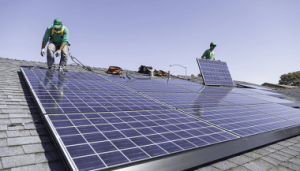 Consumers could drive UK solar capacity as high as 44GW by 2050: National Grid, Solar Power Portal, 13 Jul 17 The UK’s solar capacity could soar to as much as 44GW by 2050 if consumers take command of their own power supply, National Grid has forecasted.
The UK’s transmission system operator today unveils its Future Energy Scenarios, charting how it considers the UK’s power market might evolve from now until both 2025 and 2050.
Using various models and insight, National Grid has compiled four principal scenarios of varying levels of ambition, dubbed ‘Steady State’, ‘Slow Progression’, ‘Consumer Power’ and ‘Two Degrees’.
Its most pessimistic scenario Steady State, a word in which security of supply takes precedence and short-term policies are pursued, the UK’s solar capacity will grow to 14.33GW by 2025, an increase of less than 2GW on current levels. Solar capacity will also decrease by 2050 as PV generators are not renewed past their current operational life.
However the most ambitious scenario for renewables deployment – ‘Consumer Power’ – expects the majority of UK consumers to become ‘prosumers’ and generate their own power. This will see 23.53GW of solar deployed by 2025 and 44.15GW – a near quadrupling of current levels – by 2050……..
National Grid has already been quick to highlight the consequences that record levels of solar generation have had on the grid. Earlier this year afternoon demand dipped below that of the night before for the first time in the UK, while solar generation records have been broken already this summer.
The operator said today that this was yet more evidence of the burgeoning evolution in the power market. “Last year I said that we were in the midst of an energy revolution, and this year it is even more evident,” Marcus Stewart, head of energy insights at National Grid, wrote in the document’s foreword, adding that cost reductions in solar and storage had already “driven major change in a short space of time”.
Emma Pinchbeck, executive director at RenewableUK, said: “This year’s report recognises that renewables have transformed our energy system, disrupting the status quo and displacing fossil fuels extraordinarily fast – and that this trajectory is set to continue, with the rapid development of energy storage.” https://www.solarpowerportal.co.uk/news/consumers_could_drive_uk_solar_capacity_as_high_as_44gw_by_2050_national_g
July 15, 2017
Posted by Christina Macpherson |
decentralised, UK |
Leave a comment
Renewable power critic is chosen to head energy price review, Government’s preferred choice of Oxford economist Dieter Helm is controversial owing to criticism of wind and solar power, Guardian, Adam Vaughan and Nick Hopkins, 13 Jul 17, An academic who is a vocal critic of the price of renewable power is the government’s preferred choice to head a review of the financial cost of energy in the UK.
Dieter Helm, an economist at the University of Oxford, has been chosen by the Department for Business, Energy and Industrial Strategy (BEIS) to carry out the review, the Guardian has learned.
The Conservative manifesto promised that the resulting report would be the first step towards “competitive and affordable energy costs”…..
Hannah Martin, head of energy at Greenpeace UK, said: “Dieter has a well-known preference for gas and has historically failed to grasp the full potential of renewables.
“At a time when the costs of offshore wind and solar are plummeting this review needs somebody with the vision to grasp the opportunities offered by clean energy to provide jobs, lower bills and slash carbon pollution.”
Other figures believed to have been in the frame for the job included Lord Turner, the former chair of a government advisory body, the Committee on Climate Change, who recently told the Guardian that Tory policy on onshore wind power was endangering cheap energy in the UK.
However, concerns that the review might be tilted against renewables could be allayed by Helm’s choice of colleagues to work on the report.Guardian
The Guardian understands that he will be aided by a former boss of the National Grid, Steve Holliday, who is a proponent of decentralised energy including batteries, and Richard Nourse of Greencoat Capital, an investment fund supporting clean energy.
Rounding out the proposed team would be Jim Gao, an engineer at an artificial intelligence company, Deepmind, owned by Google, which has been an enthusiastic supporter of renewables.
The review will look at all aspects of the energy industry and how they contribute to the cost of electricity, such as new technologies includingthe rollout of smart meters in millions of homes and the increasing number of electric cars drawing power from the grid………
Helm is also a strong critic of the cost of nuclear power, saying that just to get to the “starting line” of building a new atomic power station in the UK involves a “lengthy, complex and expensive process”.
He has also questioned whether any more new nuclear power plants will be built in the UK after Hinkley Point C in Somerset, which the public spending watchdog recently described as a “risky and expensive project”.
The new energy minister, Richard Harrington, has said the government is still committed to a new generation of nuclear power stations but Helm’s review could provide a justification for abandoning that ambition on cost grounds…… https://www.theguardian.com/environment/2017/jul/12/renewable-power-energy-costs-review-dieter-helm
July 15, 2017
Posted by Christina Macpherson |
ENERGY, UK |
Leave a comment
Business Green 13th July 2017, Hopes that the Scottish onshore wind industry could be revived over the
coming years received a major boost today with the news EDF Energy
Renewables has acquired 11 wind farm sites boasting the potential for up to
600MW of capacity. The company, which is a joint venture between EDF Energy
and EDF Energies Nouvelles, announced it had purchased the sites from
development specialist Partnership for Renewables. Financial details for
the deals were not disclosed. https://www.businessgreen.com/bg/news/3013757/edf-snaps-up-600mw-scottish-wind-farm-portfolio
July 15, 2017
Posted by Christina Macpherson |
renewable, UK |
Leave a comment
 Japan vows to ramp up efforts to export renewable energy technology, July 13, 2017 (Mainichi Japan), TOKYO (Kyodo) — Foreign Minister Fumio Kishida pledged Thursday that Japan will aggressively pursue the export of renewable energy technologies to tap into growth spurred via the worldwide transition to clean energy sources necessitated by the onset of climate change.
Emphasizing that energy demand will only grow in China and Southeast Asia, Kishida noted in a message read to a symposium hosted by the ministry in Tokyo that “Japan’s environmental technologies will greatly contribute to Asian nations’ (transition).”
Calling climate change a “common challenge worldwide,” Kishida noted that Japan is a signatory to the Paris Agreement, the global effort to reduce greenhouse gas emissions through member nations setting voluntary targets. The accord entered into force in November 2016.
In Fukushima, Japan is currently pursuing the production of hydrogen from renewable sources for use in fuel cells, part of a broader plan to help the prefecture rebuild from the March 2011 quake-tsunami disaster and nuclear accident.
“We will develop Japan’s state-of-the-art technologies in energy-poor countries and regions and contribute to the improvement of energy security,” Kishida added.
However, some analysts have voiced concern that Japan has lagged behind China and the United States in the production of renewable energy, with Prime Minister Shinzo Abe’s government preferring to restart nuclear reactors under pressure from the business sector……https://mainichi.jp/english/articles/20170713/p2g/00m/0bu/078000c
July 14, 2017
Posted by Christina Macpherson |
Japan, marketing, renewable |
Leave a comment
Guardian 13th July 2017,A dramatic growth in electric vehicles on Britain’s roads could see peak
electricity demand jump by more than the capacity of the Hinkley Point C
nuclear power station by 2030, according to National Grid.
The number of plug-in cars and vans could reach 9m by 2030, up from around 90,000 today,
said the company, which runs the UK’s national transmission networks for
electricity and gas.
The impact of charging so many cars’ batteries would
be to reverse the trend in recent years of falling electricity demand,
driven by energy efficiency measures such as better boilers.
National Gridacknowledged the cars’ batteries could also provide services andreturn
power for the grid at a time when managing the network is becoming
increasingly complex as variable sources of wind and solar power grow.
https://www.theguardian.com/business/2017/jul/13/electric-car-boom-power-demand-national-grid-hinkley-point-c
July 14, 2017
Posted by Christina Macpherson |
energy storage, UK |
Leave a comment
Chernobyl nuclear reactor slated for billion-pound solar park despite radiation fears
Chernobyl was the scene of the world’s worst nuclear accident in 1986, Independent, Fiona Keating, 10 July 17 Ukraine is in talks with one of France’s biggest energy businesses to construct a £969m solar facility at the derelict Chernobyl nuclear reactor plant and its surrounding area.
Ostap Semerak, Ukraine’s minister of ecology, said Engie is starting a pre-feasibility survey, bankrolled by the French government, next week. The results should be published by the end of the year.
“France’s experience in nuclear is one of the reasons that we wanted to work with them,” Mr Semerak told The Washington Post. “They approached us after we announced our intention to develop renewables in Chernobyl.” An Engie spokesman verified that the company is in consultation with the Ukrainian government but refused to reveal any further details on the project.
July 10, 2017
Posted by Christina Macpherson |
renewable, Ukraine |
Leave a comment
Historic First: Solar Plant Illuminates Syrian Refugee Camp, Vastly Improving Quality of Life, http://www.environews.tv/world-news/historic-1st-solar-plant-illuminates-syrian-refugee-camp-vastly-improving-quality-life/ (EnviroNews World News) by Julia Travers May 27, 2017 — Azraq, Jordan — The newly activated two-megawatt solar photovoltaic power plant at the Azraq refugee camp in Jordan is the first refugee camp in the world to be powered by a renewable energy facility. The plant started running May 17, 2017, and will provide free energy to about 20,000 of the 36,000 refugees in the area – all victims of the Syrian conflict, now in its seventh year.
There are close to 15 million refugees in the world, and the integration of free renewable energy into their stressful lives is invaluable. “Lighting up the camp is not only a symbolic achievement; it provides a safer environment for all camp residents, opens up [livelihood] opportunities, and gives children the chance to study after dark. Above all, it allows all residents of the camps to lead more dignified lives,” said United Nations High Commission for Refugees (UNHCR) Deputy High Commissioner, Kelly T. Clements.
“Before this, when we cooked a meal we had to throw the leftovers away because there was no safe way to store food. When we got too hot, we had to pour water on our clothes to keep cool. Now we can listen to music or have a cold glass of water, and daily life no longer ends when the sun sets,” Fatima, a 52-year-old from Damascus who lives in the camp with her two adult sons, told the UNHCR.
UNHCR partnered with the Government of Jordan, Jordanian solar company Mustakbal, and IKEA to build this camp. The IKEA Foundation is UNHCR’s largest private sector partner and fully funded the solar installation through their “#BrighterLives4Refugees” campaign. The endeavor raised $9.6 million for the cause by donating a portion of IKEA’s LED light sales in 2015.
20,000 of the individuals now living in the desert camp have had some access to non-renewable electricity since January 2017, and they now receive additional power from the sun. The new solar station is connected to Jordan’s grid and is intended to provide electricity to the remaining 16,000 refugees at Azraq by early 2018. The solar initiative will save UNHCR $1.5 million a year, which it can devote to other refugee services, while reducing annual CO2 emissions by roughly 2,370 tons.
The 500 new solar LED streetlights make the camp safer at night, which was especially concerning for women and girls, UNHCR relayed. Mustakbal also provided training and employment to over 50 refugees. “I wasn’t able to finish my education because of the war and then exile, but this has given me a practical skill that I can hopefully use in the future. If we return to Syria, the infrastructure is all destroyed, but this is a technology that we could use to rebuild,” said Mohammad, 20, who was forced to leave school at age 14.
July 10, 2017
Posted by Christina Macpherson |
climate change, Jordan, renewable |
Leave a comment
BBC 7th July 2017 An Australian state will install the world’s largest lithium ion battery in a “historic” deal with electric car firm Tesla and energy company Neoen. The battery will protect South Australia from the kind of energy crisis
which famously blacked out the state, Premier Jay Weatherill said.
Tesla boss Elon Musk confirmed a much-publicised promise to build it within 100 days, or do it for free. The 100-megawatt (129 megawatt hour) battery should be ready this year.

July 8, 2017
Posted by Christina Macpherson |
AUSTRALIA, energy storage |
Leave a comment











 nuclear-news