Offshore wind costs tumbled: now cheaper than energy from Hinkley Point nuclear power plant
The tumbling cost of offshore wind power could mean that it turns out to be
25 per cent cheaper than energy from Hinkley Point nuclear plant when
subsidies are awarded to new projects this year, the industry regulator has
suggested.
Developers behind a series of proposed offshore wind farms are
vying to secure government contracts that will guarantee a price for the
electricity they generate for 15 years. Dermot Nolan, chief executive of
Ofgem, said he hoped the winning projects would emerge at a price of “£70
or less” per megawatt-hour (MWh).
That would compare with £92.50/MWh that
was last year awarded to Hinkley Point for a 35-year contract, fuelling
debate about the merits of the project and future nuclear plants. The
difference between the guaranteed price and wholesale price, currently
£43/MWh, will be subsidised by consumers through energy bills, with
payouts for Hinkley forecast to hit £30 billion.
Just a few years agooffshore wind was one of the most expensive technologies in the market. In
2014 the government awarded some projects a price of £150/MWh.
Technological advances, including bigger, more efficient turbines,
economies of scale in manufacturing and the introduction of a competitive
“reverse auction” process to award subsidies to the cheapest projects have
helped to bring costs down rapidly.
Times 30th June 2017
Renewable energy generation in Scotland at record high, supports 26,000 jobs
The National 30th June 2017, RENEWABLE electricity generation in Scotland has reached a record high. A
new UK government report shows that generation was up by 13 per cent in the
first quarter of this year compared to the same period last year. There was
also a 16 per cent increase in capacity with more than half of all gross
electricity consumption in Scotland coming from renewables.
Scotland’s total installed renewable capacity – the amount of renewable electricity
the country is capable of producing – now stands at 9.3GW, which is four
times what it was just a decade ago.
The renewable electricity sector also supports 26,000 jobs and has a turnover of £5 billion which is set to grow
further as new capacity comes on stream. Acting director of WWF Scotland Dr
Sam Gardner said: “It’s fantastic news that Scotland’s renewable
electricity generation is at an all-time high and re-affirms the vital role
it plays in powering the country. The renewable electricity sector
continues to play a vital role at the heart of Scotland’s economy,
delivering jobs and attracting investment.” However, he added: “If we are
to replicate these benefits in the wider economy the Energy Strategy from
the Scottish Government should make clear the steps it plans to take to
remove fossil fuels from the heat and transport sectors. “The Scottish
Government now needs to set out clear policies for how it will replicate
its amazing progress on renewable electricity in the heat and transport
sectors to ensure we hit the 50 per cent target by 2030.”
http://www.thenational.scot/business/15381373.Record_renewable_levels_in_Scotland_as_minister_describes__vindication__of_policies/
“There’s more value today in helping reduce consumption than in selling energy itself,”
 FT 27th June 2017, A year after the break-up of Eon and RWE in a
  sweeping restructuring of Germany’s power industry, investors are bracing for the next wave of upheaval in European utilities. Bankers and industry executives say further deals look certain as electricity companies scramble to adapt to the accelerating shift towards renewable energy.
The £318m sale last week of two UK gas-fired power stations by Centrica to EPH of the Czech Republic was the latest example of a utility reshaping its portfolio. Now, expectations are growing of bigger transactions to come. Much of the anticipation is focused on the new companies created by the separation of Eon and RWE. Both German utilities split themselves in two, with one unit focused on traditional thermal generating businesses – dominated by coal
and gas-fired power – and the other comprising “cleaner” businesses, such as renewables, electricity distribution and consumer services.
Uniper, the conventional power business spun out of Eon, has been touted by analysts and bankers as a potential target for Fortum, the Finnish utility. Meanwhile, Innogy, the clean energy business split from RWE, has been linked with Engie of France.
Whatever constellation of deals emerges, it looks increasingly likely that the ripples from restructuring of RWE and
Eon will not stop at Germany’s borders. As Mr Critchlow says: “Once one player consolidates, like at a dance, everybody will look for a preferred dance partner.”
Helping customers reduce their energy bills does not sound like an especially appealing business model for an electricity company. Yet that was the aim when the UK arm of Engie paid £330m to acquire a business specialising in making buildings more energy efficient from Keepmoat, the construction company.
“There’s more value today in helping reduce consumption than in selling energy itself,” says Wilfrid Petrie, head of
Engie in the UK. He likens the shift to the one undergone by the telecoms industry, which today finds its growth in services and content rather than the line rental and phone calls that used to be its core business.
https://www.ft.com/content/90003746-57f7-11e7-9fed-c19e2700005f
Trump taking America backwards – the opposite of “energy dominance”
“If President Trump wanted the United States to be truly ‘energy dominant,’ he’d invest in clean energy innovation instead of slashing renewable energy research. He’d have us lead on climate change, instead of retreating from leadership on the world stage by withdrawing the Paris climate agreement”
“Want to know what Trump’s idea of energy dominance looks like? Look no further than his crony cabinet. Thanks to this administration, Washington is more dominated by Big Oil, Gas and Coal executives and their shills than ever — and they’re having their way with American democracy,”

Trump’s road to ‘energy dominance’ excludes renewables http://reneweconomy.com.au/trumps-road-energy-dominance-excludes-renewables-16457/, By Mark Hand on 30 June 2017 ThinkProgress
President Donald Trump on Thursday touted a list of actions that he said will allow the United States to achieve “new era of American energy dominance,” while environmental groups decried the actions as gifts to corporate polluters that will harm both the climate and the clean energy sector.
The full potential of the nation’s “vast energy wealth” can be realized only “when government promotes energy development,” Trump said in a speech at the Department of Energy’s headquarters in Washington, D.C.
However, experts counter that the nation’s economic security depends on taking measures to address climate change. The vast amounts of fossil fuels in the United States and around the world will have to be left in the ground to prevent dangerous climate change.
Declaring an end to the “war on coal,” Trump announced that the Department of Treasury will remove barriers to U.S. government financing of new coal plants overseas. Led by the Obama administration, the Organisation for Economic Co-operation and Development reached an agreement in 2015 that removed financial support for large coal-fired power plants, while allowing support for smaller coal plants in developing countries.
Studies show that building new coal-fired plants, including in developing countries, will disproportionately affect the world’s poor and. With most of the households in developing countries beyond the reach of electricity grids, new coal-fired power plants will unlikely bring them electricity.
Most experts also agree that low natural gas prices, not federal regulations or policy decisions, have had the greatest impact on declining coal production in the United States.
Other prominent items on the list were a presidential order to conduct a review of the nation’s nuclear energy policy. Trump also said his administration will implement a new offshore oil and gas leasing program that will create access to “the energy wealth right off our shores.” The Interior Department said Thursday that it is publishing a “request for information,” seeking comments from the public on what areas should be open for drilling, the first step in redoing the Bureau of Ocean Energy Management’s five-year plan.
As part of the theme of using exports to create “energy dominance,” Trump said the Department of Energy plans to approve two new applications for liquefied natural gas exports from the Lake Charles export terminal in Louisiana. He also said he has approved plans to build a new petroleum pipeline from the United States to Mexico. “It’ll go right under the wall,” Trump said.
With newly elected South Korean president Moon Jae-in scheduled to meet with Trump on Thursday, the president noted that San Diego-based Sempra Energy has formally agreed to negotiate a potential LNG export contract with South Korea.
Environmental groups condemned the administration’s list of actions. “Trump’s rhetoric on energy falls short of the reality in which he’s cancelling life-saving public health standards that protect clean air and water just to boost the profits of fossil fuel executives,” Sierra Club Executive Director Michael Brune said in a statement.
Trump’s speech marked an “appalling conclusion” to what the administration has called “energy week,” said Tiernan Sittenfeld, senior vice president of government affairs for the League of Conservation Voters.
“If President Trump wanted the United States to be truly ‘energy dominant,’ he’d invest in clean energy innovation instead of slashing renewable energy research. He’d have us lead on climate change, instead of retreating from leadership on the world stage by withdrawing the Paris climate agreement,” Sittenfield said in a statement. “Without a doubt, Trump’s dirty energy week was a failure, with only vague policies that would benefit corporate polluters, while putting our natural heritage, our families’ health and our economic well-being at risk.”
Trump’s speech was preceded by a roundtable, moderated by energy industry consultant and author Daniel Yergin, that included Energy Secretary Rick Perry, Interior Secretary Ryan Zinke, and EPA Administrator Scott Pruitt. Perry explained it was research conducted at the DOE’s national laboratories that helped create early-stage directional drilling that allowed companies to extract natural gas at a much cheaper cost.
As part of its budget, though, the Trump administration requested a cut that would take about $900 million from the Office of Science, which oversees the DOE’s 10 national laboratories.
Pruitt said the job of the EPA is to “let the markets make decisions on what provides stable, cost-effective fuel to generate electricity” and not stand in the away of technology that helps to meet emissions standards.
David Turnbull, campaigns director at Oil Change International, said the “energy dominance” tagline “reveals an attitude toward our environment and energy policy that would destroy communities and our climate in order to feed his own desire to feel powerful over others.”
“Want to know what Trump’s idea of energy dominance looks like? Look no further than his crony cabinet. Thanks to this administration, Washington is more dominated by Big Oil, Gas and Coal executives and their shills than ever — and they’re having their way with American democracy,” Turnbull said in a statement. “Someone should put the leash back on Donald Trump, while the rest of us keep working to make America the leader it needs to be in renewable energy innovation and job creation.”
Also in his speech Thursday, Trump again addressed his decision to withdraw the United States from the Paris climate agreement, describing it as “one-sided” and burdensome to U.S. businesses. The president left the door open for re-joining the agreement. “Maybe we’ll be back into it some day, but it will be on better terms. It will be on fair terms,” he said. “We’ll see what happens.”
The promise of 100 Percent Renewable Energy Grid could soon be realised
 Sempra VP Surprises, Says 100 Percent Renewable Grid Is Possible Now http://www.kpbs.org/news/2017/may/26/sempra-vp-surprises-says-100-percent-renewable-gri/ By Ingrid Lobet / inewsource A vice president with Sempra Energy, one of the nation’s largest utilities, made a stunning admission to a roomful of gas and oil executives this week: there is no technical impediment to California getting all of its energy from renewables — now.
In simple terms, this means all power could come from sources like wind, solar and hydro without reliance on fossil fuels. This has been the position of environmental groups and renewable energy companies. But not utilities, which typically argue that the grid still requires fossil electricity for stability, because renewables come and go.
“I am speaking with confidence now. We have a solution now to adjust the intermittency of solar and wind energy that is no longer a technology challenge. Now it is an economic decision,” said Patrick Lee, Sempra Energy vice president for major project controls. “So installing a base load power plant is no longer your only option. You can now look at solar, wind and storage as alternatives, and still be able to manage the reliability of the grid. So that is the takeaway I would like you to have.”
He addressed the annual La Jolla energy conference sponsored by the UC San Diego Institute of the Americas at the Hilton La Jolla Torrey Pines.
Lee said that as a trained engineer, even three years ago he would not have believed this was possible.
“But today my answer is: The technology has been resolved. How fast do you want to get to 100 percent? That can be done today,” he said.
In those three years, not only have wind, solar and battery prices plunged. The software to control storage and the grid has also advanced.
Suddenly, there is software that can make grid adjustments and bring battery power online much, much faster. “We now have the ability to control the grid twenty times faster than you can blink your eye,” Lee said.
To commercialize the new control software, Sempra has spun off a company called Pxise Energy Solutions, LLC. It has licensed several patents developed with the company OSIsoft. Pxise has three more patents in the works. Lee is president of Pxise.
New abilities like this help point the way to future profit for utilities like Sempra facing financial challenges from many energy trends. But they also raise questions about the necessity of controversial new fossil fuel plants that these companies still want to build, such as the one near the beach in Carlsbad. Until recently, Sempra and that plant’s builder, NRG Energy, had countered, saying batteries were just not there yet.
Community Energy developments in European Union
 Co-op News 27th June 2017, Energy co-ops are in a bullish mood and are focused on sector-wide growth.
Last week, I attended the General Assembly of REScoop – the European
federation of renewable energy co-operatives – on behalf of Co-op Energy
and also as an elected director of Community Energy England.
One of the discussion points was that around half of the European Union population
will be producing their own energy in the next 40 years, according to the
European Renewable Energies Federation. The figures predict that over 264
million European citizens could produce their own energy in 2050, meeting
45% of Europe’s electricity demand.
The discussion was all very upbeat and heartening, although all gains made to date are still in play, with
legislative proposals subject to amendments from the European Parliament in
the near future. The European Commission is now even on record as saying:
“Our vision is of an Energy Union with citizens at its core, where
citizens take ownership of the energy transition, benefit from new
technologies to reduce their bills, participate actively in the market, and
where vulnerable consumers are protected.” https://www.thenews.coop/119543/sector/energy-coops-come-together-to-innovate/
Bristol UK to become a major generator of community-owned clean energy
Bristol Energy Co-op 27th June 2017, Bristol Energy Cooperative (BEC) launches a new crowdfund to continue its
journey to become a major generator of community-owned clean energy. The
crowdfund target of £1,150,000 will enable BEC to repay previous loans and
invest in new micro-renewable generation and storage schemes. These include
a 100kW Tesla battery storage project at a new sustainable housing site.
This bond offer builds on the popularity of BEC’s energy schemes where
surplus profits are reinvested into the community. BEC has a proven track
record of funding and developing renewables, including raising the
ambitious sum of £10m last year.
http://www.bristolenergy.coop/news–events/our-new-crowdfund-launches-to-continue-the-energy-revolution
USA House energy-water appropriations bill would slash key DOE programs
APPROPRIATIONS House bill would slash key DOE programs Geof Koss and Christa Marshall, E&E News reporters Greenwire: Tuesday, June 27, 2017 Department of Energy research and renewable energy programs would see a major funding reduction under the fiscal 2018 House energy-water appropriations bill released today, while the Advanced Research Projects Agency-Energy (ARPA-E) would be eliminated entirely.
The $37.5 billion bill, set for subcommittee markup tomorrow morning, would give DOE $209 million less than the fiscal 2017 spending level but $3.65 billion above the administration’s request, according to a GOP summary.
Funding priorities in the proposal include nuclear weapons activities and energy and water infrastructure, the summary said.
Nuclear weapons programs would see $13.9 billion under the bill, which House appropriators say equals a nearly $1 billion boost above fiscal 2017 enacted levels.
That amount includes $340 million for construction of South Carolina’s Mixed Oxide Fuel Fabrication Facility, a perennial source of tension between Congress and the executive branch.
Energy programs at DOE would see $9.6 billion next year under the bill, an amount the committee says represents a $1.7 billion cut from fiscal 2017 enacted levels but $2.3 billion more than the administration had sought.
The summary says the legislation prioritizes “early-stage research and development funding for the applied energy programs,” intended to help advance “the nation’s goal of an ‘all-of-the-above’ solution to energy independence.”……..
Yucca Mountain, Russia
House Republicans seized on President Trump’s embrace of the Yucca Mountain nuclear waste repository that’s stalled in Nevada.
The spending bill includes $90 million to advance the project northwest of Las Vegas, which the Obama administration deemed unworkable under the watchful eye of former Senate Democratic Sen. Harry Reid, a fierce opponent.
According to the bill, money would come from the Nuclear Waste Fund. The House measure would also provide $30 million for DOE’s work on disposing of defense-related nuclear waste and $30 million for the Nuclear Regulatory Commission to continue Yucca permitting activities.
The bill also lays out individual percentages that affected counties in Nevada would receive for hosting Yucca Mountain. Should the funding fail to be distributed, local officials would be cut off from future dispersals.
Furthermore, the spending bill stipulates that any money counties receive cannot be spent on litigation, interim storage or activities inconsistent with the legislation.
The bill does not otherwise include any money or language addressing interim storage of nuclear waste — a hot issue for senators eager to see solutions move forward given that Yucca could take years to complete……
The House bill also includes language that would bar any federally appropriated money from being used to forge new contracts or agreements with Russia related to nuclear nonproliferation projects without approval from the Energy secretary……… https://www.eenews.net/stories/1060056660
South Africa’s govt and nuclear power utility Eskom undermine renewable energy development
 Nuclear and coal lobbies threaten to scupper renewables in South Africa The Conversation, Professor of Physics, University of Johannesburg June 27, 2017 South African power utility Eskom recently repeated that it will not conclude supply contracts with the developers of new renewable energy power stations. These developers were selected under a programme to facilitate private sector involvement in the building of medium-sized renewable energy power stations.
The programme has won plaudits for its success in facilitating the establishment of multiple solar and wind farms in record time. But Eskom is once again stalling.
The power utility’s stand threatens the viability of the entire renewable energy sector in the country. It’s hostility also defies logic given that the whole world is embracing renewable energy as key to a clean energy future and combating climate change.
So what lies behind the opposition?
The answer lies in the fact that two powerful lobbies are at work in South Africa. One is pro-coal, the other pro-nuclear. This has made the success of the renewable energy projects a target for attacks from interested parties in both. Disrupting the renewable energy sector would ensure that the coal sector remains dominant. And that, over time, it is gradually displaced by nuclear.
The lobby groups attached to coal and nuclear appear to have had powerful allies on the state utility’s board. There is mounting evidence that they have been furthering the interests of a group linked to the Gupta family. It in turn has been accused of capturing state entities to further its own ends, as well as those of President Jacob Zuma, his family and allies.
t has also been widely argued that the massively expensive proposed nuclear build is being driven by the same interest groups.
The battle over renewables is therefore closely linked to a wider political confrontation over control of key aspects of the South African economy.
Eskom’s flawed argument
The renewables dispute centres on the state utility’s refusal to endorse 1121 MW of new renewable energy….
The Public Enterprises Minister Lynne Brown has been disingenuous in citing cost as a reason to stop the last phase of renewables. The higher costs she recently quoted were presumably those associated with the first round of renewable energy projects. These contracts were concluded in 2012 and prices for renewables have come down considerably since.
For its part Eskom has pointed to the oversupply of electricity as the reason for its objection. But elsewhere it has trumpeted the need for more nuclear power. It can’t have it both ways.
Powerful forces at play
Until two years ago Eskom was seen as a neutral player committed to effectively provide electric power in the best interests of the country. It threw its weight behind previous power procurement plans.
But that all changed in 2015 after Brian Molefe was appointed CEO.
Molefe and his successor Matshela Koko are both linked to the controversial Gupta family. Their names featured in the Public Protector’s State of Capture report as well as in a bulk leak of emails which implicated the Guptas and other leading figures in the state capture network.
Molefe and Koko played a pivotal role in helping the Guptas purchase a coal mine – the Optimum mine – and to secure a lucrative coal supply contract with Eskom. Both are also strongly pro-nuclear. They have also gone on record to argue that renewable energy is too expensive……https://theconversation.com/nuclear-and-coal-lobbies-threaten-to-scupper-renewables-in-south-africa-79799
Russia’s nuclear goliath Rosatom now branching into renewable energy export projects
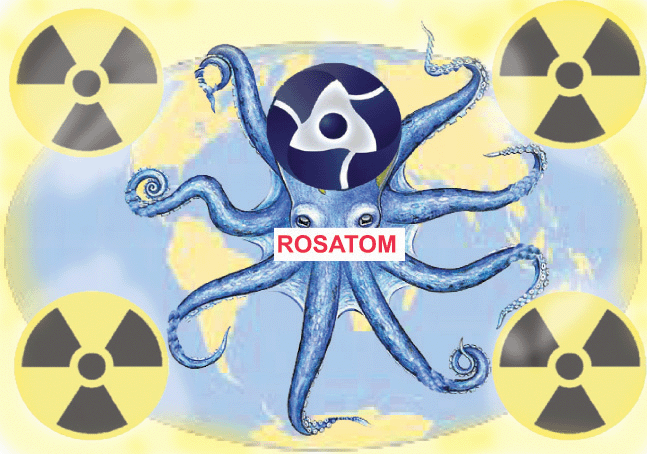 For nuke biggies, answer’s blowing in the wind http://indianexpress.com/article/india/for-nuke-biggies-answers-blowing-in-the-wind-4725180/ Despite a relatively robust position in its nuclear business, Russia’s state atomic energy corporation Rosatom is pushing the envelope by revving up renewable projects in sectors such as wind energy and small hydro. by Anil Sasi June 28, 2017, Little less than a decade ago, nuclear shills could get away by scoffing at renewables, given the promise at that time of a nascent ‘nuclear renaissance’. In the intervening years, while the script has changed overwhelmingly in favour of green energy, the nuclear-versus-renewables debate too has progressively veered off from an ‘either-or’ debate to a more overlapping narrative.
Russia’s state atomic energy corporation Rosatom figures among a handful of nuclear utilities to have bucked the broader downturn in the atomic power business, with eight reactor units in Russia and 36 nuclear reactors in various stages of planning and construction across more than a dozen countries — the largest shelf of projects globally. Creditable, considering the fate of some of its peers — Toshiba has recently pulled its US nuclear subsidiary Westinghouse out of the nuclear construction business while French utility Areva’s continues to struggle with accumulated losses of Euro 10 billion on its books. Despite the relatively robust position in its mainstay nuclear business, Rosatom is now pushing the envelope by revving up renewable projects in sectors such as wind energy and small hydro. Experts suggest that even for other major utilities invested entirely in the nuclear value chain, a move to diversify some of the sectoral risks could make sense.
The Russian nuclear major has started by rolling out wind farm projects in its home market of Russia, with plans to take wind projects to the international market in the due course “after accumulating enough experience on the domestic market”, First Deputy Director of Rosatom Corp, Kirill Komarov told reporters on the sidelines of the Atomexpo 2017 conference in Moscow last week. “We plan to develop renewable energy sources in all parts of the world and not only in Russia, but we’ll start doing it after we accumulate enough expertise here,” he said.
A licensing agreement with the Dutch company Lagerwey for the transfer of technology involved in manufacturing component parts of the windfarms is a step in that direction, with Saudi Arabia likely to be one of Rosatom’s first international markets for wind. The group has also initiated preliminary talks with the Indian government and private companies to expand its presence in India beyond the nuclear sector to the new area of mini hydro power projects, with units ranging from 0.5 to 2 megawatts, an official said. The discussions are being done through Ganz Engineering and Energetics Machinery, a 100 per cent Hungarian subsidiary of Rosatom’s engineering division Atomenergomash.
Areva too has tried its hand at renewables, with a portfolio of four energies: wind energy, bioenergy, solar power and hydrogen power. The French company offers turnkey solutions to meet both short — and long — term requirements for clients to bridge the energy demand in standard and peak consumption periods.
Rosatom’s Komarov has exuded confidence that Russian utility is in a good position for bagging contracts for construction renewable energy facilities abroad. “On the whole, we think our chances for working abroad are fair enough because whatever country we come to, we settle firmly there,” he said at the three-day expo held in the Russian capital last week. At a series of bidding rounds held during the last two years, Rosatom has bagged bids for construction of wind farms in Russia with the overall output capacity of almost 1,000 MWs.
Rosatom considers wind energy projects to be one of the most promising of their non-nuclear growth projects, with estimates suggesting that the it expects the wind energy market in Russia to reach a turnover of about 200 billion Rubles a year ($3.3 billion) by 2024. In July 2016, Rosatom announced that the company plans to build three wind farms in Russia with a total capacity of 610 MW. This amounts to about 17 per cent of the total wind power capacity planned to be commissioned in Russia until 2024.
Among the pacts signed at the expo, Rosatom’s international branch initialled an agreement to cooperate with Saudi Al-Yamama Group on potential projects in the construction of wind farms in Saudi Arabia.In markets such as India, where Rosatom is already involved in building the Kudankulam nuclear power project, the Corporation is betting on a specialised technology for mini hydro projects. Rosatom is already in preliminary talks with the Indian government and private companies to expand its presence in India beyond the nuclear sector to the new area of mini hydro power projects, with units ranging from 0.5 to 2 MW.
The discussions are being done through Ganz Engineering and Energetics Machinery, a 100 per cent Hungarian subsidiary of the Rosatom’s engineering division Atomenergomash. “We consider this as another opportunity for cooperation between Rosatom and India, and our office in India is working in this direction. We are discussing, the issues both with the government, and private bodies,” Rusatom International Network president Alexander Merten told journalists on the sidelines of the Atomexpo.
Rusatom International Network is involved in marketing and business development of a number of Rosatom projects abroad. The small hydro-power plants are pre-fabricated, and assembled in the factory and then supplied to the customer, with the cost of these projects pegged at approximately 1 million euro per megawatt (around Rs 7.1 crore per MW, varying with topography). A pilot installation of the mini hydel plants is currently on in Georgia, with discussions also underway with Turkey and the Middle East countries.
(The writer’s trip to Atomexpo was sponsored by Rosatom)
Wind and solar power does not make the U.S. electricity grid less stable
Wind and solar power does not make the U.S. electricity grid less stable, an outgoing federal regulator said on Tuesday, as the Trump administration readies a study that will examine whether renewable energy has had a harmful effect.
Colette Honorable, a member of the Federal Energy Regulatory Commission, said at a conference that renewables have different attributes than base load power, which includes coal and nuclear energy, and that those difference need to be overcome.
But Honorable stressed that record amounts of wind and solar power had been generated recently without harming the grid.
“Do I recognize we have to be attendant to supporting the different ways in which renewables work? Yes,” said Honorable, who was appointed by former president Barack Obama, a Democrat, and who will step down on Friday.
“I don’t see any problems with reliability, and I say bring on more renewables,” said Honorable, whose remarks generated warm applause at a conference of the Energy Department’s Energy Information Administration arm.
President Donald Trump, a Republican, has embarked on a program to dismantle Obama’s clean-energy policies as renewable power generation hits records.
In February, wind briefly powered more than 50 percent of electricity demand in the 14-state Southwest Power Pool, for the first time on any North American grid.
In March, wind and solar accounted for more than 10 percent of U.S. electricity generation for the first time…..http://www.reuters.com/article/us-usa-powergrid-idUSKBN19I2B6
June 2017 Britain sets a new renewable energy record

 Content Coms 22nd June 2017, It’s official; this month – June 2017 – the UK set a new renewable
energy record as wind and solar power surged. The Telegraph broke the news,
saying the blustery start to summer has helped the renewable energy
industry to its highest ever output, as wind turbines and solar panels
helped to meet more than half of the UK’s electricity demand.
It’s a telling reminder you don’t necessarily need the blinding sun of recent
days for panels to do their work. Revolutions take place quietly most of
the time.
Either way, the news is a truly astonishing result, and coupled
with last year’s confirmations that the world as a whole has decoupled
growth from carbon emissions, looks set to truly confound sceptics of
renewable and low carbon technologies.
And of course, it makes yet more of a mockery of President Trump’s fossil-based repudiation of Paris. His
idiocy now stands proven by the truth of what renewables can do, powering
over half of one of the world’s important economies; the UK. In fact,
soon we will be calling oil the energy alternative, and renewables the
mainstream. https://www.contentcoms.co.uk/content-coms-view-wind-solar-combine-build-uk-renewables-revolution/
Contrary to his boast, President Trump was NOT the first to suggest a solar wall
Times 23rd June 2017, President Trump laid claim to an idea that could help his promised wall
along the Mexico border to turn a profit: solar panels. “I will give you an
idea that nobody has heard about yet. The southern border: lots of sun,
lots of heat. We are thinking about building a wall as a solar wall. So it
creates energy. And pays for itself,” he told a campaign-style rally in
Cedar Rapids, Iowa.
The scheme would lower the cost to Mexico too, he said,
adding: “Pretty good imagination, right? My idea!” Mr Trump has discussed
the scheme in private meetings with legislators but floated it publicly for
the first time on Wednesday.
Contrary to his claim, however, others had
already raised the idea. Designs for the wall submitted to the US
government in April by Thomas Gleason, a Las Vegas businessman, had solar
panels powering lig hting, sensors and border patrol stations. The
Department of Homeland Security has been inviting companies to submit
plans, although Congress still has not allocated the funds needed to build
the wall. https://www.thetimes.co.uk/edition/world/president-trump-claims-solar-panels-will-pay-for-his-mexican-wall-bt62xbkfl
Community energy initiative in UK
Utility Week 19th June 2017, Mongoose Energy has launched a new crowdfunding platform to secure
financing for community energy projects. The company hopes the platform
will widen the pool of potential investors, bring down the cost of capital
and enable greater innovation in funding. “More people want a bigger say
in where their power comes from, where their investments go, and in
improving their own communities,” said former energy secretary and
chairman of Mongoose Energy, Sir Ed Davey. “Launching our own
crowdfunding platform means we can dispatch better energy, better financial
returns and better social dividends to UK community investors.” Mongoose
Crowd will offer people the first ever opportunity to invest up to £20,000
per year in community energy schemes via the Innovative Finance ISA (IFISA)
for peer-to-peer lending which the government launched in April last year.
http://utilityweek.co.uk/news/Community-energy-crowdfunding-platform-takes-off/1305532
Scotland’s National Academy inquiring into Scotland’s energy future
Scottish Energy News 16th June 2017, The Royal Society of Edinburgh – Scotland’s National Academy – has set up a
new Inquiry Committee to look at Scotland’s Energy Future. The inquiry
aims to contribute to the important debate around Scotland’s energy
supply, demand and use, as well as moral and environmental
responsibilities.
It will also look to inform the policy- and decision-making at a Scottish, UK and international levels in relation to
resources needed at acceptable financial, moral and environmental costs.The
committee, which is expected to sit for around 18 months, will consider how
Scotland can meet the future energy demand and how to ensure that the
energy used is secure, affordable and environmentally justifiable. It will
also examine all areas of the debate around Scotland’s energy future in
the context of its commitment to combat global climate change and the
environmental imperative to reduce carbon emissions. http://www.scottishenergynews.com/
1 This Month

of the week – Shut Down Drone Warfare!


Tell the Ukrainian Government to Drop Prosecution of Peace Activist Yurii Sheliazhenko

Petition to revoke the licensing of the Near Surface Nuclear Disposal Facility (NSDF) at Chalk River. https://www.ourcommons.ca/petitions/en/Petition/Details?Petition=e-7247
To see nuclear-related stories in greater depth and intensity – go to https://nuclearinformation.wordpress.com
-
Archives
- April 2026 (114)
- March 2026 (251)
- February 2026 (268)
- January 2026 (308)
- December 2025 (358)
- November 2025 (359)
- October 2025 (376)
- September 2025 (257)
- August 2025 (319)
- July 2025 (230)
- June 2025 (348)
- May 2025 (261)
-
Categories
- 1
- 1 NUCLEAR ISSUES
- business and costs
- climate change
- culture and arts
- ENERGY
- environment
- health
- history
- indigenous issues
- Legal
- marketing of nuclear
- media
- opposition to nuclear
- PERSONAL STORIES
- politics
- politics international
- Religion and ethics
- safety
- secrets,lies and civil liberties
- spinbuster
- technology
- Uranium
- wastes
- weapons and war
- Women
- 2 WORLD
- ACTION
- AFRICA
- Atrocities
- AUSTRALIA
- Christina's notes
- Christina's themes
- culture and arts
- Events
- Fuk 2022
- Fuk 2023
- Fukushima 2017
- Fukushima 2018
- fukushima 2019
- Fukushima 2020
- Fukushima 2021
- general
- global warming
- Humour (God we need it)
- Nuclear
- RARE EARTHS
- Reference
- resources – print
- Resources -audiovicual
- Weekly Newsletter
- World
- World Nuclear
- YouTube
-
RSS
Entries RSS
Comments RSS
 nuclear-news