 Japan vows to ramp up efforts to export renewable energy technology, July 13, 2017 (Mainichi Japan), TOKYO (Kyodo) — Foreign Minister Fumio Kishida pledged Thursday that Japan will aggressively pursue the export of renewable energy technologies to tap into growth spurred via the worldwide transition to clean energy sources necessitated by the onset of climate change.
Emphasizing that energy demand will only grow in China and Southeast Asia, Kishida noted in a message read to a symposium hosted by the ministry in Tokyo that “Japan’s environmental technologies will greatly contribute to Asian nations’ (transition).”
Calling climate change a “common challenge worldwide,” Kishida noted that Japan is a signatory to the Paris Agreement, the global effort to reduce greenhouse gas emissions through member nations setting voluntary targets. The accord entered into force in November 2016.
In Fukushima, Japan is currently pursuing the production of hydrogen from renewable sources for use in fuel cells, part of a broader plan to help the prefecture rebuild from the March 2011 quake-tsunami disaster and nuclear accident.
“We will develop Japan’s state-of-the-art technologies in energy-poor countries and regions and contribute to the improvement of energy security,” Kishida added.
However, some analysts have voiced concern that Japan has lagged behind China and the United States in the production of renewable energy, with Prime Minister Shinzo Abe’s government preferring to restart nuclear reactors under pressure from the business sector……https://mainichi.jp/english/articles/20170713/p2g/00m/0bu/078000c
July 14, 2017
Posted by Christina Macpherson |
Japan, marketing, renewable |
Leave a comment
Guardian 13th July 2017,A dramatic growth in electric vehicles on Britain’s roads could see peak
electricity demand jump by more than the capacity of the Hinkley Point C
nuclear power station by 2030, according to National Grid.
The number of plug-in cars and vans could reach 9m by 2030, up from around 90,000 today,
said the company, which runs the UK’s national transmission networks for
electricity and gas.
The impact of charging so many cars’ batteries would
be to reverse the trend in recent years of falling electricity demand,
driven by energy efficiency measures such as better boilers.
National Gridacknowledged the cars’ batteries could also provide services andreturn
power for the grid at a time when managing the network is becoming
increasingly complex as variable sources of wind and solar power grow.
https://www.theguardian.com/business/2017/jul/13/electric-car-boom-power-demand-national-grid-hinkley-point-c
July 14, 2017
Posted by Christina Macpherson |
energy storage, UK |
Leave a comment
Chernobyl nuclear reactor slated for billion-pound solar park despite radiation fears
Chernobyl was the scene of the world’s worst nuclear accident in 1986, Independent, Fiona Keating, 10 July 17 Ukraine is in talks with one of France’s biggest energy businesses to construct a £969m solar facility at the derelict Chernobyl nuclear reactor plant and its surrounding area.
Ostap Semerak, Ukraine’s minister of ecology, said Engie is starting a pre-feasibility survey, bankrolled by the French government, next week. The results should be published by the end of the year.
“France’s experience in nuclear is one of the reasons that we wanted to work with them,” Mr Semerak told The Washington Post. “They approached us after we announced our intention to develop renewables in Chernobyl.” An Engie spokesman verified that the company is in consultation with the Ukrainian government but refused to reveal any further details on the project.
July 10, 2017
Posted by Christina Macpherson |
renewable, Ukraine |
Leave a comment
Historic First: Solar Plant Illuminates Syrian Refugee Camp, Vastly Improving Quality of Life, http://www.environews.tv/world-news/historic-1st-solar-plant-illuminates-syrian-refugee-camp-vastly-improving-quality-life/ (EnviroNews World News) by Julia Travers May 27, 2017 — Azraq, Jordan — The newly activated two-megawatt solar photovoltaic power plant at the Azraq refugee camp in Jordan is the first refugee camp in the world to be powered by a renewable energy facility. The plant started running May 17, 2017, and will provide free energy to about 20,000 of the 36,000 refugees in the area – all victims of the Syrian conflict, now in its seventh year.
There are close to 15 million refugees in the world, and the integration of free renewable energy into their stressful lives is invaluable. “Lighting up the camp is not only a symbolic achievement; it provides a safer environment for all camp residents, opens up [livelihood] opportunities, and gives children the chance to study after dark. Above all, it allows all residents of the camps to lead more dignified lives,” said United Nations High Commission for Refugees (UNHCR) Deputy High Commissioner, Kelly T. Clements.
“Before this, when we cooked a meal we had to throw the leftovers away because there was no safe way to store food. When we got too hot, we had to pour water on our clothes to keep cool. Now we can listen to music or have a cold glass of water, and daily life no longer ends when the sun sets,” Fatima, a 52-year-old from Damascus who lives in the camp with her two adult sons, told the UNHCR.
UNHCR partnered with the Government of Jordan, Jordanian solar company Mustakbal, and IKEA to build this camp. The IKEA Foundation is UNHCR’s largest private sector partner and fully funded the solar installation through their “#BrighterLives4Refugees” campaign. The endeavor raised $9.6 million for the cause by donating a portion of IKEA’s LED light sales in 2015.
20,000 of the individuals now living in the desert camp have had some access to non-renewable electricity since January 2017, and they now receive additional power from the sun. The new solar station is connected to Jordan’s grid and is intended to provide electricity to the remaining 16,000 refugees at Azraq by early 2018. The solar initiative will save UNHCR $1.5 million a year, which it can devote to other refugee services, while reducing annual CO2 emissions by roughly 2,370 tons.
The 500 new solar LED streetlights make the camp safer at night, which was especially concerning for women and girls, UNHCR relayed. Mustakbal also provided training and employment to over 50 refugees. “I wasn’t able to finish my education because of the war and then exile, but this has given me a practical skill that I can hopefully use in the future. If we return to Syria, the infrastructure is all destroyed, but this is a technology that we could use to rebuild,” said Mohammad, 20, who was forced to leave school at age 14.
July 10, 2017
Posted by Christina Macpherson |
climate change, Jordan, renewable |
Leave a comment
BBC 7th July 2017 An Australian state will install the world’s largest lithium ion battery in a “historic” deal with electric car firm Tesla and energy company Neoen. The battery will protect South Australia from the kind of energy crisis
which famously blacked out the state, Premier Jay Weatherill said.
Tesla boss Elon Musk confirmed a much-publicised promise to build it within 100 days, or do it for free. The 100-megawatt (129 megawatt hour) battery should be ready this year.

July 8, 2017
Posted by Christina Macpherson |
AUSTRALIA, energy storage |
Leave a comment
 FT 7th July 2017, Tesla Motors and now Volvo may have big plans to end the addiction of drivers to fossil fuels via electric vehicles, however the environmental footprint of mining raw materials used in car batteries and their eventual disposal are emerging as a flash point.
As the mining sector presents a green face and extracts raw materials from lithium to cobalt and nickel
that constitute electric batteries, so the focus on their environmental standards and energy efficient production methods will intensify.
At the tail-end of the electric vehicle boom is the matter of improving the recycling of lithium-ion batteries and making sure the environmental impact is also contained.
To offset the environmental impact of mining there will have to be a large build out in recycling facilities to meet the first wave of electric vehicles, analysts say. Currently over 90 per cent of lead-acid
batteries used in conventional gasoline cars are recycled, versus less than 5 per cent of lithium-ion batteries. An estimated 11m tonnes of spent lithium-ion battery packs will be discarded between now and 2030, according to Canada-based Li-Cycle, a recycler of batteries.
https://www.ft.com/content/8342ec6c-5fde-11e7-91a7-502f7ee26895?mhq5j=e3
July 8, 2017
Posted by Christina Macpherson |
2 WORLD, energy storage |
Leave a comment
Renewable energy surges past nuclear for 1st time in decades, Star Tribune
By MICHAEL BIESECKER Associated Press, JULY 6, 2017, WASHINGTON — For the first time in decades, the United States got more electricity from renewable sources than nuclear power in March and April.
The U.S. Energy Information Administration said Thursday that electricity production from utility-scale renewable sources exceeded nuclear generation in both March and April, the most recent months for which data is available. That’s the first time renewable sources have outpaced nuclear since 1984.
The growth in renewables was fueled by scores of new wind turbines and solar farms, as well as recent increases in hydroelectric power as a result of heavy snow and rain in Western states last winter. More than 60 percent of all utility-scale electricity generating capacity that came online last year was from wind and solar.
In contrast, the pace of construction of new nuclear reactors has slowed in recent decades amid soaring costs and growing public opposition. Nearly all nuclear plants now in use began operation between 1970 and 1990, with utilities starting to retire some of their older reactors……..http://www.startribune.com/renewable-energy-surges-past-nuclear-for-1st-time-in-decades/432955983/
July 7, 2017
Posted by Christina Macpherson |
renewable |
Leave a comment
Solar Power Portal 4th July 2017, Aldi UK has marked the fourth Solar Independence Day with the announcement
that it will install a further 11,000 solar panels across more than 50 of
its stores by the end of the year.
The supermarket has already installed
more than 85,000 solar panels on all nine of its regional distribution
centres and more than 275 stores across the UK, generating over 17,500 MWh
of electricity a year.
This deployment will now be extended by the end of
the year, bringing its total store investment in solar to almost £17
million and saving more than 8,100 tonnes of CO2 in the process. https://www.solarpowerportal.co.uk/news/aldi_uk_marks_solar_independence_day_with_new_solar_rollout_pledge
July 7, 2017
Posted by Christina Macpherson |
renewable, UK |
Leave a comment
Study: Renewables will be cheapest power source by 2030, By Sam Morgan | EURACTIV.com, Jul 6, 2017, Renewable energy sources like wind and solar are set to be the cheapest form of power generation in the G20 countries by 2030, according to a new study. The EU also announced that the Paris Agreement “cannot be renegotiated”.
Ahead of this week’s G20 summit in Hamburg, the study also found that in half the G20 countries renewables have already been cheaper or the same price as electricity derived from coal or nuclear plants for the last two years.
The study, carried out by Finland’s Lappeenranta University and published by Greenpeace Germany, calculated the costs of electricity generation in all G20 countries for the years between 2015 and 2030.
It found that wind farms generated the cheapest electricity in 2015 across large parts of Europe, in South America, the United States, China and Australia. The study also predicted that technological progress will mean that solar power will be even cheaper than wind by 2030 in many G20 nations
Greenpeace Germany’s energy expert, Tobias Austrup, said “climate protection increasingly makes economic sense across the G20 as renewable energy becomes cheaper than dirty coal and nuclear”.
He added that “any G20 country that is still investing in coal and nuclear power plants is wasting their money on technology that will not be competitive in coming years”.
At an event organised by the French Institute of International Relations on Tuesday (4 July), the French energy ministry’s executive director, Mario Pain, acknowledged that “renewables are a major part of the answer” when asked about the future of France’s electricity system……..https://www.euractiv.com/section/energy/news/study-renewables-will-be-cheapest-power-source-by-2030/
July 7, 2017
Posted by Christina Macpherson |
2 WORLD, renewable |
Leave a comment
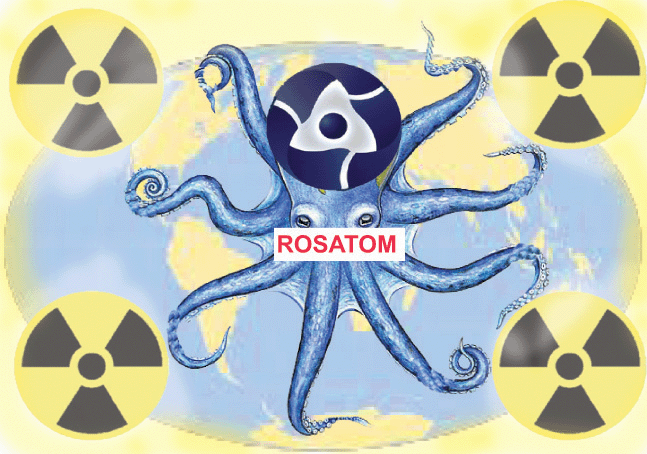
 Rosatom loses hope in its international nuclear builds, eyes renewables http://bellona.org/news/nuclear-issues/2017-07-rosatom-loses-hope-in-its-international-nuclear-builds-eyes-renewables
Amid decreasing world demand for nuclear energy, Russia’s state nuclear corporation 
 last week warned it would likely be receiving fewer requests to build nuclear power plants abroad. July 3, 2017 by Charles Digges, The announcement marks a sharp departure for the corporation, which until recently has posed its contracts with other countries as the bread and butter of its bottom line – as well as a potent tool for broadening Moscow’s sphere of political influence.
But there’s a silver lining to the nuclear monolith’s recent disillusionment with its traditional lifeblood: A possible, albeit modest, shift in the direction of renewable energy and battery technologies.
Speaking at last month’s Tekhnoprom-2017 conference, a technical conference in the Siberian city of Novosibirsk, Rosatom’s deputy director Vyacheslav Pershukov called the market for nuclear power stations abroad “exhausted.” “We see that the market is contracting, and for the sustainable growth of the corporation…we must make our money on something other than nuclear technology,” he said, according to the RBK news agency.
His remarks dovetail with a worldwide nuclear sag.
In the United States, renewable energy output eclipsed nuclear for the first time during March and April. Meanwhile, huge nuclear corporations are trying to stave off going broke. Exelon, the country’s biggest nuclear operator, has seen its share prices plummet by 60 percent since 2008.
Westinghouse, meanwhile filed for bankruptcy in March, and Toshiba, its parent company, is trying to sell of its computer divisions to cover the debt. France’s Areva was saved from financial peril by a huge taxpayer infusion into its owner EDF, but that bailout will only stop the bleed the company is experiencing thanks to huge cost overruns on an ambitious but delayed reactor build in Finland.
Pershukov told the Tekhnoprom conference that Rosatom would shift some of its efforts to providing nuclear power plant services abroad, primarily to those it’s in the process of building.
For the past several years, Rosatom has touted its VVER-1200 reactor packages to international capitols and has worked vigorously to sign up customers even – if not especially – those who can barely afford it. On paper, the company has $130 billion in outstanding “memoranda of understanding” and other handshake type deals with foreign countries.
But many of the counties Rosatom counts among its potential contracts – like Jordan, Algeria, Nigeria and Bolivia, and most recently Uganda and Ethiopia – won’t have infrastructure to support nuclear power for decades.
In other cases, like Hungary, the Rosatom-built Paks-2 plant has been approved, but will leave Budapest’s right wing-government heavily indebted to Moscow for the $10 billion plant.
Another similar deal would have indentured South Africa to Rosatom for $76 billion, but that country’s high court torpedoed the deal before it got off the ground.
Other countries where Rosatom builds are already underway – like India’s Kudankulam, Iran’s Bushehr, China’s Tianwan and Belarus’s Ostrovets – are already familiar with Rosatom’s typical cost overruns and delays.
The company can pay for these huge loans because of the generous state subsidies it receives, but taxpayer injections are slated to dry up by 2020.
Oskar Njaa, a nuclear adviser with Bellona said curtailing Rosatom’s international nuclear ambitions represents a humbling moment for the company, and a dampening of its political influence abroad. “This is an economic blow,” he said. “For Russia, reducing an ability to make other countries dependent on Moscow’s nuclear fuel and expertise for energy needs is a blow to its geopolitical interests as well.”
As such, Rosatom is casting a wide net for other avenues of influence and revenue. In May, the company appeared in Chile’s Lithium Call Roadshow, and is reportedly pursuing inroads with Santiago to become a player in cell phone and electric car batteries. Other reports say the company is making a foray into fiber-optics.
More optimistically, Njaa noted, the company also seems to have discovered a bent for the renewable energy sector. He noted Rosatom’s recent interest in small hydroelectric plants and wind energy.
July 5, 2017
Posted by Christina Macpherson |
marketing, politics international, renewable, Russia |
Leave a comment
Energy Post 27th June 2017,The introduction of renewables auctions in Germany, replacing administratively set feed-in premiums, has led to considerably lower prices and very high realization rates. However, community participation was very low in the first solar PV auctions.
Now a new rule favouring community projects in onshore wind auctions turned out to be so attractive that most
bidders created community projects to profit from them. This is turning the
market upside down. Corinna Klessmann and Silvana Tiedemann of consultancy Ecofys, a Navigant company, look at the effects of auctions on the German renewables markets and make recommendations. http://energypost.eu/germanys-first-renewables-auctions-are-a-success-but-new-rules-are-upsetting-the-market/
July 3, 2017
Posted by Christina Macpherson |
business and costs, decentralised, Germany |
Leave a comment
 Solar Portal 29th June 2017, What is expected to be Europe’s largest community battery is set to be
installed at an innovative regeneration scheme in Nottingham, with a 2MWh
Tesla battery to be deployed in September as part of a housing scheme
alongside community solar.
The £100 million Trent Basin project is a new housing development built at the site of an inland dock previously derelict
for around two decades. It is expected to deliver 500 homes over five
phases with 375kW of rooftop and ground mounted solar and the Tesla battery
to be installed by EvoEnergy.
In an innovative use of the solar farm, planning permission has been granted on the basis that the site shall be
cleared by 28 February 2020. By this time, the panels from the ground
mounted installation will be removed and installed on new homes built as
part of the development. https://www.solarpowerportal.co.uk/news/tesla_install_to_bring_europes_largest_community_battery_to_nottingham
July 3, 2017
Posted by Christina Macpherson |
decentralised, UK |
Leave a comment
Times 1st July 2017, Turbines for the world’s first floating wind farm are set to arrive in
Scottish waters within weeks after taking to the seas off Norway. Five
turbines for the £200 million Hywind project, being built by Statoil, the
Norwegian energy group, were floated near Stord island on the country’s
southwest coast. They will be towed on a four-day journey to a location 16
miles off Peterhead.
The five turbines, standing 175m above sea level, are
kept afloat by ballasted steel cylinders that extend 78m beneath the waves.
Each will be attached to the seabed by chains. Together they should
generate up to 30 megawatts of power, enough to supply 20,000 homes.
https://www.thetimes.co.uk/edition/business/turbines-sail-closer-to-the-wind-8bfzgdxnl
July 3, 2017
Posted by Christina Macpherson |
decentralised, UK |
Leave a comment
Renew Economy 30th June 2017, Global research institute McKinsey & Company has analyzed current energy
storage prices and concluded that commercial customers are already feeling
the economic benefits of cheaper batteries and recent price falls in
lithium-ion technology.
With battery-pack costs now down to less than
$230/kWh – compared to around $1,000/kWh as recently as 2010 – storage
uptake is on the rise across Europe, Asia and the U.S. This growth is being
facilitated by a greater uptick in electric vehicle (EV) adoption, with
major players now scaling-up their lithium-ion manufacturing capacity in
order to meet demand.
http://reneweconomy.com.au/energy-storage-already-cost-competitive-commercial-sector-finds-study-20246/
July 3, 2017
Posted by Christina Macpherson |
2 WORLD, energy storage |
Leave a comment
Climate News Network 1st July 2017, Trucks, trains and ships using hydrogen fuel cells for propulsion are no longer just theoretically possible: they have reached the trial stage. Decades of work on refining the technology have coincided with the need to store surplus energy from solar and wind farms when supply exceeds demand.
And making and storing hydrogen from surplus renewable energy that can then be used as fuel for vehicles is good economic sense, according to the Norwegian research group SINTEF. Fuel cells are much lighter than batteries
and with hydrogen fuel they provide a better method of propulsion for all sorts of freight and passenger transport. The only residue of burning hydrogen is water, so there is no pollution.
Top-secret research and development has been going on since 1980 at SINTEF in an attempt to make
fuel cells competitive with the internal combustion engine for transport. The technology is already used in some niche markets, but it is now expected to become mainstream, according to Steffen Møller-Holst, vice-president for marketing at SINTEF. He says: “In Japan, 150,000 fuel cells have been installed in households to generate power and heat, and in
the United States more than 10,000 hydrogen-powered forklifts are operatingin warehouses and distribution centres.”
In Norway SINTEF has been working on advancing that technology. Engineers there also want to power
forklifts, but they’re planning more: they want as well to power heavyduty trucks and passenger ferries with fuel cells. Norway is also working on a plan to make its railways greener, running long-distance trains on hydrogen as an alternative to electrifying lines currently operated by diesel locomotives.
“In Germany, the first fuel cell train is alreadyundergoing trials, and Norway is one of many European countries now
considering hydrogen-powered trains based on the conclusions of a studycarried out by SINTEF for the Norwegian Railway Directorate,” saysMøller-Holst. He is convinced Norway should follow the German example.
Surprisingly, the report concluded that between €36 and 45 billion could be saved annually on one section of the line if battery- or hydrogen-powered trains were used instead of the more conventional electric trains drawing power from overhead wires. http://climatenewsnetwork.net/hydrogen-fuel-reaches-lift-off/
July 3, 2017
Posted by Christina Macpherson |
energy storage, EUROPE |
Leave a comment







 nuclear-news