I’m preparing for a trip to your fine nation later this month to speak at the National Energy Efficiency Conference in Melbourne, so I’ve been reading up on Australian energy policy debate. It’s been fascinating.
I still have a lot to learn about your energy system, but so far one thing stands out: the discussion in Australia seems overly focused on the transition underway on the supply side of the market.
Don’t get me wrong – the decarbonisation of the world’s energy supply is crucial, and you won’t find a stronger advocate for renewables than me. Way back in the 1990s, I installed many small, remote PV and wind systems with my own two hands, and trained others to do the same.
More recently I ran two of California’s signature renewables programs – the California Solar Initiative and Self-Generation Incentive Program.
However, focusing solely on the move to low carbon generation without pursuing demand side opportunities in an ambitious, systematic way actually makes the transition harder.
Energy efficiency and demand response are just as important to the energy transition as renewables are, as we’ve learnt in California. Today’s technology helps us utilise energy smartly; and indeed the least expensive and cleanest unit of energy is the one not needed at all.
Energy efficiency has been a central contributor to California’s energy mix since the 1970s.∗Efficiency is responsible for an annual reduction in statewide electric consumption of 90 TWh (Figure 1), the equivalent of 30 percent of the state’s current electricity consumption and enough to power around eight million households.
California’s per capita electricity use has remained flat since the mid-1970s, despite a fourfold increase in real economic output, larger homes and the proliferation of consumer appliances and electronics.
Since 2000, the state’s overall carbon emissions are down 8 percent while its economy has grown by 28 percent. California’s deliberate, consistent focus on energy efficiency has played an important role in these successes.
Going forward, the California legislature and Governor Brown have established a goal to double the flow of efficiency savings by 2030. The estimated impacts of this doubling effort are shown in Figure 2. Achieving the goal will see per capita consumption decline around 25 percent by 2030. California’s suite of energy efficiency activities includes:
Building energy efficiency standards. The 2019 Standards update will require residential new construction to have advanced building shells, high-performing water heating and mechanical systems, all-LED lighting and, for the first time, sufficient self-generation (typically PV) to offset all electric load. Incremental costs are shown to be cost-effective.
Appliance efficiency standards. California has explicit authority to develop efficiency standards where national standards do not exist. Recent standards adopted include general service LEDs, computers, and battery chargers. Many appliance standards are currently in development (e.g. industrial fans and blowers, certain compressors and pumps, and room air conditioners)……
Modern energy management complements renewable energy supply
Highly efficient products and practices increasingly bundle with digital communication and control features to support demand-side responsiveness to the momentary needs of the grid. Good design of buildings and industrial processes, together with advanced energy management systems, can provide both beautifully tailored performance for customers and valuable and much-needed grid services that aid seamless incorporation of renewable energy into the supply mix.
Energy efficiency optimises the distribution grid
Energy efficiency frees capacity in the distribution grid, allowing new electric loads to be served with only moderate added investment. That ‘headroom’ will be essential, since California’s clean energy path will include widespread electrification: pervasive adoption of electric vehicles, heat pumps, induction cooking and other electric end use technologies. Electrification brings additional benefits, such as avoiding both investment in new retail gas distribution infrastructure and the risks to health and safety from indoor combustion.
Cost of wind keeps dropping, and there’s little coal, nuclear can do to stop it, An annual look at the costs of generating power. Ars Technica MEGAN GEUSS – Though a lot has changed since 2016, not much has changed for energy economics in the US. The cost of wind generation continues to fall, solar costs are falling, too, and the cost of coal-power energy has seen no movement, while the cost of building and maintaining nuclear plants has gone up. And none of those conclusions reflect subsidies and tax credits applied by the federal government.
The conclusions come from Lazard (PDF), an asset management company that publishes cost estimates for various types of electricity-generation assets each year. Lazard’s numbers reflect the Levelized Cost of Energy (LCOE), which averages the estimated costs of construction, maintenance, and fuel for electricity-generating assets over the number of megawatt-hours that each asset is expected to produce over its lifetime. In other words, the LCOE is the lifetime cost of a turbine divided by the amount of energy that turbine will produce over its lifetime. LCOE is a good way of comparing electricity generation sources that vary dramatically in cost to build and cost to maintain.
The result, tracked over years, is one way of gauging how the US energy mix is changing and could change in the coming year. Though the new presidential administration was expected (and still is expected) to be a boon to coal and nuclear energy, those efforts are still mired in the political process. And even if they succeed, thwarting the cost advantages of wind and solar energy while propping up coal and nuclear power will require not-inconsiderable amounts of intervention from the US government.
According to Lazard, in the last year, the cost of onshore wind has fallen six percent and the cost of utility-scale solar has fallen six percent, too. Those cost reductions are slower than reductions in previous years, but the cost of coal-fired generation remained stagnant in 2017…….. The cost of building and maintaining nuclear plants has actually increased in the last six years as well. Lazar wrote that “the estimated levelized cost of energy for nuclear generation increased [approximately] 35 percent versus prior estimates, reflecting increased capital costs at various nuclear facilities currently in development.” Facilities like the
Rosatom talks up wind, solar power in quest for ‘diversified portfolio’ By Frédéric Simon | EURACTIV.com 7 Nov 17, Nuclear power remains the cornerstone of Rosatom’s expansion strategy, notably in emerging countries. But the Russian state-owned energy conglomerate is now also talking up renewables, citing wind, solar and batteries as part of a diversified low-carbon energy portfolio.
Ask the director of Rosatom Western Europe about the company’s diversification strategy, and he won’t hesitate a second – it’s all about nuclear…….
But ask again and Rozhdestvin will also mention wind, solar power and even batteries.
“We are the leaders in Russia when it comes to the wind industry. And why are we doing that? Because we believe we should diversify and add new CO2-free sources of energy to our portfolio.”
Rosatom decided to invest in wind power only recently, in 2016, believing that rapid cost reductions in the renewable industry will become a competitive threat to nuclear power. Two wind farms in Russia are currently under construction, in partnership with a Dutch company, Lagerwey.
Overall, Rosatom has an order to build 1 gigawatt of wind power capacity in Russia, Rozhdestvin says, a market share which is still tiny compared to the 27.89 gigawatts of installed nuclear capacity.
“But that’s the first step,” Rozhdestvin says. “We have to be a player on that market. Wind, solar, nuclear – they are all CO2 free. We want to be able to offer a diversified portfolio to meet concrete energy needs.”….
Renew Economy 7th Nov 2017, The latest energy auction in Chile has set a new record low for solar PV,
with one bid by the local subsidiary of Italian outfit, Enel, coming in at
just $US21.48/MWh The result beats the previous record low of $US24.20 set
in the United Arab Emirates earlier this year, although it could be beaten
by Saudi Arabia’s first auction, should the early results of a tender
that secured an offer of $US17.90/MWh be verified later this month. Either
way, the Chile government is happy with the result, which secured an
average price of $US32.5/MWh for 600MW of solar and wind capacity, expected
to produce around 2,200GWh. This is a 75 per cent fall since its auction
program began in 2015. The Chile government says it will mean consumer
prices fall by nearly 50 per cent once all the new projects are completed
and online in 2024. http://reneweconomy.com.au/chile-solar-auction-sets-new-record-low-for-solar-pv-85114/
University of Manchester 7th Nov 2017, ‘Business as usual’ is not an option for the UK’s nuclear energy
sector; our energy companies’ ‘regressive and unjust funding
approach’ is causing fuel poverty, and the Northern Powerhouse could play
a key role in shaping the UK’s climate change future. These are just some
of the opinions in a new publication, ‘On Energy: How can evidence inform
future energy policy?’, by The University of Manchester.
It is being launched on Wednesday 8th November at the House of Commons. The report
brings together some of the country’s leading energy, policy, and climate
change scientists, academics and experts to offer their opinions and
solutions for the UK’s most pressing energy issues. The publication draws
on expertise from across The University of Manchester and external
collaborators, including Lord Jim O’Neill, Director of the Dalton Nuclear
Institute, Professor Francis Livens, leading climate change researcher,
Professor Alice Larkin and SUPERGEN Bioenergy HubDirector, Professor
Patricia Thornley.
On the UK’s nuclear policy, Professor Livens and his
co-authors from DNI, Professors Tim Abram, Juan Matthews and Richard
Taylor, say the industry needs to recognise that its competitors in the
renewable sector, such as wind, solar and wave, are substantially cheaper.
To combat this he says more innovation is needed to reduce the cost if it
is to be taken seriously as an alternative to fossil fuels. http://www.manchester.ac.uk/discover/news/is-the-uks-energy-policy-fit-for-purpose/
Climate change and the great disruption, Press Republican 5 Nov 17 RAY JOHNSON Climate Science “…… The pie chart from the Environmental Protection Agency website titled “Total U.S. Greenhouse Gas (GHG) Emissions by Economic Sector in 2015” indicates that “Electricity” generation accounts for 29 percent of the total while “Transportation” is not far behind at 27 percent.
Let’s concentrate on one portion of the U.S. GHG emissions: “Electricity.”
A reduction in GHG emissions here will greatly help in addressing climate change. Technology disruption can be observed in the graph “Swanson’s Law.” It’s based on an observation by Richard Swanson, “that the price of solar photovoltaic (PV) modules tends to drop 20 percent for every doubling of cumulative shipped volume” (Wikipedia). The log-log graph shows the cost reduction for the price of crystalline silicon PV cells in $/watt. In 1977 the cost was $76.67/watt, and by 2014 the price had dropped to $0.36/watt.
Thus the cost is more than 200 times lower than in 1977 (based on 2014 data). This graph is also called “the learning rate.”
Module costs have dropped in half since 2008. The implication is that if one made a business decision in 2008 to proceed with a nuclear or fossil-fuel-burning generating plant based on the cost of PV modules at that time, that business plan may have to be scrapped today due to the rapidly falling PV costs. It would not be economical.
And, this is exactly what is happening around the world. Hundreds of coal-burning plants are being retired, mothballed and/or construction stopped, with China taking the major initiative.
The bar chart “Global Solar Energy Capacity (GW)” details this extraordinary PV growth. It highlights the gigawatts of PV capacity and its near exponential growth in the last 15 years. Separately, for the U.S. alone, this trend indicates that solar could contribute 20 percent of total electricity consumption by 2030.
This growth in solar will reduce coal mining, number of coal-burning plants, nuclear power facilities and even oil sand extraction and drilling in locations that are expensive (deep water, difficult locations — Arctic) and so on.
And we have not even discussed the impact of wind turbine technology yet. Next time.
Meanwhile, our planet continues to warm. The National Oceanic Atmospheric Administration bar chart shows that warming trend with the first nine months of 2017 among the top three warmest in the 137-year climate record.
State of Green 31st Oct 2017, The Danish Minister for Energy, Utilities and Climate has given the green light to a 750-kilometre-long cable (Viking Link) that will connect Denmark with the United Kingdom. The cable, which will be the world’s longest direct current cable, will help provide Denmark with a highly secure supply and better potential for selling its wind-produced power.
The cable will run from Vejen in southern Jutland to Bicker Fen in Lincolnshire, around 170 kilometres north of London. At 1400 megawatts, its transmission capacity will be the equivalent to one third of Denmark’s total consumption. Strong electricity connections abroad are crucial for a small nation like Denmark.
We will be able to sell our power in a larger market when we have a surplus of renewable energy. At the same time, we get a larger supply of power to Denmark when the wind does not blow and the sun does not shine. Strong electricity connections to our neighbors thus contribute to ensuring cheap and reliable power for consumers and to keep the value of the wind power high. It is for the benefit of all Danes and companies in Denmark, says Minister for Energy, Utilities and Climate, Lars Christian Lilleholt. https://stateofgreen.com/en/profiles/state-of-green/news/world-s-longest-power-cable-to-connect-denmark-with-uk
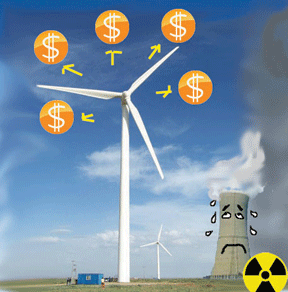
Building wind farms often cheaper than running old coal plants
Fluctuations in solar, wind power remain a challenge: Lazard
Building solar and wind farms has started to become a cheaper proposition than running aging coal and nuclear generators in parts of the U.S., according to financial adviser Lazard Ltd.
Take wind: Building and operating a utility-scale farm costs $30 to $60 a megawatt-hour over its lifetime, and that can drop to as low as $14 when factoring in subsidies, according an annual analysis that Lazard’s been performing for a decade. Meanwhile, just keeping an existing coal plant running can cost $26 to $39 and a nuclear one $25 to $32.
Two years ago, “what was interesting to us was the lifetime cost of renewables on an energy basis reached parity with conventional resources in a bunch of geographies in the U.S.,” said Jonathan Mir, head of the North American power group at Lazard. “Now, what we are seeing is that renewable technologies on a fully loaded basis are beating” existing coal and nuclear plants in some regions.
The report by Lazard, whose estimates are widely used in the power sector as benchmarks, comes as President Donald Trump’s administration is vowing to stop the “war on coal” and put America’s miners back to work. Hundreds of power plants burning the fuel have shut in recent years amid escalating competition from natural gas, wind and solar. Energy Secretary Rick Perry has proposed rewarding coal and nuclear plants with extra payments for their dependability, touching off a national debate over the country’s future power mix.
“We still need, in a modern grid, fuel diversification and a diverse generation stack,” Mir said.So someone has to think hard about how to organize this transition.”
The sudden swings in generation from wind and solar farms remain a challenge for power grid operators, he said. A modern system can handle renewables supplying about 30 percent of its power — and as much as 50 percent in some cases — but levels beyond that require storage technologies, he said.
Gas has helped, backstopping intermittent solar and wind generation. And their combined decline in costs is rapidly changing the U.S. power mix, Mir said. Globally, renewables are set to almost double from last year to make up 51 percent of the mix by 2040, according to Bloomberg New Energy Finance. The challenge of keeping open older plants has arrived faster than expected and more early retirements may ensue, he said.
These days, the most efficient gas-fired plants now cost about $700 a kilowatt to build, down from $1,000 to $1,100 five years ago, Mir said. Rooftop solar remains expensive in the U.S., costing four to five times as much as a utility-sized solar farm.
The drop in renewable energy costs is already changing how utilities operate, Mir said, using American Electric Power Co. as an example. Once the biggest burner of coal in the U.S., AEP is now planning to invest $4.5 billion in wind power and has said it could stop burning the fossil fuel altogether. “AEP is doing this because it is the cheapest way to provide energy,” he said.
To Close Climate Goals Gap: Drop Coal, Ramp Up Renewables — Fast, UN Says
A new UNEP report shows that the gap between the climate promises countries made at Paris and the emissions cuts needed is larger than previously thought. Inside Climate news Georgina Gustin, 2 Nov 17
Countries will have to phase out coal and invest in renewable energy even faster than previously expected to keep global warming below perilous levels and fend off the most dangerous impacts of climate change, according to a United Nations report released just before the next round of international climate talks.
The United Nations Environment Program on Tuesday released its annual report on the “emissions gap“—the distance between countries’ pledged commitments for meeting the targets of the 2015 Paris climate agreement and the pathways that scientists estimate could actually achieve those targets….
“The overarching conclusions of the report are that there is an urgent need for accelerated short-term action and enhanced longer-term national ambition, if the goals of the Paris Agreement are to remain achievable,” the report says. “And that practical and cost-effective options are available to make this possible.”
In other words, the world’s countries need to get moving—and fast. But there’s hope.
Staying Under 1.5C Tough, but Not Impossible
With each edition, the report’s message has become increasingly urgent as growing research suggests that reigning in global warming will require much more action than countries first outlined in their Intended Nationally Determined Contributions (INDCs) in advance of the Paris process……
The report also notes that “subnational” efforts, including those taken by corporations or states—such as the “We Are Still In” initiative and the Northeast’s Regional Greenhouse Gas Initiative—have major potential above countries’ INDCs.
Independent 1st Nov 2017, Germany generated enough wind power at the weekend for consumers to get
free energy. So much was generated by wind turbines in weekend storms that
costs fell to below zero. Bloomberg reported that power prices turned
negative as wind output reached 39,409 megawatts on Saturday. To balance
supply and demand in this situation, energy producers close power stations
or pay consumers to take extra electricity from the network.
Swamp Tales: Puerto Rico Cancels $300 Million Trump Crony Electrical Grid Rebuild Contract, The Progressive, by Harvey Wasserman October 30, 2017, The swampish saga would be hard to invent. In early October, Puerto Rico’s Energy Power Authority awarded a $300 million tax-funded contract to reconstruct the island’s hurricane devastated power grid to a two-person, two-year-old firm based in the small Montana hometown of Trump Interior Secretary Ryan Zinke. The company is financially backed by a major donor to Donald Trump’s 2016 presidential campaign.
About eighty percent of Puerto Rico is still without power. Many hospitals are still dark. Local citizens needing medical treatments such as surgeries or dialysis have been forced to flee to places where electric power is available.
Puerto Rico’s power grid centers on antiquated oil, gas, and coal generators, the median age of which is forty-four years. Just two percent Puerto Rico’s juice came from wind and solar. One wind farm, on the south side of the island, survived Hurricane Maria largely intact, as did at least one small commercial solar array.
For Puerto Rico’s 3.4 million residents, restoring power is a matter of life and death. But the $300 million dollar contract was handed, with no public hearings, legislative discussion or long-term planning, to Whitefish, an obscure company from rural Montana.
At least one Zinke relative—his son—has worked on part-time contract for Whitefish. Zinke claims he had nothing to do with the deal.
Anti-Trump sentiment is rampant throughout the island, fed by a lack of concern expressed by the President for Puerto Ricans’ dire situation, and capped by a recent visit in which he pitched paper towels to a crowd of bewildered local residents. When San Juan mayor Carmen Yulin Cruz questioned the contract with Whitefish, the company threatened to stop work, then apologized.
The Puerto Rican power company’s contract astoundingly exempted Whitefish from official audits, stating, “In no event shall [governmental bodies] have the right to audit or review the cost and profit elements.” It also waived “any claim against Contractor related to delayed completion of the work,” meaning Whitefish was empowered to pretty much take as long as it wanted to complete the job……..
the uproar should also focus on the growing demand that the electric power systems in Puerto Rico and the rest of the Caribbean be reconstructed around renewables and microgrids, rather than fossil-fired central distribution networks.
Most likely those systems will not be built by Trump cronies flown in at huge expense, who then must dodge rocks and bottles being thrown by angry locals.
Independent 27th Oct 2017,German power producers are poised to pay customers to use electricity this
weekend. Wind generation is forecast to climb to a record on Sunday,
creating more output than needed and driving electricity prices below zero,
broker data compiled by Bloomberg show.
Environmental Research Web 28th Oct 2017, In his wide ranging review of energy costs for the UK government, Prof.Dieter Helm says ‘the cost of energy is too high, and higher than
necessary to meet the Climate Change Act (CCA) target and the carbon
budgets. Households and businesses have not fully benefited from the
falling costs of gas and coal, the rapidly falling costs of renewables, or
from the efficiency gains to network and supply costs which come from smart
technologies. Prices should be falling, and they should go on falling into
the medium and longer terms’. And he sets out his ideas for enabling that
to happen.
“India is emerging as the world leader in generating clean energy, although it started by generating 17 MW of solar power in 2010, when Jawaharlal Nehru Solar Mission was launched,” Ms. Jaiswal told the media while inspecting the Kurnool Ultra Mega Solar Park at Sakunala in Gadivemula mandal of Kurnool district, said to be the largest solar park in the world. Andhra Pradesh was in the forefront among other States in solar power generation by setting solar parks to generate 4,000 MW, she added.
There was a global push for clean energy owing to limitations such as coal availability and climate changes, Ms. Jaiswal said. The Paris Climate Agreement signed by Prime Minister Narendra Modi and then US President Barack Obama in 2015 determined that 40% of non-fossil power must be generated by 2030. During his visit to California, Chief Minister N. Chandrababu Naidu held discussions with California Governor Jerry Brown and explained him about his plans to boost solar power, the NDRC Director said.
The NDRC has been working with the Union Ministry of New and Renewable Energy and Ministry of Power since a decade and helped in design and identification of suitable locations for solar parks. It was working with Administrative Staff College of India, Hyderabad, on building energy efficient buildings, working on curbing air pollution at Ahmedabad in Gujarat and heat action plan in 30 cities, including Hyderabad.
NDRC Renewable Lead Nehmat Kaur said the organisation was working in the US, China and India and has three million members. Its focus was on clean energy, climate resilience, air pollution and heat and air-conditioners having cooling with less warmth. The penetration of air-conditioners was 6% in India, where as it was 94% in China, Ms. Kaur said.
The rooftop market for solar power was mainly from the commercial and industrial sectors and some challenges like storage capacity remained in solar parks, Ms. Kaur stated. She advocated the concept of green banks and green bonds to mop up funds for solar power projects and added that they could attract international investors.
A.P. Solar Power Corporation Private Limited CEO G. Adisheshu explained about the 1,000 MW solar parks in Kurnool, Kadapa and Anantapur districts. A 1,000 MW solar park was proposed in Prakasam district besides an additional 500 MW plant in Anantapur. There were plans to set up two or three more solar parks in Kurnool district, he added. He gave a Power-point presentation on Kurnool ultra mega solar park. The NDRC team visited the Greenko office and the control room in the solar park.
Independent 25th Oct 2017. A subsidy ban for new onshore wind farms could add £1bn onto energy bills
over five years by eschewing one of the cheapest forms of clean energy.
Generating power from new onshore wind farms would be £100m a year cheaper
than doing so from new nuclear reactors or biomass plants, and at least
£30m cheaper than under the latest offshore wind-power contracts,
according to research by the Energy & Climate Intelligence Unit, a
London-based non-profit group.









 nuclear-news