French nuclear corporation EDF hedges its bets: now starting 2 renewable energy programmes
Renews 22nd June 2018 Energy giant EDF is celebrating a UK double after cutting the ribbon on two
renewables projects this week. The company’s chairman and chief executive
Jean-Bernard Levy was present for the official opening of both the 41.5MW
Blyth offshore wind farm off the Northumberland coast and the 49MW West
Burton B battery storage facility.
The Blyth project (pictured) features
five MHI Vestas V164-8.0MW turbines optimised to 8.3MW. The West Burton B
facility will operate within the new frequency control system to be
deployed across the UK to improve national grid stability. Levy said:
“These two innovative projects demonstrate our expertise in renewable
energies and electricity storage. They contribute greatly to
decarbonisation of the energy mix in the UK, our second largest market
after France.”
http://renews.biz/111572/edf-celebrates-uk-one-two/
The Financial Times launching a new guide to the “energy transition
FT 15th June 2018 , The Financial Times has launched a new guide to the “energy transition” –
the long-term restructuring of the energy system away from fossil fuels and
towards renewables. In the first of six instalments, the FT delves into the
role of the energy producers, examining “how new technologies and
environmental concerns are transforming the energy mix across the world’.
The guide includes articles on how coal is fading in the developed world
but is far from dead in Asia, why renewables and high costs are challenging
the case for nuclear power, and how natural gas is vying for a big role in
the shift to low-carbon economy. The next instalment, on the role of
citizens, will be published on 31 July.
https://www.ft.com/reports/energy-transition-guide
Reinventing Power: America’s Renewable Energy Boom
changed their lives and benefitted the diverse regions where they live.
“After I lost my job, I had about three days of sulking, and then I got
up and decided to listen to some of my co-workers’ advice to look into
wind turbines,” he said in Reinventing Power: America’s Renewable
Energy Boom, a new film (to be widely released this summer) from the Sierra
Club about the energy revolution in America.
recession. Bruce’s circumstances are not unusual: In the U.S., jobs in
sectors that have traditionally boosted the economy are disappearing. Coal
is environmentally damaging and expensive to mine. Car companies are
looking at an eventual slow-down in sales. Across both sectors and many
more, automation is putting people out of work.
employ over 800,000 people across the country, and are some of the
fastest-growing industries. As these resources scale, they’re becoming
economically viable–solar is around 50% cheaper than coal–and
wide-scale adoption of wind and solar could help curb America’s carbon
emissions. And they’re adaptable across a range of communities:
Reinventing Power traces the establishment of the country’s first
offshore wind farm near the tiny Rhode Island community of Block Island and
delves into community solar programs in Austin and wind power on Northern
Cheyenne Indian Reservation in Montana and a farm in North Carolina, The
film also follows the retraining of former coal miners and auto workers for
jobs in renewables throughout the U.S.
https://amp.fastcompany.com/40580983/this-new-doc-shows-how-renewable-energy-recharges-communities
For energy security, flexibility trumps baseload – the German experience
 ‘Baseload Is Poison’ And 5 Other Lessons From Germany’s Energy Transition https://www.forbes.com/sites/jeffmcmahon/2018/06/10/baseload-is-poison-and-5-other-lessons-from-germanys-energy-transition/#59113a2d6f88https://www.forbes.com/sites/jeffmcmahon/2018/06/10/baseload-is-poison-and-5-other-lessons-from-germanys-energy-transition/#59113a2d6f88 Jun 10, 2018
Baseload power is not the answer to the variability of renewable energy, a German energy official said Friday, and energy storage may not be the answer either.
Germany has achieved moments in its Energiewende, or Energy Transition, in which renewables met 100 percent of demand without the aid of baseload power or batteries, said Thorsten Herdan, a director general for energy policy at the German Federal Ministry for Economic Affairs and Energy. Germany was able to do that, he argued, because of its system’s flexibility.
1. Flexibility Trumps Baseload
“What we need for this fluctuating renewable energy in the electricity mix is not baseload. Baseload is poison for our electricity transition in Germany,” Herdan said in a briefing at the Dirksen Senate Office Building in Washington, D.C. “What you need is flexibility, because the sun is shining and then you have PV production, wind is blowing and you have wind production. So it’s not according to demand, it’s according to weather conditions, which means they are there in any case and then you need to have flexibility to fill the gap.”
Baseload power was traditionally supplied by coal and nuclear plants, with peaks in demand met by natural-gas plants.
But flexibility can displace the old notion of baseload and peak, Herdan said, and flexibility can take many forms, including gas peaker plants, batteries, demand management or regional exchanges. It’s most important to keep in mind, he argued, that flexiblity is the goal, not any one of the forms it takes.
2. Flexibility Trumps Storage
Herdan appeared in a briefing on Germany’s Energy Transition hosted by the Environmental and Energy Study Institute. Asked whether an energy transition like Germany’s will increase the demand for energy storage, Herdan said, “I don’t know whether the demand for storage will increase. What I know is the demand for flexibility will increase, will increase dramatically… and if storage proves to be the cheapest flexibility, and the market chooses storage, then of course storage will increase.
“It’s always coming down to flexibility. That’s what we need and storage is one sort of that.”
But other sorts may prove cheaper:
3. Flexibility Can Be Geographic
Energy storage is not necessarily the cheapest form of flexibility. Germany is building transmission lines into Norway so the two countries can exchange electricity between Germany’s northern wind farms and Norway’s 937 hydropower stations.
“That’s the cheapest flexibility you can think of. We don’t need to build, for that, storage facilities which are much more expensive,” he said. “If you integrate yourself the various states in the U.S. you can see that you can help each other.”
4. Markets Should Be Transparent
To manage flexibility, electricity providers need real-time information about electricity production and demand, Herdan said, and that information should also include the price for the various forms of flexibility.
“All you have to do is create a market, an electricity market, where prices tell the truth,” he said.
“I’m talking to everyone in the world about transparency, I tell them, try to get your data on electricity production real-time. We didn’t have that for a long time, and all the various lobby groups told us a lot of interesting stories. So we decided we needed to have in real time the electricity produced in every second from every source so that we know what’s going on.”
5. Flexibility Provides Reliability
Germany moved from almost no renewable energy in the 1990s to 37 percent today—its single largest block of power, almost all of it generated from wind and solar photovoltaic. Anxieties about a loss of grid reliability have not materialized, Herdan said:
“The grid is extremely stable. We have grid disruption in a year of about 12 minutes. So, 12 minutes a year is effectively nothing,” he said, citing Germany’s average duration of electric supply disruption. The comparable number in the U.S., where power producers boast of their reliability, is 114 minutes.
“So we could cope with the question of whether we can adopt a high share of renewables, the volatile ones in our grid, and we would like to talk with you about how we achieved that, what we did right, what we did wrong, and how can we perhaps achieve that in the States.”
6. Powerful Price Signals Help
Germany has more than 100 Gigawatts of renewable capacity, more than enough to meet a demand that fluctuates between 40 and 85GW. One day in May, renewables were meeting 100 percent of demand, Herdan said, and the price of electricity dropped below zero.
“At the time the renewables were at 100 percent, the price went down and it was negative, so we had a negative price, and what we say is, fine, there is nothing bad in negative prices because that very clearly tells the other generators how to behave,” he said. “That forced the generators, specifically the coal generators, to change their behavior, shut them down or reduce them or whatever is possible.”
Market transparency and real-time data allow prices to send such immediate signals to power producers.
“That is something that we established last year and that we heavily use in order to not be told by lobby groups that offshore wind power is the best one, or coal generators are the most flexible ones, we can see what happens, and we can tell them how they should behave or the market tells them how they should behave.”
Herdan cautioned that Germany’s example is not a model for every country. Germany has decided not to use nuclear power, for example, and few countries share that commitment. But he contends that Germany’s example reveals an underlying principle about the importance of flexiblity.
“Of course as I said in the beginning it’s different in the various countries around the world and also in the U.S., but this principle—that if you create renewable energy you need to have flexibility and no baseload—that is valid for each and every country in the world.”
Caroline Lucas: Backing Wylfa Nuclear Power Station Is The Wrong Move At The Wrong Time
Huffington Post 5th June 2018, Behind its shiny green veneer, this government has overseen
the funding stream for clean energy fall to its lowest levels in a decade.
The context for this public payout for new nuclear is an energy market
that’s making it blindingly obvious that renewables are the future. Solar
and wind are now the cheapest forms of new electricity generation, and new
technology means that power from the sun, sea and wind, balanced with
batteries and interconnection, are able to be the backbone of British
energy in the future.
Onshore wind – which the Government has all but
banned – could have a strike price a whopping £37.50 lower than Wylfa’s.
The frequent retort to those of us who oppose nuclear is centred on the
need for ‘baseload’ power – but such arguments are increasingly weak.
We know that battery technology is coming on leaps and bounds – and even
the ex-head of National Grid, Steve Holliday, has said that “the idea of
large power stations for baseload is outdated”, and noted that “from a
consumer’s point of view, the solar on the rooftop is going to be the
baseload”.
But it’s not just the government’s skewed financial
priorities that make Wylfa the wrong move at the wrong time. At the heart
of the problems with nuclear energy is the stark fact that there is still
no solution to the nuclear waste problem.
https://www.huffingtonpost.co.uk/entry/wylfa_uk_5b164eafe4b093ac33a17a41
UK govt’s new funding of nuclear projects contrasts with its lack of support for renewable project in Wales
NFLA 5th June 2018 , The Nuclear Free Local Authorities (NFLA) is very disappointed, but not at
all surprised, with the announcement by UK Energy Minister Greg Barker to
offer £5 billion of taxpayer money to assist with the funding of the Wylfa
B new nuclear reactor in Anglesey.
Whilst going against years of previous
government policy, it also compares unfavourably with the expected lack of
Government support of an exciting new renewable energy project in Wales –
the proposed development of the Swansea tidal lagoon scheme, and future
projects planned in Cardiff Bay and off the north Wales coast.
At present this scheme looks to be on a life support machine, though the Government
delayed the expected announcement to ditch the project and the thousands of
jobs that could be created.
http://www.nuclearpolicy.info/news/wylfa-b-swansea-bay-tidal-lagoon-developing-low-carbon-energy-solutions/
UK wind power – much cheaper than planned Wylfa nuclear power plant
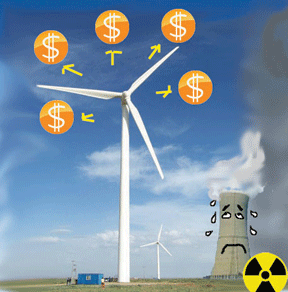
 ‘Cheap’ power at Wylfa nuclear plant blown away by wind, The Times, Emily Gosden, Energy Editor, 2 June 18 The electricity generated by the Wylfa nuclear plant could be about a fifth
cheaper than Hinkley Point’s but is likely to be much more expensive than
power from the latest offshore wind farms. It is understood that a figure
of close to £75 per megawatt-hour is under discussion as the “strike
price” that Hitachi, the Japanese conglomerate developing the Anglesey
plant, would be guaranteed by the government for the electricity it
produces. The difference between the guaranteed price and the wholesale
price — currently £50 per MWh — would be paid for by consumers through
levies on their energy bills.
Ministers are preparing to announce next week
the outline of a deal to fund the proposed Wylfa plant, which could cost in
excess of £15 billion. The twin-reactor plant could generate 2.9 gigawatts
of electricity, enough to power five million homes. It is due to start
generating in the mid 2020s. The government plans to invest directly in
Wylfa, as well as to offer extensive guarantee loans for the project. These
measures are designed to cut the cost of the project and so lower the price
that consumers will have to cover.
Critics of nuclear power are likely to
draw unfavourable comparisons with offshore wind. Two projects in UK waters
were awarded guarantees prices of £57.50 per MWh last year. Some onshore
wind and solar projects are being built without any subsidy.
https://www.thetimes.co.uk/article/cheap-power-at-nuclear-plant-blown-away-by-wind-3bzc2h5qm
International Renewable Energy Agency reports on companies across 75 nations sourcing renewable energy
Edie 29th May 2018,A new report from the International Renewable Energy Agency (IRENA) found
that corporates have actively sourced renewable energy equivalent to the overall demand of France, but renewables demand could soar if companies turned voluntary agreements into active goals.
The new IRENA report, published at last week’s Clean Energy Ministerial meeting in Copenhagen,
found that more than 2,400 companies across 75 nations sourced 465TWh of renewable energy in 2017. The report found that more than half of the companies studied are voluntarily procuring and investing in onsite generation or purchasing agreements to power their operations with renewable electricity.
Of the companies listed in the study, more than 200 are sourcing 50% or more of their energy from renewables. According to IRENA, 100% of active corporate sourcing of renewable electricity is “already feasible”, but the report found that just 17% of the companies listed had a renewable electricity target in place and three-quarters of these targets are set to expire before 2020.
MS Tûranor PlanetSolar – huge solar-powered ship
Business Insider 26th May 2018, This huge seacraft is developed by Swiss company PlanetSolar, who wanted to
create a vessel which was environmentally friendly and produced
zero-emissions. Developed in 2010, the MS Tûranor PlanetSolar is the
largest solar-powered boat ever built. Its 500 solar panels can provide 120
kilowatts of energy, allowing the ship to travel around 5 knots.
http://uk.businessinsider.com/this-huge-seacraft-is-entirely-powered-by-solar-energy-planet-solar-2018-5
Solar and Wind Subsidies are a Clear Success. The Coal and Nuclear Industries Just Aren’t Ready to Admit it.

https://www.ewg.org/news-and-analysis/2018/05/solar-and-wind-subsidies-are-clear-success-coal-and-nuclear-industries#.Wwh8jTSFPGg By Grant Smith, Senior Energy Policy Advisor 25 May 18
Scotland’s ambitious target for 100% renewable energy
Scottish Government 24th May 2018 Scotland will become one of the first countries to achieve a 100% reduction
in carbon emissions, Climate Change Secretary Roseanna Cunningham has said.
The new Climate Change Bill will immediately set a target of a 90%
reduction by 2050, which the UK Committee on Climate Change (UK CCC) states
is currently “at the limit of feasibility.”
The draft Bill sets out that the Scottish Government intends to go further still and achieve a 100%
reduction in emissions, known as ‘net-zero’, as soon as possible.
Ministers will be legally required to keep the net-zero target date under
review by seeking expert advice on the issue every five years. The target
date will become legally-binding, subject to the consent of the Scottish
Parliament, as soon as there is sufficient evidence to demonstrate the date
is credible and achievable.
As well as increasing long term ambition, the
new Bill also includes the most ambitious interim targets in the world, as
well as stretching annual targets for every year between now and 2050. This
means action will need to increase immediately, across every sector of the
Scottish economy. It will also require action by individuals, communities
and businesses – as well as government.
https://news.gov.scot/news/commitment-to-net-zero-greenhouse-gas-emissions
Response to ‘Burden of proof: A comprehensive review of the feasibility of 100% renewable-electricity systems’
 Science Direct 18 May 18
- https://doi.org/10.1016/j.rser.2018.
Highlights
- •We respond to a recent article that is critical of the feasibility of 100% renewable-electricity systems.
- •Based on a literature review we show that none of the issues raised in the article are critical for feasibility or viability.
- •Each issue can be addressed at low economic cost, while not affecting the main conclusions of the reviewed studies.
- •We highlight methodological problems with the choice and evaluation of the feasibility criteria.
- •We provide further evidence for the feasibility and viability of renewables-based systems.
-
Abstract
A recent article ‘Burden of proof: A comprehensive review of the feasibility of 100% renewable-electricity systems’ claims that many studies of 100% renewable electricity systems do not demonstrate sufficient technical feasibility, according to the criteria of the article’s authors (henceforth ‘the authors’). Here we analyse the authors’ methodology and find it problematic. The feasibility criteria chosen by the authors are important, but are also easily addressed at low economic cost, while not affecting the main conclusions of the reviewed studies and certainly not affecting their technical feasibility. A more thorough review reveals that all of the issues have already been addressed in the engineering and modelling literature. Nuclear power, which the authors have evaluated positively elsewhere, faces other, genuine feasibility problems, such as the finiteness of uranium resources and a reliance on unproven technologies in the medium- to long-term. Energy systems based on renewables, on the other hand, are not only feasible, but already economically viable and decreasing in cost every year
-
1. Introduction
………..https://www.sciencedirect.com/science/article/pii/S1364032118303307
Britain’s wind power stations providing more electricity than its nuclear stations, in first quarter of 2018
Wind power overtakes nuclear for first time in UK across a quarter https://www.theguardian.com/environment/2018/may/16/wind-power-overtakes-nuclear-for-first-time-in-uk-across-a-quarterNews of milestone comes as MPs say policy changes have caused collapse in investment in renewables, Guardian, Adam Vaughan, 16 May 18,
Britain’s windfarms provided more electricity than its eight nuclear power stations in the first three months of 2018, marking the first time wind has overtaken nuclear across a quarter.
The renewable energy industry hailed the milestone as a sign the UK was well on its way to an electricity system powered by cheap, domestic green energy.
Across the first quarter, wind power produced 18.8% of electricity, second only to gas, said a report by researchers at Imperial College London.
At one point overnight on 17 March, wind turbines briefly provided almost half of the UK’s electricity. Wind power helped during the cold snaps, too, supplying 12-43% of electricity during the six subzero days in the first three months of the year.
Two nuclear plants were temporarily offline for routine maintenance, while another was shut because of seaweed in the cooling system.
While wind together with solar supplied more power than nuclear in the final three months of 2017, thiswas the first time wind has managed the feat alone.
Dr Rob Gross, one of the authors of the Drax Electric Insights report, said: “There’s no sign of a limit to what we’re able to do with wind in the near future.”
The opening in December of a new power cable between Scotland and north Wales also helped unlock electricity from Scottish windfarms, some of which would normally be turned off to help National Grid cope.
The Western Link connection has drastically cut the amount of money paid by National Grid to windfarm owners for that curtailment. The company paid £100m in 2017 for curtailment. This year payments are already down by two-thirds.
Emma Pinchbeck, the executive director at industry group RenewableUK, said: “It is great news for everyone that rather than turning turbines off to manage our ageing grid, the new cable instead will make best use of wind energy.”
News of the quarterly milestone came as MPs said UK emissions targets were threatened by government policy changes, which had caused a collapse in clean energy investment since 2015, including a 56% fall in 2017.
Mary Creagh, Labour MP and chair of the environmental audit committee, said: “Billions of pounds of investment is needed in clean energy, transport, heating and industry to meet our carbon targets. But a dramatic fall in investment is threatening the government’s ability to meet legally binding climate change targets.”
Separately, the spending watchdog concluded that £23bn spent on a government subsidy scheme for low-carbon heating had been poor value for money and did not deliver its aims.
The public accounts committee said the renewable heat incentive had “wildly optimistic” goals and that the government failed to understand what consumers wanted.
Air conditioning units – electricity guzzlers – a threatening contribution to climate change
FT 15th May 2018 , The spread of air-conditioning in hot countries is set to create a huge
increase in demand for electricity, threatening efforts to curb greenhouse
gas emissions, according to the International Energy Agency, the watchdog
backed by consuming countries. Over the next 30 years, air-conditioning
could increase global demand for electricity by the entire capacity of the
US, the EU and Japan combined, unless there are significant improvements in
the efficiency of the equipment, the IEA warned. In a report released on
Tuesday, the agency urged governments to use regulations and incentives to
improve the efficiency of air-conditioning units, to avoid a surge in
demand that could put strains on energy supplies and increase greenhouse
gas emissions.
https://www.ft.com/content/6c062996-582c-11e8-bdb7-f6677d2e1ce8
Electricite de France (EDF) is lying about renewable energy: it’s really dedicated to nuclear power

Greenpeace France 14th May 2018 [Machine Translation] On the eve of EDF’s Annual General Meeting,
Greenpeace France points to the deception that EDF’s CEO has been driving for several months and will present the shareholders of the company tomorrow.
With a lot of communication on the energy transition, the company is far from developing renewable energies and directs almost all of its investments in nuclear power. That is a losing strategy, both for the company, and for France, which is lagging far behind the implementation of its energy transition.
Faced with EDF shareholders, Jean-Bernard Lévy will no doubt say tomorrow that the company plays a central role in the energy transition, with its solar plan for 2035 presented in December 2017. ” In reality, when we compare the calendars and EDF budgets, we realize that the company will mainly give priority to investments in the nuclear fleet and
postpone its investments in solar …
In general, the company is already behind the targets that she fixed herself. And yet, in 2017, it devoted only 10% of its investments to renewables! ” Exclaims Alix Mazounie, energy campaigner for Greenpeace France.
https://www.greenpeace.fr/espace-presse/ag-dedf-3-intox-jean-bernard-levy-presentera-demain-aux-actionnaires/
1 This Month



26 September – International Day for the Total Elimination of Nuclear Weapons


PLEASE OPPOSE HR 8255 AND S.3639 – bills would accelerate satellite deployment, with no environmental review or safeguards – https://ncstd5li.quorum.us/campaign/169331/
To see nuclear-related stories in greater depth and intensity – go to https://nuclearinformation.wordpress.com
-
Archives
- September 2026 (219)
- August 2026 (330)
- July 2026 (355)
- June 2026 (287)
- May 2026 (306)
- April 2026 (356)
- March 2026 (251)
- February 2026 (267)
- January 2026 (308)
- December 2025 (358)
- November 2025 (359)
- October 2025 (375)
-
Categories
- 1
- 1 NUCLEAR ISSUES
- business and costs
- climate change
- culture and arts
- ENERGY
- environment
- health
- history
- indigenous issues
- Legal
- marketing of nuclear
- media
- opposition to nuclear
- PERSONAL STORIES
- politics
- politics international
- Religion and ethics
- safety
- secrets,lies and civil liberties
- spinbuster
- technology
- Uranium
- wastes
- weapons and war
- Women
- 2 WORLD
- ACTION
- AFRICA
- Atrocities
- AUSTRALIA
- Christina's notes
- Christina's themes
- culture and arts
- Events
- Fuk 2022
- Fuk 2023
- Fukushima 2017
- Fukushima 2018
- fukushima 2019
- Fukushima 2020
- Fukushima 2021
- general
- global warming
- Humour (God we need it)
- Nuclear
- RARE EARTHS
- Reference
- resources – print
- Resources -audiovicual
- Weekly Newsletter
- World
- World Nuclear
- YouTube
-
RSS
Entries RSS
Comments RSS
 nuclear-news