Transition will halve our energy costs by 2050

NESO report says net zero will make energy cheaper within 25 years
Energy Live News 11th Dec 2025
Britain could halve its energy spending by 2050 as decarbonisation cuts costs and shields the economy from fossil fuel shocks.
That is the headline finding from NESO’s new analysis of the Future Energy Scenarios 2025 which lays out three illustrative routes to net zero and the price tags attached.
NESO says energy-related costs fall in every pathway dropping from roughly 10% of GDP today to around 5-6% by mid-century even as demand rises due to population growth, economic expansion and power-hungry data centres.
The reason is simple. Spending shifts from imported fossil fuels to homegrown renewables, stronger networks and efficient electric heating which cut operating costs and create local jobs.
The report also shows just how much a net zero system protects the country………….. https://www.energylivenews.com/2025/12/11/transition-will-halve-our-energy-costs-by-2050/
Building energy resilience in an uncertain world

Satisfying the demand for energy via a resilient system is important, but the system can be made even less vulnerable by reducing that demand. As the Green Alliance report notes, “the most secure unit of energy is the unit that does not need to be consumed”.
Cutting demand is emerging as one of the most powerful and overlooked options for strengthening energy security.
Lucy Colback. Ft. Dec 12 2025
In a world of polarised politics and with a shift from globalisation to national self-interest, energy resilience is a growing concern for governments. Securing stable supply requires managing considerations such as where a country’s fuel is sourced, how energy is stored and distributed, and how the system is protected from attack.
…………………………………………………………………………………………………………. Ensuring a stable and resilient fuel and energy mix and reliable infrastructure secure against cyber and physical attacks, as well as climate-related events, are all factors that need to be addressed when building a system that can withstand shocks.
Diversification of sources
…………………………………………………………………………………………………At the very least, the bloc’s overall supply picture now looks more diversified.
Fuel
The global mix of energy sources is changing as governments and industry seek to reduce their reliance on fossil fuels and slow the effects of climate change. ……………………………………………………………………………………………………………………………………………..
the [nuclear] sector must overcome multiple challenges, including workforce shortages, complex construction that can lead to cost overruns and delays and public opposition over safety concerns.
Infrastructure challenges
………………………………………………………………………………………………………………….“If you can implement smart demand reduction, not just draconian consumption limits, but market structures that allow people to turn their thermostat down at times of peak load, or agglomerate these so-called distributed energy resources in smart ways, you can really take the edge off energy security challenges while maintaining affordability for consumers.”
Cyber challenges and physical attacks……………………………………………………………….
Demand side policies
Satisfying the demand for energy via a resilient system is important, but the system can be made even less vulnerable by reducing that demand. As the Green Alliance report notes, “the most secure unit of energy is the unit that does not need to be consumed
A joint UK Energy Demand Research Centre and UK Energy Research Centre report focuses solely on demand side measures not as a reactive solution to crises but a proactive part of any energy security strategy. It says that one-off subsidies such as the £51bn it cost in 2022-23 to fill holes in household budgets created by rising energy prices would have been better spent on insulating the nation against future shocks by implementing longer-term energy demand reduction policies. This does not mean absolute demand side reduction for its own sake without the consideration of growth. With the right strategy in place, economic activity need not be sacrificed to achieve lower energy consumption, it says.
Marie Claire Brisbois, an interdisciplinary researcher into power, politics and influence in energy, water and climate governance at University College London and an author of the report, says that “people become more secure as nationally we need less energy”. While implementing such policies might be a problem for energy companies, moving individuals from a state of energy poverty to energy security is “surely better for the nation” as a whole. Resistance seems to come from lobbying and pressure industries, says Brisbois, who believes that this frequently waters down solutions “so obvious as to be absurd”, such as better insulation, heat pumps and solar panels installed as standard for new homes.
Governments could take other measures, too, for instance discouraging the use of SUVs in cities such as London which were not designed for large vehicles. “Why aren’t we doing this?” asks Brisbois. “I’m not sure. Paris is taxing large vehicles so it’s not unprecedented. However, regulating size does limit choice in markets that are supposed to be ‘free’ and I’m sure car lobbies are active in pushing back against this.”
Consumers might be open to simple policies universally implemented, such as improved household appliance efficiency. An ongoing study run by the Energy Demand Research Centre and the charity Involve is investigating citizens’ receptiveness to a suite of demand side policies, including using more public transport rather than their own cars — an approach more people might countenance if they could trust the government to provide reliable and safe services. Such measures would reduce energy consumption at the household level while boosting economic productivity and employment, says Brisbois, noting this is corroborated by a recent paper in ScienceDirect. She also says that a four-day workweek for intellectual jobs would improve energy efficiency and has been proven to increase productivity
These would augment existing measures such as the electrification of the heat and transport sectors, which have already delivered relative demand reduction given their better fuel efficiency than fossil driven equivalents. Other consumer side policies such as distributed clean energy — solar generation on people’s homes, for instance — have been around in many places for two decades, alleviating the pressure on national networks and infrastructure.
A further plank is to implement demand side response, encouraging consumers to vary their electricity consumption to smooth out high and low demand periods or to install on-site storage, such as batteries, to redistribute energy proactively from trough to peak hours. Majkut at the CSIS says: “Digital tools — you could even extend this into artificial intelligence — provide us the ability to build energy resilience on the demand side as we think about the sort of market structures and traditional energy security tools we need on the supply side.”
Conclusion
………………………………………………………………………………………. .
Majkut says: “The demand spike in the power sector and the thin excess capacity in our electricity grid is definitely a reliability issue and could really challenge our tools for resilience. If we manage demand growth poorly, or if we close resources too quickly, we could have a lot more disruption than we have now.”
Britain’s AI boom is running straight into an energy wall
Nuclear power was supposed to act as its crutch to get around it. Instead, the government has hit pause, just as data centre demand is set to explode, leading investors wondering whether the UK risks talking itself out of its opportunity.
Recent analysis from the Nuclear Industry Association and
Oxford Economics warned that data-centre electricity demand will jump more than fivefold by 2030, swallowing nearly nine per cent of the UK’s total
power use.
The AI labs and hyperscalers behind that surge want plug
in-ready, 24/7 power, all within two years. Britain currently hands out
grid connections on a ten year timetable. This forms the backdrop to Rachel Reeves’ decision to stall a sweeping package of planning reforms that had promised to finally streamline nuclear development. Fingleton’s review, which coined the now-infamous ‘fish disco’ as a symbol of regulatory overreach, was meant to clear undergrowth.
City AM 9th Dec 2025,
https://www.cityam.com/britains-nuclear-lag-could-cost-its-ai-crown/
Renewables deliver nearly two thirds of power fed to grid in Germany, not including self-consumption

Nearly two thirds of all electricity fed into Germany’s public grid
between July and September 2025 came from renewable power sources, the
country’s statistical office Destatis said, based on preliminary data.
With 98.3 billion kilowatt-hours (kWh), wind turbines, solar panels and
other renewables contributed 64.1 percent to the electricity mix, up from
63.5 percent in the same period last year. Total renewable power production
rose three percent compared to the third quarter of 2024, while total
electricity production increased by two percent. A robust expansion of
renewable power sources led to record output levels for a third quarter:
Wind power production increased by more than ten percent compared to the
third quarter of 2024, reaching a share of over one quarter (26.8%) of the
power mix, while solar PV output rose 3.2 percent to a share of 24.1
percent.
Renew Economy 9th Dec 2025,
https://reneweconomy.com.au/renewables-deliver-nearly-two-thirds-of-power-fed-to-grid-in-germany-not-including-self-consumption/
Report: Small Modular Distractors: Why a European SMR strategy hinders the energy transition

09/12/2025, https://caneurope.org/small-modular-distractors/
Click on image [on original] to download the report
“Our investigation demonstrates why betting on small modular reactors would be a costly mistake for Europe. These projects would be slow to construct, with long delays, over budget, a poor economic fit for our power system needs, and would produce toxic radioactive waste for which we do not have a solution. Many projects would likely not materialise and jeopardise our electricity supply. Distorting funding away from more realistic, lower-cost solutions such as renewables, storage, and demand side solutions risks derailing the energy transition, keeping our emissions and energy prices high.” – Thomas Lewis, Author and Energy Policy Coordinator at CAN Europe
An EU Small Modular Strategy is a distraction
Small modular reactors are not a viable solution to decarbonising our energy system and supporting a transition to net zero. The technology has not been demonstrated at any sort of scale, with great unknowns when it comes to design.
CAN Europe’s latest report details how SMR projects have been shown to be significantly delayed compared to initial estimates, are slower to construct than traditional nuclear, consistently over budget, more expensive than renewables, not economically fit to provide flexibility, not very small, deter funding away from realistic renewable solutions, produce more waste than traditional nuclear, and citizens have little trust in their governments to implement plans fairly. They are also planned under the assumption that the governments would take responsibility and invest in enabling infrastructure such as grids and nuclear storage facilities.
An EU SMR Strategy, as well as national plans to pursue SMRs, risks diverting attention, resources, and political momentum away from the proven solutions needed for a fast, fair, and effective energy transition. While the following recommendations aim to minimise the potential negative impacts of SMR-related initiatives, it is important to underline that only a transition pathway without new nuclear capacity can deliver the speed, cost-effectiveness, and system resilience required for Europe’s decarbonisation.
Diagrams and graphs within the report can be downloaded below: [ on original]
Nuclear (in)flexibility, nearly 100% electricity from solar PV and offshore wind surge!
David Toke, Dec 08, 2025
I keep hearing claims, most recently from the British Government, about how nuclear power can be used flexibly to help balance fluctuating wind and solar. But in reality in most situations around the world nuclear is inflexible and its operation simply pushes wind and solar off the grid. Also, according to a report from Ember, cheaper batteries and proliferating solar can lead to solar on its own cheaply providing all electricity demand for 97-99 per cent of the time in the sunnier parts of the world. Meanwhile back in the UK offshore wind is now surpassing generation from natural gas according to the Energy and Climate Intelligence Unit (ECIU).
Tales of SMRs nuclear (in)flexibility
Looking around the world, it is very difficult to find any examples of nuclear power being flexible. The main example quoted is France. However, France has some close connections with the rest of the European continent. These differ for example, to the connections to the UK and the continent.
Unlike the UK, the French electricity system operator has no choice but to order the scaling down of some French nuclear plant. This is to cope with inflows of wind and solar across its borders that they cannot stop. In Britain where the inflows can be better controlled, as elsewhere, nuclear operators would prefer not to be flexible. Instead, wind and solar power get turned off and the renewable sources are blamed for energy that is really being wasted by inflexible nuclear operations! A study of Scotland, where a lot of wind power is constrained because of a lack of grid capacity, found that most wind power would not have been be wasted if there were no nuclear power station s operating in Scotland (see HERE). And, in practice there is no chance of nuclear power plant being flexible in normal operations, whatever people say!
The current UK Government is struggling to mask the fact that it’s so-called new generation of ‘small modular reactors’ (SMRs) is going to cost even more, MW for MW, than the much-overpriced Hinkley C and Sizewell C Nuclear plant. Rolls Royce is leading the charge here with a proposed 470MW (not small!) nuclear reactor. This will come into operation sometime in the next 20 years or so. According to Rolls Royce this development will be ‘equivalent to more than 150 onshore wind turbines’‘ (See HERE) Ah, so that’s the crack! SMRs are now promised to replace wind turbines! That will please the wideley expected future leader, Nigel Farage! Nigel hates windfarms but loves Rolls Royce and nuclear stuff – so patriotic, he claims!
I must say, it’s pretty small fare. I mean the Rolls Royce ‘SMR’ will only replace 150 onshore wind turbines – and at double or probably triple the price of onshore wind in delivered energy! (currently there are over 11000 wind turbines in the UK). Not much of a bargain really for Nigel, there I’m afraid. But really, as with populists the world round, its the headlines that matter, and never mind the facts!
Of course, as with other policies the Government is struggling to compete in messaging with the far-right. In doing so it feels it has to buy into a lot of myths about nuclear power. As one Government minister was made to say recently (presumably by his pro-nuclear civil servants) in an answer to a Parliamentary Question from a Liberal Democrat MP:
‘The next generation of nuclear, including small modular reactors (SMR), offers new possibilities including faster deployment, lower capital costs, and greater flexibility…..Whilst nuclear energy has a unique role to play in delivering stable, low carbon baseload energy, SMRs may be able to serve the electricity grid more flexibly than traditional nuclear, as well as unlock a range of additional applications in energy sectors beyond grid electricity.’ (See HERE)
What unbelievable nonsense! I would never want to be a government minister and have to spout such rubbish! I’ve already suggested that the SMR(s) will take a long time to emerge at eye-watering cost. But flexibility? Why should this happen? It does not happen now with the PWR plant at Sizewell B. So why should it happen with the Rolls Royce ‘SMR’ which is also a PWR? No reason at all!
In fact the Rolls Royce ‘SMR’ it is even less likely to operate flexibly than Sizewell B (which does not). This is because of the likelihood that, as in the case of Hinkley C, Rolls Royce will be offered a so-called ‘baseload’ contract. This means that the nuclear power plant are paid a set price for every MWh they generate – whenever it is generated. It does not matter whether wholesale prices become negative and wind and solar is forced off the system, nuclear continues to generate.
Rolls Royce will no doubt be given such a contract to ensure that the investors get a virtually guaranteed return. Otherwise it will be virtually impossible to attract private investors to give the required facade of part-private finance to the operation. In reality of course the bulk of the money to finance the equity for the plant will come directly from the taxpayer and the consumers will pick up the bill for the inevitable cost overruns.
To cap it all, the SMR(s) will contribute practically nothing to balancing renewables since that will be done by ‘peak’ gas plant (see my blog post HERE).
Almost 100 per cent 24/7 electricity from solar + batteries
Meanwhile solar PV is advancing around the world at several times the pace of new nuclear and fossil fuel power plant. See my earlier blog post HERE and the Figure below. Now, the energy think tank ‘Ember’ (see HERE) conclude that almost 100 per cent electricity can be delivered cheaply in the sunnier parts of the year using solely solar PV and batteries.
In places like Las Vegas and Oman 97-99 per cent of all electricity demand, 24/7 can be provided solely by solar PV for a cost of $104 per MWh. That is exactly the wholesale power price in the UK. It should be recalled that they are talking about just solar PV and batteries, never mind other renewables………………………………………………………………………………… https://davidtoke.substack.com/p/nuclear-inflexibility-nearly-100
Do we really want to bust net zero targets for AI cat pics?
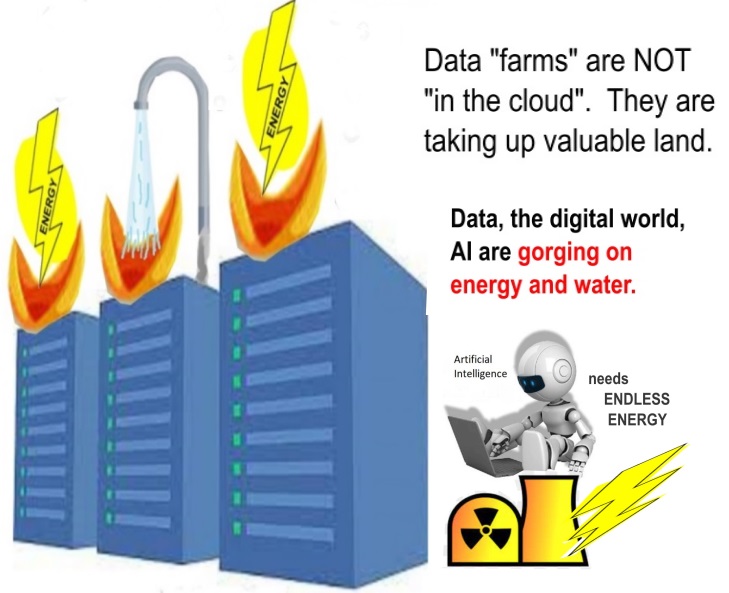
In total, across Scotland, according to the tech justice non-profit Foxglove, energy-hungry data centres which would demand “a minimum of 2000MW of electricity supply, and as much as 3000MW” are already in planning.
That figure, Foxglove points out is already equivalent to “the total generation capacity of all of Scotland’s offshore wind turbines in 2024 (2971MW)” or “the total output of the Torness and Hunterston B nuclear power stations while both were still in operation”. One projection from Loughborough University’s Digital Decarb Design Group suggests that, globally, if data consumption continues unabated, “electricity demand
driven by data could exceed global electricity production by 2033”
Of course, AI can be helpful. There are many good things already which have come out of it. It can diagnose disease, prevent accidents, help us cut waste, streamline systems, even streamline the energy and material use by AI itself.
But we only need to open our social media apps to see what much of it is actually doing. I do think my cat looks majestic in full flight, but she is far cuter sitting on the chair by me as I write. Do we really want to risk climate goals in order to just power up relentless AI video slop?
Herald 2nd Dec 2025, By Vicky Allan, Environment correspondent, https://www.heraldscotland.com/opinion/25666089.really-want-bust-net-zero-targets-ai-cat-pics/
Trump’s AI Push May Hinge on Renewable Energy
By Kyle Stock and Mark Chediak, December 5, 2025 , https://origin.www.bloomberg.com/news/newsletters/2025-12-04/how-trump-s-renewables-roadblocks-can-stall-the-ai-boom
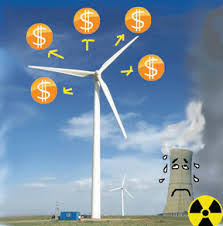
President Donald Trump is pro-AI and anti-renewables. But those two stances are increasingly contradictory: Data centers need quick power on the cheap, and that’s exactly what renewables offer.
Today’s newsletter takes you inside the mismatch and why opposing renewables might do more than hinder the US in the battle for AI supremacy.
The Trump administration is moving to fast-track the construction of power-hungry data centers as a matter of national security. At the same time, it’s adding roadblocks for new solar and wind farms.
But the two policies could be at odds: Hindering renewable energy projects risks slowing the AI boom — and could exacerbate rising electricity prices, a slew of data suggests.
“It’s an all-hands-on-deck moment right now to get the power to supply this,” said Robert Whaley, director of North American power at Wood Mackenzie, an energy consultancy. “In the next 10 years, there’s really nothing to replace renewables.”
The AI explosion — and its energy demands — is happening much faster than the pace at which utilities typically plan and build large power plants. In response, tech giants like Meta Platforms Inc. and Alphabet Inc.’s Google have taken extreme measures to keep up, cobbling together data centers in tents and signing contracts for their own power plants.
Wind and Solar Are Now Cheaper
Cost to build electricity generation in dollars per megawatt hour, based on recent projects and fuel costs
Renewable energy so far remains the fastest and cheapest option to add power to the grid. Nearly 80% of the planned power plant capacity in the pipeline is tied to renewable sources, according to filings with federal regulators and grid operators compiled by Cleanview.co, an energy data company.
The number of applications for natural gas and nuclear facilities, the options President Donald Trump is embracing to power the AI surge, is much smaller, making up about 14% of planned capacity.
The dynamic creates a potential political challenge for Trump, whose goal of using the AI boom as an engine for the American economy risks blowback at the ballot box if voters blame the data centers he’s championed for higher power bills.
“President Trump is expanding base load power from reliable energy sources like natural gas, coal, and nuclear to support growing electricity demand from AI and data centers,” said Taylor Rogers, a White House spokesperson. “Intermittent and unreliable energy sources like offshore wind that were propped up by the Green New Scam simply cannot generate the sustained power needed to make the United States the global leader in cutting-edge technologies like AI and quantum computing.”
US New Electricity
New electrons from solar, storage and wind are expected to outnumber those of new natural gas plants almost six-fold in the next 10 years
But the cost to build solar and wind farms plummeted in the years before those incentives were scrapped. Meanwhile, building up enough gas and nuclear plants to power data centers may prove too slow and expensive. Gas turbines, critical equipment to turn natural gas into electricity, are in short supply, and even though Trump is moving to accelerate permitting of the next generation of small-modular nuclear reactors, the next wave of those aren’t expected to be built until the end of the decade at the earliest.
At this point, battery storage systems, solar arrays and wind farms are faster and cheaper to build per kilowatt of capacity than anything else, according to Lazard.
Another advantage to renewable-powered data centers is that those equipped to supply their own power during heatwaves and other emergencies can begin operations much more quickly than those reliant solely on traditional utility hookups, according to a new study by Princeton University’s ZERO Lab in conjunction with energy software firms Camus Energy and encoord.
Installing onsite natural gas turbines, solar panels or batteries means data centers can achieve a speedier connection to the grid because they will represent less of a demand stress when electricity is tight. In some cases, the wait time can be cut by as much as five years — a significant difference in an industry where grid hookups can stretch up to seven years.
Read the full stories on how renewables projects are quietly getting built
South Australia averages 100 pct wind and solar over week, 90 pct over last 28 days

South Australia – the country’s most advanced renewables grid – has
average more than 100 per cent net renewables (compared to state demand)
over the past week, and more than 90 per cent renewables over the last 28
days. It is not the first time that South Australia has reached 100 per
cent renewables – it has done so previously over the Christmas/New Year
period – but it marks a significant milestone, given that its mix of
renewables is made up entirely of variable wind and solar, and with no
hydro or even biomass to speak of.
Renew Economy 2nd Dec 2025, https://reneweconomy.com.au/south-australia-averages-100-pct-wind-and-solar-over-week-90-pct-over-last-28-days/
Inside the power-hungry data centres taking over Britain.

Our thirst for AI is fuelling a new construction wave: of giant data centres. But can ourelectricity and water systems cope — and what will the neighbours say?
Plants [like the one] run by the company Stellium on the outskirts of
Newcastle upon Tyne, are springing up across the country.
There are already
more than 500 data centres operating in the UK, many of which have been
around since the Nineties and Noughties. They grew in number as businesses and governments digitised their work and stored their data in outsourced “clouds”, while the public switched to shopping, banking and even tracking their bicycle rides online.
But it was in 2022, when a nascent
technology company called OpenAI launched ChatGPT, that the world woke up to the potential of AI and large language models to change the way the planet does, well, just about everything.
It can do this thanks largely to advances in chip design by the US company Nvidia — now the world’s most valuable (and first $5 trillion) business. The trouble is, a typical 4334wChatGPT query needs about ten times as much computing power — and electricity — as a conventional Google search.
This has led to an
explosion in data centres to do the maths. Nearly 100 are currently going
through planning applications in the UK, according to the research group
Barbour ABI. Most will be built in the next five years. More than half of
the new centres are due to be in London and the home counties — many of
them funded by US tech giants such as Google and Microsoft and leading
investment firms. Nine are planned in Wales, five in Greater Manchester,
one in Scotland and a handful elsewhere in the UK.
The boom is so huge that
it has led to concerns about the amount of energy, water and land these
centres will consume, as residents in some areas face the prospect of
seeing attractive countryside paved over with warehouses of tech. Typically
these centres might use 1GW (1,000MW) of electricity — more power than is
needed to supply the cities of London, Birmingham and Manchester put
together.
Times 29th Nov 2025, https://www.thetimes.com/business/technology/article/inside-britains-ai-data-centre-boom-can-the-grid-keep-up-jllzb3b0p
Use less energy : Demand-led policy scenarios show promise.
Renew Extra 29th Nov 2025,
Demand-side energy reduction has so far received less policy support than supply-side net-zero technologies, despite the fact that, as this interesting new Nature paper claims, ‘energy demand reductions of ~50% by 2050 compared with today are possible while maintaining essential services and improving quality of life’. That would involve more than just improved technical efficiency of energy use and production, something that is already thankfully underway- although still rather too slowly. It would also mean fundamental changes in how energy is used, with radical reductions in consumption due to new social/behavioural patterns.
The paper notes that ‘policies explicitly targeting large energy demand reductions remain scarce, suggesting that they have so far been disregarded by policymakers owing to real or perceived lack of political feasibility. Instead, national energy strategies frame shifts in demand through an emphatically technological lens, focusing on efficiency gains through electrification and overlooking the broader structural and societal changes necessary to substantially cut the need to use energy..’
To address the perceived ‘persistent gap between academic energy demand scenarios and the scarcity of corresponding energy policy’, in a new approach, academics and policy makers join forces in a demand-focused process of ‘co-created’ UK 2050 energy scenario analysis, led by policymakers and evaluated through public dialogue. It takes more effort, but this paper says the new combined approach is well worth it: the ‘uniquely close involvement’ of policymakers leading the project evidently generated markedly different & positive narratives that reflect policymakers’ concerns while still leading to scenarios with reductions in energy demand of 18–45%, exceeding what policies normally suggest’. To address the perceived ‘persistent gap between academic energy demand scenarios and the scarcity of corresponding energy policy’, in a new approach, academics and policy makers join forces in a demand-focused process of ‘co-created’ UK 2050 energy scenario analysis, led by policymakers and evaluated through public dialogue. It takes more effort, but this paper says the new combined approach is well worth it: the ‘uniquely close involvement’ of policymakers leading the project evidently generated markedly different & positive narratives that reflect policymakers’ concerns while still leading to scenarios with reductions in energy demand of 18–45%, exceeding what policies normally suggest’.
The new paper expands on the method developed by Barrett et al, replacing the ‘academic scenario design’ stage by a policymaker-led process, with input from energy-system modellers. The resultant co-created scenarios are then subject to public discussion, so as to ‘avoid being perceived by policymakers either as ideologically driven or as theoretical academic exercises’……………………………………
The paper also claims that the new approach can deliver practical result and savings: ‘demand-side measures can help reduce societal risks by decreasing future reliance on technologies currently unproven at scale, in the context of a policymaker-led framework……………………………………………………………………………………………………… https://renewextraweekly.blogspot.com/2025/11/use-less-energy-demand-led-policy.html
We must embrace reality with cheap green energy
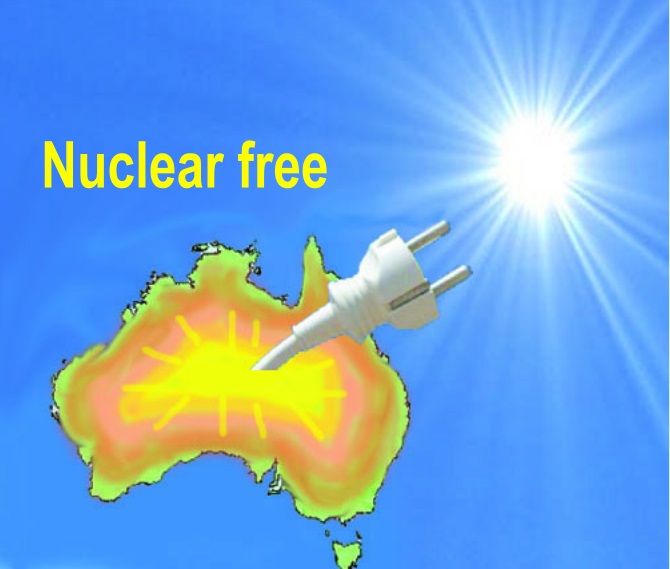
Critics will say we can’t afford to transition away from fossil fuels.
When you come face to face with the impacts, it’s reasonable to argue
that we can’t afford not to. But something interesting is starting to
happen. Around four or five years ago, it became cheaper to generate
electricity from the sun and wind than it is by setting things on fire.
Renewable energy has been getting so plentiful, to the point that some
governments are literally giving it away. In Australia, where almost 40% of
homes have solar panels on their roof, the government announced that they
have so much solar energy that from January next year, Australians will get
three free hours of electricity every single day. Whether you have a solar
panel or not, for those three hours, you can charge your car, run the
washing machine or even store up your home battery and run the house for
free all night.
At a time when it was announced that the energy price cap
is set to rise slightly here in the UK, and when the average cost of
heating and running a home is close to £1800, it’s hard not to feel
jealous of those Australians who can look forward to free power for three
hours a day.
Even more astonishingly it’s China which is driving this
change towards cleaner energy. When I lived in China back in the early
2000s, we had toxic smog so thick you couldn’t see the apartment block
across the road. Chinese cities used to dominate the top 10 most-polluted
cities in the world, today they barely feature in that most grubby of
lists.
In May of this year, China installed new solar and wind energy
systems that generated as much electricity as Poland generates all-year
round, from all available sources, and while they continue to construct
more coal-fired power stations, those stations run at most at 50% capacity,
and the country’s carbon emissions are thought to have peaked.
These power stations are used almost as back-up power, because they’re more
expensive to run than solar or wind farms, and once the next breakthrough
comes in the form of battery storage, experts argue that dirty power
stations will grow obsolete. China has figured out that clean energy and
renewables are the way forward, because they will ultimately prove to be
cheaper and more profitable.
They’ve made more money exporting green tech
in the past 18 months than the US has made in exporting oil and gas in that
same period. While America is betting the house on AI being the future,
China has gambled on renewable energy and clean tech being the way forward.
In Europe, people are nipping down to their equivalent of B&Q to pick up
plug-in solar panels they can hang off their balconies. These cheap and
cheerful solutions can provide up to 25% of an apartment’s energy usage,
and are as easy to use as plugging in a toaster. It’s such an innovative
– and useful – development that the UK Government has launched a study
to see if it could be rolled out here.
Regulations would need to be
reformed, but if this could be achieved, we could soon access the kind of
cheap and convenient solution that close to 1.5 million Germans enjoy.
It’s easy to feel overwhelmed when faced with the challenge of a warming
planet, and dither and delay from those in power. But ultimately we’ve
got more power than we think. Environmentalist Bill McKibben argues that
economics dictate that in 30 years’ time we’ll be running this planet
on solar and wind energy anyway. It’s up to us to determine how long we
want to wait to embrace reality, and cheaper energy bills.
The National 26th Nov 2025,
https://www.thenational.scot/politics/25650532.must-embrace-reality-lower-bills-cheap-green-energy/
The 50-Year Wind Farm That Ended a Nuclear Myth
A Danish offshore project’s lifespan extension to half a century dismantles one of nuclear energy’s last standing arguments.
Michael Barnard, Medium Oct 21, 2025
One of the persistent claims made by nuclear energy advocates is that nuclear power plants hold a critical advantage over wind and solar facilities due to their significantly longer operational lifespans. This argument frequently serves as justification for continued investment in nuclear, often at the expense of renewable options. News of a 25 year extension to a Danish offshore wind farm, bringing its total life to 50 years, defangs yet another nuclear talking point.
It’s not the only example. Renewables, particularly wind energy, now routinely demonstrate operational lifetimes matching those of nuclear plants. The conventional wisdom that nuclear has a built-in longevity advantage is no longer supported by real-world evidence.
The nuclear industry’s standard operating lifespan is widely cited as between 40 and 60 years, with many reactors initially licensed for 40-year terms. These facilities routinely secure extensions from regulatory bodies, typically for an additional 20 years, bringing total projected lifetimes up to 60 years. In some cases, operators are now pursuing even longer extensions……………………………(Subscribers only0 https://medium.com/the-future-is-electric/the-50-year-wind-farm-that-ended-a-nuclear-myth-9da06d3b528c
Russian Attacks Cripple Ukraine’s Nuclear Power Output
Oil Price, By Charles Kennedy – Nov 20, 2025,
Russian attacks on energy infrastructure in western Ukraine have left hundreds of thousands of Ukrainians without power as of Thursday as nuclear power plants are curbing generation because of damaged transmission lines.
Damage to power lines has forced nuclear power plants, which generate more than half of the country’s electricity, to reduce production, a representative of Ukraine’s national nuclear energy company Energoatom told Reuters today.
Earlier this week, Rafael Mariano Grossi, the Director General of the International Atomic Energy Agency (IAEA), said that two Ukrainian nuclear power plants have been operating at reduced capacity for the past ten days after a military attack damaged an electrical substation critical for nuclear safety and security.
Russia and Ukraine have intensified attacks on each other’s energy infrastructure in recent weeks, with Russia targeting Ukrainian power and gas supply and Ukraine hitting Russian refineries, oil depots, and export facilities. ……………………………………………. https://oilprice.com/Latest-Energy-News/World-News/Russian-Attacks-Cripple-Ukraines-Nuclear-Power-Output.html
Could Small Modular Nuclear Reactors add supply-side grid flexibility?
It would make sense in the UK for SMRs to be load
following only if there were vast numbers of SMRs deployed,
13 Nov, 2025 By Tom Pashby New Civil Engineer
Small modular reactors (SMRs) could have the capability of providing the British electricity grid with flexible supplies, the government has said.
Supply-side grid flexibility is the ability of electricity sources to
adjust their output to match fluctuations in power demand in real-time. The
statement came in response to a question from an MP about whether SMRs
could be used as “load-following energy sources”.
Liberal Democrat spokesperson for energy security and net zero Pippa Heylings MP asked what assessment the Department for Energy Security and Net Zero (DESNZ) “has made of the potential merits of small modular reactors being made as load-following energy sources”.
Responding, DESNZ minister of state
Michael Shanks said: “The next generation of nuclear, including SMRs,
offers new possibilities, including faster deployment, lower capital costs
and greater flexibility. “Whilst nuclear energy has a unique role to play
in delivering stable, low-carbon baseload energy, SMRs may be able to serve the electricity grid more flexibly than traditional nuclear, as well as
unlock a range of additional applications in energy sectors beyond grid
electricity.”
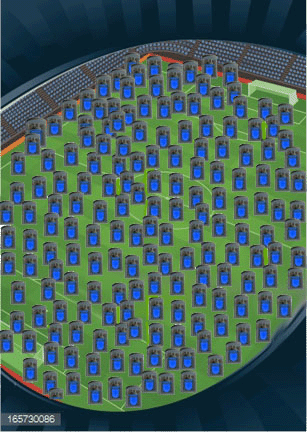
It would only make sense in the UK for SMRs to be load
following if there were vast numbers of SMRs deployed, representing a
significant proportion of the electricity generation capacity on the
national electricity transmission system of Great Britain, for them to be
load-following.
University of Sussex professor of science and technology
policy Andy Stirling told NCE: “This parliamentary answer repeats a
longstanding malaise in UK energy policy. “For far too long,
eccentrically strong official nuclear attachments have been dominated by
reference to claimed ‘new possibilities’, to what nuclear ‘may be
able’ to do, and to an unsubstantiated ‘unique role’. “
Whichever side of these debates one is on, it is clear that what is needed most is what used to be routine – but has been lacking for more than a decade.
“Questions over cost, security or flexibility claims can only be settled
by detailed comparative analysis that includes balanced attention to
non-nuclear strategies as well as nuclear ‘possibilities’. “
When such a picture is looked at in a fair way, current trends are making it
impossible even for formerly nuclear-enthusiastic bodies (like the Royal
Society) to conclude – even when looking at UK Government data –
anything other than that there is no rational need for any nuclear
contribution.”
New Civil Engineer 13th Nov 2025,
https://www.newcivilengineer.com/latest/could-smrs-add-supply-side-grid-flexibility-13-11-2025/
1 This Month
23-25 October – on Zoom – World BEYOND War’s annual global conferenc


Shut down the radiation-damaged Heysham nuclear reactors now
To see nuclear-related stories in greater depth and intensity – go to https://nuclearinformation.wordpress.com

Say No to NASA’s Reckless Nuclear Reactor on the Moon
Say No to NASA’s Reckless Nuclear Reactor on the Moon

-
Archives
- October 2026 (231)
- September 2026 (339)
- August 2026 (330)
- July 2026 (355)
- June 2026 (287)
- May 2026 (306)
- April 2026 (356)
- March 2026 (251)
- February 2026 (267)
- January 2026 (308)
- December 2025 (358)
- November 2025 (359)
-
Categories
- 1
- 1 NUCLEAR ISSUES
- business and costs
- climate change
- culture and arts
- ENERGY
- environment
- health
- history
- indigenous issues
- Legal
- marketing of nuclear
- media
- opposition to nuclear
- PERSONAL STORIES
- politics
- politics international
- Religion and ethics
- safety
- secrets,lies and civil liberties
- spinbuster
- technology
- Uranium
- wastes
- weapons and war
- Women
- 2 WORLD
- ACTION
- AFRICA
- Atrocities
- AUSTRALIA
- Christina's notes
- Christina's themes
- culture and arts
- Events
- Fuk 2022
- Fuk 2023
- Fukushima 2017
- Fukushima 2018
- fukushima 2019
- Fukushima 2020
- Fukushima 2021
- general
- global warming
- Humour (God we need it)
- Nuclear
- RARE EARTHS
- Reference
- resources – print
- Resources -audiovicual
- Weekly Newsletter
- World
- World Nuclear
- YouTube
-
RSS
Entries RSS
Comments RSS

