West Lothian halving its carbon emissions through energy conservation and renewables

West Lothian has nearly halved its carbon emissions in eight years,
building on the 40% cut it achieved after declaring its climate emergency
policy in September 2019. The report added: “There are a number of direct
actions that have contributed to our emissions reductions including the
implementation of energy efficiency projects, replacing street lighting
with low energy LED equivalents, investing in renewable and low carbon
technologies such as biomass boilers and solar photovoltaic (PV) panels and
reducing the volume of waste being sent to landfill.”
Edinburgh Reporter 19th Oct 2021
Large windfarm development off the coast of Suffolk
Leading utility Iberdrola announces new investment plans at today’s
Global Investment Summit. Leading renewable energy utility Iberdrola is set
to invest an additional £6bn in its offshore wind farm development off the
coast of Suffolk, the company confirmed at today’s Global Investment Summit
hosted by Boris Johnson. Speaking at the Summit, Iberdrola’s chairman and
CEO Ignacio Galán announced a new £6bn investment in offshore wind
projects, in addition to the £10bn already being invested by the company
to double renewable generation capacity between 2020 and 2025. The £6bn
investment will go towards Iberdrola subsidiary ScottishPower’s East Anglia
Hub, a wind farm development off the coast of Suffolk, consisting of three
wind farms: East Anglia ONE North, East Anglia TWO and East Anglia THREE.
Business Green 19th Oct 2021
https://www.businessgreen.com/news/4038888/iberdrola-floats-gbp6bn-boost-uk-offshore-wind-industry
UK’s ”low carbon” strategy relies too much on unproven technologies – what we need is energy conservation
| Finally, we have a plan to reduce emissions, but much of it rests on technology that is yet to be tested at scale. The PM confidently claimed that we will be flying and driving everywhere, guilt-free, with zero-emission technology. This optimism – based on a techno-centric, market-driven vision of the future low carbon society – is what underlines the entire net zero strategy. Take for instance the reliance on greenhouse gas removal technologies that remain untested at scale. Between now and 2050, the government envisions removing and storing more carbon than we currently emit from all our homes today. It would of course be a mistake to dismiss out of hand the possibilities that these technologies offer, but to have them play such a central role in our strategy is a gamble. To make it work would require careful planning. A similar reliance is placed on hydrogen, which the strategy foresees us using a tremendous amount of, though we barely have any production facilities in the UK today. None of this is impossible, but climate change offers very little slack for policymakers to try to fail, so getting it right the first time is paramount. The headline-grabbing announcement of a £5,000 subsidy for heat pumps distracts us from the lack of investment in insulation and making our homes warmer. At the New Economics Foundation, we estimate that the scale of finance committed by the government in decarbonising our leaky housing stock is less than a quarter of what is actually needed by 2025. That is why we launched a campaign called the Great Homes Upgrade, calling on the government to retrofit 19m homes by 2030. Without an investment of at least 2% of GDP annually, the strategy could well remain a non-starter, but the chancellor has an opportunity to fix that in his upcoming budget and spending review. Guardian 19th Oct 2021 https://www.theguardian.com/commentisfree/2021/oct/19/government-net-zero-technology-emisssions |
ALL UK energy can be obtained from renewables – Prof Mark Barrett
How we can get ALL our energy from renewables – a talk by Professor Mark
Barrett- talk slides published! Professor Mark Barrett from UCL has given a
talk about how ALL UK energy can be supplied by renewables. He focused on
heat in particular.
100% Renewables 18th Oct 2021
France’s Global Chance association recommend renewable energies, see nuclear power as unsustainable
Ten-year delays, unequal access, vulnerability … For the members of the
Global Chance association, chaired by the polytechnician Bernard Laponche,
nuclear energy is not up to the challenge of ecological transition. On the
contrary, they promote renewable energies, the sources of which are “in
essence local and sovereign”.
La Croix 18th Oct 2021
https://www.la-croix.com/Debats/Lenergie-nucleaire-repond-pas-defi-climatique-2021-10-18-1201181087
The value of energy efficiency in UK’s emissions reduction programme

Improving the energy efficiency of homes in deprived areas would cut seven
million tonnes of CO2 emissions per year, a Times investigation can reveal.
Despite much of the housing being older, insulating leaky boilers,
replacing inefficient lighting and installing solar panels in the poorest
30 per cent of neighbourhoods in England and Wales would be about as cost
effective as making the same improvements in the richest areas. It would
also reduce energy bills for those struggling the most. According to
analysis of Energy Performance Certificates (EPCs), for every £1,000 spent
in poorer parts of the country, 166kg of CO2 would be saved. Boris Johnson
has put both levelling up the country and a commitment to improving the
environment at the heart of his premiership.
Times 24th June 2021
Research shows that a rapid truly green energy transformation will achieve a near-net-zero emissions energy system

Rapidly decarbonising the global energy system is critical for addressing climate change, but concerns about costs have been a barrier to implementation. Most energy-economy models have historically underestimated deployment rates for renewable energy technologies and overestimated their costs.
The problems with these models have stimulated calls for better approaches and recent efforts have made progress in this direction. Here we take a new approach based on probabilistic cost forecasting methods that made reliable predictions when they were empirically tested on more than 50 technologies.
We use these methods to estimate future energy system costs and find that, compared to continuing with a fossil-fuel-based system, a rapid green energy transition will likely result in overall net savings of many trillions of dollars – even without accounting for climate damages or co-benefits of climate policy.
We show that if solar photovoltaics, wind, batteries and hydrogen electrolyzers continue to follow their current
exponentially increasing deployment trends for another decade, we achieve a near-net-zero emissions energy system within twenty-five years. In contrast, a slower transition (which involves deployment growth trends that are lower than current rates) is more expensive and a nuclear driven transition is far more expensive. If non-energy sources of carbon emissions such as agriculture are brought under control, our analysis indicates that a rapid green energy transition would likely generate considerable economic savings while also meeting the 1.5 degrees Paris Agreement target.
Oxford University 14th Sept 2021
UK government’s grand energy plan – focus is on saving the nuclear industry
”Nuclear power is slow, dangerous and extortionately expensive. It will do nothing to address the current energy crisis, neither will it be effective to counter climate change”
Reviving nuclear power station projects such as Wylfa B on Anglesey and Trawsfynydd in Gwynedd is at the heart of the UK Government’s ambitions to attain net zero carbon emissions by 2035, government sources have said.
The UK Government is expected to reveal its new nuclear strategy in documents to be published next week, alongside a plan for how to pay for the new array of nuclear plants. US nuclear company Westinghouse is planning to revive plans for a nuclear power plant at Wylfa that was abandoned by Japan’s Hitachi in 2019, and the UK Government has indicated that it is keen to see the plan come to fruition.

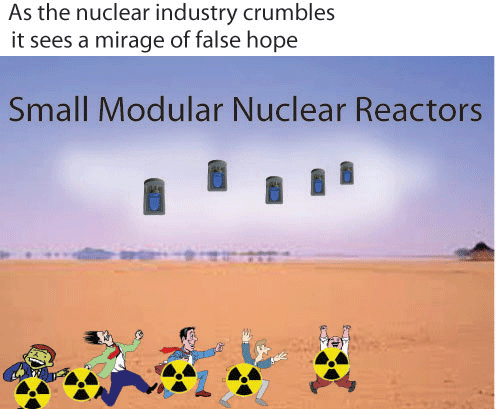
Ministers are also expected to back smaller modular reactors which are being developed by a consortium led by Rolls-Royce. One of these is planned for installation in the now-decommissioned Trawsfynydd nuclear plant. Kwasi Kwarteng, the business secretary who has been under fire from industry this week due to
the rising cost of energy prices, is to unveil the overarching ‘Net Zero Strategy’ paper on Monday.
According to the Financial Times, the strategy will have a “heavy focus” on Britain’s languishing nuclear power
programme. Under the plans, an energy levy on consumers by the UK Government finance the cost of producing the power before the nuclear energy plants are built. Kwasi Kwarteng has set a target of 2035 to reach
‘net zero’ based on nuclear power, renewables and carbon capture and storage.
Anti-nuclear groups have already criticised the plans, saying that the emphasis should be placed on green renewable energy instead. Dylan Morgan of PAWB (People Against Wylfa B) said: “We have an immediate crisis now. Building huge reactors at a nuclear power station take at least 15 years. “Nuclear power is slow, dangerous and extortionately expensive. It will do nothing to address the current energy crisis, neither will it be effective to counter climate change”
Nation Cymru 16th Oct 2021
Many businesses urge UK government to incentivise the uptake of genuinely clean energy

The government is facing yet more calls to slash VAT rates on domestic renewable energy and clean technology systems so as to incentivise the uptake of green solutions that can reduce household carbon emissions and
shield consumers from volatile gas prices.
In a letter to the government yesterday, nearly 30 companies and organisations from across the energy
sector argued steps needed to be taken to bring down the cost of a number of clean technologies, arguing that domestic zero carbon energy systems remained “unaffordable” for many households.
The coalition – which includes the Association for Renewable Energy and Clean Technology (REA), EDF, Nissan, and Ovo Energy – called on the government to slash VAT on a range of domestic energy saving materials, including energy storage systems, domestic EV chargers, heat pumps, and solar PV installations.
Business Green 15th Oct 2021
https://www.businessgreen.com/news/4038700/energy-players-vat-scrapped-green-home-solutions
European Commission urges member states to speed up solar energy deployment
The European Commission (EC) has urged member states to accelerate solar
deployment in order to tackle Europe’s rising electricity prices and has
released a ‘toolbox’ to address the short-term impact of prices and
strengthen resilience against future shocks.
Speaking at a press conference
earlier this week (13 October), the EC Energy Commissioner, Kadri Simson,
called the current situation in Europe, which has pushed energy prices up
to record levels, “exceptional” but urged member states to future proof
their countries from further shocks.
PV Tech 15th Oct 2021
Rolls Royce wants to supply data centres with their massive energy needs, by small nuclear reactors

Rolls-Royce said to be pitching small nuclear reactors to power data centers … while Boris Johnson proposes more big nuclear power stations for the UK, October 05, 2021 By Peter Judge
Rolls-Royce is planning to offer small nuclear reactors to US-based cloud operators so their hyperscale data centers can have net zero emissions and be independent of the electric grid, according to media reports.
Small modular reactors (SMRs) are under development by a consortium led by Rolls-Royce, and could potentially power data centers or other infrastructure that needs a steady supply of low-carbon energy, which may not be available from the local electricity grid. However, they will not be available until at least 2030…………. https://www.datacenterdynamics.com/en/news/rolls-royce-said-to-be-pitching-small-nuclear-reactors-to-power-data-centers/
Renewables winning bigtime, as nuclear power stagnates.

“We simply don’t have the time to waste attention, intelligence, manpower and funding for fantasy technologies that might or might not work, more likely, some time in the 2030s or 2040s, while affordable concepts from efficiency to renewables are readily available,” Schneider said, referring to the fourth-generation of nuclear power plants that several governments across the planet are presenting as a viable option. “Gen IV designs are PowerPoint reactors – they don’t exist. And the best example is Bill Gates, who started a company in 2006 to develop and promote a new design. Fifteen years later, he has nothing to show – no licensed design anywhere, no site, no prototype.”
Renewables vs. Nuclear: 256-0 PV Magazine, SEPTEMBER 28, 2021 EMILIANO BELLINI
The latest World Nuclear Industry Status Report shows that the world’s operational nuclear capacity grew by just 400 MW in 2020, with generation falling by 4%. By contrast, renewables grew by 256 GW and clean energy production rose by 13%. “Nuclear power is irrelevant in today’s electricity capacity market,” the report’s main author, Mycle Schneider, told pv magazine.
Global nuclear power capacity including grew by just 400 MW in 2020, according to the latest annual edition of the World Nuclear Industry Status Report, published by French nuclear consultant Mycle Schneider. The lackluster results for nuclear compare to 256 GW of newly deployed renewable energy capacity last year, including 127 GW of PV and 111 of wind power.
Continue readingClimate solutions must be assessed on cost and speed of operation – nuclear fails on both, while reduced demand is a winner.

Renewables displace 3–13 times more fossil-fueled generation per dollar than nuclear
“Low-carbon” misses the point — Beyond Nuclear International
https://wordpress.com/read/feeds/72759838/posts/3585195410 3 Oct 21
The view that climate protection requires expanding nuclear power has a basic flaw in its prevailing framing: it rarely if ever relates climate-effectiveness to cost or to speed—even though stopping climate change requires scaling the fastest and cheapest solutions. By focusing on carbon but only peripherally mentioning cost and speed, and by not relating these three variables, this approach misframes what climate solutions must do.
The climate argument for using nuclear power assumes that since nuclear power generation directly releases no CO2, it can be an effective climate solution. It can’t, because new (or even existing) nuclear generation costs more per kWh than carbon-free competitors—efficient use and renewable power—and thus displaces less carbon per dollar (or, by separate analysis, per year): less not by a small margin but by about an order of magnitude (factor of roughly ten). As I noted in an unpublished 17 Aug letter to The New York Times:
…[The Times’s 14 August] editorial twice extols “wind, solar and nuclear power” as if all three had equal climate benefits. They don’t. New electricity costs 3–8 (says merchant bank Lazard) or 5–13 (says Bloomberg New Energy Finance) times less from unsubsidized wind and solar than from nuclear power. Renewables thus displace 3–13 times more fossil-fueled generation per dollar than nuclear, and far sooner. Efficiency is even cheaper, beating most existing reactors’ operating costs. Competing or comparing all options…saves more carbon.
Thus nuclear power not only isn’t a silver bullet, but, by using it, we shoot ourselves in the foot, thereby shrinking and slowing climate protection compared with choosing the fastest, cheapest tools. It is essential to look at nuclear power’s climate performance compared to its or its competitors’ cost and speed. That comparison is at the core of answering the question about whether to include nuclear power in climate mitigation.
The “pro” discussion is also almost invariably focused entirely on the supply-side. Yet the International Energy Agency notes that, in 2010–2016, three-fourths of the world’s decarbonization came from energy savings. IEA also says renewables in 2010–20 decarbonized the world five times as much as nuclear growth did, but when the “pros” compare nuclear only with renewables, they are leaving out the cheapest half (or more) of the solution space—using energy more efficiently.
For example, the US in 2020 used 60% less energy per dollar of GDP than in 1975, and during that period, cumulative savings were 27 times the cumulative increase in supply from nuclear plus renewables. Looking forward, RMI’s Reinventing Fire (2011) rigorously showed how to quadruple the efficiency of using US electricity by 2050, at historically reasonable speed, and at an average cost one-tenth the cost of buying electricity today. That study’s findings have nicely tracked the decade of market evolution since, while the efficiency potential has considerably increased.
These views are explained and documented in my March 30, 2021 Energy & Environmental Study Institute 20-minute brief to Congressional members and staff. Its slides and narrative, plus a data-rich Appendix, can be found here. The content is also reflected in an earlier and more popular article in Forbes. The underlying technical analysis—including the timing of renewable substitution after a nuclear shutdown—is on pp 228–256 of the World Nuclear Industry Status Report 2019, consistent with emerging examples from California and New York.
A common myth often repeated is that renewables use far more land than nuclear power. This is corrected in my technical paper — Renewable Energy’s ‘Footprint’ Myth. Solar land-use is actually comparable to, or somewhat less than, nuclear’s if you properly include the nuclear fuel cycle, not just the power plant it supports.
Windpower’s land use in turn is 1–2+ orders of magnitude smaller than solar’s. A recent Bloomberg report, though it provides a more nuanced treatment, surprisingly botched this comparison, having been misled by a report from a Koch-funded “think tank” whose dodgy provenance Bloomberg may not have realized and did not mention.
The “pro” discussion is further confused by muddled mentions of batteries and hydrogen—just two of ten proven carbon-free resources for balancing largely or wholly renewable grids. Widely cited studies purporting to show that largely or wholly renewable power supply is impossible or at best very costly generally omit most or all of the other eight options. My recent article, Twelve energy and climate myths, dispels the common misconceptions implicit in this point of view, and should also help to dispel a common mischaracterization of what happened in Germany and Japan. Two slides from my EESI brief tell that story from the official data:
If the question of whether or not there is a nuclear “option” for stopping climate change continues to be debated (as it was in Spencer Bokat-Lindell’s August 26, 2021 column in the New York Times), then it must frame this correct and important question in a way that actually addresses it, by comparing both demand- and supply-side options in cost, speed, and hence climate-effectiveness.
And if this debate includes the question of using new sizes or types of reactors to answer the climate challenge, it won’t have a happy answer. This is both for the basic economic reasons summarized in slide 18 of my EESI brief, and because such reactors can’t scale significantly until at least the late 2030s, and by then the US power sector should already have been fully decarbonized.
Physicist Amory B. Lovins is Adjunct Professor of Civil and Environmental Engineering, and Scholar, Precourt Institute for Energy, Stanford University.
Reducing energy use is the major way to cut greenhouse emissions, not slow, outdated, and dirty nuclear power

Letter Professor Simone Abram, director, Durham Energy Institute, Durham University: You report that the government is backing a new generation of nuclear reactors. The Nuclear Industry Association has managed to convince ministers (and your reporters) that its narrative about energy is the only one.
It is not. Nuclear power remains expensive, relies on non-renewable imported fuel and creates a waste problem to which we have no solution. Worse, an electricity system based on renewables needs agile counterparts to respond rapidly to fluctuations in supply — which nuclear power is not suited to.
The recipe for a sustainable energy system lies elsewhere, in reduced demand (energy efficiency), better storage (hydrogen storage will come online quicker than a new nuclear power station) and a focus on heat rather than power (the UK could be halfway towards self-sufficiency in heat if we used our low-grade geothermal stores effectively). All this needs an energy policy based on what we know now, not on what we knew in 1956, or even in 1976.
Times 3rd Oct 2021
https://www.thetimes.co.uk/article/why-nuclear-power-cant-keep-the-lights-on-p9d3csb7d
No quick fix. Reducing demand is the key to energy supply.

Let’s hope that in the final weeks before vital international climate talks in Glasgow our political leaders show that, although there can be no quick fixes to this crisis, they’ve finally understood the way through.
Only by reducing demand will gas supply no longer be an issue For the electricity the UK will certainly need, we need to rapidly ramp up the rollout of renewable energy projects https://www.independent.co.uk/climate-change/opinion/gas-prices-energy-climate-crisis-b1927213.ht
Doug Parr , 27 Sep 21 As the effect of the gas price shock starts to seep into the lives of ordinary people over the coming weeks and months – causing bills to rise, energy suppliers to go bust and supermarket shelves to empty – many will be left wondering how the government could have allowed this to happen.
While it is true that a global surge in demand, coupled with geopolitical games and electricity supply issues in the UK have resulted in a squeeze on supply and subsequent price hike, this is only half the story.
What ministers are failing to talk about as they reassure us that they do “not expect” supplies to run out this winter, is that it is not supply but the UK’s dependency on gas, and the failure of successive governments to wean us off the stuff years ago, that has left the UK dangerously exposed.
The UK is one of the most gas-dependent countries in Europe – more than four-fifths of homes are still heated by it and almost half of our electricity is produced by burning it. Failed government policy over decades must shoulder much of the blame. The UK has the least energy-efficient housing stock in western Europe. Yet, we still don’t have a programme in place to insulate the millions of homes across the country that desperately need retrofitting.
There’s a pattern to these mistakes. Earlier this year the government botched its Green Homes Grant programme, scrapping it after just six months. Before that George Osborne binned the Zero Carbon Homes initiative after years of development. Before that, David Cameron reportedly told ministers to “get rid of the green crap”.
Insulating the UK housing stock is essential – it would reduce our dependence on gas, our exposure to such price shocks, slash emissions, reduce fuel poverty and, as Greenpeace UK’s recent report pointed out, create up to 138,000 new jobs and inject almost £10bn into the economy.
The latter economic benefit would also require a mass rollout of heat pumps, which would further reduce our dependence on gas. But once again, poor policy decisions have gotten in the way. The UK is last when it comes to the sale per household of these sources of clean heating, behind Poland, Slovakia, Estonia and almost everyone else in Europe.
Those calling for an increase in domestic supply by expanding production in the North Sea or having another go at fracking are completely wrong. This is a price shock, not an availability shock so more domestic gas production can’t and won’t affect global or regional prices – and will have zero impact on the present crisis. Seeking more supply repeats the mistakes of the past.
It also won’t reduce the UK’s carbon emissions, which is fundamental to tackling the climate crisis and something the government is legally bound to do. Reducing demand is the only option to solve the problems of the UK’s gas exposure and the climate crisis simultaneously.
For the electricity the UK will certainly consume, we need to urgently push the rollout of renewable energy projects and the job opportunities that should come with them. The government loves to boast about its record on offshore wind, but it has stalled repeatedly when it comes to onshore wind and solar. The sooner we have a renewables sector that can cater to our energy needs the faster we relieve ourselves of the risks of gas dependence.
Investment in renewables must come with investment in a smarter, more flexible grid and better storage so that even when the wind isn’t blowing or the sun shining, energy supplies and prices don’t become a problem.
New nuclear power cannot realistically help. Continual cost escalation and ever-increasing delivery timeframes have proven that it is not a viable alternative to fossil fuels. According to EDF the next UK plant that could be approved wouldn’t be up and running until 2034 and that’s assuming none of the usual long delays. We can’t wait 13 years or more for a magic nuclear bullet, even if the issues such as waste can be solved.
Aside from taking the shackles off the construction of new renewables power, the upcoming Spending Review is the government’s chance to start righting past wrongs on energy efficiency. Rishi Sunak must commit to an extra £12bn of public investment for the rest of this parliament to improve energy efficiency, green our homes. We also need to properly fund a just transition for fossil fuel workers.
Boris Johnson has spoken at the UN this week of his “frustration” with world leaders at not taking climate change seriously enough. So he must be livid with his government departments, especially the Treasury, for the missteps over the last few years which have over-exposed the electorate and economy to expensive, climate-wrecking fossil gas.
Let’s hope that in the final weeks before vital international climate talks in Glasgow our political leaders show that, although there can be no quick fixes to this crisis, they’ve finally understood the way through.
Dr Doug Parr is Greenpeace UK’s chief scientist
1 This Month

of the week – Shut Down Drone Warfare!


Tell the Ukrainian Government to Drop Prosecution of Peace Activist Yurii Sheliazhenko

Petition to revoke the licensing of the Near Surface Nuclear Disposal Facility (NSDF) at Chalk River. https://www.ourcommons.ca/petitions/en/Petition/Details?Petition=e-7247
To see nuclear-related stories in greater depth and intensity – go to https://nuclearinformation.wordpress.com
-
Archives
- April 2026 (68)
- March 2026 (251)
- February 2026 (268)
- January 2026 (308)
- December 2025 (358)
- November 2025 (359)
- October 2025 (376)
- September 2025 (257)
- August 2025 (319)
- July 2025 (230)
- June 2025 (348)
- May 2025 (261)
-
Categories
- 1
- 1 NUCLEAR ISSUES
- business and costs
- climate change
- culture and arts
- ENERGY
- environment
- health
- history
- indigenous issues
- Legal
- marketing of nuclear
- media
- opposition to nuclear
- PERSONAL STORIES
- politics
- politics international
- Religion and ethics
- safety
- secrets,lies and civil liberties
- spinbuster
- technology
- Uranium
- wastes
- weapons and war
- Women
- 2 WORLD
- ACTION
- AFRICA
- Atrocities
- AUSTRALIA
- Christina's notes
- Christina's themes
- culture and arts
- Events
- Fuk 2022
- Fuk 2023
- Fukushima 2017
- Fukushima 2018
- fukushima 2019
- Fukushima 2020
- Fukushima 2021
- general
- global warming
- Humour (God we need it)
- Nuclear
- RARE EARTHS
- Reference
- resources – print
- Resources -audiovicual
- Weekly Newsletter
- World
- World Nuclear
- YouTube
-
RSS
Entries RSS
Comments RSS
 nuclear-news