Renewable energy growing at a fast pace, China and India leading the way.

Growth in renewable energy is set to hit an all-time record this year, but is still falling “well short” of what is necessary to slash planet-warming emissions, according to the International Energy Agency. The energy watchdog estimates that around 290 gigawatts (GW) of renewable energy capacity came online around the world in 2021 — enough electricity for approximately 200 million average US homes — according to a report published Wednesday.
By 2026, the agency predicts global renewable capacity will rise more than 60% from 2020 levels, an amount equivalent to the current total global power capacity of fossil fuels and nuclear combined, it said.
But to reach net-zero emissions by 2050, a goal many nations have set, renewables need a far bigger push. The current pace is being driven by China, which the agency says remains the global leader in renewable energy growth. The country is expected to reach 1200 GW of total wind and solar
capacity in 2026, four years sooner than its target date. Renewables are also being rapidly embraced in India, where they are projected to double new installations this year, in comparison to 2015-2020.
FT 1st Dec 2021
https://www.ft.com/content/317424af-a559-4598-a4df-5fe7c9fff947
COP 26 agreement that energy efficiency investments needed for at least half of the investments needed to stall global heating.

The formal Pact, agreed at COP26, explicitly calls upon all governments to accelerate the adoption of policies “rapidly scaling up … energy efficiency measures”. This complements the International Energy Agency’s conclusions that around half the investments needed to deliver net zero by 2050 will need to be achieved via improved energy efficiency.
Andrew Warren examines the publication of the UK Government’s long-postponed “Heat and
Buildings Strategy”. He says the mantra of fabric first seems to have disappeared. He concludes that the strategy proffers no serious strategy at all to improve the energy performance of (in particular) the English building stock. Given the UK’s hosting of COP26, this dereliction of ambition will need to be rectified by no later than COP 27 next November in Egypt.
Energy in Buildings & Industry magazine (not available yet) 28th Nov 2021
Nuclear power for MINDLESS, ENDLESS, ENERGY use – Data ”Farms” and Bitcoin – theme for November 21.

When you think about the stupidity of eternal wastage of energy , it’s hard to beat the system of the supposed ”CLOUD”. Every pointless little email, little emoji, tweet, and all the other bits of digital junk produced goes not up into the disappearing ether, but down into a dirty great computer server, just one of the accumulating number of dirty great computer servers. Far from being ”farms”, these collections of steel enclosed machines actually produce nothing, but they do CONSUME massive amounts of electricity.
No wonder that the nuclear industry loves them!
The nuclear industry also loves crypto-currency, Bitcoin being the current top favourite of energy-guzzling systems.
A pernicious trio – data farms, cryptocurrency, and nuclear power – leading the world into eternal energy consumption and environmental degradation.

New German government aims for coal exit, and 80 pct renewables, by 2030

New deal between SDP, Greens and pro-business party calls for coal exit by 2030, and an 80 per cent share for renewables. The post New German government aims for coal exit, and 80 pct renewables, by 2030 appeared first on RenewEconomy.
Soren Amelung and Benjamin Wehrmann 25 November 2021 https://reneweconomy.com.au/new-german-government-aims-for-coal-exit-and-80-pct-renewables-by-2030/ Germany’s prospective new government has agreed to speed up the country’s coal exit and accelerate the rollout of renewable power to get the country on track for climate neutrality.
“We will align our climate, energy and economic policies nationally, in Europe and internationally with the 1.5 degree path and activate the potential at all levels of government,” states the coalition agreement between Social Democrats (SPD), Greens, and pro-business Free Democrats.
“With ambition and perseverance, we are making the country a pioneer in climate protection,” likely future chancellor Olaf Scholz, a Social Democrat, said during the presentation of the coalition treaty. He added that “modernisation won’t be for free – we will invest massively so Germany can stay a world leader.”
Germany plans to become climate-neutral by 2045, but the measures implemented by the outgoing government, a coalition between chancellor Angela Merkel’s Conservatives and the SPD, are insufficient to reach that target.
The September vote had been called a “climate election” due to the high importance many voters had given the topic.
Scholz aims to be elected chancellor in the week of December 6. Prior to that, the Greens will invite all 120,000 party members to vote on the coalition agreement online. The SPD and the FDP will organise party conferences on December 4 and 5, respectively, to secure their members’ backing for the agreement.
Faster rollout of renewables
“Reaching climate targets will require an accelerated exit from coal power generation,” the coalition treaty reads. “Ideally, this will be achieved by 2030 already.”
Green Party co-leader Robert Habeck said the measures agreed by the three parties would put Germany on an emissions reduction path compatible with the Paris Climate Agreement‘s target of limiting global warming to 1.5 degrees Celsius.
The coalition treaty’s “core” principle would be to reconcile prosperity with climate action, he argued.
“We have decided against setting higher climate targets in the coalition agreement, but rather formulated concrete measures,” Habeck said, adding that these measures would put the country on a 1.5 degree path.
The three parties aiming to form the next German government, said they aim to cover 80 percent of the country’s power demand with renewables by 2030, a significant increase from the current target of 65 percent. “Renewables are no longer an addition but will have to carry our supply security,” Habeck said.
FDP leader Christian Lindner, who is likely to become new finance minister, said “no other industrialised country will make efforts in climate action as great as ours, this is the most ambitious programme to date” and the government would make sure that it is sufficiently funded. At the same time, Germany would remain “an advocate of prudent financial policy,” Lindner added.
The parties also rejected calls for postponing the end of nuclear power plants. “We will stick to the nuclear exit,” their coalition agreement says.
To help the country’s famed industry to lower emissions, the future government plans to use new instruments, such as carbon contracts for difference, and support an EU-wide carbon border adjustment mechanism.
The coalition partners also said they will consider a national carbon floor price of 60 euros if the price in the EU emissions trading system falls below that limit. In the transport sector, they want to achieve a fast transition to low-emission mobility. “Our target is at least 15 million fully electric cars by 2030,” the treaty says.
The future government also agreed on considerable changes to the government architecture to implement its climate agenda. The parties plan to create a novel climate ministry that merges the energy and industry departments of the economy ministry with the environment ministry’s climate department.
First published on Clean Energy Wire
German nuclear power shutdown will not lead to power shortage: report
German nuclear power shutdown will not lead to power shortage: report https://www.euractiv.com/section/energy/news/german-nuclear-power-shutdown-will-not-lead-to-power-shortage-report/
By Jessica Bateman and Nikolaus J. Kurmayer | EURACTIV.com with CLEW 24 Nov 21, The shutdown of Germany’s last nuclear power plants will not cause supply shortages, according to calculations by the German Institute for Economic Research (DIW Berlin), CLEW reported.
As the so-called “traffic light” coalition in Berlin takes shape, there have been concerns that the country’s upcoming phase-out of nuclear power could cause power shortages as the country’s renewable expansion has been slow-going for years.
“I’m looking for a flashing orange traffic light emoji when the German government will have to face blackouts later this winter,” tweeted energy analyst Thierry Bros.
Researchers used modelling methods to see how the decommissioning of nuclear power plants Brokdorf, Grohnde and Gundremmingen C (which will be taken off the grid at the end of this year) and Neckarwestheim 2, Isar 2 and Emsland (which will be shut down in late 2022) will affect power flows and the energy mix in Germany.
They found the decline in nuclear power will temporarily lead to a higher use of fossil fuels and imports, but that this should be quickly reduced by the accelerated expansion of renewable energies.
German energy use is expected to increase by 100 TWh until 2030, while the next German government wants to phase out coal by 2030 and to be done with gas in 2040.
The next government is expected to boost the expansion of renewable energy in Germany by speeding up planning and permitting processes, as well as mandatory solar PV installations on newly built buildings, according to FAZ.
According to reports, the next German government may aim for 80% renewable electricity in 2030, up from the current target of 65%.
Projections currently put Germany’s 2030 energy demand somewhere between 645 to 665 TWh. If those prove true, it would mean that wind and solar would have to generate upwards of 516 TWh per year, or more than double the current renewable energy generation capacity.
In 2020, renewable energy consumption was 251 TWh, according to CLEW.
In order to keep grid operation stable, congestion management will also need to be adjusted. “The lights will not go out in Germany,” study author Claudia Kemfert said in statement.
“On the contrary: the [nuclear] shutdown paves the way for the overdue expansion of renewable energies. Nuclear energy was uneconomical from the start and characterised by incalculable risks.”
Plans to phase out nuclear energy in Germany were introduced in 2011 after the Fukushima nuclear disaster in Japan. The decision has been criticised for worsening the country’s reliance on imported fossil gas while Germany exits coal at the same time.
IEA: Rate of energy efficiency improvements needs to double to put world on track for net-zero
The IEA is urging other nations to follow in Europe’s footsteps and implement stricter standards and regulations for energy-using products; consider tax incentives for energy efficiency; increase public spending on building and industrial retrofitting and streamlining planning procedures to make efficiency projects more attractive to private finance. Private spending on energy efficiency between 2021 and 2023 is forecast to be more than twice as high as spending by governments.
19 November 2021, source edie newsroom, Sarah George
Globally, energy efficiency has improved in 2021 after a rocky 2020, according to a new analysis from the International Energy Agency (IEA). But the rate of progress will need to at least double to put the world on track for net-zero by 2050, the Agency is warning.
19 November), the 2021 edition of the Agency’s annual Energy Efficiency Report reveals that progress is now back on track as the world emerges from the worst of the Covid-19 pandemic.
2020 saw only a minor (0.5%) improvement to global energy intensity, amid falling energy demands and prices, slowed investment in the energy sector and many energy-using sectors and logistical issues with supply chain and solutions installation.
Global energy intensity is on track to fall 1.9% in 2021, the analysis forecasts. This is a promising yet expected figure – the year-on-year fall was 2% in 2019.
“It is still unclear whether this year’s improved energy intensity will signal the start of a sustained recovery,” the IEA said in a statement.
However, increased investment trends, rising government spending on efficiency – in large part related to recovery plans enacted in response to Covid-19 crisis – new announcements of higher climate ambition and other policy measures offer some encouraging signals.”
To this point, the report forecasts that, by the end of the year, national policies will have helped to generate $30bn of investment in energy efficiency – around 10% of the total set to be allocated between 2015 and 2021.
In recent months, much growth in energy efficiency investment has been concentrated in Europe. Policy supports have included the European Commission’s Renovation Wave and overarching Energy Efficiency Directive, and the UK’s updated Industrial Strategy and Heat and Buildings Strategy.
A long road ahead
Nonetheless, the report emphasises the fact that there is still much more to be done. It highlights the fact that, in the IEA’s scenario for net-zero by 2050, global energy intensity falls by at least 4% each year in the 2020s.
The IEA is urging other nations to follow in Europe’s footsteps and implement stricter standards and regulations for energy-using products; consider tax incentives for energy efficiency; increase public spending on building and industrial retrofitting and streamlining planning procedures to make efficiency projects more attractive to private finance. Private spending on energy efficiency between 2021 and 2023 is forecast to be more than twice as high as spending by governments.
The report emphasises the fact that, while wealthy nations are currently accounting for the majority of global investment in energy efficiency, developing and emerging nations also stand to reap benefits in terms of rapid job creation and economic growth, as well as future-proofing infrastructure and industry. Delivering the 4% annual improvement to global energy intensity, the IEA has forecast, would create four million additional jobs in energy efficiency by 2030, in sectors including construction and retrofitting.
As well as addressing low-hanging fruit using mature technologies, the IEA’s report outlines the potential for implementing the next generation of digital technologies. It states that, by the end of the year, there will be more ‘smart’ connected appliances and sensors in the world than people for the first time. This presents a major opportunity to accelerate energy efficiency improvements.
At COP26, the IEA and the UK Government launched a Product Efficiency Call to Action, which aims to double the energy efficiency of air conditioning, refrigeration, industrial motor systems and lighting by 2030. These four activities account for more than 40% of global electricity demand every year. In total, 14 countries have now signed onto the initiative, which is the largest of its kind. Read edie’s full story here.
Germany’s Chancellor Merkel maintains stand against nuclear power being classified as sustainable

Merkel defends nuclear power exit despite climate challenges, Euro News, By Andreas Rinke, 17 Nov 21,
BERLIN -Chancellor Angela Merkel has defended her decision to phase out nuclear energy, even though it has made it harder for Germany to wean its economy off fossil fuels.
In an interview with Reuters, the outgoing chancellor also said she was opposed to any plans by the European Union to label nuclear power as “sustainable”.
“It’s true, of course, that we now face the very ambitious and challenging task of completing the energy transition while phasing out coal and nuclear power,” said Merkel, who will step down once a new government is sworn in following an election in September.
“But it’s also true that this will be worth it for our country if we do it right.”
Merkel, who has led her country for 16 years, pushed for Germany to abandon nuclear power after the Fukushima disaster in Japan a decade ago, a decision that most Germans agree with……..
RENEWABLES
The share of renewables in the energy mix of Europe’s largest economy has been growing steadily since the Fukushima disaster, though energy economists say it has not risen fast enough to help Germany meet its ambitious emissions targets.
Renewables accounted for 45% of Germany’s energy last year, up from 17% in 2010, data compiled by the Agora Energiewende think-tank showed. The share of electricity generated from coal fell to 23% from 42% a decade ago. Nuclear power was halved to 11%.
The EU executive, the European Commission, is drawing up a sustainable finance “taxonomy” setting out which activities meet the environmental criteria to qualify for funding under an EU sustainable investment programme.
A document viewed by Reuters in March indicated experts were preparing to label nuclear power as sustainable because it has none of the carbon dioxide emissions produced by fossil fuels.
Merkel said Germany would continue to oppose the plan but acknowledged that it would be hard to rally 19 other members behind its position to block it.
“It’s difficult to stall the procedure as such once the European Commission has presented an act,” said Merkel.
“We in Germany believe – across party lines – that nuclear energy should not be classified as being as clean as wind and solar energy.”……… https://www.euronews.com/next/2021/11/17/germany-merkel-nuclear-exclusive
Plan for solar power to UK via cable from Morocco, as nuclear power closes
As the UK’s ageing fleet of nuclear power stations begins to close –
until recently a steady source of low-carbon baseload generation –
Utility Week speaks to Simon Morrish, chief executive at XLinks, about its
plans to transmit cheap solar power thousands of kilometres across the
Atlantic seabed from the sun-drenched deserts of Morocco to help fill the
looming gap.
Utility Week 15th Nov 2021
As the UK’s ageing fleet of nuclear power stations begins to close –
until recently a steady source of low-carbon baseload generation –
Utility Week speaks to Simon Morrish, chief executive at XLinks, about its
plans to transmit cheap solar power thousands of kilometres across the
Atlantic seabed from the sun-drenched deserts of Morocco to help fill the
looming gap.
Utility Week 15th Nov 2021
The greenest energy is the energy we don’t use

The fact that Bill Gates’ .. book does not focus on energy efficiency – while giving nuclear energy a large and not very imaginative role – slightly annoys me. [ed. only slightly?] Because decision makers, young people, and many others will read the book and draw the wrong conclusions. But also, because it feels like a symptom of a broader issue: intellectually it is evident for most people that energy efficiency is a central, cost-effective and economically smart way to contribute to the green transition. Yet energy efficiency does not play a central role in many countries’ efforts to secure a green transition. It is as if they overlook the fact that the greenest and cheapest energy is the energy we don’t use at all
The greenest energy is the energy we don’t use, energypost.eu
November 12, 2021 by Martin Rossen As COP26 comes to a close, Martin Rossen, Senior Vice President, Head of Group Communication and Sustainability at Danfoss reminds us in a powerfully persuasive way why the most direct route to net-zero is managing consumption. Inspired by a glaring omission by Bill Gates in his recent book, Rossen draws our attention to the futility of developing new tech if we don’t prioritise making use of readily available energy efficiency solutions. According to IEA figures almost half of emissions reductions must come from efficiency and the solutions are already at hand. Article promoted by Danfoss.
The Glaring Omission
The summer of 2021 was the first time in a while that I not only felt the urge but also had time to read a book. No more government files and committees. I read Microsoft founder Bill Gates’ newest book “How to Avoid A Climate Disaster: The Solutions We Have and the Breakthroughs We Need.” …………

However ……. Bill Gates basically ignores that the greenest and cheapest energy is the energy we don’t use. I will get back to that, but let’s first look into climate action according to Bill Gates:
Primary Energy Consumption virtually unchanged through 26 years of COPs……. According to the British economist Helen Thompson, fossil fuels constituted 86% of the world’s primary energy consumption when COP1 was held in Berlin in 1995. What is the progress today, 26 years later? The answer is almost nothing. According to the latest numbers, fossil fuels now constitute 84% of the world’s primary energy consumption.
………Reversing the Energy Density Trend
Czech-Canadian environmental researcher Vaclav Smil, of whom Bill Gates is big fan, says the underlying challenge is the fact that humanity historically has moved in the direction of more and more energy-intense energy sources……….
Bill Gates encourages decision makers around the world to make big investments in new technologies. …….
IEA’s “Green Equation”
So, what’s the plan, I’m tempted to ask? To a large degree, I agree with Bill Gates’ conclusions – but I can’t help being a bit disappointed by the fact that he essentially ignores the importance of energy efficiency to the green transition. Bill Gates briefly mentions that energy efficiency could make the green transition easier, but after that, it is left out of his analysis.
Yet the International Energy Agency (IEA), a central source in the book, mapped out the cheapest and most effective path to reach the goals of the Paris agreement – let’s call it the green equation – like this: 36% of carbon reductions must come from renewable energy, 2% from switching fuels, 6% from nuclear power, 9% from carbon capture ands, 3% from other sources – and the biggest chunk, with a total of 44% reductions, has to come from energy efficiency. In other words, we can’t merely build windmills.
The world’s energy consumption has risen dramatically since 1945. For each day that passes, the green transition challenge we face is growing ………… it is important we become better at creating more societal value by using less energy, for example, by recycling it.
Now to the good news
Solutions already exist. In Denmark, we know that. We often live in an energy efficient manner – in bright, well-isolated homes with a secure water supply. This didn’t come by coincidence, but out of necessity.
During WWII, the Danes rationed. This included use of energy, so the living room temperature was to be kept at about 18 degrees Celsius. On a farm on the island of Als in the corner of Denmark, Danfoss’ founder Mads Clausen had the idea to develop a thermostatic expansion valve, which automatically keeps a constant temperature. The result? An improved indoor climate in millions of homes all over the world, as well as energy bills and emissions that have dropped. It was a green breakthrough before we knew we needed it. Today, the island of Als is one of the global centers of energy efficiency.
The solutions vary, but at their core, they are the same – they provide energy efficiency. According to the IEA, these are the solutions to be put into play if we are to overcome the many barriers on the road to climate neutrality………..
even in buildings with thermostats, heat pumps and other energy efficient solutions, we must take action. We need to equip our buildings with ‘intelligent’ systems – a ‘brain’ that links the buildings’ thermostats, heat pumps and air conditioning – as well as any other cooling and heating appliances– to big data that constantly optimizes energy consumption. The modern thermostat includes all factors in the equation – including the weather, showering habits of the inhabitants and expensive peak hours – and adjusts the consumption of energy accordingly. With solutions like this, according to the consultants ECOFYS, we can reduce CO2 emissions in Europe by 156 million tons – equaling the emissions of 82 million cars.
Industry, Transport and Food distribution
The industrial sector consumes a lot of energy and is responsible for one-fourth of the world’s emissions, so this sector demands our focus, too. Electric motors are a good place to start. In Europe alone, there are eight billion in use at the time of writing this. However, most of them only have two functions: they are either on or off. If electric motors were fitted with AC drives that enabled them to have adjustable speeds, the world’s demand for electricity could be reduced by 8%, according to the IEA – corresponding to the combined demand for electricity of India and France.
And then we have the transport sector that accounts for 24% of the world’s energy-related CO2-emissions. If cars are to be powered by electricity instead of gasoline, batteries and drives need to replace the combustion engine. This means that the gearbox of the future is a power module that converts power so the car can drive at various speeds. That movement is already on the way. What few people know is that Danfoss’ power modules already are installed in about 40 million cars, but there is still quite a way to go to replace the world’s 1.5 billion cars……….
Massive amounts of the world’s resources go into the production of food that is lost or wasted in areas without proper cooling facilities. In India, more than a third of food is lost on the journey from fields to the hungry population. It isn’t hard to imagine farmers’ disbelief and frustration in the face of this inconceivable loss of value. In many developing countries, proper cooling facilities in the supply chain can reduce the blatant waste of food (and associated emissions) by up to 40%, according to estimates.
The Solutions are already at hand
These are big numbers, and I could go on, because it is the same in practically the entire economy. We are not using our energy wisely. This results in a massive waste of energy. It costs fortunes on the energy bills of families and companies all over the world. It results in the emission of many billion tons of greenhouse gasses. And it makes the renewable energy infrastructure bill much bigger than it has to be.
We need to take this in hand, particularly in the Western World. It is necessary if we are to reach net zero. But also, because net zero is a zero-sum game, imposing a certain responsibility on us. We need to make an extra effort in the green transition so developing countries are not held back in their efforts to reach the same level of prosperity that we are privileged with.
Luckily, there are various energy-efficient solutions from many competent companies, that have a payback time of only a few years. That’s good because there is plenty of work to be done.
According to the IEA, the steam has gone off investments in energy-efficient buildings, equipment and vehicles. Both literally and figuratively speaking, we are wasting our energy at the same time we should be doing the exact opposite. It is a huge challenge many seem to forget: the green transition, in a lot ways, neither requires technological breakthroughs nor revolutions. It simply requires that we apply readily available cost-efficient solutions – not the least within energy efficiency.
The fact that Bill Gates’ .. book does not focus on energy efficiency – while giving nuclear energy a large and not very imaginative role – slightly annoys me. Because decision makers, young people, and many others will read the book and draw the wrong conclusions. But also, because it feels like a symptom of a broader issue: intellectually it is evident for most people that energy efficiency is a central, cost-effective and economically smart way to contribute to the green transition. Yet energy efficiency does not play a central role in many countries’ efforts to secure a green transition. It is as if they overlook the fact that the greenest and cheapest energy is the energy we don’t use at all. https://energypost.eu/the-greenest-energy-is-the-energy-we-dont-use/
A cross-continental electricity interconnector grid system may be a practical option for renewable energy .
One of the key discussions at the COP26 summit in Glasgow has been the practicalities of building a cross-continental electricity interconnector system, and this may be rather more practical than some of the commentators have implied. It could, indeed, eventually turn into a global energy system where solar pv as well as wind power and other renewables, could supply power 24/7 with a much-reduced need for storage for systems dominated by renewable energy. Talking about supplying Europe with solar pv from North Africa, eg via the putative Desertec scheme, has often been a source of debate amongst renewables afficianados.
Some greens have decried the notionas a centralised vision of renewable energy that is little more desirable than centralised nuclear power plant. The traditional preference among greens has been on locally owned plant either on rooftops or at least, in
the case of ground-mounted solar pv, owned by community renewable energy organizations. But in a world where the overall prize is the achievement of net zero carbon energy systems, then two key factors come into play: cost and resource availability (which of course are related to each other).
If solar and wind resources in some countries, especially some of the most landlocked states, are difficult to access at reasonable cost, then international, even intercontinental, supplies could come into play. If it is cost-effective to build plant and build the interconnectors to trade in electricity, then it is quite likely to happen.
100% Renewables 13th Nov 2021
Rapid growth in solar and wind power in UK
| MORE than 10,000 megawatts per hour of renewable energy were produced in Southampton last year. Figures from the Department for Business, Energy and Industrial Strategy show 16,730 megawatts per hour (around 17 gigawatts) of renewable electricity were generated in Southampton in 2020. This was 10% more energy than the 15 GWh produced the year before, and 23% more than the amount produced in 2014 – the earliest year of data available. Across the UK, 134,600 GWh of renewable energy was generated in 2020, a 13% rise on the year before, and above the 9% increase from 2018 to 2019. Climate think tank Ember said huge falls in costs means the growth in offshore wind power is set to go “parabolic” in the coming months. Phil MacDonald, chief operating officer at the organisation, added: “But the Government is still missing the opportunity of cheap onshore wind, and not doing enough to explore earlier-stage technologies like geothermal and tidal. The biggest producer of energy in Southampton last year was solar power, which generated 10 GWh – 62% of the total. Daily Echo 8th Nov 2021 https://www.dailyecho.co.uk/news/19700736.figures-renewable-energy-produced-southampton-yearly/ |
The role of efficiency and smart grids in conserving energy
Australia, Indonesia, Japan and Nigeria have joined a collaborativeinitiative steered by the UK Government and the International Energy Agency (IEA) aimed at drastically improving the energy efficiency of appliances such as lighting, refrigerators and air conditioners.
“IEA analysisclearly shows the importance of energy efficiency for reaching net zero emissions globally,” Fatih Birol, the IEA Executive Director said. “Policies to improve the efficiency of products have already helped halve the energy consumption of major appliances in many markets, allowing consumers to benefit from significant savings while also loweringgreenhouse gas emissions.
Smart grids
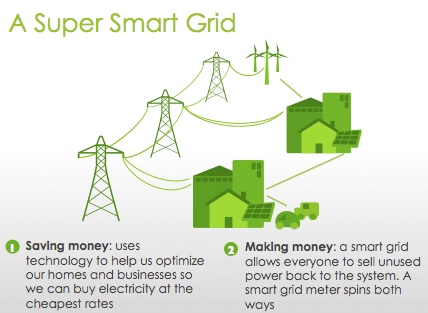
What Is a Smart Grid, and How Might One Protect Our Energy Future? Our electric grid is old and fraying, but new technology could insulate us from the possibility of widespread blackouts and cyberattacks. In February 2021, an electric grid failure in Texas caused more than 4.5 million homes and businesses to lose power. Months later, wide-scale droughts and wildfires threatened the western US with rolling blackouts. With new energy sources such as wind and solar power, maintaining a steady balance gets even more complicated. This is because power from these sources is inconsistent.
“Smart grids” sense small imbalances faster, making adjustments so problems don’t get larger. They use sensors to constantly measure the status of different parts of the grid, and a series of devices that control the current flowing through different points. The sensors and controllersare run by computers that make automatic adjustments to maximize efficiency.
Scientific American 4th Nov 2021
New study throws gloom on hopes for future nuclear energy in Central Europe

 | |||
Experts dampen hopes of Central Europe’s nuclear future https://www.euractiv.com/section/politics/short_news/experts-dampen-hopes-of-central-europes-nuclear-future/
By EURACTIV Network, Aneta Zachová | EURACTIV.cz, edited by Alexandra Brzozowski 3 Nov 2021
As Czechia looks to decarbonise its coal-based economy, it sees nuclear energy as the backbone of its future energy mix. The Czech government plans to build a new nuclear power plant unit that is expected to be operational in 2036. Still, experts warn of delays and high costs, already observed in Slovakia or Hungary.
According to the Industry and Trade Ministry, nuclear energy could solve the Czech need for low-carbon and stable energy sources. The country’s future energy mix is a hot topic due to the EU’s climate ambitions and the recent energy price hikes.
However, a new study published on Tuesday contradicts the current pro-nuclear narrative of the Czech government. “The new nuclear unit would not really contribute to decarbonisation, in terms of replacing the current coal sources,” said Oldřich Sklenář, author of the study and energy analyst at the Association for International Affairs, in an interview for EURACTIV.cz.
“The launch of the new unit should take place after 2036, but we have to phase out coal much earlier. Experience from the Euro-Atlantic area shows that it is a huge problem to meet the deadlines. Basically, everyone faces this problem,” Sklenář warned, adding that the actual costs of the projects could be double those expected.
Czechia is not the only Central European country betting on nuclear energy, but new nuclear projects in Slovakia and Hungary have faced long delays.
New units in Slovakia’s Mochovce were supposed to be in operation in 2012 and 2013 but have been delayed until 2022.
Planned Hungarian Paks II, to be constructed by Rosatom, faces problems as well, as the licensing of the project has been postponed. Hungary has amended its nuclear safety protocols to custom-fit the project, allowing some work to begin before the entire project gets the regulatory nod.
At the same time, the US has also tried to lure Eastern Europe with nuclear power, teasing a $23 trillion market to countries in Central and Eastern Europe by 2030.
In October last year, Poland and Washington signed a 30-year intergovernmental agreement on future cooperation in developing the Polish civil nuclear energy programme. The first nuclear power station could start operating in 2033.
With the currently ongoing energy crisis, a group of primarily Eastern European member states have heaped pressure on the European Commission to grant nuclear energy a ‘green’ label under the EU’s sustainable finance taxonomy, which guides climate-friendly investments.
A proposal from the European Commission is now expected “by the end of the year,” said Kadri Simson, the EU’s energy commissioner said after the recent energy ministerial in October.
Solar and wind keep getting cheaper, and crush coal, gas and nuclear on costs: Lazard

Latest LCOE report from Lazard confirms that wind and solar by far the cheapest of all energy sources, and cost of storage is falling too. The post Solar and wind keep getting cheaper, and crush coal, gas and nuclear on costs: Lazard appeared first on RenewEconomy.
Solar and wind keep getting cheaper, and crush coal, gas and nuclear on costs: Lazard — RenewEconomy Giles Parkinson & Sophie Vorrath 1 November 2021 [GOOD GRAPHS]
As world leaders meet in Glasgow for critical climate talks, they have been given a stark reminder of the lowest cost alternatives to achieve the full decarbonised grid that science says is required of major economies by the middle of next decade, at the latest.
Investment bank Lazard has released the 15th edition of its highly regarded Levelised Cost of Energy Analysis and it reinforces what is pretty much already known: Wind and solar are by far the cheapest forms of electricity generation, storage costs are falling, and now hydrogen is part of the equation.
The best illustration of the cost difference between the various technologies is this following table, which shows the various energy supply sources and their sensitivity to the cost of capital.
All technologies are affected in some way, but wind and solar, which are easily the cheapest form of generation, actually increase their advantage as the cost of capital increases. In all cases, they are five times cheaper than nuclear. Even storage and network costs don’t come close to making up the difference…………………………….. https://reneweconomy.com.au/solar-and-wind-keep-getting-cheaper-and-crush-coal-gas-and-nuclear-on-costs-lazard/—
Positive developments: rise in electric cars, ever cheaper renewables, moves towards energy efficiency

| The climate emergency is the biggest threat to civilisation we have ever faced. But there is good news: we already have every tool we need to beat it. The challenge is not identifying the solutions, but rolling them out with great speed. Some key sectors are already racing ahead, such as electric cars. They are already cheaper to own and run in many places – and when the purchase prices equal those of fossil-fueled vehicles in the next few years, a runaway tipping point will be reached. Electricity from renewables is now the cheapest form of power in most places, sometimes even cheaper than continuing to run existing coal plants. There’s a long way to go to meet the world’s huge energy demand, but the plummeting costs of batteries and other storage technologies bodes well. And many big companiesmare realising that a failure to invest will be far more expensive as the impacts of global heating destroy economies. Even some of the biggest polluters, such as cement and steel, have seen the green writing on the wall. Buildings are big emitters but the solution – improved energy efficiency – is simple to achieve and saves the occupants money, particularly with the cost of installing technology such as heat pumps expected to fall. Guardian 31st Oct 2021 https://www.theguardian.com/environment/2021/oct/31/reasons-to-be-hopeful-the-climate-solutions-available-no |
1 This Month
19 February – VIRTUAL EVENT-Decision Time: AI and Our Nuclear Arsenal
12:45 p.m. Central / 1:45 p.m. Eastern
To see nuclear-related stories in greater depth and intensity – go to https://nuclearinformation.wordpress.com

-
Archives
- February 2026 (141)
- January 2026 (308)
- December 2025 (358)
- November 2025 (359)
- October 2025 (376)
- September 2025 (258)
- August 2025 (319)
- July 2025 (230)
- June 2025 (348)
- May 2025 (261)
- April 2025 (305)
- March 2025 (319)
-
Categories
- 1
- 1 NUCLEAR ISSUES
- business and costs
- climate change
- culture and arts
- ENERGY
- environment
- health
- history
- indigenous issues
- Legal
- marketing of nuclear
- media
- opposition to nuclear
- PERSONAL STORIES
- politics
- politics international
- Religion and ethics
- safety
- secrets,lies and civil liberties
- spinbuster
- technology
- Uranium
- wastes
- weapons and war
- Women
- 2 WORLD
- ACTION
- AFRICA
- Atrocities
- AUSTRALIA
- Christina's notes
- Christina's themes
- culture and arts
- Events
- Fuk 2022
- Fuk 2023
- Fukushima 2017
- Fukushima 2018
- fukushima 2019
- Fukushima 2020
- Fukushima 2021
- general
- global warming
- Humour (God we need it)
- Nuclear
- RARE EARTHS
- Reference
- resources – print
- Resources -audiovicual
- Weekly Newsletter
- World
- World Nuclear
- YouTube
-
RSS
Entries RSS
Comments RSS
 nuclear-news