The extraordinary popularity of renewable energy university courses

The number of students on renewables-related courses in Scotland has
soared by 70% in four years, figures reveal. Scottish Renewables found that
22,000 undergraduates were studying subjects which cover the sector,
ranging from engineering to maths. The same survey in 2019 reported around
13,000 young people studying in similar areas. Scottish Renewables said it
demonstrated the attractiveness of the industry.
BBC 7th March 2023
‘No miracles needed’: Prof. Mark Jacobson on how much wind, sun and water can power the world
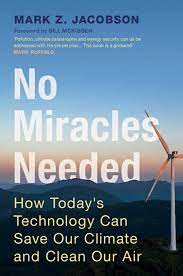
by Damian Carrington, Environmental Editor, The Guardian, January 23 2023 https://www.theguardian.com/environment/2023/jan/23/no-miracles-needed-prof-mark-jacobson-on-how-wind-sun-and-water-can-power-the-world
“Combustion is the problem – when you’re continuing to burn something, that’s not solving the problem,” says Prof Mark Jacobson.
The Stanford University academic has a compelling pitch: the world can rapidly get 100% of its energy from renewable sources with, as the title of his new book says, “no miracles needed”.
Wind, water and solar can provide plentiful and cheap power, he argues, ending the carbon emissions driving the climate crisis, slashing deadly air pollution and ensuring energy security. Carbon capture and storage, biofuels, new nuclear and other technologies are expensive wastes of time, he argues.
“Bill Gates said we have to put a lot of money into miracle technologies,” Jacobson says. “But we don’t – we have the technologies that we need. We have wind, solar, geothermal, hydro, electric cars. We have batteries, heat pumps, energy efficiency. We have 95% of the technologies right now that we need to solve the problem.” The missing 5% is for long-distance aircraft and ships, he says, for which hydrogen-powered fuel cells can be developed.
Jacobson’s claim is a big one. He is not just talking about a shift to 100% renewable electricity, but all energy – and fossil fuels still provide about 80% of that today. Jacobson has scores of academic papers to his name and his work has been influential in policies passed by cities, states and countries around the world targeting 100% green power. He is also controversial, not least for pursuing a $10m lawsuit against researchers who claimed his work was flawed, which he later dropped.
The evidence that proves he is right is collected in the new book, Jacobson says. Not only is a 100% renewables-powered world possible, it also promises much lower energy bills, he says. The first reason for that is that electrified vehicles, heating and industrial processes are far more efficient than those powered by fossil fuels, where much of the energy is wasted as heat.
Add in better-insulated buildings and ending the drilling and mining for the fossil fuels that consume about 11% of all energy, and you get 56% less energy use on average from 2035 to 2050, Jacobson says. Wind and solar energy are cheaper too, so average bills will fall 63%, he says.
Jacobson divides approaches to the energy transition into two camps: “One says we should just try everything – they’re the ‘all-of-the-above camp’ – and keep investing huge amounts of money in technologies that may or may not be available to work in 10 years. But 10 years is too late.” Carbon emissions must fall by 45% by 2030, scientists agree, to keep on track for no more than 1.5C of global heating.
His camp takes a different approach, Jacobson says: “Let’s focus on what we have and deploy as fast as possible. And we will improve those technologies just by deploying, bringing better solar panels, batteries, electric vehicles and so on. Some people just don’t realise the speed that we need to solve these problems, especially air pollution – 7 million people die every year. We can’t wait.”
However, there are major barriers to a rapid rollout of a 100% renewable energy system, he says: “The No 1 barrier is that most people are not aware that it’s possible. My job is trying to educate the public about it. If people are actually comfortable that it’s possible to do, then they might actually do it.”
He adds: “The policy of all-of-the-above is also a big barrier to a transition. In the US, for example, in the recent [climate legislation], a lot of money was spent on carbon capture, small modular nuclear reactors, biofuels, blue hydrogen. These are all what I consider almost useless, or very low-use, technologies in terms of solving the problems. And yet, a lot of money is spent on them. Why? Because there are big lobby groups.” Another barrier is funding the upfront costs of renewable energy in poorer countries – rich countries need to help, he says.
Jacobson believes progress towards a 100% renewable energy system can be fast: “The goal is 80% by 2030, and 100% by 2050. But, ideally, if we can get 80% by 2030, we should get 100% by 2035 to 2040.”
Solving the stability problem
A big concern about a world overwhelmingly reliant on electricity is maintaining the stability of grids powered by renewables. Where there are large amounts of hydropower from dams this is relatively easy – at least 10 countries already have 100% renewable grids. But in other places reliance on intermittent wind and solar is more challenging. The answer, says Jacobson, is energy storage, managing the demand, and connecting up renewables over wider areas to enable greater continuity of supply.
Storage can be batteries, pumped hydro, flywheels, compressed air and lowering and raising heavy weights. Jacobson thinks batteries will win, but says others could contribute if they can compete on cost. New research indicates that electric vehicle batteries alone could provide the short-term storage needed by global grids as early as 2030.
Jacobson also advocates heat storage for some buildings: “Storing heat in boreholes, aquifers or water pits is dirt cheap, excuse the pun. It’s less than $1 a kilowatt hour of storage.” Managing demand, by varying electricity prices with demand, is already growing fast, he says. When the renewables supply exceeds the demand, the electricity should be used to produce green hydrogen, he says, to power the fuel cells needed by energy-intensive users.
“Managing the grid is just an optimisation problem, not a rocket science problem,” he says. “I don’t want to say there’s zero problems, but usually these challenges are ironed out over time just by experience.”
Another criticism of a major renewables rollout is the mining required for the metals used. But Jacobson says such a rollout would in fact hugely reduce extraction from the earth by ending fossil fuel exploitation: “The total amount of mining that’s going to be needed for wind, water, solar, compared to [the] fossil fuel system, is much less than 1% in terms of the mass of materials.”
Jacobson is scathing about many nascent technologies being promoted as climate solutions. “Carbon capture and storage is solely designed to keep the fossil fuel industry in business,” he says. Only some of the CO2 is captured and buried, he says, and deadly air pollution continues unabated. Blue hydrogen, produced from fossil gas with some CO2 then captured and buried, is far inferior to green hydrogen produced directly from renewable electricity, Jacobson says: “Blue hydrogen is just really convoluted.”
New nuclear plants are too slow to build and too expensive compared with wind and solar, in Jacobson’s view: “You end up waiting 15 to 20 years longer, for a seven to eight times higher electricity price – it just makes no sense. Even if they improve [build times], say to 12 years, that’s still way too long. We have cheaper, faster, safer technologies. Why waste time?”
Biofuels are also dismissed by Jacobson: “The biofuels push was really not helpful. They hold constant, or increase, air pollution and they use a huge amount of land.”
He is a little more measured when it comes to direct air capture (DAC): technologies that can suck CO2 from the air for burial. It has no role today, he says, with spending on renewables far more cost effective in cutting emissions. But even when fossil fuel burning ends, many scientists have concluded that CO2 will have to be drawn from the air to avoid the worst effects of the climate crisis. At that point, Jacobson says, the costs of DAC should be compared with other ways to sequester carbon and limit global heating, such as reforestation and cutting emissions of other more powerful greenhouse gases, including methane from livestock and nitrous oxide from fertilisers.
Supporters and critics
Jacobson’s book has attracted support from some experts. Prof Michael Mann, at the University of Pennsylvania, says the book “presents a comprehensive and detailed blueprint for the options we have right now to address the climate crisis”. Mann has said those insisting we lack the tools to decarbonise the economy today are wrong.
Prof Claudia Kemfert, at the German Institute for Economic Research, who has advised the German government and European Commission, says: “[The book] shows impressively that numerous crises can be killed with one stone, without us having to wait for miracles.”
But others are critical of a focus on only wind, water and solar. Prof Ken Caldeira, at the Carnegie Institution for Science in the US, says: “Having a broader set [of technologies] in the toolbox only makes it easier to solve problems. We will only use the tools that it makes sense to use in any particular circumstance, but maintaining and expanding our options is a good thing.
“The key question is not what is physically possible in an ideal world, but what is practically possible in the world as we know it,” he says.
Prof Rob Gross, the director of the UK Energy Research Centre, is somewhere in the middle of the debate: “I broadly agree that we can largely use existing technologies, but we will need to put those to new applications, such as using bulk stores of hydrogen in order to provide interseasonal storage.”
“Moonshot efforts to invent entirely new things are almost certainly a distraction,” he adds. “Jacobson is right that the principal need is to deploy what we have. He is wrong to the extent he makes this sound easy.”
Asked about the controversy around his work, Jacobson says: “Usually, the people against us don’t like the fact that we don’t include their technologies.” On the lawsuit over a critical paper, he says: “That was not a question of a scientific disagreement.” He claims it was an attempt to protect his reputation. He dropped the case in 2018.
Jacobson remains optimistic: “There is a technical and economic solution to the climate, air pollution and energy security problems we face. But we do have major challenges in trying to implement that solution. The challenges are getting the political willpower to focus on a narrow set of solutions that we can implement quickly. The vested interests are very much a problem because they are pushing this ‘all of the above’ approach.”
- No Miracles Needed: How Today’s Technology Can Save Our Climate and Clean Our Air by Mark Z Jacobson is published by Cambridge University Press on 2 February 2023.
The Unholy Alliance – nuclear power, endless data centers, and endless energy use

Nuclear-Powered Data Center Planned in Connecticut
NE Edge, Dominion Energy team on 1.5M SF campus next to Millstone nuke plant.
GLOBEST.com, By Jack Rogers | February 24,
The rapidly expanding data center sector, with a voracious appetite for electricity, increasingly has been embracing renewable energy as the most viable path for expanding data-processing capacity while reducing carbon footprints.
The power and water consumption of data centers—as well as the noise generated by the operations—have fueled NIMBY backlash in many locations as the industry’s footprint expands.
Now comes a project that offers a unique solution to these issues—an alternative electricity source that doesn’t burn fossil fuels and a location that is probably NIMBY-proof: a new data center player and one of the largest US utilities are teaming to put a data center in the back yard of nuclear power plant.
Richmond, VA-based Dominion Energy—the primary supplier of electricity for the largest North American data center hub in Northern Virginia—and NE Edge have announced plans to build a 1.5M SF data center campus adjacent to Dominion’s nuclear power plant in Waterford, Connecticut.
The companies have filed plans in Waterford to build the campus, consisting of two hyperscale data centers, next to the Millstone Nuclear Power Station, a 57-year-old facility owned by Dominion, according to a report in the Connecticut Examiner.
Millstone is Connecticut’s only nuclear power plant—and the only nuke facility in New England with more than one operating reactor. At full power, the Waterford complex can generate more than 2 gigawatts of electricity.
Under an incentive enacted in Connecticut in 2021 to spur data center development, data centers are exempted from local property taxes if they negotiate a fee with the municipality where the facility will be located. NE Edge has offered $231M to Waterford over 30 years in lieu of the property tax, according to the newspaper report.
The partners are planning two, two-story data centers on a 25-acre site adjacent to the power plant, the first encompassing 1.14M SF and the second totaling 428K SF, with delivery expected by mid-2025.
The data center campus will draw power directly from the Millstone plant in what is known as a “behind the meter” agreement with Dominion. Behind the meter arrangements generally have lower rates because no transmission is involved in servicing the facility…………………………. https://www.globest.com/2023/02/24/nuclear-powered-data-center-planned-in-connecticut/?slreturn=20230124224756
South Australia: Grid with the most wind and solar has the smallest reliability gap
South Australia is leading Australia – and the world – with the amount of
wind and solar within its state grid. And not only is it defying the
skeptics that insisted wind and solar can’t power a modern economy, it’s
also the grid facing the smallest reliability gaps over the coming decade.
South Australia sourced 70 per cent of its local demand from variable
renewables in 2022 – nearly twice the percentage of the second best state
grid (Victoria, with 38 per cent), and more than any other gigawatt scale
grid in the world.
In the December quarter, that average lifted to 80 per
cent wind and solar – and it’s doing this at the end of a long “skinny
grid” that is connected to only one other state – and breaking the
stranglehold that gas generators have over wholesale electricity prices in
Australia and around the world.
Renew Economy 21st Feb 2023
Small scale renewable technology installations being deployed rapidly in Britain without government subsidies.
The installation of small scale clean technologies returned to levels not
seen since government subsidies were axed in 2015, according to new figures
that confirm demand for solar panels and heat pumps surged last year in
response to soaring energy bills.
The Microgeneration Certification Scheme
(MCS), which provides independent quality certification for renewable power
and heating technology installations, yesterday reported that the number of
certified installations rose 65 per cent last year to 163,341.
The performance marks the highest annual deployment since 2015, when just over
200,000 installations were registered, the bulk of which were deployed
ahead of the government’s controversial axing of subsidies for domestic and
small scale renewables installations.
Business Green 16th Feb 2023
France’s nuclear output plummeted in 2022
France’s nuclear output plummeted by 22.6% year on year in 2022, down 81.7
TWh to 279 TW, EDF said on Friday, citing lower nuclear fleet availability
amid inspections and reactor repairs.
Last November, EDF cut its full-year
French nuclear output estimate to 275-285 TWh, down from 280-300 TWh
previously, due to 10-year maintenance schedules and strikes, as well as
extended outages at four nuclear reactors. The French utility’s nuclear
generation slumped to a 33-year low in 2022 as the country became a net
power importer for the first time since 2001, according to data previously
released from TSO RTE.
EDF posted an operating loss of EUR 19.36bn for 2022
due to the record low nuclear output and government caps on energy bills,
it said this morning.
Montel 17th Feb 2023
https://www.montelnews.com/news/1444244/frances-nuclear-output-plunges-23-in-2022–edf
Solar’s stunning journey from lab curiosity to global juggernaut wiping out fossil fuels
One of the four Australian solar researchers who have won the world’s most
prestigious engineering prize says it won’t be long before solar is at a
cost level across the world where it will “wipe fossil fuels out of the
global economy.
Renew Economy 10th Feb 2023
Young people want to work in genuinely clean industries
MILLIONS of youngsters want a career in the green industries with many
planning to pursue roles in renewable energy and engineering. A poll of
1,000 people aged between 15 and 25 found 71 per cent want to work towards
a career which doesn’t have a negative impact on the planet.
The Sun 9th Feb 2023
https://www.thesun.co.uk/news/21331673/young-workers-green-industries/
Renewables In China Trend Upward While Nuclear Trends Flat.

The blue line at the bottom is nuclear, and not particularly sharp eyes will note that it’s trending to flat. The red line at the top is wind, water, and solar cumulative additions to annual TWh of electricity flowing into China’s grid, and not particularly sharp eyes will note it’s curving upwards.
The natural experiment of renewables vs nuclear continues in China, and it continues to unfold in renewables’ favor.
Clean Technica, ByMichael Barnard, 7 Feb 23,
I’ve been publishing assessments of the poor performance of nuclear compared to wind and solar in China for years (2014, 2019, 2021, 2022). My premise nine years ago was a first principles assertion with limited empirical results that wind and solar would radically outstrip nuclear in China. Why? Modularity reducing long-tailed risks, as Professor Bent Flyvbjerg, global expert and go to person for megaprojects, puts it in his new book How Big Things Get Done, where he includes my assessment of the natural experiment.
Subsequent assessments found that was true. Every year, the combination of wind and solar, and usually both individually, outstripped new nuclear generation, both in raw nameplate capacity and in additional TWh of annual generation. But as Professor Mark Z. Jacobson likes to remind us, it’s not WS, it’s WWS, that is wind, water, and solar. And so, today I spent a bit of time looking at hydroelectric generation capacity additions around the world since 2000, which turned out to be almost entirely in China. Of the 132.5 GW of new big hydroelectric projects connected to the grid in the world since 2000, 113 GW were in China. Unsurprising to anyone paying the slightest attention, but still, big numbers.
But what does that mean when added to wind and solar and compared to nuclear, leveraging the 2010 to 2022 data set I already had?…………………………………….
there is an interesting question about all forms of electrical generation, which is what capacity factors they are operating at. China’s wind and solar were historically curtailed by transmission connection challenges, which have been being resolved every year. Last year’s bumper crop of offshore wind, of course, were connected with HVDC to the grid without challenges.
What about hydro? It has different challenges for capacity factors, typically having a spring spate with often far too much water to use for generation, and a fall lull where generation is low. In the case of China, the best data I have at present is from the International Hydropower Association (IHA) which lists 1,355 TWh of electrical generation from 370,160 MW of capacity in 2020. That’s a 42% capacity factor, which I used for the generation.
I was somewhat surprised by this, and would be interested in better data, should anyone have some at hand. What it does mean is that while nuclear added a total of about 243 TWh of net new electrical generation from 2010 through 2022, hydro only added about 229 TWh of new generation. It was an interesting result which I’ll spend a little time assessing in a bit. Of course, wind energy added about 711 TWh of new generation annually over that period and solar added about 474 TWh. Both outstripped nuclear and hydro.
For purposes of wind, solar, and nuclear, I’d been simply presenting the new TWh of generation added each year. But in adding water to the data set, it seemed reasonable to make it cumulative.
In the graph above , the blue line at the bottom is nuclear, and not particularly sharp eyes will note that it’s trending to flat. The red line at the top is wind, water, and solar cumulative additions to annual TWh of electricity flowing into China’s grid, and not particularly sharp eyes will note it’s curving upwards.
Poking at the disparity between additions of actual TWh by renewable generation source a bit more, there are a few things to note.
The first, of course, is that wind and solar siting is much simpler than major hydroelectric siting. They just need flattish areas with good wind and sun, and wind likes ridge lines where flat bits can be made. Big hydro needs a big river with a reasonably significant drop along its length and at least one place where it’s carved a big valley. Meandering rivers like the Mississippi need not apply, although they are much better for inland shipping. The combination means that it’s typically easier to get materials and workers for wind and solar farms to the sites, easier to move construction vehicles around them and the like.
And hydroelectric reservoirs have another reality: you can’t live or work where they are. Unlike solar farms which can simply be built around existing buildings or roads, or wind farms where turbines can be built in the non-productive corners of farm fields, hydroelectric reservoirs displace everybody and everything where they exist. …………………………………
Still, China has managed to construct and attach 16 of them [hydro-electric dams] to the grid since 2000. I was aware of the Three Gorges Dam, of course, but was unaware that it was a small portion of the hydroelectric China had constructed. And while each project’s cost and schedule results vs plans are unavailable, China did succeed in building them.
The natural experiment of renewables vs nuclear continues in China, and it continues to unfold in renewables’ favor. https://cleantechnica.com/2023/02/06/renewables-in-china-trend-upward-while-nuclear-trends-flat/
Four separate reports show that the UK could save over €120 bn by 2050 by switching to a renewable energy strategy

LUT University in Finland has found that a 100% renewable energy/storage
mix would save the UK over €120 bn by 2050 compared with the UK
Government’s current net zero plan.
That’s one conclusion from a series of
scenarios in a new LUT report. Its ‘Best Policy Scenario’ (BPS), aims for
100% renewable energy in 2050, with offshore wind as the main resource,
limiting onshore wind and solar according to available land area, but it’s
backed up by a second scenario called ‘Inter-Annual Storage’ (IAS) which
adds on to the BPS the required inter-annual storage needed to provide good
levels of insurance against the possibilities of low-wind years.
A third scenario (BPSplus) tests the limits of higher land area availability for
onshore wind and solar photovoltaics, and where also renewable
electricity-based e-fuel imports are allowed. And finally, a fourth scenario, called ‘Current Policy Scenario’ (CPS), looks at the UK Government’s strategy for net zero as published in 2020.
A very worthwhile assessment exercise – all credit to Dr David Toke and the ‘100%
Renewables’ lobby group for supporting it. It does clearly show that a zero
carbon 100% renewables scenario is possible, at lower cost than any other
scenario. As Toke notes the implications are that ‘all public and
enforced consumer spending on new nuclear power and carbon capture and
storage should be scrapped and instead funding should be put into renewable
energy, energy efficiency and storage capacity.’
Renew Extra 21st Jan 2023
https://renewextraweekly.blogspot.com/2023/01/lut-university-in-finland-has-found.html
Renewable energy is the only credible path forward -António Guterres

Renewable energy is the only credible path forward if the world is to avert
a climate catastrophe, UN Secretary-General António Guterres said on
Saturday, outlining a five-point plan for a just transition.
“Only renewables can safeguard our future, close the energy access gap, stabilize
prices and ensure energy security,” he said in a video message to the
13th Session of the International Renewable Energy Agency (IRENA) Assembly,
taking place this weekend in Abu Dhabi, United Arab Emirates. “Together,
let’s jumpstart a renewables revolution and create a brighter future for
all.
UN 14th Jan 2023
Prolonged outages of France’s nuclear reactors.
French power prices advanced after the start of two nuclear reactors were
pushed back, denting the nation’s ramp up in capacity at a time they are
most needed. French power for next month gained the most in two weeks,
rising as much as 3.9%. An oncoming cold snap in western Europe and rising
natural gas prices also provided bullish sentiment for electricity traders
across the region.
The prolonged outages will set back the recovery of the
nation’s nuclear capacity, which is the backbone of Europe’s integrated
power system. Availability at EDF’s nuclear fleet has increased in recent
weeks and is near the highest level in a year. The Chooz-1 unit is now due
to start on Feb 28, a month later than planned, while Blayais-1 was delayed
by 10 days to Feb. 11, according to data submitted to the grid.
Bloomberg 13th Jan 2023
Germany aims for faster expansion of wind energy, not nuclear
Germany Targets Three New Windmills a Day for Energy Reboot. Chancellor
Scholz says faster expansion of renewables needed. He rules out further
nuclear power extension to ease crunch.
Bloomberg 14th Jan 2023
The renewable energy transition is creating a green jobs boom

12.7 million people now work in the global renewable energy sector, according to the
International Renewable Energy Agency. It says the biggest growth has been
in the solar photovoltaic (PV) sector, especially in Asia, which employs
79% of the global total. Wind and hydropower, as well as liquid biofuels
make up most of the rest of the growth in renewable energy jobs. China
dominates employment in most renewable energy sectors, however Brazil has
the most biofuel jobs.
World Economic Forum 13th Jan 2023
https://www.weforum.org/agenda/2023/01/renewable-energy-transition-green-jobs/
Analysis Shows U.S. Wind and Solar Could Outpace Coal and Nuclear Power in 2023
EcoWatch By: Common Dreams, January 8, 2023, By Jake Johnson
A new analysis of federal data shows that wind and solar alone could generate more electricity in the United States than nuclear and coal over the coming year, critical progress toward reducing the country’s reliance on dirty energy.
The SUN DAY Campaign, a nonprofit that promotes sustainable energy development, highlighted a recently released U.S. Energy Information Administration (EIA) review finding that renewable sources as a whole—including solar, wind, biomass, and others—provided 22.6% of U.S. electricity over the first 10 months of 2022, a pace set to beat the agency’s projection for the full year.
“Taken together, during the first ten months of 2022, renewable energy sources comfortably out-produced both coal and nuclear power by 16.62% and 27.39% respectively,” the SUN DAY Campaign noted Tuesday. “However, natural gas continues to dominate with a 39.4% share of total generation.”…………………… more https://www.ecowatch.com/wind-solar-outpace-nuclear-coal.html
1 This Month

of the week – Shut Down Drone Warfare!


Tell the Ukrainian Government to Drop Prosecution of Peace Activist Yurii Sheliazhenko

Petition to revoke the licensing of the Near Surface Nuclear Disposal Facility (NSDF) at Chalk River. https://www.ourcommons.ca/petitions/en/Petition/Details?Petition=e-7247
To see nuclear-related stories in greater depth and intensity – go to https://nuclearinformation.wordpress.com
-
Archives
- March 2026 (251)
- February 2026 (268)
- January 2026 (308)
- December 2025 (358)
- November 2025 (359)
- October 2025 (376)
- September 2025 (257)
- August 2025 (319)
- July 2025 (230)
- June 2025 (348)
- May 2025 (261)
- April 2025 (305)
-
Categories
- 1
- 1 NUCLEAR ISSUES
- business and costs
- climate change
- culture and arts
- ENERGY
- environment
- health
- history
- indigenous issues
- Legal
- marketing of nuclear
- media
- opposition to nuclear
- PERSONAL STORIES
- politics
- politics international
- Religion and ethics
- safety
- secrets,lies and civil liberties
- spinbuster
- technology
- Uranium
- wastes
- weapons and war
- Women
- 2 WORLD
- ACTION
- AFRICA
- Atrocities
- AUSTRALIA
- Christina's notes
- Christina's themes
- culture and arts
- Events
- Fuk 2022
- Fuk 2023
- Fukushima 2017
- Fukushima 2018
- fukushima 2019
- Fukushima 2020
- Fukushima 2021
- general
- global warming
- Humour (God we need it)
- Nuclear
- RARE EARTHS
- Reference
- resources – print
- Resources -audiovicual
- Weekly Newsletter
- World
- World Nuclear
- YouTube
-
RSS
Entries RSS
Comments RSS
 nuclear-news