Welsh campaigners call for Wylfa to be at heart of Ynys Mon ‘green energy’ island
Campaigners from several organisations opposed to new nuclear power
developments in Wales have written to Climate Change Minister Julie James
calling for the Welsh Government to acquire the Wylfa site as a national
asset to develop a range of cutting-edge renewable energy technologies.
Last week, the Welsh Affairs Committee in Westminster called on the British
Government to acquire the former nuclear power plant site at Wylfa to
redevelop for nuclear power, but, in their response, ministers indicated
that it was a ‘commercial decision’ for Hitachi, the owners of the
site, to determine who they sell the site to.
Anti-nuclear activists
believe this represents an opportunity for the Welsh Government to approach
Hitachi to see if they can purchase the site to become the hub of an Ynys
Mon (Anglesey) that is truly a ‘green energy island’. This would be in
line with Cardiff’s aspiration to ensure that all electricity consumed in
Wales is from renewable sources by 2035, and that such generation should be
ramped up in line with demand in the future.
NFLA 15th July 2023
New Book -The Path to a Sustainable Civilisation
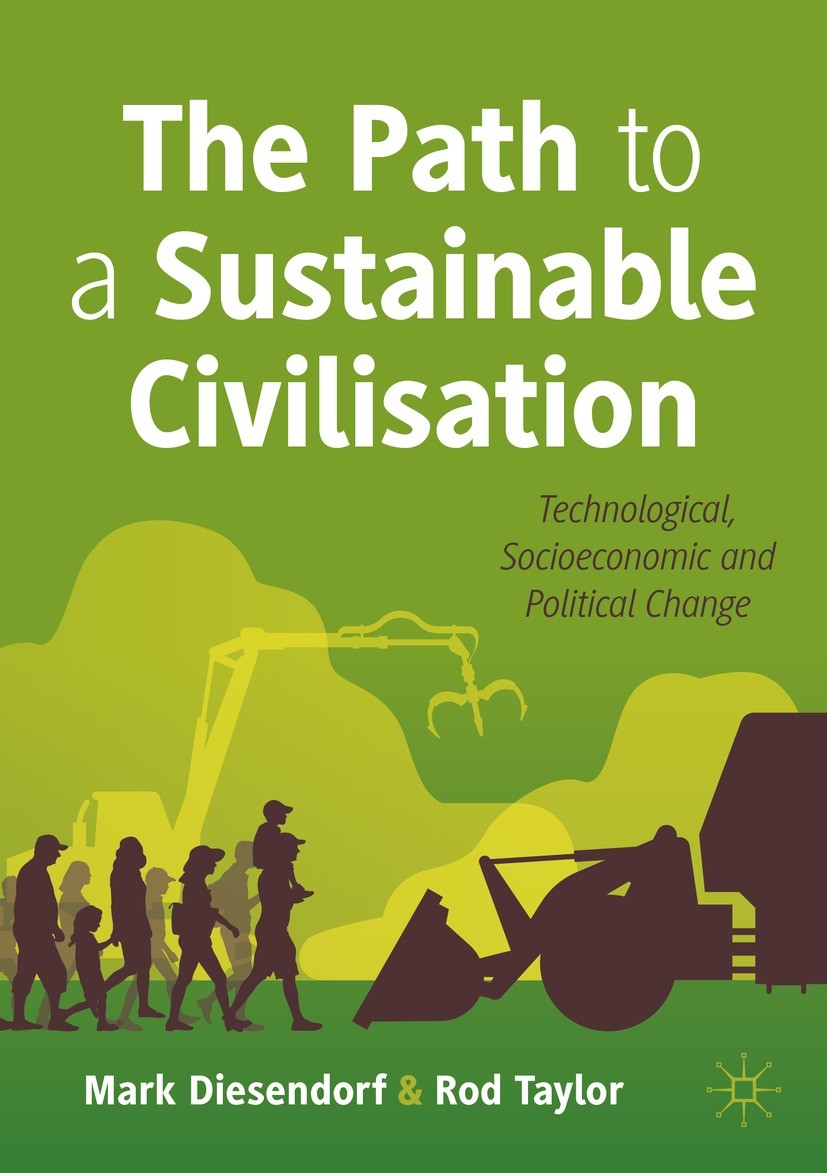
In this radical new book Prof. Mark Diesendorf and Rod Taylor, who are
based in Australia, say that major changes have to be made in order the
move to a sustainable future.
They claim that we have allowed large
corporations, the military and other vested interests to capture
governments and influence public opinion and markets excessively. The
result will be social, economic and environmental disaster.
They argue that the way forward is to build social movements to apply overwhelming pressure on government and big business, weaken the power of vested interests and
strengthen democratic decision-making.
This, they say, must be done simultaneously with action on the specific issues of climate, energy, natural resources & social justice, so as to transition to a truly
sustainable civilisation. That may sound Utopia, but the book takes us
through the practical technology options and explores how the transition to
their use might come about globally. However, it goes well beyond just
offering technical and social fixes, challenging the idea that
technological changes alone will be sufficient to transition to ecological
sustainability. It says that a sustainable civilisation needs ‘an
economic system that fosters ecological sustainability and social
justice’, whereas ‘the current dominant system, neoclassical economic
theory together neoliberalism practice, is based on numerous myths. Its
practitioners claim it’s a science although it does not stand up to
scientific scrutiny’.
Renew Extra 8th July 2023
https://renewextraweekly.blogspot.com/2023/07/the-path-to-sustainable-civilisation.html
Germany’s power mix boasts more renewables, lower spot market prices – despite nuclear exit
Germany’s shutdown of nuclear power plants in April did not result in a
ramp-up of lignite-fired power plants, despite concerns. Instead, there has
been a significant increase in the share of renewables in the electricity
mix, and the proportion of coal-generated electricity has fallen by more
than 20%.
Electricity in Germany has become cheaper and cleaner since its
last three nuclear power plants were shut down, according to new data from
the Fraunhofer Institute for Solar Energy Systems ISE. Net electricity
production from lignite and hard coal has decreased by more than 20%, while
natural gas has experienced a minor decline.
In contrast, renewables have
reached a record share of 57.7% of net electricity generation. According to
Fraunhofer ISE, the German energy system successfully managed the nuclear
phase-out. The decommissioned reactors’ reduced output was offset by lower
consumption, decreased exports, and increased imports.
PV Magazine 4th July 2023 https://www.pv-magazine.com/2023/07/04/germanys-nuclear-exit-leads-to-more-renewables-lower-spot-market-prices/
Community energy for the UK
At the close of Community Energy Fortnight (10-23 June), the Nuclear Free
Local Authorities have written to a minister asking the government to hold
onto parts of the Energy Bill that will be vital if the community energy
sector is to continue to grow.
In his letter to Nuclear and Networks
Minister Andrew Bowie, who is leading on the legislation for the
government, NFLA Steering Committee Councillor Lawrence O’Neill has asked
for Clauses 272 and 273 to be retained in the bill.
These clauses, backed by the campaign group Power for People, would allow small community owned projects generating renewable energy to supply electricity to the National
Grid or to the communities that they serve on a fairer basis, and they
would also guarantee these suppliers a set income. Disappointingly, the
government is believed to be looking at dropping these clauses from the
bill, without suggesting any alternate provision.
NFLA 23rd June 2023
Expert: Germany’s energy system has coped with nuclear shutdown
| 06/18/2023 https://www.marketscreener.com/quote/stock/E-ON-SE-3818998/news/Expert-Energy-system-has-coped-with-nuclear-shutdown-44138125/ – The German energy system has not experienced any problems after the shutdown of the last three nuclear power plants in mid-April, according to an expert. “The energy supply has coped very well with the nuclear phase-out,” Claudia Kemfert, an energy economist at the German Institute for Economic Research, told the Augsburger Allgemeine newspaper (Monday edition). | ||
“The remaining three nuclear reactors still produced just under six percent of the electricity. The loss of this electricity production was lost in the noise of the European electricity market,” Kemfert said. The volumes that were eliminated were easy to replace: “Electricity production from renewable energies has increased significantly in Germany,” Kemfert explained. Electricity has also become cheaper, she added. “The price of electricity on the borsen has fallen during the period of the nuclear phase-out,” she pointed out
In May, the borsen electricity price for next-day delivery averaged around 82 euros per megawatt hour, the lowest since July 2021
Nuclear Free Local Authorities – visiting community owned project in the UK, at the start of Community Energy Fortnight,
At the start of Community Energy Fortnight (10 June), NFLA Secretary
Richard Outram travelled to picturesque Dovestones Reservoir to visit his
nearest community owned hydro project. Saddleworth Community Hydro was
holding a public open day to mark the start of this annual event promoted
by Community Energy England, which is held to showcase projects, share
knowledge in the sector, and celebrate success.
Community Energy England
was founded in 2014 by community energy practitioners as the ‘voice’ of
the sector and to help put people at the heart of the energy system. Now
with over 275 community energy organisations as members, its mission is to
‘to help active community energy organisations implement new projects,
innovate, improve and grow.’ Saddleworth Community Hydro also started in
2014, commencing operations in September of that year. It was the first
high head project in England to generate power from the waters of a
reservoir.
At a cost of £500,000, it was financed almost equally by grants
from the Department for Environment, Food and Rural Affairs and the
European Agricultural Fund for Rural Development and by the sale of shares
to around 200 members, and subsequent upgrades have been funded by local
supporters.
NFLA 16th June 2023
45 nations pledge to double their rate of energy efficiency improvements

45 nations pledge to double rate of energy efficiency improvements. The
UK, the US and Ukraine are among the 45 nations endorsing a new global
commitment to accelerate the rate of energy efficiency improvements. The
declaration takes the form of a new ministerial statement, released to mark
the conclusion of the International Energy Agency’s (IEA) global
conference on energy efficiency in France. As the conference began earlier
this week, the IEA confirmed that global energy intensity decreased 2.2%
last year, twice the average of the previous five years, largely due to
policy responses to the energy price crisis. Yet annual decreases of 4% are
needed to give the world the best chance of achieving net-zero by
mid-century and averting the worst physical impacts of the climate crisis.
To that end, the 45 nations have pledged to develop and implement better
policies to improve energy efficiency domestically. These include both
government-led schemes and policies that help to unlock private investment.
Edie 9th June 2023 https://www.edie.net/45-nations-pledge-to-double-rate-of-energy-efficiency-improvements/
Wind and solar overtake fossil fuel generation in the European Union
New data from energy think tank Ember shows that wind and solar produced
more EU electricity than fossil fuels in May, for the first full month on
record. Almost a third of the EU’s electricity in May was generated from
wind and solar (31%, 59 TWh), while fossil fuels generated a record low of
27% (53 TWh). “Europe’s electricity transition has hit hyperdrive,”
said Ember’s Europe lead Sarah Brown. “Clean power keeps smashing
record after record.”
Ember 8th June 2023
https://ember-climate.org/press-releases/wind-and-solar-overtake-fossil-generation-in-the-eu/
Business Green 8th June 2023
How Much Would It Cost to Solve Climate Change? And How Would We Pay for It?

Palmer Owyoung, Medium 31st May 2023
We know we need to replace fossil fuels with renewable energy. But as of
2023, we still get about 78 % of our energy from fossil fuels, with coal
making up the single biggest source of electricity at 36%. So how do we get
from where are today to 100% renewable energy before 2050? Is there a
climate change solution? Most importantly how much will it cost and who
will pay for it?
To answer the first question, we look to Mark Jacobson, a
professor of civil and environmental engineering and director of the
Atmosphere/Energy Program at Stanford University. In his 2023 Book No
Miracle Needed, he puts together a comprehensive plan based on real-world
data that shows how the world can transition off fossil fuels using
existing technology in the form of wind, solar, geothermal, hydo-electric,
and battery storage.
According to Jacobson we already have 95% of what we
need to get there and the remaining 5% will come from hydrogen fuel cells
that can power airplanes and long-distance cargo ships. The data for his
book comes from a detailed study that he published in 2015 of what each of
the 50 U.S. States needs to transition their electrical grid,
transportation, heating/cooling, and industrial sectors to renewable energy
powered by wind, water and sun.
The plan’s goal is to replace 80 to 85% of
fossil fuels by 2030 and 100% by 2050. This time frame is considerably more
aggressive than the Paris Climate Agreement and Jacobson not only addresses
the need to reduce greenhouse gas emissions and air pollution, but does so
while keeping energy costs low, creating new jobs and maintaining a stable
power grid.
One of the biggest issues with solar and wind is the
intermittency problem, which means that the sun does not always shine and
the wind doesn’t always blow. Jacobson’s 2015 report was criticized for
making assumptions about how energy could be stored and it was dismissed as
using unrealistic assumptions. His response was to write the 2018 study
that divided the world into 143 countries and 20 regions around the world.
Using data and a simulator he and his team looked at the grid stability in
each of the regions for every 30 seconds for the past five years to
determine the cost of energy per unit. What they found was that wind, water
and solar power are enough to keep the grid stable and uninterrupted
contrary to what his critics said. In fact, he found that there is enough
wind generated on the Earth to power our needs 6 or 7 times over and while
it’s true this energy is intermittent, he says it would require no more
than 4 hours of battery storage in order to solve the problem.
Furthermore,
a 2023 study published in Nature indicates that electric vehicle batteries
alone could provide the short-term storage needed by global grids as early
as 2030.
·
Taiwan Considers Keeping Nuclear Reactors on Emergency Standby
Cindy Wang and Stephen Stapczynski, Mon, May 29, 2023 https://finance.yahoo.com/news/taiwan-considers-keeping-nuclear-reactors-022439242.html
(Bloomberg) — Taiwan is considering keeping nuclear power plants on standby in case of emergencies, signaling a loosening of policy to phase out the energy source.The government plans to maintain shut reactors so that they could be restarted in an emergency, Taipei-based United Daily News reported, citing Vice President Lai Ching-te, the ruling Democratic Progressive Party’s presidential candidate. It’s the first time the government has signaled it’s possible to restart plants, United Daily News said.
The use of nuclear as backup generation would be unusual because of the high costs and safety measures required. Taiwan’s plans to phase out its last remaining atomic plant by 2025 go against a global resurgence of the technology to reduce dependence on fossil fuels. The island is also seeking to reduce coal consumption, leaving the government under pressure to build out gas-powered generation and offshore wind to avoid power shortages.
A restart strategy would only be needed in extreme emergencies, such as external blockades or serious natural disaster, and would need to be safe and have consensus among lawmakers and the public, Economics Minister Wang Mei-hua told reporters on Monday.
Taiwan got about 11% of its power from nuclear in 2021, according to state-owned Taiwan Power Co. It has two operating reactors that started in the 1980s and which are slated to close next year and in 2025.
US Electricity From Renewable Energy Beat Electricity From Coal Or Nuclear In 2022
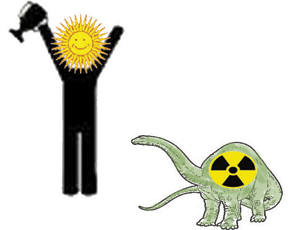
Since 2007, the use of coal for electricity generation has generally been in decline, while the use of renewables has been on the rise. Electricity generation from nuclear had remained relatively flat over the last two decades but has experienced a slight decline in recent years. In 2022, net generation of electricity from renewables reached 0.91 billion megawatt-hours, topping both coal and nuclear (0.83 and 0.77 billion megawatt-hours, respectively). In 2022, renewables accounted for about 21% of all net generation of electricity.
- Renewable sources of power include wind, solar, hydropower, biomass, and geothermal energy. “Other” category includes petroleum liquids, petroleum coke, batteries, chemicals, hydrogen, pitch, purchased steam, sulfur, miscellaneous technologies, and non-renewable waste.
- Electricity net generation is the amount of gross electricity generation a generator produces minus the electricity used to operate the power plant.
Source: U.S. Energy Information Administration, Electricity Data Browser, queried April 21, 2023.
View the supporting data for this Fact of the Week.
Portugal’s renewable energy success
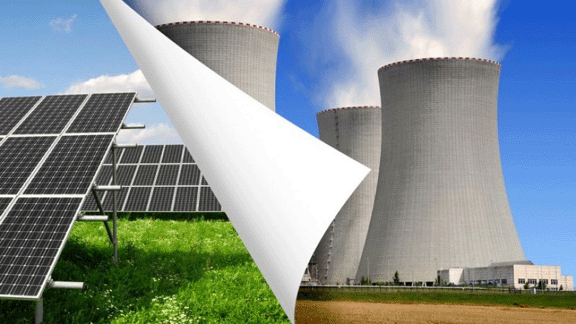
Portugal reached a major milestone of producing more than half (51%) of
its electricity from wind and solar in April. The previous monthly record
high was 49%, set in December 2021.
According to Ember, Portugal’s record
of 50% from wind and solar comes despite relatively modest wind generation.
Strong deployment of solar capacity pushed solar generation to an all-time
high of 360 GWh in April, significantly higher than the previous record of
300 GWh in July and August of 2022. Last year, the country installed 0.9 GW
of solar photovoltaics, increasing its solar capacity by more than 50% to
2.5 GW.
Review Energy 18th May 2023
New report finds millions of Britons planning to get rid of their cars
How the cost of living crisis and environmental concerns mean 6 million
Britons could ditch their cars.
A new report has found that 6.4 million
people are preparing to sell, or not replace, their motors due to the cost
of living crisis and a growing interest in healthier, more sustainable,
lifestyles.
There are currently around 33 million cars in the UK. But while
millions of people may intend to sell their cars in the coming years, how
feasible is it really for such large numbers to switch to alternatives,
such as walking, cycling and e-biking and buses, coaches and trains?
There are signs that a shift is already taking place. This was fueled, in part,
by the pandemic, which prompted people to walk and cycle more to avoid
crowded public transport and reduced car journeys as people worked from
home.
The new report reveals that 9.1 million Britons have already stopped
using their cars for at least some short journeys. In many cases they are
using public transport instead – although nearly 4 million are now
cycling or e-biking to work, according to the report, from Swytch
Techology, a maker of kit to convert regular bikes to e-bikes. This
involved a survey of 2,074 British adults conducted by the Yonder research
group.
iNews 21st May 2023
Germany’s green revolution puts nuclear power in the past

Renewed support for renewables and an end to nuclear power keep Germany on its carbon neutral path
By Linda Pentz Gunter 21 May 23
Germany is a country of sensible shoes. And, I might add, supremely comfortable ones. Germans do buttery leather as well as they do beer.
Germany’s energy policy is similarly sensible. Germans see no reason to choose the slowest, most expensive, most dangerous and decidedly non-renewable energy source with which to address the climate crisis.
Consequently, Germany rejected nuclear power, and on Saturday April 15, it closed the last of its reactors. Germany, like its even more sensible neighbor, Austria — where nothing nuclear may even traverse its terrain — is now a nuclear-free country. Almost. The next step for the German anti-nuclear movement will be to close the URENCO uranium enrichment facility there and the Lingen fuel fabrication plant. And of course there remain nuclear weapons in Germany, not theirs, but ours.
While France continues to wobble along on its high-fashion nuclear stilettos, turning ankles and snapping off heels whenever the going gets rough, Germany will trudge on inexorably, and comfortably, to its stated goal of carbon neutral by 2045.
Germany also plans to end it coal use possibly as soon as 2030, but certainly by 2038. Although, you’d never know it, with all the alarmist hype in circulation post nuclear shutdown. The nuclear lobby, already in propaganda over-drive, has now gone supersonic in its efforts to persuade the world that Germany’s choice to close those last three reactors — never mind that their energy has already been replaced by renewables —will mean burning more coal.
The decision to prolong the operating time of its last three reactors until April 2023 (they were originally due to close at the end of 2022) was largely political, designed to appease rightwing voices within the governing alliance led by the Social Democrats. “We could, in fact, have already shut down the nuclear power plants by January 1 of this year without the lights going out,” said German economist, Claudia Kemfert. “The extension was more like a psychological comfort blanket, as we had an oversupply of electricity,” she told the Washington Post.
Germany didn’t need those last three reactors to keep its green revolution on track. And it especially didn’t need them through this winter, after rejecting the supply of gas from Russia in response to that country’s invasion of Ukraine. German heating is not electric. So nuclear power had no role to play in easing that situation.
Meanwhile, power prices on the European Energy Exchange for the first quarter of 2024 were more than twice as high in France than in Germany. Much of this was due to loss of market confidence in French state energy company, EDF, to get sufficient numbers of their troubled nuclear reactors back on line to meet demand.
This did not change after Germany’s last three reactors closed. As Bruno Burger of Energy Charts noted as a caption to the graphic below [ on original] : “The shutdown of the last three German nuclear power plants has no visible effect on weekly Future Electricity Prices in Germany.”
The nuclear power contribution to Germany’s energy mix has been steadily declining since the renewable energy boom, known as the Energiewende, was launched in 2000 with the Renewable Energy Act. A precondition of the Act’s passage was that as nuclear power was phased out it would be replaced by renewable energy and energy efficiency (although demand should have been brought down much faster, much further) and not by fossil fuels.
In 2000, the renewables share in German electricity was just over 6%. The nuclear share was 30%. In just 23 years, those numbers have more than reversed, with today’s share of on- and off-shore wind plus solar at just over 46% and nuclear at 4.6% in the last week before the final reactor closures. Germany remains on track to achieve its carbon neutral goal by 2045.
The renewable energy boom was greatly helped by the implementation of a feed-in tariff that helped to create confidence and certainty for renewable energy investors who were guaranteed a fixed price for 20 years, above the standard market price. This spurred a big investment, not just by companies, farmers, and coops, but by individuals and many municipalities.
This led to local success stories such as Morbach, a small town about 92 miles west of Frankfurt that boasts 14 wind turbines, 4,000 square meters of solar panels and a biogas plant. Combined, these generate three times more electricity than the community of 11,000 people needs. They sell the surplus back to the grid.
Simply put, the nuclear phaseout opened the way for renewable energy growth in Germany and put the country on the path to a fossil fuel-free future as well. Without the former, the latter would not have happened.
Critics who falsely ascribe Germany’s continued use of coal, including brown coal or lignite, to the nuclear phaseout, fail to understand that these upticks are driven by the export market and are not related to domestic consumption or the nuclear shutdown.
Ironically it is nuclear France, dependent on electric heat, that is partially responsible for the demand for German coal. This was especially so this past winter when the French nuclear sector all but collapsed with more than 50% of its nuclear capacity down due to serious safety issues combined with scheduled maintenance.
In contrast, in 2022, Germany succeeded in weaning itself off Russian gas entirely and supplying France with 15 billion kWh of electricity net.
Furthermore, Germany’s lignite and coal production remains well below earlier levels and Germany is legally committed to end coal use by 2038. The current government is working to advance this date to 2030.
According to the 2022 World Nuclear Industry Status Report: “Lignite peaked in 2013 and then declined—especially in 2019–2020—before increasing again by 20.2 percent in 2021. However, lignite generation remained below the 2019-level and 25 percent below the 2010 level.
“Hard coal also peaked in 2013 then dropped to 64 percent below the 2010-level. While it has seen, at 27.7 percent, the strongest increase in 2021 of any power generation technology, it also remains below the 2019 numbers.
“Natural gas fluctuated since 2010 and peaked in 2020 at 2.6 percent above the 2010-level before dropping by 5.3 percent in 2021.”
In fact, Germany’s struggle to get off fossil fuels lies mainly in the transport rather than the electricity sector. The country’s love affair with the car and speed limit-free autobahns is a long engagement that now needs to be broken.
Germany’s path to a carbon neutral economy is all about the trajectory, which is on track, despite bumps in the road. As always, it is about a political commitment rather than any technological challenges. If the current government sticks to its word to greatly accelerate renewable energy implementation, the Energiewende, by no means a perfect roadmap, will get itself back on track.
Mistakes were undoubtedly made. Even after then Chancellor Angela Merkel had her epiphany in 2011 in light of the Japan nuclear disaster at Fukushima, making an overnight decision to restore Germany on the path to nuclear shutdown, she subsequently made drastic cuts in solar subsidies, something environmentalists described as “nothing less than a solar phase-out law”.
But despite this, Germany remains one of the few Western countries that has demonstrated a consistent commitment both to a nuclear phaseout and to climate chaos abatement.
The German anti-nuclear movement is greatly to be credited with much of this progress. It has long been one of the most powerful and politically effective. Like the sensible shoes they march in, green advocates in Germany understood exactly what their fight was about and the significance of that final nuclear shutdown. I hope they are having a jolly good party. They deserve it. Then it will be back to vigilance over the Energiewende — and hopefully to removing US nuclear weapons from German soil and closing those uranium fuel fabrication plants. Because that is the kind of thing that only people power can get done.
“The German nuclear phase-out is a victory of reason over the lust for profit; over powerful corporations and their client politicians,” read a statement from Greenpeace. “It is a people-powered success against all the odds.”
Linda Pentz Gunter is the international specialist at Beyond Nuclear and writes for and curates Beyond Nuclear International.
The nine hours in which Spain made the 100% renewable dream a reality
Electricity generation through solar, wind and water exceeded total demand in mainland Spain on Tuesday, a pattern that will be repeated more and more in the future
IGNACIO FARIZA 19 May 23 El Pais
The Spanish power grid on Tuesday tasted an appetizer of the renewable energy banquet that is expected to flourish in the coming years. For nine hours, between 10 a.m. and 7 p.m., the generation of green electricity was more than enough to cover 100% of Spanish peninsular demand, a milestone that had already been reached on previous occasions, but not for such a prolonged period. The achievement — which was backed up by figures sent to EL PAÍS by the state electricity provider Red Eléctrica de España (REE) — took place, moreover, on a typical weekday, when the consumption pattern is higher, and not on a holiday or at the weekend, when demand falls sharply.
A huge drive in the installation of renewables — especially photovoltaics — is enabling Europe’s fourth-largest economy to cover an increasing part of its electricity needs with renewable energy, something that not only substantially reduces the country’s carbon footprint but also applies downward pressure on prices during daylight hours. Above all, it increases the incentives — both environmental and economic — to invest in storage and to electrify transport, industry, and heating, which are intensive in oil or natural gas consumption……………………………………………………………….
Xavier Cugat, project manager at a photovoltaic company who is at the origin of the statistic. “The nuclear closure schedule is not only carried out well, but it is also conservative: at the rate at which we are installing renewables, it could even be brought forward. What will provide more flexibility is hydropower and, within hydropower, pumping,” adds the expert.
“By 2030, Spain will have three fewer nuclear reactors and it turns out that renewables are solving the problem on their own,” says Pedro Fresco, former director of Energy Transition in the Valencia region. Not only is nuclear power contributing less but Spain’s waterfalls, another of the country’s biggest sources of electricity, are being severely hit by the drought, which is reducing productive capacity in many areas. “It is true that it is a one-off, and at a time of very good solar and wind production, but with very little water and with hydroelectric power at a technical minimum… even so, we are covering 100%.
. Where will we be in three years, when we will have between 10 and 15 gigawatts more of photovoltaic and another five of wind? There is a huge window of opportunity for hydrogen and electric cars, especially in the central hours of the day,” adds Fresco. “But we need strategies to take advantage of it.” https://english.elpais.com/spain/2023-05-19/the-nine-hours-in-which-spain-made-the-100-renewable-dream-a-reality.html
1 This Month

of the week – Shut Down Drone Warfare!


Tell the Ukrainian Government to Drop Prosecution of Peace Activist Yurii Sheliazhenko

Petition to revoke the licensing of the Near Surface Nuclear Disposal Facility (NSDF) at Chalk River. https://www.ourcommons.ca/petitions/en/Petition/Details?Petition=e-7247
To see nuclear-related stories in greater depth and intensity – go to https://nuclearinformation.wordpress.com
-
Archives
- March 2026 (251)
- February 2026 (268)
- January 2026 (308)
- December 2025 (358)
- November 2025 (359)
- October 2025 (376)
- September 2025 (257)
- August 2025 (319)
- July 2025 (230)
- June 2025 (348)
- May 2025 (261)
- April 2025 (305)
-
Categories
- 1
- 1 NUCLEAR ISSUES
- business and costs
- climate change
- culture and arts
- ENERGY
- environment
- health
- history
- indigenous issues
- Legal
- marketing of nuclear
- media
- opposition to nuclear
- PERSONAL STORIES
- politics
- politics international
- Religion and ethics
- safety
- secrets,lies and civil liberties
- spinbuster
- technology
- Uranium
- wastes
- weapons and war
- Women
- 2 WORLD
- ACTION
- AFRICA
- Atrocities
- AUSTRALIA
- Christina's notes
- Christina's themes
- culture and arts
- Events
- Fuk 2022
- Fuk 2023
- Fukushima 2017
- Fukushima 2018
- fukushima 2019
- Fukushima 2020
- Fukushima 2021
- general
- global warming
- Humour (God we need it)
- Nuclear
- RARE EARTHS
- Reference
- resources – print
- Resources -audiovicual
- Weekly Newsletter
- World
- World Nuclear
- YouTube
-
RSS
Entries RSS
Comments RSS
 nuclear-news