Utility scale solar farms contribute to bird diversity
New research has shown that solar parks can play a positive role in promoting bird diversity in the agricultural landscape of Central Europe. The scientists said solar farms offer food availability and nesting sites.
JANUARY 9, 2024 LIOR KAHANA, PV Magazine
A European group of researchers has conducted a study on the impact of solar parks on birds in a Central European agricultural landscape. They surveyed 32 solar park plots and 32 adjacent control plots in Slovakia during a single breeding season.
“We selected ground-mounted photovoltaic power plants with an area of at least 2 hectares,” the researchers explained. “All of the studied solar parks had fixed-tilt solar racks, one of which also had panels mounted on biaxial trackers, and were developed at least eight years earlier. Seventeen solar parks were developed on arable land, and 15 parks were developed on grassland.”…………………………………………………………………..
According to the research group, bird species richness, diversity, and invertebrate-eater species richness and abundance were higher in the solar parks than in the control plots. Among the reasons provided by the research group is the food availability for insectivorous birds, as the PV panels attract various species of water-seeking aquatic insects.
“As food availability and accessibility is low in winter, it can be assumed that solar parks can have a positive impact on farmland birds outside the breeding season, as they can serve as stopover, foraging and roosting sites during migration and wintering as the ground under the solar panels can remain snow-free in winter,” the academics explained……………………………..
They presented their analysis in the study “Solar parks can enhance bird diversity in the agricultural landscape,” published in the Journal of Environmental Management. The research was a collaborative work of scientists from Slovakia’s Slovak Academy of Sciences, Gemer-Malohont Museum, Comenius University in Bratislava, Catholic University in Ružomberok, Slovak Ornithological Society/BirdLife Slovakia, and Belgium’s University of Antwerp. https://www.pv-magazine.com/2024/01/09/utility-scale-solar-farms-contribute-to-bird-diversity/
Reducing energy demand- technologies are available, scalable and affordable today

Economic growth relies in part on affordable and reliable energy. Demand
for energy is set to rise by up to a third between now and 2050 to support
a global economy that will be twice as large and a population of 2bn more
people. This surge in population and productivity will be most concentrated
in emerging markets, which makes the energy transition even more
challenging.
We have to change the very nature of our energy system, from a
predominantly fossil fuel-based economy to one based on low-carbon energy
sources. Crucially, we must do so while ensuring energy remains affordable
and secure for all.
The conversation has concentrated on the supply-side.
Governments and energy companies are rightly focusing on how to increase
the supply of low-carbon energy sources and boost transmission
infrastructure. Despite this, we are nowhere near reaching our climate
goals. And there is another side of this debate that has received far less
attention.
Energy supply is critical, but what about energy demand? Demand
is something everybody — individuals, businesses and governments alike
— can take action on. By reducing the intensity of our energy demand (by
one definition, the energy used per unit of gross domestic product
generated) we can do more with less.
But we are not doing nearly enough on
this front. The International Energy Agency estimates that the world needs
to improve energy intensity by more than 4 per cent a year between 2020 and
2030, and almost 3 per cent annually thereafter, to reach net zero by 2050.
Last year, we only managed 1.3 per cent.
First, we need to find ways to save energy.
For instance, artificial intelligence innovations in heating,
ventilation and air conditioning of offices could achieve a 25 per cent
drop in consumption. Second, we need to focus on energy efficiency: using
less energy to perform the same task or produce the same product. For
instance, retrofitting buildings can reduce energy consumption by 45 per
cent. Finally, we have to find value chain collaborations. That means
different businesses along the value chain working together to drive change
in the wider energy system. Recovering heat from industrial plants, for
example, could reduce energy consumption by around 25 per cent, as seen in
the use of waste heat from sulphuric acid production in Sweden. These
technologies are available, scalable and affordable today.
FT 7th Jan 2024
https://www.ft.com/content/bc2ba5ae-ac4c-4ea8-b7b2-160c5b8aaaa1
‘The potential is extraordinary’: Business action on energy efficiency could save $2tr a year, new research claims

Business Green Michael Holder, 08 January 2024
World Economic Forum and PwC report sets out host of energy efficiency actions it claims are ‘doable today, at attractive returns with no need for new technology’
A suite of “doable today” business actions that would slash demand for energy could unlock annual savings of at least $2tr a year across the global economy, while helping to boost growth, save companies cash, unlock competitive advantages, and reduce greenhouse gas emissions.
That is the conclusion of major new research published today and backed by over 120 CEOs of global corporates, which sets out a host of near-term actions businesses can take to reduce energy demand across their buildings, infrastructure, and transport use.
Drawn up by consulting giant PwC in collaboration with the World Economic Forum (WEF), the research contends that if cost effective energy efficiency measures were taken by companies by the end of the current decade, and better supported by effective policy frameworks, it could unlock a major acceleration in the net zero transition.
The research, which comes ahead of next week’s annual global WEF meeting in Davos, Switzerland, argues “the potential of demand-side action is extraordinary”, and details a host of measures it claims are “doable today, at attractive returns with no need for new technology”.
Recommended measures include retrofitting buildings with insulation and other efficiency and green energy measures, electrifying transport systems, and harnessing artificial intelligence to optimise factory-line design to unlock efficiencies. The report also recommends deeper collaboration between businesses across value chains in order to unlock further efficiencies, as well as “industrial clustering” to share clean energy sources and maximise the benefits of efficiency initiatives.
The research argues energy efficiency measures remain an “under-addressed” component of the net zero transition, which can deliver substantial energy and emissions savings.
It claims proven measures could deliver a short-term, cost-efficient reduction in energy demand of almost a third – 31 per cent – shared across the buildings, industry, and transport sectors, and avoid the need to construct almost 3,000 extra power stations.
Moreover, these efforts would support the UAE Consensus agreed at COP28 in Dubai last month, which saw hundreds of nations commit to tripling renewable energy capacity and doubling the rate of energy efficiency improvements worldwide by 2030…………………………………………………………………………………..
today’s report warns that awareness among companies of the potential for energy efficiency to benefit their business, achieve cost savings, and support emissions reduction efforts remains low, as it called for more supportive government policy to help drive progress.
As many as 47 per cent of CEOs on the WEF’s International Business Council surveyed for the report cited a lack of supportive regulation as a barrier to effort to reduce energy demand.
Chair of the Council Ana Botín, who is group executive chair at Spanish banking giant Santander, said businesses had a “vital role to play” in slashing energy demand worldwide, and stressed that firms could do so without decreasing economic output.
“Reducing the amount of energy needed to manufacture products and deliver services is something we can act on now,” she said. “Although progress is being made, there is a lot more to be done, and the fact is that our energy demand continues to rise at unsustainable rates.
“It is crucial, therefore that we work together with governments and regulators across both developed and developing markets to help accelerate progress on this issue.” https://www.businessgreen.com/news/4161032/potential-extraordinary-business-action-energy-efficiency-save-usd2tr-research-claims
Germany’s coal power production drops to lowest level in 60 years in2023 after nuclear exit
Germany’s coal power production drops to lowest level in 60 years in
2023 after nuclear exit. Germany’s lignite power production fell to the
lowest level since 1963 last year, while hard coal power production even
dropped to the lowest level since 1955, an analysis by research institute
Fraunhofer ISE has found.
The country’s entire coal-fired power
production fell by almost one third (48 TWh), cutting coal’s share of
total net power generation to 26 per cent. Meanwhile, the country sourced
nearly 60 percent (59.7%) of its net power production from renewables,
which generated a total of 260 terawatt hours (TWh), an increase of 7.2
percent compared to 2022. With an increase of more than 17 TWh, output from
wind turbines grew particularly strong, according to the institute’s
annual energy review.
Renew Economy 4th Jan 2024
Nuclear weapons test treaty fears sink plans for major wind farm
UK Ministry of Defence objected to 315MW array over fears nuclear monitoring station would be affected by vibrations
5 January 2024 By Cosmo Sanderson , Recharge,
The UK’s obligations to monitor nuclear weapons testing have helped scupper a proposal for a Scottish wind farm over fears it could affect a nearby monitoring station.
The Scottish government rejected a proposal from British developer Community Windpower for a planned 315MW array made up of 45 turbines near the border with England last month.
The reasons for this included the potential impact of the wind farm on the nearby Eskdalemuir Seismic Array, a seismological monitoring station that forms part of the UK’s obligations under a multilateral treaty to ban nuclear weapons testing…………..(Subscribers only) more https://www.rechargenews.com/wind/nuclear-weapons-test-treaty-fears-sink-plans-for-major-wind-farm/2-1-1579329
UK Nuclear Output Slumps to 42-Year Low
- More reactors are due to be decommissioned in a few years
- EDF has warned of delays to its new Hinkley Point plant
Bloomberg, By Rachel Morison, January 3, 2024
Power output from the UK’s nuclear power plants slumped to the lowest in more than four decades last year, potentially increasing a reliance on fossil fuels that will make it more difficult to reach the nation’s net zero emissions target.
Output shrank to about 37 terawatt-hours after two stations closed, dropping below 40 terawatt-hours for the first time since the early 1980s, according to data from the government and the UK unit of Electricite de France SA. …the country’s current fleet of five nuclear plants scheduled to shrink to just three by the end of 2026,…
The UK, which has a target to reach net zero emission by the middle of this century, wants to build as much as 24 gigawatts of new nuclear capacity by that time. The government is due to publish a roadmap on how it intends to achieve that ambitious target.
But construction takes many years and is often beset by cost overruns and delays. To reach the goal, developers would need to add 16 gigawatts in the next decade at a cost of more than £150 billion ($190 billion), according to estimates from Aurora Energy Research.
“With revenues materializing around a decade after the Final Investment Decision, this generally makes nuclear a very different investment case to banks compared to other low-carbon generation technologies, one which fewer lenders are willing to consider,” said Ashutosh Padelkar, senior associate at Aurora. “It would be extremely challenging if not impossible to deliver 24 gigawatts of nuclear capacity by 2050 without the government taking most of the burden.”…………
Most of the current atomic fleet is reaching the end of it’s operating life. EDF has spent about £7.5 billion on life extensions and maintenance since 2009, when it acquired the current fleet.
EDF’s Hinkley Point C is the first project to be constructed in more than three decades. Startup of its two reactors is due in 2027 and 2028, though the utility has warned that may be pushed back by more than a year. https://www.bloomberg.com/news/articles/2024-01-03/uk-nuclear-output-slumps-to-42-year-low-in-threat-to-net-zero?embedded-checkout=true
More than half of eligible schools enlist in new solar scheme in Ireland

More than half of eligible schools enlist in new solar scheme in Ireland.
Ireland’s Department of Education says that just over 900 schools out of
1,600 eligible facilities have signed up to participate in the
government’s first round of the Solar for Schools Programme, a nationally
funded scheme to cover the costs of 6 kW roof-mounted solar installations.
Panels would be connected to the electricity grid, leading to €1,200
($1,310) to €1,600 per annum in savings, according to the government.
Schools from 11 districts could sign up in the first application round
which opened in mid-November and is expected to reach completion in May
this year.
PV Magazine 2nd Jan 2024
‘Renewable surge powers all UK homes in 2023’
Renewable electricity production in the UK reached a significant milestone
in 2023, generating more than 90 terawatt hours (TWh) of power from wind,
hydro and solar sources. This amount surpasses the energy needed to power
all of the UK’s 28 million homes.
Energy Live News 2nd Jan 2024
Swedish nuclear outage extended by 3 weeks
The outage coincides with a winter cold snap that has sent Nordic temperatures to their lowest levels in decades
Terje Solsvik, Reuters News, January 3, 2024, https://www.zawya.com/en/world/uk-and-europe/swedish-nuclear-outage-extended-by-3-weeks-njnyjkcb
A partial outage at Sweden’s Forsmark 2 nuclear reactor was extended by three weeks until Jan. 24 while repairs are made to a generator, the operator said in a market message posted via Nordic power exchange Nord Pool on Wednesday.
Forsmark Block 2 will operate at just 490 megawatt (MW) of its total 1,121 MW capacity, the note said.
The outage coincides with a winter cold snap that has sent Nordic temperatures to their lowest levels in decades, boosting demand for electricity in heating. (Reporting by Terje Solsvik, editing by Nora Buli)
Why Artificial Intelligence is a disaster for the climate.

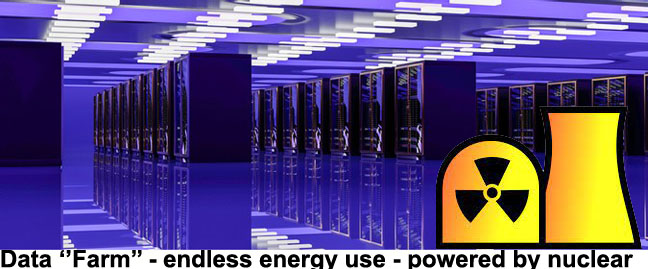
What this excellent article does not go on to explain is that the “tech gods” (that’s Musk, Gates, Bezos etc) are happy to have nuclear power expand – to fill the endless hunger for electricity of artificial intelligence and the rest of the digital marvels to come.

AI requires staggering amounts of computing power. And since computers require electricity, and the necessary GPUs (graphics processing units) run very hot (and therefore need cooling), the technology consumes electricity at a colossal rate. Which, in turn, means CO2 emissions on a large scale – about which the industry is extraordinarily coy, while simultaneously boasting about using offsets and other wheezes to mime carbon neutrality.
Guardian, John Naughton, 24 December 23
Amid all the hysteria about ChatGPT and co, one thing is being missed: how energy-intensive the technology is.
What to do when surrounded by people who are losing their minds about the Newest New Thing? Answer: reach for the Gartner Hype Cycle, an ingenious diagram that maps the progress of an emerging technology through five phases: the “technology trigger”, which is followed by a rapid rise to the “peak of inflated expectations”; this is succeeded by a rapid decline into the “trough of disillusionment”, after which begins a gentle climb up the “slope of enlightenment” – before eventually (often years or decades later) reaching the “plateau of productivity”.
Given the current hysteria about AI, I thought I’d check to see where it is on the chart. It shows that generative AI (the polite term for ChatGPT and co) has just reached the peak of inflated expectations. That squares with the fevered predictions of the tech industry (not to mention governments) that AI will be transformative and will soon be ubiquitous. This hype has given rise to much anguished fretting about its impact on employment, misinformation, politics etc, and also to a deal of anxious extrapolations about an existential risk to humanity.
All of this serves the useful function – for the tech industry, at least – of diverting attention from the downsides of the technology that we are already experiencing: bias, inscrutability, unaccountability and its tendency to “hallucinate”, to name just four. And, in particular, the current moral panic also means that a really important question is missing from public discourse: what would a world suffused with this technology do to the planet? Which is worrying because its environmental impact will, at best, be significant and, at worst, could be really problematic.
How come? Basically, because AI requires staggering amounts of computing power. And since computers require electricity, and the necessary GPUs (graphics processing units) run very hot (and therefore need cooling), the technology consumes electricity at a colossal rate. Which, in turn, means CO2 emissions on a large scale – about which the industry is extraordinarily coy, while simultaneously boasting about using offsets and other wheezes to mime carbon neutrality.
The implication is stark: the realisation of the industry’s dream of “AI everywhere” (as Google’s boss once put it) would bring about a world dependent on a technology that is not only flaky but also has a formidable – and growing – environmental footprint. Shouldn’t we be paying more attention to this?
Fortunately, some people are, and have been for a while. A study in 2019, for example, estimated the carbon footprint of training a single early large language model (LLM) such as GPT-2 at about 300,000kg of CO2 emissions – the equivalent of 125 round-trip flights between New York and Beijing. Since then, models have become exponentially bigger and their training footprints will therefore be proportionately larger.
But training is only one phase in the life cycle of generative AI. In a sense, you could regard those emissions as a one-time environmental cost. What happens, though, when the AI goes into service, enabling millions or perhaps billions of users to interact with it? In industry parlance, this is the “inference” phase – the moment when you ask Stable Diffusion to “create an image of Rishi Sunak fawning on Elon Musk while Musk is tweeting poop emojis on his phone”. That request immediately triggers a burst of computing in some distant server farm. What’s the carbon footprint of that? And of millions of such interactions every minute – which is what a world of ubiquitous AI will generate?……………………………………………………more https://www.theguardian.com/commentisfree/2023/dec/23/ai-chat-gpt-environmental-impact-energy-carbon-intensive-technology
Talen Energy Is Building Data Centers That Run on Nuclear Power. Now, It Needs to Find Buyers
A potential partnership for data campus can boost independent power producer’s earnings
WSJ, By Soma Biswas, Dec. 27, 2023
Independent nuclear power company Talen Energy is betting its future on supplying power to technology companies that are looking for carbon-free energy sources to develop their artificial-intelligence capabilities.
Talen, which exited bankruptcy this year, is developing a 1,200-acre data-center campus with dedicated power supply from the Susquehanna nuclear plant in Berwick, Pa., according to the company’s public presentations. Talen could lease, sell or form a joint venture with technology companies such as Google, Microsoft or Amazon.com to operate the facility, according to Talen shareholders and a report by investment bank Oppenheimer.
In December, Oppenheimer analysts initiated coverage of the company, and added that such a deal could boost the company’s cash flow by $50 million annually. A power-supply contract to a tenant or buyer would yield higher rates than what Talen would earn in the wholesale power market since commercial customers, such as data centers, pay more for electricity, the company has said. ……………………………. (Subscribers only) more https://www.wsj.com/articles/talen-energy-is-building-data-centers-that-run-on-nuclear-power-now-it-needs-to-find-buyers-c9c8c4a9—
CSIRO says wind and solar much cheaper than nuclear, even with added integration costs
The big mover – and one that is significant in the context of the Australian debate on the energy transition, and the federal Coalition’s insistence that nuclear is the answer to most questions – is the cost of nuclear and small modular reactors.

Giles Parkinson 21 December 2023 ReNewEconomy
The CSIRO has published the latest edition of its important GenCost report, and responded to critics by dialling in near term integration costs for wind, solar and storage. But the result is just the same – renewables are clearly Australia’s cheapest energy option, and the story for nuclear just got a whole ot worse.
The annual GenCost report, prepared in collaboration with the Australian Energy Market Operator since 2018, is an important guide to where Australia’s energy transition is at and where it should be heading, but over the past has become the target of attack from conservative naysayers and the pro-nuclear lobby.
CSIRO has defended its methodology, but to satisfy the critics has added in pre-2030 integration costs – including the new transmission lines being built to connect new generation – and finds that the story is much the same.
“While this change leads to higher cost estimates, variable renewables (wind and solar) were still found to have the lowest cost range of any new-build technology,” the CSIRO says, noting that this includes all integration costs up to and including 90 per cent renewables.
In the past year, cost of solar and offshore wind has fallen, the cost of battery storage has remained steady, but the cost of other technologies such as onshore wind and pumped hydro has increased.
The big mover – and one that is significant in the context of the Australian debate on the energy transition, and the federal Coalition’s insistence that nuclear is the answer to most questions – is the cost of nuclear and small modular reactors.
The CSIRO has been attacked by the pro-nuclear lobby, including conservative media and right wing think tanks, for what the lobby claims are inflated cost estimates, but the CSIRO says recent events have backed its numbers. In fact, they make clear that nuclear SMR costs are worse than thought.
CSIRO economist Paul Graham points to the collapse of a major deal this year involving the most advanced SMR projects in the US, the NucScale projects in Utah, which were withdrawn because of soaring costs.
Graham says it is significant because, as NuScale was listed and had to abide by strict regulatory disclosure rules, it had to be “honest” about the anticipated costs of SMRs.
And these were nearly double what was previously thought. In fact they ended up at the equivalent of $A31,000/MW, according to NuScale filings, and much higher than the $A19,000/MW estimated by the CSIRO in its previous report, and for which it was accused of inflating.
“The UAMPS (Utah utility) estimate implies nuclear SMR has been hit by a 70 per cent cost increase which is much larger than the average 20% observed in other technologies,” the CSIRO writes.
“The cancellation of this project is significant because it was the only SMR project in the US that had received design certification from the Nuclear Regulatory Commission which is an essential step before construction can commence.” Graham says that all other claims on nuclear SMR costs are just marketing and sales talk.
The reality, however, is that talk of nuclear SMRs as a solution for Australia’s energy transition and near term emissions targets are a distraction, given that the SMR technology is simply not available, and unlikely to be so for two decades.
The CSIRO report says some interesting things about the costs of wind and solar, technologies which are available and which do work. It says the costs of these technologies will continue to fall in coming years after the various price shocks that have affected the technologies over the last couple of years.
By including the costs of transmission and storage that is underway now and committed out to 2030 adds 40 to 60 per cent to the 2023 cost of deploying high shares of wind and solar, although that also ignores the technologies cost falls that will occur over time……………………………………………………………………………………….more https://reneweconomy.com.au/csiro-says-wind-and-solar-much-cheaper-than-nuclear-even-with-added-integration-costs/
German nuclear plant to be replaced by Europe’s biggest battery.
PreussenElektra, operator of the decommissioned Brokdorf nuclear power
plant in northern German state Schleswig-Holstein, which was taken offline
at the end of 2021, wants to transform the site into a power storage
facility, reports NDR.
Initial plans could see a 100-megawatts (MW) battery
plant operating on a site close to the nuclear power station in 2026. A
second phase would add 700-megawatts of capacity, hosted on the 12-hectare
site of the nuclear power plant itself. (No storage duration was cited).
The company hopes to have the entire project online in 2036, but is waiting
for authorisation to begin dismantling the decommissioned reactor.
Renew Economy 15th Dec 2023
Chernobyl, site of world’s worst nuclear disaster, could soon be home to an exciting new project: ‘Tolerable exposure levels for limited periods of time’
Jeremiah Budin, November 20, 2023 , https://news.yahoo.com/chernobyl-world-worst-nuclear-disaster-213000130.html
Chernobyl, the site of the world’s most well-known nuclear disaster, has been essentially abandoned since the infamous reactor meltdown of 1986 — with good reason, as the site has been contaminated by radiation.
Nonetheless, Ukraine now plans to give Chernobyl a makeover that will have it generate power once again. But this time, it’s going to be a massive wind farm.
The current plan, according to a report from Popular Mechanics, is to turn Chernobyl into a one-gigawatt wind farm, which would be one of the largest in Europe. At full capacity, the wind farm could power up to 800,000 homes in nearby Kyiv, Ukraine’s capital, according to the report.
As for whether it will actually be safe for workers to spend time in the radiated zone, the answers are somewhat unclear. According to the International Atomic Energy Agency, there is still radioactive material in the atmosphere, but it exists at “tolerable exposure levels for limited periods of time.”
However, there were also reports of Russian soldiers experiencing radiation sickness as recently as last year after digging into the dirt near the power plant. Russian forces seized the Chernobyl site during its invasion of Ukraine and held it for several weeks before abandoning it.
The Ukrainian government and Notus Energy, the German company that has been brought on to build out the project, are reportedly still assessing how to move forward safely. While there are certainly concerns around the projects, the Chernobyl site also comes with big upsides, as there is already a lot of power plant infrastructure in place. Furthermore, no residents will be displaced by the project, as the radiation zone is still basically a ghost town.
There is also a nice symmetry to the site of one of the world’s worst-ever power-related disasters being rehabilitated into a modern power plant that can produce clean, renewable energy that allows Ukraine to transition away from harmful dirty energy sources.
It could “become a symbol of clean, climate-friendly energy, providing Kyiv with green electricity,” said Oleksandr Krasnolutskyi, Ukraine’s deputy ecology minister.
Portugal made great strides in renewable energy.
This week Portugal made strides to meet its 2045 deadline, by producing
more renewable energy than it needed for 149 hours straight – a new record.
Portugal aims to generate 85% of its electricity from renewable sources by
2030 and be carbon neutral by 2045 – five years earlier than most European
nations.
Positive News 10th Nov 2023
1 This Month
23-25 October – on Zoom – World BEYOND War’s annual global conferenc


Shut down the radiation-damaged Heysham nuclear reactors now
To see nuclear-related stories in greater depth and intensity – go to https://nuclearinformation.wordpress.com

Say No to NASA’s Reckless Nuclear Reactor on the Moon
Say No to NASA’s Reckless Nuclear Reactor on the Moon

-
Archives
- October 2026 (243)
- September 2026 (339)
- August 2026 (330)
- July 2026 (355)
- June 2026 (287)
- May 2026 (306)
- April 2026 (356)
- March 2026 (251)
- February 2026 (267)
- January 2026 (308)
- December 2025 (358)
- November 2025 (359)
-
Categories
- 1
- 1 NUCLEAR ISSUES
- business and costs
- climate change
- culture and arts
- ENERGY
- environment
- health
- history
- indigenous issues
- Legal
- marketing of nuclear
- media
- opposition to nuclear
- PERSONAL STORIES
- politics
- politics international
- Religion and ethics
- safety
- secrets,lies and civil liberties
- spinbuster
- technology
- Uranium
- wastes
- weapons and war
- Women
- 2 WORLD
- ACTION
- AFRICA
- Atrocities
- AUSTRALIA
- Christina's notes
- Christina's themes
- culture and arts
- Events
- Fuk 2022
- Fuk 2023
- Fukushima 2017
- Fukushima 2018
- fukushima 2019
- Fukushima 2020
- Fukushima 2021
- general
- global warming
- Humour (God we need it)
- Nuclear
- RARE EARTHS
- Reference
- resources – print
- Resources -audiovicual
- Weekly Newsletter
- World
- World Nuclear
- YouTube
-
RSS
Entries RSS
Comments RSS

