Nuclear is not “the answer”
Nuclear is not the answerL slowing down in a sped-up world
Science blogs Rebecca Solnit 9 Sept 09
“………….Well, the first problem is that they still think like big science–that there is “the answer.” In fact, there are hundreds of little answers that don’t include nuclear, including scaling back our consumption and travel and building better and using a lot of the elegant new engineering Continue reading
Coal on the outer as US goes green
Coal on the outer as US goes green
THE AUSTRALIAN Peter Beattie | September 05, 2009
“………Projects to build new coal-fired power stations are being abandoned from Florida to Utah. Money is pouring in for renewable energy and legislation is being enacted to support it……………. Continue reading
Edward Kennedy’s legacy for clean energy, and a clean environment
Sen. Edward M. Kennedy, champion of the environment and clean energy, dies at 77
Grist by Joseph Romm 26 August
“He was a great champion of progressive causes, and his death is a great loss,………..
His legacy on “Protecting the Environment and Promoting Energy Efficiency” is below. How many Senators would even mention “energy efficiency” among their achievements?……
Promoting Energy Research and Development
In 2007, Senator Kennedy’s “America COMPETES Act” was passed by both chambers of Congress and sent to the White House to become law. That bill established an Advanced Research Projects Authority at the Department of Energy to be the focal point of federal efforts to support breakthrough research on new clean energy technologies.
In 2009, Senator Kennedy urged that funds from the American Recovery and Reinvestment Act be used to build a wind blade technology testing facility in Massachusetts, and in May 2009, Energy Secretary Steven Chu announced that $25 million of such funds will be available for the project at the Autoport in Charlestown.
Improving Energy Efficiency
Senator Kennedy was a strong proponent of increasing energy efficiency, which is an essential part of reducing greenhouse gas emissions. He was a long time supporter of programs like the weatherization assistance program and the Low-Income Home Energy Assistance Program that helps those most in need reduce their energy bills by improving home energy efficiency.
…. Kennedy Fought to Reduce Greenhouse Gas Emissions and Address Global Warming. During consideration of the FY 2002 Budget Resolution, Senator Kennedy cosponsored an amendment to reduce greenhouse gas emissions and address concerns related to global climate change. The amendment sought to promote voluntary programs for reducing emissions in the near term. In addition, Senator Kennedy’s amendment included provisions designed to assist developing countries in addressing the danger of global warming and specifically increased funding to help them reduce greenhouse gas emissions. Finally, the amendment provided additional funding for programs that assist U.S. businesses willing to export clean energy technologies to developing nations………
Kennedy Opposed the Permanent Nuclear Waste Storage Facility at Yucca Mountain. Senator Kennedy is a strong opponent of the plan to create a permanent storage facility for nuclear waste at Yucca Mountain in Nevada. The potential for groundwater contamination from the site is yet to be determined, and the transfer of nuclear materials to Nevada from almost every state in the nation raises serious safety concerns. In addition, in March 2005, the Department of Energy admitted that falsified documents were used to ensure the credibility and safety of operations at Yucca Mountain. Until questions are resolved that will guarantee the health of both the public and the environment, it is irresponsible to approve a permanent storage site for nuclear waste.
‘Fourth Generation’ Nuclear Power
ENERGY BULLETIN by Jim Green 25 August 09
‘Integral fast reactors’ and other ‘fourth generation’ nuclear power concepts have been gaining attention, in part because of comments by US climate scientist James Hansen.
…… There are two main problems……. nuclear power could at most make a modest contribution to climate change abatement, mainly because it is used almost exclusively for electricity generation which accounts for about one-quarter of global greenhouse emissions. Continue reading
German customers are saying ‘No Thanks” to nuclear power
Many German customers are saying ‘No Thanks” to nuclear power
American German Business News Flavia Westerwelle 24 August 09
After the recent nuclear reactor shutdown at the Vattenfall Kruemmel nuclear plant near Hamburg, Germany, many German customers are preferring green energy.On July 4th, 2009 the Kruemmel nuclear plant near Hamburg had been running for less than two weeks after a two year shutdown, when a sudden drop of voltage send shopping centers and traffic lights in Germany’s second largest city into an hour long blackout.After this incident the green energy company Lichtblick saw a dramatic jump in customers, with ca. 200 new customers per day.
This corresponds to a 70 % increase in customers for Lichtblick, a Hamburg-based company providing energy from renewable sources, with a mix of hydro, wind, solar and biomass power.It looks like the recent series of problems at nuclear plants combined with the issue of storing the nuclear waste has trigger a process of rethinking by many German customers eager to find a long term solution for Germany’s energy needs.
Many German customers are saying ‘No Thanks” to nuclear power « American-German Business News
Economic Climate Opens Door for Small Wind Energy Projects
Economic Climate Opens Door for Small Wind Energy Projects
REUTERS Renewable Energy World By Sarah Lozanova, Aug 18, 2009
Very few large-scale wind projects are able to obtain financing under the current economic climate. But falling turbine, steel and labor prices have created the perfect environment for mid-scale wind energy projects to thrive. Although total new installed capacity in 2009 may not rival the impressive 8,900 MW installed in North America in 2008, a golden opportunity exists for smaller wind development.
Small wind projects range in size from 100 kW to 30 MW and typically serve schools, farms, rural villages, businesses and municipal utility companies. Because these type of installations can access funding from various sources, they are less vulnerable to the credit crisis than their large-scale wind farm counterparts…………………
…………
Although 2009 may be a year to survive for some players in the wind industry, it presents a golden opportunity for the mid-scale market. Time will tell if this opening will result in a boom in this segment of the industry. “If this opportunity for smaller projects is successful, we will start seeing the turbines ordered this year for projects to be installed later in the year or in 2010,” says Slaymaker. “It sounds like there are a number of small to mid-size projects working towards turbine purchase right now.”
Reprinted with permission from
Economic Climate Opens Door for Small Wind Energy Projects | Green Business | Reuters
Chile: tidal power more likely than nuclear
Chile sees tidal power filling energy gap
SANTIAGO, Chile, Aug. 17 (UPI) — Chile is actively considering several tidal energy installations as a way of filling a major gap in its future energy needs and reducing dependence on coal-fired power generation. A feasibility study on the potential for exploiting the renewable energy resource in Chile found the country had a “unique” wealth of natural sites that, if harnessed only up to 10 percent of available tidal power, could exceed the installed capacity of Chile’s central grid. The study was conducted for the Inter-American Development Bank by Garrard Hassan energy consultancy, based in Bristol, England………………….. Electricity generation from tidal waves is a proven technology, more predictable than solar or wind power, and already used on a commercial scale by France since 1966. The French tidal barrage at Rance, operated by Electricite de France, produces 240 megawatts at peak time. Uses of tidal power in mills date back to Roman times. Tidal power generation units of varying capacity are in different stages of completion or operation in the United States, Canada, China, Russia, South Korea, Australia and New Zealand and India…………………… Chile’s tentative tilt toward tidal power follows intense debate over a switchover from coal-fired electricity generation to “clean” nuclear power, but the idea has led to an outcry from environmental campaign groups………………… If the environmental groups win the argument for renewable sources such as tidal power, Chile’s nuclear power generation program could be pushed to the back burner……………………. Chile’s environmental groups oppose the nuclear option also because they cite the country’s earthquake fault lines as a major risk. Amid the ongoing discussions, for now at least, tidal power seems to stand a greater chance of winning friends among politicians who will fund its introduction to Chile. Chile sees tidal power filling energy gap – UPI.com
“There is money in energy efficiency”
There is money in energy efficiency Business World
21 July 09 Investments in energy efficiency projects are enjoying a resurgence of popularity in attracting investments, although they still have to play catchup to their more popular cleantech cousin, renewable energy. This was apparent from the Asian Clean Energy Forum (ACEF) held at the Asian Development Bank (ADB) in Manila last June 15-19.One of the concepts explored in the ACEF was the concept of an equivalent power plant, or “efficiency power plant,” as some of the speakers called it. An efficiency power plant is a visualization of savings in power capacity from energy savings, a concept that is useful considering that most laypersons struggle to conceptualize energy efficiency, unlike the popular images of renewable wind turbines and solar farms etched in many minds……………………..
Energy efficiency is a relatively inexpensive and proven way to contribute to climate change mitigation, and at the same time contribute to the bottom line. We should expect it to share the limelight with its more visible cleantech cousin, renewable energy, particularly with ADB’s announcement during the closing plenary (and in media releases) that its target for energy efficiency investments is $2 billion.
But until a way can be found to help businessmen and investors visualize what energy efficiency is and its viability as an investment vehicle, it will always remain the unsung relative of its more popular cleantech cousin, renewable energy.
No coal, no nuclear, only renewable energy for Scotland by 2030?

Red, Green and Blue by Mridul Chadha
July 15th, 2009
According to a new study, Scotland could shut down all its coal and nuclear power plants in the next 20 years and fulfill all its energy needs using renewable sources. The study commissioned by a consortium of environmental groups and conducted by an independent engineering consultant will soon be presented to the Scottish government. The study hold significant importance as the government has set ambitious goals for cutting carbon emissions and switching to renewable energy sources for power generation. The research studies and evaluates five different scenarios to predict the energy demand and generation trends over the next 20 years……………………… The report is revolutionary as even the worst case scenario (Scenario One) would mean a significant supply (64 percent) of electricity coming from renewable sources. With additional tools of energy efficiency and targeted financial help for small and micro scale energy generation, Scotland would be able to generate a huge power surplus.
At a time when the world leaders are struggling to even promise significant emission cuts, Scottish government’s continuous efforts to promote renewable energy and cut carbon emissions to meet the highly ambitious goals is commendable.
No Coal, No Nuclear, Only Renewable Energy For Scotland By 2030?
Another Green World: Nuclear power? No point, says new report
Nuclear power? No point, says new report
Another Green World 12 july 09 In Nuclear Power? No Point! the Green Party’s spokesperson on trade and industry, Darren Johnson AM, reviews recent developments and argues that:a.. Nuclear power provides less than 4% of UK energy – which is far less than could be saved by energy-efficiency measures that would cut people’s fuel bills.b.. New nuclear stations will not help the fight against climate change because major CO2 reductions are needed in the next ten years. New nuclear power stations could not be built fast enough.c.. Massive investment in renewables could deliver the necessary short-term CO2 cuts – but “feeding cash to the nuclear delusion” could help starve the renewables industry of some of the investment and skilled personnel it needs to grow rapidly.d.. The nuclear industry’s current financial problems cast serious doubt on its ability to deliver new power stations anyway. Darren Johnson, who is currently chair of the London Assembly and Green Party candidate for Lewisham Deptford, said today:
“The industry that was going to produce electricity ‘too cheap to meter’ has landed us with massive costs for handling its dangerous waste. Now the nuclear industry can’t even give us a reliable quote for the cost of a power station. The current projects in Finland and France are experiencing safety concerns, long delays and big overspends.
“There’s no point expecting nuclear to solve the climate crisis, because new stations couldn’t be built fast enough to help achieve the big CO2 reductions we need to make in the next ten years – which mature renewables could deliver.
“There is no point even considering nuclear power, because demand-reduction measures could easily save far more power than nuclear could generate. And the latest studies argue convincingly that green energy sources with a European smart grid could provide all the power we need.”
Another Green World: Nuclear power? No point, says new report
Seven proven policies that will help build a cleaner planet
Seven proven policies that will help build a cleaner planet
THE AUSTRALIAN Tony Blair | July 06, 2009 “……………………….A new report from the Breaking the Climate Deadlock project, a strategic partnership between my office and The Climate Group, shows how major reductions even by 2020 are achievable if we focus action on certain key technologies, deploy policies that have been proven to work, and invest now in developing those future technologies that will take time to mature.
Perhaps the most interesting fact to emerge is that fully 70 per cent of the reductions needed by 2020 can be achieved by investing in three areas: increasing energy efficiency, reducing deforestation, and use of lower-carbon energy sources, including nuclear and renewables. Implementing just seven proven policies – renewable energy standards (say, feed-in tariffs or renewable portfolio standards); industry efficiency measures; building codes; vehicle efficiency standards; fuel carbon content standards; appliance standards, and policies for reduced emissions from deforestation and forest degradation – can deliver these reductions.All seven policies have already been successfully implemented in countries around the world, but they need scaling up.
Seven proven policies that will help build a cleaner planet | The Australian
UN urges countries to boost clean development
UN urges countries to boost clean development http://www.chinaview.cn 2009-06-19 UNITED NATIONS, June 18 (Xinhua) — The United Nations on Thursday urged countries to invest more in renewable and clean energy sources which could help world mitigate climate change as well as defy global economic downturn.
At a UN General Assembly interactive thematic dialogue held here in the UN headquarters, UN General Assembly President Miguel D’Escoto Brockmann said that the time for renewable sources of energy has arrived.
“The prospects for renewable energy have never looked better, even in the face of recession,” D’Escoto told the meeting focusing on energy efficiency, energy conservation, and new and renewable sources of energy.
He said all the people, especially those are more vulnerable, hope to recover from the slump before too long. “It would be an enormous step forward if this recovery were coupled with visionary policies, innovative technologies and broad incentives for new and renewable sources of energy.”
UN urges countries to boost clean development_English_Xinhua
Renewable Energy Jobs Boom In Europe
Renewable Energy Jobs boom in Europe Energy Matters 17 June 09 A new study by the WWF has revealed that of the 130 million people employed in the European Union altogether, in excess of 3.4 million European jobs are directly related to renewable energy, sustainable transport and energy efficiency related goods and services – far more than the 2.8 million jobs in polluting industries. Indirect jobs related to the green collar sector are estimated at approximately another 5 million. Close to 400,000 people are employed specifically in renewable energy activities, such as the manufacturing, installation and maintenance of wind turbines and solar panels.
The leading European countries for wind power are Germany, Spain and Denmark. For solar power jobs, Germany and Spain are the front runners. Germany and Spain have or had generous gross feed in tariff programs that were major contributors to the solar power boom in both countries.
Germany, which experiences far less sunlight than countries such as Australia, is light years ahead in solar power uptake. Germany commands close to half the global installations market and is also a leading producer of solar cells.
Renewable Energy Jobs Boom In Europe : Renewable Energy News
‘The question now is not whether nuclear energy is clean, but is it sustainable to provide power?’
‘The question now is not whether nuclear energy is clean, but is it sustainable to provide power?’ indian express.com by Neha Sinha Jun 06, 2009 – “FRANZJOSEF SCHAUFHAUSEN, Deputy Director General of the German Federal Ministry for the Environment, Nature Conservation and Nuclear Safety, s………………………..Germany is trying to phase out nuclear energy and we don’t support nuclear energy becoming CDM projects. We have scientific studies on the table showing that it is possible to have a future without nuclear energy. We had a very long discussion in Germany on nuclear energy.
The question now is not whether nuclear energy is clean, but is it sustainable to provide power? The position of the German government is that nuclear energy is too risky. At the moment in Europe, we don’t have the possibility to store the very dangerous nuclear waste which is produced from nuclear energy. Also uranium is limited. We have to construct an energy future working with energy efficiency and renewable energy.
‘The question now is not whether nuclear energy is clean, but is it sustainable to provide power?’
Wind power gets set for huge thrust
Wind power gets set for huge thrust By Wan Zhihong (China Daily)2009-06-03 0″………………..China now has the fourth largest wind power capacity in the world. The sector has seen over 100 percent year-on-year growth in the past few years…………………Industry insiders said, by 2020 wind power will likely surpass nuclear power as China’s third-largest source of electricity, after thermal and hydropower.
“Among all the clean energy sources, wind power is developing the fastest these days. The 30,000 mW target is achievable given the fast pace of growth,” said Shi.
1 This Month
26 April – Chernobyl: Inside the Meltdown airs on National Geographic on Sunday 26th April from 4pm

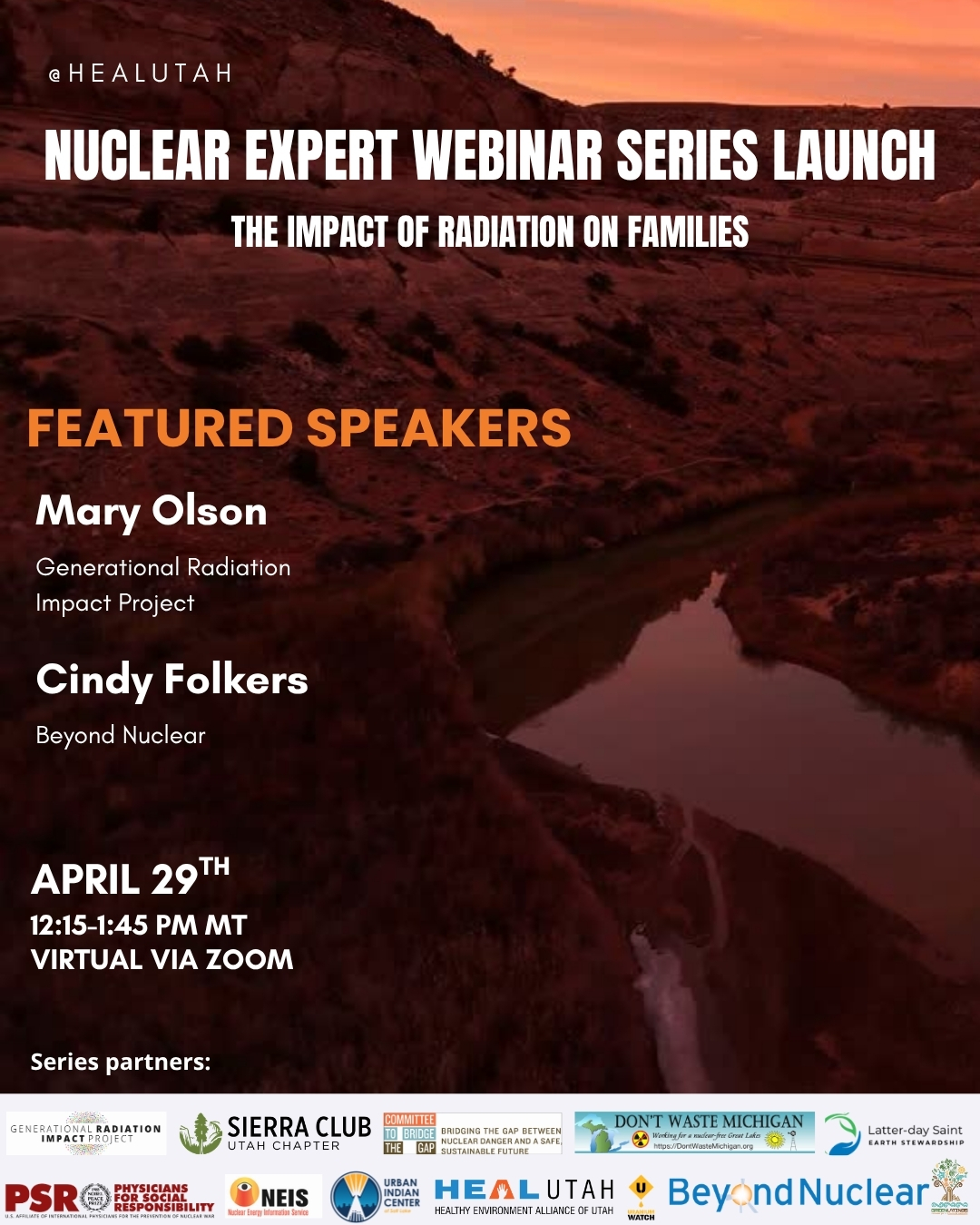
29 April – Nuclear Expert Webinar #1 – Radiation Impacts on Families with Mary Olson and Cindy Folkers
- 12:15 PM MT – 1:45 PM MT
- Location: Virtual – REGISTER TODAY

4 May -West Suburban Peace Coalition to discuss Iran war at May Educational Forum
Monday, May 4, 7:00 – 8:00 PM Central Standard Time
Title: : How Trump’s Narrative Tries to Shape the Reality of the War on Iran.
Contact Walt Zlotow, zlotow@hotmail.com 630 442 3045 for further information
14 May – online event From Bombs to Data Centres: the Face of Nuclear Colonialism

Pine Ridge Uranium is the real threat, not Tehran- Tell Burgum: Stop the Extraction.
Chernobyl: The Lost Tapes – A good documentary on Chernobyl on SBS available On Demand for the next 3 weeks– https://www.sbs.com.au/ondemand/tv-program/chernobyl-the-lost-tapes/2352741955560
To see nuclear-related stories in greater depth and intensity – go to https://nuclearinformation.wordpress.com
-
Archives
- April 2026 (346)
- March 2026 (251)
- February 2026 (268)
- January 2026 (308)
- December 2025 (358)
- November 2025 (359)
- October 2025 (376)
- September 2025 (257)
- August 2025 (319)
- July 2025 (230)
- June 2025 (348)
- May 2025 (261)
-
Categories
- 1
- 1 NUCLEAR ISSUES
- business and costs
- climate change
- culture and arts
- ENERGY
- environment
- health
- history
- indigenous issues
- Legal
- marketing of nuclear
- media
- opposition to nuclear
- PERSONAL STORIES
- politics
- politics international
- Religion and ethics
- safety
- secrets,lies and civil liberties
- spinbuster
- technology
- Uranium
- wastes
- weapons and war
- Women
- 2 WORLD
- ACTION
- AFRICA
- Atrocities
- AUSTRALIA
- Christina's notes
- Christina's themes
- culture and arts
- Events
- Fuk 2022
- Fuk 2023
- Fukushima 2017
- Fukushima 2018
- fukushima 2019
- Fukushima 2020
- Fukushima 2021
- general
- global warming
- Humour (God we need it)
- Nuclear
- RARE EARTHS
- Reference
- resources – print
- Resources -audiovicual
- Weekly Newsletter
- World
- World Nuclear
- YouTube
-
RSS
Entries RSS
Comments RSS
 nuclear-news