South Australia is leading the world on the integration of wind and solar.
There is little doubt that South Australia is leading the world on the
integration of wind and solar. Now, it’s about to take an even bolder
leap into a deep green energy future through its hydrogen jobs plan.
The state has sourced more than 70 per cent of its electricity demand from wind
and solar over the past year, and when RenewEconomy interviewed state
energy minister Tom Koutsantonis on Sunday afternoon for its Energy
Insiders podcast, it was nearing the end of a 60-hour period where it
average more than 100 per cent wind and solar. Earlier that day, the state
had reached a stunning new peak of 264 per cent “potential” wind and
solar, the combination of renewable energy actually produced, and the
renewable energy curtailed by the lack of a market.
South Australia response to the this excess of green energy is to encourage even more, with
another bold step that it hopes will make it a global leader in green
hydrogen, just as it has done with renewables.
Renew Economy 25th Oct 2023 #Australia #nuclear #antinuclear #nuclearfree #NoNukes
Dunkelflaute (or… can we keep the lights on when the wind doesn’t blow and the sun doesn’t shine?)
Prof. Andrew Blowers tackles this question in the BANNG column for Regional Life, October, 2023 https://www.banng.info/news/dunkelflaute/—
The Blackwater estuary is a place where sea, land and sky meet. It is a vast natural environment where wind and sun provide unlimited resources that are transforming our energy supply as we shift from fossil fuels to low carbon renewables, in the desperate race to avert impending climate catastrophe.
There is one problem with a carbon free energy future built on wind and sun. That problem is Dunkelflaute, a German word meaning ‘dark doldrums’, times when there is little wind and sunlight. Think of those short, dark and windless days in mid-winter when lights and heating are on all day and the demand for power rises and the energy supply system is fully stretched. As we become more dependent on intermittent sources of electricity supply can we keep the lights on?
The answer must be ‘yes’, since not to have light is unthinkable in our modern society. But, how? For some, the answer lies in nuclear power which provides ‘firm power’, continuous generation able to meet baseload whenever Dunkelflaute persists. The Government recently proclaimed that ‘Nuclear is the critical baseload of the future energy system’. But, even if it were true, it hardly justifies the plans for massive investment in outmoded, dangerous and costly nuclear power plants that cannot conceivably be delivered until well into the next decade – if then. Installing big, inflexible nuclear will just get in the way of the flexible supply and demand management system for the future
‘Firm power which cannot be switched off when you don’t need it will be as much of a problem as variable power which cannot be switched on when you do. What is called for is flexibility, in huge quantities and of all types’. (Michael Liebreich quoted in Carbon Brief)
That future lies in wind and solar backed up by green power and by long duration storage (including battery, hydrogen and pumped hydro-electric). Distributed local heat and power systems, interconnectors with other countries and reducing and managing demand through energy efficiency and smart metering will all contribute to an energy system that meets net zero by the middle of the century.
It is already happening. At its present moment of hubris nuclear is already doomed. On the Blackwater estuary, the hulk of Bradwell A provides a forlorn epitaph to a bygone era. #nuclear #antinuclear #nuclearfree #NoNukes
World may have crossed solar power ‘tipping point’
The world may have crossed a “tipping point” that will inevitably make
solar power our main source of energy, new research suggests. The study,
based on a data-driven model of technology and economics, finds that solar
PV (photovoltaics) is likely to become the dominant power source before
2050 – even without support from more ambitious climate policies.
However, it warns four “barriers” could hamper this: creation of stable
power grids, financing solar in developing economies, capacity of supply
chains, and political resistance from regions that lose jobs.
The researchers say policies resolving these barriers may be more effective
than price instruments such as carbon taxes in accelerating the clean
energy transition. The study, led by the University of Exeter and
University College London, is part of the Economics of Energy Innovation
and System Transition (EEIST) project, funded by the UK Government’s
Department for Energy Security and Net Zero and the Children’s Investment
Fund Foundation (CIFF).
“The recent progress of renewables means that
fossil fuel-dominated projections are no longer realistic,” Dr Femke
Nijsse, from Exeter’s Global Systems Institute.
Exeter University 17th Oct 2023 #nuclear #antinuclear #nuclearfree #NoNukes
‘Cottage industry’: Gurus say nuclear no match for solar energy

Hans van Leeuwen https://www.afr.com/companies/energy/cottage-industry-gurus-say-nuclear-no-match-for-solar-energy-20231013-p5ebxp
Hans van Leeuwen covers British and European politics, economics and business from London. He has worked as a reporter, editor and policy adviser in Sydney, Canberra, Hanoi and London. Connect with Hans on Twitter. Email Hans at hans.vanleeuwen@afr.com
London | The debate on nuclear power is a distraction from solar, which is about to tip into exponential growth that will sweep aside all other energy sources, say Australia’s much-garlanded pair of leading solar inventors.
Andrew Blakers and Martin Green, often dubbed the “fathers of photovoltaics”, described nuclear energy as “a cottage industry”, with no chance of reaching economies of scale in any useful timeframe.
Solar, though, “is going to take over energy it is in a way that will be utterly astonishing for most people”, Professor Blakers said.
“It is going to do it as fast as we went from film photography to digital photography. In the space of 20 years, basically we’re going to flip from solar being a few per cent to solar being everything but a few per cent. It really is the fastest energy change in all of history by a large margin,” he said.
The two men were in London to collect the latest in a string of prizes for their work on PERC solar photovoltaic technology, which has brought down the cost of solar panels by 80 per cent in the past decade.
At Buckingham Palace on Thursday (Friday AEDT), the King awarded them and their colleagues Aihua Wang and Jianhua Zhao with the Queen Elizabeth Prize for Engineering.
Professor Green described nuclear as “pie in the sky” – including the small modular reactor technologies that have enthused the British government and the opposition in Australia as countries race to transition to green energy.
“They are going to have a few prototypes up by 2030, but it really needs the economy of volume to get the prices down to where they’re projecting,” he said. “So you need to be selling hundreds of these things, not just a few sample ones.”
He also said that the history of power generation had been about reducing costs by making things bigger. “It’s going against historical trend, I think, imagining that you can do things cheaply by making a lot of [smaller ones].”
Professor Blakers said nuclear was simply not in the net-zero race. “This year, it looks like the world will do about 500 gigawatts of solar and wind – maybe 400 gigawatts of solar, 100 gigawatts of wind. Hydro will do about 20 gigawatts, nuclear will do approximately one, gas and coal maybe 50,” he said.
“Solar has been growing at 20 per cent a year for a long time. If it continues to grow at this level, we will completely decarbonise the world by the early 2040s. This is how fast it’s happening. It’s so cheap compared with anything else.”
Nuclear, meanwhile, had not increased its capacity in the past 13 years, he said, adding no more than a gigawatt a year.
“You cannot grow an industry from one to multi-thousand gigawatts, which is what you’d need per year, in any reasonable timeframe. It’s impossible unless you put it on a war footing,” he said.
“You just don’t have enough engineers, scientists, raw materials, the factories, the factories to build the factories, the factories to build the factories to build the factories – it just doesn’t happen.”
Grids: the big hurdle
Both men were convinced that battery technologies and costs would continue to fall, driving increasingly rapid growth. The one big obstacle in Australia was transmission.
“Basically, you need a lot of new transmission to bring the new solar and wind into cities. And we’re not building it,” Professor Blakers said.
“Transmission only becomes important once you get up to 30, 40 per cent solar-wind. We’re currently 33 per cent solar-wind, and we will be 75 per cent by 2030. We don’t have a transmission problem yet. But in two years’ time, we’ll have a major one, and everyone can see that.”
He said initiatives to increase compensation to land owners should overcome the remaining community resistance.
Professor Green said the growth of solar energy use would not unseat China’s dominance of the supply chain for solar panels.
“Solar is basically going to demolish the market for coal and gas. And the geopolitical question is whether India, Europe and the US would tolerate having 80 or 90 per cent of the global solar industry coming out of China,” he said.
“It’s very hard to see other countries competing with China. The momentum they’ve got.”
He said India might become a major manufacturer, but its industry’s development would not be as co-ordinated and co-operative as China’s had been.
China, though, would have to address the demand of its customers for higher environmental and social standards – creating an opportunity for Australia to become a player in providing green-friendly metallurgical-grade silicon. #nuclear #antinuclear #NuclearFree #NoNukes #NuclearPlants
Endless electricity and water use: the Artificial-Intelligence-Blockchain-Data Centre -Nuclear-NuScale nightmare to come

Blockchain biz goes nuclear: Standard Power wants to use NuScale reactors for DCs
Please, no crypto boom, thank you
The Register, Tobias Mann, Sun 8 Oct 2023 #nuclear #anti-nuclear #nucler-free #NoNukes
Colocation outfit Standard Power hopes to power two new datacenters in Ohio and Pennsylvania entirely by miniaturized nuclear reactors from NuScale.
Standard Power makes no secret it focuses on providing datacenter services to not just those into AI workloads and other kinds of high-performance computing but also those performing proof-of-work blockchain mining, the kind needed to craft digital tokens like Bitcoin. The significant energy requirements of this type of blockchain work spurred an investigation by the White House Office of Science and Technology Policy last year, and calls by lawmakers to implement reporting and/or sustainability requirements for such operations.
Generally speaking, a datacenter packed with proof-of-work miners is going to demand a chunky amount of power. Concerned it may not get adequate electricity supplies for its new facilities, which by the sounds of it will support blockchain mining as well as other workloads, Standard Power said it hopes to take the nuclear option.
“We see a lot of legacy baseload grid capacity going offline with a lack of new sustainable baseload generation options on the market especially as power demand for artificial intelligence-computing and datacenters is growing,” Standard Power CEO Maxim Serezhin said in a statement.
And the colo outfit’s Ohio and Pennsylvania datacenters may need or get a lot of power. The company expects to deploy 24 of NuScale’s small modular reactors between the two sites. These reactors are reportedly capable of generating 77 megawatts apiece — putting the total deployed capacity at 1,848 megawatts.
Despite the announcement, it may be a few years before Standard Power can realize its nuclear dreams. As we learned in January, Idaho National Labs will be among the first to demonstrate NuScale’s reactors, and the first of these modules isn’t expected to come online until 2029. We asked Standard Power when it expects its facilities will be operational; we’ll let you know if we hear anything back…………………………………..
Standard Power is hardly the first datacenter operator to get excited about nuclear power, either. Cumulus Data opened a datacenter next to a nuclear plant — the full-size kind — in January and last month we learned that Microsoft is now hiring someone to potentially deploy SMR systems to power its growing cloud enterprise. https://www.theregister.com/2023/10/08/standard_power_nuclear_datacenter/
Wind and solar are only forms of power generation rising globally, study finds.

Independent, Stuti Mishra 8 Oct 23,
China leads the charge by contributing to 43 per cent of the global
growth in solar energy generation.
. Electricity data from 78 countries that
represented 92 per cent of global electricity demand for the first half of
2023 was analysed in the study released by environmental think-tank Ember
on Thursday. It found that while overall emissions remained stable, with a
slight 0.2 per cent increase, wind and solar power generation surged ahead.
Independent 6th Oct 2023
Chart: China’s solar export dominance grows with surging European orders
#nuclear #antinuclear #nuclear-free #NoNukes
China’s solar export dominance grows with surging European orders. The
country produces 80 percent of the world’s solar panels, and Europe is
now buying over half of the panels it exports.
Canary Media 29th Sept 2023
Microsoft May Go Nuclear to Support Its Energy-Hungry AI.

powering that AI is extraordinarily costly, even more so than its other cloud-based products. Microsoft’s latest sustainability report noted that the company’s water consumption has increased 30% year over year in order to keep its AI supercomputers cool.
Kyle Barr, September 28, 2023 https://gizmodo.com.au/2023/09/microsoft-may-go-nuclear-to-support-its-energy-hungry-ai/
Artificial intelligence has proved a costly endeavour—well, yes, in terms of money, but AI requires massive amounts of energy, and water consumption to operate at scale. That hasn’t stopped big tech companies such as Google and Microsoft from putting that energy-hungry AI into practically every single one of their user and enterprise end-products. Big daddy Microsoft has been trying to keep its (OpenAI-assisted) lead in the AI rat race, and it may need to grab the fuel rod by both hands if it wants to continue its big AI ambitions.
And when we say fuel rod, we mean it literally. Microsoft put out calls for a program manager on “Nuclear Technology” on Monday. As first reported by CNBC, The job specifically mentions that this new initiative would use “microreactors” and “Small Modular Reactors” to power the data centres used by Microsoft Cloud and AI. Whatever it is, the scope for Microsoft’s nuclear AI could be “global” as Microsoft has Azure data centres in all parts of the globe.
Microsoft declined to comment on any plans for future nuclear endeavours. The company instead linked to past blog posts on company sustainability initiatives. It’s unclear what plans Microsoft may have for nuclear-powered AI. The position references that the nuclear program manager would build a “roadmap for the technology’s integration,” which would also mean selecting partners for developing and implementing how the hell the tech giant would facilitate nuclear.
Small Modular Reactors, or SMRs, are a proposed class of reactors that would be a purportedly smaller version of a full-on nuclear plant with a smaller power capacity. The idea is they can be built in one location and then moved to a separate site. There are only a few prototype SMRs implemented in Places like Russia and China, though the U.S. Office of Nuclear Energy only approved its first SMR design in January this year.
Back in May, Microsoft signed a power purchase agreement with nuclear fusion startup Helion set to start in 2028. That’s different than an SMR, which still uses fission to generate power, and while there have been some recent successes with fusion this past year, we still could be a long way off from any kind of energy pivot.
Microsoft has spent the last year implementing generative AI into practically every one of its software products. Most recently, the Redmond, Washington company announced its AI copilot for Windows 11 to act as a kind of virtual assistant on a desktop. Court documents have shown that Microsoft has been looking for ways to implement more AI capabilities on its Azure cloud platform.
But powering that AI is extraordinarily costly, even more so than its other cloud-based products. Microsoft’s latest sustainability report noted that the company’s water consumption has increased 30% year over year in order to keep its AI supercomputers cool. Microsoft has put billions of dollars into a partnership with ChatGPT-maker OpenAI, and the Redmond company now being forced to power and cool its partner’s growing energy needs to train OpenAI’s latest models. Training GPT-3 consumed enough water to fill a full nuclear reactor’s cooling tower, according to one recent study.
Studies have shown AI is responsible for massive amounts of carbon emissions, and OpenAI’s GPT-3 model was responsible for CO2 emissions than most other large language models. The company’s GPT-4 model is purportedly 1,000 times more powerful than GPT-3.5 and was trained on nearly four times as much data. Running a larger AI model would require several times as much power as smaller models, and AI companies aren’t slowing down.
Solar and wind farms can easily power the UK by 2050, scientists say
A team at the University of Oxford claims that the two technologies could provide ten times our present need
Adam Vaughan, Environment Editor, Tuesday September 26 2023, The Times
Wind and solar power could comfortably supply all the UK’s energy needs by the middle of the century, according to a University of Oxford team.
The researchers calculated that the two renewable technologies could power the nation even after making a conservative estimate that accounted for the amount of land and sea available, energy storage needs, economics and a high future demand for energy.
The analysis found that the UK has enough wind and solar resources to generate 2,896 terawatt hours a year by 2050, or almost ten times today’s electricity needs.
Shotwick Solar Farm in Deeside covers 220 acres and is the biggest in Britain. Similar farms could provide almost of a fifth of our energy
The vast majority, 73 per cent, would come from offshore wind farms, followed by utility-scale solar in fields at 19 per cent. The Solar Energy Industries Association defines a solar project as utility-scale
if it generates greater than 1 megawatt of
solar energy.
Onshore wind farms, which the government this month promised
to unblock in England by changing planning barriers, would supply about 7
per cent. Solar on rooftops would provide less than 1 per cent, because it
was assumed the technology would be largely confined to the south of
Britain and only for south-facing rooftops.
The paper by the Smith School of Enterprise and the Environment said wind and solar had been underestimated in Great Britain, and “predominant narratives that
renewables are too expensive or impractical are wildly out of date”.
Professor Cameron Hepburn, director of the Smith School, said a renewable
powered Britain was now possible because of falling costs of wind and solar
power. He said a recent Royal Society report on energy storage showed the
intermittent nature of renewables could be cost-effectively tackled by
using hydrogen stored in the country’s network of salt caverns. “I
think the public would be stunned that we could power not just the entire
electricity system but the whole energy system of this country with wind
and solar,” Hepburn said.
The country was assumed to need 1,500 terawatts
of energy by 2050, far higher than most other estimates, to ensure the
analysis was conservative. The report assumed 2 per cent of land was given
over to utility-scale solar, 5 per cent of land to onshore wind farms and
10 per cent of the UK’s exclusive economic zone to offshore wind
turbines. Hepburn said wind turbines on land would coexist with farms.
Times 26th Sept 2023
UK risks power supply crunch in January as nuclear plants halt.
Rachel Morison and Elena Mazneva, Bloomberg News, 27 Sept 23
(Bloomberg) — The UK’s National Grid Plc is preparing for a possible power crunch in January as several planned nuclear outages coincide with peak winter demand.
Electricity consumption is projected to climb to a high during the first two weeks of January, just as nuclear availability is forecast to drop, according to National Grid’s winter outlook report published Thursday. Blackouts are a less likely than last winter but can’t be ruled out, the grid’s Electricity Supply Operator said. ………..
Units at Electricite de France SA’s Hartlepool and Torness nuclear stations are scheduled to be offline for work in January, company data show.
National Grid expects it will need to use “operational tools” like market warnings to help balance supply and demand this winter. The network operator has been stress-testing tens of thousands of weather scenarios this winter to ensure it can manage margins, Dyke said. …….. https://www.bnnbloomberg.ca/uk-risks-power-supply-crunch-in-january-as-nuclear-plants-halt-1.1977313
Renewables boost in Germany: turning the corner after a bad year?

DAVID TOKE, SEP 15, 2023 https://davidtoke.substack.com/p/renewables-boost-in-germany-turning
Germany could be turning a corner after a bad year in 2022 as renewables increase and solar power deployment dramatically increases. 2022 saw coal electricity production increase driven by a mixture of the need to substitute for Russian natural gas and the phase-out of nuclear power. In the first half of 2023 compared to the same period in 2022 coal production as a proportion of electricity fell back from 31 per cent to 27 per cent. Renewable energy increased from 48 per cent to 53 per cent. See here.
On top of that solar pv deployment is surging ahead at the rate of over 1 GW a month according to PVMagazine. To put this in context this means that solar pv’s share of electricity production increases by somewhat over 2 per cent per annum. Of course, that’s certainly not enough on its own, but it is a start. Energy Minister Habeck hopes that planning reforms he oversaw will dramatically increase wind power deployment rates. These have been flagging in recent years.
The production of renewable energy is higher in Germany compared to other countries. Rapid progress in renewables growth is set to resume with reforms introduced by the current Government in which the Green Party’s Robert Habeck holds the Economic Affairs and Climate Action portfolio. However Germany is still to recover from the impact of the shutdown of Nordstream 1 gas pipeline from Russia and the big increase in energy costs involved in the pivot away from Russian gas.
Certainly, the embrace of Russia was not a choice favoured by Greens, who argued for energy conservation and renewables instead. But the geopolitical blunder, led by the the SDP’s former Chancellor, Gerhard Schroader, is costing Germany dearly. By contrast there was much greater consensus on phasing out nuclear power after the Fukushima accident in 2011.
The strength of coal interest in Germany has continued, with a completed phase-out now set for 2038. The strength of coal interests in Germany has been much higher compared to the UK because the UK has had (at least in the past) greater availability of cheap gas from the North Sea. Natural gas prices rose for the UK after 2006, but by then most of the coal electricity production had been replaced by natural gas.
There has been a big struggle recently over a heating law. The opposition was fiercely opposed to a mandatory phase-out of gas boilers by 2025. This was ultimately watered down so that, in effect, consumers can still replace gas boilers if there is no provision for local district heating networks.
The provision of district heatimng networks, already a lot more common than in the UK, is to be radically increased. They will be supplied by large-scale heat pumps. It should be mentioned that a law since 2021 effectively bans gas boilers in new buildings – something that is not yet the case in the UK.
Solar energy boost for France
CNR is leading a consortium in the development of “Ombrières
PHotovoltaïquE grand LIneAire”, a solar shading project along the
ViaRhôna cycling route in southern France’s Caderousse department,
alongside the Rhône River.
The pilot project aims to evaluate the
integration of a PV facility into the landscape and assess its energy
performance. The project partners include French cable supplier Nexans,
Schneider Electric, railway operator SNCF, and the SuperGrid Institute.
The PV system will span 900 meters in length and have an installed capacity of
900 kW. It will consist of 30 shaded structures with west-east oriented
solar panels. The consortium will conduct tests on the system’s overall
architecture and the equipment needed for transporting medium voltage
direct current (MVDC) electricity to the delivery point. Construction and
testing are scheduled for the 2025-28 period, following a three-year phase
of engineering studies, research and development (R&D), and prototyping.
PV Magazine 13th Sept 2023
https://www.pv-magazine.com/2023/09/13/french-consortium-plans-900-kw-solar-cycling-path/
In Australia, big batteries and solar push new boundaries on the grid
The rapid evolution of Australia’s energy system continues apace as the
mild weather of spring and new production benchmarks give voice to the new
capacity that has been added over the past 12 months. As noted earlier this
week, spring is the season for new records because of the good conditions
and moderate demand.
In South Australia on Sunday, solar set a new record
of 120 per cent of local demand in the state (the excess was exported to
Victoria) and on Wednesday and Thursday it was the turn of wind and battery
storage. Wind hit a peak of 141.4 per cent of local demand at 4.35am on
Thursday morning. That wasn’t a record in itself, but the big share of
wind and later solar during the daytime was accompanied by a record amount
of activity from the state’s growing fleet of big batteries.
Renew Economy 14th Sept 2023
Ukraine plans up to 1GW wind farm in Chernobyl nuclear disaster zone
Five years after a small solar farm was built at the site, Ukraine has
unveiled plans to develop a potentially huge wind power plant in the
Chernobyl exclusion zone – the site of the worst nuclear power plant
disaster in world history. Der Spiegel reports that a declaration of intent
was signed this week between German-based developer Notus Energy, the
Ukrainian government and electricity transmission system operator
Ukrenergo, to build an up to 1,000MW wind farm, capable of supplying power
to around 800,000 homes – including in the capital Kyiv.
Renew Economy 13th Sept 2023
Endless energy use needed for endless data storage – so, small nuclear reactors for Sweden
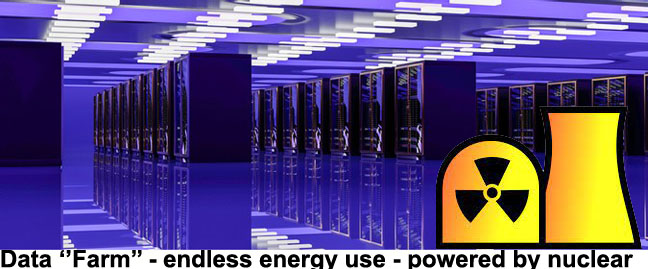
Nuclear-powered campus in Sweden will power data centers
Small modular player Kärnfull Next plans commercial campus at Nyköping
September 11, 2023 By Peter Judge
Swedish nuclear company Kärnfull Next has announced plans for a campus of small modular reactors (SMRs) on the Swedish coast, which will power data centers.
The company plans to build the campus at a site in Nyköping, on the east coast of Sweden, where nuclear software firm Studsvik currently operates test reactors. It is planned to come on stream in 2030.
DCD has asked Kärnfull for more details, including the type of data center partners the company hopes to engage with…………………………………………
The company is still checking on aspects such as financing, permitting, and the possibility of power purchase agreements with power off-takers, and expects to finalize some decisions on all that towards the end of 2024……………………………………………………………. https://www.datacenterdynamics.com/en/news/nuclear-powered-campus-in-sweden-will-power-data-centers/
1 This Month

of the week – Shut Down Drone Warfare!


Tell the Ukrainian Government to Drop Prosecution of Peace Activist Yurii Sheliazhenko

Petition to revoke the licensing of the Near Surface Nuclear Disposal Facility (NSDF) at Chalk River. https://www.ourcommons.ca/petitions/en/Petition/Details?Petition=e-7247
To see nuclear-related stories in greater depth and intensity – go to https://nuclearinformation.wordpress.com
-
Archives
- March 2026 (244)
- February 2026 (268)
- January 2026 (308)
- December 2025 (358)
- November 2025 (359)
- October 2025 (376)
- September 2025 (257)
- August 2025 (319)
- July 2025 (230)
- June 2025 (348)
- May 2025 (261)
- April 2025 (305)
-
Categories
- 1
- 1 NUCLEAR ISSUES
- business and costs
- climate change
- culture and arts
- ENERGY
- environment
- health
- history
- indigenous issues
- Legal
- marketing of nuclear
- media
- opposition to nuclear
- PERSONAL STORIES
- politics
- politics international
- Religion and ethics
- safety
- secrets,lies and civil liberties
- spinbuster
- technology
- Uranium
- wastes
- weapons and war
- Women
- 2 WORLD
- ACTION
- AFRICA
- Atrocities
- AUSTRALIA
- Christina's notes
- Christina's themes
- culture and arts
- Events
- Fuk 2022
- Fuk 2023
- Fukushima 2017
- Fukushima 2018
- fukushima 2019
- Fukushima 2020
- Fukushima 2021
- general
- global warming
- Humour (God we need it)
- Nuclear
- RARE EARTHS
- Reference
- resources – print
- Resources -audiovicual
- Weekly Newsletter
- World
- World Nuclear
- YouTube
-
RSS
Entries RSS
Comments RSS
 nuclear-news