“Baseload power” soon to be outmoded by smart grids, flexible energy sources
the concept of baseload and peaking power – the current model for electricity grids worldwide – will be replaced by a system of flexible and inflexible energy sources…… a smart grid system.
The end of baseload? It may come sooner than you think, RENeweconomy, By Giles Parkinson 20 February 2012 One of the principal architects of Germany’s push into renewable energy technologies, Hans-Josef Fell, believes that the country could achieve 100 per cent renewables in its electricity sector by 2030 – and may do it quicker. The rest of the world could follow soon after. Continue reading
Wind and solar alone provided 70% of new European electricity capacity
 More than 68% of New European Electricity Capacity Came from Wind and Solar in 2011, by Care2 Causes Editors. February 18, 2012 by Stephen Lacey, ThinkProgress As the sovereign debt crisis unfolds in Europe, onlookers have questioned whether the region will stay committed to renewable energy. The answer so far is “yes.”
Even with a few countries pulling back on government support of the industry because of fiscal troubles, 2011 was still a huge year for deployment — with wind and solar alone representing almost 70% of new capacity.That’s almost a 10-fold increase over deployment in 2000, when only 3.5 GW of renewable energy projects were installed. Last year, 32 GW of renewables — mostly wind and solar — were deployed across European countries.
The figures come from the European Wind Energy Association, which just released a report on industry growth.
Growth in Europe has consistently outstripped forecasts. The EU currently has a target of getting 20% of its final energy (heat, electricity and fuels) from renewable energy. Numerous countries have already surpassed their needed targets in the electricity and heating sectors, and it’s likely that the entire region will move past the goal well ahead of schedule.
It’s expected that renewable electricity sources will meet 34% of demand in Europe by 2020, with 25 of 27 countries to surpass their targets beforehand.
In 2011, solar PV accounted for 26.7% of capacity additions, wind power accounted for 21.4% of additions, and natural gas made up 22% of installations. Below that was coal at 4.8%, fuel oil at 1.6%, large hydro at 1.3%, and concentrating solar power at 1.1% of capacity…. http://www.care2.com/causes/more-than-68-of-new-european-electricity-capacity-came-from-wind-and-solar-in-2011.html#ixzz1mxnzejRH
Florida to “start the conversation” on developing renewable eneergy
Energy Independence Is Golden Chance to Develop Renewables: Renewable advocates support Florida energy bills CBS News, (AP) TALLAHASSEE, Fla.16 Feb 12, — Advocates of conservation and renewable sources such as solar and biomass are supporting what sponsors are calling “modest” energy legislation in the belief that even a small start would cause those efforts to snowball. Continue reading
320.000 UK homes get electricity from offshore wind turbines
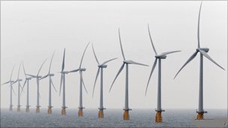 World’s biggest offshore wind farm officially connected to the Grid, Environmental News Network, 10 Feb 2012, The world’s biggest offshore wind farm was officially opened today after record-fast construction in the middle of the Irish Sea. The 102 turbines of the two connected Walney wind farms cover an area of 73 square-kilometres and were formally connected to the National Grid in a ceremony today.
With a capacity of 367.2MW, the huge project can provide low-carbon, green electricity to 320,000 homes. The generating capacity of each turbine, supplied by Siemens Wind Power, is 3.6MW, and the rotor diameter of the turbines is 107m for Walney 1 and 120m for Walney 2, with a maximum height of 150m from sea level to blade tip….. http://www.enn.com/energy/article/43984
Canada’s emerging renewable energy power needs a national focus
Clean energy also needs political focus, Montreal Gazette, By TIM WEIS, Financial Post February 10, 2012 Whether it is the Keystone XL pipeline, the Northern Gateway pipeline or securing an export market in China, the oil sands have dominated
much of the recent energy discussions in Canada.
What might surprise many is that Canada is quietly emerging as a renewable energy leader, but it will take the same political focus
currently being put toward oil sands to ensure we retain and grow the jobs that are being created in the country’s emerging clean energy sector.
In 2011 Canada was sixth in the world in wind energy installations, and as recently as November 2011, Ernst & Young ranked Canada as the eighth most attractive country in the world for renewable energy investment, ahead of some traditional leaders including Denmark, Spain and Japan.
Despite having fewer than 35 million people, Canada has the sixth-largest electricity system on the planet, behind only China, the
United States, Russia, Japan and Germany. Given the size of our electricity system, perhaps it shouldn’t come as a surprise that
Canada ought to be one of the leading markets for renewable electricity. Continue reading
New ways to store surplus renewable energy
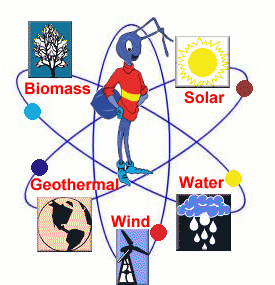 As the use of renewable energy spreads, some companies are storing energy as heat rather than cold. And some are harnessing batteries at the point of generation.
 Surplus Renewable Energy: An Update, NYT, By MATTHEW L. WALD, 9 Feb 2012 Last year I wrote about sudden surges in renewable energy that set up a conflict between wind producers in the Pacific Northwest and the Bonneville Power Administration, a federal agency that runs hydroelectric dams and the regional grid. ….
…at a two-day National Electricity Forum sponsored by the Energy Department and others, the federal energy secretary, Steven Chu, on Wednesday proposed a different set of solutions to the problem, which is likely to emerge elsewhere as installations of renewable energy expand and systems have to cope with surges or deficits of power they cannot predict. Continue reading
Vermont’s renewable energy kickstarts energy independence for the State
Local renewable industry poised to make ‘Vermont energy strong’ , VT Digger, Gabrielle Stebbins, 9 Feb 2012 Montpelier, Vermont – Vermont’s local renewable energy industry— made up of diverse manufacturers, construction contractors, installers, developers, and suppliers— announced today the industry is equipped to help make “Vermont energy strong” in the 21st Century.
The industry, which ranges from local fabricators assembling electrical boards and contractors that specialize in hot water, solar, wind, hydro, geothermal and biomass heating installations to regional and international manufacturers of innovative renewable energy technologies, held a press conference on pending policy issues today in Montpelier.
“The benefits of a strong renewable industry flow throughout the state by creating local jobs, producing energy locally, and providing energy security,” said Gabrielle Stebbins, Executive Director of Renewable Energy Vermont (REV), the state trade association representing more than 300 renewables and efficiency businesses in the state. “Growing our own renewable energy in-state is in keeping with Vermonters’ desire for self reliance, a clean energy future that leaves a better legacy for our children, and keeping our dollars local.” Continue reading
Energy efficiency program by Australian government
 New Australian government energy efficiency programs opened Eco Business, February 9th, 2012 By : Energy Matters The Gillard Government has just announced the opening of series of energy efficiency initiatives and assistance targeted towards business, local government, households and communities.
A joint statement from Minister for Climate Change and Energy Efficiency Greg Combet, Minister for Regional Australia, Regional Development and Local Government Simon Crean; and Parliamentary Secretary for Climate Change and Energy Efficiency Mark Dreyfus states these programs will make it easier for regional communities and smaller councils to access assistance and support in the transition to a low carbon future.
The programs include:
Community Energy Efficiency Program – $200 million
To assist local government, not-for-profit and community organisations to undertake energy efficiency upgrades to community infrastructure, including council buildings, stadiums, education facilities, town halls and nursing homes. Continue reading
Germany’s prosperity with wind and solar feed-in tariffs
Energy production using fossil and nuclear fuels is penalised in Germany by virtue of the Renewable Energy Act, which guarantees higher prices for generators of electricity sourced from wind and solar through feed-in-tariffs.
Today Germany has over 150 million solar panels installed or 25,000MW,
 Germany has the wind at its back, MATTHEW WRIGHT, ABC 9 FEB 2012, Germany is currently the world-leader in installing renewable energy THE recent clinching of a $1.9 billion Australian defence contract by the Germans illustrates to carbon price knockers that they need look no further for proof that an economy which relies on renewable energy can outsmart one dependent on fossil fuels.
Germany’s electricity sector delivers 21 per cent of its power from renewable sources, such as the wind and the sun. …..
what of Germany, which finds itself at the epicenter of the EU debt maelstrom?
How is it possible that a nation shouldering the lion’s share of bailing out Europe’s basket-case economies has its finances in the best shape ever in two decades?
The yearly German unemployment rate keeps falling and at 6.7 per cent in January was the lowest since reunification. The Berlin based BGA Exporters and Wholesalers group estimated total German exports hit a record $US1.3 trillion last year.
This is hardly a picture of an economy that has been struggling under the impost of a carbon cost and renewable energy subsidies.
Energy production using fossil and nuclear fuels is penalised in Germany by virtue of the Renewable Energy Act, which guarantees higher prices for generators of electricity sourced from wind and solar through feed-in-tariffs.
The legislation has encouraged a phenomenal uptake of solar roof panels for a nation that hardly boasts sunny weather. ….
Critics who claim that pricing carbon using feed-in-tariffs, taxes or emissions trading is somehow linked to an underperforming economy and high jobless rates ought to be silenced by Germany’s success in bursting that myth.
And if the proof in the pudding is not enough for the naysayers, they could look to volumes of published material demonstrating that the early costs of encouraging renewable energy benefit an economy in a matter of years.
Respected energy experts Dr Wolfram Krewitt and Dr Joachim Nitsch’s published research while at the German Aerospace Centre that is regularly cited to drive home this point.
In a peer reviewed paper they wrote: “While the success of the German Renewable Energy Sources Act in supporting the use of renewable energy sources for electricity generation is widely acknowledged, it is partly criticised for imposing unjustified extra costs on society.
“[This] paper makes an attempt to estimate the external costs avoided in the German energy system due to the use of renewable energies for electricity generation, and to compare them against the compensation to be paid by grid operators for electricity from renewable energies according to the Renewable Energy Sources Act.
“… [R]esults clearly indicate that the reduced environmental impacts and related economic benefits do outweigh the additional costs for the compensation of electricity from renewable energies,” Krewitt and Nitsch concluded.
Another misleading argument renewable energy doubters like to peddle is that the rise in renewable energy use and the reduction in coal use is only possible in economies that also have a nuclear sector, to supply supposedly ‘reliable’ electricity when ‘the sun don’t shine and the wind don’t blow’.
Germany also recently burst this myth…..http://www.abc.net.au/environment/articles/2012/02/09/3426757.htm
The facts on renewable energy in Southern USA
Mythbusting facts about renewable energy in  the southern U.S., http://www.renewableenergyworld.com/rea/blog/post/2012/02/mythbusting-facts-about-renewable-energy-in-the-southern-u-sRenewable Energy World, By Lauren Glickman , February 7, 2012
Renewable energy sources (like wind power) and energy efficiency can help the southern U.S. meet what is expected to be growing future electricity demand, but a lingering set of myths is hampering their development in the region, according to a new study, “Myths and Facts About Electricity in the U.S. South,” by researchers from Duke and Georgia Tech. These misimpressions could have serious consequences–the South’s population is expected to increase by 28 percent over the next 20 years, and wise use of resources will be needed to satisfy energy demand while reducing energy-related pollution.
The researchers used economic and energy modeling to examine the myths. To avoid repeating the myths and thereby giving them further credence, I’m going to list some selected findings with the most significance for wind power as a set of “mythbusting facts” instead:
Future growth in electricity demand in the South can be met by renewable energy and efficiency: Continue reading
Social ownership of South Africa’s renewable energy sector
 Renewable energy plans can create 50,000 jobs (With Video), Business Live 7 Feb 12 The Department of Energy will seek to ensure that government commits R22 billion over the next five years to green projects and aims to create 50,000 jobs in the renewable energy sector. This was revealed by Energy Minister Dipuo Peters who was speaking at a National Union of Metalworkers of South Africa (Numsa) conference on Monday, which was looking at social ownership of SA’s renewable energy sector.
“We want to ensure that the state, through its entities, invests R22 billion in green projects with a commitment of R3 billion towards local manufacturing in the next five years, and at the same time create 50,000 jobs in the renewable energy sector,” Peters said.
She also emphasised that foreign companies can invest in SA’s energy sector, but they must bring with them their technology so that local companies can adopt it.
“The renewable energy drive in China could succeed because companies relocated; based in China, where intimately they perfected the technology and now they’re exporting the technology to SA. So we are also saying as part of our requirement for localisation, let us insist
that these companies that want to invest here, they must bring this
technology to SA.” … http://www.businesslive.co.za/southafrica/sa_markets/2012/02/07/renewable-energy-plans-can-create-50000-jobs-with-video
Renewable energy economy now paying off for Californians
The California renewables market is robust and competitive, Switchboard, Peter Miller, February 7, 2012 The market for renewable electricity is robust and competitive according to the California Public Utilities Commission (CPUC).
In a report on the state’s 33% Renewable Portfolio Standard (RPS) released yesterday, the CPUC provided a snapshot on the impressive progress that has been made in building the state’s clean energy economy.
According to the CPUC: The state’s three largest private utilities collectively served 17% of
their load with renewable energy in 2010. All three of the state’s largest utilities are projected to meet the requirement to provide an average of 20% renewable power from 2011 to
2013. Over 830 MW of renewable capacity came on line in 2011. Bid prices in response to the 2011 solicitation dropped 30% compared to 2009.
This growth in the renewable energy market bodes well for California’s residents and demonstrates the benefits of the state’s ambitious renewable energy policy. The RPS has led to a steady increase in reliance on renewable electricity, which means growing energy security
and price stability for California utility customers. And a competitive, orderly market means that costs are coming down, helping to keep energy clean and affordable for residents of the Golden State. http://switchboard.nrdc.org/blogs/pmiller/the_california_renewables_mark.html
Decentralised solar power saving money in USA schools
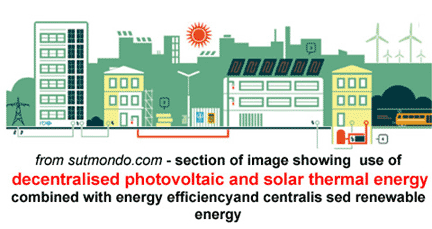
70 Percent Of Energy Needs Met Via Solar Power, Earth Techling, by Kristy Hessman, February 7th, 2012 Solar panels are popping up on school campuses across the nation as financial incentives become more readily available for schools that implement renewable energy as a way to offset their energy costs. In Arizona, Constellation Energy and Buckeye Union High School District have just completed a 4.3-megawatt solar generation project. The project will provide up to 70 percent of the electricity needs for three area high schools. Buckeye Union High School and Youngker High School in Buckeye and Estrella Foothills High School in Goodyear will be the recipients of the new renewable energy. The school district has agreed to purchase and receive all of the electricity generated by the solar panels at a fixed rate from Constellation Energy under a 25-year deal.
The solar power systems include 15,468 photovoltaic panels on 29 carport rooftops and two ground-mounted installations. The project is expected to generate more than 7 million kilowatt-hours of electricity per year. That equals a savings of more than 3,875 metric tons of carbon dioxide, or the equivalent emissions from 760 passenger vehicles annually, according to U.S. EPA data for the Arizona region.
“We’re pleased to celebrate the addition of three solar installations in our school district,” Beverly Hurley, superintendent of Buckeye Union High School District, said in a statement. “This addition will play an important role in meeting the district’s electricity needs and will serve as an educational tool for our students to learn about solar energy production.”
The installations, were developed by GV Enterprises and REgeneration Finance and built by CORE Construction. The project was coordinated with help from the Arizona Corporation Commission-approved APS Renewable Energy Incentive Program. The program offers financial incentives, covering up to 40 percent of the installation costs, to customers who add renewable energy systems to their homes or businesses. http://www.earthtechling.com/2012/02/schools-go-solar-in-arizona-of-all-places/
Hawaii’s smart grid will show the way to efficient renewable energy
Smart Grid Program Will Help Integrate More Renewable Energy Onto Hawaii’s Grid North American Wind Power, 02 February 2012 Honeywell and Hawaiian Electric Co. (HECO) have launched a pilot program that aims to demonstrate how smart grid technology can help integrate more intermittent renewable energy – such as wind power and solar energy – onto the electric grid.
During the two-year program, the utility will connect with commercial and industrial customers to temporarily reduce the need for electricity – which the companies say is critical to maintaining gridreliability as Hawaii reduces its dependence on fossil fuels….
http://nawindpower.com/e107_plugins/content/content.php?content.9328
AREVA’s nuclear sales losses partly offset by renewable energy profits
 Areva Reports Fall In 2011 Revenue On Nuclear Concerns –Areva reported full year revenue hit by the effects of Fukushima on the nuclear industry – WSJ By Nadya Masidlover 26 Jan 12, PARIS (Dow Jones)–French state-controlled nuclear engineering firm Areva SA Thursday reported 2011 consolidated revenue down 2.6%, as nuclear operations were hit by growing concern on atomic energy following the Fukushima nuclear accident in March 2011.
The company said that revenue fell to EUR8.87 billion from EUR9.1 billion a year earlier, below analysts’ expectations of EUR8.99 billion.
 Areva posted a full-year revenue down 1.2% on a like-for-like basis however revenue in the fourth quarter was stable at EUR2.92 billion, falling 0.5% on a like-for-like basis…. The company said that a decrease in nuclear operations revenue was partly offset by growth in renewable energies business which rose 98.2% to EUR297 million.
1 This Month
26 September – International Day for the Total Elimination of Nuclear Weapons





PLEASE OPPOSE HR 8255 AND S.3639 – bills would accelerate satellite deployment, with no environmental review or safeguards – https://ncstd5li.quorum.us/campaign/169331/
To see nuclear-related stories in greater depth and intensity – go to https://nuclearinformation.wordpress.com
-
Archives
- September 2026 (313)
- August 2026 (330)
- July 2026 (355)
- June 2026 (287)
- May 2026 (306)
- April 2026 (356)
- March 2026 (251)
- February 2026 (267)
- January 2026 (308)
- December 2025 (358)
- November 2025 (359)
- October 2025 (375)
-
Categories
- 1
- 1 NUCLEAR ISSUES
- business and costs
- climate change
- culture and arts
- ENERGY
- environment
- health
- history
- indigenous issues
- Legal
- marketing of nuclear
- media
- opposition to nuclear
- PERSONAL STORIES
- politics
- politics international
- Religion and ethics
- safety
- secrets,lies and civil liberties
- spinbuster
- technology
- Uranium
- wastes
- weapons and war
- Women
- 2 WORLD
- ACTION
- AFRICA
- Atrocities
- AUSTRALIA
- Christina's notes
- Christina's themes
- culture and arts
- Events
- Fuk 2022
- Fuk 2023
- Fukushima 2017
- Fukushima 2018
- fukushima 2019
- Fukushima 2020
- Fukushima 2021
- general
- global warming
- Humour (God we need it)
- Nuclear
- RARE EARTHS
- Reference
- resources – print
- Resources -audiovicual
- Weekly Newsletter
- World
- World Nuclear
- YouTube
-
RSS
Entries RSS
Comments RSS

