Solar energy catching on with friends and neighbours
Solar Power Adoption is Contagious, Dani Thé, ENN , October 22, 2012
Apparently doing something good can be contagious. Or at least this seems to be the case with solar power adoption. According to a study by Yale and New York University, published though Marketing Science, individuals are most likely to install solar panels on their home if one of their neighbors has also done so. The study, “Peer Effects in Diffusion of Photovoltaic Panels“, took a close look at solar installation clusters between January 2001 and December 2011 throughout the state of California. They found that a resident was most likely to install solar panels if solar panels had already been installed within that resident’s same zip code…… However, without governmental policy measures to create a market for which solar panel installations are desirable, initial installations by a household in a zip code area remains the principal challenge. Without it, a likelihood of adoption domino effect is minimal.
An example of such policy required to kick-start solar technology adoption rates is the “California Solar Initiative”. Established in 2006 by the California Public Commission, it played an integral role of encouraging solar infrastructure installations. Ten years since its establishment, the 3.3 billion dollar, 10-year rebate program encouraged the installation of over 3,000 megawatts of solar infrastructure. This study provides insight into the diffusion process of solar technology infrastructure, and also encourages policy makers to take action. It will require both governmental guidance and business strategy to take full advantage of these findings, so that solar technology adoption rates can quickly grow. The hope is that future studies will discover that the diffusion of other environmentally friendly technologies are just as contagious as solar is. http://www.enn.com/top_stories/article/45120
Taxpayers still paying up for dirty energy
When It Comes to Government Subsidies, Dirty Energy Still Cleans Up http://www.businessweek.com/articles/2012-10-21/when-it-comes-to-government-subsidies-dirty-energy-still-cleans-up
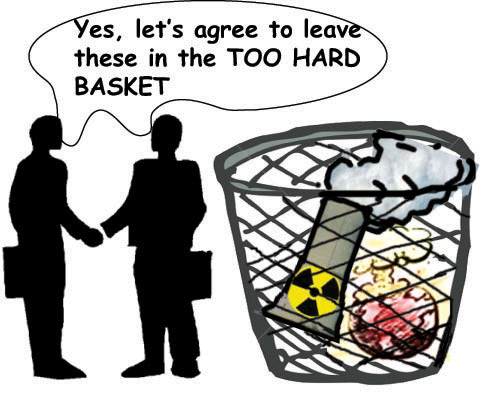 by: Charles Kennyn October 21, 2012 The Oct. 16 presidential town hall debate featured Mr. Romney and Mr. Obama facing off on who was really Mr. Oil or Mr. Gas or Mr. Coal. Neither candidate even mentioned climate change. And while President Obama did refer to renewable production, solar got short shrift—doubtless because of the fracas over now-bankrupt thin-film solar manufacturer Solyndra, which had received loan guarantees as part of the stimulus bill.
That’s a shame, because the reason panel production has moved from such countries as America and Germany to China is because prices have dropped and production has become a commoditized, high-volume enterprise. That may be bad news for Western manufacturing jobs, but it’s great news for the global environment, consumers, and even American energy security.
In fact, if we had a level playing field, where neither fossil fuels nor renewable energy received favorable regulatory or subsidy treatment, solar would be increasingly competitive. Mr. Coal would be going home, and Mr. Sun would be coming out to play.
Global subsidies for oil, gas, and coal amounted to $409 billion in 2010 —compared with $60 billion for renewable energy that year. Cutting those subsidies would be economically efficient, reduce overall energy consumption, and level the playing field with renewable power. The International Energy Agency suggests that removing fossil fuel subsidies would reduce carbon dioxide emissions by as much as 2.6 gigatonnes a year by 2035. That’s half of what’s required to prevent the planet’s average temperature from increasing by two degrees centigrade or more per year. Continue reading
Tamil Nadu – not a TOTAL disaster – solar energy policy

 TN Govt unveils solar energy policy http://www.thehindubusinessline.com/news/states/tn-govt-releases-solar-energy-policy/article4016264.ece R. BALAJI CHENNAI, OCT 20: Industrial and Commercial buildings connected to a high tension power load will have to use solar power to meet a portion of their power consumption , according to a solar energy policy announced by the Tamil Nadu Government on Saturday.
The policy offers incentives and mandates exploitation of solar energy in industrial, commercial and residential buildings. Continue reading
Costly to set up, but Germans think that clean energy is worth the price
Poll finds large majority of Germans favor phasing out nuclear power despite rising costs News Ser 22 Oct 12 Poll: Germans accept nuke exit despite rising bill ASSOCIATED PRESS |22 Oct 12 A new poll finds that a large majority of Germans back the government’s decision to phase out nuclear power and switch to renewable energies within a decade, despite rising electricity bills.
The poll for German news magazine Focus published Sunday found that 72 percent continue to support the country’s energy switchover. Only 24 percent were opposed to the policy.
Germany’s grid operators announced earlier this month that a surcharge on households’ electricity prices financing the expansion of renewable energies will increase by 47 percent starting in January. A typical family of four will then have to pay about (EURO)250 ($325) per year on top of their bill… http://www.newser.com/article/da21vv5g1/poll-finds-large-majority-of-germans-favor-phasing-out-nuclear-power-despite-rising-costs.html
Denmark is way ahead of its solar energy goal
Denmark Hits 200 Megawatt Solar Capacity Goal 8 Years Ahead of Schedule by Molly Cotter, 10/15/12http://www.stumbleupon.com/su/1jrNeg/inhabitat.com/denmark-hits-200-megawatt-solar-capacity-goal-8-years-ahead-of-schedule/ Lets face it – its rare we see a government goal reached on time, let alone early. Not too long ago, the Danish Government announced an ambitious goal to reach 200 megawatts of solar capacity by 2020, and as of last week, they have already met it! The country is currently installing an average of 36 megawatts of solar panels each month. At this rate, their resulting capacity by 2020 will be over five times the original goal. Denmark‘s power is currently 20% supplied by renewable sources, and the nation has set a goal of sourcing 100% of its energy from renewable sources by 2050.
Northern Scotland goes from nuclear to wind and waves, DW 19 Oct 12, The sparsely populated region of Caithness in northern Scotland once relied heavily on the development of nuclear energy for electric power and for job creation. Now wind and wave energy are set to take over. Continue reading
In a grid connected solar power system, a solar inverter converts the DC electricity generated by solar panels into AC electricity suitable for use by home appliances and for exporting to the mains grid. Continue reading
International Renewable Energy Agency’s success in developing countries
The World Energy Forum in Dubai from October 22 to 24 is a major event. It is the first time this event is being held away from UN headquarters in New York.
 Renewable energy in developing countries to inspire world http://gulfnews.com/news/gulf/uae/environment/renewable-energy-in-developing-countries-to-inspire-world-1.1090242 Around 160 countries joined Irena within a few years — an unprecedented achievement By Binsal Abdul Kader, October 16, 2012 Abu Dhabi: Initiatives in renewable energy in developing countries will inspire the world to adopt clean energy to address energy poverty and climate change caused by pollution, a top official of International Renewable Energy said on Monday. Continue reading
USA leads in 5 top countries using renewable energy
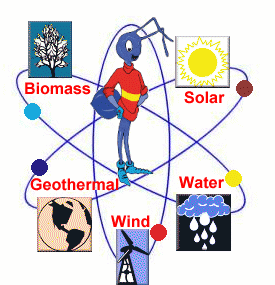 5 Top Countries Leading The World In Renewable Energy, Care 2, by Judy Molland October 9, 2012 ” Sustainable Energy and Renewable Energy are terms that are thrown around a lot these days, but what exactly do they mean, and how many countries are taking them seriously?
The US Energy Information Adminstration (EIA) estimates that in 2008, 10% of the world’s energy consumption was from renewable energy sources. EIA forecasts that by 2035, consumption of renewable energy will be about 14% of total world energy consumption.
What are these renewable sources?
First, what they are not: the coal, oil and natural gas that the U.S. relies heavily on are all non-renewable, and will eventually dwindle and disappear.
By contrast, the many types of renewable, or sustainable, energy resources, such as wind and solar energy, are constantly replenished and will never run out…. And why do we love renewable energy?
These are clean sources of energy, meaning they have a much lower environmental impact than conventional energy technologies. They won’t run out, their costs revolve around materials and workmanship for facilities rather than on expensive energy imports, and better yet, renewable energy technologies developed and built in the U.S. are being sold overseas. Finally, U.S. energy security is at risk when we become so dependent on foreign oil supplies. Continue reading
Barefoot Power and Kiva bring decentralised renewable energy across the world
Barefoot Power and Kiva Join Forces, Making Renewable Energy Solutions a Reality http://prwire.com.au/pr/32383/barefoot-power-and-kiva-join-forces-making-renewable-energy-solutions-a-reality, 9 Oct 12,
Award-winning social enterprise Barefoot Power and non-profit organisation Kiva are working together to improve the lives of millions of families that do not have access to affordable energy in remote communities across the world. Continue reading
Cooling city buildings by using roof gardens
Adelaide in South Australia is leading the way in water-sensitive urban design and green roof technology.
Roof gardens proven to cool buildings ABC Radio The World Today Nicola Gage reported this story on Tuesday, October 9, 2012 ELEANOR HALL: Roof gardens are becoming more prevalent in the world’s major cities.
Now a study has found that not only are they building mini-ecosystems, they’re also cooling buildings significantly and reducing carbon emissions, as Nicola Gage reports.
NICOLA GAGE: Major cities have inherently been linked to pollution and rising carbon emissions, but 22 stories up on the roof of a building in Adelaide, there’s a micro-climate that’s returning wildlife to the city. Continue reading
How wind power from Ireland could power UK
Irish Wind Could Help Power The UK By 2020 http://www.energymatters.com.au/index.php?main_page=news_article&article_id=3412 by Energy Matters, 8 Oct 12 Wind power has the potential to deliver billions of Euros to the Irish economy and unlock thousands of new jobs under a plan to supply the UK with renewable electricity via an undersea “Energy Bridge”. Continue reading
Renewable energy resulting in cheaper baseload power
German baseload power cheaper than French 12 months running, Renewables International, 7 Oct 12 Yesterday, the European Energy Exchange (AEX) released figures for September, revealing that the price of baseload power in Germany has fallen by nearly 0.8 cents per kilowatt-hour over the past year – and has been cheaper than baseload power in France for 12 consecutive months.
The EEX published the trading results for September yesterday, but unfortunately the press release is currently only available in German.
What it shows is that day-ahead prices in Germany & Austria are lower than in France or Switzerland both in terms of base load and peak load. Indeed, though the press release explains that prices on the German and French markets “converge 75% of the time” (during periods of low consumption, such as during the night and on weekends), the difference in prices has become considerable, with the difference in base load prices being 4% on the average for September…..
day-ahead prices have been lower in Germany than in France for 12 consecutive months. The average German baseload price in September was slightly below the price in August, so the downward pressure on prices continues. The drop over the past 12 months in Germany has indeed been quite dramatic at around 18% – from 5.264 cents per kilowatt-hour in
September 2011 to the current 4.467 cents last month.
The news is especially important because nuclear power, which provides slightly more than 75% of France’s power supply, is often held to be an especially inexpensive source of baseload power. Furthermore, opponents of renewables repeatedly voice their concern about the cost impact of green power scaring away industry. …..
http://www.renewablesinternational.net/german-baseload-power-cheaper-than-french-12-months-running/150/537/57302/
Renewable energy taking over in European regions
100 % RENEWABLE ENERGY IS ALREADY REALITY World Future Council, 8 Oct 12, Anna Leidreiter Europe is showing the world that we can move to a sustainable energy future based on cost-effective, clean and stable supplies. Renewable energies (RE) accounted for more than 71% of total electric capacity additions in 2011, bringing renewable energy’s share of total electric capacity to 31.1%. A number of European cities, regions and countries have committed to and even already achieved 100% renewable energy-sourced electricity, heating, and transport.
A network of 100% RE regions in Germany has 74 regions and municipalities that have already reached 100% renewable energy. One of these is Jühnde, the first bioenergy village in Germany. Through its 712kW biogas plant Jühnde produces twice the amount of electricity demanded by the local area and provides heat for 70% of the inhabitants through the co-operative, with 80% of the revenue remaining in the region. The initiative began with a public meeting in 2001 and citizen participation continues to be emphasised.
The municipality of Skellefteå, Sweden, is another good example of ambitious RE targets being set and met through community-owned power. Skellefteå Kraft is Sweden’s fifth largest electricity producer and 100% municipality-owned. The company, therefore, has a social mandate over and above its commercial pursuits. With renewables accounting for nearly 90% of its energy production it is in a good position to contribute to reaching the national targets of 50% share of renewable energy in the energy mix and 10% in transport by 2020, targets that will increase to 100% by 2050 and 2030, respectively.
This is reality not only in small towns: Denmark makes the case that 100% RE targets are set and can be met at a national level in one of the world’s wealthiest countries. As with Germany’s approach to achieving the 100% renewable energy target, the Danish experience has been one of bottom-up, participatory community power. On the Thy peninsula, where the World Future Council‘s workshop on 100% Renewable Energy in European Regions is taking place this wekeend at the Folkecenter, renewable energy – the bulk of which coming from wind – account for 100% of electricity consumption and 85% of space heating. The ‘Fossil-Free Thy’ project initiated by the Folkecenter aims to reach 100% renewable energy heating in the region in several years, and Thy is but one European example already demonstrating the feasibility of a fully renewable energy supply….. http://power-to-the-people.net/2012/10/100-renewable-energy-is-already-reality/
Massive solar power farm for Japan
SMA Solar Inverters To Be Used In Japan’s Biggest Solar Farm http://www.energymatters.com.au/index.php?main_page=news_article&article_id=3409 5 Oct 12 SMA has been selected as the sole supplier of inverters for Japan’s largest solar power plant.
The 70 megawatt solar panel based project operated by Kagoshima Mega Solar Power Corporation will utilise 140 Sunny Central 500CP–JP inverters. SMA will also supply 1,260 Sunny String Monitors for monitoring the massive solar farm. Continue reading
1 This Month
26 September – International Day for the Total Elimination of Nuclear Weapons





PLEASE OPPOSE HR 8255 AND S.3639 – bills would accelerate satellite deployment, with no environmental review or safeguards – https://ncstd5li.quorum.us/campaign/169331/
To see nuclear-related stories in greater depth and intensity – go to https://nuclearinformation.wordpress.com
-
Archives
- September 2026 (305)
- August 2026 (330)
- July 2026 (355)
- June 2026 (287)
- May 2026 (306)
- April 2026 (356)
- March 2026 (251)
- February 2026 (267)
- January 2026 (308)
- December 2025 (358)
- November 2025 (359)
- October 2025 (375)
-
Categories
- 1
- 1 NUCLEAR ISSUES
- business and costs
- climate change
- culture and arts
- ENERGY
- environment
- health
- history
- indigenous issues
- Legal
- marketing of nuclear
- media
- opposition to nuclear
- PERSONAL STORIES
- politics
- politics international
- Religion and ethics
- safety
- secrets,lies and civil liberties
- spinbuster
- technology
- Uranium
- wastes
- weapons and war
- Women
- 2 WORLD
- ACTION
- AFRICA
- Atrocities
- AUSTRALIA
- Christina's notes
- Christina's themes
- culture and arts
- Events
- Fuk 2022
- Fuk 2023
- Fukushima 2017
- Fukushima 2018
- fukushima 2019
- Fukushima 2020
- Fukushima 2021
- general
- global warming
- Humour (God we need it)
- Nuclear
- RARE EARTHS
- Reference
- resources – print
- Resources -audiovicual
- Weekly Newsletter
- World
- World Nuclear
- YouTube
-
RSS
Entries RSS
Comments RSS

