MdAmerican to power equivalent of 1 million households with Wind Energy
MidAmerican Energy Plans To Invest Additional $280 Million In Wind Generation WOWT NBC Omaha 10 Oct 14 MidAmerican Energy Company today announced plans to develop one new wind farm site in Adams County and expand a second site in O’Brien County in 2015 – an additional investment of up to $280 million for the nation’s leader in ownership of wind-powered generation among rate-regulated utilities.
If approved, the company’s proposed wind project would result in installation of up to 67 wind turbines. The project, scheduled for completion by the end of 2015, would add up to 162 megawatts of new wind generation capacity in Iowa……..
Coupled with projects currently underway in Grundy, Madison, O’Brien and Webster counties, MidAmerican Energy will have approximately 3,500 megawatts of wind generation capability in Iowa by year-end 2015 – enough capability to provide energy for the equivalent of approximately 1.05 million average Iowa households. With the completion of this newest project, MidAmerican Energy will have invested more than $6 billion for wind generation development in Iowa, making wind approximately 40 percent of its electric generator nameplate capacity. http://www.wowt.com/home/headlines/MidAmerican-Energy-Plans-to-Invest-Additional-280-Million-In-Wind-Generation-278797921.html
US Energy Dept funding Concentrated Solar Power (CSP) research
US Energy Department to fund CSP research Renewable Energy Focus 08 October 2014 DoE allocates $25 Million to support research and development of concentrating solar power.
The US Energy Department has announced $25 million in funding to advance concentrating solar power (CSP) system technologies. This investment will fund research and development projects to improve the performance and increase the efficiency of all components of CSP plants, ultimately lowering the cost of solar electricity.
“Investments to improve the efficiency and lower the costs of concentrating solar power technologies enhance our ability to deliver affordable solar-generated electricity to American families and businesses, while also moving us closer to achieving President Obama’s goal of doubling renewable energy generation again by the end of the decade,” said David Danielson, Assistant Secretary for Energy Efficiency and Renewable Energy.
Chile forms the top market for renewable energy
Chilean geography makes nation the top market for renewable energy, Chicago Tribune
By Matt Craze, Bloomberg News,Bloomberg SANTIAGO, Chile — With the sunniest desert on Earth, a windswept coast and limited fossil fuel supplies, northern Chile has become the world’s top market for renewable energy.
The government of President Michelle Bachelet has approved 76 solar and wind projects since taking power March 11. Renewable energy developers are pursuing contracts to deliver electricity to mines run by by companies including Anglo American and BHP Billiton, which consume a third of the country’s power.
“Chile is the market with the highest level of activity in the world,” Ben Warren, head of Ernst & Young’s renewables team, said in a telephone interview from London………
“Despite being a small market we attracted all of the players because we have significant growth rates,” Finat said. “We have clear economic rules and political stability. And there is a gigantic amount of untapped renewable energy resources.” http://www.chicagotribune.com/sns-wp-blm-news-bc-chile07-20141007-story.html
Wind and solar generation racing ahead, nuclear energy slowing
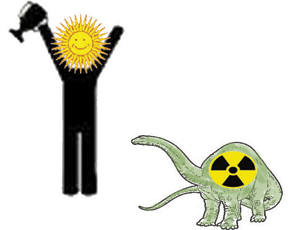 Wind & Solar Energy Generation Capacities Both Catching Up With Nuclear, Clean Technica October 5th, 2014 by James Ayre Renewables have been capturing a larger and larger portion of the total global energy infrastructure pie, while the portion nuclear energy has not just been stagnating but actually shrinking somewhat, as noted by a new Vital Signs report from Worldwatch Institute.
More interesting than that observation, though, is the fact that solar and wind energy have been gaining fast on nuclear — and are now, more or less, on the same trajectory that nuclear power was on in the 1970s and 1980s, in its heyday.

So, it looks like that “nuclear renaissance” that some analysts have been babbling about for the last several years will have to wait for at least another couple of years — or, more likely, forever. Solar and wind energy will no doubt continue growing at a fair rate (at the least) in the years to come.
Here are some of the exacts: nuclear’s share of total global power production has steadily declined from a peak of 17.6% in 1996 to 10.8% in 2013. And renewables have increased their share from 18.7% in 2000 to 22.7% in 2012. Continue reading
Promising new ‘solar battery’ – a revolution in energy technology?
 New rechargeable ‘solar battery ‘promises to revolutionize solar technology By Daily Digest News October 04, 2014 Scientists from Ohio State University invented a revolutionary breakthrough green energy technology that has the chance to upend the solar power industry.
Led by Professor Yiying Wu, scientists created a solar cell that also doubles as a rechargeable battery– the first combined device of its type.
“The state of the art is to use a solar panel to capture the light, and then use a cheap battery to store the energy,” Wu said. “We’ve integrated both functions into one device.”…….
By combining both the generation and storage processes, Wu and his team have been able to drastically reduce lost potential, saving nearly 100 percent of the electrons produced.
“Any time you can do that, you reduce cost,” said Wu.
The team estimates that their device brings down costs by 25 percent, which would be a significant boon to the solar energy industry.
Costs and innefficiency are the two factors consumers often point to that inhibits solar energy usage compared to traditional fossil fuel sources.
The team filed for a patent on the solar battery, and plans to license it to the broader energy industry for sale and distribution.http://dailydigestnews.com/2014/10/new-rechargeable-solar-battery-promises-to-revolutionize-solar-technology/
IN 2014 Germany gets 27% of electricity from renewable energy
 Germany kicks our butts, again, at clean energy Grist, By Liz Core 2 Oct 2014 Germany has hit a new clean energy milestone: So far this year, the country has gotten more electricity from renewables than from any other single source, 27.7 percent. That (just barely) beats the 26.3 percent of power generated by lignite coal, according to Agora research organization.
“This is a real success and watershed moment,” said Famke Krumbmuller, an analyst at Eurasia Group.
Wind accounted for 9.5 percent of the power fed into the country’s grid in the first nine months of 2014, biomass for 8.1, solar for 6.8 percent, and hydropower for less than 4 percent.
Last year, Germany got 24.1 percent of its electricity from renewables, so it’s up more than 3 percent. German Chancellor Angela Merkel’s government is aiming to get as much as 60 percent of the nation’s electricity from clean sources by 2035, even while phasing out nuclear power by 2022. (If you’re still looking for a star quarterback for your climate hawk fantasy league, Merkel is looking like she might be ace at pummeling her way to a climate goal.)
The U.S., by contrast, got just 6 percent of its electricity from wind, solar, biomass, and geothermal last year, and other 7 percent from hydro……http://grist.org/list/germany-kicks-our-butts-again-at-clean-energy/
Rooftop solar becoming an unbeatable rival to old energy generators
Solar costs heading to 4c/kWh, rooftop solar seen “unbeatable” REneweconomy. By Giles Parkinson on 30 September 2014 The highly conservative International Energy Agency predicts the cost of solar energy will fall to around 4c/kWh in coming decades as the sun becomes the dominant source of power generation across the world.
As we reported yesterday, the IEA now expects solar to become the biggest single source of energy by 2050 and has now doubled its forecast capacity for solar PV.
Rooftop solar, it says, will now account for one half of the world’s solar PV installations, because as a distributed energy source the technology is “unbeatable”.
On costs, it says all solar technologies will fall dramatically in coming decades, with solar PV falling to as low as 4c/kWh, utility-scale solar to around the same level, and solar thermal with storage will fall to as low as 6.4c/kWh.
As this graph [in original] below shows, the minimum price tends to occur in regions with great sunshine, and it also assumes a low capital cost of around 8%……..
The forecasts from the IEA are not the most dramatic that can be found, but they are significant because the IEA is essentially a conservative organisation that was created in the 1970s to defend developed countries’ access to fossil fuels
It has a history of underestimating the impact of new technologies such as solar, as we pointed out in this article – even though it has doubled its forecast for solar PV deployment in just the last few years. Other agencies, such as IRENA, have a much more bullish forecast for solar……http://reneweconomy.com.au/2014/solar-costs-heading-4ckwh-rooftop-solar-seen-unbeatable-74425
The era of clean, free, solar energy is nigh
The coming era of unlimited — and free — clean energy http://www.washingtonpost.com/blogs/innovations/wp/2014/09/19/the-coming-era-of-unlimited-and-free-clean-energy By Vivek Wadhwa September 19 In the 1980s, leading consultants were skeptical about cellular phones. McKinsey & Company noted that the handsets were heavy, batteries didn’t last long, coverage was patchy, and the cost per minute was exorbitant. It predicted that in 20 years the total market size would be about 900,000 units, and advised AT&T to pull out. McKinsey was wrong, of course. There were more than 100 million cellular phones in use 2000; there are billions now. Costs have fallen so far that even the poor — all over world — can afford a cellular phone.
The experts are saying the same about solar energy now. They note that after decades of development, solar power hardly supplies 1 percent of the world’s energy needs. They say that solar is inefficient, too expensive to install, and unreliable, and will fail without government subsidies. They too are wrong. Solar will be as ubiquitous as cellular phones are.

Futurist Ray Kurzweil notes that solar power has been doubling every two years for the past 30 years — as costs have been dropping. He says solar energy is only six doublings — or less than 14 years — away from meeting 100 percent of today’s energy needs. Energy usage will keep increasing, so this is a moving target. But, by Kurzweil’s estimates, inexpensive renewable sources will provide more energy than the world needs in less than 20 years. Even then, we will be using only one part in 10,000 of the sunlight that falls on the Earth.
In places such as Germany, Spain, Portugal, Australia, and the Southwest United States, residential-scale solar production has already reached “grid parity” with average residential electricity prices. In other words, it costs no more in the long term to install solar panels than to buy electricity from utility companies. The prices of solar panels have fallen 75 percent in the past five years alone and will fall much further as the technologies to create them improve and scale of production increases. By 2020, solar energy will be price-competitive with energy generated from fossil fuels on an unsubsidized basis in most parts of the world. Within the next decade, it will cost a fraction of what fossil fuel-based alternatives do.
It isn’t just solar production that is advancing at a rapid rate; there are also technologies to harness the power of wind, biomass, thermal, tidal, and waste-breakdown energy, and research projects all over the world are working on improving their efficiency and effectiveness. Wind power, for example, has also come down sharply in price and is now competitive with the cost of new coal-burning power plants in the United States. It will, without doubt, give solar energy a run for its money. There will be breakthroughs in many different technologies, and these will accelerate overall progress.
Despite the skepticism of experts and criticism by naysayers, there is little doubt that we are heading into an era of unlimited and almost free clean energy. This has profound implications.
First, there will be disruption of the entire fossil-fuel industry, starting with utility companies — which will face declining demand and then bankruptcy. Several of them see the writing on the wall. The smart ones are embracing solar and wind power. Others are lobbying to stop the progress of solar power — at all costs. Witness how groups in Oklahoma persuaded lawmakers to approve a surcharge on solar installations; the limited victory that groups backed by the Koch brothers won in Arizona to impose a $5 per month surcharge; and the battles being waged in other states. They are fighting a losing battle, however, because the advances aren’t confined to the United States. Countries such as Germany, China, and Japan are leading the charge in the adoption of clean energies. Solar installations still depend on other power sources to supply energy when the sun isn’t shining, but battery-storage technologies will improve so much over the next two decades that homes won’t be dependent on the utility companies. We will go from debating incentives for installing clean energies to debating subsidies for utility companies to keep their operations going.
Witness how groups in Oklahoma persuaded lawmakers to approve a surcharge on solar installations; the limited victory that groups backed by the Koch brothers won in Arizona to impose a $5 per month surcharge; and the battles being waged in other states. They are fighting a losing battle, however, because the advances aren’t confined to the United States. Countries such as Germany, China, and Japan are leading the charge in the adoption of clean energies. Solar installations still depend on other power sources to supply energy when the sun isn’t shining, but battery-storage technologies will improve so much over the next two decades that homes won’t be dependent on the utility companies. We will go from debating incentives for installing clean energies to debating subsidies for utility companies to keep their operations going.
Vivek Wadhwa is a fellow at Rock Center for Corporate Governance at Stanford University, director of research at Center for Entrepreneurship and Research Commercialization at Duke, and distinguished fellow at Singularity University. His past appointments include Harvard Law School, University of California Berkeley, and Emory University.
The death spiral of fossil fuel electricity: but the utilities are fighting back
“Distributed generation (DG) could be the end of utilities as we know them today,” U.S. investment research firm Morningstar said earlier this year. “Utilities’ centralized network monopolies break down when customers become self-sufficient competitors.”
Romero, the Spanish renewable energy expert, said: “Utility companies know that the future is in renewables, but they’re not going to go down without putting up a fight.”
 From Sydney To Spain, Old Energy Is Doing Everything It Can To Hold Back The Rise Of Solar, Business Insider Australia TRACY RUCINSKI, BYRON KAYE MADRID/SYDNEY (REUTERS) 29 SEPT 14
“The government wanted people to be afraid to generate their own energy, but they haven’t dared to actually pass the law,” Alonso said as he tightened screws on the panel on a sunny summer day this month. He had removed solar panels from the roof last year.
“We’re tired of being afraid,” he said.
Halfway across the globe, in the “sunshine state” of Queensland, Australia, electrical engineer David Smyth says the war waged by some governments and utilities against “distributed energy”, the term used for power generated by solar panels, is already lost.
“The utilities are in a death spiral,” he told Reuters by telephone while driving between a pub where he helped set up 120 solar panels to cut its $53,000 annual power bill and a galvanizing plant which was also adding solar panels to reduce costs.
In Australia, he said, solar panels have shifted from being a heavily subsidized indulgence for environmentally-conscious households to a pragmatic option for businesses wanting certainty about what their running costs will be next year.
“Not many people are doing it because of emissions or the environment,” Smyth said. “It’s about the cost.” Continue reading
AUDIO: Energy independence El Hierro Island goes straight to 100% renewable energy
 .http://www.npr.org/blogs/parallels/2014/09/17/349223674/tiny-spanish-island-nears-its-goal-100-percent-renewable-energy Audio Tiny Spanish Island Nears Its Goal: 100 Percent Renewable Energy NPR, by LAUREN FRAYER September 28, 2014 “….. Spanish island of El Hierro. The ancient island off the west coast of Africa is now a model for the future, within months of running on 100 percent renewable energy, which consists of a mix of wind and hydro-power.
El Hierro, the most remote of Spain’s Canary Islands, is now billing itself as the world’s first energy self-sufficient island that has never been hooked up to a power grid.A Danish island, Samso, is also energy-independent, but was previously hooked up to the Danish grid and didn’t make the change in isolation, like El Hierro.

Because of the topography of the surrounding seabed, El Hierro, an active volcanic island with a population of about 10,000, could never hook up to Spain’s power grid.
Instead, it used big barges to ship in 6,600 tons of diesel fuel — the equivalent of 40,000 barrels of oil — each year, to power electricity generators. It was an expensive, time-consuming and dirty endeavor … until now.
This past summer, El Hierro inaugurated the Gorona del Viento power plant, a $110 million wind and water turbine farm. By the end of this year, the plant will generate all of the island’s energy needs of up to 48 gigawatt hours per year……..
El Hierro is already planning its next energy project. It wants all the island’s cars to be electric by the year 2020.
Australian research shows the way to 50% renewable energy by 2050
 Australia Encouraged To Set 50% Renewable Energy Target By 2030 September 25th, 2014 by Giles Parkinson RenewEconomy. Imagine a world in 2050. Everyone drives an (electric) car, homes have all the gadgets, appliances and nick-nacks. The public transport system is emissions free. Mining work and transport is electrified, and diesel is dumped. Electrification has taken place in much of the steel industry. And it is all emissions free. It might be powered by 100 per cent renewables – the sun, wind, the sea, and geothermal, hydro and biomass. And the economy is still strong.
Welcome to the zero carbon world awaiting Australia and much of the rest of the world.
Major new analysis – Pathways to Deep Decarbonisation – produced by Australia’s ClimateWorks, along with ANU, shows that 15 of the world’s biggest economies can move to “net carbon zero” by 2050, and it need impose no extra costs over business as usual. In fact, electricity bills will be lower than what they are now. Economic growth will remain more or less the same, and the benefits, in terms of health and the environment, will be enormous.
The report is timed for the New York climate summit being hosted by the UN this week, and in the 12 months leading up to the Paris event that will hopefully result in a new climate treaty next year. It is designed to help change the political rhetoric around decarbonisaion. In Australia, only one party, the Greens, talks in terms of net carbon zero by 2050, and of higher renewable energy targets. Yet this report says not only is it necessary to meet climate goals, it is eminently doable.
Anna Skarbek, the executive director of ClimateWorks, says that Australia’s political rhetoric needs to change quickly. While the Abbott government is talking of the need to “cut” the renewable energy target down to a “real” 20 per cent, for “fear” that it might reach 25 or 26 per cent by 2020, Skarbek says that to achieve climate goals, Australia’s renewable energy target needs to be at least 50 per cent by 2030 – and then carbon free by 2050.
“There are many pathways for Australia to substantially reduce emissions, but all include greatly improved energy efficiency across the economy, a nearly carbon free power system and switching to low carbon energy sources in transport, buildings and industry,” Skarbek says.
“Taking the carbon out of our electricity system provides the largest reduction in emissions. Then we can use the carbon-free electricity to replace petrol in cars, and gas in buildings and some industrial processes.”
“The move to a low emissions electricity system can be developed with technologies that exist today. But we need to move faster – this report shows we’ll need at least 50 per cent renewable electricity by 2030 to achieve a decarbonised electricity system in the time we have left to stay within the carbon budget.”….in all scenarios, even those that hope for cost-competitive carbon capture and storage, renewable energy is the dominant technology, and solar provides at least 50 per cent of all generation.
By 2030, under the renewable scenario, coal is nearly eliminated, although it plays a greater role in the other scenarios because CCS will take a decade at least to bring into production (if it can ever deliver the costs, which many think it won’t), and nuclear will not have a presence before 2030.
Even then, it is assumed that nuclear would provide no more than one-quarter of generation – and this is based on the rather generous cost estimates of past government reviews, and does not reflect the significant cost declines that can be expected of solar. Note however, that the emissions per MWh is the renewables scenario is nearly half of that entertained in the CCS or nuclear scenario – that’s because coal generators get to pollute for many years longer in those scenarios……..
The ClimateWorks report was one of 15 prepared for the UN Deep Decarbonisation Pathways Project that involves modelling teams from 15 major emitters that also include Australia, Brazil, Canada, China, France, Germany, India, Indonesia, Japan, Mexico, Russia, South Africa, South Korea, the UK and the USA.
The findings are being presented to the UN this week by leading economist Jeffrey Sachs. It shows that these countries account for 70 per cent of the world’s greenhouse gas emissions. The interim results show that all 15 countries found ways to achieve near zero carbon electricity by 2050, while sustaining economic growth……http://cleantechnica.com/2014/09/25/australia-renewable-energy-target-50-2030/
Rockefeller family investing in renewable energy, dumping oil

 Rockefeller family to sell oil investments to reinvest in renewables ABC News, 23 Sept 14, The heirs of the Rockefeller family, who made their vast fortune in oil, have joined in a pledge to divest more than $56 billion of fossil fuel investments to reinvest in clean energy on the eve of a major climate change summit in New York.
The Global Divest-Invest coalition has drawn 650 individuals and 180 institutions, which control billions of dollars in fossil fuel assets, to switch to renewables over five years using a variety of approaches.
One of the signatories is Rockefeller Brothers Fund and heir of Standard Oil tycoon John D Rockefeller, Stephen Heintz, who said the move would be in line with his wishes.
“We are quite convinced that if he were alive today, as an astute businessman looking out to the future, he would be moving out of fossil fuels and investing in clean, renewable energy,” he said.
Another of the higher profile institutional divestments came in May, when Stanford University said it would no longer use any of its $21 billion endowment to invest in coal mining companies.
New York mayor Bill de Blasio on Sunday unveiled a new plan for the city to reduce its greenhouse gas emissions by 80 per cent from 2005 levels by 2050.
All 3,000 major city-owned buildings would be retrofitted with energy-saving heating, cooling and light systems, but he said meeting the commitment would also require significant investments by private landlords…….http://www.abc.net.au/news/2014-09-23/rockefeller-family-to-sell-oil-investments-to-reinvest-in-renew/5761966
In Japan solar floating panels are taking over from nuclear power
Japan: ‘solar islands’ replace nuclear power http://www.enn.com/business/article/47833 15 Sept 14 As Japan seeks to end reliance on nuclear power, one of the answers is floating ‘solar islands’, writes Jon Major. A 70MW solar island opened last year, and two additional plants have just been announced. Two companies in Japan recently announced they are to begin building two large solar power islands that will float on reservoirs.

This follows smartphone maker Kyocera’s Kagoshima Nanatsujima Mega Solar power plant, the country’s largest at 70 megawatts, which opened in late 2013 and is found floating in the sea just off the coast of southern Japan.
The two new solar islands, to be built by Kyocera and commercial partners, will form a network of thirty 2MW stations – adding another 60MW of solar capacity.
The move comes as Japan looks to move on from the Fukushima disaster of 2011 and meet the energy needs of its 127m people without relying on nuclear power.Shattered confidence in nuclear power
Before the incident around 30% of the country’s power was generated from nuclear, with plans to push this to 40%. But Fukushima destroyed public confidence in nuclear power, and with earthquakes in regions containing reactors highly likely, Japan is now looking for alternatives.
Solar power is an obvious solution for relatively resource-poor nations. It is clean, cost-competitive, has no restrictions on where it can be used and has the capability to make up for the energy shortfall.
A small fact that solar researchers love to trot out is that enough sunlight falls on the earth’s landmass around every 40 minutes to power the planet for a year. To put this another way, if we covered a fraction of the Sahara desert in solar panels we could power the world many times over.
The technology already exists, so producing enough solar power comes primarily down to one thing: space. For countries such as the USA with lots of sparsely populated land this is not an issue, and there have already been a large number of solar farms installed around the country.
For Japan, the answer is offshore
But Japan where space is limited, more inventive solutions are required. This is the principle reason behind the decision to move their solar power generation offshore.
While the land is highly congested, and therefore expensive, the sea is largely unused. It therefore makes a good degree of sense to use this space for floating power plants.
Continue reading at ENN affiliate The Ecologist.
Vermont’s largest city gets 100% of its electricity from renewables
Largest City in Vermont Now Gets All Its Power From Renewables, Reader Supported News, By Ari Phillips, ThinkProgress 15 September 14  he 42,000 people living in Burlington, Vermont can now feel confident that when they turn on their TVs or power up their computers they are using renewable energy. With the purchase of the 7.4 megawatt Winooski One hydroelectric project earlier this month, the Burlington Electric Department now owns or contracts renewable sources — including wind, hydro, and biomass — equivalent to the city’s needs.
“We’re now in a position where we’re supplying Burlington residents with sources that are renewable,” said Ken Nolan, manager of power resources for Burlington Electric Department, earlier this month. “The prices are not tied to fossil fuels — they’re stable prices — and they provide us with the flexibility, from an environmental standpoint, to really react to any regulation or changes to environmental standards that come in the future.”…….
Vermont has a statewide goal of getting 90 percent of its energy from renewable sources by 2050, including electricity, heating, and transportation. Christopher Recchia, the commissioner of the Vermont Department of Public Service, told the Associated Press that Burlington’s achievement shows that they’re able to make this transition cost-effectively and “in a way that makes Vermonters really positioned well for the future.”
The Washington Electric Co-operative, which has about 11,000 customers across central and northern Vermont, also reached the 100 percent renewable milestone earlier this year. Both utilities acknowledge that when renewable sources aren’t readily available — if the wind isn’t blowing or water levels are low — they will purchase traditional fossil fuel-generated electricity. However, when the wind is strong and water levels are high more than enough electricity is generated and the surplus can be sold to other utilities. On average, they will be selling more than they buy……..http://readersupportednews.org/news-section2/318-66/25892-largest-city-in-vermont-now-gets-all-its-power-from-renewables
Access to renewable energy the key to world’s electricity needs – IRENA report
In an accompanying media release, IRENA Director-General Adnan Amin said speeding up the adoption of renewable energy technologies is the most feasible way of reducing carbon emissions and avoiding catastrophic global warming.
 Speeding Up Renewable Energy Access Critical for Climate, Health and Economy: Report DESMOGBLOG.com Chris Rose, 14 Sep 14 Renewable energies are increasingly seen as the best solution to a growing global population demanding affordable access to electricity while reducing the need for toxic fossil fuels that are creating unsustainable levels of greenhouse gas emissions.
That’s the underlying message of a new report — REthinking Energy: Towards a New Power System — published this week by the Abu Dhabi-based International Renewable Energy Agency (IRENA).
“Rapid technological progress, combined with falling costs, a better understanding of financial risk and a growing appreciation of wider benefits, means that renewable energy is increasingly seen as the answer,” the 94-page report says.
“Not only can renewable energy meet the world’s rising demand, but it can do so more cheaply, while contributing to limiting global warming to under 2 degrees Celsius – the widely cited tipping point for climate change,” the report adds.
“A technology once considered as niche is becoming mainstream. What remains unclear is how long this transition will take, and how well policy makers will handle the change.”……..
The report said renewable energy technologies have grown more robust and more efficient in the last decade and are increasingly able to generate power even in suboptimal conditions such as low wind speeds and low solar irradiation. Energy storage technologies are improving fast, it added, while costs have plummeted.
“Worldwide, renewable power capacity has grown 85% over the past 10 years, reaching 1,700 GW in 2013, and renewables today constitute 30% of all installed power capacity,” the report said, noting the challenge today is how to finance and accelerate the continued deployment of renewables.
Total investment in renewable energy rose from $55 billion in 2004 to $214 billion in 2013 (excluding large hydropower), said the report, which also pointed out that $550 billion is needed annually until 2030 to double the global share of renewable energy and avert catastrophic climate change.
The report added that politicians have an important role to play. “If they make it clear that renewable energy will be a larger part of their national energy mix, and commit to long-term, non-financial support mechanisms, they could reduce uncertainty and attract more investors.”
Deploying renewables also stimulates economic activity, creates jobs, provides power for those left off the grid, the report said. Most renewables do not deplete finite resources and they also reduce the risk of ecological disasters.
“The changes at hand offer the potential for a new industrial revolution – creating a renewables-based system, which enhances access, health and security, creates jobs and safeguards the environment,” the report said. “The technology is ready to deploy. People, businesses and governments must now embrace its potential.”
In an accompanying media release, IRENA Director-General Adnan Amin said speeding up the adoption of renewable energy technologies is the most feasible way of reducing carbon emissions and avoiding catastrophic global warming.
“A convergence of social, economic and environmental forces are transforming the global energy system as we know it,” Amin was quoted as saying. “But if we continue on the path we are currently on and fuel our growing economies with outmoded ways of thinking and acting, we will not be able avoid the most serious impacts of climate change.” http://www.desmogblog.com/2014/09/14/speeding-renewable-energy-access-critical-climate-health-and-economy-report
1 This Month
26 September – International Day for the Total Elimination of Nuclear Weapons





PLEASE OPPOSE HR 8255 AND S.3639 – bills would accelerate satellite deployment, with no environmental review or safeguards – https://ncstd5li.quorum.us/campaign/169331/
To see nuclear-related stories in greater depth and intensity – go to https://nuclearinformation.wordpress.com
-
Archives
- September 2026 (291)
- August 2026 (330)
- July 2026 (355)
- June 2026 (287)
- May 2026 (306)
- April 2026 (356)
- March 2026 (251)
- February 2026 (267)
- January 2026 (308)
- December 2025 (358)
- November 2025 (359)
- October 2025 (375)
-
Categories
- 1
- 1 NUCLEAR ISSUES
- business and costs
- climate change
- culture and arts
- ENERGY
- environment
- health
- history
- indigenous issues
- Legal
- marketing of nuclear
- media
- opposition to nuclear
- PERSONAL STORIES
- politics
- politics international
- Religion and ethics
- safety
- secrets,lies and civil liberties
- spinbuster
- technology
- Uranium
- wastes
- weapons and war
- Women
- 2 WORLD
- ACTION
- AFRICA
- Atrocities
- AUSTRALIA
- Christina's notes
- Christina's themes
- culture and arts
- Events
- Fuk 2022
- Fuk 2023
- Fukushima 2017
- Fukushima 2018
- fukushima 2019
- Fukushima 2020
- Fukushima 2021
- general
- global warming
- Humour (God we need it)
- Nuclear
- RARE EARTHS
- Reference
- resources – print
- Resources -audiovicual
- Weekly Newsletter
- World
- World Nuclear
- YouTube
-
RSS
Entries RSS
Comments RSS

