China getting control of UK’s wind industry, as well as its nuclear?

 Chinese nuclear group to buy UK wind farms, Ft.com Chris Adams, Energy Editor 14 Dec 14 China’s biggest nuclear power generator is preparing to enter Europe’s renewable energy market, snapping up three UK wind farms from French utility EDF in a signal of its intent to build a global generating business.
The move by state-owned China General Nuclear Corporation (CGN), set to be announced on Monday, would be its first big acquisition of onshore wind generating capacity in the west………
The agreement with EDF could help smooth talks on a bigger deal to build Britain’s first nuclear power plant in a generation, at Hinkley Point in Somerset………
The Chinese group will pay EDF more than £100m, analysts estimate, for an 80 per cent stake in the sites. Together, the sites generate more than 70 megawatts of electricity — enough to serve nearly 40,000 homes.
EDF will retain a 20 per cent stake in the three wind farms and continue to operate the turbines. It will also buy the electricity generated……….
The deal’s timing is significant: it comes as EDF, one of the Britain’s “big six” energy suppliers, looks to finalise agreement with possible investors, including CGN and China National Nuclear Corporation, on the financing of Hinkley Point C, the new nuclear power plant expected to cost £24.5bn.
The Chinese companies have been pushing for a bigger role in the plant’s construction and want a substantial share of the supply contracts, a demand that has complicated negotiations.
They also want ownership of another nuclear site, at Bradwell in Essex, with the aim of building their own reactor. Discussions over that have been a stumbling block. EDF is aiming to make a final investment decision early next year.http://www.ft.com/intl/cms/s/0/db8c9540-838f-11e4-9a9a-00144feabdc0.html#axzz3LzcYrpGa
Community solar projects poised to include large scale systems
 A community solar program, an alternative to rooftop solar panel systems, allows customers, investors and utilities — or a combination — to build large solar panel arrays on neutral sites to share power generation and cost savings. ………….
Energy Co. are expected to propose new community solar projects starting in 2015, although officials for the two largest utilities in Michigan say they can’t yet be precise on the amount of renewable energy they will generate.
 In a filing with the Michigan Public Service Commission in late November, Jackson-based Consumers Energy said it intends to submit an amended renewable-energy plan to the commission by Jan. 23. The filing proposes up to 10 megawatts over three years through unspecified community solar pilot projects.
Detroit-based DTE, which had its two-year renewable-energy plan approved last December, is also expected to submit a community solar plan in 2015, following a commission-ordered solar work group report.
This year, DTE has been studying how to add large-scale community solar to its blend of renewable-energy projects. Depending on customer demand, DTE could add more than 22 megawatts of energy in community solar projects over the next few years, said David Harwood, DTE’s director of renewable energy.
Earlier this year, the commission work group report said DTE and Consumers easily could double their collective 28-megawatt solar power customer programs by at least 50 megawatts over the next 18 months.
The work group suggested DTE and Consumers could do so by expanding their customer-owned solar projects and add community solar for customers unable to participate in rooftop solar.
A community solar program, an alternative to rooftop solar panel systems, allows customers, investors and utilities — or a combination — to build large solar panel arrays on neutral sites to share power generation and cost savings. ………….
Jay Greene: (313) 446-0325, jgreene@crain.com. Twitter: @jaybgreene
Recommended renewable energy stocks for investment in 2015
 3 Best Renewable Energy Stocks for 2015 Nasdaq By Motley Fool, December 14, 2014 We’re halfway through the 2010’s and renewable energy is no longer an uneconomical pipe dream conjured up by wishful thinkers. Wind energy, solar energy, and first-generation biofuels for blendstock applications are all competitive with incumbents in their respective markets — and the economics will only improve throughout the remainder of the decade. It may take
another several decades for each technology group to steal a substantial market share, but advances in wind turbines, rooftop solar, and efficient fuel production processes promise to add competition to fossil fuel projects. We’ve asked some of our top energy analysts which renewable energy stocks they’re eying for 2015. Here’s what they’re focusing on……..http://www.nasdaq.com/article/3-best-renewable-energy-stocks-for-2015-cm423026
Malaysia now a world leader in producing solar energy equipment

 Solar Rises in Malaysia During Trade Wars Over Panels, NYT, By KEITH BRADSHERDEC. 11, 2014 KULIM, Malaysia — Tucked away in this former tin-mining town, past the small farms of banana trees and oil palms, is one of the solar industry’s best-kept secrets.
The six factories here with cavernous rooms up to one-third of a mile long constitute the production backbone of First Solar. Working alongside minivan-size robots adapted from car assembly plants and other industries, 3,700 employees produce five-sixths of the American company’s solar panels. Workers in Ohio make the rest.
The list of manufacturers is long. Panasonic of Japan has a solar panel factory a mile down the road. SunEdison makes wafers 60 miles away in Chemor. Hanwha Q Cells and SunPower have giant factories even farther south, while Solexel, a Silicon Valley start-up, is preparing to build an $810 million solar panel factory in stages.
Malaysia, a Southeast Asian nation with just 30 million people, is the biggest winner in the trade wars that have embroiled the solar sector. As Chinese companies have been hit with American tariffs and European quotas, Malaysia has increasingly attracted multinationals with its relatively low labor costs, lucrative tax breaks, warm relations with the West and abundance of English-speaking engineering talent.
Malaysia is now the world’s third-largest producer of solar equipment, trailing China by a wide margin but catching up rapidly with the European Union. And Malaysia’s role in the global solar trade is only likely to increase in the coming months if the American government broadens tariffs on panels made in China next Tuesday as expected……
The solar manufacturing boom in Malaysia has been almost invisible, a rarity in an industry known for heavily promoting even the smallest factory opening or new solar panel farm as progress toward cleaner energy……..
Trade wars have helped some American companies. SolarWorld, a big manufacturer that has led trade litigation against China, recently said that it was expanding capacity by 150 megawatts and adding 200 jobs at its main solar panel factory in Hillsboro, Ore. It partly pointed to the trade actions that had slowed the flood of Chinese imports.
But production in Malaysia, already triple the United States’ output, is rising faster. The latest project underway in Cyberjaya, Malaysia, is an 800-megawatt solar module factory for Hanwha Q Cells. First Solar is putting the finishing touches on a 100-megawatt factory here to supply the Japanese market.
Malaysia is a beneficiary of the complex interaction of global trade rules, economic competitiveness and environmental policies in the solar industry. Tariffs have had the most immediate effect………. http://www.nytimes.com/2014/12/12/business/energy-environment/solar-rises-in-malaysia-during-trade-wars-over-panels.html
Scotland got 107% of its electricity needs from wind power, in November

 Wind Power Provided 107% of Scotland’s Home Electricity Needs In November http://sustainnovate.ae/en/industry-news/detail/wind-power-provided-107-of-scotlands-home-electricity-needs-in-november 10 December 2014 | Posted by Zachary Scotland is an amazing leader in the renewable energy space. As I wrote last month,renewable energy provided more electricity than either nuclear energy, coal, or natural gas in the first half of 2014 in Scotland. It aims to get 100% of its electricity from renewable resources by 2025, one of the most ambitious targets in the developed world.
In October, wind energy provided 126% of home electricity demand. While that was a great month for wind energy, it wasn’t a wild fluke. WWF Scotland reports that, in November, wind power again provided over 100% of the country’s residential electricity needs, 107% this time. Producing 812 TWh of electricity, that’s enough for 2.6 million Scottish homes.
Scotland has excellent wind resources, but it also has great political leadership and is attractive to industry leaders.
“While Torness nuclear power station had to be shutdown unexpectedly, November turned out to be another big month for wind power in Scotland, with enough pollution-free electricity generated to supply 107 per cent of Scottish households with the electricity they need,” said WWF Scotland’s director Lang Banks. “Even on calmer days, when wind wasn’t at its strongest, wind still supplied the equivalent of almost a third of electricity needs of every home. It’s clear that wind is now a critical and growing part of our current power sector.”
The highest wind power output during the month was on November 11, when 55,611 MWh of electricity were produced by wind turbines. That was enough to supply 5.34 million homes with electricity, or 221% of Scottish homes.
The data above was provided by WeatherEnergy and analysed by WWF Scotland.
Communities back wind power as UK gets record levels of electricity from wind energy
Record wind power levels as new research shows clear majority back wind energy projects near them, Renewable UK, 9 December 2014
RenewableUK was today celebrating a new daily record amount of electricity generated from wind. Official National Grid figures showed that on Sunday 7th December an average of 7.315GW of power was produced by wind farms. The previous record was 7.234GW. This means that the equivalent of 43% of all GB homes were powered by wind on Sunday.
RenewableUK also commented on research carried out by Accent for the Energy Institute and New Power Magazine which showed that 61% of people would accept a wind turbine, or several turbines, within five miles of their home. The research, which was carried out in November, among householders throughout the UK, found that only 24% of people would welcome a gas extraction site with possible fracking near them, and just 18% backed local nuclear. The only technology with more popular support than wind was solar PV.
The survey also showed that 54% of UKIP voters, and 57% of Conservative voters support wind energy within 5 miles of their home, despite the leaders of their parties opposing onshore wind.
: http://www.renewableuk.com/en/news/press-releases.cfm/2014-12-09-record-wind-power-levels-as-new-research-shows-clear-majority-back-wind-energy-projects-near-them#sthash.PmKPUfot.dpuf
Latin America and Caribbean ripe for renewable energy growth
Renewable Energy Growth Opportunities In Latin America & Caribbean Clean Technica, December 12th, 2014 by Joshua S Hill The renewable energy focus has slowly been shifting away from traditional national powerhouses in Europe and North America towards developing nations, primarily across the Southern Hemisphere. A new report published by the Worldwatch Institute has analysed the particular market barriers and growth pathways available for two specific regions, Latin America and the Caribbean, and found that renewable energy growth could address significant economic, social, and environmental challenges.
The report, Study on the Development of the Renewable Energy Market in Latin America and the Caribbean, published Wednesday, was designed to identify renewable energy growth opportunities and barriers, and offer up specific methods to overcome these challenges.
“Our goal was to prepare a concise and comprehensive report on the current status of, and powerful drivers for, renewable energy in the LAC region,” says Alexander Ochs, Worldwatch’s Director of Climate and Energy and the project leader.
“We identify key technology, market, and policy barriers, as well as concrete instruments to overcome them. Because of the region’s high vulnerability to extreme weather events, we specifically address the energy sector’s climate change adaptation needs. And we provide a clear set of recommendations to multilateral banks for how to best fulfil their important role in supporting renewable energy development and deployment.”
Of particular interest were the particular opportunities to address key economic, social, and environmental challenges that investing in renewables will provide Latin America and the Caribbean. The authors of the report identified several such challenges, including:
- Achieving universal access to electricity
- Meeting future electricity demand
- Transforming the electricity system
- Mitigating and adapting to climate change
The report claims that, even dismissing large-scale hydro, Latin America and the Caribbean have the potential to generate more than 78,000 TWh of electricity from renewable energy sources, enough to meet the region’s current and future energy needs many times over.
“The falling prices of renewables, their abundance, their complementarity, and their reliability today make renewable energy an economically favorable alternative to all conventional technologies in almost all countries of the region—if there is open and fair competition,” says Ochs. “But in many places, existing policies still support fossil fuels, and additional hindrances often exist, including social, market, and finance barriers. Governments have a responsibility to address these, and multilateral banks have important tools to support them.” http://cleantechnica.com/2014/12/12/renewable-energy-growth-opportunities-latin-america-caribbean/
1,000 MW of renewable energy contracts for South Africa
South Africa to announce 1,000 MW of renewable energy contracts Fri Dec 12, 2014 JOHANNESBURG (Reuters) – South Africa will announce a series of renewable energy projects on Monday that will add 1,000 megawatts (MW) of power into the country’s constrained electricity grid, sources close to the deals told Reuters……http://af.reuters.com/article/investingNews/idAFKBN0JQ19W20141212
Germany models the way to cut greenhouse gases, for a coal-free, nuclear-free future
 The international community has at its disposal more than sufficient renewable resources and the technical capabilities to sustainably harvest these sources. And given the total cost calculations mentioned earlier, we have a moral responsibility to do so. The time for a transition, then, is now. An Energiewende by any other name will still smell as sweet
How Germans Go Green Germany is laying out a model for how to gut greenhouse gas emissions.US News.com By Michael Shank and Johann Saathoff Dec. 9, 2014 With the German government’s reaffirmation this month of carbon emissions reduction goals of 40 percent by 2020, and its courageous commitment to phase out coal, the country is now leading the world with an aggressive and unparalleled climate action plan. This sets a new bar for nations gathering in Lima, Peru, for climate talks.
Germany’s energy transition, or Energiewende, and its aggressive goal of achieving 100 percent renewable energy by 2050 is a direct result of experiencing, firsthand, the risks that come with dirtier and more dangerous fuels. Germany first targeted nuclear and now it’s targeting coal – and for good reason.
Phasing out nuclear energy was a decision based on two factors Germans found so convincing that they now won’t even accept nuclear power as a bridge technology: the Chernobyl nuclear catastrophe and the question of nuclear waste storage.
The decision to opt-out of nuclear power started with Chernobyl, and the nuclear contamination of Germany 28 years ago, and it ended with the Fukushima disaster. By then, nuclear power had lost all traction with the German public. Additionally, there was no conclusive evidence of how to deal with nuclear waste responsibly. This meant that the true cost of producing a kilowatt-hour of nuclear energy remained unknown, leaving most Germans skeptical.
That nuclear rationale is relevant to Germany’s current response to coal. While coal’s catastrophic risks may not be as immediately visible as Chernobyl or Fukushima, the costs are equally immense. Both nuclear and coal come with an incredibly high capacity to contaminate natural resources. And nuclear and coal pollutants don’t disappear over time. They accumulate and contaminate quickly and the consequences will be borne most heavily by future generations.
On nuclear, disposing radioactive waste in deep rock formations with high radiation density and little geological activity is not a sustainable option. Leaks are likely and already occurring. On coal, a vast quantity of heavy metals, toxins and radioactive substances are emitted by all power plants that use coal for electricity generation. Even the most modern and effective filters do not enable coal-fired power plants to be zero emission.
Coal-fired power plants, in particular, emit large amounts of greenhouse gases that have a direct impact on global warming and the inevitable rise of sea levels, as well as extreme weather events. And coal’s contaminating potential is indiscriminate, transcending boundaries and borders, and equally culpable for catastrophic consequences…………….
A responsible alternative, then, if carbon taxes and trading mechanisms are unfeasible or fallible, is to ramp up renewable energy investments, as Germany has done with its Energiewende and will continue to do. And why not: The international community has at its disposal more than sufficient renewable resources and the technical capabilities to sustainably harvest these sources. And given the total cost calculations mentioned earlier, we have a moral responsibility to do so. The time for a transition, then, is now. An Energiewende by any other name will still smell as sweet. http://www.usnews.com/opinion/blogs/world-report/2014/12/09/germany-commits-to-alternative-energy-not-coal-or-nuclear
Report from global power group -Solar, wind, cost-competitive for peak energy
 Solar, wind cost-competitive for peak energy, study finds,CBC News 8 Dec 14, Solar and wind power are increasingly cost-competitive with conventional forms of electrical power, including coal and nuclear, even without subsidies, according to a new study.
“The economics of alternative energy have changed dramatically in the last decade,” said George Bilicic, global head of the power energy and infrastructure group at Lazard Ltd. and author of the report.
“Utilities still require conventional technologies to meet the energy needs of a developed economy, but they are using alternative technologies to create diversified portfolios of power generation resources. The cost for utilities to generate energy from photovoltaic technologies has fallen by nearly 20 per cent in the past year, and nearly 80 per cent in the last five years, he said.
China’s entry into the solar panel business has helped push down the cost of solar technologies.
‘What’s most interesting about renewable and the mature area right now is utility-scale wind on land and utility-scale solar on land’– George Bilicic, Lazard
As a source of peak energy — that is, power at times when there is the greatest demand on the electrical grid — photovoltaics are more flexible and cost-competitive than conventional technologies, Bilicic said.
“What’s most interesting about renewable and the mature area right now is utility-scale wind on land and utility-scale solar on land. That is the most financeable and the most cost-effective,” he said in an interview with CBC’s The Exchange with Amanda Lang.
Lazard has published the study, called Levelized Cost of Energy Analysis, since 2008 and has a perspective on the fall prices.
It found land-based wind power has dropped in price — as much as 60 per cent in the last five years, though off-shore power remains expensive……….http://www.cbc.ca/news/business/solar-wind-cost-competitive-for-peak-energy-study-finds-1.2781609
The most efficient way to reduce greenhouse gases – yes, it’s energy efficiency!
Energy Efficiency May Be the Key to Saving Trillions NYT 30 Nov 14 Compared with eye-catching renewable power technologies like wind turbines and solar panels, energy efficiency is nearly invisible. But advocates say doing more with less power may be an even more critical weapon in the fight against climate change and offers big economic benefits, too.

Worldwide, governments, companies and families could be saving trillions of dollars by improving efficiency with cars that go farther on less fuel and improved appliances, light bulbs and factories, experts say. “It’s logical, because we simply waste so much,” said Harry Verhaar, head of global and public affairs at Philips Lighting and chairman of the European Alliance to Save Energy. “Some people call energy efficiency low-hanging fruit. I would even say energy efficiency is fruit lying on the ground. We only need to bend over and pick it up.”
Realizing those energy savings would be a huge boon to the climate, ease illness-causing air pollution, reduce many nations’ reliance on fuel imports and increase competitiveness by lowering costs, the advocates say. It creates jobs in fields like upgrading buildings, and is generally cheaper than the alternative of constructing new power plants and buying more energy, they argue.
But increasing efficiency is logistically complicated, requiring many individuals and organizations to take a tremendous number of small steps, and most nations have failed to aggressively pursue the potential savings………..
The countries that have made the most progress on efficiency are those whose governments have prioritized it, Mr. Nadel said. Many are in Europe, where Germany, for example, requires regular efficiency audits of manufacturers and has stringent building codes, Ms. Young said.
Environmentalists, though, are disappointed with an October agreement by European Union leaders to set a non-binding target of increasing the bloc’s energy efficiency by at least 27 percent by 2030, as part of a broader climate deal.
Monica Frassoni, president of the European alliance, said that would hardly exceed the rate of efficiency improvements already happening, and stronger government action was needed. “These things do not fall from the sky,” she said. “You need political leadership and you need money.” China has made major strides in recent years and ranks fourth on the efficiency scorecard.
When Deng Xiaoping set his sights in the early 1980s on quadrupling economic output, China’s leaders realized that, without dramatic efficiency improvements, it would depend heavily on imported energy, Mr. Sinton said.
“It really takes persistence, and persistence is what has characterized the Chinese effort,” he said. “They began to institutionalize energy efficiency, they allocated money to research and development, they started to set targets.”
While China still has wasteful factories and buildings, it also boasts some of the world’s most efficient, he said………..
Despite up-front costs, advocates say efficiency measures are a bargain compared with other pieces of the puzzle. “Energy efficiency is the only energy that you could say is for free, where you get your money back,” Mr. Verhaar said. “Because it’s energy that you don’t use.” http://www.nytimes.com/2014/12/01/business/energy-environment/energy-efficiency-may-be-the-key-to-saving-trillions.html?ref=earth&_r=0
Nuclear power outdone by renewable energy in Scotland
 Renewable energy overtakes nuclear as Scotland’s top power source, Guardian, Jessica Shankleman 27 Nov 14 Clean energy produced more power in Scotland than nuclear, coal or gas for the first time, in first half of 2014 industry figures show, reports BusinessGreen
Renewable energy in Scotland from wind farms, hydro power plants and other clean technologies provided the single largest source of electricity to the country for the first time, in the first half of 2014, new industry figures will show on Thursday.
Analysis by the trade body Scottish Renewables shows that renewables produced nearly one third more power than nuclear, coal or gas in the first six months of the year, generating a record 10.4 terawatt hours (TWh) during the six-month period.
The analysis was compiled by comparing Energy Trends data produced by the Department of Energy and Climate Change (Decc) on renewable energy output with figures produced by National Grid on coal, gas and nuclear power.
Many renewable energy sources do not feed into the National Grid, and instead are part of a local distribution network, meaning it is difficult for National Grid to compare how renewables are fairing compared to traditional sources of energy.
Niall Stuart, chief executive of Scottish Renewables, said the record figures marked “an historic” moment for the renewable energy industry, as well as a major milestone for the Scottish government’s plans to generate 100% of its electricity from renewable sources by 2020…….
Scotland’s Business, energy and tourism minister, Fergus Ewing, said the figures highlight the potential that renewable energy has to replace nuclear power.
“The fact that energy from renewables has exceeded that from nuclear in the first half of 2014, highlights the vast potential of renewable generation to provide a safe, secure and cost-effective means of electricity generation for this country, together with appropriate levels of thermal generation,” he said. “It is vital that appropriate support for renewables in Scotland is maintained following the introduction of electricity market reform in the UK.”…….http://www.theguardian.com/environment/2014/nov/27/renewable-energy-overtakes-nuclear-as-scotlands-top-power-source
China’s very rapid renewable energy growth- IRENA reports
 IRENA Says China Can Nearly Quadruple Renewable Energy By 2030 Clean Technica, November 25th, 2014 by Joshua S Hill A new report published Monday by the International Renewable Energy Agency (IRENA) has shown that China can increase its use of renewable energy from 13% to 26% by 2030, representing a nearly fourfold increase if the economic powerhouse is able to pull it off.
“As the largest energy consumer in the world, China must play a pivotal role in the global transition to a sustainable energy future,” said Adnan Z. Amin, Director-General of IRENA, at a launch event in Beijing. “China’s energy use is expected to increase 60 per cent by 2030. How China meets that need will determine whether or not the world can curb climate change.”
The report, Renewable Energy Prospects: China, was compiled by IRENA in association with the China National Renewable Energy Centre, and is part of IRENA’s renewable energy roadmap,REmap 2030, which aims to provide a plan to double the global share of the renewable energy mix by 2030.
Following the recent announcement made between China and the US, this report (and others like it) acquire even more significance, as China looks to be actively seeking ways to increase its renewable energy share……..
Economic Growth and Renewable Energy
Fears that economic growth must be stifled in favour of cleaner, more renewable sources of energy have recently been laid to rest, thanks partially to another report published recently that focused on China. The study, China and the New Climate Economy, showed that “China can achieve economic development, energy security and reduce pollution at the same time.”…….http://cleantechnica.com/2014/11/25/irena-says-china-can-nearly-quadruple-renewable-energy-2030/
Farming sunlight and wind in the California desert
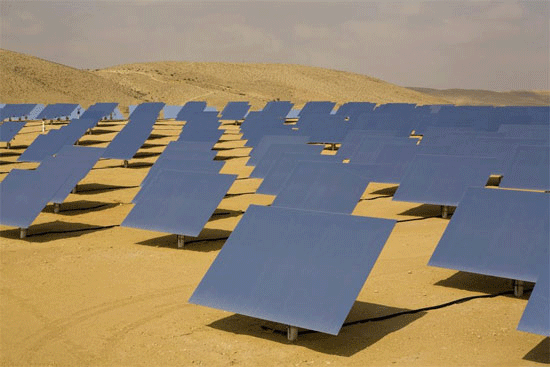 Renewable Energy Farms Spread Through California Deserts NewsWeek, BY ELIJAH WOLFSON / NOVEMBER 24, 2014 “…….. , part of the interconnected swatches of desert land in California that, combined, make up the largest wilderness area in the Lower 48. It’s also about to become host to the biggest renewable-energy projects in the world.
Already, 13 of them are built or on the way. There’s the Desert Sunlight Solar Farm, under construction just east of Joshua Tree National Park; its solar photovoltaic cells will cover over 4,000 acres of public land administered by the federal Bureau of Land Management (BLM). When completed in 2015 (assuming things go as planned), it is expected to peak at a nominal power of 550 megawatts—making it the most powerful solar farm on the planet. There’s also the McCoy Solar Energy Project, in the middle of the Mojave. When it’s done, it will be even bigger and more powerful than Desert Sunlight, covering 7,700 acres of BLM land and 470 acres of private land, and with an electrical production capacity of 750 megawatts.
Then there are the wind farms. These produce less power than their solar brethren and take up much more space. The Ocotillo Wind Energy Facility, for example, covers 12,436 acres at the edge of the Anza-Borrego Desert State Park, near the border with Mexico, and produces 315 megawatts of power……..
And these new wind and solar farms—cities, call them, since they aren’t like any farm you’ve seen—are only going to multiply in the coming years. The need for clean energy is expected to increase dramatically in the next decade, particularly after the U.S. and China recently announced a historic agreement to lower greenhouse gas emissions in their respective countries. At the core of the pact are two sets of commitments: The U.S. will lower emissions 26 to 28 percent by 2025 from the initial 2005 baselines, while China has agreed to set an emissions peak for 2030 and then commit to lowering emissions……….
It’s cheaper to have a big mass—having power all come from one source,” says Elkin. “But the advantages of having a more distributed rooftop-type solar is that you can provide the power generation really close to being used. It’s more efficient.” He says we are probably headed toward a mix, with “microgrids” providing neighborhoods with access to small, local solar farms.
Until then, though, achieving emissions reductions at the scale of what has been agreed to between the U.S. and China “is not going to happen without some level of large-scale renewable-energy development,” says Helen O’Shea, director of the National Resources Defense Council’s Western Renewable Energy Project.
And Michael Gerrard, director of the Sabin Center for Climate Change Law at Columbia University, says that if conservationists keep fighting that, they will be missing the forest for the trees. “We are facing a mass extinction,” he says. “The only pathway to solve that problem involves a massive increase in renewable energy. Unfortunately, many new renewable-energy facilities have been slowed down or stopped because of their adverse effects on certain species. I think we can no longer have the luxury of doing that.”ttp://www.newsweek.com/renewable-energy-farms-populate-california-286644
Google shows its ignorance about renewable energy
Why Google gave up on renewables (hint, they don’t understand energy), REneweconomy By Karel Beckman on 25 November 2014 The two scientists responsible for Google’s failed attempt to launch a renewable energy revolution have written an article explaining what, according to them, went wrong with their project. They have come to the conclusion that fighting climate change with today’s renewable energy technologies won’t work – but they present no evidence for it, writes Energy Post editor Karel Beckman.
Critics of renewable energy are having a field day in the blogosphere. It has now been proven beyond doubt, they cry, that “renewables simply won’t work”. Why not? Well, because Google says so.
Some years ago, in 2007, to be exact, Google embarked on an ambitious project to develop reneweable energy sources that would generate electricity more cheaply than coal-fired power. Google’s hope was that in this way the buildup of CO2 in the atmosphere could be halted and reversed. However, in 2011, after four years of trying, the company gave up the project, known as RE<C.
The two engineers who were responsbile for Google’s venture into renewables, Ross Koningstein and David Fork, have now written an article in which they try to explain what went wrong – and what lessons can be drawn from it……..they argue that renewables “won’t work” to effectively tackle climate change. They don’t say renewables won’t work, period. But even this first claim appears doubtful on the basis of the evidence offered in the article………
by 2011, they note, “it was clear that RE<C would not be able to deliver a technology that could compete economically with coal.”
Unfortunately, the reader has to take this assertion at face value. The authors do not cite any figures or published research. Nor do they make it clear whether these were all the “innovative technologies” they investigated or what they mean in the first place by “investigated”………..
They add this notable remark: “Let’s face it, businesses won’t make sacrifices and pay more for clean energy based on altruism alone. Instead, we need solutions that appeal to their profit motives.” Well, yes – unless of course we introduce regulations or put a price on carbon, for example, but such possibilities appear to lie outside the authors’ frame of reference.
The two Google-men have also come to the surprising – to them – discovery that in the electricity market “the value of generated electricity varies … depending on how easily it can be supplied to reliably meet local dmeand.” Thus, they write, dispatchable power can have added value to cover peak demand. Indeed. Distributed power, on the other hand, “can also be worth more as it avoids the costs and losses associated with transmission and distribution”.
These amazing insights into the nature of the electricity market have led them to a positive conclusion. Here, they write, “we see an apportunity for change. A distributed, dispatchable power source could prompt a switchover if it could undercut …end-user prices.” But, they add, “unfortunately, most of today’s clean generation sources can’t provide power that is both distributed and dispatchable. Solar panels, for example, can be put on every rooftop but can’t provide power if the sun isn’t shining.”
So what about solar PV-with-storage? Koningstein and Fork appear not to be aware that such a solution may be possible. Nor do they seem to have heard of microgrids or to have thought of a combination of solar and electric cars. They merely sigh that “if we invented a distributed, dispatchable power technology, it coud transform the energy marketplace and the roles by utilities and their customers”. They can’t think of any possible solution, though: we “don’t have the answers”. The technologies required to reverse climate change “haven’t been invented yet”, they write……..
what do Koningstein and Fork think that researchers in the energy sector are doing right now? Did they try to find out how much is being spent on cleantech research worldwide? Or what technologies are actually being developed? If so, they show no signs of it. Indeed, they seem to know very little about what’s going on in the energy sector. Perhaps it is too much expect Google to solve the world’s energy problems – they could search the internet a bit better. http://reneweconomy.com.au/2014/why-google-gave-up-on-renewables-hint-they-dont-understand-energy-12048
1 This Month



19 November – Webinar – The Reality of Reprocessing
Time: 11:00 AM Pacific Time (US & Canada) / 2:00 PM Eastern / 7:00 PM UK / 8:00 PM CET
Register for the Zoom Event Here



Shut down the radiation-damaged Heysham nuclear reactors now
To see nuclear-related stories in greater depth and intensity – go to https://nuclearinformation.wordpress.com

Say No to NASA’s Reckless Nuclear Reactor on the Moon
Say No to NASA’s Reckless Nuclear Reactor on the Moon
-
Archives
- November 2026 (32)
- October 2026 (302)
- September 2026 (339)
- August 2026 (330)
- July 2026 (355)
- June 2026 (287)
- May 2026 (306)
- April 2026 (356)
- March 2026 (251)
- February 2026 (267)
- January 2026 (308)
- December 2025 (358)
-
Categories
- 1
- 1 NUCLEAR ISSUES
- business and costs
- climate change
- culture and arts
- ENERGY
- environment
- health
- history
- indigenous issues
- Legal
- marketing of nuclear
- media
- opposition to nuclear
- PERSONAL STORIES
- politics
- politics international
- Religion and ethics
- safety
- secrets,lies and civil liberties
- spinbuster
- technology
- Uranium
- wastes
- weapons and war
- Women
- 2 WORLD
- ACTION
- AFRICA
- Atrocities
- AUSTRALIA
- Christina's notes
- Christina's themes
- culture and arts
- Events
- Fuk 2022
- Fuk 2023
- Fukushima 2017
- Fukushima 2018
- fukushima 2019
- Fukushima 2020
- Fukushima 2021
- general
- global warming
- Humour (God we need it)
- Nuclear
- RARE EARTHS
- Reference
- resources – print
- Resources -audiovicual
- Weekly Newsletter
- World
- World Nuclear
- YouTube
-
RSS
Entries RSS
Comments RSS

