2014 Renewable Energy Boom Driven by Solar Power
 Solar power drives renewable energy investment boom in 2014, Guardian, Damian Carrington, 10 Jan 15 Global clean energy investment leapt 16% in 2014 led by solar power surge in US and China – but Europe lags behind Global investment in clean energy jumped 16% in 2014, boosted by fast-growing solar power in the US and China. Solar, whose costs have plummeted in recent years, attracted over half the total funding for the first time.
The green energy market has been gloomy in recent years and the rise in investment is the first since 2011. But despite strong growth in most regions, only a series of large offshore wind farms stopped Europe going into reverse, while the Australian government’s antipathy to renewables saw investment there tumble by 35%.
The new figures, from Bloomberg New Energy Finance (BNEF), show $310bn (£205bn) was ploughed into green energy last year, just short of the record $317bn in 2011. However, as green energy gets ever cheaper, the money invested in 2014 bought almost double the clean electricity capacity than in 2011.
“The investment bounce back in 2014 exceeded our expectations,” said Michael Liebreich, chairman of BNEF’s advisory board. “Solar was the biggest single contributor, thanks to the huge improvements in its cost-competitiveness over the last five years.”…….
“The figures show that renewable energy is increasingly cost-competitive, with solar in particular rapidly approaching parity with fossil-fuel generation. They suggest also that investors are growing weary of increasingly volatile fossil fuel markets,” said Richard Black, director of the Energy and Climate Intelligence Unit.
“Some developing countries have increased low-carbon investment hugely – a staggering 88% in the case of Brazil – and there is a danger that the UK, with its restrictive planning regulations for renewables, will find itself increasingly swimming against the global tide,” Black said.
“It’s encouraging to see the smart money in the world’s economic powerhouses is betting on clean energy,” said Doug Parr, Greenpeace UK’s chief scientist. “The only disappointment is that, save for offshore wind, the UK and the EU are now lagging behind. For all the whinging about UK ‘going it alone’ on clean energy, it is increasingly clear that the bigger economic risk is being left behind as the low-carbon jobs go where political leaders show genuine commitment to a clean energy future.”http://www.theguardian.com/environment/2015/jan/09/solar-power-drives-renewable-energy-investment-boom-2014
Utah gets big solar power investment – Google and Prudential Capital Finance 104MW Solar Plant
 Google and Prudential Capital Finance 104MW Solar Plant in Utah http://www.solarnovus.com/google-and-prudential-capital-finance-104mw-solar-plant-in-utah_N8442.html 9 January 2015 Scatec Solar ASA, an integrated independent solar power producer, has entered into financing agreements totalling USD 157 million for construction of a 104 MW(dc) Red Hills solar power plant in Utah. When complete, the Red Hills solar project will be Scatec Solar’s largest developed and constructed project in North America.
Total investment for the plant is estimated at USD 188 million—with Google providing tax equity, Prudential Capital Group providing debt financing, and Scatec Solar providing sponsor equity. The power plant will be wholly-owned by a partnership jointly owned by Google and Scatec Solar, which structured and executed the financing for the project. Scatec Solar will manage and operate the plant when it goes into operation.
Google has signed agreements to fund over $1.5 billion in renewable energy investments across three continents with a total planned capacity of more than 2.5 GW (gigawatts).This agreement represents the 18th renewable energy investment project for Google and supports its continued push towards a clean, low carbon energy future.
Prudential Capital Group, a Prudential Financial asset management business, provided term financing for the project.
The Utah Red Hills Renewable Energy Park, set to be built on a site with excellent solar irradiation, will generate around 210 million kilowatt hours (kWh) of electricity per year, which will be fed into the grid under a twenty-year Power Purchase Agreement (PPA) with PacifiCorp’s Rocky Mountain Power, according to the utility’s obligation under the federal Public Utility Regulatory Policies Act. When operational by the end of 2015, the plant will be Utah’s largest solar energy generation facility, generating enough energy to power approximately 18,500 homes annually. Based on US Environmental Protection Agency estimates, it will produce enough renewable power to prevent nearly 145 thousand tons of carbon dioxide emissions annually—the equivalent to not burning 156 million pounds of coal each year.
The ground-mounted photovoltaic solar facility is being developed on approximately 650 acres of privately-owned land in Parowan, Utah, will deploy approximately 325,000 PV modules on a single-axis tracking system and will interconnect to an existing transmission line.
Scatec Solar is an integrated independent power producer, aiming to make solar a sustainable and affordable source of energy worldwide. Scatec Solar develops, builds, owns and operates solar power plants, and will in 2014 deliver power from 220 MW in the Czech Republic, South Africa and Rwanda. The company is in strong growth and has a solid pipeline of projects under development in Africa, US, Asia, Middle East and Europe. Scatec Solar is headquartered in Oslo, Norway and listed on the Oslo Stock Exchange under the ticker symbol ‘SSO’. – See more at: http://www.solarnovus.com/google-and-prudential-capital-finance-104mw-solar-plant-in-utah_N8442.html#sthash.YOfvBs2F.dpuf
Alaska’s Renewable Energy project recognised as awinner
Project review: 2014 CESA installations, Part I, Renewable Energy Focus 09 January 2015 Reg Tucker
Biennial program recognizes outstanding state and municipal programs that have accelerated the adoption of clean energy technologies. Part I of this series provides a sampling of a few case studies behind the award-winning projects and initiatives.
The Clean Energy States Alliance (CESA), a national, nonprofit coalition of public agencies working together to advance clean energy, recently announced the recipients of the 2014 State Leadership in Clean Energy Awards. According to CESA, the winning programs exemplify the ground-breaking work being done by states and municipalities in the arena of clean energy development and deployment.The programs nominated for these awards were submitted by state and municipal clean energy agencies from across the country. The entries were reviewed by a team of distinguished, independent judges and were scored based on public benefits and results, cost effectiveness, leadership and innovation and the ability to replicate.
- The Alaska Energy Authority and the Kodiak Energy Association for Kodiak, Alaska: A 99% Renewable Energy Community………
-
Project #1: Alaska Energy Authority/KEAAlaska’s Renewable Energy Fund, managed by the Alaska Energy Authority, has catalyzed a movement towards renewable energy across Alaska by funding 277 renewable energy grants totaling $250 million over the past seven years. With support from the Fund, strong local leadership, and hard work, the Kodiak Electric Association (KEA) has achieved more than 99 per cent renewable energy electric generation. KEA has developed a renewable energy grid that includes hydro power, wind, and battery storage technologies.Alaska’s Renewable Energy Fund has made it possible for communities and villages across the state to study their renewable energy resources, conduct proper engineering designs for those projects that are economically and technically feasible, and construct their projects for the greatest public benefit possible. In the case of Kodiak Electric, which serves about 6,300 people on Kodiak Island, prior to the Renewable Energy Fund’s start in 2008, KEA generated approximately 60 per cent of its electricity from hydro power and 40 per cent from diesel.
Through multiple successful applications to the Renewable Energy Fund, KEA was able to conduct feasibility studies, design, permit, and construct two phases of wind development, adding six 1.5MW turbines on Pillar Mountain, just above the City of Kodiak. During phase two of the project, KEA added two 1.5MW (1MWhr) battery storage systems that provide 30 to90 seconds of bridging power to allow ramping up of output of a nearby hydroelectric system at times when the wind output decreases rapidly.
The addition of the battery systems has allowed the wind to be used without curtailment, and it allows more water to be stored at the hydro facility during times when the wind blows. Additionally, and with the financial support of the Renewable Energy Fund, a third hydroelectric turbine was added to the existing Terror Lake powerhouse to increase output by an additional 13.8 MW. Since the end of 2013, KEA has been able to shut off the diesel generators and allow the battery/hydro mix to fulfill their spinning reserve requirement. They also have enough hydro redundancy to allow for maintenance of hydro turbines without burning diesel fuel to generate power. For the first nine months of 2014, KEA generated 99.7 per cent of its power from renewable energy, resulting in significantly lower energy costs for the community by reducing its diesel fuel purchases to nearly zero.
KEA estimates that it saved its small community about $13 million in reduced fuel costs through the end of 2013. Over $4 million per year is now saved by the community, to the benefit of residents, seafood processors, the Coast Guard Base, and all other electrical customers. It has also cut diesel emissions to zero except for a few hours per year, resulting in cleaner local air and dramatically reduced greenhouse gas emissions…………http://www.renewableenergyfocus.com/view/41059/project-review-2014-cesa-installations-part-i/
Top renewable energy investment trends for 2015

 UK watch: Tracking renewable energy investment trends, Renewable Energy Focus 05 January 2015 KATHARINE EARLEY As we head into 2015, Renewable Energy Focus contributor Katharine Earley speaks to Triodos Bank about investment trends, including crowd-funding, community-owned energy and businesses opting for on-site energy generation.
With renewable energy set to be one of the key winners to emerge from the EU’s new three-year, £250bn investment plan, 2015 could be a promising year for renewables. We caught up with ethical investment pioneer Triodos Bank to understand what trends it foresees for the year ahead.
“We could see some real strides forward for renewable energy in Europe, particularly if the EU’s investment plan focuses on grid infrastructure,” Matthew Clayton, executive director of Triodos Renewables, explained. “As we move from centralised power plants to smaller, distributed energy generation, government investment could really help to address this important systems issue. Coupled with private investment in energy efficiency and generation, such a move could lead to more rapid progress.”
For Triodos’ part, its renewables company, owned by some 5,000 shareholders, operates 11 onshore wind and hydroelectric projects across the UK with a capacity of 53MW, enough electricity to power 34,200 homes. Founded in 1994, the company has seen a 35% increase in shareholders and a 50% increase in generating capacity in the past three years. Its projects generated more than 100m kWh of clean electricity in 2013. Having already raised £2m from its latest share offer, it is now extending the offer until 30th January 2015.
So what does Clayton see as the reasons for this prosperity?
“Investor confidence has grown as the nature of the projects become more robust,” he explained. “The technology is proven and is also decreasing gradually in price. Interestingly, we’re seeing interest from a wide range of investors, from individuals through to institutional investors. And we want to make investing in renewables accessible – that’s why we’re inviting minimum investments of £50 through our current share offer………..
1. More projects will be developed to supply a business
“We’ll see more projects developed with a direct supply of renewable electricity to a business,” Bazin stated. “This helps the developer to achieve a better price for the power and reduces electricity losses during transmission. Meanwhile, the business purchasing the energy benefits from greater security of supply, lower cost compared to using major utilities and a boost to its efforts to reduce its environmental footprint.”
According to Bazin, this direct supply of electricity will be a key component of roof-mounted solar projects, which are high on the UK government’s agenda in 2015. This type of direct supply model also helps to raise awareness of the positive impact of renewable energy among building users, he confirms.
2. Community-owned energy will gather momentum
In 2014 Scotland had a massive success in renewable energy, especially wind power

 Scotland Saw A “Massive Year” Of Renewable Energy http://cleantechnica.com/2015/01/06/scotland-saw-massive-year-renewable-energy/ January 6th, 2015 by Joshua S Hill That Scotland saw impressive records broken last year is of no real surprise to those who followed news of their monthly wind energy generation numbers. New numbers published early January have only confirmed that sense of record breaking, with another record month and a “massive year” in total.
WWF Scotland provided the information, by way of WeatherEnergy, and found that for December, wind energy provided 164% of Scottish household electrical needs — a massive record, well up on what had already seemed to be a mammoth record, set in October, when wind energy provided 126% (though, as it turns out, before Scotland’s performance was brought to my attention, they hit 163% in February). Specifically, wind energy delivered 1,279,150MWh of electricity to the National Grid, enough for 3.96 million homes.
In fact, wind energy generated enough energy to supply over 100% of Scottish household needs on 25 out of the 31 days of December.
“December turned out to a record-breaking month for wind power, with enough green energy generated to supply a record 164% of Scottish households with the electricity they need,” said WWF Scotland’s director Lang Banks. “Even on calmer days, wind still supplied the equivalent of over a third of electricity needs of every home.”
For 2014 as a whole, wind energy delivered an estimated 8,958,130MWh of electricity to the National Grid, or an average of 746,510MWh each month. That’s enough to supply the electrical needs of 98% of all Scottish households.
Without doubt, 2014 was a massive year for renewables, with wind turbines and solar panels helping to ensure millions of tonnes of climate-wreaking carbon emissions were avoided,” added Banks. “With 2015 being a critical year for addressing climate change internationally, it’s vital that Scotland continues to press ahead with plans to harness even greater amounts of clean energy.”
Solar power did relatively well throughout the year for Scotland, though it’s hard to come close to the country’s wind energy industry. Homes fitted with solar PV panels generated enough energy to supply homes in Aberdeen, Edinburgh, Glasgow, and Inverness with an estimated 100% or more of their electricity needs throughout June and July, and 60% or more across the same four cities during March, April, May, August, and September.
“For 2014 as a whole, on average, wind power generated enough to supply the electrical needs of 98% of Scottish households, with six months where the amount was greater that 100%,” Banks continued. “And, in the tens of thousands of Scottish households that have installed solar panels saw them meet two-thirds or more of their electricity or hot water needs from the sun during several months of the year, helping those homes to reduce their reliance on coal, gas, or even oil.”
Karin Robinson of WeatherEnergy also commented on the remarkable year-that-was for Scotland: “We’re famous in the UK for our obsession with the weather, but how often do we see it in a positive light? At a time when the world is desperately looking for low-carbon sources of energy, the data show that clean renewables are already playing a significant and growing role in Scotland’s, and the rest of the UK’s, overall energy mix. We just need to blow their trumpet a bit more.
The news came just a few days before WWF published another report, this time based upon technical analysis conducted by international energy and engineering consultancy DNV GL, which found that Scotland could be a renewable energy powerhouse by 2030, completely decarbonised and delivering renewable energy enough for all the country’s electricity needs.
“It’s great to see the vision for a secure, renewables-based future for Scotland independently tested and proven,” said WWF Scotland’s Climate and Energy Policy Officer, Gina Hanrahan. “It’s clear that Scotland doesn’t have to generate electricity from coal, gas or nuclear to ensure security of supply.”
Keep up to date with all the hottest cleantech news by subscribing to our (free) cleantech newsletter, or keep an eye on sector-specific news by getting our (also free) solar energy newsletter, electric vehicle newsletter, or wind energy newsletter.
Egypt’s New and Renewable Energy Authority (NREA) selects 67 companies to develop 4.3 GW project
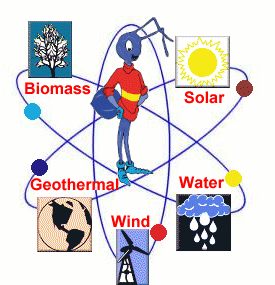 Huge interest in Egyptian renewable energy tender
05. JANUARY 2015 | GLOBAL PV MARKETS, APPLICATIONS & INSTALLATIONS | BY: JONATHAN GIFFORD
The chairman of Egypt’s New and Renewable Energy Authority (NREA) has revealed that 67 companies have been selected to take part in developing 4.3 GW of renewable energy projects in the country. The successful companies were chosen from 177 applicants. http://www.pv-magazine.com/news/details/beitrag/huge-interest-in-egyptian-renewable-energy-tender_100017661/#ixzz3OAPGU0b4
USA’s most ambitious renewable energy target proposed by California’s Governor, Jerry Brown
California Governor Proposes Most Ambitious Renewable Energy Target In U.S. DeSmogBlog MIKE GAWORECKI 6 JAN 15 California Governor Jerry Brown used the occasion of his fourth inaugural address to propose an ambitious new clean energy target for the state: 50% renewable energy by 2030.
“We are at a crossroads,” Brown said in announcing the proposal, according to Climate Progress. “The challenge is to build for the future, not steal from it, to live within our means and to keep California ever golden and creative.”
Already the leader in installed solar capacity and third when it comes to wind power, the Golden State had previously adopted a Renewable Portfolio Standard mandate to procure 33% of its electricity from renewable sources by 2020, a goal it was easily on pace to meet.
Environmentalists were quick to applaud Governor Brown’s 50% by 2030 proposal, which would give California the most ambitious renewable energy target of any US state, eclipsing Hawaii’s 40% by 2030 target.
But given the current growth rate of California’s renewable sector, even 50% by 2030 might not end up being that ambitious, according to Abigail Dillen, Vice President of Climate and Energy for Earthjustice.
“Indeed, projecting the current growth in renewables to the following decade is likely conservative given that the cost of solar and other renewable resources is expected to continue to decrease. So 50% renewable is achievable and should be seen as the bare minimum for 2030,” Dillen told DeSmog………http://www.desmogblog.com/2015/01/06/california-sets-ambitious-new-renewable-energy-target
Pakistan makes a big move towards renewable energy with feed in solar tariffs

 Pakistan to pull solar energy into national power grid – TRFN BY AAMIR SAEED REPORTING BY AAMIR SAEED; EDITING BY LAURIE GOERING Tue Jan 6, 2015 ISLAMABAD, (Thomson Reuters Foundation) – Amid a worsening energy crisis, Pakistan has approved the use of grid-connected solar energy, rooftop solar installations and mortgage financing for home solar panels to boost uptake of clean energy in the country.
The government has also reversed course and eliminated a 32.5 percent tax imposed on imported solar equipment in the country’s 2014-2015 budget. The reversal aims to bring down the cost of installing solar panels.
The approval of net-metering – which allows solar panel purchasers to sell power they produce to the national grid – is a major breakthrough that could spur use of solar energy and help Pakistan’s government cut power shortages in the long run, said Asjad Imtiaz Ali, chief executive officer of the Alternative EnergyDevelopment Board, a public organisation.
“The initiative will help scale up demand for solar energy acrossPakistan,” he said, “and we hope the increased demand will also result in sufficient decreases in the price of solar equipment.”
Ali said the government decided to cut newly imposed taxes on the import of solar panels following pressure from business owners, the public and media.
And the decision to allow solar generators to sell their excess generating capacity means “consumers can now install rooftop solar systems and sell the extra energy to the national grid,” he said……….
Qamar-uz-Zaman, an expert on climate change with Lead Pakistan, a non-profit organisation in Islamabad, predicted net-metering and private sector financing for solar installation would revolutionise the use of renewable energy in Pakistan, as it has done for many other developed and developing countries.
“Pakistan can cut carbon emissions to a significant extent and access international climate financing by promoting solar energy, besides overcoming its energy crisis,” he said. http://www.reuters.com/article/2015/01/06/pakistan-solar-idUSL6N0UL15J20150106
Middle East’s first GW-scale tender for solar power swamped with applicants
Solar twice oversubscribed in Middle East’s first GW-scale tender http://www.pv-tech.org/news/solar_twice_over_subscribed_in_middle_easts_first_gw_scale_tender 5 Jan 15 Egypt’s recent renewable energy tender was twice oversubscribed for solar projects, it has been revealed.
The Egyptian government is expected to reveal the full list of pre-approved projects in the region’s first gigawatt-scale tender later today.
The law firm Eversheds hosted an event in December with the chairman of Egypt’s New and Renewable Energy Authority and the managing director of the electricity regulator, EgyptERA. The subject of the country’s 4.3GW feed-in tariff programme was raised. The scheme includes 2GW of large-scale solar, 300MW of PV projects under 500kW and 2GW of wind.
Michelle T Davies, head of Eversheds’ clean energy and sustainability group, spoke to PV Tech after the event: “They explained more about the programme during that day. They had 178 projects apply for the FiT and they have pre-qualified 67. Forty of those are solar. The rest are wind.
“Solar was more than double subscribed and wind was 56% subscribed. So the wind tender will go out again,” she said, adding that the first power purchase agreements are likely to be awarded in the first half of 2015.
PV plants between 500kW and 20MW will receive a rate of US$0.136/kWh. Project between 20 and 50MW will be offered US$0.1434/kWh. Contracts will be offered for a 25-year term.
Chna’s revolutionary programme for renewable energy
 China as a model renewable energy economy Ft.com By Li Hejun, China New Energy Chamber of Commerce and Hanergy Holding Group 31 Dec 14 Almost 200 governments met in Peru this month to hammer out a first draft of a global deal to cut emissions, ahead of a new round of climate talks next year in Paris. If the world is to arrest climate change, global economies need to embrace renewable energy. Those looking for a model of how this might be done should consider a possibly surprising source: China.
It has been little noticed by the outside world, but in China a technological revolution that will result in huge gains in efficiency and new applications for renewable energy has already begun…….
China’s renewable energy goals are not simply hot air. The country’s leadership recognises that China must break its dependency on coal if it is to satisfy the surging power demands of a growing middle class and an expanding economy without blanketing the country in smog. China’s renewable energy goals are also necessary for the country’s long-term energy security. Neither coal, shale gas nor any other fossil fuel can secure our energy future………
The new goals will trigger a huge investment push towards renewables. The scale of the new generating capacity to be installed in the next decade will reshape China’s renewable energy market, weeding out weak companies as the government gradually phases out subsidies, and driving gains in efficiency and technological innovation as the remaining industry players compete for market share.
I believe that solar will be at the forefront of this technological advance. Solar energy is fast becoming more affordable. The cost for solar power generation is now 50 per cent lower than it was three years ago. China’s cost of solar power generation has fallen to below Rmb1 per kWh and if we continue that trend, I predict that within 3-5 years the generation cost of solar cells will approach that of coal-fired power………….. http://blogs.ft.com/beyond-brics/2014/12/31/guest-post-china-as-a-model-renewable-energy-economy/
New solar farms for Pacific Island countries
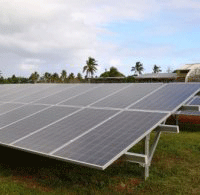 More Solar For Pacific Island Nationshttp://www.energymatters.com.au/renewable-news/pacific-solar-masdar-em4624/ December 31, 2014 Energy Matters
The solar power projects will collectively have 1.8 megawatts capacity and their output will translate to fuel savings worth US$2 million per year. Many island nations in the Pacific rely primarily on diesel imports for electricity generation. It’s expensive, carbon intensive and creates dependence on external suppliers for what is a critical service.
Pacific Island nations can spend 10 percent of GDP or more on petroleum imports, so renewables can also free up government budgets for infrastructure investments
Completion of the solar farms is expected by the second half of 2015.
The projects will be constructed by Masdar, a subsidiary of the Abu Dhabi Government-owned Mubadala Development Company.
“Access to clean energy is a pathway toward economic and social development,” said Dr. Ahmad Belhoul, CEO of Masdar. “For Pacific islands, which rely on imported fuel for electricity generation, renewable energy provides a viable alternative. In fact, wind and solar power projects deliver immediate savings, while underpinning long-term energy security.”
Masdar has already been active in the region; building the La’a Lahi ‘Big Sun’ 512kW solar farm in Tonga and Samoa’s first wind farm, which was commissioned in August this year. Both of these projects were also financed through the UAE-Pacific Partnership Fund.
The 550kW wind farm in Samoa is located on the island of Upolu; which is home to nearly 75 percent of the population. The cyclone-proof facility will generate 1,500 MWh of power per year
The UAE-Pacific Partnership Fund was launched in March last year and has so far helped fund 2.8 megawatts of renewable energy capacity across six countries in the region.
“The UAE-Pacific Partnership Fund demonstrates the tangible benefits that renewable energy offers all developing countries,” said His Excellency Mohammed Saif Al Suwaidi, director-general of the Abu Dhabi Fund for Development. “Today, renewables are cost-effective and offer real solutions for growth across the Pacific.”
Falling oil prices will not be a handicap to renewable eneergy
Renewables need not fear falling oil prices, The National Business, Robin Mills January 4, 2015 “The use of solar energy has not been opened up because the oil industry does not own the sun,” said the US consumer advocate Ralph Nader and one-time presidential candidate back in 1980. Now, falling prices for both oil and solar panels may put his theory to the test.
Brent oil prices reached US$56 per barrel on Friday. By comparison, Acwa Power’s astonishingly low bid for the second phase of the Sheikh Mohammed bin Rashid solar park in Dubai would equate to a conventional power plant burning oil priced at less than $20 per barrel.
Renewable energy in the right locations – solar power in the Middle East, and onshore wind in north-west Europe, the United States’ Midwest or the Red Sea coast – has already won the cost competition with oil. So the falling oil price makes no difference to the uptake of renewable energy. Indeed, if a lower oil price spurs economic growth, it might even lead to more installation of renewable energy, in absolute if not relative terms.
Oil produces less than 5 per cent of electricity globally, a share that is rapidly falling. Even at current prices, oil is simply too expensive to burn for power – compared to coal and gas. Those other two fossil fuels are the real alternatives to renewable energy………
the real impact of cheap oil and gas on the viability of renewable energy is psychological. ……..
Now, it is clear that we do not need renewable energy urgently to compensate for resource depletion, but the environmental need – to reduce greenhouse gas emissions – is more pressing than ever.
Instead of seeing falling fossil fuel prices as an excuse to cut back on renewables support, it may actually be an opportunity to make renewable targets more aggressive, without raising overall costs to consumers. But renewables subsidies need to be targeted away from deploying mature systems that are already commercial, and towards encouraging new technologies.
So what do renewable energy developers have to do to stay competitive in a world of falling fossil fuel prices? Continuing to bring down costs is the obvious key, especially for less favourable locations such as offshore wind, low-wind locations, and less sunny regions.
To make further inroads into fossil fuel markets, renewable energy needs to move into providing heat for homes and industrial processes, cooling and water desalination, either directly or via electricity.
Oil remains uniquely valuable in transport, which is why it still commands a premium price. There is as yet no realistic alternative to oil for aviation, and large-scale use of biofuels is environmentally problematic. The development of a truly competitive electric car would allow renewable energy ultimately to power ground transport.
Even without owning the sun, the oil and gas industry is laying down a new economic and psychological challenge. But, unlike after 1980, lower oil prices should not mean another lost decade for renewable energy.
Robin Mills is head of consulting at Manaar Energy, and author of The Myth of the Oil Crisis. http://www.thenational.ae/business/energy/renewables-need-not-fear-falling-oil-prices
China’s distributed power grid will revolutionise renewable energy
 China as a model renewable energy economy Ft.com By Li Hejun, China New Energy Chamber of Commerce and Hanergy Holding Group 31 Dec 14 “……..Even more exciting than falling costs are the new ways in which China will use and transmit power. China is now intent on developing a distributed power grid that will rely on the interconnection of thousands of rooftop and building-integrated solar installations generating power close to the point of consumption. This is a drastic departure from the current centralised power system that relies on goliath, coal-burning power plants and costly, inefficient power transmission over hundreds, or even thousands of kilometres. This new, smart grid will help eliminate pollution, slash costs, and increase reliability.
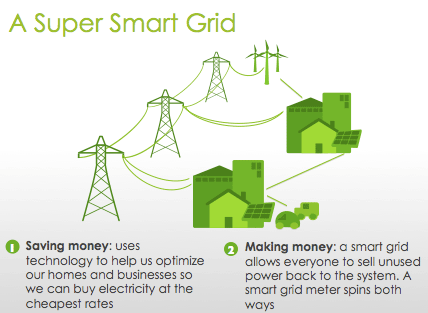
In addition to making the distributed grid possible, new forms of solar technology are ushering in an era of mobile energy in which customers can take power with them wherever they go.
At present, around 90 per cent of the world’s solar power output is geared towards first-generation crystalline silicon panels, which for a long time were the most efficient technology available. But traditional silicon panels are hard, opaque and heavy, while thin film solar technology can be can be lightweight, flexible, and translucent, making it ideal for a wide variety of applications, from curved automobile rooftops and building integration to consumer clothing and portable power stations.
In recent years, thin-film technology has caught up with, and even surpassed, crystalline silicon in terms of both conversion efficiency and cost. Furthermore, producing thin-film cells requires just a fraction of the material and energy necessary to make crystalline silicon, conserving resources, cutting costs, and reducing pollution.
In the coming years, technologies will continue to improve, and prices will continue to fall. Two of the most promising technologies now are solar cells made from CIGS (Copper, Indium, Gallium, Selenide) and those from GaAs (Gallium-Arsenide), with maximum conversion efficiencies topping 20 percent, and 30 percent, respectively. As these are further developed and brought to market on a mass scale, solar panels will transform into something capable of being integrated into nearly every fabric, product, and structure at a reasonable cost……..
Li Hejun is Director of the China New Energy Chamber of Commerce, and CEO of multinational clean energy company Hanergy Holding Group. http://blogs.ft.com/beyond-brics/2014/12/31/guest-post-china-as-a-model-renewable-energy-economy/
Economically, closure of Vermont Nuclear Plant points to the coming transformation of USA’s electricity system
 Even optimistic projections of the cost of building new nuclear reactors leaves them four times as costly as energy efficiency and twice as costly as wind and gas. Many analysts believe that solar power will be significantly less costly than nuclear in the next decade. Moreover, nuclear power never lives up to the optimistic cost projections of its boosters. Reactors under construction in the U.S. and Europe are way behind schedule and over budget.
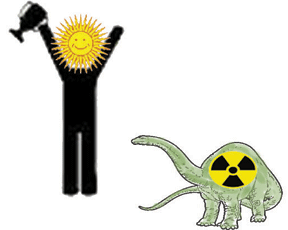 The problem with new reactor construction costs is well known, but the really stunning development is the problem that nuclear power has in terms of operating costs
the “dinosaurs” in the electricity sector have enough political clout to slow or prevent the change in the environment. Nuclear power is a major obstacle, demonstrated by its steadfast opposition to and an all-out attack on renewables and efficiency. Shuttering old, uneconomic reactors like Vermont Yankee is important not only because it removes an economic obstacle to change, but also because it shows the political will to transform America’s electricity system.
Why Closing Vermont Yankee Won’t Raise New England’s Power Bills Forbes Staff , Contributor Mark Cooper 31 Dec 14 Mr. Cooper is a senior fellow for economic analysis at Vermont Law School’s Institute for Energy and the Environment. Critics of the closing of the Vermont Yankee nuclear reactor have forecast a 40 percent jump in New England winter heating bills as a result of the shutdown. The facts suggest they have it wrong in more ways than one. Continue reading
Grim year ahead for nuclear industry, with ever cheaper renewables and climate action
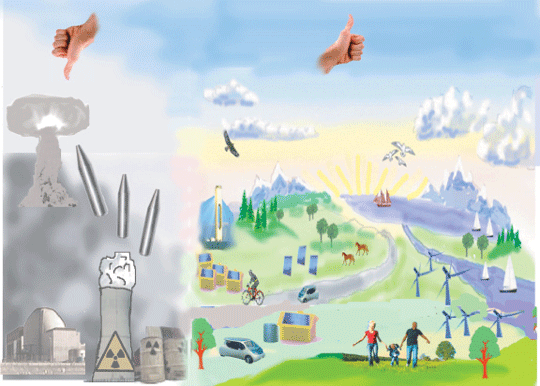 Nuclear faces tough 2015 as renewables growth soars RTCC Responding to Climate Change 31 December 2014, Governments are still spending billions on nuclear research, but it looks like being an unhappy new year for the industry By Paul Brown
With nuclear power falling ever further behind renewables as a global energy source, and as the price of oil and gas falls, the future of the industry in 2015 and beyond looks bleak.
Renewables now supply 22% of global electricity and nuclear only 11% − a share that is gradually falling as old plants close and fewer new ones are commissioned.
New large-scale installations of wind and solar power arrays continue to surge across the world. Countries without full grids and power outages, such as India, increasingly find that wind and solar are quick and easy ways to bring electricity to people who have previously had no supply.
Developed countries, meanwhile, faced with reducing carbon dioxide emissions, find that the cost of both these renewable technologies is coming down substantially. Subsidies for wind and solar are being reduced and, in some cases, will disappear altogether in the next 10 years.
Speed of installation
The other advantage that renewables have is speed of installation. Solar panels, once manufactured, can be installed on a rooftop and be in operation in a single day. Wind turbines can be put up in a week.
Nuclear power, on the other hand, continues to get more expensive. In China and Russia, costs are not transparent, and even in democracies they hard to pin down. But it is clear that they are rising dramatically…………
a drawback is the price tag of around $3 billion dollars. Both the US and UK are supporting private firms in research and development, but commercial operation is a long way off.
Whether a small nuclear power station would be any more welcomed than a wind or solar farm to provide power in a neighbourhood is a question still to be tested.
Nuclear enthusiasts − and there are still many in the political and scientific world − continue to work on fast breeder reactors, fusion and thorium reactors, heavily supported by governments who still believe that one day the technology will be the source of cheap and unlimited power. But, so far, that remains a distant dream.
In the meantime, investors are increasingly sceptical about putting their money into nuclear − whereas renewables promise an increasingly rapid return on investment, and may get a further boost if the governments of the world finally take climate change seriously. http://www.rtcc.org/2014/12/31/nuclear-faces-tough-2015-as-renewables-growth-soars/#sthash.GPucWfk6.dpuf
1 This Month
26 September – International Day for the Total Elimination of Nuclear Weapons





PLEASE OPPOSE HR 8255 AND S.3639 – bills would accelerate satellite deployment, with no environmental review or safeguards – https://ncstd5li.quorum.us/campaign/169331/
To see nuclear-related stories in greater depth and intensity – go to https://nuclearinformation.wordpress.com
-
Archives
- September 2026 (290)
- August 2026 (330)
- July 2026 (355)
- June 2026 (287)
- May 2026 (306)
- April 2026 (356)
- March 2026 (251)
- February 2026 (267)
- January 2026 (308)
- December 2025 (358)
- November 2025 (359)
- October 2025 (375)
-
Categories
- 1
- 1 NUCLEAR ISSUES
- business and costs
- climate change
- culture and arts
- ENERGY
- environment
- health
- history
- indigenous issues
- Legal
- marketing of nuclear
- media
- opposition to nuclear
- PERSONAL STORIES
- politics
- politics international
- Religion and ethics
- safety
- secrets,lies and civil liberties
- spinbuster
- technology
- Uranium
- wastes
- weapons and war
- Women
- 2 WORLD
- ACTION
- AFRICA
- Atrocities
- AUSTRALIA
- Christina's notes
- Christina's themes
- culture and arts
- Events
- Fuk 2022
- Fuk 2023
- Fukushima 2017
- Fukushima 2018
- fukushima 2019
- Fukushima 2020
- Fukushima 2021
- general
- global warming
- Humour (God we need it)
- Nuclear
- RARE EARTHS
- Reference
- resources – print
- Resources -audiovicual
- Weekly Newsletter
- World
- World Nuclear
- YouTube
-
RSS
Entries RSS
Comments RSS

