New solar farms for Pacific Island countries
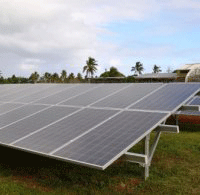 More Solar For Pacific Island Nationshttp://www.energymatters.com.au/renewable-news/pacific-solar-masdar-em4624/ December 31, 2014 Energy Matters
The solar power projects will collectively have 1.8 megawatts capacity and their output will translate to fuel savings worth US$2 million per year. Many island nations in the Pacific rely primarily on diesel imports for electricity generation. It’s expensive, carbon intensive and creates dependence on external suppliers for what is a critical service.
Pacific Island nations can spend 10 percent of GDP or more on petroleum imports, so renewables can also free up government budgets for infrastructure investments
Completion of the solar farms is expected by the second half of 2015.
The projects will be constructed by Masdar, a subsidiary of the Abu Dhabi Government-owned Mubadala Development Company.
“Access to clean energy is a pathway toward economic and social development,” said Dr. Ahmad Belhoul, CEO of Masdar. “For Pacific islands, which rely on imported fuel for electricity generation, renewable energy provides a viable alternative. In fact, wind and solar power projects deliver immediate savings, while underpinning long-term energy security.”
Masdar has already been active in the region; building the La’a Lahi ‘Big Sun’ 512kW solar farm in Tonga and Samoa’s first wind farm, which was commissioned in August this year. Both of these projects were also financed through the UAE-Pacific Partnership Fund.
The 550kW wind farm in Samoa is located on the island of Upolu; which is home to nearly 75 percent of the population. The cyclone-proof facility will generate 1,500 MWh of power per year
The UAE-Pacific Partnership Fund was launched in March last year and has so far helped fund 2.8 megawatts of renewable energy capacity across six countries in the region.
“The UAE-Pacific Partnership Fund demonstrates the tangible benefits that renewable energy offers all developing countries,” said His Excellency Mohammed Saif Al Suwaidi, director-general of the Abu Dhabi Fund for Development. “Today, renewables are cost-effective and offer real solutions for growth across the Pacific.”
Falling oil prices will not be a handicap to renewable eneergy
Renewables need not fear falling oil prices, The National Business, Robin Mills January 4, 2015 “The use of solar energy has not been opened up because the oil industry does not own the sun,” said the US consumer advocate Ralph Nader and one-time presidential candidate back in 1980. Now, falling prices for both oil and solar panels may put his theory to the test.
Brent oil prices reached US$56 per barrel on Friday. By comparison, Acwa Power’s astonishingly low bid for the second phase of the Sheikh Mohammed bin Rashid solar park in Dubai would equate to a conventional power plant burning oil priced at less than $20 per barrel.
Renewable energy in the right locations – solar power in the Middle East, and onshore wind in north-west Europe, the United States’ Midwest or the Red Sea coast – has already won the cost competition with oil. So the falling oil price makes no difference to the uptake of renewable energy. Indeed, if a lower oil price spurs economic growth, it might even lead to more installation of renewable energy, in absolute if not relative terms.
Oil produces less than 5 per cent of electricity globally, a share that is rapidly falling. Even at current prices, oil is simply too expensive to burn for power – compared to coal and gas. Those other two fossil fuels are the real alternatives to renewable energy………
the real impact of cheap oil and gas on the viability of renewable energy is psychological. ……..
Now, it is clear that we do not need renewable energy urgently to compensate for resource depletion, but the environmental need – to reduce greenhouse gas emissions – is more pressing than ever.
Instead of seeing falling fossil fuel prices as an excuse to cut back on renewables support, it may actually be an opportunity to make renewable targets more aggressive, without raising overall costs to consumers. But renewables subsidies need to be targeted away from deploying mature systems that are already commercial, and towards encouraging new technologies.
So what do renewable energy developers have to do to stay competitive in a world of falling fossil fuel prices? Continuing to bring down costs is the obvious key, especially for less favourable locations such as offshore wind, low-wind locations, and less sunny regions.
To make further inroads into fossil fuel markets, renewable energy needs to move into providing heat for homes and industrial processes, cooling and water desalination, either directly or via electricity.
Oil remains uniquely valuable in transport, which is why it still commands a premium price. There is as yet no realistic alternative to oil for aviation, and large-scale use of biofuels is environmentally problematic. The development of a truly competitive electric car would allow renewable energy ultimately to power ground transport.
Even without owning the sun, the oil and gas industry is laying down a new economic and psychological challenge. But, unlike after 1980, lower oil prices should not mean another lost decade for renewable energy.
Robin Mills is head of consulting at Manaar Energy, and author of The Myth of the Oil Crisis. http://www.thenational.ae/business/energy/renewables-need-not-fear-falling-oil-prices
China’s distributed power grid will revolutionise renewable energy
 China as a model renewable energy economy Ft.com By Li Hejun, China New Energy Chamber of Commerce and Hanergy Holding Group 31 Dec 14 “……..Even more exciting than falling costs are the new ways in which China will use and transmit power. China is now intent on developing a distributed power grid that will rely on the interconnection of thousands of rooftop and building-integrated solar installations generating power close to the point of consumption. This is a drastic departure from the current centralised power system that relies on goliath, coal-burning power plants and costly, inefficient power transmission over hundreds, or even thousands of kilometres. This new, smart grid will help eliminate pollution, slash costs, and increase reliability.
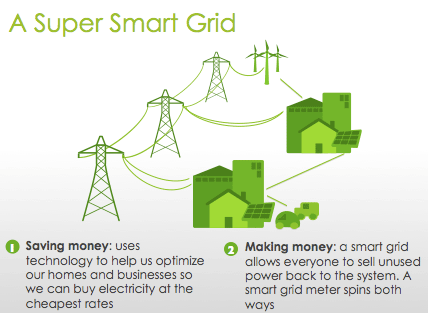
In addition to making the distributed grid possible, new forms of solar technology are ushering in an era of mobile energy in which customers can take power with them wherever they go.
At present, around 90 per cent of the world’s solar power output is geared towards first-generation crystalline silicon panels, which for a long time were the most efficient technology available. But traditional silicon panels are hard, opaque and heavy, while thin film solar technology can be can be lightweight, flexible, and translucent, making it ideal for a wide variety of applications, from curved automobile rooftops and building integration to consumer clothing and portable power stations.
In recent years, thin-film technology has caught up with, and even surpassed, crystalline silicon in terms of both conversion efficiency and cost. Furthermore, producing thin-film cells requires just a fraction of the material and energy necessary to make crystalline silicon, conserving resources, cutting costs, and reducing pollution.
In the coming years, technologies will continue to improve, and prices will continue to fall. Two of the most promising technologies now are solar cells made from CIGS (Copper, Indium, Gallium, Selenide) and those from GaAs (Gallium-Arsenide), with maximum conversion efficiencies topping 20 percent, and 30 percent, respectively. As these are further developed and brought to market on a mass scale, solar panels will transform into something capable of being integrated into nearly every fabric, product, and structure at a reasonable cost……..
Li Hejun is Director of the China New Energy Chamber of Commerce, and CEO of multinational clean energy company Hanergy Holding Group. http://blogs.ft.com/beyond-brics/2014/12/31/guest-post-china-as-a-model-renewable-energy-economy/
Economically, closure of Vermont Nuclear Plant points to the coming transformation of USA’s electricity system
 Even optimistic projections of the cost of building new nuclear reactors leaves them four times as costly as energy efficiency and twice as costly as wind and gas. Many analysts believe that solar power will be significantly less costly than nuclear in the next decade. Moreover, nuclear power never lives up to the optimistic cost projections of its boosters. Reactors under construction in the U.S. and Europe are way behind schedule and over budget.
 The problem with new reactor construction costs is well known, but the really stunning development is the problem that nuclear power has in terms of operating costs
the “dinosaurs” in the electricity sector have enough political clout to slow or prevent the change in the environment. Nuclear power is a major obstacle, demonstrated by its steadfast opposition to and an all-out attack on renewables and efficiency. Shuttering old, uneconomic reactors like Vermont Yankee is important not only because it removes an economic obstacle to change, but also because it shows the political will to transform America’s electricity system.
Why Closing Vermont Yankee Won’t Raise New England’s Power Bills Forbes Staff , Contributor Mark Cooper 31 Dec 14 Mr. Cooper is a senior fellow for economic analysis at Vermont Law School’s Institute for Energy and the Environment. Critics of the closing of the Vermont Yankee nuclear reactor have forecast a 40 percent jump in New England winter heating bills as a result of the shutdown. The facts suggest they have it wrong in more ways than one. Continue reading
Grim year ahead for nuclear industry, with ever cheaper renewables and climate action
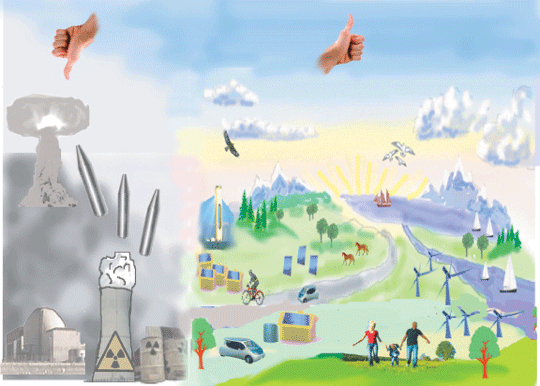 Nuclear faces tough 2015 as renewables growth soars RTCC Responding to Climate Change 31 December 2014, Governments are still spending billions on nuclear research, but it looks like being an unhappy new year for the industry By Paul Brown
With nuclear power falling ever further behind renewables as a global energy source, and as the price of oil and gas falls, the future of the industry in 2015 and beyond looks bleak.
Renewables now supply 22% of global electricity and nuclear only 11% − a share that is gradually falling as old plants close and fewer new ones are commissioned.
New large-scale installations of wind and solar power arrays continue to surge across the world. Countries without full grids and power outages, such as India, increasingly find that wind and solar are quick and easy ways to bring electricity to people who have previously had no supply.
Developed countries, meanwhile, faced with reducing carbon dioxide emissions, find that the cost of both these renewable technologies is coming down substantially. Subsidies for wind and solar are being reduced and, in some cases, will disappear altogether in the next 10 years.
Speed of installation
The other advantage that renewables have is speed of installation. Solar panels, once manufactured, can be installed on a rooftop and be in operation in a single day. Wind turbines can be put up in a week.
Nuclear power, on the other hand, continues to get more expensive. In China and Russia, costs are not transparent, and even in democracies they hard to pin down. But it is clear that they are rising dramatically…………
a drawback is the price tag of around $3 billion dollars. Both the US and UK are supporting private firms in research and development, but commercial operation is a long way off.
Whether a small nuclear power station would be any more welcomed than a wind or solar farm to provide power in a neighbourhood is a question still to be tested.
Nuclear enthusiasts − and there are still many in the political and scientific world − continue to work on fast breeder reactors, fusion and thorium reactors, heavily supported by governments who still believe that one day the technology will be the source of cheap and unlimited power. But, so far, that remains a distant dream.
In the meantime, investors are increasingly sceptical about putting their money into nuclear − whereas renewables promise an increasingly rapid return on investment, and may get a further boost if the governments of the world finally take climate change seriously. http://www.rtcc.org/2014/12/31/nuclear-faces-tough-2015-as-renewables-growth-soars/#sthash.GPucWfk6.dpuf
25% renewable energy – the biggest contributor to Germany’s electricity production
 Germany Exceeds 25% Renewable Energy http://www.energymatters.com.au/renewable-news/germany-25percent-renewables-em4621/ 2014 is the first year renewable energy has been the major source in Germany’s electricity generation mix.

According to preliminary surveys by the German Association of Energy and Water (BDEW), renewable energy based electricity generation reached 25.8 percent this year; up from 24.1 percent last year. Renewables provided 27.3 percent of gross domestic electricity consumption in 2014.
Electricity from renewables increased from 152.4 to 157.4 billion kilowatt-hours (expected). Wind turbines contributed 52.4 billion kWh and solar panel systems generated 35.2 billion kWh – the latter almost 14 percent more power than last year.
Biomass electricity production was up five percent from 46.6 billion kWh to 48.9 billion kWh and electricity generation from hydroelectric power reached 20.8 billion kWh.
Coal-fired power in Germany during 2014 was 10% less than in 2013. Coal’s share in the nation’s energy mix dropped to 18%. Gas-fired power plants dropped to 9.7% and nuclear energy’s share increased by half a percent to 15.9%.
2014 saw all sorts of new renewable energy related records set in Germany. Most recently, wind power achieved a new record of 29.7 GW peak power production on December 12. According to the Fraunhofer Institute, wind based electricity production on that day was 562 GWh.
” Both figures represent new records,” says Prof. Dr. Bruno Burger. ” The last records of 5th of December 2013 with a maximum power of 26.3 GW and a daily energy of 485 GWh have been exceeded by 13% resp. 16%.”
On a day in April this year, renewables made up nearly 3/4 of peak domestic German power demand.
By the end of October this year, Germany had 35.062 GW of onshore wind capacity and 616 MW offshore. Installed solar power capacity had reached 38.124 GW.
USA Energy companies waking up to the renewable energy future
Another Wake-Up Call For Energy Companies CleanTechnica December 30th, 2014 by Tina Casey “…Electricity generated by solar, wind, or geothermal offers a more solid fiscal footing, since once the equipment is up and running the fuel is virtually free.
Consumers have been getting the message about prices as well as community benefits. According to the latest Pew energy poll (h/t to fuelfix.com), Americans favor alternative energy by a whopping 60 percent to 30 percent margin.
 Speaking of Republicans, that figure includes self-identified Republicans, which is the only demographic group in the survey to favor fossil energy over renewables. Did I say Republicans too many times in this article?
Where was I? Oh, right. Utility companies such as Duke Energy have been taking that message to heart and are rapidly increasing their renewable energy portfolios, as chronicled endlessly here at CleanTechnica and our sister site PlanetSave.
As for energy extraction companies, earlier this week we made the point that energy is fungible. If you think of energy to the energy industry as mobility to the auto industry, you can see why the reality is that the transition to a more safe and sustainable business model can be painful, it is doable.
Some extraction companies are doing it faster than others. For example Chevron (yes, that Chevron) is heavily invested in solar energy, and Saudi Aramco is busily transitioning its host nation’s domestic energy profile into renewables.
On the other side of the coin, there are still plenty of fossil-invested companies that don’t seem to be interested in any kind of transition at all, and that have been aggressively lobbying against renewables.
That would be Koch Industries and Exxon, for starters. If you can think of some other examples, drop us a note in the comment thread.
Follow me on Twitter and Google+.
Keep up to date with all the hottest cleantech news by subscribing to our (free) cleantech newsletter, or keep an eye on sector-specific news by getting our (also free) solar energy newsletter, electric vehicle newsletter, or wind energy newsletter http://cleantechnica.com/2014/12/30/more-renewable-energy-for-the-us-navy/
Renewable energy: wind and solar parks in India
 Gujarat: Hinustan Salt, SJVN to set up renewable energy plants, NITI Central, Shimla, Dec 30 (PTI) Sutlej Jal Vidyut Nigam (SJVN) along with Hindustan Salt will set up ultra mega hybrid renewable energy park, having up to 5,000 MW power generation capacity in Gujarat.
The proposed park would have both solar and wind plants. The park will be developed on the surplus salt pan land of Hindustan Salt.
It would have the generation capacity of 4,000-5,000 MW including about 3,500–4,200 MW solar and 600–800 MW wind capacities……http://www.niticentral.com/2014/12/31/gujarat-hinustan-salt-sjvn-to-set-up-renewable-energy-plants-294062.html
Norway’s Statkraft investing billions in renewable energy
 Statkraft to invest billions in renewable energy http://www.renewableenergymagazine.com/article/statkraft-to-invest-billions-in-renewable-energy-20141230 Robin Whitlock 30 Dec 14 The Norwegian government is proposing to bolster Statkraft SF’s equity by NOK 5 billion allowing the company to invest in green projects in Norway and abroad.The planned investments by the company will take place over the next four years. The government’s proposal to inject money into the company was adopted by the Norwegian parliament on 11th December. A reduction in the dividend received by the Ministry of Trade, Industry and Fisheries over the 2016-2018 period will result in an overall equity increase of NOK 10 billion which will enable Statkraft to acquire more capital in the market. This in turn will enable the company to make investments of NOK 60 billion.
Statkraft has established a strategy calling for major investments in renewable energy in Norway, Europe and emerging markets in Asia and South America.
“Statkraft has a long-term ambition to grow as an international company within clean energy” said CEO Christian Rynning-Tønnesen. “In addition to implementing the investment decisions we have made, we are working on concrete projects in all countries where we operate. The projects are primarily within hydropower and wind power, but we are also exploring opportunities within solar energy and biomass.”
The company will open hydropower plants in Kargi, Turkey, and Cheves in Peru. The Kargi project is being constructed in Turkey’s Corum province in the north of the country. It will have an installed capacity of 102 MW and will supply electricity to 150,000 households. The Cheves project is located in the Peruvian Andes and will have a capacity of 168 MW. It will be able to supply 840 GWh of clean hydropower per year, replacing fossil fuel thermal power plants. Cheves is a UN-approved project to be developed under the Clean Development Mechanism (CDM) and it will be able to reduce Peru’s greenhouse gas emissions by 394,000 tonnes per year. Statkraft will also decide whether to continue with the Rapay hydropower project, also in Peru. This has been divided into two phases and could ultimately yield a total of 162 MW of new hydropower.
Statkraft’s plans for a major wind power project in Norway may be one of the largest ever investments made by the company in the country. The Fosen/Snillfjord project will be the subject of an investment decision during the course of 2015. The company is currently working hard with its partners in Fosen Vind AS to prepare the necessary documentation.
There are also plans for further growth in India and Brazil. Statkraft is working with Tata Power on plans to develop the 420 MW Dugar hydropower project in the Indian state of Himachal Pradesh.
For additional information:
US Navy ‘s move to renewable energy is benefiting surrounding communities
More Renewable Energy For US Navy CleanTechnica December 30th, 2014 by Tina Casey“……… Let’s gear up for the New Year with the Navy’s latest contribution to the US clean energy future.
Earlier this month, the Navy announced a renewable energy plan for seven installations in the Washington, D.C. area, including Walter Reed National Military Medical Center, the Washington Navy Yard, and the Naval Academy, Observatory, and Maritime Intelligence Center.
Also included in the renewable energy package are four installations in New Jersey, Pennsylvania, and Illinois Here’s the attraction of renewable energy as stated by the head of the Navy’s Renewable Energy Program Office:
The Department of the Navy has been aggressively pursuing cost-effective renewable energy that will provide long-term price stability and power diversity…Strategically placed renewable energy can create reliable access to energy for DON installations and provide a myriad of benefits to the surrounding communities.
That thing about benefiting the surrounding communities is not just an add-on, by the way. If you’ve been reading up on your US military clean tech news, you know that community stewardship is part and parcel of military sustainability (for more on that, see our recent interview with Rebecca Rubin, CEO of the sustainability consulting firm Marstel-Day)………….http://cleantechnica.com/2014/12/30/more-renewable-energy-for-the-us-navy/
Big global corporations adopt on-site solar energy
Tuesday, December 23, 2014 Call them renewable energy pioneers. The number of high-profile companies calling for power procurement policy changes or making direct investments in clean energy sources grew exponentially over the past 12 months.
Over the summer, a dozen trend-setters — including General Motors, Hewlett-Packard and Walmart — wrote and signed the Corporate Renewable Energy Pledge asking utility companies to make it simpler for them to buy power generated sustainably through solar, wind, fuel cells and other alternative sources.
More than 19 big brands are on board, representing a combined demand of more than 10 million megawatt hours (MWhs) per year. Or, put another way, enough power to run 1 million homes for a year.

Then, in October, another group of companies lit up the RE100 campaign, which seeks to convince 100 of the world’s largest companies to switch over to 100 percent renewable power. First on board: BT, Commerzbank, FIA Formula E, H&M, IKEA, KPN, Mars, Nestle, Philips, Reed Elsevier, J. Safra Sarasin, Swiss Re and Yoox. (IKEA and Swiss Re were the founding sponsors.)
Both developments underscore growing frustration within the corporate world with the level of progress being made (or not made) by utility companies adding renewable energy-generating sources.
Many big companies buy renewable energy credits as a method of addressing their carbon footprint, and have done some for quite some time. Now, they are taking matters into their own hands, often in the name of guaranteeing price stability and energy independence decades into the future. No more baby steps……..
The Environmental Protection Agency provides a quarterly ranking of companies involved in on-site renewables projects through its Green Power Partnership program. Using that information as a starting point, here’s my list of 12 big companies taking clean power generation into their own hands. ………http://www.greenbiz.com/article/Apple-Google-Walmart-corporate-renewables-leaders?mkt_tok=3RkMMJWWfF9wsRogv6rAZKXonjHpfsX74%2B4qX6%2BylMI%2F0ER3fOvrPUfGjI4HSMdnI%2BSLDwEYGJlv6SgFSLHEMa5qw7gMXRQ%3D
Electricity Utilities must change their business model as distributed energy races ahead
Report: Distributed-Renewables Disruption Will Reduce Utility Revenues By Up To $123 Billion A Year By 2025 Clean Technica, December 29th, 2014 by James Ayre
The ongoing growth of distributed renewable energy generation throughout the US and Europe will see utility-company revenues reduced by as much as $123 billion a year by 2025, according to a new report from the consulting company Accenture.
That new report — titled the Digitally Enabled Grid report — clearly states that if the utilities wish to maintain a market share comparable to that of today, the companies will need to “fundamentally transform their business models.”………
As noted by the report, solar PV is actually already at grid parity in some parts of the US, the EU, and Australia. The expectation is that Japan will follow in that direction as well in a few years.
While the utility companies certainly have their work cut out for them, they aren’t facing extinction like some have predicted — according to de Miguel anyways. “While the ‘death spiral’, as commonly defined, is a myth, the demand disruption caused by the growing adoption of energy demand-disrupting technologies is a very real threat to utilities’ business models. And in addition to the financial pressure, this will cause significant operational challenges for utilities, increase technical stress on the grid and open the market to new competition for energy products and services.”
Given the growing number of executives at the utility companies that seem to be aware of the issues (see graph below), it seems pretty likely that some of the companies will institute major changes of some sort in the relatively near future………..
Those interested can find the full report here. http://cleantechnica.com/2014/12/29/report-distributed-renewables-disruption-will-reduce-utility-revenues-us123-billion-year-2025/
Concentrated Solar Power market rising
Browse Report:http://www.transparencymarketresearch.com/concentrated-solar-power-market.html

Growing concerns towards declining fossil fuel reserves, rising demand of power in industrial, commercial and residential sector is expected to bolster CSP market growth. Furthermore, rising concerns over greenhouse gases emissions and increasing prices of power generation from fossil fuels are expected to enhance the overall market growth. Rising awareness in several countries to reduce carbon emissions and the urge to find an alternate solution of clean and sustainable source is likely to bolster the overall demand. Key challenges faced by the market participants include immature technology and high cost of power generation which are expected to curb market growth. However, research and development is hopeful to overcome the challenge.
global-csp-market Growing popularity of CSP technology in power generation is likely to bolster the overall demand over the forecast period. CSP market is segmented on the basis of technologies such as Parabolic Trough, Tower, Fresnel and Dish Sterling. In terms of volume (MW), the Parabolic trough technology segment is likely to grow at a CAGR 20.3% from 2014 to 2020………http://www.energyblogs.com/tmr/index.cfm/2014/12/28/Global-Concentrated-Solar-Power-CSP-Market-is-Expected-to-Reach-USD-86747-million-in-2020
Solar energy storage now commercially viable
Storage is here’: Solar-plus-storage market will surpass $1B by 2018, Utility Dive By Robert Walton | December 17, 2014 10% of new commercial solar customers will pair their installations with storage by 2018, according to research published Thursday morning by GTM Research. Spurred by falling battery prices, the solar-plus-storage market will surpass $1 billion that year,………
For climate change action, the switch to renewable energy is essential
When considering factors like the cost of ill health and environmental damage due to pollution, switching to renewable energy could save up to $740bn (£476bn) per year by 2030. If these costs were factored into energy prices, renewable energy and energy efficiency measures would be cheaper than fossil fuel alternatives.
 The switch to renewable power is a battle we cannot afford to lose Adnan Z Amin http://www.theguardian.com/environment/2014/dec/24/the-switch-to-renewable-power-is-a-battle-we-cannot-afford-to-lose
Since the final gavel fell at the Lima climate talks earlier this month, discussions have centred on one question: what did the talks actually accomplish?
After two weeks of intense negotiation, governments settled on a draft text that will hopefully lead to a successful global climate deal in Paris next December. While opinions vary regarding the success or failure of the outcome, there is another story emerging outside the negotiation room.
This year’s conference represented a highly-significant shift in the positive momentum to act on climate change. While negotiators engaged in contentious debates, businesses, non-governmental organisations and local authorities stepped forward to present their own climate initiatives and committed to more action on the ground.
In this shift, renewable energy took centre stage. Continue reading
1 This Month
Chernobyl: The Lost Tapes – A good documentary on Chernobyl on SBS available On Demand for the next 3 weeks– https://www.sbs.com.au/ondemand/tv-program/chernobyl-the-lost-tapes/2352741955560

of the week–London Campaign for Nuclear Disarmament

Tell the Ukrainian Government to Drop Prosecution of Peace Activist Yurii Sheliazhenko
To see nuclear-related stories in greater depth and intensity – go to https://nuclearinformation.wordpress.com
-
Archives
- April 2026 (152)
- March 2026 (251)
- February 2026 (268)
- January 2026 (308)
- December 2025 (358)
- November 2025 (359)
- October 2025 (376)
- September 2025 (257)
- August 2025 (319)
- July 2025 (230)
- June 2025 (348)
- May 2025 (261)
-
Categories
- 1
- 1 NUCLEAR ISSUES
- business and costs
- climate change
- culture and arts
- ENERGY
- environment
- health
- history
- indigenous issues
- Legal
- marketing of nuclear
- media
- opposition to nuclear
- PERSONAL STORIES
- politics
- politics international
- Religion and ethics
- safety
- secrets,lies and civil liberties
- spinbuster
- technology
- Uranium
- wastes
- weapons and war
- Women
- 2 WORLD
- ACTION
- AFRICA
- Atrocities
- AUSTRALIA
- Christina's notes
- Christina's themes
- culture and arts
- Events
- Fuk 2022
- Fuk 2023
- Fukushima 2017
- Fukushima 2018
- fukushima 2019
- Fukushima 2020
- Fukushima 2021
- general
- global warming
- Humour (God we need it)
- Nuclear
- RARE EARTHS
- Reference
- resources – print
- Resources -audiovicual
- Weekly Newsletter
- World
- World Nuclear
- YouTube
-
RSS
Entries RSS
Comments RSS
 nuclear-news