China to head green energy boom with 60% of new projects in next six years

China is expected to account for almost 60% of all renewable energy
capacity installed worldwide between now and 2030, according to the
International Energy Agency. The IEA’s highly influential renewable energy
report found that over the next six years renewable energy projects will
roll out at three times the pace of the previous six years, led by the
clean energy programmes of China and India.
It found that the world’s
renewable energy capacity is on course to outpace the 2030 goals set by
governments to roughly equal the power systems in China, the EU, India and
the US combined. Fatih Birol, the executive director of the IEA, said:
“If I could sum this [trend] up in two words they would be: China,
solar.”
Guardian 9th Oct 2024, https://www.theguardian.com/environment/2024/oct/09/china-to-head-green-energy-boom-with-60-of-new-projects-in-next-six-years
Ukrainian energy minister censured over response to power grid attacks
Ahead of Ukraine’s third and most testing winter of the war, criticism
is mounting over the government’s slow response to Russia’s attacks on
the energy grid and its priorities when rebuilding.
Energy minister German
Galushchenko has come under fire for delaying by two years efforts to
decentralise power generation so it is less vulnerable to Russian attacks.
The energy ministry started taking steps towards building smaller power
stations only this summer, with the government announcing cheap loans to
attract investors in these projects. But critics say those efforts should
have started in 2022 soon after Russia’s full-scale invasion when Moscow
homed in on Ukraine’s energy grid and that hundreds of smaller
gas-powered stations or renewable energy projects could have been built in
this period.
“The energy ministry is not interested in decentralisation.
Rather, they are interested in centralisation, they want as much of energy
sector, particularly generation, under their state companies,” said an
energy official.
Galushchenko, say experts and officials, has instead
lobbied for the construction of large and costly nuclear reactors, which
take between seven to 10 years to build. Before becoming minister in 2021,
Galushchenko was vice-president of the state nuclear company, Energoatom.
FT 30th Sept 2024. https://www.ft.com/content/69b56215-c373-45a6-b52e-c1ab403565d5
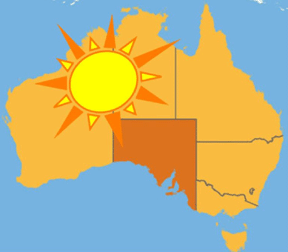
South Australia sets spectacular new records for wind, solar and negative demand
Giles Parkinson, Sep 30, 2024, https://reneweconomy.com.au/south-australia-sets-spectacular-new-records-for-wind-solar-and-negative-demand/
Records continue to tumble across Australia’s main grids as the spring weather boosts the output of wind and solar and mild weather moderates demand, but none are as spectacular as those being set in South Australia.
The state’s unique end-of-the-line grid already leads the country, and arguably the globe, in the integration of variable wind and solar, with an average of more than 70 per cent of its demand over the last year and a world-first target of 100 per cent net renewables by 2027.
On Sunday, at 9.35 am, the state set a new milestone, setting a new record share of wind and solar (as a percentage of state electricity demand) of 150.7 per cent, beating a record set on Christmas Day last year, when – for obvious reasons – there was little electricity demand.
As Geoff Eldridge, from GPE NEMLog, notes, this means that the rooftop PV, along with large scale wind and solar farms, were generating 50.7 per cent more power than the state’s total electricity demand at the time.
The scale of excess output was further crystallised later in the day with a new minimum record for instantaneous residual demand, which hit minus 927 megawatts at 12.35pm.
Eldridge says residual demand is what’s left for other generators to supply after wind and solar have met a share of the demand. A negative residual demand means wind and solar were producing more electricity than SA needed, resulting in excess renewable generation which can be managed by exporting and battery charging. The remainder is curtailed.
Of the surplus 927 MW, the state was exporting 685 MW to Victoria, while another 163 MW was being soaked up by the state’s growing fleet of battery storage projects, and 730 MW of output was curtailed. Prices at the time were minus $47/MWh, a good opportunity for batteries to charge.
A further 84 MW was being produced by a couple of gas generators – not because their power output was needed, but because the state, at least for the moment, relies on them for essential grid services such as system strength and fault current.
That will be reduced considerably when the new link to NSW is completed in a few years, and it will allow the state to both export more, and import more when needs be.
“Balancing the system with such high renewable penetration is challenging but necessary as the energy transition progresses,” Eldridge says. “Managing excess generation through exports, storage, and curtailment is critical to keeping the grid stable and efficient.”
It wasn’t the only record to fall over the weekend. In Queensland, the country’s most coal dependent state in terms of annual share of demand and generation, large scale solar hit a record share of 34 per cent, and coal output – in megawatt terms – hit a record low of 2,882 MW.
The Queensland coal fleet capacity is more than 8,000 MW, so that is about as low as it can run until more units are closed down.
In Victoria on Saturday, just before the AFL grand final, rooftop solar also hit a new record output of 3,164 MW – although it did not push operational demand down low enough for the market operator to enact Minimum System Load protocols and possibly switch off some rooftop solar panels to maintain grid stability.
It had flagged a potential MSL event on Friday but cancelled it in the morning. Those events will likely occur at other times in spring and over the summer holidays, although the market operator is now working on new rules for big batteries to avoid a potentially unpopular and unwieldy solar switch off.
Chart: Solar power keeps beating expectations
Energy forecasters have long underestimated the speed at which solar power is growing around the world. It’s not the first time that’s happened. [charts on original]
By Carrie Klein, 27 September 2024, https://www.canarymedia.com/articles/solar/chart-solar-power-keeps-beating-expectations
Canary Media’s chart of the week translates crucial data about the clean energy transition into a visual format. Canary thanks Clean Energy Counsel for its support of the column.
Solar is becoming predictable in its unpredictability — time and time again, experts have underestimated how much the clean energy source will grow globally. This year is no different.
The price of panels has continued to plummet and their efficiency keeps rising, while deadlines for meeting climate laws creep closer. The result? The world is installing more solar than ever before — at a pace that even many top energy analysts didn’t see coming, according to a new analysis by think tank Ember.
So far this year, 29 percent more solar has been installed than was at this point last year, per Ember. By the end of 2024, Ember says the world will be on track to reach 593 gigawatts of solar installations — 200 GW more than the International Energy Agency (IEA) predicted at the start of the year. That’s a significant underestimate: Those extra gigawatts alone represent more solar than the entire world built in 2021.
This year’s record-breaking solar installations follow another peak year in 2023, when installations grew by 86 percent over 2022.
Five countries account for the majority of solar additions: China takes the top spot, followed by the United States, India, Germany, and Brazil. In the U.S., utility-scale solar is driving the industry’s growth. Policy changes in India have helped encourage solar; this year, the country has already installed more solar panels than it did in all of 2023. In Germany, small-scale solar has grown thanks to lower panel costs and incentives for rooftop solar. Solar is also taking off in new markets, particularly distributed solar in Pakistan and Saudi Arabia.
Cost is the main factor driving solar’s always-faster-than-expected ascension, says Kingsmill Bond, senior principal on the strategy team at RMI. As solar has become cheaper, it’s “not entirely surprising” that solar installations have spiked, Bond said.
“When technologies get cheap enough, they are like water flowing down a mountain. You don’t know exactly how the water will find a way down the mountain, but you know that it will find a way,” he said.
The solar industry’s success is putting the world’s climate pledges within reach. Annual solar installations will now have to show only “relatively modest levels of growth” to meet global goals, the Ember report notes. Recent BloombergNEF (BNEF) data sees a slight shortfall on the current trajectory but says 2030 goals are still entirely feasible.
Getting there, of course, won’t be simple. “Every single solar panel needs someone to put it up and needs planning permission in many countries,” Bond said. “Change is not easy, but it is nevertheless inexorable and driven by the internal logic of what happens when you get really cheap technologies available to 8,000 million people.”
Clean Energy Counsel is the only mission-driven law firm exclusively focused on renewable energy and clean technologies. From early-stage venture investment, offtake, site control, equipment supply, and EPC contracting, through project acquisitions, debt, and tax equity, we counsel clients through every stage of the project life cycle. Visit our website to explore how we can work together toward a sustainable future.
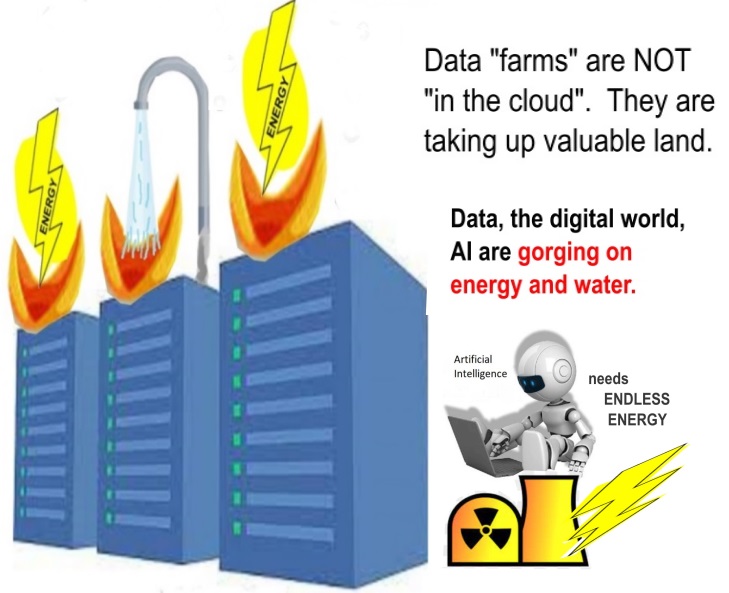
US nuclear plants won’t power up Big Tech’s AI ambitions right away
Reuters, By Laila Kearney and Timothy Gardner, September 25, 2024
A plan by Microsoft, opens new tab to use the restart of a Three Mile
Island nuclear reactor to help power its expanding data centers reflects
the tech industry’s hopes nuclear energy can be a quick and
[?] climate-friendly answer to its massive electricity needs.
But it will be tough to swiftly meet soaring power demand from the data centers behind
artificial intelligence with new or resurrected nuclear reactors, as
companies will face high regulatory hurdles, potential fuel supply
obstacles, and sometimes stiff local and environmental opposition.
U.S. data center power use is expected to roughly triple between 2023 and 2030
and will require about 47 gigawatts of new generation capacity, according
to Goldman Sachs estimates, which assumed natural gas, wind and solar would
fill the gap.
Climate conscious investors and regulators are keen to ensure
this spike does not trigger a huge rise in greenhouse gas emissions. In
general, simply purchasing power from nuclear plants to run data centers
just means diverting it away from other consumers, creating competition for
supplies on the grid that could potentially drive up power bills.
In the meantime, the Three Mile Island project is posing a major test of public
appetite for expanded nuclear power. Talabi said four years is likely
enough for Constellation to address any technical issues at Three Mile
Island, which could be substantial when sensitive components such as steam
generators and reactor vessels have been closed for years.
Reuters 24th Sept 2024, https://www.reuters.com/technology/artificial-intelligence/us-nuclear-plants-wont-power-up-big-techs-ai-ambitions-right-away-2024-09-24/
Microsoft’s Three Mile Island deal: How big tech is snatching up nuclear power
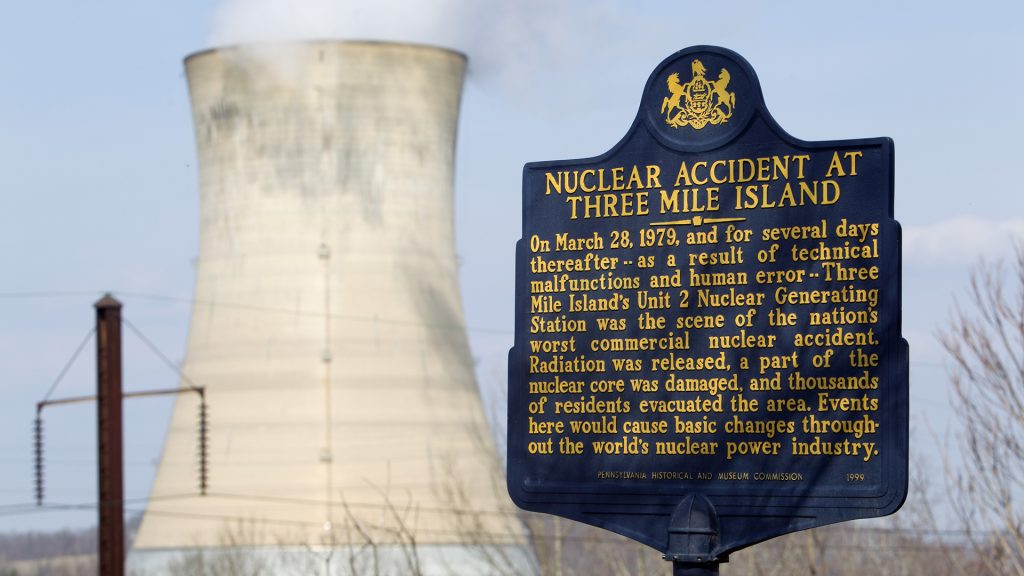
The company paid for access to all the power made by the previously defunct nuclear plant
By Theara Coleman, The Week US, 24 September 2024
With artificial intelligence putting a damper on its clean energy goals, Microsoft is turning to nuclear power in a first-of-its-kind exclusive deal with a nuclear plant. The massive amount of energy needed to power artificial intelligence has contributed to a resurgence of interest in nuclear power, a turn for an industry on its way out over the last decade. But with Big Tech closing in on nuclear plants, some wonder what will be left for everyone else.
The symbolism of the deal
Three Mile Island, the dormant Pennsylvania nuclear plant at the center of the Microsoft deal, became “shorthand for the risks posed by nuclear energy after one of the plant’s two reactors partly melted down in 1979,” said The New York Times. The other reactor operated safely for years before ultimately closing down for economic reasons five years ago. With the Microsoft deal, a “revival is at hand.” Because of artificial intelligence, the tech giant needs massive amounts of electricity for its growing number of data centers, and the company has agreed to use as much power as possible from the plant over the next 20 years. The plant’s owner, Constellation Energy, promises to spend $1.6 billion refurbishing the reactor, hoping to restart it by 2028 with regulatory approval. The deal marks the first time “Microsoft has secured a dedicated, 100% nuclear facility for its use,” the Times said.
“The symbolism is enormous,” Joseph Dominguez, the chief executive of Constellation, said to the Times. Even though Three Mile Island “was the site of the industry’s greatest failure,” it can now be a “place of rebirth.”…………………………………………………………….
Unfortunately, tech’s bullish approach to securing nuclear power has some experts worried there will not be enough to go around. The owners of nearly a third of the country’s nuclear power plants were in talks with tech companies to meet the demands of the AI boom, The Wall Street Journal said. These deliberations could potentially “remove stable power generation from the grid while reliability concerns are rising across much of the U.S,” and the electricity demand is driven up by new tech like AI, the outlet said. Instead of helping to add new green energy solutions to meet their “soaring power needs,” tech companies would be “effectively diverting existing electricity resources.” That could raise prices for other customers and “hold back emission-cutting goals,” said the Journal.
Amazon Web Services closed a similar deal earlier this year, acquiring a data center campus connected to Talen Energy Corp.’s nuclear power plant on the Susquehanna River in Pennsylvania for $650 million. The arrangement raised concerns among clean energy advocates and regulators, specifically the the state’s consumer advocate, Patrick Cicero, who said he was worried about cost and reliability if big companies snatch up all the plants. “Never before could anyone say to a nuclear-power plant, we’ll take all the energy you can give us,” Cicero said to the Journal.
https://theweek.com/tech/microsoft-three-mile-island-nuclear-power-big-tech
Record solar boom

The world is on track to install a record-breaking 593 gigawatts (GW) of
new solar capacity in 2024, according to analysis by thinktank Ember. This
would be up 29% on 2023 levels and nearly six times the amount added just
five years ago. In addition to established leaders, such as China, Europe
and the US, Ember said there was strong growth in new markets, such as
Pakistan and Saudi Arabia, in 2024. It added that solar growth continues to
outpace many forecasts for the industry, “put[ting] ambitious climate
pledges within reach”.
Carbon Brief 20th Sept 2024
Is the new UK government prepared to rise to the challenge of investing in energy efficiency measures and reducing the country’s energy use?

Internationally, more recent UN assessments are placing much greater emphasis on changing demand for fuel, broadly supporting the CREDS’ analysis of the scale of the potential. The International Energy Agency consistently refers to energy efficiency as ‘the first fuel’, and the European Commission actively promotes ‘Energy Efficiency First’.
Is the new government prepared to rise to the challenge of investing in energy efficiency measures and reducing the country’s energy use? asks Andrew Warren.
The UK has a new government. It arrives determined to deliver the potential that greater investment in energy efficiency offers, and these are acknowledged to be ‘wins all round’ in economic, social and environmental terms. Every plausible scenario for delivering climate targets depends critically on delivering these improvements.
The key question remains – how best to deliver this potential? Fortunately, for the past six years, there has been a major project, funded by UK Research & Innovation, that has been exploring precisely these answers.
The Centre for Research into Energy Demand Solutions (CREDS) has been run by an Oxford University professor, Nick Eyre – a man with a very practical background in the subject. Prior to becoming an academic, he worked at a senior level for the Energy Saving Trust. An active County Councillor, he was a key figure seconded to the Cabinet Office, helping create the first energy White Paper for 30 years, launched by Tony Blair in 2003, which elucidated the entire case for an energy efficiency/renewables-based future.
And way back in 1989, he helped prepare the energy efficiency case for Margaret Thatcher’s government on the ‘greenhouse effect’. This included the identification of potential emission reductions of 477 Mt CO₂ within 30 years. These were deemed grossly over ambitious by the energy establishment at the time, but they have nonetheless been achieved. Practically half these savings have come from improvements in energy efficiency, which have been spread across the three major categories of energy use: electricity (32%, 123 Mt CO₂) heating (34%, 68 Mt CO₂) and transport (17%, 33 Mt CO₂).
Energy demand matters
A full analysis of what has actually been achieved to date can be found on the Centre’s website (www.creds.ac.uk/creds-research-findings/). In addition, there are approaching 500 other publications drawn from academics based throughout the UK involved in this initiative, the vast majority of these fully peer-reviewed. On the website, these have been grouped under nine different ‘themes’. The overall findings of the six-year project can be found in 15 one-page topic summaries, each of which provides links to the underlying evidence base.
The CREDS consortium has a wide range of perspectives. For a collection of academics this is inevitable, and healthy. But there are some insights that are commonly shared.
The first is that energy demand management matters. Use of energy is fundamental to a modern society, but it is currently the main cause of greenhouse gas emissions. The analysis confirms it has to be reduced, made more flexible and switched to decarbonised fuels. Reducing the amount of energy that needs to be decarbonised reduces the cost of the transition.
The work reasserts the importance of energy efficiency improvements, and importantly identifies the huge boost to its potential offered by electrification. But also established is that some of the broader benefits of demand reduction (e.g. for health, energy security and green employment) also require more fundamental change in the systems that drive energy use, in particular shifts to a circular economy.
Reducing consumption
Going forward, CREDS’ analyses show clearly that current UK energy consumption can be halved by 2050 – and, critically, the policy measures that need to be introduced, and enforced, to achieve this. The research has consistently found that fairness matters – not just because it is normatively important, but also because perceptions of fairness, or otherwise, affect public support for change.
All this means that managing demand for energy is central to the shift to sustainable energy within a zero emissions concept. Conceptualising changing energy demand purely in terms of ‘individual responsibility’, ‘greener choices’ or ‘behaviour change’ simply misses the point.
Just like changing energy supply, changing demand requires changes in infrastructure, technology and business models.
For many people, this may well be CREDS’ most surprising insight. It certainly also means that existing institutions and policies will not be adequate. Previous UK governments have failed to address this key conclusion. All significant change takes time and effort. Particularly in democracies, a ‘long march through the institutions’ is needed. And there are positive signs that these insights are beginning to have traction.
Efficiency first
Internationally, more recent UN assessments are placing much greater emphasis on changing demand for fuel, broadly supporting the CREDS’ analysis of the scale of the potential. The International Energy Agency consistently refers to energy efficiency as ‘the first fuel’, and the European Commission actively promotes ‘Energy Efficiency First’.
In the UK, some similar shifts can be seen in reports from the Climate Change Committee, the National Infrastructure Commission and the Government Office of Science. And there are positive signs in the Scottish and Welsh governments and many local authorities, as well as forward-thinking businesses and civil society organisations.
For research funders, the CREDS initiative has a clear message – inter-disciplinary approaches are still needed. They can be hard work, but the challenges of changing demand require multiple perspectives. As importantly, ‘changing energy demand’ is not a single topic; the challenges are diverse and require in-depth knowledge of specific sectors, technologies and energy services. Expertise matters and should be supported.
One of the biggest long term benefit of CREDS will be from the skills and commitment of the people its existence has brought together. They are part of the generation that will help government map the pathways through to complete decarbonisation.
As his professorship becomes ‘emeritus’, wise leaders in the new UK administration should be expressing considerable gratitude to Nick Eyre, for the very remarkable groundwork his foresight in creating the insightful CREDS initiative has provided for them.
Global Solar Installations on Track for Another Record Year

Solar capacity around the world will be installed at a record pace in 2024,
as bargain panel prices help countries’ efforts to deploy cleaner energy.
Global additions are set to hit 593 gigawatts this year, a jump of about
29% from last year, London-based energy research firm Ember said in a new
report. The increase comes on top of a near doubling of new installations
in 2023, and largely matches a forecast from BloombergNEF.
Bloomberg 19th Sept 2024 https://www.bloomberg.com/news/articles/2024-09-18/global-solar-installations-on-track-for-another-record-year
Three Mile Island nuclear reactor to restart to power Microsoft AI operations
Three Mile Island will also be renamed the Crane Clean! Energy Center
Pennsylvania plant was site of most serious nuclear meltdown and radiation leak in US history in 1979
Guardian, Richard Luscombe, 21 Sept 24
A nuclear reactor at the notorious Three Mile Island site in Pennsylvania is to be activated for the first time in five years after its owners, Constellation Energy, struck a deal to provide power to Microsoft’s proliferating artificial intelligence operations.
The plant was the location of the most serious nuclear meltdown and radiation leak in US history, in March 1979 when the loss of water coolant through a faulty valve caused the Unit 2 reactor to overheat. More than four decades later, the reactor is still in a decommissioning phase.
Constellation closed the adjacent but unconnected Unit 1 reactor in 2019 for economic reasons, but will bring it back to life after signing a 20-year power purchase agreement to supply Microsoft’s energy-hungry data centers, the company announced on Friday……………
As part of the agreement, Three Mile Island will also be renamed the Crane Clean Energy Center to recognize Chris Crane, the former chief executive of Constellation’s parent company………………….
Significant investment will be required to restore the plant, including replacing or refurbishing the turbine, generator, main power transformer and cooling and control systems, Dominguez said.
There will also be a comprehensive safety and environmental review by the US Nuclear Regulatory Commission before it issues a permit for the restart of the reactor, which is scheduled to be online sometime in 2028. Constellation said it would seek licenses that will extend plant operations to at least 2054.
Tech giants including Microsoft, Google, Amazon, Meta and Apple are consuming ever-greater amounts of energy to power the boom in artificial intelligence. According to Goldman Sachs, demand will grow 160% by 2030, when data centers are expected to account for 8% of the power generated in the US.
With the spike in demand, however, comes rising concerns over the impact on the environment. An analysis by the Guardian published this week found that data center emissions of four of the biggest tech companies, Google, Microsoft, Meta and Apple, are probably about 662% – or 7.62 times – higher than officially reported. https://www.theguardian.com/environment/2024/sep/20/three-mile-island-nuclear-plant-reopen-microsoft
As Biden deliberates, Ukraine’s nuclear plants are increasingly at risk
fear this coming winter may prove to be a breaking point for Ukraine in the energy war.
Stuck in the crosshairs are key substations feeding high voltage electricity to Ukraine’s still functioning nuclear power stations in Rivne, Khmelnytskyi and Yuzhnoukrainsk in southern Ukraine. Take these substations out and the reactors have to be shut down rapidly, or else it could provoke a “nuclear incident,” energy expert Mykhailo Gonchar told POLITICO. And “that’s what the Russians are aiming to do — hit the key substations.”
Paralyze the three nuclear power stations, though, and it’s game over for Ukraine in the energy war ,
The risk of Ukraine losing the war this winter has pushed Washington and London to reconsider how Kyiv uses Western-supplied long-range missiles, but the U.S. remains fearful of escalation.
Politico, September 15, 2024 , By Jamie Dettmer
KYIV — As the U.S. ponders loosening some of the restrictions on Ukraine’s use of Western-supplied long-range missiles to allow for the targeting of airfields and missile launch sites deeper inside Russia, Ukraine remains on tenterhooks.
As it stands, Washington doesn’t appear ready to take the gloves off entirely and allow Ukraine to target Russia’s airfields with long-range U.S. missiles quite yet — though it may withdraw restrictions on the U.K.’s Storm Shadows, which use U.S. technology.
“I would like to see a more forthright position coming from the Biden administration that says there’s no reason why Ukraine shouldn’t be fighting back,” former U.S. envoy to NATO Kurt Volker told POLITICO. “Russia’s the one attacking Ukraine from all these facilities across Russia. There’s no reason for there to be a sanctuary. But I don’t think we’re going to see Biden authorizing the use of U.S. missiles to strike at Russian airfields, although the British might be allowed to proceed without U.S. objection,” he added. “That won’t be enough.”
And if that’s really the outcome of these weeks-long intense negotiations, Ukraine’s energy officials will be among those most alarmed.
They fear this coming winter may prove to be a breaking point for Ukraine in the energy war. And that’s largely because Russian commanders are adapting their airstrike tactics, having learned from their previous failed bombing campaign to collapse the country’s energy system — and the recent shipments of Iran’s Fath-360 close-range ballistic missiles to Russia will help them do so.
Ukrainian officials expect Russia will use these missiles, which have a range limit of 120 kilometers, to complement their glide bombs in targeting logistics and communications hubs and ammunition depots in the rear of Ukraine’s front lines. That, in turn, will free Russia up to concentrate its own longer-range missiles on civilian infrastructure — particularly the energy system in a bid to break it.
Stuck in the crosshairs are key substations feeding high voltage electricity to Ukraine’s still functioning nuclear power stations in Rivne, Khmelnytskyi and Yuzhnoukrainsk in southern Ukraine. Take these substations out and the reactors have to be shut down rapidly, or else it could provoke a “nuclear incident,” energy expert Mykhailo Gonchar told POLITICO. And “that’s what the Russians are aiming to do — hit the key substations.”
Currently, 55 percent of Ukraine’s energy is generated by its three operating nuclear power stations — the one in Zaporizhzhia, which is the largest nuclear plant in Europe, was captured by Russia in 2022 and has largely been shut down. Russian missile and drone strikes have destroyed 9 gigawatts of the country’s electrical generating capacity — that’s half of the peak winter consumption — with 80 percent of thermal generation from coal- and gas-fired power plants and a third of hydroelectric production capacity wiped out by bombing.
Last year, Russia tried to isolate these nuclear power plants, focusing on degrading Ukraine’s energy transmission. It targeted distribution to consumers and businesses but was met with characteristic Ukrainian ingenuity and confounded by improvised repairs and rerouting.
Paralyze the three nuclear power stations, though, and it’s game over for Ukraine in the energy war , diminishing its war-fighting capacity, crashing the economy and weakening its position if peace negotiations do ever commence.
And according to officials in Kyiv, it’s the fear of this happening that’s been one of the factors driving the Biden administration to reconsider the restrictions, including on U.S. ATACMS and British Storm Shadows. Washington sat up when Russian airstrikes started targeting the main substations feeding operational electricity to the nuclear power plants in late August. “That concentrated minds,” said one Ukrainian official who asked not to be identified in order to speak freely………………………………………………………………………………………………
Burns also stressed no one should underestimate the risk of escalation and admitted his agency genuinely feared Russia might resort to tactical nuclear weapons in 2022. And while Biden and British Prime Minister Kier Starmer brushed off Putin’s threats on Friday, the U.S. administration still appears to be trapped between two worries — fear of how Moscow might respond if Western-supplied missiles start striking Russian airfields, and wreck projects for peace talks to get going, and alarm over the prospect of Ukraine losing power……………………………………………………………… https://www.politico.eu/article/russia-ukraine-nuclear-plants-energy-war-joe-biden-united-states-nato/
Die Welt predicts a mass exodus of people from Ukraine in winter
Die Welt predicts a mass exodus of people from Ukraine in winter
▪️ The article states:
Rolling power outages are already occurring across the country. In the summer, they are perhaps a minor inconvenience, and only cause real problems when it comes to refrigeration units or storage facilities. However, in the winter, such a situation could lead to a large-scale catastrophe. Millions of people would flee en masse.
▪️ The publication notes that only half of Ukraine’s energy production capacity remains, and the situation could become extremely difficult by winter.
Nuclear vs Energy Storage

The Chair of the Nuclear Free Local Authorities has made a plea to the new
Minister of State for Energy for the Department of Energy Security and Net
Zero to prioritise investment in energy storage capacity alongside
renewables as a key component in making Britain a Net Zero nation. Energy
storage, both short- and long-term, is often an unsung, but essential,
element to achieving – as is the Labour Government’s stated ambition
– the goal to make the UK a ‘clean, green energy superpower’.
Numerous academic studies have demonstrated that this is not only possible
solely through investment in renewables, but that it can be achieved at a
cost to the taxpayer that is £100 billion lower than one which embraces
nuclear energy.
The NFLA’s Scotland Policy Advisor Pete Roche has just
written an excellent briefing published under the No2 Nuclear banner
titled, ‘Energy Storage and Flexibility in a 100% Renewable Energy
System’, which highlights its criticality in capturing the surplus energy
often generated, but unused, by renewables as well is in more effectively
managing energy demand against supply.
Dr. M.V. Ramana, the Simons Chair in
Global Disarmament and Human Security at the University of British
Columbia, described the balance between generation, storage and management:
“We have learned how to manage grids with high proportions of renewable
sources. To balance this variability, we must invest in a mix of renewable
energy technologies across various regions, and in battery and other
storage technologies to store excess energy. In addition, we need to shape
electricity demand to more closely match supply.”
NFLA 12th Sept 2024
Renewables beat nuclear – even with full balancing included
RENEW EXTRA WEEKLY, 9 Sept 24
A new Danish study comparing nuclear and renewable energy systems (RES) concludes that, although nuclear systems require less flexibility capacity than renewable-only systems, a renewable energy system is cheaper than a nuclear based system, even with full backup: it says ‘lower flexibility costs do not offset the high investment costs in nuclear energy’.
It’s based on a zero-carbon 2045 smart energy scenario for Denmark, although it says its conclusions are valid elsewhere given suitable adjustments for local conditions. ‘The high investment costs in nuclear power alongside cost for fuel and operation and maintenance more than tip the scale in favour of the Only Renewables scenario. The costs of investing in and operating the nuclear power plants are simply too high compared to Only Renewables scenario, even though more investment must be put into flexibility measures in the latter’.
In the Danish case, it says that ‘the scenario with high nuclear implementation is 1.2 billion EUR more expensive annually compared to a scenario only based on renewables, with all systems completely balancing supply and demand across all energy sectors in every hour.’ It goes on ‘to achieve a more cost-efficient system based predominantly on nuclear power- the investment costs would have to drop to 1.55 MEU/MW. This is significantly below any current or future cost projection for nuclear power. Such a high cost-margin indicates that a combination of low-cost RES and sector coupling presents a cost-effective energy transition making it very hard for nuclear power to deliver a competitive alternative’…………………………………………………………………………….
Interestingly, in the UK context, Lord Turner, Chair of the UK Energy Transitions Commission, has also said that costly new nuclear plants may not be needed for net zero, since there are cheaper, low-carbon alternatives that could back up intermittent renewables. Hydrogen fuel or gas power plants fitted with CCS could fill the gap when wind or solar was not enough to keep the lights on. ‘I don’t think it is the case that you need new nuclear to balance the system. The systems of the future don’t absolutely need a base load.’ The power system ‘can work on a combination of intermittent variable renewables, wind & solar plus some hydro. I think the challenge for new nuclear is that it is just expensive. Bluntly, new nuclear can play very little role in a 2030 target.’
Well maybe that’s why there seems to have been some second thoughts about the new EPR reactor proposed for Sizewell in the UK, with the final investment decision for the Sizewell C nuclear plant evidently facing delays. Initially, EDF, the project’s developer, aimed to secure funding by the end of this year, but the timeline may now extend into 2025.
The prospect for nuclear do seem a bit uncertain, with the case for it these day relying in part on the claim that it can back up renewables and help avoid climate change. But that also seems to be uncertain, as is argued in a new comprehensive review of nuclear issues by academics from Germany and Finland, arguing that it has no role to play in responding to climate change. It says that it is ‘not a sustainable and affordable source of energy for the low-carbon energy transformation’ given its ‘cost-intensive nature, coupled with safety considerations’. And crucially it says that it is ‘characterized by very long construction times, and even longer developments of new technical generations, too far away and uncertain to contribute to climate change mitigation anytime soon’.
In addition ‘from an energy system perspective, nuclear power is not compatible with a system based on renewables, but rather hinders its expansion. Last but not least, nuclear power is particularly unfavorable in a future with higher temperatures and weather extremes and more military threats’.
That sounds pretty damning, even leaving aside radioactive waste handing, and also weapons proliferation and terrorism-related issues, with, as Prof. Ramana discusses in his recent powerful overview book ‘Nuclear is not the solution’, in addition to its other problems, reliance on civil nuclear power making ‘catastrophic nuclear war more likely’. Even if, hopefully, we can avoid that, there are still concerns about nuclear blackmail. And all this just to generate expensive energy.
Yes, going for renewables does mean we have invest in flexible balancing technology and energy storage, but that is cheaper overall and it also getting even cheaper, with many new options emerging. As Ramana says, to balance the variability of renewables, ‘we must invest in a mix of renewable energy technologies across various regions, and in battery and other storage technologies to store excess energy. In addition, we need to shape electricity demand to more closely match supply.’ In common with the German and Finnish researchers, he too sees that as the way ahead. https://renewextraweekly.blogspot.com/2024/09/renewables-beat-nuclear-even-with-full.html
The massive new projects propelling South Australia towards 100 per cent net renewables
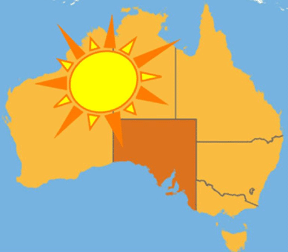
The season of renewable records has begun early in Australia, sending
average coal power down below 50 per cent for the first time, establishing
new records for wind output, and sending grid demand to new lows across the
main grid.
The state at the forefront of the country’s energy transition
is, without a shadow of a doubt, South Australia. It kicked out coal in
2016, and is steadily reducing its dependence on gas. When a new
transmission link to NSW is completed in the next two years, the state
expects to run at 100 per cent net renewables – reducing gas to a support
role and becoming the first multi-gigawatt scale grid in the world to reach
such a milestone through wind and solar, rather than more conventional
renewable sources.
Big industry is lining up to build new factories and
production facilities to take advantage of cleaner power and lower
wholesale prices, and BHP is talking of doubling its mining production at
the giant Olympic Dam – and its smelting and refining capacity. The
latest data shows that wind and solar provided enough power to meet more
than 70 per cent of the state’s electricity demand in the last 12 months
– although the government says it is 75 per cent.
Over the past 30 days
it has been 86.4 per cent, and over the past week it has been more than 105
per cent. Rooftop solar now supplies the equivalent of all state demand on
occasions, presenting a complication for the market operator which prefers
to run the grid with assets it can control. It’s working on that solution
with new inverter standards and grid protocols, including solar
switch-offs. South Australia also led the country, and the world, in the
installation of the first big battery, the original “Tesla Big Battery”
now properly known as the Hornsdale Power Reserve.
Renew Economy 6th Sept 2024
1 This Month
To see nuclear-related stories in greater depth and intensity – go to https://nuclearinformation.wordpress.com/
12 February – Webinar The Big Push: New Nuclear Projects in Canada
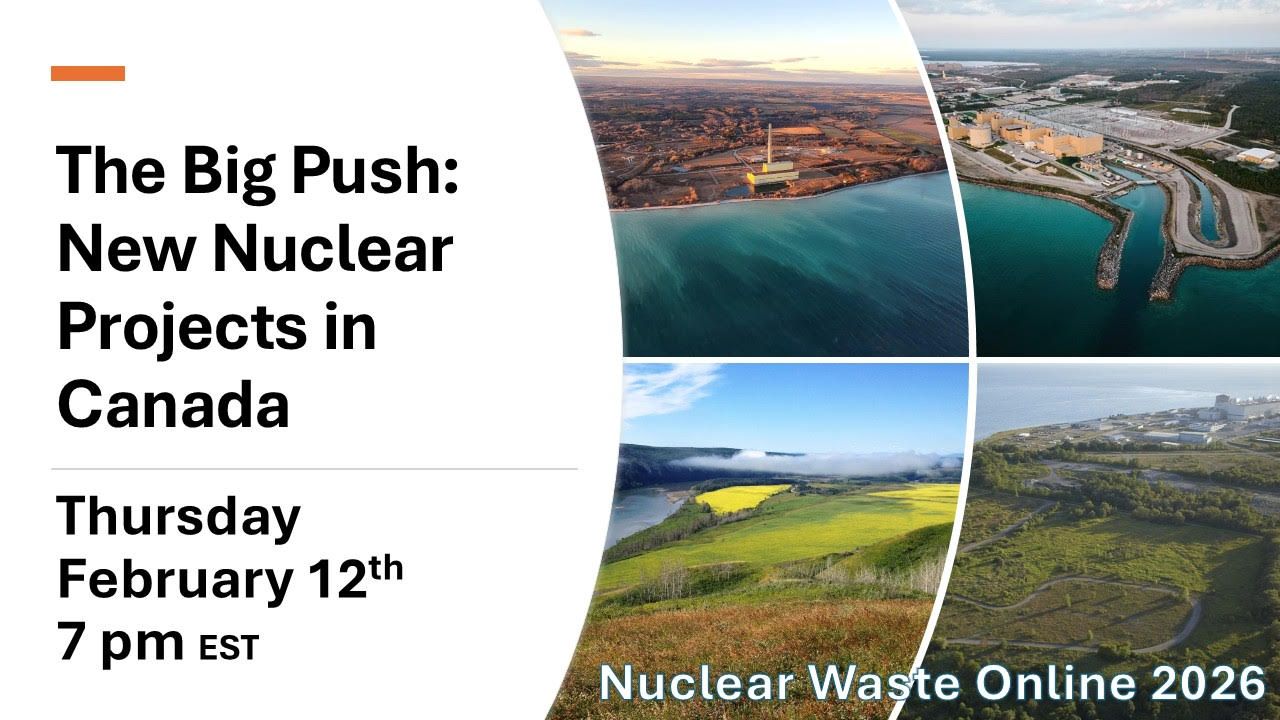
Thursday, February 12, 7 pm Eastern | 2nd of 4 sessions in the 2026 Nuclear Waste Online webinar series
Join a webinar on the push for new nuclear generation in Canada. Go to Northwatch.org to register or use the registration link https://us02web.zoom.us/webinar/register/WN_ZfWOf1GITqSRIZX8CB-A9w

-
Archives
- February 2026 (115)
- January 2026 (308)
- December 2025 (358)
- November 2025 (359)
- October 2025 (376)
- September 2025 (258)
- August 2025 (319)
- July 2025 (230)
- June 2025 (348)
- May 2025 (261)
- April 2025 (305)
- March 2025 (319)
-
Categories
- 1
- 1 NUCLEAR ISSUES
- business and costs
- climate change
- culture and arts
- ENERGY
- environment
- health
- history
- indigenous issues
- Legal
- marketing of nuclear
- media
- opposition to nuclear
- PERSONAL STORIES
- politics
- politics international
- Religion and ethics
- safety
- secrets,lies and civil liberties
- spinbuster
- technology
- Uranium
- wastes
- weapons and war
- Women
- 2 WORLD
- ACTION
- AFRICA
- Atrocities
- AUSTRALIA
- Christina's notes
- Christina's themes
- culture and arts
- Events
- Fuk 2022
- Fuk 2023
- Fukushima 2017
- Fukushima 2018
- fukushima 2019
- Fukushima 2020
- Fukushima 2021
- general
- global warming
- Humour (God we need it)
- Nuclear
- RARE EARTHS
- Reference
- resources – print
- Resources -audiovicual
- Weekly Newsletter
- World
- World Nuclear
- YouTube
-
RSS
Entries RSS
Comments RSS
 nuclear-news