Greta Thunberg on the global inaction on climate change
Greta Thunberg: the world is still in a state of climate crisis denial https://www.theguardian.com/environment/2020/aug/19/another-two-years-lost-to-climate-inaction-says-greta-thunberg, Damian Carrington Environment editor @dpcarrington, Wed 19 Aug 2020 Two years on from Greta Thunberg’s first solo school strike for the climate, she says the world has wasted the time by failing to take the necessary action on the crisis.
Thunberg’s strike inspired a global movement, and on Thursday she and other leading school strikers will meet Angela Merkel, the chancellor of Germany, which holds the rotating presidency of the European council. They will demand a halt to all fossil fuel investments and subsidies and the establishment of annual, binding carbon budgets based on the best science.
“Looking back [over two years], a lot has happened. Many millions have taken to the streets … and on 28 November 2019, the European parliament declared a climate and environmental emergency,” Thunberg said in an article for the Guardian with fellow strikers Luisa Neubauer, Anuna de Wever and Adélaïde Charlier.
“But over these last two years, the world has also emitted over 80bn tonnes of CO2. We have seen continuous natural disasters taking place across the globe. Many lives and livelihoods have been lost, and this is only the very beginning.”
They said leaders were speaking of an “existential crisis”, yet “when it comes to action, we are still in a state of denial. The gap between what we need to do and what’s actually being done is widening by the minute. Effectively, we have lost another two crucial years to political inaction.”
Thunberg and her colleagues said fighting the climate emergency must involve rich nations stopping some of their polluting activities.
- “However, it’s a fact which most people refuse to accept. Just the thought of being in a crisis that we cannot buy, build or invest our way out of seems to create some kind of collective mental short-circuit. This mix of ignorance, denial and unawareness is the very heart of the problem,” they said.
The trillions of dollars being spent by governments in response to the coronavirus pandemic are seen as a once-in-a-lifetime opportunity to put the world on course to halt global heating, with economists, scientists and health experts all saying the benefits would outweigh the costs.
However, G20 governments’ rescue packages are giving significantly more support to fossil fuels than to low-carbon energy. Germany’s recovery plan includes €40bn for climate measures such as electric vehicles, public transport and energy efficiency, and has been praised by green groups. But elsewhere, too little is being done, Thunberg and colleagues said.
“Even a child can see that the policies of today are incompatible with the current best available science,” they said.
- Scientists calculate that global carbon emissions must be cut by half by the end of this decade if humanity is to have a reasonable chance of keeping temperature rises to below 1.5C, the limit set in the Paris climate deal. Drops in emissions during coronavirus lockdowns are only a small blip in a long-term rising trend and will have a “negligible” effect on the climate crisis, researchers say.
“We understand the world is complicated and that what we are asking for may not be easy or seem unrealistic,” said the school strikers. “But it is much more unrealistic to believe that our societies would be able to survive the global heating we’re heading for. We are inevitably going to have to fundamentally change, one way or another. The question is: will the changes be on our terms, or on nature’s terms?”
High financial risks in nuclear power – from global heating
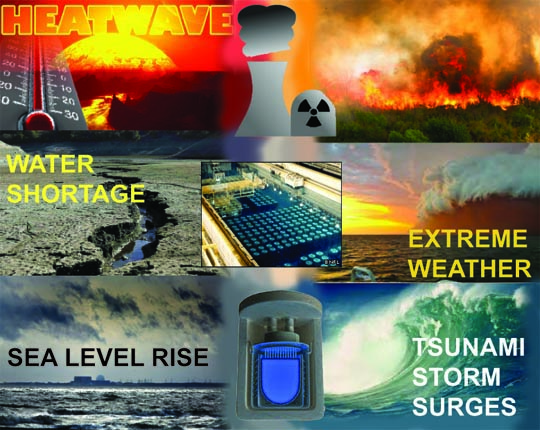 Climate change poses high credit risks for nuclear power plants, Moody’s says, https://www.reuters.com/article/us-moody-s-powerplants/climate-change-poses-high-credit-risks-for-nuclear-power-plants-moodys-says-idUSKCN25E2A5 (Reuters) Reporting by Diptendu Lahiri in Bengaluru; Editing by Steve Orlofsky, 19 Aug 20
– Credit risks associated with climate change for nuclear power plant operators in the United States will rise over the next 10 to 20 years, Moody’s Investor Service said on Tuesday.Climate change can affect every aspect of nuclear plant operations like fuel handling, power and steam generation, maintenance, safety systems and waste processing, the credit rating agency said.
However, the ultimate credit impact will depend upon the ability of plant operators to invest in mitigating measures to manage these risks, it added.
Close proximity to large water bodies increase the risk of damage to plant equipment that helps ensure safe operation, the agency said in a note.
Moody’s noted that about 37 gigawatts (GW) of U.S. nuclear capacity is expected to have elevated exposure to flood risk and 48 GW elevated exposure to combined rising heat and water stress caused by climate change.
Nuclear plants seeking to extend their operations by 20, or even 40 years, beyond their existing 40-year licenses face this climate hazard and may require capital investment adjustments, Moody’s said.
“Some of these investments will help prepare for the increasing severity and frequency of extreme weather events.”
Greenland’s meltdown taking flight

This century is shaping up to be designated an inflection point of radical change with solid evidence of trouble down the line found most recently in a rapid meltdown phase of the Greenland Ice Sheet, a target way too big to miss. It’s melting fast and faster beyond the scope of climate models, which, for reasons not fully explained, cannot keep up with the cascading ice mass.Starting with this decade, Greenland’s meltdown took flight. This is indisputable as its acceleration has a familiar ring found amongst all major ecosystems, planet-wide. In short, climate change acceleration is universal. It’s a horrifyingly dangerous threat to the integrity of life-sourcing ecosystems, like the Great Barrier Reef, three massive unprecedented bleaching events in only five years; all the result of rising ocean temperatures driven by global heat, up to 90% mortality in some locations. (Source: Australian Academy of Sciences).
Greenland represents 23 feet of sea level encased in ice up to two miles thick and will likely require hundreds or thousands of years to completely melt-down, but for current purposes that doesn’t count! What counts are the upcoming years on the way to 23 feet. And, that’s a dicey proposition when consideration is given to how far off scientists’ models have been. It’ best to brace for the worst.
After all, there is no chance that emissions will be curbed. In today’s real world, it is simply not on the docket. Greenhouse gases have been accelerating ever since China decided to mix a cocktail of High-end Capitalism and the Communist Party of China; thereafter, building a brand spanking new coal-burning power plant every week like clockwork to meet capitalistic demands for cheaper products for America and the world, starting in the late 1970s.
Not only China but also Japan plans to build 20 new coal-powered plants and India is planning numerous new coal-powered plants. And, that’s only half of today’s fossil-fuel renaissance, looking ahead thru this decade, oil barons, like Saudi Arabia and the U.S., intend to increase oil and gas production by up to 130% by 2030, meaning substantially higher CO2 emissions leading to hotter temperatures leading to higher sea levels leading to increased flooding of coastal cities.
Where’s the IPCC when it’s really needed or is it hopelessly feckless?
In truth, the underlying Greenland message is not subtle; it’s simply build seawalls, thus protecting hundreds of millions of people, businesses, and urban environments from massive flooding, and soil contamination and aquifer spoilage via salt water. Coastal cities across the world need to start constructing enormous seawalls, in some cases extending for miles beyond the city’s limits, possibly as far as an entire coastline, as rising waters find voids in structures.
U.S. Senator Harris and Rep Ocasio-Cortez introduce Bill on climate harm
 Reuters 6th Aug 2020, U.S. Senator Kamala Harris and Representative Alexandria Ocasio-Cortez on
Thursday introduced legislation to beef up federal accountability for
pollution in minority communities disproportionately harmed by climate
change. Harris, a leading contender to be Democratic presidential candidate
Joe Biden’s running mate, was running in the Democratic primary last year
when she first floated the Climate Equity Act with Ocasio-Cortez.
Past the tipping point: Greenland glaciers will continue to lose ice, no matter what
Warming Greenland ice sheet passes point of no return https://www.sciencedaily.com/releases/2020/08/200813123550.htm Even if the climate cools, study finds, glaciers will continue to shrink. August 13, 2020, Source: Ohio State University
- Summary:
- Nearly 40 years of satellite data from Greenland shows that glaciers on the island have shrunk so much that even if global warming were to stop today, the ice sheet would continue shrinking.
-
Nearly 40 years of satellite data from Greenland shows that glaciers on the island have shrunk so much that even if global warming were to stop today, the ice sheet would continue shrinking.
The finding, published today, Aug. 13, in the journal Nature Communications Earth and Environment, means that Greenland’s glaciers have passed a tipping point of sorts, where the snowfall that replenishes the ice sheet each year cannot keep up with the ice that is flowing into the ocean from glaciers.
“We’ve been looking at these remote sensing observations to study how ice discharge and accumulation have varied,” said Michalea King, lead author of the study and a researcher at The Ohio State University’s Byrd Polar and Climate Research Center. “And what we’ve found is that the ice that’s discharging into the ocean is far surpassing the snow that’s accumulating on the surface of the ice sheet.”
- King and other researchers analyzed monthly satellite data from more than 200 large glaciers draining into the ocean around Greenland. Their observations show how much ice breaks off into icebergs or melts from the glaciers into the ocean. They also show the amount of snowfall each year — the way these glaciers get replenished.
The researchers found that, throughout the 1980s and 90s, snow gained through accumulation and ice melted or calved from glaciers were mostly in balance, keeping the ice sheet intact. Through those decades, the researchers found, the ice sheets generally lost about 450 gigatons (about 450 billion tons) of ice each year from flowing outlet glaciers, which was replaced with snowfall.
“We are measuring the pulse of the ice sheet — how much ice glaciers drain at the edges of the ice sheet — which increases in the summer. And what we see is that it was relatively steady until a big increase in ice discharging to the ocean during a short five- to six-year period,” King said.
- The researchers’ analysis found that the baseline of that pulse — the amount of ice being lost each year — started increasing steadily around 2000, so that the glaciers were losing about 500 gigatons each year. Snowfall did not increase at the same time, and over the last decade, the rate of ice loss from glaciers has stayed about the same — meaning the ice sheet has been losing ice more rapidly than it’s being replenished.
“Glaciers have been sensitive to seasonal melt for as long as we’ve been able to observe it, with spikes in ice discharge in the summer,” she said. “But starting in 2000, you start superimposing that seasonal melt on a higher baseline — so you’re going to get even more losses.”
-
Before 2000, the ice sheet would have about the same chance to gain or lose mass each year. In the current climate, the ice sheet will gain mass in only one out of every 100 years.
King said that large glaciers across Greenland have retreated about 3 kilometers on average since 1985 — “that’s a lot of distance,” she said. The glaciers have shrunk back enough that many of them are sitting in deeper water, meaning more ice is in contact with water. Warm ocean water melts glacier ice, and also makes it difficult for the glaciers to grow back to their previous positions.
That means that even if humans were somehow miraculously able to stop climate change in its tracks, ice lost from glaciers draining ice to the ocean would likely still exceed ice gained from snow accumulation, and the ice sheet would continue to shrink for some time.
“Glacier retreat has knocked the dynamics of the whole ice sheet into a constant state of loss,” said Ian Howat, a co-author on the paper, professor of earth sciences and distinguished university scholar at Ohio State. “Even if the climate were to stay the same or even get a little colder, the ice sheet would still be losing mass.”
Shrinking glaciers in Greenland are a problem for the entire planet. The ice that melts or breaks off from Greenland’s ice sheets ends up in the Atlantic Ocean — and, eventually, all of the world’s oceans. Ice from Greenland is a leading contributor to sea level rise — last year, enough ice melted or broke off from the Greenland ice sheet to cause the oceans to rise by 2.2 millimeters in just two months.
The new findings are bleak, but King said there are silver linings.
“It’s always a positive thing to learn more about glacier environments, because we can only improve our predictions for how rapidly things will change in the future,” she said. “And that can only help us with adaptation and mitigation strategies. The more we know, the better we can prepare.”
This work was supported by grants from NASA. Other Ohio State researchers who worked on this study are Salvatore Candela, Myoung Noh and Adelaide Negrete.
Story Source:
Materials provided by Ohio State University. Original written by Laura Arenschield. Note: Content may be edited for style and length.
- Journal Reference:
- Michalea D. King, Ian M. Howat, Salvatore G. Candela, Myoung J. Noh, Seonsgu Jeong, Brice P. Y. Noël, Michiel R. van den Broeke, Bert Wouters, Adelaide Negrete. Dynamic ice loss from the Greenland Ice Sheet driven by sustained glacier retreat. Communications Earth & Environment, 2020; 1 (1) DOI: 10.1038/s43247-020-0001-2
Climate stabilization: Lessons from the corona crisis
|
Climate stabilization: Lessons from the corona crisis https://www.eurekalert.org/pub_releases/2020-08/pifc-csl081420.php 16 Aug 20, The dynamics of the current COVID-19 pandemic could offer valuable insights for the efforts to mitigate climate change POTSDAM INSTITUTE FOR CLIMATE IMPACT RESEARCH (PIK) The dynamics of the current COVID-19 pandemic could offer valuable insights for the efforts to mitigate climate change. Highlighting the parallels between the global health and the climate emergency, a team of researchers from the Potsdam Institute for Climate Impact Research (PIK) has analyzed what policy makers and citizens can learn from the corona outbreak and how to apply it to the global effort of reducing CO2 emissions. Their proposal: A Climate Corona Contract that unites the younger and the older generations.”The corona crisis is a test case for global emergency prevention and management in general,” says lead author Kira Vinke. “The pandemic has shown that when reaction time is kept to a minimum, a larger public health crisis can be averted. In fact, we should take this very lesson to heart and apply it to managing the climate emergency.” Assessing risks and predicting outcomes Vinke and the team of authors have looked at four dimensions of risk management: diagnosis, prognosis, therapy, and rehabilitation. They deduced which lessons of the COVID-19 pandemic could be used to stabilize global mean temperature. “The risks and causes of both the coronavirus and the climate crisis have to be scientifically assessed and quantified,” explains PIK director and co-author Johan Rockström. But just as important as diagnostics are prognostic approaches: “Countries like New Zealand and Germany were able to predict the outbreak’s possible effects and moreover had the ability of immediate action. In the same vein, the global community must integrate climate risks assessments into decision making and act accordingly.” The authors argue that insights from the Corona crisis can help to identify pathways for treating the causes and symptoms of climate change. “Both the Corona and the climate crisis are the result of increasing human pressure on the planet,” says co-author Sabine Gabrysch, “But the good news is that the pandemic has demonstrated that with a combination of government action and individual lifestyle changes, it is possible to prevent damages. If there is a will, there is a way.” Compassion and solidarity as guiding principles The researchers conclude by proposing an intergenerational Climate Corona Contract informed by reason and the principle of social justice. . Former PIK director and co-author Hans Joachim Schellnhuber explains: “Younger generations would agree to protect the elderly from COVID-19 by adhering to social distancing measures, while the older generations would push for measures to keep global warming in line with the Paris Agreement.” Thus, the researchers’ outlook is cautiously optimistic: The outpouring of generosity and new forms of social interactions in the wake of the pandemic show great potentials for cooperation towards the much needed stabilization of the global climate. ### Article: Kira Vinke, Sabine Gabrysch, Emanuela Paoletti, Johan Rockström, Hans Joachim Schellnhuber (2020): Corona and the Climate: A Comparison of Two Emergencies. Global Sustainability. DOI: [10.1017/sus.2020.20] Link to the article: https://dx.doi.org/10.1017/sus.2020.20 |
|
The Arctic – where global heating meets nuclear pollution – theme for September 20
Global heating is bringing massive changes to the Arctic, and at an accelerating pace. It is the warning system to the world, as sea ice melts, Greenland’s glaciers melt, swathes of frozen ground thaw, permafrost melts. The Arctic ocean will probably be ice-free in summer by 2040.
Crazily, Russians and Americans rejoice, seeing all this as the opportunity to exploit the region for oil and gas, the very things that are causing this unfolding climate nightmare. Apparently these governments are not concerned about the Arctic processes that bring changed global weather, with changed ocean currents, sudden extreme cold snaps. Global heating speeds up with feedback loops: as ice is lost , dark water absorbs more heat from the sun, melting permafrost releases methane and carbon dioxide into the atmosphere.
Arctic regions now experience repeated uncontrollable forest fires, bringing environmental and economic destruction.
Nuclear pollution. The Arctic is where the the two disastrous threats meet – climate change and nuclear radiation. This danger is happening with fires threatening Northern Russian radioactive sites, and with radiation released as buried nuclear items appear from under the ice. Russia’s dumping of nuclear submarines and other radioactive trash is now recognised as a danger to Arctic ecosystems.
There are 39 nuclear-powered vessels or installations in the Russian Arctic today with a total of 62 reactors. This includes 31 submarines, one surface warship, five icebreakers, two onshore and one floating nuclear power plant. These numbers are set to increase; . “By 2035, the Russian Arctic will be the most nuclearized waters on the planet.”
There were 2 fatal arctic accidents in 2019 – 14 sailors killed due to a fire on a nuclear-powered submarine, and an underwater nuclear-powered cruise missile exploded. Several serious submarine nuclear reactor accidents have occurred in Arctic waters, and a U.S. bomber with plutonium warheads crashed at Thule airbase on Greenland. In the Kara Sea, thousands of containers wit radioactive waste were dumped, together with 16 reactors.
Drastic flooding in Bangladesh, displaces ove 1.5 million, increasing coronavirus risk
|
Floods leave one third of Bangladesh underwater and displace more than 1.5 million, raising coronavirus risk, ABC News 14 Aug 20, About a third of Bangladesh has been inundated by floods, with at least 161 people killed and an estimated 1.5 million displaced, according to local officials. Key points:
The heaviest rains in almost a decade began last month and are part of the subcontinent’s summer monsoon from June to September. The floods are making it more difficult to contain coronavirus, with Bangladesh reporting 266,498 infections, including 3,513 deaths, as of Thursday. The unusually heavy rain and floods have also impacted nearby India and Nepal. Bangladesh shares a border with India, with 53 rivers running through both countries….. https://www.abc.net.au/news/2020-08-13/bangladesh-floods-sees-a-third-of-nation-underwater-coronavirus/12555448 |
|
Vulnerability of nuclear reactors to extreme weather events. Flooding all too close to North Korea’s main nuclear reactor
North Korea floods kill 22, approach nuclear reactor — but Kim doesn’t want help, WP, By Simon Denyer August 14, 2020 , TOKYO — Flooding caused by weeks of unusually heavy monsoon rains has killed at least 22 people in North Korea, with four others missing, and even approached the country’s main nuclear reactor, but leader Kim Jong Un says he is too worried about coronavirus to accept outside help.
The International Federation of the Red Cross said the floods have left at least 22 people dead and four missing, citing the Democratic People’s Republic of Korea Red Cross and the country’s State Committee for Emergency and Disaster Management.
The floodwaters approached the Yongbyon nuclear complex last week, reaching the bases of two pump houses designed to cool the country’s main nuclear reactor, according to the 38 North website, citing satellite imagery.
The floodwaters have receded somewhat and pose “no imminent danger,” as the main reactor apparently has not been operating for some time and a nearby experimental light water reactor has yet to come online, said Jenny Town, deputy director of 38 North, part of the Stimson Center.
“But this year, the river level is usually high,” Town added. “If this were to happen when a reactor was running, it could cause problems in the cooling systems that would necessitate the reactors to be shut down.” ………. https://www.washingtonpost.com/world/north-korea-floods-kill-22-approach-nuclear-reactor–but-kim-doesnt-want-help/2020/08/13/f53992a8-ddda-11ea-b4f1-25b762cdbbf4_story.html
Torres Strait Islanders claim climate change affects their human rights – Australia govt tries to stifle their claim
Australia asks UN to dismiss Torres Strait Islanders’ claim climate change affects their human rights
Complaint argues Morrison government has failed to take adequate action on emissions or adaptation measures, Guardian, Katharine Murphy Political editor 14 Aug 20 The Morrison government has asked the human rights committee of the United Nations to dismiss a landmark claim by a group of Torres Strait Islanders from low-lying islands off the northern coast of Australia that climate change is having an impact on their human rights, according to lawyers for the complainants.
The complaint, lodged just over 12 months ago, argued the Morrison government had failed to take adequate action to reduce emissions or pursue proper adaptation measures on the islands and, as a consequence, had failed fundamental human rights obligations to Torres Strait Islander people.
But the lead lawyer for the case, Sophie Marjanac, says the Coalition has rejected arguments from the islanders, telling the UN the case should be dismissed “because it concerns future risks, rather than impacts being felt now, and is therefore inadmissible”.
Marjanac said lawyers for the commonwealth had told the committee because Australia is not the main or only contributor to global warming, climate change action is not its legal responsibility under human rights law.
“The government’s lawyers also rejected arguments that climate impacts were being felt today, and that effects constituting a human rights violation are yet to be suffered”.
A spokesman for the attorney general, Christian Porter, said submissions to the human rights committee were not publicly available……
Lawyers for the islanders have alleged that the catastrophic nature of the predicted future impacts of climate change on the Torres Strait Islands, including the total submergence of ancestral homelands, is a sufficiently severe impact as to constitute a violation of the rights to culture, family and life.
The challenges associated with sea level rise in the Torres Strait have been well documented. A report from the Climate Council on the risks associated with coastal flooding notes that Torres Strait Island communities are extremely low-lying and are thus among the most vulnerable in Australia to the impacts of climate change.
The report concludes the shallowness of the strait “exacerbates storm surges and when such surges coincide with very high tides, extreme sea levels result”. It cites sea level data collected by satellite from one location in the Torres Strait between 1993 and 2010 that indicated a rise of 6 mm per annum, “more than twice the global average”,
Although the report notes this was a single dataset, low-lying islands in the Pacific – and Torres Strait islands such as Masig and Boigu – are likely to be at the forefront of forced displacement. Some forecasts have predicted up to 150 million people could be forcibly displaced by climate change by 2040 – larger than the record number of people already forced from their homes globally.
The non-profit group ClientEarth is supporting the complaint. A spokesman for the group said: “It is shameful that Indigenous communities on Australia’s climate frontline are being told that the risk of climate change to their human rights is merely a future hypothetical issue, when scientists are clear these impacts will happen in coming decades”.
“Climate change risk is foreseeable and only preventable through immediate action in the present. States like Australia have legal duties to protect the human rights of their citizens”. https://www.theguardian.com/australia-news/2020/aug/14/australia-asks-un-to-dismiss-torres-strait-islanders-claim-climate-change-affects-their-human-rights
Climate Change Is a Security Threat to the Asia-Pacific
|
Climate Change Is a Security Threat to the Asia-Pacific Climate change is likely to alter the local physical and strategic environment profoundly, and potentially catastrophically. The Diplomat, By Shiloh Fetzek and Dennis McGinn, August 10, 2020 This week the ASEAN Joint Task Force on Humanitarian Assistance and Disaster Relief (HADR) will meet via video conference, with the COVID-19 pandemic escalating just as some countries in the disaster-prone Indo-Asia Pacific enter their cyclone, drought, heatwave, or monsoon seasons. The overlaying of the pandemic with existing complex challenges is a timely reminder that planning for HADR capacities – and regional security – needs to be attuned to the increasing likelihood of multiple, overlapping hazards and converging security risks, especially in a future where climate change alters the context in which other disasters and crises take place. Developing a clearer recognition of how climate change can reshape the strategic environment will be essential for preserving regional security, stability, and prosperity in the face of complicated and interlocking challenges, as we argue in a new report on the Indo-Asia Pacific published by the International Military Council on Climate and Security (IMCCS).
The Indo-Asia Pacific is highly exposed to climate change impacts. Climate change is likely to alter the local physical and strategic environment profoundly, and potentially catastrophically. More frequent or intense extreme weather, sea level rise, and ocean acidification (among other climate impacts) will create a range of threats to the well-being and security of countries in the region, many of which are already threatened by disaster vulnerability and increasingly complex security tensions.
As well as the immediate physical impacts, climate change will increase food and water insecurity, contribute to forced migration and displacement, and challenge disaster response and recovery capabilities …….. https://thediplomat.com/2020/08/climate-change-is-a-security-threat-to-the-asia-pacific/
|
|
$6.6 trillion in annual GDP at risk as Asian climate warms – McKinsey Global Institute
|
McKinsey sees $6.6 trillion in annual GDP at risk as Asian climate warms, https://www.smh.com.au/business/markets/mckinsey-sees-6-6-trillion-in-annual-gdp-at-risk-as-asian-climate-warms-20200813-p55ley.html By Bloomberg News, August 14, 2020 Lethal heatwaves, droughts, floods and typhoons will become more common in Asia-Pacific, which faces more severe potential impacts from climate change than many parts of the world, McKinsey & Co. researchers warn.Asia is particularly at risk because it has such a high number of poor people, who tend to rely more on outdoor work, living in areas most vulnerable to extreme increases in heat and humidity, McKinsey Global Institute said in a new report published on Thursday. By 2050, the loss of that labor could cost the region as much as $US4.7 trillion ($6.6 trillion) a year in GDP, about two-thirds of the global total at risk. The report underscores the economic risks of delaying investments that mitigate or adapt to climate change. The potential for widespread damage is similar to the region’s experience during the current pandemic, according to McKinsey. What we have seen is that countries, cities and people can take resolute actions and if we do take these actions and sustain them, we can cooperate globally and see positive outcomes,” said Oliver Tonby, McKinsey’s Asia chairman, who co-authored the report. The projections are based on a scenario in which the world fails to cut greenhouse gas emissions and Asia warms by 2 degrees Celsius. They show that by 2050, between 500 million and 700 million people living in places like India, Bangladesh and Pakistan could experience heatwaves that exceed the survivability threshold. The loss of outdoor labour during those times could shave off 7 per cent to 13 per cent off GDP in those three countries, resulting in losses of $US2.8 trillion to $US4.7 trillion across the whole of Asia on average per year, according to the report. Extreme precipitation events could rise three- or four-fold by 2050 in parts of Japan, China, South Korea and Indonesia, according to McKinsey. Increased riverine flooding could cause $US1.2 trillion in damage in Asia, about 75 per cent of the global impact. Conversely, as the earth warms, parts of southwestern Australia could spend more than 80 per cent of a decade in drought conditions by 2050 and regions of China could experience droughts 40 per cent to 60 per cent of the time. Climate change will also increase the likelihood of severe typhoon strikes from the Philippines and Vietnam to Northeast Asia. It will also create winners and losers, increasing surface water supply in parts of northern India and China while depleting reservoirs in Australia.
To face the business risks, Tonby said companies need to assess their exposure and take it into consideration when making plans. A significant opportunity lies in infrastructure development in Asia as the region is still rapidly urbanising. |
Arctic permafrost is thawing, as the region experiences unprecedented heat
I study the Arctic. The decision to withdraw from the Paris climate accord is reprehensible – but we can’t give up hope
When you stand facing an exposed edge of permafrost, you can feel it from a distance.
It emanates a cold that tugs on every one of your senses. Permanently bound by ice year after year, the frozen soil is packed with carcasses of woolly mammoths and ancient ferns. They’re unable to decompose at such low temperatures, so they stay preserved in perpetuity – until warmer air thaws their remains and releases the cold that they’ve kept cradled for centuries.
I first experienced that distinct cold in the summer of 2016. I was traveling across Arctic Europe with a team of researchers to study climate change impacts. We were a few hours past the Finnish border in Russia when we stopped to first set foot on the tundra. The ground was soft but solid beneath our feet, covered with mosses and wildflowers that stretched into the distance until abruptly interrupted by a slick, towering wall of thawing permafrost.
As we stood facing the muddy patch of uncovered earth, the sensation of escaping cold felt terrifying.
The northern hemisphere is covered by 9m sq miles of permafrost. This solid ground, and all the organic material it contains, is one of the largest greenhouse gas stores on the planet. Frozen, it poses little threat to the 4 million people that call the Arctic home, or to the 7.8 billion of us that call Earth home. But defrosted by rising temperatures, thawing permafrost poses a planetary risk.
When the organic material begins to decompose, permafrost thaw can destabilize major infrastructure, discharge mercury levels dangerous to human health and release billions of metric tons of carbon. We witnessed small-scale damage in Russia that summer through slumped landscapes and uneven roads. At the time, the larger, more dramatic changes were predicted to unfold over the course of this century.
Four years later, those changes are happening much sooner than scientists predicted. The carbon-laden cold of the Arctic’s permafrost is leaking into Earth’s atmosphere, and we are not ready for the consequences.
In June, the Russian Arctic reached 100.4F, the highest temperature in the Arctic since record-keeping began in 1885. The heat shocked scientists, but was not a unique or unusual event in a climate-changed world. The Arctic is warming at nearly three times the rate of the global average, and June’s single-day high was part of a month-long heatwave. This relentless heat has melted sea ice and made traditional subsistence dangerous for skilled Indigenous hunters. It’s fueled costly wildfires, some of which are so strong they now last from one summer to the next. And it’s sped up permafrost thaw, buckling roads and displacing entire communities.
Watching the heat of 2020 devastate the Arctic, I think back to the fear we experienced while watching that permafrost thaw in 2016, but I also remember feeling hopeful.
Just weeks before our expedition began, 174 countries had signed the Paris agreement on the first day it opened for signatures. Barack Obama and China’s President Xi Jinping released a joint statement of climate commitments for the world’s two largest greenhouse gas emitters. It seemed like every world leader had finally dedicated themselves to climate action. Throughout our trip across the Arctic, my colleagues and I discussed the difficulties of limiting global warming to 1.5 degrees, but, with the momentum of Paris, we agreed that it was still possible to contain a climate catastrophe.
It is much harder to find hope today than it was four years ago – but it’s not impossible.
The Arctic’s skies are blackened with wildfire smoke and we are not even halfway through summer. The Trump administration has reversed 100 environmental rules and stands on the precipice of pulling the US out of the Paris agreement in November 2020.
Things may seem hopeless, but we are not helpless.
Every individual has a skill, a voice, a career to wield as a tool to address climate change. Ultimately, climate action is not powered by the Paris agreement – it’s powered by people. From presidents to protesters, we each have a part to play in limiting the devastation of the climate crisis.
Climate change cannot be stopped. The Arctic’s ice will melt and large swaths of frozen ground will thaw. Climate change is already causing devastating loss of life, destroying irreplaceable cultural heritage and inundating the places we hold dear. With every degree we allow our world to warm, the more we lose. But by demanding climate action from our governments, and demanding climate action from ourselves, we can work today to avert the worst damage and adapt to the impacts we can no longer avoid.
As the Arctic burns, we cannot afford climate silence from anyone. The cost of inaction is too high.
- Dr Victoria Herrmann is the president and managing director of the Arctic Institute
Flooding might have damaged Bort Korea’s nuclear reactor site
|
North Korea nuclear reactor site threatened by recent flooding, U.S. think-tank says https://www.reuters.com/article/us-northkorea-nuclear-floods/north-korea-nuclear-reactor-site-threatened-by-recent-flooding-u-s-think-tank-says-idUSKCN25908S, Josh Smith 12 Aug 20SEOUL (Reuters) – Satellite imagery suggests recent flooding in North Korea may have damaged pump houses connected to the country’s main nuclear facility, a U.S.-based think-tank said on Thursday.
Analysts at 38 North, a website that monitors North Korea, said commercial satellite imagery from August 6-11 showed how vulnerable the Yongbyon Nuclear Scientific Research Center’s nuclear reactor cooling systems are to extreme weather events. The Korean peninsula has been hammered by one of the longest rainy spells in recent history, with floods and landslides causing damage and deaths in both North and South Korea. Located on the bank of the Kuryong River about 100 km (60 miles) north of North Korea’s capital, Pyongyang, Yongbyon is home to nuclear reactors, fuel re-processing plants and uranium enrichment facilities that are thought to be used in the country’s nuclear weapons programme. The five-megawatt reactor – believed to be used to produce weapons-grade plutonium – does not appear to have been operating for some time, and an Experimental Light Water Reactor (ELWR) has not yet come online, but such flooding in the future would likely force a shutdown, the 38 North report said. “Damage to the pumps and piping within the pump houses presents the biggest vulnerability to the reactors,” the report said. “If the reactors were operating, for instance, the inability to cool them would require them to be shut down.” While there was further flooding downstream, it did not appear to reach the Yongbyon facility’s Uranium Enrichment Plant and by August 11 the waters appear to have somewhat receded, 38 North said. South Korea’s Ministry of Defence declined to comment on the report, but said it is always monitoring developments related to North Korea’s nuclear and missile programmes and maintaining close cooperation with the U.S. government. At a summit with U.S. President Donald Trump in Vietnam in 2019, North Korean leader Kim Jong Un offered to dismantle here Yongbyon in exchange for relief from a range of international sanctions imposed over North Korea’s nuclear weapons and ballistic missile programmes. At the time Trump said he rejected that deal because Yongbyon is only one part of the North’s nuclear programme, and was not enough of a concession to warrant loosening so many sanctions. Reporting by Josh Smith. Additional reporting by Hyonhee Shin.; Editing by Lincoln Feast. |
|
Extreme weather causes emergency shutdown of nuclear plant in Iowa
|
‘Derecho’ storm causes Cargill plant closure, emergency shutdown of nuclear plant in Iowa
The storm caused crop damage and outages throughout the Midwest Star Tribune,
By Mike Hughlett Star Tribune, AUGUST 12, 2020 — A violent storm that tore through Iowa on Monday caused an emergency shutdown at a nuclear power plant near Cedar Rapids.
The storm packing hurricane-force winds tore across the Midwest, compounding troubles for a U.S. farm economy already battered by extreme weather, the U.S.-China trade war and most recently, the disruption caused to labor and consumption by the COVID-19 pandemic. Grain silos were ripped apart, and Minnetonka-based Cargill and Archer Daniels Midland closed crop-processing plants in Cedar Rapids. The Duane Arnold nuclear plant lost its connection to the electricity grid. At about 1 p.m., the plant in Palo, 11 miles northwest of Cedar Rapids, declared an “unusual event” — an indication of a safety threat, according to a report posted Tuesday by the U.S. Nuclear Regulatory Commission (NRC). An unusual event is the lowest of four levels of emergency conditions under NRC regulations. While the Duane Arnold plant is not now producing electricity, it does have power to run its emergency systems. The plant is stable and is using a backup power source at this time,” Duane Arnold’s majority owner and operator, Florida-based NextEra Energy Resources, said in a statement. The storms damaged the plant’s cooling towers, which are used in electricity production to cool steam after it exits the turbine, NextEra said. The cooling towers are not part of the safety systems used to cool the reactor and other critical components……. David Lochbaum, former director of the Union of Concerned Scientists’ nuclear safety project, said that loss of off-site power at nuclear power plants — usually due to storms — happens about four to five times a year in the U.S. Iowa’s 45-year-old Duane Arnold plant, which is a little smaller than Xcel Energy’s nuclear plant in Monticello, is due to shut down later this year………. |
|
1 This Month



26 September – International Day for the Total Elimination of Nuclear Weapons


PLEASE OPPOSE HR 8255 AND S.3639 – bills would accelerate satellite deployment, with no environmental review or safeguards – https://ncstd5li.quorum.us/campaign/169331/
To see nuclear-related stories in greater depth and intensity – go to https://nuclearinformation.wordpress.com
-
Archives
- September 2026 (257)
- August 2026 (330)
- July 2026 (355)
- June 2026 (287)
- May 2026 (306)
- April 2026 (356)
- March 2026 (251)
- February 2026 (267)
- January 2026 (308)
- December 2025 (358)
- November 2025 (359)
- October 2025 (375)
-
Categories
- 1
- 1 NUCLEAR ISSUES
- business and costs
- climate change
- culture and arts
- ENERGY
- environment
- health
- history
- indigenous issues
- Legal
- marketing of nuclear
- media
- opposition to nuclear
- PERSONAL STORIES
- politics
- politics international
- Religion and ethics
- safety
- secrets,lies and civil liberties
- spinbuster
- technology
- Uranium
- wastes
- weapons and war
- Women
- 2 WORLD
- ACTION
- AFRICA
- Atrocities
- AUSTRALIA
- Christina's notes
- Christina's themes
- culture and arts
- Events
- Fuk 2022
- Fuk 2023
- Fukushima 2017
- Fukushima 2018
- fukushima 2019
- Fukushima 2020
- Fukushima 2021
- general
- global warming
- Humour (God we need it)
- Nuclear
- RARE EARTHS
- Reference
- resources – print
- Resources -audiovicual
- Weekly Newsletter
- World
- World Nuclear
- YouTube
-
RSS
Entries RSS
Comments RSS

