The climate crisis has tripled the length of ocean heatwaves, study finds.
The climate crisis has tripled the length of ocean heatwaves, a study has
found, supercharging deadly storms and destroying critical ecosystems such
as kelp forests and coral reefs. Half of the marine heatwaves since 2000
would not have happened without global heating, which is caused by burning
fossil fuels.
The heatwaves have not only become more frequent but also
more intense: 1C warmer on average, but much hotter in some places, the
scientists said. The research is the first comprehensive assessment of the
impact of the climate crisis on heatwaves in the world’s oceans, and it
reveals profound changes.
Hotter oceans also soak up fewer of the carbon
dioxide emissions that are driving temperatures up. “Here in the
Mediterranean, we have some marine heatwaves that are 5C hotter,” said Dr
Marta Marcos at the Mediterranean Institute for Advanced Studies in
Mallorca, Spain, who led the study. “It’s horrible when you go
swimming. It looks like soup.”
Guardian 14th April 2025, https://www.theguardian.com/environment/2025/apr/14/climate-crisis-has-tripled-length-of-deadly-ocean-heatwaves-study-finds
How climate change could disrupt the construction and operations of US nuclear submarines

By Allie Maloney | April 14, 2025 https://thebulletin.org/2025/04/how-climate-change-could-disrupt-the-construction-and-operations-of-us-nuclear-submarines/ Allie Maloney is the Herbert Scoville Jr. Peace Fellow with the Nuclear Information Project at the Federation of American Scientists. Maloney holds two bachelor’s degrees in international affairs and political science from the University of Georgia. Previously, she was a Richard B. Russell Security Leadership Fellow at the University of Georgia’s Center for International Trade and Security.
The US Defense Department is currently in the midst of a multi-decade-long nuclear modernization effort that includes replacing all the nuclear submarines making up the sea leg of the US nuclear triad. The nuclear-armed and -powered submarines—which hold over half of deployed US nuclear warheads—are known for their “survivability,” thereby providing the United States with second-strike capability even after a surprise attack.
But climate change could make the US submarine force inoperable over the coming decades.
Rising sea levels and extreme weather events increasingly threaten the submarine force’s infrastructure, which is mainly located in at-risk flood areas. This vulnerability reveals the precarious state of nuclear weapons—which the Defense Department considers the “backbone of America’s national security”—to the threat of climate change.
Threat multiplier. The Navy plans to spend $130 billion on procuring new Columbia-class nuclear-powered ballistic missile submarines (SSBNs) over the next two decades to replace the current Ohio-class fleet. The delivery of the lead boat—the USS District of Columbia (SSBN-826)—has already been delayed by 12 to 16 months due to insufficient work instructions, low material availability, and disruptions from the COVID-19 pandemic. It is now only about halfway through construction. According to the Government Accountability Office, budget overruns are five to six times higher than estimates by the Navy and General Dynamics Electric Boat, the submarine’s building company. As the Pentagon spends more and more on modernizing its nuclear submarines, natural disasters are likely to disrupt supply chains and damage nuclear facilities, sinking costs further.
In recent years, the Defense Department has started to acknowledge climate change as a “threat multiplier”—albeit slowly. Acknowledging the billions of dollars climate change could cost the Navy in the future, the Pentagon now incorporates inclement weather disasters and other climate effects into military planning and base structures. However, during the first Trump administration, the Navy quietly ended the climate change task force put in place by the Obama administration, which taught naval leaders how to adapt to rising sea levels. As the new Trump administration wipes all mention of climate change and other environmental measures from federal agency websites, climate-related measures may also be halted despite being critical for the viability of naval missions.
Most of the naval construction and operations infrastructure for the United States’ ballistic missile submarines are located on the Pacific and Atlantic coasts. Due to sea level rise and increased inclement weather attributed to climate change, these facilities are becoming more vulnerable to flooding. The intensity and number of hurricanes in the North Atlantic region have increased since the 1980s and will continue to do so as ocean temperatures keep rising, further threatening coastal areas. These incidents are highly costly and disruptive to operations. According to a Congressional Research Service report, the Defense Department has 1,700 coastal military installations that could be impacted by sea level rise. In 2018, Tyndall Air Force Base in Florida suffered $4.7 billion in damages from Hurricane Michael.
Infrastructure at risk.……………………………………………………………………………………………………………………
Self-induced vulnerability. The Navy’s Final Environmental Assessment for the Columbia class submarines estimated that homeporting at Kings Bay, Georgia, would result in emissions of 998 metric tons of carbon dioxide equivalent. This is equivalent to 1,108,593 pounds of coal burned and the amount of carbon sequestered by 1,001 acres of US forests in one year. General Dynamic’s greenhouse gas emissions for 2023 were around 713,874 metric tons—over 700 times higher. While it had committed to reducing GHG emissions in 2019, the company’s emissions have increased since taking on several Pentagon contracts related to nuclear modernization.
The geophysical threats the nuclear deterrent faces show just how precarious these weapons are. As the United States builds new ships for national security, it also contributes to the sinking of its bases. A nuclear weapon buildup is vulnerable to changing environments and cannot save the United States from the looming threat of climate change.
Eco anxiety – environment doom.

I’m struggling to function under the weight of something I don’t know
how to manage any more — what I now understand is called eco-anxiety.
I think I’ve felt it for years, but lately it’s become overwhelming.
Every time I read the news — about rising temperatures, deforestation,
mass extinction, wildfires — I feel this flood of dread, guilt and
helplessness.
I recycle, use public transport and have tried to change my
lifestyle, but it never feels like enough. I can’t shake the feeling that
we’re heading for collapse and that anything I do is just a drop in a
rising ocean.
It’s got to the point where I find it hard to enjoy the
present. I feel anxious when buying food, travelling, or even thinking
about having children. Sometimes I wake up with a tight chest and a sense
of impending doom that I can’t explain.
I love this planet — and that
love is starting to feel like grief. I’ve tried talking about this with
friends but some tell me I’m “too sensitive” or “too negative”,
which just makes me feel more isolated. I don’t want to shut down, but
I’m tired. I want to be engaged but I need to find a way to live with
these feelings without falling apart.
Times 14th April 2025,
https://www.thetimes.com/life-style/health-fitness/article/eco-anxiety-environment-doom-tanya-byron-cjpgclvrz
Arctic sea ice hit a record low as global powers eye shipping routes

Arctic sea ice hit a record low for the end of the region’s winter last
month, in a stark sign of how climate change is opening up the North Pole
to a geopolitical race for military and energy exploration. March was the
fourth consecutive month in which sea ice reached a record low for that
calendar period, based on a 47-year satellite record, EU earth observation
agency Copernicus reported on Tuesday.
FT 10th April 2025 https://www.ft.com/content/f8083632-e6bc-45f5-8032-0ee60e263cf6
Climate crisis on track to destroy capitalism, warns top insurer.
Action urgently needed to save the conditions under which markets – and civilisation itself – can operate, says senior Allianz figure
The climate crisis is on track to destroy capitalism, a top insurer has
warned, with the vast cost of extreme weather impacts leaving the financial
sector unable to operate. The world is fast approaching temperature levels
where insurers will no longer be able to offer cover for many climate
risks, said Günther Thallinger, on the board of Allianz SE, one of the
world’s biggest insurance companies.
He said that without insurance,
which is already being pulled in some places, many other financial services
become unviable, from mortgages to investments. Global carbon emissions are
still rising and current policies will result in a rise in global
temperature between 2.2C and 3.4C above pre-industrial levels.
The damage at 3C will be so great that governments will be unable to provide financial
bailouts and it will be impossible to adapt to many climate impacts, said
Thallinger, who is also the chair of the German company’s investment
board and was previously CEO of Allianz Investment Management.
Guardian 3rd April 2025 https://www.theguardian.com/environment/2025/apr/03/climate-crisis-on-track-to-destroy-capitalism-warns-allianz-insurer
Global warming is ‘exposing’ new coastlines and islands as Arctic glaciers shrink .
Retreating glaciers created 2,500km of “new” coastline and 35
“new” islands in the Arctic between 2000 and 2020, according to a new
study. The research uses satellite images of more than 1,700 glaciers in
Greenland, Alaska, the Canadian Arctic, Russian Arctic, Iceland and
Svalbard.
The findings show that 85% of these glaciers retreated over
2000-20, revealing 123km of new coastline per year on average. The study,
published in Nature Climate Change, links the acceleration in glacier melt
to warmer ocean and air temperatures.
Carbon Brief 1st April 2025 https://www.carbonbrief.org/global-warming-is-exposing-new-coastlines-and-islands-as-arctic-glaciers-shrink/
Quakers condemn police raid on Westminster Meeting House
Quakers 28th March 2025, https://www.quaker.org.uk/news-and-events/news/quakers-condemn-police-raid-on-westminster-meeting-house
Police broke into a Quaker Meeting House last night (27 March) and arrested six young people holding a meeting over concerns for the climate and Gaza.
Quakers in Britain strongly condemned the violation of their place of worship which they say is a direct result of stricter protest laws removing virtually all routes to challenge the status quo.
Just before 7.15pm more than 20 uniformed police, some equipped with tasers, forced their way into Westminster Meeting House.
They broke open the front door without warning or ringing the bell first, searching the whole building and arresting six women attending the meeting in a hired room.
The Police, Crime, Sentencing and Courts Act 2022 and the Public Order Act 2023 have criminalised many forms of protest and allow police to halt actions deemed too disruptive.
Meanwhile, changes in judicial procedures limit protesters’ ability to defend their actions in court. All this means that there are fewer and fewer ways to speak truth to power.
Quakers support the right to nonviolent public protest, acting themselves from a deep moral imperative to stand up against injustice and for our planet.
Many have taken nonviolent direct action over the centuries from the abolition of slavery to women’s suffrage and prison reform.
Paul Parker, recording clerk for Quakers in Britain, said: “No-one has been arrested in a Quaker meeting house in living memory.
“This aggressive violation of our place of worship and the forceful removal of young people holding a protest group meeting clearly shows what happens when a society criminalises protest.
“Freedom of speech, assembly, and fair trials are an essential part of free public debate which underpins democracy.”
No Virginia, NUCLEAR REACTORS DO RELEASE carbon into the atmosphere
Gordon Edwards, 23 Mar 25
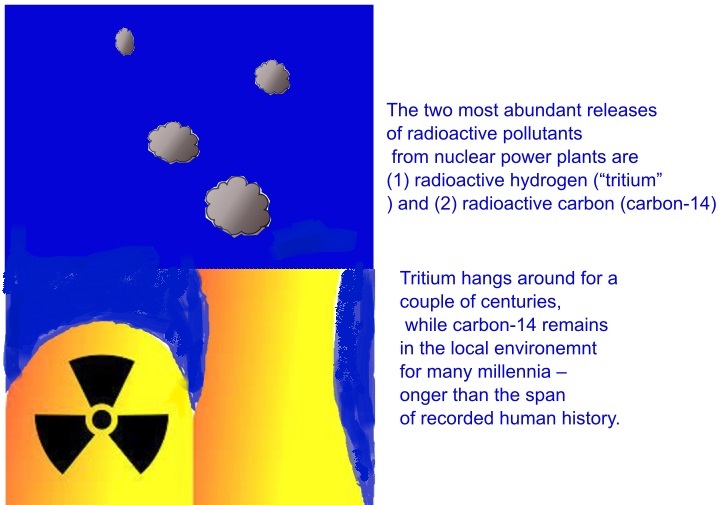
The two most abundant releases of radioactive pollutants from nuclear power plants are (1) radioactive hydrogen (“tritium”) and (2) radioactive carbon (carbon-14).Tritium hangs around for a couple of centuries, while carbon-14 remains in the local environemnt for many millennia – longer than the span of recorded human history.Both of these radioactive materials are “activation products” for the most part, created outside the nuclear fuel and therefore much easier to escape into the environment. Even without any fuel damage, a lot of tritium and a lot of carbon-14 is created by stray neutrons striking non-radioactive atoms outside the fuel assemblies.
Below I mention one way in which carbon-14 is created — when a neutron strikes a nitrogen atom. Another mechanism which is important in CANDU reactors is the collision of a stray neutron with an oxygen-13 atom (which is much more abundant in heavy water compared with ordinary light water).
Technically, radioactive carbon-14 is produced from non-radioactive nitrogen-14, making up about 78 percent of the air we breathe. When a neutron hits a nitrogen atom, a proton is given off and the result in radioactive carbon-14. It is the only radioactive isotope of carbon, just as hydrogen-3 (tritium) is the only radioactive isotope of hydrogen.Carbon and hydrogen are the basic building blocks of all organic molecules.
The half-life of carbon-14 is 5,700 years. The half-life of tritium is 12.3 years,
Very little if any radioactive carbon-14 comes from non-radioactive carbon directly.
Climate impacts may be starting to spiral, but a sub-1.5C world is ‘still possible’
Climate impacts may be starting to spiral, but a sub-1.5C world is ‘still
possible’. World Meteorological Organisation report shows CO2 in atmosphere
has reached its highest level in 800,000 years, but the world can still
avoid a climate catastrophe. Carbon dioxide in the Earth’s atmosphere has
reached its highest level in 800,000 years, with temperature records being
shattered, polar ice melting at unprecedented rates, and ocean
acidification worsening.
Business Green 19th March 2025, https://www.businessgreen.com/news-analysis/4411077/climate-impacts-starting-spiral-sub-5c-world
More than 150 ‘unprecedented’ climate disasters struck world in 2024, says UN
The devastating impacts of the climate crisis reached new heights in 2024,
with scores of unprecedented heatwaves, floods and storms across the globe,
according to the UN’s World Meteorological Organization. The WMO’s
report on 2024, the hottest year on record, sets out a trail of destruction
from extreme weather that took lives, demolished buildings and ravaged
vital crops.
More than 800,000 people were displaced and made homeless, the
highest yearly number since records began in 2008. The report lists 151
unprecedented extreme weather events in 2024, meaning they were worse than
any ever recorded in the region. Heatwaves in Japan left hundreds of
thousands of people struck down by heatstroke. Soaring temperatures during
heatwaves peaked at 49.9C at Carnarvon in Western Australia, 49.7C in the
city of Tabas in Iran, and 48.5C in a nationwide heatwave in Mali.
Guardian 19th March 2025, https://www.theguardian.com/environment/2025/mar/19/unprecedented-climate-disasters-extreme-weather-un-report
‘Global weirding’: climate whiplash hitting world’s biggest cities, study reveals
Climate whiplash is already hitting major cities around the world,
bringing deadly swings between extreme wet and dry weather as the climate
crisis intensifies, a report has revealed. Dozens more cities, including
Lucknow, Madrid and Riyadh have suffered a climate “flip” in the last
20 years, switching from dry to wet extremes, or vice versa.
The report analysed the 100 most populous cities, plus 12 selected ones, and found
that 95% of them showed a distinct trend towards wetter or drier weather.
The changing climate of cities can hit citizens with worsened floods and
droughts, destroy access to clean water, sanitation and food, displace
communities and spread disease. Cities where the water infrastructure is
already poor, such as Karachi and Khartoum, suffer the most.
Guardian 12th March 2025 https://www.theguardian.com/environment/2025/mar/12/global-weirding-climate-whiplash-hitting-worlds-biggest-cities-study-reveals
Turbine, cooling: these unforeseen events that keep the Flamanville EPR at a standstill.
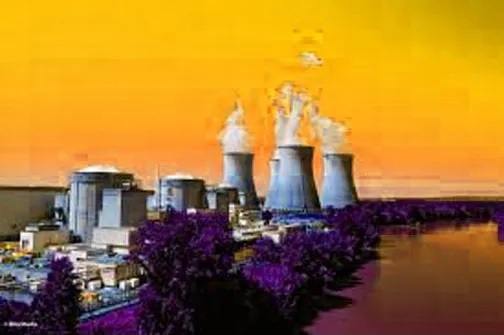
EDF is extending an unscheduled shutdown of the Flamanville EPR until the end of March in order to make adjustments to the turbine. During its first 100 days of operation, the nuclear reactor will have undergone 76 days of maintenance.
By Amélie Laurin, March 6, 2025
EDF had warned: the ramp-up of the Flamanville EPR, the first nuclear reactor to be commissioned in France in twenty-five years, would be very gradual. The public group has once again shut down, for a month and a half, its Normandy pressurized water reactor, which had been connected to the electricity grid on December 21, the first day of winter.
These maintenance operations were not planned and are the result of technical difficulties. They began on February 15 and are due to continue until March 30, after being extended three times.
Turbine heating
This work follows two initial suspensions of electricity production at Flamanville, between Christmas and mid-January, and at the turn of February. Two shutdowns that were, themselves, scheduled. In total, the reactor will have been immobilized for 76 days, during its first 100 days of operation.
The cause: various technical adjustments. In mid-February, the EPR stopped producing electrons due to an insufficient water flow in the seawater cooling circuit, which is only used “in exceptional situations”. This was followed by an intervention “on a temperature probe of the main circuit”, specifies a regulatory press release.
We’ve failed to stop climate change — this is what we need to do next.
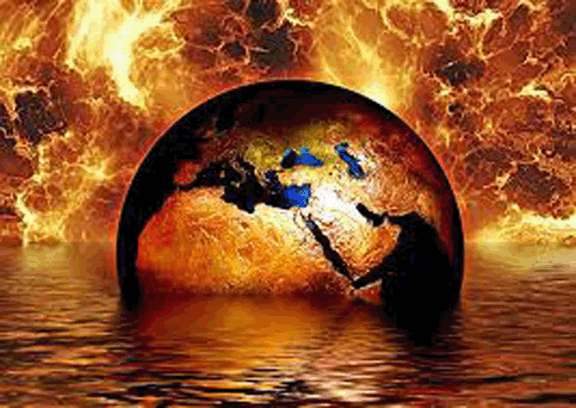
While we can still limit warming by cutting emissions, we now face having to adapt to more extreme weather.
Ben Spencer, Science Editor, |Anna Dowell, Data Journalism Trainee, Thursday March 06 2025, https://www.thetimes.com/uk/environment/article/climate-change-adaptation-decarbonisation-times-earth-93jln78vd
here is a story that used to be told about the fight against climate change. It was a narrative of hope, of a battle to be fought and won.
“This is the moment when we must come together to save this planet,” Barack Obama told a crowd of 200,000 people in Berlin in 2008, the summer before he was elected president.
That moment, of course, came and went. But there were more speeches, more moments of urgency. Al Gore tried, so did Leonardo DiCaprio. Sir David Attenborough and Greta Thunberg attempted to mobilise the masses; even the King has had a go.
Boris Johnson tried again in 2021 at the Cop26 climate summit in Glasgow, urging world leaders to “keep alive” the hope of limiting global warming to 1.5C, enshrined in the Paris Agreement of 2015. He said: “Let’s keep moving forward and make this the moment we irrefutably turn the tide against climate change.”
There are only so many times, however, that the same stories can be told.
Laurie Laybourn, director of the Strategic Climate Risks Initiative, said: “It’s only really now that the penny is dropping that we didn’t prevent a global-scale climate crisis. We’re now in a global-scale climate crisis.”
The wildfires in Los Angeles, flooding in Valencia, and the storms that have battered the British Isles this winter — Bert, Darragh and Éowyn — have confirmed what the scientists have long forecast. Climate change is no longer something that can be averted: it has arrived.
In January the Met Office announced that global average temperatures for 2024 had risen 1.5C above pre-industrial levels for the first time. One year’s weather records do not in themselves mean the 2015 Paris Agreement, which set out to limit global warming long-term, has failed. But the Met Office also warned that carbon dioxide in the atmosphere is still rising, and is now “incompatible” with the modelled pathways that would keep warming below the totemic 1.5C.
“There is an adjustment that’s needed now to understand that that preventative project has not worked,” Laybourn said. “Emissions reductions were not tried at the scale that were needed — being confronted with that failure is actually quite difficult for people.”
After years of focusing on averting climate change, what climate scientists refer to as “mitigation”, experts are warning that we now need far greater focus on adaptation to cope with the new weather that comes with a warming world.
There is no doubt that in the UK we are not ready for climate change. Chris Stark, former chief executive of the climate change committee (CCC) and now a senior energy official, in 2022 described the government’s planning for global warming as “genuinely poor”, blaming a “wilful reluctance” to factor adaptation into policy.
This reluctance goes back years. In a speech at Chatham House in September, the former Labour politician David Miliband admitted that preparing for global warming had been something of a taboo. “When I was environment secretary in 2006-7, it felt as though talking about adapting to climate change meant admitting defeat on mitigating climate change.”
Climate change for the UK means hotter, drier summers and wetter winters with more frequent, more severe storms…………………………………………………………………………………………………………………………………
It is not just the UK failing to prepare. The United Nations Environment Programme (Unep) in November published its “adaptation gap” report, setting out how far the issue has been neglected. It found that annual global spending on climate adaptation is between $187 billion and $359 billion short of what it should be, “with adaptation planning slowing and implementation falling behind”.
Inger Andersen, Unep executive director, said in the foreword: “People and the natural systems upon which our livelihoods depend are increasingly in danger from the hell and high water that climate change is bringing. The world must get serious about adaptation, now.”
MARK PASSMORE/ALAMY
Laybourn stressed that while much more must be done to adapt to climate change, it does not mean that politicians should abandon decarbonisation. “You have to do both,” he said. “If you’re busy mopping the floor you mustn’t forget to turn off the tap.”
Part of the reluctance to push forwards with climate adaptation is finding ways to pay for it. Decarbonisation is a relatively easy sell: it is not difficult to persuade a developer to build a wind farm or install solar panels if they can then profit from the cheap power they generate.
Flood defences, on the other hand, do not generate a return, so central investment is needed.
But experts say a long view is required. Existing flood defences in Britain prevent £1.15 billion in damage each year. Laybourn thinks this approach is required for other sectors. “If the UK had a more nature-abundant, more balanced, sustainable farming system, for example, it would mean that the farming system was better able to handle shocks.”
A UK government spokesman insisted adaptation was being taken seriously………………………… https://www.thetimes.com/uk/environment/article/climate-change-adaptation-decarbonisation-times-earth-93jln78vd
UK’s richest can boost climate action but need to cut outsized emissions – study
Better-off Britons are well placed to accelerate the transition towards
low-carbon technologies, but only if they are prepared to curb their
excessive consumption to lower their outsized carbon footprints, a study
has found.
Researchers found people from the richest 10% in the UK were
more likely to invest in electric vehicles, heat pumps and other clean
energy alternatives, and were more likely to support green policies. But
they also found wealthier people used far more energy at home, were more
likely to fly for leisure, were more reluctant to sacrifice luxuries, and
were likely to underestimate the carbon impact of their own behaviour.
As a result, many wealthy people were caught in a contradiction: vocally
supporting climate action and, in many cases, making climate-conscious
consumer choices, while at the same time materially exacerbating climate
breakdown.
Guardian 5th March 2025, https://www.theguardian.com/environment/2025/mar/05/uks-richest-can-boost-climate-action-but-need-to-cut-outsized-emissions-study
First Trump threatened to nuke hurricanes. Now he’s waging war on weather forecasters
Some politicians go whichever way the wind blows. Not, however, the US’s
esteemed leader, Donald Trump. He is such a force of nature that he can
dictate the direction of the wind. During his first term, he suggested
“nuking hurricanes” to stop them from hitting the country. A few weeks
after that, Trump seemed to think he could alter the course of Hurricane
Dorian with a black marker, scribbling over an official map to change its
anticipated trajectory in an incident now known as Sharpiegate. Weirdly,
Dorian did not end up following Trump’s orders. Hurricanes can be
uncooperative like that. Six weeks into Trump’s second term, the
president hasn’t bombed any hurricanes, but he has nuked the US’s
weather-forecasting capabilities. Last week, hundreds of workers at the
National Oceanic and Atmospheric Administration (Noaa), the US’s
pre-eminent climate research agency, were abruptly fired.
Guardian 4th March 2025, https://www.theguardian.com/commentisfree/2025/mar/04/trump-waging-war-weather-forecasters-nuke-hurricanes
1 This Month
To see nuclear-related stories in greater depth and intensity – go to https://nuclearinformation.wordpress.com/
12 February – Webinar The Big Push: New Nuclear Projects in Canada
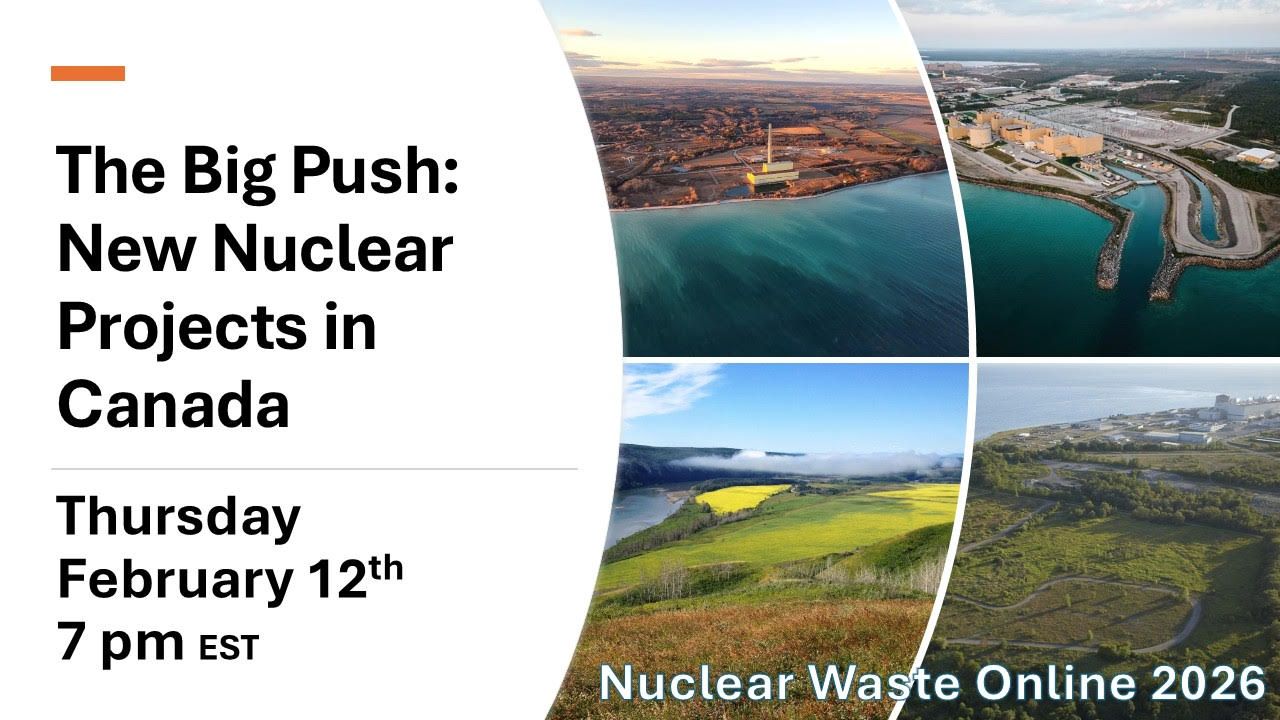
Thursday, February 12, 7 pm Eastern | 2nd of 4 sessions in the 2026 Nuclear Waste Online webinar series
Join a webinar on the push for new nuclear generation in Canada. Go to Northwatch.org to register or use the registration link https://us02web.zoom.us/webinar/register/WN_ZfWOf1GITqSRIZX8CB-A9w
-
Archives
- February 2026 (115)
- January 2026 (308)
- December 2025 (358)
- November 2025 (359)
- October 2025 (376)
- September 2025 (258)
- August 2025 (319)
- July 2025 (230)
- June 2025 (348)
- May 2025 (261)
- April 2025 (305)
- March 2025 (319)
-
Categories
- 1
- 1 NUCLEAR ISSUES
- business and costs
- climate change
- culture and arts
- ENERGY
- environment
- health
- history
- indigenous issues
- Legal
- marketing of nuclear
- media
- opposition to nuclear
- PERSONAL STORIES
- politics
- politics international
- Religion and ethics
- safety
- secrets,lies and civil liberties
- spinbuster
- technology
- Uranium
- wastes
- weapons and war
- Women
- 2 WORLD
- ACTION
- AFRICA
- Atrocities
- AUSTRALIA
- Christina's notes
- Christina's themes
- culture and arts
- Events
- Fuk 2022
- Fuk 2023
- Fukushima 2017
- Fukushima 2018
- fukushima 2019
- Fukushima 2020
- Fukushima 2021
- general
- global warming
- Humour (God we need it)
- Nuclear
- RARE EARTHS
- Reference
- resources – print
- Resources -audiovicual
- Weekly Newsletter
- World
- World Nuclear
- YouTube
-
RSS
Entries RSS
Comments RSS
 nuclear-news