Climate future depends on what action humans take

Climate scientists on Earth’s two futures The worst effects of climate change don’t have to happen, scientists say. But humans’ actions in the near future will determine if they do. CBS News 60 Minutes Overtime, 2020 Oct 04, BYBrit McCandless Farmer
-
- For more than three decades, climate scientists have accurately forecast how carbon emissions would cause a global rise in temperatures. Now they’re looking ahead at the decades to come.
When it comes to predicting the future, scientists do not see just one possible outcome. Rather, they say the actions humans take in the near-term will have a major effect on how Earth changes for generations beyond.
“We need to change our course in the next few years because it’s still possible, I think, to avoid the worst outcomes,” Former NASA scientist James Hansen told 60 Minutes correspondent Scott Pelley…….
California is facing the largest wildfires in its history, the East Coast has already been pummeled by nine powerful storms, and what may be the highest temperature ever recorded on Earth scorched California’s Death Valley.
But as bad as they are, Hansen believes, raging forest fires and destructive hurricanes will not be Earth’s worst crises if humans fail to change their actions. The worst consequences will come from permanent changes — rising sea levels and the potential extermination of species.
“We can get back to the old climate if we haven’t caused irreversible things,” Hansen said. “If we lose our coastal cities, that’s irreversible on any time scale that we would care about. And also, the loss of species. So those are the things that I worry about. But those are … late-in-century effects which our children and grandchildren will feel.”
Stopping climate change before irreversible effects have damaged the planet is possible, some scientists believe. …….
According to the latest models, how much the planet will warm is mostly a function of how much carbon humans have burned up to now. If all carbon emissions were to cease today, Mann said, both plants and the ocean would increase the amount of carbon they take out of the atmosphere. As a result, temperatures would remain fairly flat.
“We are only committed to the warming that has happened already,” Mann said. “If we stop burning carbon now, we stop the warming of the planet. In a sense, that is empowering. It tells us we can have a real impact.”
That does not necessarily mean the damage that has been done is reversible. Future generations may be able to figure it out, Mann said—but only if humans halt the planet’s warming. https://www.cbsnews.com/news/climate-scientists-earth-future-60-minutes-2020-10-04/
David Attenborough’s call – ‘Curb excess capitalism’ to save nature
Attenborough: ‘Curb excess capitalism’ to save nature, BBC, 8 October 2020
Sir David Attenborough says the excesses of western countries should “be curbed” to restore the natural world and we’ll all be happier for it.
The veteran broadcaster said that the standard of living in wealthy nations is going to have to take a pause.
Nature would flourish once again he believes when “those that have a great deal, perhaps, have a little less”.
Sir David was speaking to Liz Bonnin for BBC Radio 5 Live’s new podcast ‘What Planet Are We On?’.
Speaking personally and frankly, Sir David explained, “We are going to have to live more economically than we do. And we can do that and, I believe we will do it more happily, not less happily. And that the excesses the capitalist system has brought us, have got to be curbed somehow.”
“That doesn’t mean to say that capitalism is dead and I’m not an economist and I don’t know. But I believe the nations of the world, ordinary people worldwide, are beginning to realise that greed does not actually lead to joy.”
Sir David said when we help the natural world, it becomes a better place for everyone and in the past, when we lived closer to nature, the planet was a “working eco-system in which everybody had a share”.
The 10-part podcast is being released on the second anniversary of the publication of a key scientific report on global warming.
The Intergovernmental Panel on Climate Change study looked at how the world would cope if temperatures rose by 1.5C by the end of this century.
The IPCC special report, released in October 2018 didn’t “save the planet” but it may yet prove to be the most critical moment in the story of climate change.
The study made two things very clear. The first was that there was a massive difference in keeping the rise in global temperatures this century to 1.5C as opposed to 2C.
Politicians had for years focussed on the higher number – the special report made clear that was a risky strategy, which could see the end of coral reefs and expose millions of people to the threat of floods.
The second key message from the IPCC was that the world could stay under 1.5C if carbon emissions were essentially slashed in half by 2030.
The urgency of the challenge laid out in the report inspired millions of young people to take action. This pressure is filtering up to politicians…….. https://www.bbc.com/news/science-environment-54268038
Nuclear and renewables – mutually exclusive: renewables better for climate action
Comparative impact of nuclear and renewables on CO2 emissions, By Philippe Gauthier, Resilience.org October 9, 2020 Countries which are heavily invested in nuclear energy remain higher CO2 emitters, on average, than countries which have invested at the same level in renewable energy. This is the main finding of a study recently published in the journal Nature Energy. The results also tend to confirm the hypothesis that it is difficult to commit both to nuclear and renewables due to a systemic incompatibility between these two approaches.
The work aimed to assess three hypotheses. The first is that the greater a country’s nuclear power generation capabilities, the lower its greenhouse gas emissions are. The second is that the greater a country’s renewable energy generation capabilities, the lower its emissions are. The third is that nuclear and renewables coexist uneasily within a national energy system and that the dominance of either delays or prevents the adoption of the other………….
Explanatory factors
What explains these rather unfavorable results for nuclear power? Data collected by the researchers shows that, on average, the delivery time is 90 months for nuclear projects, compared to 40 months for solar and wind projects. Only hydropower has longer lead times. Nuclear and hydropower projects are more prone to delays and cost overruns than smaller-scale renewable projects, which yield low carbon energy more quickly.
Renewables are also associated with a positive learning curve whereby each completed project decreases the costs and increases the performance of subsequent projects. In comparison, nuclear power exhibits a negative learning curve. The study specifically cites the case of France, where each new generation of reactors has involved increased costs or lower performance. The tightening of safety measures after each major accident (Three Mile Island, Chernobyl, Fukushima) has greatly contributed to these increased costs in every country.
The study concludes that renewables have a demonstrable record of reducing greenhouse gas emissions. Nuclear power has a more mixed record, due to the different nature of the energy systems in which it operates. Finally, the results tend to confirm the hypothesis of mutual exclusion already widely noted in the scientific literature. According to the researchers, countries that think they can obtain emission reductions by investing in nuclear energy may actually be forgoing even greater reductions that could be achieved by renewables.
Source:
Benjamin K. Sovacool et al. Differences in carbon emissions reduction between countries pursuing renewable electricity versus nuclear power, in Nature Energy, October 5, 2020 https://www.nature.com/articles/s41560-020-00696-3.epdf?
Conservative UK government is considering a carbon tax, in its commitment to reduce greenhouse gas emissions
 Times 9th Oct 2020, Rishi Sunak is examining proposals for a UK-wide carbon tax that could
raise billions of pounds while encouraging the drive towards net-zero emissions. The chancellor is seeking to replace existing EU carbon-reduction schemes with the new tax when the transition period finishes at the end of the year.
“The danger with relying solely on a carbon tax is that no one believes politicians will not scrap it when things get tough, so no one invests. A cap and trade scheme that guarantees an outcome, alongside regulation and innovation support, is much more likely to lead to cuts in emissions.”https://www.thetimes.co.uk/edition/news/sunak-plans-carbon-emissions-tax-to-help-rebuild-economy-jbl3gs993
Countries that have included nuclear in their green stimulus plans may want to rethink their strategy
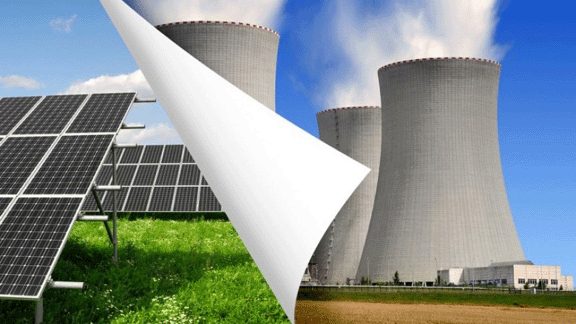
now, a new study spearheaded by the UK’s University of Sussex (UoS) for the scientific journal Nature Energy, shows that nuclear might not even be that great for lowering carbon emissions.
In fact, the study found that renewables are “up to seven times more effective at reducing carbon emissions than nuclear power.” As summarized by PV Magazine, the study “concluded nuclear could no longer be considered an effective low carbon energy technology, and suggests that countries aiming to rapidly and cost-effectively reduce their energy emissions should prioritize renewables.” …………
This study comes at an essential moment in which nations around the world are designing economic stimulus packages to overcome the recession being ushered in by the novel coronavirus pandemic. Countries that have included nuclear in their green stimulus plans may want to rethink their strategy–even if it’s in concert with investment in renewables. Another report by Science Daily this week shows that trying to adopt a hybrid approach that includes both nuclear and renewables is even less effective. At a time when the world is reckoning with and engineering a “new energy order” and a “great reset, such findings have never been so important, and governments around the world would do well to read the reports. https://oilprice.com/Alternative-Energy/Nuclear-Power/The-Biggest-Obstacle-For-Nuclear-Energy.html
Nuclear power, irrelevant to climate change – and in fact, hinders climate action
|
Countries investing in renewables are achieving carbon reductions far faster than those which opt to back nuclear power.Thomson Reuters Foundation, 7 Oct 20 Countries wishing to reduce carbon emissions should invest in renewables, abandoning any plans for nuclear power stations because they can no longer be considered a low-carbon option. That is the conclusion of a study by the University of Sussex Business School, published in the journal Nature Energy, which analysed World Bank and International Energy Agency data from 125 countries over a 25-year period. The study provides evidence that it is difficult to integrate renewables and nuclear together in a low-carbon strategy, because they require two different types of grid. Because of this, the authors say, it is better to avoid building nuclear power stations altogether. A country which favours large-scale nuclear stations inevitably freezes out the most effective carbon-reducing technologies − small-scale renewables such as solar, wind and hydro power, they conclude. Perhaps their most surprising finding is that countries around the world with large-scale nuclear programmes do not tend to show significantly lower carbon emissions over time. In poorer countries nuclear investment is associated with relatively higher emissions. The study found that in some large countries, going renewable was up to seven times more effective in lowering carbon emissions than nuclear. The findings are a severe blow to the nuclear industry, which has been touting itself as the answer to climate change and calling itself a low-carbon energy. The scientists conclude that if countries want to lower emissions substantially, rapidly and as cost-effectively as possible, they should invest in solar and wind power and avoid nuclear.
“Countries planning large-scale investments in new nuclear power are risking suppression of greater climate benefits from alternative renewable energy investments.” The report says that as well as long lead times for nuclear, the necessity for the technology to have elaborate oversight of potentially catastrophic safety risks, security against attack, and long-term waste management strategies tends to take up resources and divert attention away from other simpler and much quicker options like renewables. Consistent resultsThe nuclear industry has always claimed that countries need both nuclear and renewables in order to provide reliable power for a grid that does not have input from coal- or gas-fuelled power stations. This study highlights several other papers which show that a reliable electricity supply is possible with 100 per cent renewables, and that keeping nuclear in the mix hinders the development of renewables. Patrick Schmidt, a co-author from the International School of Management in Munich, said: “It is astonishing how clear and consistent the results are across different time frames and country sets. In certain large country samples the relationship between renewable electricity and CO2 emissions is up to seven times stronger than the corresponding relationship for nuclear.” As well as being a blow to the nuclear industry, the paper’s publication comes at a critical time for governments still intending to invest in nuclear power. For a long time it has been clear that most advanced democratic countries which are not nuclear weapons states and have no wish to be have been investing in renewables and abandoning nuclear power, because it is too expensive and unpopular with the public. In Europe they include Germany, Italy and Spain, with South Korea in the Far East. Nuclear weapons needsNuclear weapons states like the UK and the US, which have both admitted the link between their military and civilian nuclear industries, continue to encourage the private sector to build nuclear stations and are prepared to provide public subsidy or guaranteed prices to induce them to do so. With the evidence presented by this paper it will not be possible for these governments to claim that building new nuclear power stations is the right policy to halt climate change. Both Russia and China continue to be enthusiastic about nuclear power, the cost being less important than the influence gained by exporting the technology to developing countries. Providing cheap loans and nuclear power stations gives their governments a long-term foothold in these countries, and involves controlling the supply of nuclear fuel in order to keep the lights on. Andy Stirling, professor of science and technology policy at Sussex and also a co-author, said: “This paper exposes the irrationality of arguing for nuclear investment based on a ‘do everything’ argument. “Our findings show not only that nuclear investments around the world tend on balance to be less effective than renewable investments at carbon emissions mitigation, but that tensions between these two strategies can further erode the effectiveness of averting climate disruption.” This story was published with permission from Climate News Network. |
|

Major study finds that renewables lower emissions substantially, and nuclear power does not
Two’s a crowd: Nuclear and renewables don’t mix, https://techxplore.com/news/2020-10-crowd-nuclear-renewables-dont.html by University of Sussex OCTOBER 5, 2020
If countries want to lower emissions as substantially, rapidly and cost-effectively as possible, they should prioritize support for renewables, rather than nuclear power, the findings of a major new energy study concludes.
That’s the finding of new analysis of 123 countries over 25 years by the University of Sussex Business School and the ISM International School of Management which reveals that nuclear energy programs around the world tend not to deliver sufficient carbon emission reductions and so should not be considered an effective low carbon energy source.
Researchers found that unlike renewables, countries around the world with larger scale national nuclear attachments do not tend to show significantly lower carbon emissions—and in poorer countries nuclear programs actually tend to associate with relatively higher emissions.
Published today in Nature Energy, the study reveals that nuclear and renewable energy programs do not tend to co-exist well together in national low-carbon energy systems but instead crowd each other out and limit effectiveness.
Benjmin K Sovacool, Professor of Energy Policy in the Science Policy Research Unit (SPRU) at the University of Sussex Business School, said: “The evidence clearly points to nuclear being the least effective of the two broad carbon emissions abatement strategies, and coupled with its tendency not to co-exist well with its renewable alternative, this raises serious doubts about the wisdom of prioritizing investment in nuclear over renewable energy. Countries planning large-scale investments in new nuclear power are risking suppression of greater climate benefits from alternative renewable energy investments.”
The researchers, using World Bank and International Energy Agency data covering 1990-2014, found that nuclear and renewables tend to exhibit lock-ins and path dependencies that crowd each other out, identifying a number of ways in which a combined nuclear and renewable energy mix is incompatible.
These include the configuration of electricity transmission and distribution systems where a grid structure optimized for larger scale centralized power production such as conventional nuclear, will make it more challenging, time-consuming and costly to introduce small-scale distributed renewable power.
Similarly, finance markets, regulatory institutions and employment practices structured around large-scale, base-load, long-lead time construction projects for centralized thermal generating plant are not well designed to also facilitate a multiplicity of much smaller short-term distributed initiatives.
Andy Stirling, Professor of Science and Technology Policy at the University of Sussex Business School, said: “This paper exposes the irrationality of arguing for nuclear investment based on a ‘do everything’ argument. Our findings show not only that nuclear investments around the world tend on balance to be less effective than renewable investments at carbon emissions mitigation, but that tensions between these two strategies can further erode the effectiveness of averting climate disruption.”
The study found that in countries with a high GDP per capita, nuclear electricity production does associate with a small drop in CO2 emissions. But in comparative terms, this drop is smaller than that associated with investments in renewable energy.
And in countries with a low GDP per capita, nuclear electricity production clearly associates with CO2 emissions that tend to be higher.
Patrick Schmid, from the ISM International School of Management München, said: “While it is important to acknowledge the correlative nature of our data analysis, it is astonishing how clear and consistent the results are across different time frames and country sets. In certain large country samples the relationship between renewable electricity and CO2-emissions is up to seven times stronger than the corresponding relationship for nuclear.”
USA ‘s Environment and climate cases face a bleak future with a Republican dominated Supreme Court
 HOW WILL CLIMATE AND ENVIRONMENTAL CASES FARE ON A 6-3 CONSERVATIVE SUPREME COURT? THE ALLEGHENY FRONT, REID FRAZIER, OCTOBER 2, 2020
It appears that President Trump has enough votes in the Senate to confirm Supreme Court nominee Amy Coney Barrett before Election Day. That means the court’s balance would tip from a 5 to 4 advantage for conservatives to 6 to 3. What would this majority mean for the environment?
For our podcast, Trump on Earth, Reid Frazier examines what the loss of RBG could mean for the environment with Ellen Gilmer, senior legal reporter for Bloomberg Law.
But first, we take a look back at Ginsburg’s environmental legacy with Pam King and Jeremy Jacobs, reporters for E&E News who wrote in a recent article, “The passing of Supreme Court Justice Ruth Bader Ginsburg could shake the foundation of America’s bedrock environmental laws, leaving a chasm on the bench where once sat an environmental champion.” (Read the transcript to that interview HERE.)
(The interviews were conducted before Amy Coney Barrett was nominated to fill Justice Ruth Bader Ginsburg’s seat on the Supreme Court.)
Listen to the full episode or read the transcript below:
Coastal flooding will disproportionately impact 31 million people globally
Coastal flooding will disproportionately impact 31 million people globally
Indiana University researchers analyzed these geographic regions, which include cities like New Orleans, Bangkok, and Shanghai, using a new global dataset to determine how many people live on river deltas, how many are vulnerable to a 100-year storm surge event, and the ability of the deltas to naturally mitigate impacts of climate change.
Severe floods in Italy and France
A storm which moved overnight across southeastern France, and then northern Italy caused major flooding on both sides of the border, damaging homes, destroying bridges, blocking roads and isolating communities………
Unrelenting rainfall overnight hit levels not seen since 1958 in northern Italy’s Piedmont region, where 630mm (24.8 inches) of rain fell in 24 hours, according to the Italian civil protection agency.
Two brothers were swept away by floodwaters while they were tending animals near the French border. One brother managed to grab onto a tree and was saved, while authorities were searching on the French side for the other brother.
Flooding in France
On the other side of the border, in southeastern France, almost a year’s average rainfall fell in less than 12 hours in the mountainous area surrounding the city of Nice.
Local firefighters said at least eight people were missing, including two firefighters whose vehicle was swept away by water when the road collapsed during a rescue operation. Several dozen people were evacuated from their homes overnight, firefighters said.
The storm, dubbed Alex, ravaged several villages around the city of Nice on the French Riviera. Nice Mayor Christian Estrosi called it the most severe flooding disaster in the area for more than a century after flying over the worst-hit area by helicopter.
“The roads and about 100 houses were swept away or partially destroyed,” he told French news channel BFM……. https://www.aljazeera.com/news/2020/10/3/one-killed-25-missing-in-severe-floods-in-italy-and-france
The climate crisis is heating up nights faster than days in many parts of the world
 Global heating warming up ‘nights faster than days’
Effect seen across much of world will have profound consequences, warn scientists . https://www.theguardian.com/environment/2020/oct/01/global-heating-warming-up-nights-faster-than-days Damian Carrington Environment editor @dpcarrington, Thu 1 Oct 2020 09. The climate crisis is heating up nights faster than days in many parts of the world, according to the first worldwide assessment of how global heating is differently affecting days and nights.
The findings have “profound consequences” for wildlife and their ability to adapt to the climate emergency, the researchers said, and for the ability of people to cool off at night during dangerous heatwaves.
The scientists compared the rises in daytime and night-time temperatures over the 35 years up to 2017. Global heating is increasing both, but they found that over more than half of the world’s land there was a difference of at least 0.25C between the day and night rises.
In two-thirds of those places, nights were warming faster than the days, Continue reading
‘We have a chance’: David Attenborough says $500 billion needed to save earth
‘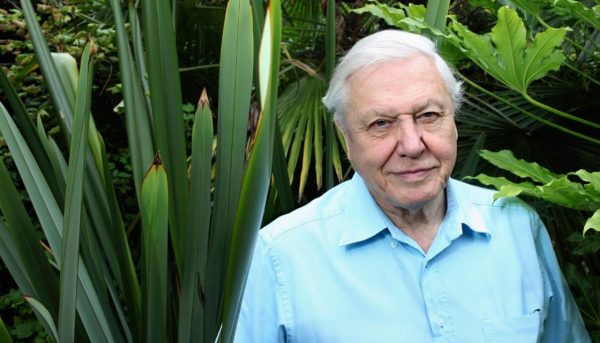 We have a chance’: David Attenborough says $500 billion needed to save earth, https://thenewdaily.com.au/news/world/2020/10/01/david-attenborough-un-summit-climate-change/ Attenborough: $500 billion a year for natureBritish broadcaster David Attenborough led a call from conservation groups on Wednesday for the world to invest $500 billion a year to halt the destruction of nature. Olivia Chan reports., Matthew Green
British broadcaster Sir David Attenborough is leading a call from conservation groups for the world to invest $US500 billion ($A700 billion) a year to halt the destruction of nature.
Sir David, whose latest film documents the dangers posed by climate change and the extinction of species, issued the call as the United Nations convened a one-day summit aimed at galvanising action to protect wildlife.
“Our natural world is under greater pressure now than at any time in human history, and the future of the entire planet – on which every single one of us depends – is in grave jeopardy,” Sir David, 94, said in a statement on Thursday (Australian time).
“We still have an opportunity to reverse catastrophic biodiversity loss, but time is running out.”
Opening the summit in New York, UN Secretary-General Antonio Guterres warned that a million species were at risk of extinction and that climate change and the loss of biodiversity were “destroying earth’s web of life”.
“We are part of that fragile web and we need it to be healthy so we and future generations may thrive,” Mr Guterres said.
The call to redirect financing away from fossil fuels and other polluting industries and into locally led conservation was launched by environmental group Fauna & Flora International and backed by more than 130 organisations.
The world spends an estimated $US80-90 billion ($A112-125 billion) on conservation each year, but studies show that hundreds of billions of dollars may be needed to save ecosystems from collapse.
Britain, Canada and others joined the European Union on Monday in pledging to protect 30 per cent of their land and seas by 2030.
UN officials hope to secure a global agreement on that target at a major round of negotiations on biodiversity due to take place in China in 2021.
Accelerating rate of ice sheet loss from Greenland
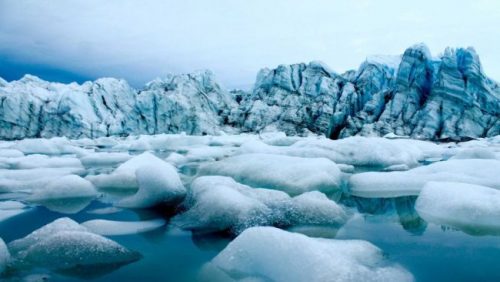 Greenland ice sheet loss already ‘unprecedented’ and set to accelerate Greenland ice sheet loss already ‘unprecedented’ and set to accelerate
Given our lag in getting emissions down since then, Professor Steffen said he doesn’t think 1.5C is still realistically achievable, but keeping warming below 2C is. ABC Science By environment reporter Nick Kilvert, 30 Sept, 20
Melting of the Greenland ice sheet has hit a rate unmatched in the last 12,000 years and is accelerating, scientists have confirmed. Key points:
Research published in Nature today predicts that the Greenland ice sheet will be melting by as much as six times its current rate by the end of the century if we don’t get emissions down. On the flipside, if we can achieve the best-case emissions reduction scenario forecast by the IPCC we can limit its increasing melt rate to around 40 per cent greater than its present rate. While he is cautiously optimistic, Professor Steffen said what is equally important is how they get there. Currently China are responsible for about a quarter of the world’s greenhouse gas production, and if they begin rapidly cutting emissions from today right through until 2060, then that is significant, he said. But if they continue burning fossil fuels and make rapid cuts at the last minute, the damage will already be done. “We use what’s called the carbon budget approach to estimate how much temperature is going to rise — that is the cumulative emissions between now and net-zero [emissions],” Professor Steffen said. “If [China] get their emissions down really quickly, say by 2040, that’s a big difference between whether they coast to 2050 and then cut them over a decade.” On the flipside, if we can achieve the best-case emissions reduction scenario forecast by the IPCC we can limit its increasing melt rate to around 40 per cent greater than its present rate…. As the earth emerged from the last Ice Age around 11,000 years ago, the Arctic experienced a warm period or thermal maximum between about 10,000 and 7,000 years before present. Researchers presumed that the rate of melting of the Greenland ice sheet in that period was higher than it is today. Instead, they found that over the last 20 years, the southwestern Greenland ice sheet where this research was focussed, has been losing ice at an rate of about 6,100 billion tonnes per century on average — around 100 billion tonnes more than at its previous historical peak, according to author Jason Briner from the University of Buffalo. “Our results suggest that yes, this century we will experience ice-loss rates not just similar to those in the past but exceeding those of the past, even under strict carbon emissions scenarios,” Professor Briner said. Worst-case scenario would see 600% increase in melting this centuryAs well as comparing present-day melting with the past, they looked at how different global greenhouse gas emissions trajectories would impact melting over the coming century. They modelled the IPCC’s best-case emissions scenario, called Representative Concentration Pathway (RCP) 2.6, and the worst-case emissions scenario called RCP 8.5. Under RCP 2.6, emissions are drastically reduced starting now and we achieve net-negative emissions this century. That is, we get our emissions to zero and also draw greenhouse gases from the atmosphere through technology or by boosting natural sinks like forests and blue carbon. Under RCP 2.6 we limit global average warming to within 2 degrees Celsius by 2100. On the other hand, under RCP 8.5 we continue burning fossil fuels as per usual, making no substantial efforts to reduce our greenhouse gas emissions through to 2100. Under the RCP 2.6 scenario, their models forecast that melting of the southwestern Greenland ice sheet would increase to around 8,800 billion tonnes per century on average by 2100 — about a forty per cent increase on today’s rate. But under the worst-case RCP 8.5 scenario, they forecast the southwestern Greenland ice sheet could be losing up to 35,900 billion tonnes per century — an increase of nearly 600 per cent on today’s melting rate. Although their study area didn’t encompass the entire ice sheet, Professor Briner said Greenland tends to melt fairly uniformly. “Based on reconstructions of ice sheet changes over the past several decades, it has been shown that when the ice sheet loses mass in our study area, it loses mass across its entire surface,” he said.
The study is an important demonstration of the difference that we can make by cutting emissions, according to David Etheridge from the CSIRO’s Climate Science Centre. “The range of predictions shows a high sensitivity to emissions scenarios with the possibility to limit ice loss with low emissions,” Dr Etheridge said. ‘We still have time’ to slow down sea level riseModelling sea level rise was outside the bounds of this study, but the researchers tentatively suggest that the worst-case scenario melting from the southwestern Greenland ice sheet would add around 10 centimetres to sea levels this century. If that was scaled to the entire ice sheet, that would likely be “doubled or tripled”, Professor Briner said. And that’s without accounting for any melting from the Antarctic ice sheet. Research published earlier this month in Nature found that the Antarctic ice sheet will add 1.3 metres to sea level for every degree of warming up to 2 degrees Celsius above pre-industrial levels. That research found that we have locked in at least two-and-a-half metres of sea level rise from Antarctica, regardless of what happens with our emissions from now on. But it’s the rate at which the melting happens that we have some control over and is the crucial issue, according to Will Steffen from the ANU’s Climate Change Institute. “We can still influence the rate at which Greenland melts and thus the rate that sea level rises. That’s the important message,” Professor Steffen said.
Rather than needing to adapt and shift coastal communities over decades, we can buy ourselves a century or more if we act to get emissions down immediately, Professor Steffen said. When countries signed up to the Paris Agreement in 2015, the aim was to keep warming to 1.5C. Given our lag in getting emissions down since then, Professor Steffen said he doesn’t think 1.5C is still realistically achievable, but keeping warming below 2C is. |
|
The Arctic Has Entered A New Climate State


The Arctic Has Entered A New Climate State, Radio Ecoshock 25 Sept 20 Ice is rapidly disappearing from both Poles. Two polar ice experts report latest science. From the U.S. National Center For Atmospheric Research in Colorado, Arctic scientist Laura Landrum: in 2020, the Arctic has reached a new climate state. Thomas Slater from Leeds University UK reports ice loss from glaciers has surpassed the worst case scenarios. Manhattan-size chunks falling away, other ice shelves shatter in unnatural heat and warmed-up seas.
Listen to or download this Radio Ecoshock show ………..
The new water added to the ocean runs away to every country with a sea coast. It runs up estuaries, eats away coastlines, and piles up in every hurricane, high tide and storm. Slater agrees with NASA that in some cases, there is no way to stop these mountains of ice from becoming sea water. This massive change has happened. The tipping point for a grand melting of the world’s second biggest pile of ice, Greenland, was 20 years ago. Like light from the stars, rising seas just take a while to reach us.
Hot in the cold news, this: the Arctic’s largest remaining ice shelf lost a very large chunk of ice, like the volume of mountains, broken away in North Eastern Greenland – floating off into the Atlantic are new melting ice islands twice the size of Manhattan. I won’t try to pronounce the complicated Nordic name. Scientists also call it “79N”. According to satellite images, a portion of the shelf about 110 square kilometers – that’s 42 square miles of thick glacier – just shattered. It fell apart this summer.
This follows absolute record hot summers in the Arctic in 2019 and 2020, on top of the whole region warming around 3 degrees C since 1980. The far north has already gone past 3 degrees C of warming, way beyond the supposed safe line of 1.5 or even 2 degrees C. demanded by the Intergovernmental Panel on Climate Change, and agreed by most governments under the Paris Accord of 2015. The Arctic is already soaring into dangerous warming, and the ice is responding at rates older scientists would never have believed possible. ………….
the change in sea ice cover is, Dr. Laura Landrum, scientist NCAR says, the single largest driver of big climate changes not just in the Arctic, but around the world. Of course our emissions are forcing that change in sea ice cover, by warming not just the atmosphere, but the seas as well.
Now in the Arctic, the traditional expectations for the seasons no longer work. Aboriginal people can no longer hunt at the same times, and animals are confused or spending energy adapting as they can. Plant life will shift. So will insects.
Plus: changes in the Arctic will alter teleconnections to cycles, weather and variability further south. The “new Arctic climate” does not stay in the Arctic. Already we have observations, from Jennifer Francis at Rutgers, that reduction of Arctic sea ice and dramatic changes to the behavior of the Jet Stream further south may be linked. Dr. Landrum agrees. Another scientist on Radio Ecoshock, Dr. Ivana Cvijanovic found evidence of a teleconnection between changes in the Arctic and rainfall in California. …….
There is no going back to the old Arctic. Summer sea ice will not return to levels seen in the 1950’s, when a crossing of the Northwest passage was a major newsworthy expedition requiring ice-breakers. Now individuals in yachts travel across the Canadian Arctic by themselves, while tankers and freighters move in the Arctic Ocean above Siberia, significantly shortening the route from China to Europe. From shipping to hope for more oil and gas, big business is betting the new Arctic climate is here to stay.
Will the growing season in the Tundra, formerly about 60 days, get longer? Could the Boreal forests begin to extend into the Arctic? In Siberia, Northwest Canada, and Alaska the treeline extends into the Arctic Circle, (about 66 degrees North). Also, if winters get shorter, that could mean an increase in Arctic wildfires. Even “more” rain does not necessarily mean more rain in the fire season. Rain may not stop wildfires, especially as Mike Flannigan told us that thin northern soils can dry out and be ready to burn just 3 sunny days after a rainfall. ……
THOMAS SLATER – GLACIER MELT HIGHER THAN WORST CASE SCENARIO, Dr. Thomas Slater, University of Leeds We are trying to look forward in time, to see what the force of rising seas will do. For me, one of the clearest examples comes with higher storm surges, like the dramatic flooding of lower Manhattan during Hurricane Sandy in October of 2012. Are we already at a point where Polar ice loss is bringing more intense disasters?
Discussing an article in Nature published August 13, Grace Palmer in scitechdaily quotes scientist Marco Tedesco saying the percentage contribution of Greenland to sea level rise could increase from 20 to 25 percent now, to 30 or 40 percent by the end of the century.
We begin our state-of-the-glaciers talk with the sad example of the Okjökull Glacier (simple known as Ok) in Iceland. It is the first world glacier declared “dead” due to climate change. On that site is a plaque reading:
A letter to the future
Ok is the first Icelandic glacier to lose its status as a glacier.
In the next 200 years all our glaciers are expected to follow the same path.
This monument is to acknowledge that we know
what is happening and what needs to be done.
Only you know if we did it.
……….. , our climate situation is even worse than the best scientists thought. NASA has a mas balance graphic showing Greenland Ice Loss 2002-2016. That graphic reveals a steady staircase down in the balance of Greenland ice.
THE BIG TWO ON SEA LEVEL RISEWhen it comes to sea level rise, two key points:
1. more sea level rise is now coming from glacial meltwater than thermal expansion of warming seas
2. about 60% of that added sea level is coming from Greenland – more than from Antarctica……. https://www.ecoshock.org/2020/09/the-arctic-has-entered-a-new-climate-state.html
Satellite imagery shows North Korea’s Yongbyon Nuclear Center is drying off after breaching of overflow dam
 North Korea’s Yongbyon Nuclear Center: Drying Off, 38 NORTH BY: PETER MAKOWSKY, FRANK PABIAN, JACK LIU AND JENNY TOWN, SEPTEMBER 25, 2020 EXCELLENT SATELLITE IMAGERY
Commercial satellite imagery of the Yongbyon Nuclear Scientific Research Center from September 21 reveals minimal damage to the buildings throughout the complex, but notable damage along the river. Moreover, the breaching of the overflow dam, which regulates the water level of the river adjacent to the reactor area, raises a more serious concern about the ability to maintain a steady reservoir of water for the reactors when they may be operating in the future.
Additionally, substantial grain drying activities are observed throughout the complex and nearby town. While this is a common occurrence during the harvest season, the scale of what is taking place is well beyond what has been observed in previous years.
Reactor Area
There are no observable indications that the 5 MWe reactor is operating or that the Experimental Light Water Reactor (ELWR) has been started. Some vehicles are present around the 5 MWe reactor area, but this has become fairly common over the past year.
The typhoons, which recently impacted North Korea’s west coast, have once again shown the vulnerability of the reactors to seasonal flooding. This is despite the numerous measures taken to protect the site, including dredging along the riverbank to build up the embankments.
The eastern end of the reservoir dam has been breached, resulting in a dramatically lower water level behind the dam, a sharp contrast with the previously reported flooding. The reduced water level has left the two pumphouses servicing the reactors “high and dry,” with the water level above the dam down significantly and the intake cisterns exposed.
The inability to maintain a stable reservoir level, regardless of weather conditions, poses a potential problem for continuous reactor operations if the 5 MWe reactor is restarted or the ELWR is brought online.
Uranium Enrichment Plant (UEP)
At the Uranium Enrichment Plant, what appeared to be work on the cooling units in July to repair, replace or remove old units seems to have been suspended as post-typhoon clean up and repairs and harvest-related activities are currently underway.
Construction and clean-up on the nearby causeway and bridge continues. It appears that sections of the two man-made islands and channels that were damaged from previous flooding are undergoing repairs……. https://www.38north.org/2020/09/yongbyon092520/
1 This Month



26 September – International Day for the Total Elimination of Nuclear Weapons


PLEASE OPPOSE HR 8255 AND S.3639 – bills would accelerate satellite deployment, with no environmental review or safeguards – https://ncstd5li.quorum.us/campaign/169331/
To see nuclear-related stories in greater depth and intensity – go to https://nuclearinformation.wordpress.com
-
Archives
- September 2026 (257)
- August 2026 (330)
- July 2026 (355)
- June 2026 (287)
- May 2026 (306)
- April 2026 (356)
- March 2026 (251)
- February 2026 (267)
- January 2026 (308)
- December 2025 (358)
- November 2025 (359)
- October 2025 (375)
-
Categories
- 1
- 1 NUCLEAR ISSUES
- business and costs
- climate change
- culture and arts
- ENERGY
- environment
- health
- history
- indigenous issues
- Legal
- marketing of nuclear
- media
- opposition to nuclear
- PERSONAL STORIES
- politics
- politics international
- Religion and ethics
- safety
- secrets,lies and civil liberties
- spinbuster
- technology
- Uranium
- wastes
- weapons and war
- Women
- 2 WORLD
- ACTION
- AFRICA
- Atrocities
- AUSTRALIA
- Christina's notes
- Christina's themes
- culture and arts
- Events
- Fuk 2022
- Fuk 2023
- Fukushima 2017
- Fukushima 2018
- fukushima 2019
- Fukushima 2020
- Fukushima 2021
- general
- global warming
- Humour (God we need it)
- Nuclear
- RARE EARTHS
- Reference
- resources – print
- Resources -audiovicual
- Weekly Newsletter
- World
- World Nuclear
- YouTube
-
RSS
Entries RSS
Comments RSS

