Experts are calling for international collaboration to combat wildfires
Independent 22nd Aug 2020, Experts are calling for international collaboration to combat wildfires,
which they say are an under-acknowledged component of the climate crisis.
Extreme fire conditions in Siberia this summer, ongoing and devastating
blazes across California and the worst start to the Amazon fire season in a
decade are sparking concern from across the scientific community.
“People globally should start to perceive wild land fires as part of the global
climate crisis, and then, try to find where the solutions require global
participation” says Anton Beneslavsky, from Greenpeace International.
28 trillion tonnes of ice have disappeared from the surface of the Earth since 1994.

the Earth since 1994. That is stunning conclusion of UK scientists who have
analysed satellite surveys of the planet’s poles, mountains and glaciers
to measure how much ice coverage lost because of global heating triggered
by rising greenhouse gas emissions.
Edinburgh universities and University College London – describe the level
of ice loss as “staggering” and warn that their analysis indicates that
sea level rises, triggered by melting glaciers and ice sheets, could reach
a metre by the end of the century.
centimetre of sea level rise means about a million people will be displaced
from their low-lying homelands,” said Professor Andy Shepherd, director
of Leeds University’s Centre for Polar Observation and Modelling.
Scotland’s Covid-19 recovery and Climate Policy
|
THE Scottish Government remains “absolutely committed” to meeting emissions
reduction targets despite the Covid-19 crisis, Environment Secretary Roseanna Cunningham has said. She described the virus as an “unprecedented global crisis” but also insisted the need to tackle climate change has not gone away. She spoke out on the issue on Earth Overshoot Day – which marks
the date when global demand for ecological resources and services exceeds what the planet can regenerate. Although Cunnignham insisted that “no aspect of this terrible pandemic is to be celebrated” she said coronavirus had underlined “the changes we could see in our environment in the long term if, at this critical juncture, we choose not to return to previous practice”. She added: “Resetting our pathway towards a sustainable net-zero
future, while creating good jobs for people across Scotland, will be the core objective of a just and green recovery from Covid-19.” Cunningham stressed: “We must learn lessons for the future, redesign our economy and create a different way of life to support a greener, more sustainable society which will secure the wellbeing of our planet for generations to come. |
|
Global warming is bringing new “fire regime”all too quickly
Record Arctic blazes may herald new ‘fire regime’ decades sooner than anticipated, more https://www.washingtonpost.com/weather/2020/08/14/record-arctic-fires/?arc404=true Other signs of rapid Arctic warming are evident, including the partial loss of a symbolic Canadian ice shelf, WP, By Andrew Freedman and Lauren Tierney, August 14 2020
The Arctic summer of 2019 was supposed to be an outlier. Featuring massive blazes in Siberia, including what scientists strongly suspected were smoldering fires beneath the peat in the carbon-rich soils of the transition zone between the tundra and Arctic taiga, last year set records for emitting planet-warming greenhouse gases via wildfires. Many scientists thought it might be a one-off, considering that computer model projections tend to show that the emergence of such extreme fire years won’t happen until mid-century.
However, this year is proving those scientists wrong. And it raises the unsettling possibility that fire seasons that begin much earlier than average and end later — and affect delicate Arctic ecosystems — could soon be the new normal. Wildfires continue to burn unimpeded across Siberia, as they have since May, after getting an unusually early start to the fire season. A thick blanket of smoke has turned the sky a milky gray in Siberia’s cities, with some smoke making it across the Pacific into Alaska and Canada’s Hudson Bay.
In fact, according to Mark Parrington, senior scientist and wildfire expert at the European Union’s Copernicus Atmosphere Monitoring Service, Siberian wildfire smoke has been seen around the world as it hitches a ride on upper air winds. To track wildfires and estimate their emissions of planet-warming carbon dioxide, black carbon and more, Parrington uses satellite instruments to detect heat signals all over the world.
He and his colleagues then use the temperature of the signals to arrive at an estimate of the energy emitted by each fire, by making the assumption that a particular amount of biomass (plants, grasses and trees, for example) is needed to burn at that temperature. This measure of the rate of radiant heat output from a fire is known as “radiatiative power,” which can then be translated into estimated emissions.
Based on data stretching back to 2003, when the satellite sensors began recording reliable data, Parrington says Arctic fires released more carbon dioxide in June and July this year than during any complete fire season before that. This is an especially noteworthy milestone, since 2019 itself had been a record-breaker for Arctic wildfires. This year, some of the Arctic fires were burning so far north that they were spotted bordering sea ice cover.
Looking at carbon emissions from fires in the Arctic Circle, Parrington says 2020 is already the top year even when the Jan. 1 to Aug. 11 period is considered, vs. the full 365 days for each of the other years. Last year had set a record for such emissions, with 180 megatons of carbon dioxide emitted by Arctic fires, but 2020 has eclipsed it so far, with about 240 megaton through Aug. 11. Parrington said Arctic wildfire emissions rose significantly from June into July, particularly in the northern Russia Sakha Republic, a pattern also observed last year.
“It’s an indicator that something’s changed in the environment there,” he said of the fire activity of the past two summers.
Jessica McCarty, a wildfire expert at Miami University of Ohio with experience working in the Siberian Arctic, said Parrington’s emissions estimates are probably underestimates, since satellites don’t detect the heat signatures from Arctic peat fires. Such blazes smolder without open flames above the surface, consuming ancient organic matter and freeing up planet-warming gases such as methane and carbon dioxide that had been locked away. This, along with permafrost melt, acts to speed up global warming as part of a self-reinforcing cycle.
McCarty has searched through the scientific literature from Arctic nations as part of a report she is co-authoring for the Arctic Council. “This is the type of fire event that would be described by these worst-case modeling scenarios that were supposed to occur mid-century,” she said, adding that we may be 30 years early in seeing such fire impacts, which would require a reevaluation of how the Arctic is responding to global warming.
[Rapid Arctic meltdown in Siberia alarms scientists]
For next year, she’ll be examining when the fire season starts, where it begins, what types of landscapes burn and what the ignition sources are. Once you log a few extreme fire seasons, she says, the extreme becomes the norm, known to fire researchers as a “fire regime.”
“If seven out of 10 years are extreme years, that’s a fire regime,” McCarty said.
She said a review of scientific literature from Russia and other Arctic nations shows that Siberian fires typically subside in mid- to late August, when the first snows arrive in the Far North. But that assumption may need to be revisited, too. If any fires this year continue into September, she said, “I’ll be really shocked. I don’t know that I’ll have words that are ready to be published.”
The fires were touched off by an unusually hot year to date, which has helped dry out the soils and melt snow cover unusually early in the spring.
For example, temperatures have hit record levels even in the Arctic, north of 66 degrees north latitude. A reading of 100.4 degrees (38 Celsius) on June 20 was probably the hottest temperature on record in the Arctic. It was recorded in Verkhoyansk, about 3,000 miles east of Moscow, on June 20.
The people who live in Siberia and other Arctic regions are used to variable weather. In Verkhoyansk, for example, temperatures can drop to minus-50 degrees in the winter and climb into the 70s during the summer. Yet the persistent warmth so far this year has stood out to climate researchers.
[An oil spill in Russia’s Arctic exposes risks for Moscow’s Far North plans]
“What is incredibly unusual is the persistence of the warm signal” in Siberia, said Samantha Burgess, deputy director of the Copernicus Climate Change Service, in an interview. She said the warmth has had significant implications for the region, ranging from clearing out sea ice north of Siberia unusually early in the summer melt season to contributing to permafrost melt that led to a major oil spill in Norilsk, Russia.
Burgess said the temperature spike in Siberia this summer heralds events to come not only there but in other parts of the Arctic, as well, as the region warms at about three times the rate of the rest of the world. She said the Siberian warm streak is likely to occur again and likely to show up in other parts of the Arctic.
It’s really taken people by surprise how quickly these changes have taken place in the Arctic,” Burgess said.
The Arctic as a whole has had record warm temperatures from May through July, as measured in the lower atmosphere.
Much of Siberia experienced an exceptionally mild winter, followed by a warmer-than-average spring, and it has been among the most unusually warm regions of the world during the summer as well. During May, parts of Siberia had an average monthly temperature that was a staggering 18 degrees Fahrenheit (10 Celsius) above average for the month, according to the Copernicus Climate Change Service. The unusually mild weather has continued through August so far, as an area of high pressure, or heat dome, has been parked over the Siberian Arctic.
Fires and ice
The summer fire and melt season hasn’t just featured an unusual surge in fires and their harmful emissions. It is also bringing dramatic declines in sea ice and, in one prominent case, long-lasting ice attached to land.
Meier says warm ocean waters in other parts of the Arctic could continue melting ice throughout the month, despite the weakening energy from the sun as fall approaches. Sea ice typically reaches its minimum extent in early- to mid-September.
Similar dynamics are playing out in Greenland and Antarctica, where massive glaciers have been destabilized by the disintegration of their ice shelves, which act as doorstops that prevent inland ice from sliding into the sea, where it would dramatically raise sea levels.
Before the breakup of the Canadian shelf into large icebergs, it was about the size of D.C., the Associated Press has reported.
France’s nuclear energy continues to be hit by global heating, drought, water shortage
 Low flow rate may halve output at France’s Saint-Alban nuclear plant, https://in.reuters.com/article/france-nuclear/low-flow-rate-may-halve-output-at-frances-saint-alban-nuclear-plant-idINL8N2FM54B PARIS, Aug 20 (Reuters) – A low flow rate on the Rhone River will likely restrict output on Saturday and Sunday at EDF’s Saint-Alban nuclear plant in southeastern France, French grid operator RTE said on Thursday.The two Saint-Alban reactors produce 1.3 gigawatts (GW) of power each, and the output reduction could be equivalent to the production of one unit, RTE said.
EDF’s use of water is regulated by law to protect plant and animal life. It is obliged to reduce output during hot weather when water temperatures rise, or when river levels and the flow rate are low.
Last month was the driest July in at least 60 years and the first half of August was the second hottest on record, making it the fifteenth consecutive month with higher than average temperatures, Meteo France data showed.
RTE published a similar warning for the Chooz reactors in northern France on Tuesday, as low water levels on the Meuse river risk extending current maintenance periods.
French nuclear availability is currently at 63.6% of total capacity, with 22.7 GW offline. (Reporting by Forrest Crellin; Editing by Jan Harvey)
Unprecedented rise in carbon dioxide in the atmosphere
 Anthropogenic CO2 increase is unprecedented, Science Daily
 - Date:
- August 20, 2020
- Source:
- University of Bern
- Summary:
- Even in earlier warm periods there were pulse-like releases of CO2 to the atmosphere. Today’s anthropogenic CO2 rise, however, is more than six times larger and almost ten times faster than previous jumps in the CO2 concentration.
-
A new measurement technology developed at the University of Bern provides unique insights into the climate of the past. Previous CO2 concentrations in the atmosphere could be reconstructed more accurately than ever before, thanks to high-resolution measurements made on an Antarctic ice core. The study, which analyzed the Earth’s atmospheric composition between 330,000 and 450,000 years ago, was made possible by the commitment of experts, and their decades of experience, at the University of Bern. The results of the study have been published in Science.
Melting ice masses disturbed the ocean circulation…………
- CO2 increase was ten times slower than today ……..
-
 The largest jump in the past corresponds to the current CO2 emissions over only six years
The researchers compared the CO2 jumps of the past with the ongoing human-driven rise of CO2 concentration in the atmosphere. According to Stocker, the largest centennial CO2 jump in the past was around 15 ppm (parts per million is the unit for atmospheric CO2 concentration), which is approximately equivalent to the increase caused by humankind over the last of six years. “This may not seem significant at first glance,” says Stocker, “but in light of the quantities of CO2 that we are still allowed to emit in order to achieve the 1.5°C climate target agreed in Paris, such increases are definitely relevant.” The findings of this study put us under even greater pressure to protect the climate.
Story Source:
Materials provided by University of Bern. https://www.sciencedaily.com/releases/2020/08/200820151335.htm

Permafrost will thaw faster, as global heating causes more rain in the North

|
Climate change is causing more rain in the North. That’s bad news for permafrost
New study shows wetter weather is thawing the frozen ground that covers a quarter of the northern hemisphere, threatening to release massive stores of carbon, The Narwhal, Julien Gignac, Local Journalism Initiative reporter . Aug 20, 2020
Longer, rainier summers are thawing permafrost at an accelerated rate in interior Alaska, according to a new study, begging the question: what does this mean for rainy summers in the Canadian North? “Thawing is happening even faster than we thought,” said Thomas Douglas, an environmental engineer with the U.S. Army Cold Regions Research and Engineering Laboratory and lead author of the study. “We’ve had these crazy wet summers. It’s gonna be bad for permafrost.” The study, published in Nature’s Climate and Atmospheric Science journal, found that between 0.6 and 0.8 centimetres of permafrost thawed for every centimetre of above-average rainfall in Alaska between 2013 and 2017……………… According to a 2015 report by Yukon University, annual precipitation in the territory has increased by six per cent over the past 50 years, with summers seeing the most rainfall compared to other seasons. “Rain water, especially in the summer, is pretty warm and it can move warm, thermal mass down through the soil a lot faster than just warm air temperatures can,” Douglas said. “If you lose three to four weeks of winter to summer, what used to be falling as snow is now falling as rain.”……… According to a 2015 report by Yukon University, annual precipitation in the territory has increased by six per cent over the past 50 years, with summers seeing the most rainfall compared to other seasons. “Rain water, especially in the summer, is pretty warm and it can move warm, thermal mass down through the soil a lot faster than just warm air temperatures can,” Douglas said. “If you lose three to four weeks of winter to summer, what used to be falling as snow is now falling as rain.”……….. it’s not only the North that is impacted by thawing permafrost. Arctic permafrost stores an estimated 1.4 million megatonnes of carbon in frozen organic matter. As it thaws, microorganisms that were dormant when frozen start to break down that matter, releasing carbon and methane into the atmosphere. “It has global ramifications,” Douglas said……………………. we could see all Arctic precipitation levels change in the coming years as sea ice continues to disappear, leaving more open water and more evaporation that eventually becomes precipitation. “As the Arctic Ocean becomes more ice-free in the summer, you would expect many of these areas to become eventually wetter,” Marsh said. https://thenarwhal.ca/climate-change-rain-arctic-permafrost-thaw/ |
|
|
See this How the climate crisis is already harming America – photo essay
 How the climate crisis is already harming America – photo essay
The damage rising temperatures bring is been seen around the country, with experts fearing worse is to come, Guardian , by Oliver Milman in New York, with photographs compiled by Gina Lachman 21 Aug 20
Climate change is not an abstract future threat to the United States, but a real danger that is already harming Americans’ lives, with “substantial damages” to follow if rising temperatures are not controlled.
This was the verdict of a major US government report two years ago. The Trump administration’s attitude to climate change was perhaps illustrated in the timing of the report’s release, which was in the news dead zone a day after Thanksgiving.
The report was the fourth National Climate Assessment (NCA), and is seen as the most authoritative official US snapshot of the impacts of climate change being seen already, and the estimate of those in the future.
It is the combined work of 13 federal agencies, and it warns how climate-related threats to Americans’ physical, social and economic wellbeing are rising, and will continue to grow without additional action.
Here we look at the regions of the US where it describes various impacts, with photography from these areas showing people and places in the US where climate change is very real.
If there was a ground zero for the climate crisis in the US, it would probably be located in Alaska. The state, according to the national climate assessment, is “ on the front lines of climate change and is among the fastest warming regions on Earth”.Sign up to the Green Light email to get the planet’s most important stories
Since the early 1980s, Alaska’s sea ice extent in September, when it hits its annual minimum, has decreased by as much as 15% per decade, with sea ice-free summers likely this century. This has upended fishing routines for remote communities that rely upon caught fish for their food.
The thinning ice has seen people and vehicles collapse into the frigid water below, hampering transport routes.Roads and buildings have buckled as the frozen soils underneath melt. Wildfires are also an increasing menace in Alaska, with three out of the top four fire years in terms of acres burned occurring since 2000. The state’s residents are grappling with a rapidly changing environment that is harming their health, their supply of food and livelihoods.
Last year was the hottest year on record in Alaska, 6.2F warmer than the long-term average.
North-east – snowstorms, drought, heatwaves and flooding…………
Northern Great Plains – flash droughts and extreme heat………
Midwest – heavy rains and soil erosion……
South-east – flooding in Louisiana………
Southern Great Plains – Hurricane Harvey……
South-west – drought in the Colorado river basin reduced Lake Mead by more than half since 2000…….
North-west – wildfire increases and associated smoke…..
Hawaii and Pacific islands – coral bleaching….….
Caribbean – hurricanes…. https://www.theguardian.com/us-news/2020/aug/20/climate-crisis-environment-america
California: 10,849 lightning strikes spark more than 367 fires
|
More than 300,000 acres burned in three days as resource-depleted Calif. battles blazes 10,849 lightning strikes spark more than 367 firesBy Amy Graff, SFGATE, August 19, 2020 In the grips of a rare summer weather pattern marked by blistering heat and violent thunderstorms, California has seen hundreds of wildfires sparked by lightning strikes erupt into monstrous conflagrations that are tearing through a parched landscape and swallowing homes.
Cal Fire spokesperson Jeremy Rahn spoke to the extreme conditions at a Wednesday press briefing and said in the last three days the state experienced a “historic lightning siege” with 10,849 lightning strikes starting more than 367 fires in three days. In all, these fires have burned 300,000 acres, he said. More than 69,000 federal, state and local personnel are battling flames. “Firefighting resources are depleted as new fires continue to ignite,” Rahn said. The state has requested 375 fire engines from other states as well as hand crews as the demand for resources has surpassed availability. Nearly all available private firefighting aircraft in the Western U.S. have been hired and assigned to the incidents. “The size and complexity at which these incidents are burning is challenging all aspects of emergency response,” Rahn said. “It’s important that the community heeds the warnings of law enforcement and remain prepared to evacuate at a moment’s notice.” The greater San Francisco Bay Area is seeing some of the most severe wildfire conditions. Police and firefighters went door-to-door before dawn Wednesday in a frantic scramble to warn residents to evacuate as fire encroached on Vacaville, a city of about 100,000 between San Francisco and Sacramento. At least 50 structures were destroyed, including some homes, and 50 damaged. “This is an incredibly emotional and stressful time for most of us who’ve endured a number of wildfires over the last few years,” said Sonoma County Sheriff Mark Essick.
Ash and smoke filled the air in San Francisco, which is surrounded by wildfires burning in multiple counties to the north, east and south. The LNU Lightning fire is made up of several fires burning in five counties north of San Francisco, including in Vacaville, and had consumed 72 square miles as of Wednesday morning (186 square kilometers)………… In the East San Francisco Bay, a cluster of 20 separate lightning-sparked fires called the SCU Lightning complex was threatening about 1,400 structures in rugged terrain with dense brush. The fires have torched 133 square miles (344 square kilometers). To the south of San Francisco in San Mateo and Santa Cruz counties, about 22,000 people were ordered to evacuate because of a fire burning in dense wooded parkland that threatened communities, Cal Fire spokesman Jonathan Cox said. About 22 fires are part of the complex and most had been burning in relatively remote, dense brush until strong winds overnight Tuesday pushed them into more populated areas, merging some of the fires together. Resources are strapped, he said, given the number of fires burning in California. “We’re in the unfortunate position where firefighters are going to be spending several days out on the fire line,” he said. “It’s grueling, it’s exhausting.” Christopher Godley, Sonoma County’s emergency management director, also conceded that resources are thin. “It’s difficult to second guess what the fire commanders are doing with their aircraft. But it’s not like last year when we saw just a huge wealth of resources flowing into the county,” he said. “It is what it is.” The cluster of wine country fires threatens an area that only last year grappled with another massive blaze that forced 200,000 to flee — a task made more complicated this year because of the pandemic. The Associated Press contributed to this story. https://www.sfgate.com/bayarea/article/California-fires-2020-lightning-total-acreage-15496403.php?utm_campaign=CMS&fbclid=IwAR19z_-L1kTTmmf0btDiMiWwRUk0FaiXAjwGg5Bb5VQ59catMA6cfpZWJkc  |
|
As climate extreme weather impacts grow, American nuclear reactors are threatened
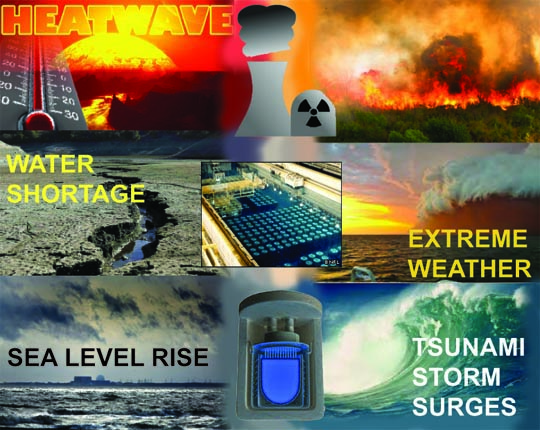 Mounting Climate Impacts Threaten U.S. Nuclear Reactors, Scientific American, Higher temperatures, rising flood risks and increased water stress mean facilities need to take additional resiliency measures, By Avery Ellfeldt, E&E News on August 20, 2020
Soaring temperatures, intensified flood risks and heightened water stress will threaten 57 U.S. nuclear plants over the next 20 years, forcing operators to take additional resiliency measures, according to a new report.
“The consequences of climate change can affect every aspect of nuclear plant operations—from fuel handling and power and steam generation to maintenance, safety systems and waste processing,” said the analysis, which was published yesterday by Moody’s Investors Service.
Analysts used data from Four Twenty Seven, a Moody’s affiliate that provides climate risk intelligence, to examine threats to operating nuclear plants.
“It looks like almost all plants see some kind of climate risk worsening over the next 20 years,” said David Kamran, the report’s author.
The study also underscored that the nuclear sector’s vulnerability to regional climate risks in large part depends on plants’ proximity to water.
Because nuclear generation facilities rely on external water sources for cooling, the vast majority are situated near rivers, lakes and oceans. That exposes them to flooding and storm surges, which can damage critical equipment.
The Four Twenty Seven data show 37 gigawatts of U.S. nuclear capacity is overly exposed to flood risk.That includes plants along the East and Gulf coasts, which are likely to grapple with rising sea levels and intensifying hurricanes in the decades to come. Storm-related rainfall, the reports adds, could “inundate” nuclear facilities and “damage transmission lines or substations, hindering a plant’s ability to deliver power.”
Facilities in the Midwest and South Florida, meanwhile, are more likely to suffer from higher temperatures that have the potential to reduce plants’ ability to generate power. The generation process involves creating steam, which is then cooled and condensed into liquid for reuse.
“If the temperature of incoming water to cool and condense steam is too high, or if the temperature of the discharge water is too high, power plants can be forced to curtail production or shut down temporarily,” the report says.
Facilities in the Rocky Mountain region, near the Colorado River and in California, on the other hand, are projected to face water scarcity, spiking uncertainty about having long-term access to necessary water supplies……. https://www.scientificamerican.com/article/mounting-climate-impacts-threaten-u-s-nuclear-reactors/
Climate, weather extremes, threaten nuclear reactors, and costs of preparing for them are increasing
Dozens of US nuclear power plants at risk due to climate change: Moody’s, S and P Global, Author Steven Dolley Washington Editor, Keiron Greenhalgh 19 Aug 20
37 GW of nuclear capacity at risk from flooding
48 GW at risk from heat, water stress
Merchant plants have fewer options to recover mitigation costs
Washington — Dozens of US nuclear power plants, comprising nearly half the country’s operational nuclear generating capacity, “will face growing credit risks” in the next 10 to 20 years due to flooding, hurricanes, heat stress and other predicted impacts of climate change, Moody’s Investors Service said in a report Aug. 18.
“The consequences of climate change can affect every aspect of nuclear plant operations – from fuel handling and power and steam generation to maintenance, safety systems and waste processing,” the report said, noting that “the severity of these risks will vary by region, with the ultimate credit impact depending on the ability of plant operators to invest in mitigating measures to manage these risks.”
Moody’s did not specify mitigation measures that are being, or should be, taken.
Water cooling needs expose plants to the risk of flooding, sea-level rise and hurricanes, and “about 37 gigawatts (GW) of US nuclear capacity [have] elevated exposure to flood risk,” Moody’s said.
Also, the report noted, “rising heat and water stress can have an adverse impact on plant operations,” with “about 48 GW of nuclear capacity [having] elevated exposure to combined rising heat and water stress.”
“Regulated or cost-based nuclear plants,” comprising about 55 GW of capacity in the US, “face elevated heat and water stress across most locations, with moderate to high risk of floods, hurricanes, and sea level rise for certain coastal plants,” Moody’s said. However, it added: “The credit impact of these climate risks is likely to be more modest for operators of these nuclear plants, relative to market-based plants, because they have the ability to recoup costs through rate recovery mechanisms.”
By contrast, “market-based plants,” with a total of about 44 GW of capacity, “face elevated heat stress and more water stress than regulated/cost-based plants, with fewer plants at risk of floods and hurricanes,” it said.
The highest risk, or “red flag,” category includes plants that are “highly exposed to historical and/or projected risks, indicating high potential for negative impacts,” Moody’s said.
According to the report, five plants with a combined capacity of about 9.1 GW are in the red flag category for floods. Some 13 plants with a combined capacity of about 23.8 GW were found to be at red-flag risk for heat stress. The categories of hurricanes, sea level rise and water stress each had one plant expected to be at red-flag risk.
Because some US nuclear units “are seeking to extend their operations by 20, or even 40 years,” Moody’s said, “operators will have to consider these risks when implementing resilience measures.”………. https://www.spglobal.com/platts/en/market-insights/latest-news/electric-power/081820-dozens-of-us-nuclear-power-plants-at-risk-due-to-climate-change-moodys
Climate change a problem for nuclear waste dumps
 Climate change included in nuclear waste study, Dryden now, August 2020 by Mike Aiken
 Experts with the Nuclear Waste Management Organization are adjusting their forecasts for the Ignace area, so they include the possibility of more rainfall. The adjustment will allow for climate change, including the possibility of extreme weather and increased flooding.
“This is the first time this modelling work has been done for a potential repository location and any assessment of sites for the safe storage of used nuclear fuels must take into account the potential future impact of climate change on its infrastructure,” said Kelly Liberda, who is a senior engineer with Golder Associates, who are working on the site selection process.
“While it’s difficult to project the extent to which precipitation could fluctuate in specific geographic areas, the NMWO is taking steps to anticipate the most likely scenarios,” Liberda added.
Based on a multi-model assessment of publicly available data, the Golder Associates study found that both one-day probable maximum precipitation and one-day rainfall events in the Ignace study area are projected to increase in the 2050s and 2080s. …….
Global heating now posing physical and financial risks to U.S. nuclear reactors
|
A new report from Moody’s shows that a warming world may cause more service disruptions in the US. Climate change—particularly intense heat—is advancing so rapidly that it poses physical as well as credit risks to America’s aging nuclear fleet, a new report from Moody’s Investors Service finds. “Our plants are fairly hardened to severe weather,” said David Kamran, a projects and infrastructure analyst at Moody’s and the lead author of the report. “But climate change is moving quickly.” ……… in 2011, the US Nuclear Regulatory Commission asked domestic plants to conduct their own assessments of risks from climate change and other natural hazards. A 2019 Bloomberg review of correspondence between the commission and owners of 60 plants concerning those assessments found that 54 of their facilities weren’t designed to handle the flood risk they now face. ……. The new report is the result of an analysis conducted by Four Twenty Seven Inc, a climate risk data company Moody’s acquired last year. The group evaluated the potential effects of heat stress, water stress, hurricanes, flooding, and rising sea levels on 57 US nuclear power plants over the next 20 years. It found that while a handful of plants—including Cooper Nuclear Station in Nemaha, Neb. and Prairie Island in Goodhue, Minn.—face severe risk from floods, far more either will face or already face “red flag” conditions from heat. Nuclear plants are cooled by water, and in times of intense heat and drought, water resources can become either too warm or too scarce, forcing shutdowns. This has already happened, and not just in the South: in 2012, Dominion Energy Inc’s Millstone nuclear plant in Waterford, Conn. The report predicts that nuclear plants in the Rocky Mountain states, the Colorado River region, and California face the highest levels of water stress risk going forward. …… the report was meant to highlight the extent of the environmental pressures plants will have to adapt to withstand if they want to operate consistently in the coming decades. Resisting those stresses is potentially expensive— even more expensive than the plants have currently estimated, he said: “In certain cases they will need to make investments to further reinforce their plants and they need to have money in their cap-ex funds to do that.” https://www.livemint.com/news/world/nuclear-plants-face-more-heat-risk-than-they-re-prepared-to-handle-11597848362280.html |
|
Bill McKibben not sure that Kamala Harris will be strong on addressing climate change
|
We’re in the Kamala Harris era now, and so far, so good. Of the four people on the major-party Presidential tickets, she appears to be the most energetic and normal………. Listening to Joe Biden speak, I feel a constant mild apprehension about what may emerge; Harris relaxes me.
Given the very real possibility that she’ll be at or near the pinnacle of our politics for somewhere between four and sixteen years, it’s worth asking how she will handle the gravest crisis that looms over our planet. That’s not the same as asking if she should be elected, because, on climate issues, a shrink-wrapped pallet of frozen Ore-Ida French fries would be a vast improvement on the incumbent. But it’s going to take an unflinching, unrelenting effort to transform America’s energy system and lead a similar process globally. Is she committed to that?
Her defenders point to a number of powerful statements that she made over the course of her Presidential primary campaign. She’d eliminate the filibuster to pass a Green New Deal. She’d tell the Department of Justice to investigate oil and gas companies. ………
Harris has been particularly outspoken about environmental injustice: just six days before she got the V.P. nod, she joined Alexandria Ocasio-Cortez to introduce the Climate Equity Act, which, as the Times explained, “would create a dedicated Office of Climate and Environmental Justice Accountability within the White House and require the federal government to rate the effect that every environmental legislation or regulation would have on low-income communities.”
If there’s a rub, it’s that, to date, she hasn’t been that eager to really stand up to power on this issue. ……. What will she do if she becomes Vice-President? I imagine that her courage will depend on the climate movement’s success in eroding the political power of the oil companies. The weaker the fossil-fuel conglomerates become, the less scary they are. (Oil barons understand this, which is why they’re spending large sums to reëlect Trump). My guess is that Harris is a run-of-the mill politician, who will go where the footing is easiest. ………. (Note to Joe Biden.) The Sunrise Movement—the group of under-thirties who organized the sit-in at House Speaker Nancy Pelosi’s office that served as a coming-out party for the Green New Deal—produced a YouTube video for Markey last week, which may be my favorite political ad of all time. (Watch till the end for one of the best knife twists in campaign history). If Markey wins, he will go back to the Senate a national progressive hero; more to the point, he will have demonstrated that truly taking on climate change can pay off politically. That lesson won’t be lost on anyone, Harris included. ………. Obvious but important: a new study from Climate Central found that as temperatures rise, so does demand for air-conditioning. It projects that, by 2050, demand for air-conditioning will rise in the United States by fifty-nine per cent—and far more than that around the world. That is why we need highly efficient air-source heat pumps, which also cool air, and why we need enormous amounts of renewable electricity to power it all. …… Scoreboard ⬇️ Big number on the board this week: a hundred and thirty degrees Fahrenheit (54.4 degrees Celsius), which is the highest reliably recorded temperature ever on planet Earth. It happened over the weekend, in California’s Death Valley, which is also the place where the nominal Earth temperature record of a hundred and thirty-four degrees Fahrenheit was set, in 1931. That number, though, has been disputed ever since, and the great weather historian Christopher Burt published a lengthy investigation, in 2016, proving it could not have happened. For now, a hundred and thirty degrees is the mark—but don’t expect it to last. ……..Extraordinarily bad fire news from across the planet. In the Amazon, fires are burning at a rate not seen for a decade. In Siberia, fires may be burning at a rate we’ve never previously seen—and the heating, drying region may be on the verge of moving into a new and extreme “fire regime.” In Colorado and elsewhere in the American West, this year’s fire season has begun in earnest. The forests surrounding Hanging Lake—one of the state’s premier tourist sites—almost burned. The fourteen-year-old climate activist Haven Coleman reports via Twitter: “Even inside my house it’s hazy. . . . Feels like I’m being cornered, trapped. Stuck home since there’s covid everywhere, but NOW my home is becoming unbreathable. Everything sucks. Ugh.” Indeed. By midweek, evacuations were under way in California, where fires were threatening the city of Vacaville and other parts of Napa and Sonoma. …….The two-thousands were, officially, the hottest decade on record, up 0.39 degrees Celsius from the previous decade, which is a huge change in ten years’ time. It’s an urgent reminder that the next decade may be our final chance to take serious climate action A new study in Nature confirms that the effect of the pandemic on the planet’s temperature was negligible—greenhouse-gas emissions fell, but much of the smog that tends to cool the planet also disappeared. “These results highlight that without underlying long-term system-wide decarbonization of economies, even massive shifts in behaviour, only lead to modest reductions in the rate of warming,” the authors wrote. They also, however, noted some good news: “Pursuing a green stimulus recovery out of the post-covid-19 economic crisis can set the world on track for keeping the long-term temperature goal of the Paris Agreement within sight.” |
|


Greta Thunberg on the global inaction on climate change
Greta Thunberg: the world is still in a state of climate crisis denial https://www.theguardian.com/environment/2020/aug/19/another-two-years-lost-to-climate-inaction-says-greta-thunberg, Damian Carrington Environment editor @dpcarrington, Wed 19 Aug 2020 Two years on from Greta Thunberg’s first solo school strike for the climate, she says the world has wasted the time by failing to take the necessary action on the crisis.
Thunberg’s strike inspired a global movement, and on Thursday she and other leading school strikers will meet Angela Merkel, the chancellor of Germany, which holds the rotating presidency of the European council. They will demand a halt to all fossil fuel investments and subsidies and the establishment of annual, binding carbon budgets based on the best science.
“Looking back [over two years], a lot has happened. Many millions have taken to the streets … and on 28 November 2019, the European parliament declared a climate and environmental emergency,” Thunberg said in an article for the Guardian with fellow strikers Luisa Neubauer, Anuna de Wever and Adélaïde Charlier.
“But over these last two years, the world has also emitted over 80bn tonnes of CO2. We have seen continuous natural disasters taking place across the globe. Many lives and livelihoods have been lost, and this is only the very beginning.”
They said leaders were speaking of an “existential crisis”, yet “when it comes to action, we are still in a state of denial. The gap between what we need to do and what’s actually being done is widening by the minute. Effectively, we have lost another two crucial years to political inaction.”
Thunberg and her colleagues said fighting the climate emergency must involve rich nations stopping some of their polluting activities.
- “However, it’s a fact which most people refuse to accept. Just the thought of being in a crisis that we cannot buy, build or invest our way out of seems to create some kind of collective mental short-circuit. This mix of ignorance, denial and unawareness is the very heart of the problem,” they said.
The trillions of dollars being spent by governments in response to the coronavirus pandemic are seen as a once-in-a-lifetime opportunity to put the world on course to halt global heating, with economists, scientists and health experts all saying the benefits would outweigh the costs.
However, G20 governments’ rescue packages are giving significantly more support to fossil fuels than to low-carbon energy. Germany’s recovery plan includes €40bn for climate measures such as electric vehicles, public transport and energy efficiency, and has been praised by green groups. But elsewhere, too little is being done, Thunberg and colleagues said.
“Even a child can see that the policies of today are incompatible with the current best available science,” they said.
- Scientists calculate that global carbon emissions must be cut by half by the end of this decade if humanity is to have a reasonable chance of keeping temperature rises to below 1.5C, the limit set in the Paris climate deal. Drops in emissions during coronavirus lockdowns are only a small blip in a long-term rising trend and will have a “negligible” effect on the climate crisis, researchers say.
“We understand the world is complicated and that what we are asking for may not be easy or seem unrealistic,” said the school strikers. “But it is much more unrealistic to believe that our societies would be able to survive the global heating we’re heading for. We are inevitably going to have to fundamentally change, one way or another. The question is: will the changes be on our terms, or on nature’s terms?”
1 This Month
19 February – VIRTUAL EVENT-Decision Time: AI and Our Nuclear Arsenal
12:45 p.m. Central / 1:45 p.m. Eastern
To see nuclear-related stories in greater depth and intensity – go to https://nuclearinformation.wordpress.com
-
Archives
- February 2026 (181)
- January 2026 (308)
- December 2025 (358)
- November 2025 (359)
- October 2025 (376)
- September 2025 (258)
- August 2025 (319)
- July 2025 (230)
- June 2025 (348)
- May 2025 (261)
- April 2025 (305)
- March 2025 (319)
-
Categories
- 1
- 1 NUCLEAR ISSUES
- business and costs
- climate change
- culture and arts
- ENERGY
- environment
- health
- history
- indigenous issues
- Legal
- marketing of nuclear
- media
- opposition to nuclear
- PERSONAL STORIES
- politics
- politics international
- Religion and ethics
- safety
- secrets,lies and civil liberties
- spinbuster
- technology
- Uranium
- wastes
- weapons and war
- Women
- 2 WORLD
- ACTION
- AFRICA
- Atrocities
- AUSTRALIA
- Christina's notes
- Christina's themes
- culture and arts
- Events
- Fuk 2022
- Fuk 2023
- Fukushima 2017
- Fukushima 2018
- fukushima 2019
- Fukushima 2020
- Fukushima 2021
- general
- global warming
- Humour (God we need it)
- Nuclear
- RARE EARTHS
- Reference
- resources – print
- Resources -audiovicual
- Weekly Newsletter
- World
- World Nuclear
- YouTube
-
RSS
Entries RSS
Comments RSS
 nuclear-news