On nuclear power as climate solution, Bill Gates shows alarming ignorance
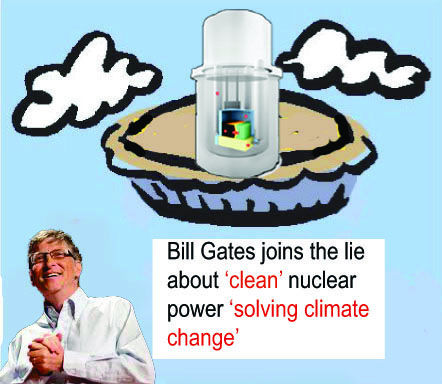
David Lowry’s Blog 16th Feb 2021 The multi-billionaire Bill Gates, founder of Microsoft, in his new book, “How to Avoid a Climate Disaster”, is sceptical of the Green New Deal.(Allen Lane/Penguin) published on 16 February. Gates secured much pre-publication publicity for his new tome, including an interview in the Guardian Weekend Magazine, which wrote “Of the Green New Deal, the proposal backed by Alexandria Ocasio-Cortez [the Congresswoman who has promoted the merits of the GND in the US] that raises the goal of carbon neutrality in a decade, he is flatly dismissive, with Gates telling the interviewer. “Well, it’s a fairytale. It’s like saying vaccines don’t work – that’s a form of science denialism. Why peddle fantasies to people?”
Gates also opined: “I’m not a survivalist.” Instead his version of survivalism is to fund innovation, the reporter noted. “I’m putting money into carbon capture and nuclear fission” Gates told her. (Bill Gates: ‘Carbon neutrality in a decade is a fairytale. Why peddle fantasies?’, Guardian, 13 February 2021; https://www.theguardian.com/technology/2021/feb/15/bill-gates-carbon-neutrality-in-a-decade-is-a-fairytale-why-peddle-fantasies)
Indeed, his book is laced with positive, if inaccurate, mentions of nuclear power. For example, he asserts on page 84, in a section on “Making Carbon-Free Electricity”, uns der a sub-section titled ‘ Nuclear Fission’ he writes: “”Here’s the one sentence case for nuclear power: It’s the only carbon-free energy sources that can reliably deliver power day and night, through every season.”
Carbon is emitted throughout the nuclear fuel chain

Radioactive carbon 14 is released up the stack; however, this is not a source of concern here. (Solely in consideration of carbon release as it is minuscule.) The planet doesn’t care where CO2 emissions originate. The warming effect is the same regardless of geographic origin.
There are CO2 releases throughout the nuclear fuel cycle. Mining, milling, fuel fabrication, fuel transportation, and fuel enrichment all pump CO2 into the atmosphere. Fuel enrichment for US plants (Roughly 90% of it.) is primarily done in former Soviet Union countries using coal as the prime energy source. One not so obvious source of CO2 emissions is a simple fact: Millstone runs off of the grid. The grid is not zero carbon.
Additionally, it takes people, lots of people to operate the plants,–all driving-emitting CO2- in and out of the plant. One day, I stood outside the plant’s gates and asked drivers their estimates of how many vehicles went in and out of the plant each day. The average reply was about 1500 vehicle trips, with more during refueling. Millstone zero-carbon- I don’t think so.
P.S. Will a reporter please ask Dominion Nuclear Connecticut LLC, Inc. for a copy of its electric bill and post it here.
Busting the propaganda that the nuclear industry wants to reduce carbon emissions
Big money, nuclear subsidies, and systemic corruption, Bulletin of the Atomic Scientists, By Cassandra Jeffery, M. V. Ramana | February 12, 2021 ”………..Material interests and policy interests.
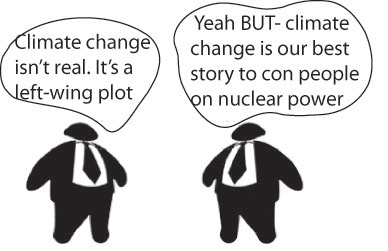
The most common argument used by these companies and those who support nuclear subsidies is the need to fight climate change. There are two problems with this argument.
First, it is based on the false idea that nuclear power, if shut down, will necessarily be replaced by fossil fuel plants. A June 2016 decision by Pacific Gas and Electric (PG&E) demonstrates the invalidity of this assumption. PG&E will close the last two nuclear power plants in California (the Diablo Canyon units) by 2024 and 2025, replacing the lost electrical capacity “with a cost-effective, greenhouse gas free portfolio of energy efficiency, renewables and energy storage.” This move to renewables is more cost-effective today than it was in 2016 because of declining costs of renewables and energy storage. As Matthew McKinzie of the Natural Resources Defense Council argued at that time, the decision “shows that given sufficient time to prepare, retiring nuclear capacity can transition smoothly to a mix of energy efficiency measures; clean, renewable resources; and energy storage without any role for fossil fuels – an outcome that can be optimal for the environment, the market, and the reliability of the electric grid.” At a larger scale, Germany has shown that it is possible to retire nuclear plants and reduce emissions at the same time.
The second problem is the assumption that corporations owning nuclear plants are primarily interested in rapidly reducing emissions. Many utilities have large fossil fuel investments— investments that suggest a shutdown won’t be happening anytime soon. This suggestion seems especially true with natural gas plants. Although utilities often describe natural gas as clean (for example, Exelon describes its fleet as powered by “clean burning natural gas”), the climate implications of continued natural gas use are substantial. Exelon, the company with the most nuclear plants in the country, also owns and operates, along with its subsidiaries, 11 oil-fired power plants, five dual-fuel (natural gas and oil-powered) power stations, and 10 natural gas-based power plants throughout North America. In addition to its four nuclear power plants, Dominion owns 17 power plants fueled by natural gas and 14 power plants fueled by coal or oil. The company’s estimate of carbon dioxide emissions from its power plants is around 40 million metric tons in 2018, roughly the same level as in 2012. Likewise, PSEG owns just two nuclear power plants, but the company owns or has a stake in 10 fossil fuel generating plants with one more natural gas powered plant under construction.
With such large stakes in fossil fuel-based power plants, it is clear that these utilities are not about to switch immediately to renewables—or even to nuclear power—and give up on years and years of future profits that they and their shareholders are hoping for. In all of the states that offered nuclear subsidies, and elsewhere, the utilities have tried to hold back the deployment of renewables in more or less obvious ways. US utilities are not alone. Studies show that electric utilities around the world have “hindered the transition of the global electricity sector towards renewables, which has to date mostly relied on non-utility actors (such as independent power producers) for expanding the use of renewables.”
Rather than adapting to the necessity of building up renewables, these utilities resort to tactics that have been used in the past to justify nuclear power plant construction. As former Nuclear Regulatory Commission member Peter Bradford listed at the beginning of the so-called nuclear renaissance, these include “subsidy, tax breaks, licensing shortcuts, guaranteed purchases with risks borne by customers, political muscle, ballyhoo, and pointing to other countries (once the Soviet Union, now China) to indicate that the US is ‘falling behind.’”…. https://thebulletin.org/2021/02/big-money-nuclear-subsidies-and-systemic-corruption/
Los Alamos National Laboratory not alert to the increasing danger of wildfires
 Audit raises concerns about wildfire risks at U.S. nuclear lab https://www.pbs.org/newshour/science/audit-raises-concerns-about-wildfire-risks-at-u-s-nuclear-labScience Feb 10, 2021 By — Susan Montoya Bryan, Associated Press
ALBUQUERQUE, N.M. (AP) — One of the nation’s premier nuclear laboratories isn’t taking the necessary precautions to guard against wildfires, according to an audit by the U.S. Energy Department’s inspector general.
The report comes as wildfire risks intensify across the drought-stricken U.S. West. Climatologists and environmentalists have been warning about worsening conditions across the region, particularly in New Mexico, which is home to Los Alamos National Laboratory and where summer rains failed to materialize last year and winter precipitation has been spotty at best.
The birthplace of the atomic bomb, Los Alamos has experienced hundreds of millions of dollars in losses and damage from major wildfires over the last two decades. That includes a blaze in 2000 that forced the lab to close for about two weeks, ruined scientific projects, destroyed a portion of the town and threatened tens of thousands of barrels of radioactive waste stored on lab property.
Watchdog groups say the federal government needs to take note of the latest findings and conduct a comprehensive review before the lab ramps up production of key plutonium parts used in the nation’s nuclear arsenal.
“The threat and risks of wildfire to the lab and northern New Mexico will continue to increase because of climate warming, drought and expanded nuclear weapons production,” said Jay Coghlan, director of the group Nuclear Watch New Mexico.
The audit released this month found that cutting back vegetation along power lines and other measures to reduce the risk of catastrophic fires were not always done, increasing the potential for another devastating fire like the Cerro Grande Fire in 2000.
Federal auditors said not all fire roads were maintained to ensure safe passage for firefighters and equipment responding to blazes on lab property.
The audit also cited federal policy that requires a comprehensive, risk-based approach to wildfire management — something the inspector general’s office said had not been developed by the contractor that manages the lab for the U.S. government. It also pointed to a lack of oversight by Energy Department field staff.
“Without documenting planning and preparedness activities, there was no assurance that all prevention and mitigation options were considered and that the site was fully prepared for wildland fire events,” the audit says.
The report included photos that depicted overgrown areas. In Los Alamos Canyon, for example, specialists indicated there were about 400 to 500 trees per acre. Auditors said the ideal number should be 40 to 50 trees per acre.
Lab spokesman Peter Alden Hyde said that since the audit was conducted in late 2018 and early 2019, the lab has adopted “an aggressive approach” to wildfire management on its 39-square-mile (101-square-kilometer) campus. That has included thinning vegetation along access routes, improving fire roads and recently removing thousands of trees downed by wind storms.
“We continue to review our wildfire and forest health plans and have already implemented most of the recommendations the Department of Energy offered to improve our efforts to protect the public, the environment and the laboratory,” he said.
It was not immediately clear how many acres were thinned during the last year or whether the lab had any major projects planned for 2021.
Nuclear waste facilities at risk of flooding and sea surges

Recent research suggests that as seas rise, some nuclear waste storage facilities are at risk of flooding or storm damage.
“We really focused in to say, ‘OK, well, how many plants might actually be subject to these risks?'” says Sarah Jordaan of the School of Advanced International Studies at Johns Hopkins University.
Her team looked at 13 facilities along the U.S. coast.
They found that if seas rise about six feet – which is possible by the end of the century – more than half of the waste storage sites would be directly along the water’s edge or even surrounded by water.
So she says it’s critical to anticipate these long-term vulnerabilities and take action.
“There are certainly ways that those risks can be managed now,” Jordaan says.
For example, after five years, spent fuel can be moved to dry casks. This is a safer long-term storage method than the cooling pools where a lot of spent fuel is currently stored.
So Jordaan says it’s critical for policymakers to understand the risks at nuclear facilities and create regulations and policies to ensure greater safety.
Expensive, experimental, Sizewell nuclear project would be operational far too late to affect global heating

 Independent 8th Feb 2021, A new nuclear power plant at Sizewell is the wrong choice for a zero carbon Britain. The climate column: The proposed Sizewell C will not produce electricity until about 2040, which means it cannot reduce the UK’s carbon emissions with the speed necessary to avoid catastrophic tipping points.
couple of years of being commissioned.
ever. It’s been trying to build the first four of them for over 20 years but had not yet got any actually working.
Nuclear reactors, big or small, useless to combat climate change, because of slowness to develop.
Just under 15 minutes on how nuclear power — far from presenting a “solution” — has actually contributed to climate change.
In 1952 the US government was advised to go solar. Instead, we got “Atoms for Peace”.
If the solar recommendation had been taken, and we had chosen the solar instead of the nuclear path, we might not have had climate change at all.
But solar had no military utility, while nuclear reactors made an important “by-product”: plutonium. This is a pre-recorded version of a talk Inrecently gave for Helensburgh, Scotland CND’s Beyond Nuclear conference.
Not in this video is a section I added during the conference presentation about how nuclear power still gets in the way of much needed and urgent nrenewable energy and energy efficiency development. This is well laid out by Amory Lovins who notes that, to protect the climate, we must save the most carbon at the least cost and in the least time.
Since nuclear power isthe most expensive way to generate a megawatt hour of electricity, and
plants take years to build, it is out of the running even before evaluating its carbon footprint. As Lovins points out, costly options save less carbon per dollar than cheaper options. Slow options save less carbon per year than faster options. So in the case of nuclear power, whether it is “low carbon” or not instantly becomes irrelevant because it is already useless
for climate change due to its cost and slowness.
https://www.youtube.com/watch?app=desktop&v=6gWXFcFfN7E&feature=youtu.be
Scientists must tell the truth on our consumerist, ecology-killing Ponzi culture

Scientists must not sugarcoat the overwhelming challenges ahead. Instead, they should tell it like it is. Anything else is at best misleading, and at worst potentially lethal for the human enterprise.
Worried about Earth’s future? Well, the outlook is worse than even scientists can grasp , The Conversation, Corey J. A. Bradshaw, Matthew Flinders Professor of Global Ecology and Models Theme Leader for the ARC Centre of Excellence for Australian Biodiversity and Heritage, Flinders University. Daniel T. Blumstein, Professor in the Department of Ecology and Evolutionary Biology and the Institute of the Environment and Sustainability, University of California, Los Angeles, Paul Ehrlich, President, Center for Conservation Biology, Bing Professor of Population Studies, January 13, 2021
Anyone with even a passing interest in the global environment knows all is not well. But just how bad is the situation? Our new paper shows the outlook for life on Earth is more dire than is generally understood.
The research published today reviews more than 150 studies to produce a stark summary of the state of the natural world. We outline the likely future trends in biodiversity decline, mass extinction, climate disruption and planetary toxification. We clarify the gravity of the human predicament and provide a timely snapshot of the crises that must be addressed now.
The problems, all tied to human consumption and population growth, will almost certainly worsen over coming decades. The damage will be felt for centuries and threatens the survival of all species, including our own………
academics tend to specialise in one discipline, which means they’re in many cases unfamiliar with the complex system in which planetary-scale problems — and their potential solutions — exist.
What’s more, positive change can be impeded by governments rejecting or ignoring scientific advice, and ignorance of human behaviour by both technical experts and policymakers.
More broadly, the human optimism bias – thinking bad things are more likely to befall others than yourself – means many people underestimate the environmental crisis.
Numbers don’t lie
A bad situation only getting worse
The human population has reached 7.8 billion – double what it was in 1970 – and is set to reach about 10 billion by 2050. More people equals more food insecurity, soil degradation, plastic pollution and biodiversity loss.
Essentially, humans have created an ecological Ponzi scheme. Consumption, as a percentage of Earth’s capacity to regenerate itself, has grown from 73% in 1960 to more than 170% today.
High-consuming countries like Australia, Canada and the US use multiple units of fossil-fuel energy to produce one energy unit of food. Energy consumption will therefore increase in the near future, especially as the global middle class grows.
The danger of political impotence
Our paper found global policymaking falls far short of addressing these existential threats. Securing Earth’s future requires prudent, long-term decisions. However this is impeded by short-term interests, and an economic system that concentrates wealth among a few individuals.
Right-wing populist leaders with anti-environment agendas are on the rise, and in many countries, environmental protest groups have been labelled “terrorists”. Environmentalism has become weaponised as a political ideology, rather than properly viewed as a universal mode of self-preservation.
Changing course
Fundamental change is required to avoid this ghastly future. Specifically, we and many others suggest:
- abolishing the goal of perpetual economic growth………..
Don’t look away………
Scientists must not sugarcoat the overwhelming challenges ahead. Instead, they should tell it like it is. Anything else is at best misleading, and at worst potentially lethal for the human enterprise. https://theconversation.com/worried-about-earths-future-well-the-outlook-is-worse-than-even-scientists-can-grasp-153091
USA is not facing up to the climate threats to its nuclear wastes
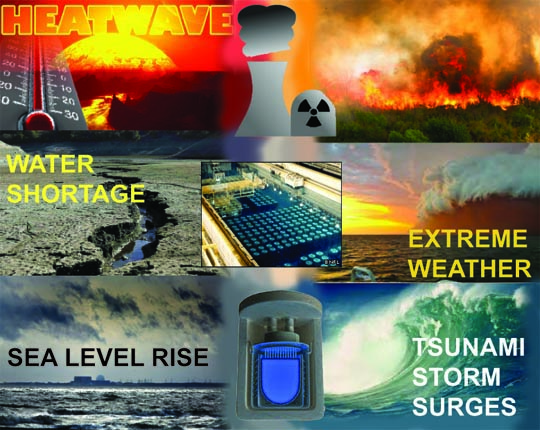 US is Ill-Prepared to Safely Manage its Nuclear Waste from Climate Threats. More than 150 sites across the country have to be managed for radioactive waste for centuries or millennia. But there’s no plan in place for how this will be done, says GAO report. Earth Island Journal , CHARLES PEKOW, December 29, 2020 The Cold War never erupted into the nuclear nightmare that the world feared for decades. But the legacy of the never-used nuclear weapons remains a ticking time bomb that could endanger countless people and lead to environmental catastrophe any time.
The GAO report, “Environmental Liabilities: DoE Needs to Better Plan for Post-Cleanup Challenges Facing Sites” (pdf), issued earlier this year, found, among other things, that the DoE doesn’t have a plan for how to address challenges at some sites that may require new cleanup work that is not in the scope of LM’s expertise.
some of these sites have already been creating serious problems.
Among the many other problem sites, the Legacy Management office is struggling to figure out what to do with contaminated groundwater at the Shiprock nuclear waste dump on the Navajo Nation Indian Reservation in northwest New Mexico. Contaminated water, the legacy of uranium mining for nuclear power plants and weapons, is being pumped to an evaporation pond there.
nuclear watchdog groups aren’t satisfied with the slow progress on this front. The nation needs “a reverse Manhattan project,” to figure out how to safely diffuse the radioactive waste, says Schaeffer of the Alliance for Nuclear Accountability. https://www.earthisland.org/journal/index.php/articles/entry/us-is-ill-prepared-to-safely-manage-its-nuclear-waste-from-climate-threats
Biden flirts with the fantasy of small nuclear reactors as the cure for climate change
if the nuclear revolution doesn’t happen in the next four years, it’s probably not going to happen
The Green Fantasy and Messy Reality of Nuclear Power. TNR, 23 Dec 20, Biden is flirting with the idea of rejuvenating the industry to help decarbonize the economy—and there are skeptics in spades. Joe Biden will have to do more about climate change than any president before him. He has no choice. Already, close U.S. allies are openly expressing their relief about the end of the ecologically disastrous Trump era while a coalition of left-wing politicians and organizations are demanding sweeping emissions reductions.
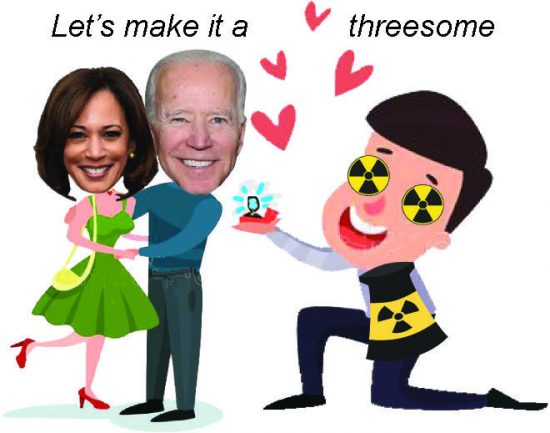 Biden’s campaign climate promises were extensive. But one of the more interesting promises in the plan—and one of the ones key to determining how he approaches emissions reduction—was his promise to “identify the future of nuclear energy.” That means reopening discussion of a technology many environmentalists once thought would be rotting in the dustbin of history by now.
Part of the reason nuclear energy construction remains difficult and expensive in the U.S. is that in polls Americans are split down the middle on their approval of nuclear energy, and opponents make a big stink when construction of a nuclear plant is being discussed. These are rational worries, according to Mark Delucchi, a research scientist affiliated with UC Berkeley and Lawrence Berkeley National Laboratory, which operates on behalf of the U.S. Department of Energy. In addition to the risk of meltdowns—which are, admittedly, rare—we have to also consider the disposal of caches of spent nuclear fuel, the risks of which “are potentially much more abroad in time and space,” Delucchi said. “They affect people. They affect other ecosystems. They affect different generations. And they’re unknown.”
“It kinda boggles my mind how anyone who has any clue about solving problems related to climate or energy still considers nuclear power,” said Mark Jacobson, professor of civil and environmental engineering at Stanford University and a frequent collaborator with Delucchi. As Jacobson pointed out, there’s next to no active construction of nuclear power plants currently going on in the U.S. All of the U.S. nuclear energy construction happening right now consists of two reactors in Georgia that Jacobson says “may never even be finished.”
A project in Utah set to break ground soon was set in motion by politicians accused of conflicts of interest, and construction of that plant has faced opposition from activists since its inception. In 2017, two U.S. nuclear reactor projects were canceled after construction had begun, leaving investors on the hook for billions of dollars. “So people are trying to say that we should build lots of these things that you can’t even build one of?” Jacobson said.
Despite the near impossibility of constructing one of these plants, greater federal investment in nuclear energy appears to be on the table. Biden’s transition team includes Rachel Slaybaugh, a Berkeley nuclear engineer. The Senate Committee on Energy and Public Works earlier this month approved a bipartisan bill aimed at protecting existing nuclear infrastructure, developing new nuclear technology, and supporting uranium mining.
 America’s pro-nuclear voices tend to hail from the aggressively moderate part of the political spectrum. The centrist think tank Third Way says on its website that “advanced nuclear is shaping up to be a key component in our race to zero emissions.” House Minority Leader Kevin McCarthy conceded in February that climate change is real—a step not all Republicans have taken—but claimed that the Democrats are going about trying to fix it all wrong. We should be, McCarthy wrote on his website, “investing in clean energy technology that will lead to less emissions, lower costs, and produce as much or more power. Chief among them is advanced nuclear technology.”
Rather predictably for anyone who follows this issue, McCarthy’s statement about clean energy (which doesn’t mention wind or solar) includes several citations of rockstar nuclear activist Michael Shellenberger, a guy who doesn’t think climate change is that bad and who has given not one, but two blockbuster TED talks attempting to bodyslam wind and solar, one of which is bluntly named “Why renewables can’t save the planet.” Over 2 million people have watched it on YouTube alone.
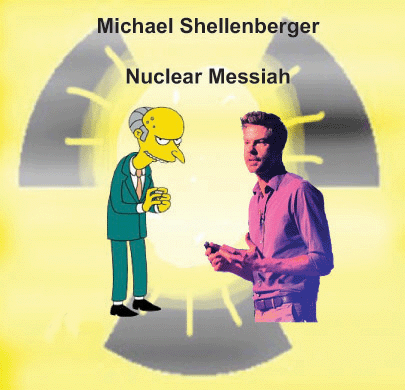
The notion that nuclear power is necessary and inevitable is far from a fringe viewpoint. Last year, The New York Times ran an op-ed called “Nuclear Power Can Save the World,” written by three Ph.D.-holders, including cognitive neuroscientist and radical optimist Steven Pinker.
According to this brand of eco-contrarianism, nuclear is not just viable, but the only pragmatic plan for decarbonizing the U.S. energy grid. Built into this message is invariably the idea that plans outlined by environmentalists, activists, and alternative energy proponents are actually doing more harm than good. It’s not that these folks want nuclear to have a seat at the table as humanity negotiates its energy future; they want to nuke-pill the whole climate movement.
But inevitably, this rhetoric has to address the chief problem of nuclear power, which is that it is extremely time-consuming and expensive to build new reactors. The solution, nuclear supporters argue, is to take a modular approach to our nuclear construction. Modularity means minimal  variation at each new site, a streamlined design process, and less of the sort of worksite entropy that slows things down. In other words, cookie-cutter them into the energy landscape as quickly as possible.
There’s reason to be skeptical of this approach. “Claims about the technical and economic attractiveness of modular or small scale nuclear reactors, I think, are potentially especially problematic on the political side of things,” Delucchi said. “A lot of the costs associated with nuclear power are based on technologies that are not commercialized, or even particularly close.”
Plans based on 100 percent renewable energy are routinely criticized for relying on technology not yet available or cost-effective. Clearly, though, that’s also true for nuclear power. Nuclear fans, then, are asking the country to bet on a successful nuclear expansion at a time when we have less than ten years—roughly the time it takes to carry out the relatively smooth construction of a single nuclear power plant—to cut our greenhouse gas emissions by 40–50 percent from 2010, or else we’ll blow past the ugly 1.5 degree warming threshold, according to the Intergovernmental Panel on Climate Change (IPCC), and plunge ourselves into climate chaos. That’s quite a bet.
In practical terms, all Biden has promised to do with regard to nuclear energy is form a research agency, dubbed ARPA-C, and churn out some government reports about it and other energy possibilities. And it won’t be at all surprising if, like Trump, Biden also gives a little boost to uranium mining companies that are desperate to expand their operations.
If ARPA-C’s research into modular reactors produces breakthroughs, more uranium gets mined, regulations fall away, public outcry dies down, and nuclear really turns out to be the answer to climate change, that should become clear by the end of Biden’s first term. If the U.S. is going to come anywhere close to meeting the IPCC’s recommendations for avoiding catastrophic warming through nuclear power, modular nuclear plants will be going up all over the place by January of 2025. We should see ribbons being cut, foundations being poured, and uranium ore well on its way to being enriched. “Small-scale modular” will have to become one of those eye-rollingly overused cliches, like “OK Boomer” or “social distancing.”
None of this seems particularly likely. And if the nuclear revolution doesn’t happen in the next four years, it’s probably not going to happen, given the slow pace of nuclear power construction. All those pragmatic arguments for nuclear energy will probably end up looking as fantastical as a three-eyed fish. https://newrepublic.com/article/160712/green-fantasy-messy-reality-nuclear-power
Are forest fires unlocking radiation in Chernobyl?
The firefighters sent in to tackle the blazes in the radioactive forests agreed to speak to BBC anonymously, scared of losing their jobs.
Their accounts expose a month of chaos in which fires almost reached the nuclear reactors.
Journalism: Zhanna Bezpiatchuk and Charlotte Pamment
Greenhouse gas emissions transforming the Arctic into ‘an entirely different climate’
Guardian 8th Dec 2020. The Arctic’s rapid transformation into a less frozen, hotter and
biologically altered place has been further exacerbated by a year of
wildfires, soaring temperatures and loss of ice, US scientists have
reported. The planet’s northern polar region recorded its second hottest
12-month period to September 2020, with the warmest temperatures since 1900
all now occurring within the past seven years, according to an annual
Arctic report card issued by the National Ocean and Atmospheric
Administration (Noaa). The Arctic is heating up at a rate around double
that of the global average, due to the human-caused climate crisis.
—
European Commission excludes nuclear power from the EU’s proposed green finance taxonomy,
  Energy Transition 8th Dec 2020, As we approach the end of a tumultuous 2020, with the UK finally to leave the European Union on 31 December after its transition period expires, the EU – primarily the Commission – itself has continued to refine the parameters of its sustainable energy strategy, which has been constructedvery much in the face of the pressures of the unprecedented global pandemic. Energy Transition 8th Dec 2020, As we approach the end of a tumultuous 2020, with the UK finally to leave the European Union on 31 December after its transition period expires, the EU – primarily the Commission – itself has continued to refine the parameters of its sustainable energy strategy, which has been constructedvery much in the face of the pressures of the unprecedented global pandemic.David Lowry has the details. One big issue has been whether nuclear power should have any role, and if so, what? This debate has had a long gestation period. For example, the green taxonomy, which some see as the most sensitive part of a European Commission plan on sustainable finance – which aims at shifting financial flows towards the decarbonisation of the economy – were presented in May 2018 by then Commission Vice-President Valdis Dombrovskis, who underlined that financing the energy transition could not be financed with public money alone.
Then, on 28 March 2019, the European Parliament voted on the proposed classification for sustainable assets, which would have excluded nuclear power from receiving a green stamp of approval on financial markets. The text voted in Parliament also excludes fossil fuels and gas infrastructure from the EU’s proposed green finance taxonomy, which aims to divert investments away from polluting industries into clean technologies.
|
Federal funding for new nuclear reactors is a serious mistake that blocks swift ation on climate
|


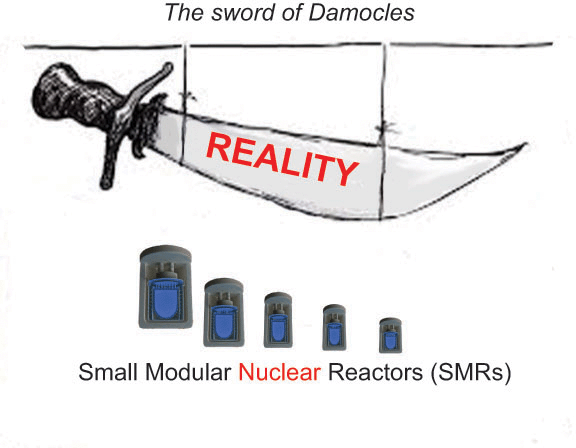
Small Nuclear Reactors (SMRs) if they work, will arrive too late to make a difference to global heating
 Is nuclear power the answer?, DECEMBER 8, 2020 JOHN QUIGGIN
The last (I hope) extract from the climate change chapter of Economic Consequences of the Pandemic. I’m in two minds about whether this is really needed. The group of pro-nuclear environmentalists seems to be shrinking towards a hard core who can’t be convinced (and some of them, like Shellenberger turn out to have been concern trolls all along). But every now and then I run across people who seem open-minded enough, but haven’t caught up with the bad news on nuclear.
Debates about decarbonizing electricity generation inevitably raise the issue of nuclear power. Since nuclear power generates no carbon dioxide emissions (except in the construction phase) it is a potential solution to climate change, with a strong body of advocates.
Some of this advocacy may be dismissed as point-scoring. Rightwing pundits who oppose any action on climate change simultaneously promote nuclear power as carbon free, with the aim of embarrassing environmentalist. There is, however, a small but vocal group of nuclear power advocates who are convinced that a massive expansion of nuclear power is the only way to replace coal-fired power………
Today the choice is not between new nuclear and new or existing coal. It is whether to allocate investment to building nuclear plants or to accelerating the shift to solar and wind energy.
The key problem is not safety but economics. New plants are safer and more sophisticated than those that failed in the past, but they are also massively more expensive to build, and quite costly to operate. The capital costs of recent projects in the US, France and Finland (none yet complete) have been around $10/kw, compared to $1/kw or less for solar. And, whereas solar PV is essentially costless to operate, the operating costs of nuclear power plants are around 2c/kwH. Even when solar PV is backed up with battery storage, it is cheaper to build and to operate, than new nuclear.
The facts speak for themselves. Over the last decade, only two or three reactors have commenced construction each year, not even enough to replace plants being retired. This isn’t the result of pressure from environmentalists or alarm about the safety of nuclear plants. The slowdown is evident in countries like China, where public opinion has little influence on policy decisions, and in countries where public opinion is generally favorable to new nuclear power. China failed to reach its 2020 target of 58 GW of installed power, and currently has only about 15 GW of nuclear power under construction. That compares to 55 GW of new solar and wind capacity installed in 2019 alone.
It is clear by now that large-scale nuclear reactors have no future. The last hope for nuclear power rests on Small Modular Reactors. The idea is that, rather than building a single large reactor, typically with a capacity of 1 GW, smaller reactors will be produced in factories, then shipped to the site in the required number. The leading proponent of this idea is Nuscale Power, which currently has a contract with UAMPS to supply a pilot plant with a dozen 60MW modules.
It remains to be seen whether SMR’s will work at all. Even if they do, it is not clear that the reduced costs associated with off-site manufacturing will offset the loss of the scale economies associated with a large boiler, let alone yield power at a cost competitive with that of solar PV.
In any case, the issue is largely irrelevant as far as the climate emergency is concerned. NuScale’s pilot plant, with a total capacity of 720 MW, is currently scheduled to start operation in 2029. Large-scale deployment will take at least a decade more .
If we are to have any chance of stabilising the climate, coal-fired power must be eliminated by 2030, and electricity generation must be decarbonized more or less completely by 2035. SMRs, if they work, will arrive too late to make a difference. ….https://johnquiggin.com/2020/12/08/is-nuclear-power-the-answer/#more-17451
1 This Month



26 September – International Day for the Total Elimination of Nuclear Weapons


PLEASE OPPOSE HR 8255 AND S.3639 – bills would accelerate satellite deployment, with no environmental review or safeguards – https://ncstd5li.quorum.us/campaign/169331/
To see nuclear-related stories in greater depth and intensity – go to https://nuclearinformation.wordpress.com
-
Archives
- September 2026 (257)
- August 2026 (330)
- July 2026 (355)
- June 2026 (287)
- May 2026 (306)
- April 2026 (356)
- March 2026 (251)
- February 2026 (267)
- January 2026 (308)
- December 2025 (358)
- November 2025 (359)
- October 2025 (375)
-
Categories
- 1
- 1 NUCLEAR ISSUES
- business and costs
- climate change
- culture and arts
- ENERGY
- environment
- health
- history
- indigenous issues
- Legal
- marketing of nuclear
- media
- opposition to nuclear
- PERSONAL STORIES
- politics
- politics international
- Religion and ethics
- safety
- secrets,lies and civil liberties
- spinbuster
- technology
- Uranium
- wastes
- weapons and war
- Women
- 2 WORLD
- ACTION
- AFRICA
- Atrocities
- AUSTRALIA
- Christina's notes
- Christina's themes
- culture and arts
- Events
- Fuk 2022
- Fuk 2023
- Fukushima 2017
- Fukushima 2018
- fukushima 2019
- Fukushima 2020
- Fukushima 2021
- general
- global warming
- Humour (God we need it)
- Nuclear
- RARE EARTHS
- Reference
- resources – print
- Resources -audiovicual
- Weekly Newsletter
- World
- World Nuclear
- YouTube
-
RSS
Entries RSS
Comments RSS
 nuclear-news