Climate protestors stop Rupert Murdoch’s press in Britain
 Rupert Murdoch’s British papers delayed as climate protesters stop the presses, SMH 6 Sept, 20, London: Distribution of several British newspapers was disrupted on Saturday after climate change activists blockaded printworks used by Rupert Murdoch’s News UK, publisher of The Times and The Sun, drawing condemnation from Prime Minister Boris Johnson.Extinction Rebellion said nearly 80 people had blocked roads leading to two printworks, at Broxbourne in Hertfordshire, north east of London, and at Knowsley, near Liverpool. Hertfordshire police said they made 42 arrests and Merseyside police made 30.
The Murdoch-owned Newsprinters works also print the Daily Mail, the Daily Telegraph and the Financial Times. Campaigners said they had taken the action to highlight what they regard as the newspapers’ failure to accurately report on climate change. ……….
The blockade was part of more than a week of protests by Extinction Rebellion, which says an emergency response and mass move away from polluting industries and behaviours is needed to avert a looming climate cataclysm.
On Saturday it also protested in central London, including holding a “die-in” in front of Buckingham Palace, where demonstrators lay under white sheets to represent corpses. …….. https://www.smh.com.au/environment/climate-change/rupert-mudoch-s-british-newspapers-delayed-as-extinction-rebellion-protesters-stop-the-presses-20200905-p55sqr.html
Global heating – low water rate affecting France’s Saint-Alban nuclear plant
  Low water flow may halve output at France’s Saint-Alban nuclear plant https://www.reuters.com/article/france-nuclear/low-water-flow-may-halve-output-at-frances-saint-alban-nuclear-plant-idUSL8N2G04V7 PARIS, Sept 3 (Reuters) – A low flow rate on the Rhone River will likely restrict output from Saturday to Monday at EDF’s Saint-Alban nuclear plant in southeastern France, French grid operator RTE said on Thursday.The two Saint-Alban reactors produce 1.3 gigawatts (GW) of power each and RTE said the reduction in output could be equivalent to the production of one unit. Low water flow may halve output at France’s Saint-Alban nuclear plant https://www.reuters.com/article/france-nuclear/low-water-flow-may-halve-output-at-frances-saint-alban-nuclear-plant-idUSL8N2G04V7 PARIS, Sept 3 (Reuters) – A low flow rate on the Rhone River will likely restrict output from Saturday to Monday at EDF’s Saint-Alban nuclear plant in southeastern France, French grid operator RTE said on Thursday.The two Saint-Alban reactors produce 1.3 gigawatts (GW) of power each and RTE said the reduction in output could be equivalent to the production of one unit.
The Saint-Alban 2 reactor is currently scheduled to go offline for routine maintenance on Sept. 19. EDF’s use of water is regulated by law to protect plant and animal life. The company is obliged to reduce output during hot weather when water temperatures rise, or when river levels and the flow rate are low. August was the third hottest in France on records going back to 1900, with the summer months between June and August entering the top 10 hottest summers on record, Meteo France data showed. Low flow rates were already an issue at the Saint-Alban plant last month, as RTE warned on Aug. 20 that the equivalent of one reactor could be taken offline for that reason. French nuclear availability is currently at 52.4% of total capacity, with 29.7 GW offline. (Reporting by Forrest Crellin; Editing by Susan Fenton) |
|
Radiation from Chernobyl spreads far away, as global heating exacerbates widfires
 Climate change is spreading radiation from Chernobyl over 2,000 miles away, Boing Boing, 3 Sep 20, One of the more difficult parts of trying to convince people about the seriousness of climate change is explaining how so many disparate elements and factors can collude and compound* and make everything worse. And it’s even harder to predict how long those complications will take to manifest, whenever they do what they do…….
. As The Atlantic reports:
Monitors in Norway, 2,000 miles away, detected increased levels of cesium in the atmosphere. Kyiv was smothered in smoke [from forest fires]. Press reports estimated that the level of radiation near the fires was 16 times higher than normal, but we may never know how much was actually released: Yoschenko, Zibtsev, and others impatient to take on-the-ground measurements were confined to their homes by the coronavirus pandemic. August is typically the worst month of the Chernobyl fire season, and this year, public anxiety is mounting. The devastation left by the world’s worst nuclear disaster is colliding with the disaster of climate change, and the consequences reach far and deep.
The unexpected result is an immense, long-term ecological laboratory. Within the exclusion zone, scientists are analyzing everything, including the health of the wolves and moose that have wandered back and the effects of radiation on barn swallows, voles, and the microorganisms that decompose forest litter. Now, as wildfires worsen, scientists are trying to determine how these hard-hit ecosystems will respond to yet another unparalleled disruption. ……
when something nuclear does go wrong — which is still likely, because nothing’s perfect — more nuclear power production will result in more radiation damage. And, if this situation with Chernobyl’s forest fires is any indication, then the ultimate fallout of that combined with our existing climate change problems could be even more insurmountably devastating……. https://boingboing.net/2020/09/04/climate-change-is-spreading-ra.html
Six Portuguese youth file ‘unprecedented’ climate lawsuit against 33 countries
Six Portuguese youth file ‘unprecedented’ climate lawsuit against 33 countries Climate Home News, first climate case to be filed with the European Court of Human Rights, six Portuguese youth argue inadequate emissions cuts violate their human rights t
This is the first climate change case to be filed with the European Court of Human Rights (ECHR) in Strasbourg, France. If admissible, it could set an important precedent, showing the way for other climate lawsuits based on human rights arguments.
Cláudia Agostinho (21), Catarina Mota (20), Martim Agostinho (17), Sofia Oliveira (15), André Oliveira (12) and Mariana Agostinho (8) are suing the 27 European member states, as well as the UK, Switzerland, Norway, Russia, Turkey and Ukraine for failing to make deep and urgent emissions cuts to safeguard their future.
Their complaint comes after lethal wildfires in Portugal in 2017 killed more than 120 people. Researchers have linked the intensity of the 2017 blaze to global warming. The case is being filed after Portugal recorded its hottest July in the last 90 years……….. https://www.climatechangenews.com/2020/09/03/six-portuguese-youth-file-unprecedented-climate-lawsuit-33-countries/
Sea ice at its lowest state in 5,500 years in Bering sea

 in the region is lower than it’s been for thousands of years.A newly published paper in the journal Science Advances describes how a peat core from St. Matthew Island is providing a look back in time. By analyzing the chemical composition of the core, which includes plant remains from 5,500 years ago to the present, scientists can estimate how sea ice in the region has changed during that time period.
“It’s a small island in the middle of the Bering Sea, and it’s essentially been recording what’s happening in the ocean and atmosphere around it,” said lead author Miriam Jones, a research geologist with the U.S. Geological Survey. Jones worked as a faculty researcher at the University of Alaska Fairbanks when the project began in 2012.
………. UAF’s Alaska Stable Isotope Facility analyzed isotope ratios throughout the peat layers, providing a time stamp for ice conditions that existed through the millennia.
After reviewing the isotopic history, researchers determined that modern ice conditions are at remarkably low levels.
“What we’ve seen most recently is unprecedented in the last 5,500 years,” said Matthew Wooller, director of the Alaska Stable Isotope Facility and a contributor to the paper. “We haven’t seen anything like this in terms of sea ice in the Bering Sea.”
Jones said the long-term findings also affirm that reductions in Bering Sea ice are due to more than recent higher temperatures associated with global warming. Atmospheric and ocean currents, which are also affected by climate change, play a larger role in the presence of sea ice.
“There’s a lot more going on than simply warming temperatures,” Jones said. “We’re seeing a shift in circulation patterns both in the ocean and the atmosphere.” https://www.eurekalert.org/pub_releases/2020-09/uoaf-bsi082820.php
Viruses could be harder to kill after adapting to warm environments
Viruses could be harder to kill after adapting to warm environments, https://www.eurekalert.org/pub_releases/2020-09/acs-vcb082820.php AMERICAN CHEMICAL SOCIETY 2 Sept 20, Enteroviruses and other pathogenic viruses that make their way into surface waters can be inactivated by heat, sunshine and other microbes, thereby reducing their ability to spread disease. But researchers report in ACS’ Environmental Science & Technology that global warming could cause viruses to evolve, rendering them less susceptible to these and other disinfectants, such as chlorine.Enteroviruses can cause infections as benign as a cold or as dangerous as polio. Found in feces, they are released into the environment from sewage and other sources. Their subsequent survival depends on their ability to withstand the environmental conditions they encounter. Because globalization and climate change are expected to alter those conditions, Anna Carratalà, Tamar Kohn and colleagues wanted to find out how viruses might adapt to such shifts and how this would affect their disinfection resistance.
The team created four different populations of a human enterovirus by incubating samples in lake water in flasks at 50 F or 86 F, with or without simulated sunlight. The researchers then exposed the viruses to heat, simulated sunlight or microbial “grazing” and found that warm-water-adapted viruses were more resistant to heat inactivation than cold-water-adapted ones. Little or no difference was observed among the four strains in terms of their inactivation when exposed to either more simulated sunlight or other microbes. When transplanted to cool water, warm-water-adapted viruses also remained active longer than the cool-water strains. In addition, they withstood chlorine exposure better. In sum, adaptation to warm conditions decreased viral susceptibility to inactivation, so viruses in the tropics or in regions affected by global warming could become tougher to eliminate by chlorination or heating, the researchers say. They also say that this greater hardiness could increase the length of time heat-adapted viruses would be infectious enough to sicken someone who comes in contact with contaminated water.
3 unplanned shutdowns- Turkey Point nuclear station vulnerable to climate extremes
Critics have pushed Turkey Point and the NRC to take sea rise impacts more seriously, Lyman said.
“We think nuclear plants need to be protected not only against the flood hazards that are reasonably expected today but far into the future, especially plants that have a license renewal like Turkey Point,” he said. “Unfortunately, the NRC today is not interested in increasing regulatory requirements for its current fleet.”
After 3 unplanned shutdowns at Turkey Point nuclear plant, feds launch ‘special inspection’, Miami Herald BY ADRIANA BRASILEIRO AND ALEX HARRIS, SEPTEMBER 01, 2020 After three unplanned nuclear reactor shutdowns over three days this month, federal regulators have launched a “special inspection” at Florida Power & Light’s Turkey Point plant.
In a statement issued Monday, the Nuclear Regulatory Commission said it was inspecting the plant this week to determine why one of the reactors in the two-unit facility “tripped” or shut down three times between Aug. 17 and Aug. 19. Such visits from the federal agency that oversees nuclear power plants aren’t unheard of but are unusual.
The NRC said FPL had supplied different explanations for each event………..
Edwin Lyman, director of nuclear power safety at the Union of Concerned Scientists, called the number of scrams “very unusual,” in a whole year, much less a few days. He said the NRC has a specific set of criteria plants must meet before they need a special investigation.
“These inspections are fairly rare events,” he said. “This could be a sign that they think there is some increase in risk to the public.”
Edwin Lyman, director of nuclear power safety at the Union of Concerned Scientists, called the number of scrams “very unusual,” in a whole year, much less a few days. He said the NRC has a specific set of criteria plants must meet before they need a special investigation.
“These inspections are fairly rare events,” he said. “This could be a sign that they think there is some increase in risk to the public.”………..
Over the past few years FPL has faced criticism and legal challenges over Turkey Point’s aging cooling system, a unique canal network that doesn’t exist anywhere else in the U.S. The problems from the leaking canal water, which created a saltwater plume encroaching into the adjacent freshwater aquifer, have led state and county regulators to cite FPL for polluting the waters in Biscayne Bay.
The plant last year won federal approval to continue to operate through at least 2053 — an unprecedented decision by regulators to extend the operating lifespan of nuclear reactors to 80 years.
The extended approval also brings up concerns of sea level rise and the increased storm surge that comes with it. By the end of this plant’s current license, Miami-Dade is planning for just under two feet of sea-level rise. Turkey Point is planning for between a half foot and a little over a foot by 2050.
Critics have pushed Turkey Point and the NRC to take sea rise impacts more seriously, Lyman said.
“We think nuclear plants need to be protected not only against the flood hazards that are reasonably expected today but far into the future, especially plants that have a license renewal like Turkey Point,” he said. “Unfortunately, the NRC today is not interested in increasing regulatory requirements for its current fleet.” The plant last year won federal approval to continue to operate through at least 2053 — an unprecedented decision by regulators to extend the operating lifespan of nuclear reactors to 80 years.
The extended approval also brings up concerns of sea level rise and the increased storm surge that comes with it. By the end of this plant’s current license, Miami-Dade is planning for just under two feet of sea-level rise. Turkey Point is planning for between a half foot and a little over a foot by 2050.
Critics have pushed Turkey Point and the NRC to take sea rise impacts more seriously, Lyman said.
“We think nuclear plants need to be protected not only against the flood hazards that are reasonably expected today but far into the future, especially plants that have a license renewal like Turkey Point,” he said. “Unfortunately, the NRC today is not interested in increasing regulatory requirements for its current fleet.” https://www.miamiherald.com/news/local/environment/article245384945.html?fbclid=IwAR2h6Kk7IV87lRlc0HWNgR42aIVowxmKXeijJzIwcPyUADkGEUIngnV2xHo
Geoengineering to counter global heating? It’s a risky gamble
|
SHOULD WE BANK ON INNOVATION TO HOLD BACK GLOBAL HEATING? HISTORY SAYS IT’S A RISKY BET, Ensia
Andrew Urevig September 2, 2020 — From research scientists to political organizers, people around the planet are working to thwart a threat whose scale has become increasingly clear: Global heating is spurring a climate crisis of megafires, superstorms and record-setting heat waves that current policies are not enough to address.Many climate activists, driven in part by the youth movements of Gen Z, are joining major scientific bodies in calling for economic and social transformation, while other onlookers are hoping for “moonshot” technology to step in as climate “savior.” How did we end up here? Answers to that vary, but research published earlier this year in the journal Nature Climate Change puts at least some of the blame on a surprising villain: computer modeling–based on wishful thinking. In the paper, Duncan McLaren and Nils Markusson, social scientists with the UK-based Lancaster University’s Lancaster Environment Centre, note that speculative technologies promising big climate benefits down the line have been included again and again in computer models used to inform government policies. That relieves some of the political pressure to cut or sequester greenhouse gases here and now, helping to stall tangible reductions in the near term. But it also spurs scientists creating the next round of models to rely, however unintentionally, on even more hoped-for innovations to make established climate goals appear feasible. We need to “recognise and break this pattern to unleash more effective and just climate policy,” the researchers conclude. …………… In the paper, Duncan McLaren and Nils Markusson, social scientists with the UK-based Lancaster University’s Lancaster Environment Centre, note that speculative technologies promising big climate benefits down the line have been included again and again in computer models used to inform government policies. That relieves some of the political pressure to cut or sequester greenhouse gases here and now, helping to stall tangible reductions in the near term. But it also spurs scientists creating the next round of models to rely, however unintentionally, on even more hoped-for innovations to make established climate goals appear feasible. We need to “recognise and break this pattern to unleash more effective and just climate policy,” the researchers conclude. https://ensia.com/notable/climate-change-models-technology-innovation/ |
|
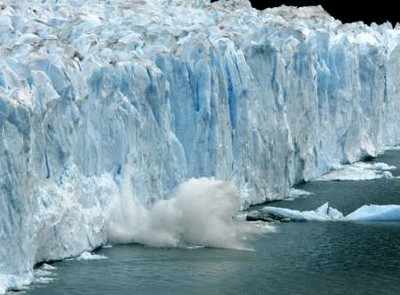
Sea level rise from melting ice sheets match worst-case climate warming scenarios.
Sea level rise from ice sheets track worst-case climate change scenario, https://www.sciencedaily.com/releases/2020/08/200831112101.htm August 31, 2020
 Source: University of Leeds
- Summary:
- Ice sheets in Greenland and Antarctica whose melting rates are rapidly increasing have raised the global sea level by 1.8cm since the 1990s, and are matching the Intergovernmental Panel on Climate Change’s worst-case climate warming scenarios.
-
Ice sheets in Greenland and Antarctica whose melting rates are rapidly increasing have raised the global sea level by 1.8cm since the 1990s, and are matching the Intergovernmental Panel on Climate Change’s worst-case climate warming scenarios.
According to a new study from the University of Leeds and the Danish Meteorological Institute, if these rates continue, the ice sheets are expected to raise sea levels by a further 17cm and expose an additional 16 million people to annual coastal flooding by the end of the century.
Since the ice sheets were first monitored by satellite in the 1990s, melting from Antarctica has pushed global sea levels up by 7.2mm, while Greenland has contributed 10.6mm. And the latest measurements show that the world’s oceans are now rising by 4mm each year.
“Although we anticipated the ice sheets would lose increasing amounts of ice in response to the warming of the oceans and atmosphere, the rate at which they are melting has accelerated faster than we could have imagined,” said Dr Tom Slater, lead author of the study and climate researcher at the Centre for Polar Observation and Modelling at the University of Leeds.
“The melting is overtaking the climate models we use to guide us, and we are in danger of being unprepared for the risks posed by sea level rise.”
- The results are published today in a study in the journal Nature Climate Change. It compares the latest results from satellite surveys from the Ice Sheet Mass Balance Intercomparison Exercise (IMBIE) with calculations from climate models. The authors warn that the ice sheets are losing ice at a rate predicted by the worst-case climate warming scenarios in the last large IPCC report.Dr Anna Hogg, study co-author and climate researcher in the School of Earth and Environment at Leeds, said: “If ice sheet losses continue to track our worst-case climate warming scenarios we should expect an additional 17cm of sea level rise from the ice sheets alone. That’s enough to double the frequency of storm-surge flooding in many of the world’s largest coastal cities.”
-
So far, global sea levels have increased in the most part through a mechanism called thermal expansion, which means that volume of seawater expands as it gets warmer. But in the last five years, ice melt from the ice sheets and mountain glaciers has overtaken global warming as the main cause of rising sea levels.
Dr Ruth Mottram, study co-author and climate researcher at the Danish Meteorological Institute, said: “It is not only Antarctica and Greenland that are causing the water to rise. In recent years, thousands of smaller glaciers have begun to melt or disappear altogether, as we saw with the glacier Ok in Iceland, which was declared “dead” in 2014. This means that melting of ice has now taken over as the main contributor of sea level rise. ”
Increasing climate risks threaten nuclear reactors
Analysis: Nuclear operators face growing climate risks, https://www.michiganradio.org/post/analysis-nuclear-operators-face-growing-climate-risks
In the report, analysts found the Cook, Fermi, and Palisades nuclear power plants in Michigan and the nearby Davis-Besse plant in Ohio fall into the High Risk category (although Palisades is scheduled to close in 2022).
The analysis says that means the nuclear power plants will face relatively high changes in temperature extremes compared to the global average, according to the report.
“If the temperature goes up a little bit too high, the plan would either have to lower its output for a given period or maybe shut down if things are extreme,” said David Kamran one of Moody’s analysts.
The trickiest part for the nuclear power plant operators is reacting to how quickly changes in the climate happen. Recently, some models show the planet is getting warmer faster than previously thought.
“As these entities, the plants, want to have their licenses extended over many years, they may need to make additional investments to keep up with new information regarding climate and temperature and water, that sort of thing,” Kamran said.
The nuclear power plants use massive amounts of water. While the supply is not an issue, the temperature of the water could be an issue in the future depending on how fast the climate changes.
Climate change and its impacts are not just the future: they are now

Everything Is Unprecedented. Welcome To Your Hotter Earth, NPR, REBECCA HERSHER, NATHAN ROTT, LAUREN SOMMER-30 Aug 20,
|
The upshot of climate change is that everyone alive is destined to experience unprecedented disasters. The most powerful hurricanes, the most intense wildfires, the most prolonged heat waves and the most frequent outbreaks of new diseases are all in our future. Records will be broken, again and again. But the predicted destruction is still shocking when it unfolds at the same time. This week, Americans are living through concurrent disasters. In California, more than 200,000 people were under evacuation orders because of wildfires, and millions are breathing smoky air. On the Gulf Coast, people weathered a tropical storm at the beginning of the week. Two days later, about half a million were ordered to evacuate ahead of Hurricane Laura. We’re six months into a global pandemic, and the Earth is on track to have one of its hottest years on record. Climate scientist Camilo Mora of the University of Hawaii says if our collective future were a movie, this week would be the trailer. “There is not a single ending that is good,” he says. “There’s not going to be a happy ending to this movie.” Mora was an author of a study examining all the effects of climate change. The researchers concluded that concurrent disasters will get more and more common as the Earth gets hotter. That means we will live through more weeks like this one — when fires, floods, heat waves and disease outbreaks layer on top of one another. “Keep in mind that all these things are related,” Mora explains. “CO2 is increasing the temperature. As a result, the temperature is accelerating the evaporation of water. The evaporation of water leads to drought that in turn leads to heat waves and wildfires. In places that are humid, that evaporation — the same evaporation — leads to massive precipitation that is then commonly followed by floods.” Disease outbreaks are also more likely. The most recent U.S. National Climate Assessment warns that changing weather patterns make it more likely that insect-borne illnesses will affect the U.S. Climate change is also causing people and animals to move and come in contact with one another in new and dangerous ways. If humans dramatically reduce greenhouse gas emissions immediately, scientists say it will help avoid the most catastrophic global warming scenarios. Worldwide emissions are still rising, and the United States is the planet’s second-largest emitter. Mora says helping people connect the dots between the current disasters and greenhouse gas emissions should be every scientist’s priority. “That’s the million-dollar question,” he says. “How do we speak to people in a way that we get them to appreciate the significance of these problems?” Hurricanes and climate change Climate change is making the air and water hotter, and that means more power for hurricanes. “Whenever you get ocean temperatures that are much above average, you’re asking for trouble,” meteorologist Jeff Masters explains. “And we’ve seen some of the warmest ocean temperatures on record for the Atlantic basin this year.” Hot water is like a battery charger for hurricanes. As a storm moves over hot water, like Hurricane Laura did this week, it captures moisture and energy very quickly. In recent years, scientists have seen evidence that global warming is already making storms more likely to grow large and powerful and more likely to intensify quickly. …….. Scientists have also found that hurricanes are dropping more rain, which means more flooding. Flooding is consistently the most deadly and damaging effect of a hurricane. Studies show many people underestimate the flood risks from hurricanes. Just a few inches of moving water can make it impossible to stay on your feet or control your car. Add all that to the current pandemic, and you get a dangerous situation, especially for people living in the path of the storm. As NPR has reported, safe options for people who evacuate this year could be limited because group shelters might accept fewer people in order to maintain social distancing. ………. “People are becoming more vulnerable as this COVID crisis goes on,” Morris says, as more people get laid off or run out of savings. “We have frankly been failing to serve the most vulnerable, and the people who have been made vulnerable by these cascading catastrophes.” Wildfires and Climate Change The fingerprints of climate change are all over the Western wildfires, too. ………. Fires are burning more frequently and intensely in places where they’ve always occurred, and they’re creeping into places where they were previously rare. …………….. How bad it eventually gets depends on how quickly the world can reduce carbon emissions. But the past weeks should make clear: “Climate change and its impacts are not the future,” says Crystal Kolden, a fire scientist at the University of California, Merced. “They are now.” https://www.npr.org/2020/08/28/905622947/everything-is-unprecedented-welcome-to-your-hotter-earth?utm_campaign=storyshare&utm_source=twitter.com&utm_medium=social |
|
Climate science deniers jump on to Far Right with QAnon conspiracy group
In May, a second Q-Drop riffed on climate change, with a link to a snarky tweet about science and the Swedish teen climate activist Greta Thunberg by a would-be House Republican who’d lost her primary race in March.
Both of those Q-Drops were picked up by a report commissioned by a coalition of environmental groups and conducted by the research firm Graphika, which found that a group of vocal climate science deniers began using QAnon hashtags in May — and they haven’t stopped since.
“The QAnon movement hasn’t traditionally covered climate change, but in May, when an influential QAnon account tweeted about climate denial, there was a notable and sustained increase of QAnon content shared within the climate denial group,” Michael Khoo, an advisor on disinformation for the environmental group Friends of the Earth, and Melissa Ryan, CEO of CARD Strategies and author of the Ctrl Alt-Right Delete weekly newsletters, wrote in an article published today on Medium.
Asked and Answered
The questions that Q advanced on climate change have been asked and answered — as essentially all of the burning questions on climate science still churning around in climate denial circles have been.
And today, as the impacts of a warming climate are accelerating, it is very clear that we collectively have little time to spare waiting until those who haven’t been keeping up with, or who refuse to acknowledge, the scientific consensus are convinced. The longer the world waits to slash greenhouse gas pollution, the less chance we collectively have to calm the worst impacts of a warming world, according to the world’s top climate experts, and if we don’t, climate change could make all of the calamities we’ve faced in 2020 soon pale in comparison.
Q, however, raised different concerns about climate action.
“Who audits where the money goes?” the December Q-Drop asked, linking to an article about the Green Climate Fund, which provides funding to help developing countries reduce their greenhouse gas emissions to help them meet their Paris Agreement goals.
Nevermind that if you want the audits of the Green Climate Fund alluded to in the Q-Drop, the answer is extraordinarily unmysterious and unglamorous: the audited financial statements are posted online and they’re done by accountants. Nevermind also that the Paris Agreement itself was never fundamentally about the movement of money, but instead involves countries promising to regulate pollution inside their borders — something we’re still continuing to fail to do, both in the United States and worldwide.
And nevermind that the U.S., whose politicians the Q-Drop implies are pocketing money somehow along the way, has nearly walked away from both the Paris Agreement and the Green Climate Fund. That’s despite the glaring fact that the U.S. has been the world’s worst climate polluter since 1750, meaning that this country has played the single largest role in causing the very problem that the global climate pact attempts to (somewhat) address.
To turn Q’s question around, one very basic question Q has never answered is who exactly they are — and to what extent, if any, they’ve sought to monetize the power and influence they’ve been busy amassing. “At this point, who’s behind it is speculation more than anything,” Ryan told DeSmog.
Another key part of the problem — as ever — is that climate science deniers publicly talk a lot more than others. Whereas in years past, mainstream media was faulted for giving climate science deniers a misleading amount of airtime, today, they’re using social media to achieve the same ends. Graphika’s research found that for every social media post by the vocal climate scientists and environmentalists they studied, the vocal climate science deniers they studied posted four times.
“On average, they observed that the Climate Denial group was about four times ‘louder’ (number of tweets relative to the group size) than the Climate Science group,” Khoo and Ryan, both advisors to a coalition of environmental groups that commissioned Graphika’s research, wrote.
Clutching at Q’s Coattails
Not only is QAnon taking up climate denial, but prominent climate deniers have been taking up QAnon.
“The other thing we see is that the right needs QAnon more and more to amplify their messaging,” said Ryan.
Take, for example, Naomi Seibt, a young German YouTuber who has questioned climate science and who has worked with the Heartland Institute, a U.S. think tank and notorious promoter of climate science denial………….
As in Germany, white supremacists in the U.S. have increasingly engaged in racially motivated “mass shooter” armed attacks on unarmed people. And QAnon followers have also begun committing violent acts. “I think it’s also important to remember that the FBI has declared QAnon a domestic terrorism threat,” said Ryan, “and QAnon has inspired kidnappings, it has inspired at least one murder, it has inspired arson, there is a real danger from these folks who are drawn to this and become just embroiled in it.”…………
Social Media Fail
Khoo and Ryan pointed to the ways that social media companies for years failed to conduct the most basic scrutiny of information that they publish online and allowed all sorts of demonstrably false information to be repeated in an endless rumor mill online.
“Facebook has policies that let Trump lie uninterrupted,” they wrote. “And when climate deniers get a simple fact-check on Facebook, members of Congress themselves have sent letters to company executives to complain.”
All of this can, of course, have significant policy consequences in the real world.
“The danger for environmental advocates and for the planet is that QAnon could be the energy that stops a big push for any meaningful climate action,” Khoo told DeSmog. “If a Green New Deal is the next thing, we could see QAnon followers serving as the foot soldiers in that war.”
There’s also the risk that fossil fuel companies and trade organizations might jump on the QAnon bandwagon, inspired by the conspiracy theory’s popularity. Last week, President Trump praised the movement, claiming not to know much about it except that “they like me very much.”
“If QAnon becomes more mainstream,” Ryan said, “I could see a scenario where industry groups that are invested in climate denial and fossil fuels and such will be incentivized to embrace QAnon or rely on those tactics and networks.”
The other risk is that conspiracy theorizing, when mixed with social media, can not only bring in adherents, it can also raise money.
“The new addition to this history of climate capitalism is the capitalism behind the clicks, the monetizing of disinformation that happens on all the platforms,” Khoo and Ryan wrote. “Virality is central to the profit model, as are ads. Whether or not they’re true is secondary, from a business perspective.”
And the reality is that QAnon has been growing, with NBC News reporting earlier this month that Facebook discovered QAnon accounts and pages have attracted over 3 million member and follower accounts.
Last week, Facebook removed nearly 800 QAnon groups and took some steps to restrict QAnon hashtags and other social media. That follows moves by Twitter to take down roughly 7,000 Twitter accounts and designating QAnon as “coordinated harmful activity.”
Some see that as far too little, far too late. “They’ve had three years of almost unfettered access outside of certain platforms to develop and expand,” Brian Friedberg, a senior researcher at the Harvard Shorenstein Center’s Technology and Social Change Project, told MIT Technology Review in July.
As of press time, Facebook and Heartland have not responded to questions from DeSmog. https://www.desmogblog.com/2020/08/27/qanon-conspiracy-naomi-seibt-climate-science-deniers?utm_source=DeSmog%20Weekly%20Newsletter
Welcome to the ‘Pyrocene,’ an Epoch of Runaway Fire
Welcome to the ‘Pyrocene,’ an Epoch of Runaway Fire
Fire scholar Stephen J. Pyne proposes a pyrocentric view of the last 10,000 years — and warns that California’s wildfires herald a very combustible future. Bloomberg City Lab By Laura Bliss, August 27, 2020 It isn’t just California that’s burning. This summer, smoke from massive wildfires in Siberia choked skies as far as Alaska and set new pollution records, in a second consecutive year of unprecedented blazes in the Arctic Circle. Rising temperatures, a loss of precipitation, and parched vegetation are hallmarks of climate change, scientists say, as are the increasingly extreme wildfires that result, from the arid Western U.S. to some of coldest places on Earth.
We have always had what I call “living landscapes,” which are the ones we live in, with growing stuff and dead stuff on the surface. The fires burning in California right now are fires in living landscapes. Then I offer the term “lithic landscape,” which shows a continuity between us burning in one setting and then another. These are the fossil landscapes buried in the past that we’re now burning in the present, with all kinds of strange interactions that we don’t understand.
We can also certainly prevent cities from burning. There is no reason to see them burn like they are. We can shut down the nastier ignition sources like power lines by reinvesting in our grids. We can reimagine how we power our cities: If we had more solar or local power sources, then you would not need [a spread-out electrical grid].
I also think there needs to be a sense of recognition that fire is here to stay, and that we need to work with it in ways that don’t destroy us, or in ways that turn tame fires into feral fires, which is what we have done. Living with fire is an awkward phrase, but it’s true. Unlike Covid-19, there’s no vaccine possible. https://www.bloomberg.com/news/articles/2020-08-27/as-wildfires-rage-the-pyrocene-age-is-upon-us?srnd=citylab
Trump re-elected would mean unsafe climate for the world, democracy’s end in USA
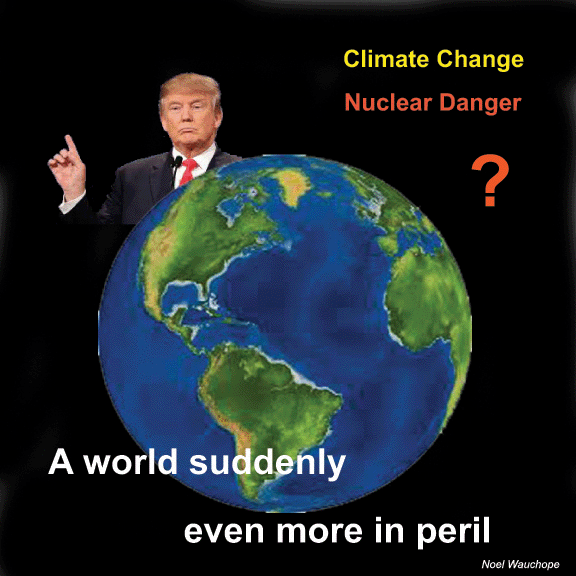
Four more years of Trump would leave democracy, and hope for a safe climate, in tatters
From the perspective of the human species as a whole, the arc of its life on this planet, it may be the most important election ever.
A second Trump term would mean severe and irreversible changes in the climate No joke: It would be disastrous on the scale of millennia. VOX, By David Roberts@drvoxdavid@vox.com Aug 27, 2020, I f Donald Trump is reelected president, the likely result will be irreversible changes to the climate that will degrade the quality of life of every subsequent generation of human beings, with millions of lives harmed or foreshortened. That’s in addition to the hundreds of thousands of lives at present that will be hurt or prematurely end.
This sounds like exaggeration, some of the “alarmism” green types are always accused of. But it is not particularly controversial among those who have followed Trump’s record on energy and climate change……..
………..a Trump victory would make any reasonable definition of “success” on climate change impossible….
More Trump will ensure the continued escalation of global temperatures
We know from the latest IPCC report that the climate target agreed to by nations — no more than a 2° Celsius rise in global average temperatures — is not a “safe” threshold at all. Going from 1.5° to 2° means many more heat waves, wildfires, crop failures, migrations, and premature deaths. We know that every fraction of a degree beyond 2° means more still, along with the increasing risk of tipping points that make further warming unstoppable. Continue reading
Water shortage, drought, necessitate shutdown of France’s Chooz Nuclear Plant
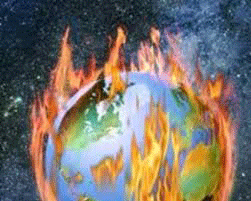 Nuclear reactor in France shut down over drought, Chooz Nuclear Plant on Belgian border turned off after dry summer evaporates water needed to cool reactors, AA, Cindi Cook |25.08.2020 A nuclear power plant in northern France has been temporarily shuttered due to a drought in the area, said the company that runs the plant Tuesday.
The second reactor of the Chooz Nuclear Power Plant, in Ardennes, on the Belgian border, was shut down late Monday night, after the first reactor ceased operations Friday evening.
The actions were taken due to low water levels in the Meuse River, the main artery that runs through the area used to cool the two reactors.
The plant is named after Chooz, the commune where it is located in the Ardennes. The region is on level three of four drought alert levels…….
Water is a crucial ingredient for nuclear plant safety to cool the reactor core. ……
Water restrictions have been imposed this summer in 79 out of the 96 mainland departments in France due to drought conditions. https://www.aa.com.tr/en/europe/nuclear-reactor-in-france-shut-down-over-drought/1952943
1 This Month
19 February – VIRTUAL EVENT-Decision Time: AI and Our Nuclear Arsenal
12:45 p.m. Central / 1:45 p.m. Eastern
To see nuclear-related stories in greater depth and intensity – go to https://nuclearinformation.wordpress.com
-
Archives
- February 2026 (181)
- January 2026 (308)
- December 2025 (358)
- November 2025 (359)
- October 2025 (376)
- September 2025 (258)
- August 2025 (319)
- July 2025 (230)
- June 2025 (348)
- May 2025 (261)
- April 2025 (305)
- March 2025 (319)
-
Categories
- 1
- 1 NUCLEAR ISSUES
- business and costs
- climate change
- culture and arts
- ENERGY
- environment
- health
- history
- indigenous issues
- Legal
- marketing of nuclear
- media
- opposition to nuclear
- PERSONAL STORIES
- politics
- politics international
- Religion and ethics
- safety
- secrets,lies and civil liberties
- spinbuster
- technology
- Uranium
- wastes
- weapons and war
- Women
- 2 WORLD
- ACTION
- AFRICA
- Atrocities
- AUSTRALIA
- Christina's notes
- Christina's themes
- culture and arts
- Events
- Fuk 2022
- Fuk 2023
- Fukushima 2017
- Fukushima 2018
- fukushima 2019
- Fukushima 2020
- Fukushima 2021
- general
- global warming
- Humour (God we need it)
- Nuclear
- RARE EARTHS
- Reference
- resources – print
- Resources -audiovicual
- Weekly Newsletter
- World
- World Nuclear
- YouTube
-
RSS
Entries RSS
Comments RSS
 nuclear-news