Queensland, Australia to get the ‘world’s greenest city’
Renew Economy 21st Oct 2020, French energy giant Engie backs Greater Springfield development, aiming to be ‘world’s greenest city’, with zero emissions transport plan. The post Energy giant Engie supercharges green city development with support for EVs, hydrogen transport appeared first on RenewEconomy.
A new city being developed in south-east Queensland aiming to become one of
the world’s greenest is set to get a boost, with a new roadmap launched with the backing of one of the world’s largest energy companies.
Greater Springfield, which is located around 30km south-west of Brisbane and has
grown to a population of 45,000 has released a new master plan that will see electric vehicle charging infrastructure and a hydrogen fuelled bus network rolled out, in an effort to create the ‘world’s greenest city’ by 2038.
The city is one of Australia’s largest privately funded city developments, including a mix of residential and business districts, and has attracted a campus of the University of Southern Queensland.
Energy giant Engie supercharges green city development with support for EVs, hydrogen transport — RenewEconomy
UK’s Conservative politicians want strong action on climate change
|
Business Green 20th Oct 2020, The UK’s departure from the EU provides an opportunity to establish a “much
more” ambitious climate target for 2030 that aligns with its longer-term statutory goal of reaching net zero emissions by 2050, Conservative backbenchers have told the government. In a letter sent this morning to Business Secretary Alok Sharma, dozens of Tory MPs urged the government to submit a strengthened climate goal – or nationally determined contribution (NDC), in the UN jargon – that follows the forthcoming recommendations of the Committee on Climate Change (CCC), which is in December due to unveil its advice for meeting the UK’s emissions goals for the 2033-37 period, also known as the sixth carbon budget. Signatories to the letter include
former Environment Secretary Theresa Villiers, former First Secretary of State Damian Green, and former Under Secretary of State for BEIS Lord Duncan. The UK government, meanwhile – which has not updated its UN Paris
Agreement climate pledges since adopting its 2050 net zero target last year – has said it plans to submit its enhanced, net zero-aligned NDC ahead of next year’s UN climate summit in Glasgow. And, in a bid to keep up pressure
on the government to ensure the UK’s plans are as ambitious as possible, 42 MPs and Lords in the Conservative Environment Network have signed today’s letter arguing the UK has a responsibility as host of the forthcoming COP26 climate conference to establish a world-leading national climate plan that sets an example to other member states and raises collective international ambition. |
|
Scientific women get together in plan for marine protected area for Antarctica Peninsula
All-female scientific coalition calls for marine protected area for Antarctica Peninsula Plus other ways to help penguins, whales, and seabirds, EurekAlert, UNIVERSITY OF SYDNEY, Research News 19 Oct 20, The Western Antarctic Peninsula is one of the fastest warming places on earth. It is also home to threatened humpback and minke whales, chinstrap, Adélie and gentoo penguin colonies, leopard seals, killer whales, seabirds like skuas and giant petrels, and krill – the bedrock of the Antarctic food chain.With sea ice covering ever-smaller areas and melting more rapidly due to climate change, many species’ habitats have decreased. The ecosystem’s delicate balance is consequently tilted, leaving species in danger of extinction.
Cumulative threats from a range of human activities including commercial fishing, research activities and tourism combined with climate change is exacerbating this imbalance, and a tipping point is fast approaching.
Dr Carolyn Hogg, from the University of Sydney School of Life and Environmental Sciences, was part of the largest ever all-female expedition to the Antarctic Peninsula, with the women in STEMM initiative, Homeward Bound, in late 2019. There, she witnessed the beauty and fragility of the area, and the negative impacts of climate change and human activity on native species, first-hand. As part of the Homeward Bound program she learnt about the science, conservation and governance of Antarctica.
In a new commentary piece published in Nature, Dr Hogg and her colleagues from the expedition outline these threats, and importantly, offer ways to counter them. More than 280 women in STEMM who have participated in the Homeward Bound initiative are co-signatories to the piece.
A global initiative, Homeward Bound ‘aims to elevate the voices of women in science, technology, engineering mathematics and medicine in leading for positive outcomes for our planet’.
Women are noticeably absent in Antarctica’s human history, which is steeped in tales of male heroism. Female scientists are still a minority in the region’s research stations.
“Now, more than ever, a broad range of perspectives is essential in global decision-making, if we are to mitigate the many threats our planet faces,” said Dr Hogg.
“Solutions include the ratification of a Marine Protected Area around the Peninsula, set to be discussed on 19 October, at a meeting of a group of governments that collectively manage the Southern Ocean’s resources,” said Dr Hogg. “The region is impacted by a number of threats, each potentially problematic in their own right, but cumulated together they will be catastrophic.”
Decreasing krill affects whole ecosystem
The Peninsula’s waters are home to 70 percent of Antarctic krill. In addition to climate change, these krill populations are threatened by commercial fishing. Last year marked the third largest krill catch on record. Nearly 400,000 tonnes of this animal were harvested, to be used for omega-3 dietary supplements and fishmeal.
“Even relatively small krill catches can be harmful if they occur in a particular region, at a sensitive time for the species that live there,” said Dr Cassandra Brooks, a co-author on the comment from the University of Colorado, Boulder. “For example, fishing when penguins are breeding lowers their food intake, and affects their subsequent breeding success. A Marine Protected Area will conserve and protect this unique ecosystem and its wildlife, and we need to implement it now.”
Climate change is fundamentally altering the Western Antarctic Peninsula:……
Three ways to protect the Peninsula
1. A Marine Protected Area (MPA) designation for the waters………
2. Protect land areas ………
3. Integrate conservation efforts…….
….https://www.eurekalert.org/pub_releases/2020-10/uos-asc101520.php
Anti-science in America – climate denial to coronavirus denial
 America re-discovers anti-science in its midst, Environmental Health News,16 Oct 20
Fauci, Birx, Redfield & Co. are in the middle of a political food fight. They could learn a lot from environmental scientists.
Let’s start with the story of a scientist who beat back a powerful global denial movement without any help from social media or modern, sophisticated organizing campaigns.
It took Galileo 359 years to wrangle an apology out of the Vatican for his heretical belief that the Earth revolved around the sun.
I’m glad he didn’t take it personally. Science denial is neither new nor purely American—but we sure are finding ways to make it lethal and lasting.
Climate scientists have been dealing with anti-science, largely unnoticed by the general public, for 20 years. Doctors face a growing wave of anti-vaccination zealots. Now a pandemic with a seven-figure global death toll and a stranglehold on the world’s economy has opened the doors wide for some multi-front anti-science blowback.
Americans, many refusing to wear masks and ignoring social distancing guidelines, appear to be gathering at frat parties, raves, political rallies, nightclubs and more in defiance of what credentialed experts say are the most vital ways to restrict the spread of COVID-19.
Major sporting events, notably college football, are backing down from previously self-imposed restrictions.
And, lo and behold, positive test rates are going back up in a big way.
Past is deadly prologue
Here are a couple recent, high profile examples of anti-science fervor in the U.S.:………
But nothing in science can quite match the decades-long assault on climate science and climate scientists. On the high end, there are PR campaigns backed by fossil fuel money, well-heeled litigation, and unhinged attacks from national pols and pundits. Then, there are the confounding, face-palming antics of the Coal Rollers—pickup truck owners who modify their rides with “Prius Repellent”—thick sooty black smoke intended to make a bizarre anti-science, pro-climate denial statement. Yes, people do this.
Penn State’s Michael Mann is arguably the highest-profile climate scientist in the U.S. Let’s make a minor leap of faith and say Mann’s climate stature is the closest equivalent to Dr. Anthony Fauci’s standing on coronavirus.
Right now, Dr. Fauci’s main public tormentor is President Trump. Their conflicts are tame compared to the deniers’ gang-up on Mann, which has lasted more than a decade and may offer Fauci a few tips on being a scientist in the middle of a political peeing match…….
Make no mistake, Fauci’s a heroic public servant in an awful bind who, as far as I know, may not even be interested in the killer tell-all book that now resides in his head.
But after COVID-19 is finally conquered, Mike Mann and a thousand others will still be getting bashed, and the worst impacts of climate change will still be ahead of us.
Peter Dykstra is our weekend editor and columnist and can be reached at pdykstra@ehn.org or @pdykstra.
Climate change: Arctic Circle teens call for help to save their homes
Climate change: Arctic Circle teens call for help to save their homes
Teenagers living in remote Arctic communities say they’re worried about the effects of climate change. Scientists warn that melting ice and warming temperatures show rapid climate change is taking place.
Rarely heard young people from multiple countries within the Arctic Circle say their way of life is at risk and governments must act. https://www.bbc.com/news/av/science-environment-54572400
International Monetary Fund recommends a carbon price, for the economy as well as for the climate
climate change will actually help us deal with the recession. Acting on
climate change boosts growth in the short term and massively prevents
economic destruction later.
global temperatures will increase “well above the safe levels agreed to
in the Paris agreement, raising the risk of catastrophic damage for the
planet.” the IMF report is not all doom and gloom – it actually
proposes a way out – a carbon price.
need massive investment. Together they can prevent catastrophic climate
change while also getting us out of a recession. Win-win. And no political
party has any excuse not to act.
Carbon emissions are deeply embedded in our lifestyle – the challenge post-pandemic
 Observer 18th Oct 2020, The fall in global carbon emissions since the coronavirus outbreak may
appear to be one of the few silver linings from the pandemic, but even this
wafer-thin glimmer looks set to fade. The International Energy Agency (IEA)
estimated last week that carbon emissions from the energy industry had
fallen by up to 7% this year, but warned in the same breath that this
seemed unlikely to last.
As global economies emerge from lockdown,
factories will whir back to life, the world’s steel furnaces and power
plants will fire up once again, and passenger planes will return to the
air. The brief reprieve from rising emissions in 2020 could be followed by
the greatest surge in emissions growth on record.
Perhaps the most important lesson governments can learn from the current emissions lull is
how deeply embedded the sources of carbon dioxide are in the systems of our
everyday lives. That it has taken an unprecedented upending of society to
shave 7% from the world’s carbon footprint reveals the challenge ahead if
we hope to eliminate carbon entirely.
On climate: instead of denial or despair, there’s determined resolve
 ATLANTIC PLANET Scylla and Charybdis, Beyond climate denial and despair, The Atlantic, LAWRENCE
  WESCHLER 16 Oct 20 ”……………………..There is only one truly serious political problem facing all of us today, and that is climate change. Judging whether or not the human prospect on our planet is worth saving is the fundamental question confronting Americans in particular these coming weeks. Everything else—the fate of the Affordable Care Act, especially in the context of a rampaging pandemic; whether identity politics ought to supersede class solidarity; whether immigration controls should be tightened or loosened; even what to do about that Supreme Court vacancy—comes afterward………..
But it is possible, and urgent, to imagine a third possibility in lieu of Denial and Despair, a path forging clean between them: the course of Determined Resolve.
It’s worth remembering, for example, that the entire Manhattan Project in its Los Alamos incarnation, from soup to nuts—from the erection of those barracks and the ingathering of those scientists through the dropping of the first atomic bomb in Hiroshima, as hideous as that outcome proved—took less than three years. And if the prospect of climate disaster indeed calls us to what William James once cast as “the moral equivalent of war,” what would it be like if a president (or, for the time being, just a candidate for the presidency) promised to exercise his considerable authority by bringing together the finest minds in the country (not just scientists but educators and social workers and writers and artists and thinkers and managers as well) to brainstorm better battery technologies; quantum improvements in solar, tidal, and wind technologies and disbursements; desalinization; carbon-capture technologies; meat replacements; massive reforestation; resilient coastline and floodplain projects; ….—all on a virtually wartime footing, worthy of the urgencies and streamlined exigencies involved?……..
And as for all those other campaign issues, almost all of them can be subsumed within the wider climate debate, or at least viewed in ways that render the climate component crucial. Black lives matter, to be sure, but that’s all the more reason to foreground environmental-justice initiatives. This current pandemic may well turn out to be just the first of many more occasioned by mankind’s relentless encroachment on nature. If you think tidal migrations are politically destabilizing now, just wait until the migrations necessitated by the rising seas caused by polar melts or the narrowing zones of habitability caused by droughts, their attendant firestorms, and the ensuing wars for arable land really begin to kick in. …….. https://www.theatlantic.com/science/archive/2020/10/lawrence-weschler-beyond-climate-denial-and-despair/616698/
Global heating is unravelling the Arctic, much faster than expected
 The Arctic is in a death spiral. How much longer will it exist?
The region is unravelling faster than anyone could once have predicted. But there may still be time to actThe great thaw: global heating upends life on Arctic permafrost – photo essay, Guardian,
Gloria Dickie, Tue 13 Oct 2020 At the end of July, 40% of the 4,000-year-old Milne Ice Shelf, located on the north-western edge of Ellesmere Island, calved into the sea. Canada’s last fully intact ice shelf was no more.On the other side of the island, the most northerly in Canada, the St Patrick’s Bay ice caps completely disappeared.
Two weeks later, scientists concluded that the Greenland Ice Sheet may have already passed the point of no return. Annual snowfall is no longer enough to replenish the snow and ice loss during summer melting of the territory’s 234 glaciers. Last year, the ice sheet lost a record amount of ice, equivalent to 1 million metric tons every minute.
The Arctic is unravelling. And it’s happening faster than anyone could have imagined just a few decades ago. Northern Siberia and the Canadian Arctic are now warming three times faster than the rest of the world. In the past decade, Arctic temperatures have increased by nearly 1C. If greenhouse gas emissions stay on the same trajectory, we can expect the north to have warmed by 4C year-round by the middle of the century.
There is no facet of Arctic life that remains untouched by the immensity of change here, except perhaps the eternal dance between light and darkness. The Arctic as we know it – a vast icy landscape where reindeer roam, polar bears feast, and waters teem with cod and seals – will soon be frozen only in memory.
A new Nature Climate Change study predicts that summer sea ice floating on the surface of the Arctic Ocean could disappear entirely by 2035. Until relatively recently, scientists didn’t think we would reach this point until 2050 at the earliest. Reinforcing this finding, last month Arctic sea ice reached its second-lowest extent in the 41-year satellite record………
At outposts in the Canadian Arctic, permafrost is thawing 70 years sooner than predicted. Roads are buckling. Houses are sinking. In Siberia, giant craters pockmark the tundra as temperatures soar, hitting 100F (38C) in the town of Verkhoyansk in July. This spring, one of the fuel tanks at a Russian power plant collapsed and leaked 21,000 metric tons of diesel into nearby waterways, which attributed the cause of the spill to subsiding permafrost.
This thawing permafrost releases two potent greenhouse gases, carbon dioxide and methane, into the atmosphere and exacerbates planetary warming.
The soaring heat leads to raging wildfires, now common in hotter and drier parts of the Arctic. In recent summers, infernos have torn across the tundra of Sweden, Alaska, and Russia, destroying native vegetation………..
The Northwest Passage through the Canadian Arctic Archipelago could soon yield another shortcut. And in Greenland, vanishing ice is unearthing a wealth of uranium, zinc, gold, iron and rare earth elements. In 2019, Donald Trump claimed he was considering buying Greenland from Denmark. Never before has the Arctic enjoyed such political relevance………….
Stopping climate change in the Arctic requires an enormous reduction in the emission of fossil fuels, and the world has made scant progress despite obvious urgency. Moreover, many greenhouse gases persist in our atmosphere for years. Even if we were to cease all emissions tomorrow, it would take decades for those gases to dissolve and for temperatures to stabilize (though some recent research suggests the span could be shorter). In the interim, more ice, permafrost, and animals would be lost.
“It’s got to be both a reduction in emissions and carbon capture at this point,” explains Stroeve. “We need to take out what we’ve already put in there.”………..
Climate disasters – Earth is becoming uninhabitable for millions of humans.

An uninhabitable hell’: UN says climate change ‘doubled the rate’ of disasters, SMH, By Olivia Rudgard, October 13, 2020 Climate change is largely responsible for a doubling in the number of natural disasters since 2000, the United Nations said Monday, as it warned that the Earth was becoming uninhabitable for millions of humans.
Three quarters of a billion more people were affected by catastrophic events of nature over the past two decades than in the 20 years before, the UN’s office for disaster risk reduction said.
Calling humanity “wilfully destructive”, it said the data was a wake-up call to governments that had failed to take the threat of climate change seriously or to prepare for more natural disasters.
It is baffling that we willingly and knowingly continue to sow the seeds of our own destruction, despite the science and evidence that we are turning our home into an uninhabitable hell for millions of people,” the authors said.
The report found that there were 7,348 major recorded disaster events between 2000 and 2019, compared with 4,212 between 1980 and 1999.
Climate-related disasters explained the bulk of the rise, increasing from 3,656 to 6,681. Floods and storms were the most common events. The incidence of flooding more than doubled, from 1,389 to 3,254.
Mami Mizutori, the UN’s representative for disaster risk reduction, said that NGOs and emergency services were “fighting an uphill battle against an ever-rising tide of extreme weather events”. She added: “The odds are being stacked against us when we fail to act on science and early warnings to invest in prevention, climate-change adaptation and disaster-risk reduction,” she said.
Asia was the worst-hit continent and China the worst-affected country, followed by the US. Overall, more than 4 billion people were affected by disasters, a rise from 3.25 billion. …….https://www.smh.com.au/environment/climate-change/an-uninhabitable-hell-un-says-climate-change-doubled-the-rate-of-disasters-20201013-p564hj.html
A positive story: We’ve had so many wins’: why the green movement can overcome climate crisis

We’ve had so many wins’: why the green movement can overcome climate crisis
Leaded petrol, acid rain, CFCs … the last 50 years of environmental action have shown how civil society can force governments and business to change, Guardian, by Fiona Harvey Environment correspondent, Mon 12 Oct 2020
Leaflets printed on “rather grotty” blue paper. That is how Janet Alty will always remember one of the most successful environment campaigns of modern times: the movement to ban lead in petrol.
There were the leaflets she wrote to warn parents at school gates of the dangers, leaflets to persuade voters and politicians, leaflets to drown out the industry voices saying – falsely – there was nothing to worry about.
In the late 1970s, the UK was still poisoning the air with the deadly toxin, despite clear scientific evidence that breathing in lead-tainted air from car exhausts had an effect on development and intelligence. Recently returned from several years in the US, Alty was appalled. Lead had been phased out in the US from 1975. Why was the British government still subjecting children to clear harm?
Robin Russell-Jones asked the same question. A junior doctor, he quickly grasped the nature of the lead problem, moving his family out of London. His fellow campaigner, Robert Stephens, amassed a trove of thousands of scientific papers, keeping them in his garage when his office burned down – he suspected foul play.
Their campaign took years. But in 1983, a damning verdict from the Royal Commission on Environmental Pollution prompted the UK government to decree that both petrol stations and manufacturers must offer lead-free alternatives. Leaded petrol was finally removed from the last petrol pumps in the UK in 1999.
Today, it seems incredible that lead was ever used as a performance improver in car engines. Clean alternatives were available by the 1970s, but making the transition incurred short-term costs, so the motor industry, led by chemicals companies, clung on, lobbying politicians and ridiculing activists.
Faced with multiplying, and interlinked, environmental crises in the 2020s – the climate emergency, the sixth extinction stalking the natural world, the plastic scourge in our oceans, the polluted air of teeming metropolises – it is easy to feel overwhelmed. Lockdown offered a tantalising glimpse of a cleaner world, but also revealed a starker truth: that the global economy is not set up to prioritise wellbeing, climate and nature. What can we do, in the face of these devastating odds?
It is easy to forget that environmentalism is arguably the most successful citizens’ mass movement there has been. Working sometimes globally, at other times staying intensely local, activists have transformed the modern world in ways we now take for granted. The ozone hole has shrunk. Whales, if not saved, at least enjoy a moratorium on hunting. Acid rain is no longer the scourge of forests and lakes. Rivers thick with pollution in the 1960s teem with fish. Who remembers that less than 30 years ago, nuclear tests were still taking place in the Pacific? Greenpeace’s Rainbow Warrior ship was blown up by the French government in 1985, with one death and many injuries, in a long-running protest.
The world’s climate future – much depends on America’s presidential election
|
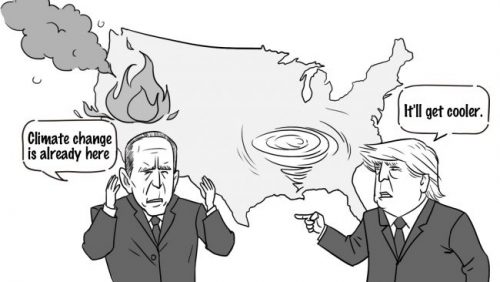
As we approach planetary tipping points, it’s vital to understand the two candidates’ plans—or lack thereof (Trump doesn’t have one)—for combatting climate change. Fast Company, 9 Oct 20, BY ADELE PETERS Whether the world succeeds in avoiding the worst impacts of climate change is likely to hinge in part on the results of the upcoming U.S. election. Climate scientist Michael Mann has said that a second Trump term would be “game over” for the climate, making it virtually impossible to limit global warming to 1.5 degrees Celsius. Biden, by contrast, is proposing the most ambitious climate policy of any major party nominee in U.S. history. Here’s a closer look at the differences. TRUMP: “IT WILL START GETTING COOLER”
The first major difference: Trump doesn’t accept the science of climate change or even necessarily seem to understand what “climate change” means. On a September visit to California, where heat and drought driven by climate change have helped fuel record-breaking fires, Trump said, “It will start getting cooler.” (He has previously called climate change a “con,” “hoax,” and claimed that it was invented by China.) At the first presidential debate, when asked about climate change, Trump started talking about clean air and water, and then claimed “we have now the lowest carbon.” (In fact, carbon dioxide levels in the atmosphere are now the highest that they have been in 15 million years.)
Through his first term, Trump has actively moved the country in the wrong direction on climate. “Across the board, the Trump administration has rolled or attempted to roll back all of the significant steps that the previous administration took under the Clean Air Act and other laws to reduce the carbon pollution and the other pollutants that are driving dangerous climate change,” says David Doniger, a senior advisor to the NRDC Action Fund, a political affiliate organization of the Natural Resources Defense Council. The administration weakened fuel economy standards, eliminated the Clean Power Plan, and weakened standards for emissions from the oil and gas industry. ……..
Trump’s campaign website says nothing about a plan for climate change. The Republican platform, recycled from 2016, says that climate change is “the triumph of extremism over common sense,” even though military experts have identified climate change as a national security threat and thousands of scientists have warned that we’re facing a climate emergency. To actually tackle climate change, the federal government would need to do far more, and a second Trump term would delay that action as the window of opportunity is closing………..
BIDEN: THE MOST AMBITIOUS CLIMATE POLICY OF ANY MAJOR PARTY NOMINEE
Biden, by contrast, has proposed investing $2 trillion to set us “on an irreversible course to meet the ambitious climate progress that science demands,” with a target of net-zero emissions by 2050. By 2035, he wants to decarbonize the electric grid. “This is more ambitious than the most ambitious states in the country,” says Stokes. (California and Hawaii are aiming for 100% clean electricity by 2045; New York is aiming for 2040.) The work on the electric grid would create millions of jobs. Retrofitting buildings to improve energy efficiency would create another million jobs. Ramping up the electric vehicle industry, and infrastructure like charging stations, would create a million more jobs. The plan also calls for “high-quality, zero-emissions” public transit for every large city, “climate-smart” agriculture, cleaning up pollution from the oil and gas industry, and the construction of 1.5 million sustainable homes and housing units. All of this would be done through the lens of environmental justice, ensuring that communities that have been hardest hit by pollution in the past see the benefits.
Though Biden has said that his plan is different from the Green New Deal, a resolution sponsored by Alexandria Ocasio-Cortez, the core principle is the same—creating jobs and fostering equity while reducing emissions. …..
The scope of the plan has to be massive because the country has waited so long to act; the changes could have been much more gradual if we had started 25 years ago. “We’re in a tough spot now,” Doniger says. “If Biden is elected, there’s a need for very deep reductions very fast.” Still, the vast scope of work means creating millions of jobs at a moment when the country also needs to invest in economic recovery.
If Biden wins—and, crucially, if Democrats also control Congress—it’s possible that the world could still avoid the worst impacts of climate change while addressing the recovery. “We’re going to need a very big recovery package, probably a lot bigger than the one from 2009,” Doniger says. “There’s a huge opportunity to build into that infrastructure spending for the transition to clean energy and low emissions that we need, and to do it in a way that invests in communities that have been underserved and beset by pollution.” https://www.fastcompany.com/90560969/the-2020-presidential-election-will-decide-the-fate-of-the-climate
|
|

Global and European temperature levels for September – hottest on record
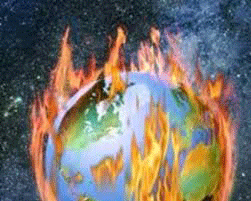 September breaks global and European records for hottest ever https://www.theguardian.com/environment/2020/oct/07/september-saw-hottest-temperatures-on-record-globally-and-in-europe September breaks global and European records for hottest ever https://www.theguardian.com/environment/2020/oct/07/september-saw-hottest-temperatures-on-record-globally-and-in-europe
Air temperatures hit all-time highs for month and Arctic sea ice level was ‘particularly low’ PA Media Surface air temperatures last month were 0.05C warmer than in September 2019, making it the hottest September on record globally, experts from the European Union’s Copernicus Climate Change Service (C3S) said. It was also the hottest September Europe has seen, beating the previous record for the continent, set in 2018, by around 0.2C. Temperatures were also well above average in other parts of the world including in the Middle East, parts of South America and Australia, the scientists said. And temperatures in the Siberian Arctic continued to be warmer than average, continuing the hot spell that has affected parts of the region since early spring. Monitoring by C3S also confirms that the average Arctic sea ice extent was the second lowest recorded for September, the month when sea ice is at its lowest after the summer melt before it refreezes in winter, after 2012. The C3S, which is implemented by the European Centre for Medium-Range Weather Forecasts (ECMWF), monitors the global and European climate, producing computer-generated analyses using billions of measurements from satellites, ships, aircraft and weather stations around the world. Carlo Buontempo, director of C3S at ECMWF, said: “In 2020, there was an unusually rapid decline in Arctic sea ice extent during June and July, in the same region where above average temperatures were recorded, preconditioning the sea ice minimum to be particularly low this year. “The combination of record temperatures and low Arctic sea ice in 2020 highlight the importance of improved and more comprehensive monitoring in a region warming faster than anywhere else in the world.” |
|
Climate misinformation advertisements on Facebook, seen by millions

Climate denial ads on Facebook seen by millions, report finds
The ads included calling climate change a hoax and were paid for by conservative US groups, Guardian, Damian Carrington 9 Oct 20, Adverts on Facebook denying the reality of the climate crisis or the need for action were viewed at least 8 million times in the US in the first half of 2020, a thinktank has found.The 51 climate disinformation ads identified included ones stating that climate change is a hoax and that fossil fuels are not an existential threat. The ads were paid for by conservative groups whose sources of funding are opaque, according to a report by InfluenceMap.
Last month Facebook said it was “committed to tackling climate misinformation” as it announced a climate science information centre. It said: “Climate change is real. The science is unambiguous and the need to act grows more urgent by the day.”Facebook uses factcheckers and bans false advertising but also says this process “is not meant to interfere with individual expression, opinions and debate”. Some of the ads were still running on 1 October. The ads cost just $42,000 to run and appear to be highly targeted, with men over the age of 55 in rural US states most likely to see them.
Warren and other senators wrote to Facebook in July calling on it to close the loopholes.
Climate future depends on what action humans take
Climate scientists on Earth’s two futures The worst effects of climate change don’t have to happen, scientists say. But humans’ actions in the near future will determine if they do. CBS News 60 Minutes Overtime, 2020 Oct 04, BYBrit McCandless Farmer
-
- For more than three decades, climate scientists have accurately forecast how carbon emissions would cause a global rise in temperatures. Now they’re looking ahead at the decades to come.
When it comes to predicting the future, scientists do not see just one possible outcome. Rather, they say the actions humans take in the near-term will have a major effect on how Earth changes for generations beyond.
“We need to change our course in the next few years because it’s still possible, I think, to avoid the worst outcomes,” Former NASA scientist James Hansen told 60 Minutes correspondent Scott Pelley…….
California is facing the largest wildfires in its history, the East Coast has already been pummeled by nine powerful storms, and what may be the highest temperature ever recorded on Earth scorched California’s Death Valley.
But as bad as they are, Hansen believes, raging forest fires and destructive hurricanes will not be Earth’s worst crises if humans fail to change their actions. The worst consequences will come from permanent changes — rising sea levels and the potential extermination of species.
“We can get back to the old climate if we haven’t caused irreversible things,” Hansen said. “If we lose our coastal cities, that’s irreversible on any time scale that we would care about. And also, the loss of species. So those are the things that I worry about. But those are … late-in-century effects which our children and grandchildren will feel.”
Stopping climate change before irreversible effects have damaged the planet is possible, some scientists believe. …….
According to the latest models, how much the planet will warm is mostly a function of how much carbon humans have burned up to now. If all carbon emissions were to cease today, Mann said, both plants and the ocean would increase the amount of carbon they take out of the atmosphere. As a result, temperatures would remain fairly flat.
“We are only committed to the warming that has happened already,” Mann said. “If we stop burning carbon now, we stop the warming of the planet. In a sense, that is empowering. It tells us we can have a real impact.”
That does not necessarily mean the damage that has been done is reversible. Future generations may be able to figure it out, Mann said—but only if humans halt the planet’s warming. https://www.cbsnews.com/news/climate-scientists-earth-future-60-minutes-2020-10-04/
1 This Month
19 February – VIRTUAL EVENT-Decision Time: AI and Our Nuclear Arsenal
12:45 p.m. Central / 1:45 p.m. Eastern
To see nuclear-related stories in greater depth and intensity – go to https://nuclearinformation.wordpress.com
-
Archives
- February 2026 (181)
- January 2026 (308)
- December 2025 (358)
- November 2025 (359)
- October 2025 (376)
- September 2025 (258)
- August 2025 (319)
- July 2025 (230)
- June 2025 (348)
- May 2025 (261)
- April 2025 (305)
- March 2025 (319)
-
Categories
- 1
- 1 NUCLEAR ISSUES
- business and costs
- climate change
- culture and arts
- ENERGY
- environment
- health
- history
- indigenous issues
- Legal
- marketing of nuclear
- media
- opposition to nuclear
- PERSONAL STORIES
- politics
- politics international
- Religion and ethics
- safety
- secrets,lies and civil liberties
- spinbuster
- technology
- Uranium
- wastes
- weapons and war
- Women
- 2 WORLD
- ACTION
- AFRICA
- Atrocities
- AUSTRALIA
- Christina's notes
- Christina's themes
- culture and arts
- Events
- Fuk 2022
- Fuk 2023
- Fukushima 2017
- Fukushima 2018
- fukushima 2019
- Fukushima 2020
- Fukushima 2021
- general
- global warming
- Humour (God we need it)
- Nuclear
- RARE EARTHS
- Reference
- resources – print
- Resources -audiovicual
- Weekly Newsletter
- World
- World Nuclear
- YouTube
-
RSS
Entries RSS
Comments RSS
 nuclear-news