Nuclear weapons have triggered a new geological era

NUCLEAR WEAPONS IN THE ANTHROPOCENE
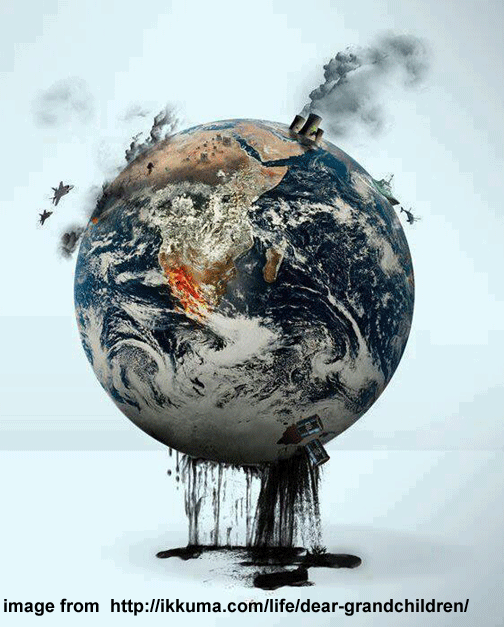
Nuclear weapons have triggered a new geological era, but what does that really mean ? Inkstick Media: Peter Waring, 3 May 21, There were a few possible contenders when a working group established by the International Commission on Stratigraphy began searching for a “golden spike” — a geological inflection point marking the end of one era and the beginning of another. ………
from a geological perspective, no marker better captures humanity’s impact on the physical environment than the fallout from decades of atmospheric nuclear testing.

In 2019, the Working Group voted overwhelmingly to recommend establishing a new era — the Anthropocene — to record the beginning of the period where humans have drastically altered the planet. The proposed start day was July 16, 1945, the day of the Trinity Test.

The beginning of the nuclear age marks a new stratigraphic boundary in Earth’s history. The “bomb spike,” as it came to be known, represents the level of carbon 14 and plutonium 239 in the atmosphere, both of which peaked in the mid-1960s at the height of the Cold War. And though levels have subsequently reduced — as states limited and finally halted atmospheric testing — evidence of the spike is now a matter of geological record. In other words, it will exist for as long as the Earth does. But what does this really mean for our security and our environment?
RACING TOWARD CATASTROPHE
Humanity and the environment are now “mutually transformative — and potentially mutually destructive,” a fact which forces us to confront the possibility that the era of climate stability, known as the Holocene, has ended and that our own collective and individual actions are to blame. Apart from its prominent geological signature, the “bomb spike” is also emblematic of the so-called Great Acceleration, the exponential growth in various metrics of human activity since the mid-twentieth century, which include: population, technology, economic development, industrial output, energy consumption, carbon emissions, and international tourism. These measures have been thrust ever upwards by the spread of extractive capitalism, endless technological innovation, and an underlying assumption that somehow the realm of human activity exists outside and separate from nature. Today, we are not witnessing the failure of this world view. Rather, we are witnessing the consequences of its success.
Nuclear arsenals are regularly justified as a bulwark against threats to the postwar, liberal international order. But it is precisely this global system that has served as the launching pad for the Great Acceleration. And as such, it is difficult to separate our conceptions of wealth, progress, and liberty — the very things nuclear weapons are meant to secure — from the causes of human-induced climate change. We have been led to believe that this skyward trajectory is a good thing, that all of our problems will disappear if only there were more progress, more technology, more freedom. But like Icarus, have we flown too close to the sun?
OUR WORST ENEMY
The Manhattan Project, which developed the first atomic weapons, has been described as a “full stop on modernity” — or in other words, the natural terminus of a worldview that separated humankind from our environment. It is the belief that we can do whatever we want to nature and that the Earth exists to support humanity. The Manhattan Project, which developed the first atomic weapons, has been described as a “full stop on modernity” — or in other words, the natural terminus of a worldview that separated humankind from our environment. It is the belief that we can do whatever we want to nature and that the Earth exists to support humanity.
Modernity in this sense is not merely technology or our institutions but rather a mode of thought premised on a belief in human supremacy. Nuclear weapons are the apotheosis of modernity. We can take whatever we want from the Earth and we can destroy it too. Here is the intersection some nuclear threat experts have been looking for, between the environmental movement and the nuclear movement. Between a cause with seemingly endless cultural cachet and one that appears like a mid-century relic.
The nuclear weapons industry is undoubtedly the source of much environmental damage: There are uranium mines, plutonium production facilities, and former test sites. But the true impact exists on a different register altogether. It is more than just the material effects, more even than the devastating ecological impact of a nuclear blast.
Atomic weapons are the most extreme example of our world-possessing pretensions. Their existence and central role in our security apparatus is representative of a mode of thought that portrays humanity as the chief protagonist in the story of Earth. The Anthropocene is the point at which the plot changes.
It is also clear that on a planet increasingly defined by human activity the old dichotomies of friend and foe — of good and evil — are no longer relevant. But constructing enemies is at the core of nuclear thinking as only the most extreme adversaries can justify the most extreme weapons. During the Cold War this was a relatively simple task, albeit one pursued with a kind of cartoonish zeal by politicians on both sides. And while there is a worrisome element of deja vu about the rising discord between Russia and NATO, talk of a new Cold War seems oddly out of place in a world of pandemics and catastrophic climate change. Yet it remains an inescapable feature of the Atomic Age that enemies must be suitably evil and suitably different from us. They must “hate freedom” and they must reject the so-called “rules-based” global order. More significantly, the enemies themselves are largely inconsequential: When they crumble or retreat into the background, we create new ones. As long as the weapons exist there will be myths to justify them. Arundhati Roy perhaps said it best:
“Nuclear weapons pervade our thinking. Control our behavior. Administer our societies. Inform our dreams. They bury themselves like meat hooks deep in the base of our brains. They are purveyors of madness.”
The Anthropocene forces us to grapple with this madness and to reconsider our need for enemies. It demands that we confront unsettling truths and come to terms with the prospect that the greatest threat to our security and way of life is our way of life.
ADJUSTING OUR POLITICS
The long half-life of the Atomic Age is as much the product of outdated thinking as it is bureaucratic inertia or military strategy. The scholarship surrounding nuclear weapons is held back — stuck — by a kind of thinking that belongs to a different epoch. International Relations (IR) and its dominant paradigms of realism and liberalism have lost whatever explanatory power they once had. They are no longer fit for purpose as either an academic discipline or a collection of governing institutions. They have become a trap of our own making. In fact, IR fails even to acknowledge the threat posed by the Anthropocene or the consequences of inaction. The global apparatus constructed to manage twentieth-century challenges, such as genocide, nuclear conflict, and world wars has proved disastrously ill-suited to our new era.
This has been particularly true with regards to the supposed preeminence of the nation-state, which serves as the very basis of world governance. But it is precisely this belief — the privileging of the national above the international, of the human above the planetary — that has drawn attention away from the devastation occurring all around us.
Viewed from the perspective of deep geological time, the pantomime of global politics and state rivalry has been little more than a distraction. What good are states if their future consists of flooded cities, devastated ecosystems, and uninhabitable wastelands? And can states defend the interests of future generations, both human and non-human?
If indeed the domain of the human and the natural are now indistinguishable, then it follows that our notions of international security and geopolitics must change. What is needed is not more realism or liberalism or business-as-usual diplomacy but rather an altogether new way of organizing the world — a theory of IR based on the belief that the Earth itself matters. ……. https://inkstickmedia.com/nuclear-weapons-in-the-anthropocene/
The huge carbon footprint and massive energy use of online activities and of Bitcoin

This is a most timely article. Why is the world not noticing this? Elon Musk and other billionaire Bitcoin fans are also fans of space travel – another energy-gobbling thing. They are fans of nuclear energy. The thing that nuclear energy fans have in common with space travel fans and Bitcoin fans is their religious fervour for endless growth and endless energy use.
Unfortunately our entire culture, the Western consumer culture, has swept the world with a mindless belief in ever more stuff, ever more digital use, with no awareness of the energy used. So we tink that our billions of trivial tweets are up ”in the cloud”, – not even realising that they are in dirty great steel data buildings that use massive amounts of energy just to keep cool, This ever- expanding energy and resource gobbling is going to kill us, – and Bitcoin is just one glaring, sorry example of this.
Truth or fiction: Is mining bitcoin a ticking time bomb for the climate? Rehabilitating Earth By Jennifer Sizeland 2 May 21
While many of us may consider the carbon footprint of buying a physical item like a jumper or a toaster, it is truly mind boggling to think about the environmental impact of time spent online. This may be why the huge carbon footprints of cryptocurrencies like bitcoin are going largely under the radar for many of us, including investors and climate activists.
Yet the real-world cost of bitcoin cannot be underestimated. A University of Cambridge study found that the network burns through 121 terawatt-hours per year, putting it into a category of a top-30 country in terms of electricity usage. In fact, the carbon cost was largely ignored altogether until 2017 when prices surged and the general population started to take more notice. Aside from the significant carbon footprint of bitcoin, it’s important to understand what bitcoin is and why it’s so popular.
Decoding Cryptocurrencies
Bitcoin is created by mining a 64-digit hexadecimal number (known as a ‘hash’) that is less than or equal to the target hash that the miner is looking for. The miner gets paid in crypto tokens for all the currency they make. The act of solving these computational equations on the bitcoin network makes the payment network trustworthy. It proves the worth of the bitcoin and verifies it at the same time so that it can’t be spent twice. Essentially, an online log makes records of the transactions made and once approved, they’re added to a block on the chain, hence the phrase ‘blockchain’.
What makes it all the more confusing is that not only is cryptocurrency fairly new to the general population, but the way it is created is shrouded in secrecy due to its niche status. This makes it much harder for miners to be held accountable for their intensive carbon usage, in a time when every company needs to consider their impact on the planet.
The secrecy is also what excites investors about bitcoin since it isn’t tied to a certain location or institution and it’s completely decentralised – unlike a bank. Investors trust bitcoin as inflation is controlled algorithmically by cutting the reward rate periodically, rendering the rate of new bitcoin supplies as unalterable by design. The issue remains that there is no government or organisation to hold them to account for their carbon footprint. A footprint which is intrinsically tied to its value as the demand for it increases, using more and more energy. With every market jump, the cost to the planet is greater.
The price of one bitcoin is $57,383 at the time of writing, which takes the market cap value above that of Facebook and Tesla. The wider cryptocurrency market that includes dogecoin, ethereum and litecoin has reached an estimated $1.4 trillion and counting.
From a financial perspective, miners want cheap servers to increase their profit margins which is why much of the bitcoin activity is done in China. As the industry is unregulated there is no reason why activity wouldn’t surge in the place where it costs the least to do it. Currently, China does not have a cost-effective renewable energy supply so two thirds of the grid is fuelled by dirty coal power stations.

Another problematic caveat to the bitcoin story is the amount of so-called green companies and investors that are buying into it. Some of them are not disclosing this element of their portfolio due to the immense carbon footprint but those that are publicly traded have no choice. Perhaps one of the most high-profile companies to reap the rewards from bitcoin is Elon Musk’s Tesla, who have made $1 billion in 10 weeks from their investment. It remains to be seen whether these businesses are doing their due diligence regarding the origins of their bitcoin and if it is mined from a sustainable source. While this may give Tesla more money to invest in green infrastructure, it’s hard to say whether this is the more ethical way to do so……….
One important lesson we can take from this is that it demonstrates how the digital world has a very real impact on planet Earth. Whether we’re buying cryptocurrency or simply scrolling the internet, we are impacting the planet in one way or another. https://rehabilitatingearth.com/2021/05/02/truth-or-fiction-is-mining-bitcoin-a-ticking-time-bomb-for-the-climate/
Poor prospects for small nuclear reactors (SMRs) as a cure for climate change

The nuclear industry and the U. S. Department of Energy are promoting the development of SMRs, supposedly to head off the most severe impacts of climate change. But are SMRs a practical and realistic technology for this purpose?
To answer, two factors are paramount to consider – time and cost. These factors can be used to divide SMRs into two broad categories:
Light water reactors based on the same general technical and design principles as present-day power reactors in the U.S., which in theory could be certified and licensed with less complexity and difficulty.
Designs that use a range of different fuel designs, such as solid balls moving through the reactor core like sand, or molten materials flowing through the core; moderators such as graphite; and coolants such as helium, liquid sodium or molten salts.
On both counts, the prospects for SMRs are poor.
EWG 25th March 2021
France and Russia portray nuclear hydrogen as ”green”- arousing anger of several European nations.

Atomic giants EDF and Rosatom push plan to sell nuclear-powered hydrogen as ‘green’Labelling nuclear hydrogen as green is likely to cause irritation among countries without atomic power or exiting it, 28 April 2021 By Bernd Radowitz , Recharge
French and Russian state-owned nuclear energy giants EDF and Rosatom have teamed up to develop low carbon hydrogen projects in Russia and Europe in order to decarbonise mobility and industrial sectors – but their labelling of H2 produced from nuclear power as ‘green’ is likely to cause irritation elsewhere in Europe.
As part of a strategic cooperation agreement signed last month, the hydrogen is slated to be produced both from nuclear power and from methane conversion linked to carbon capture and storage (CCS) technologies……..
Any massive use of nuclear hydrogen on an EU level is strongly opposed by countries without atomic power, or exiting it, such as Germany and Austria. Andreas Feicht, secretary of state in Germany’s economics and energy ministry, at a late-2020 virtual conference on hydrogen organised by his ministry stressed nuclear is not an option for Germany’s energy system or for the production of hydrogen.
The French government (backed by some Eastern European countries), by contrast, is trying to push nuclear hydrogen and wants it to be entitled for state support, which would be a way to use French or EU funds to help its highly-indebted nuclear utility EDF and give new life to its ageing nuclear fleet.
…… Béatrice Buffon, group executive vice-president in charge of EDF’s International Division.
“The agreement with the Rosatom Group, our historical partner in Russia and one of the country’s key players in the field of decarbonised hydrogen, illustrates EDF’s desire to develop a new energy model with lower CO2 emissions wherever we operate.”
The two nuclear companies didn’t provide more detail on specific projects being studied. https://www.rechargenews.com/energy-transition/atomic-giants-edf-and-rosatom-push-plan-to-sell-nuclear-powered-hydrogen-as-green/2-1-1002350
Earth has shifted on its axis due to melting of ice, study says
Earth has shifted on its axis due to melting of ice, study says https://thebulletin.org/2021/04/earth-has-shifted-on-its-axis-due-to-melting-of-ice-study-says/?utm_source=Newsletter&utm_medium=Email&utm_campaign=MondayNewsletter04262021&utm_content=ClimateChange_AxisTilt_04242021
By Damian Carrington | April 24, 2021Editor’s note: This story was originally published by The Guardian. It appears here as part of the Climate Desk collaboration.
The massive melting of glaciers as a result of global heating has caused marked shifts in the Earth’s axis of rotation since the 1990s, research has shown. It demonstrates the profound impact humans are having on the planet, scientists said.
The planet’s geographic north and south poles are the point where its axis of rotation intersects the surface, but they are not fixed. Changes in how the Earth’s mass is distributed around the planet cause the axis, and therefore the poles, to move.
In the past, only natural factors such as ocean currents and the convection of hot rock in the deep Earth contributed to the drifting position of the poles. But the new research shows that since the 1990s, the loss of hundreds of billions of tons of ice a year into the oceans resulting from the climate crisis has caused the poles to move in new directions.
The scientists found the direction of polar drift shifted from southward to eastward in 1995 and that the average speed of drift from 1995 to 2020 was 17 times faster than from 1981 to 1995.
Since 1980, the position of the poles has moved about 4 meters in distance. “The accelerated decline [in water stored on land] resulting from glacial ice melting is the main driver of the rapid polar drift after the 1990s,” concluded the team, led by Shanshan Deng, from the Institute of Geographic Sciences and Natural Resources Research at the Chinese Academy of Sciences.
Gravity data from the Grace satellite, launched in 2002, had been used to link glacial melting to movements of the pole in 2005 and 2012, both following increases in ice losses. But Deng’s research breaks new ground by extending the link to before the satellite’s launch, showing human activities have been shifting the poles since the 1990s, almost three decades ago.
The research, published in the journal Geophysical Research Letters, showed glacial losses accounted for most of the shift, but it is likely that the pumping up of groundwater also contributed to the movements. Groundwater is stored under land but, once pumped up for drinking or agriculture, most eventually flows to sea, redistributing its weight around the world. In the past 50 years, humanity has removed 18 trillion tons of water from deep underground reservoirs without it being replaced.
Vincent Humphrey, at the University of Zurich, Switzerland, and not involved in the new research said it showed how human activities have redistributed huge amounts of water around the planet: “It tells you how strong this mass change is—it’s so big that it can change the axis of the Earth.” However, the movement of the Earth’s axis is not large enough to affect daily life, he said: It could change the length of a day, but only by milliseconds.
Jonathan Overpeck, a professor at the University of Arizona, told the Guardian previously that changes to the Earth’s axis highlighted “how real and profoundly large an impact humans are having on the planet”.
Some scientists argue that the scale of this impact means a new geological epoch – the Anthropocene—needs to be declared. Since the mid-20th century, there has been a marked acceleration of carbon dioxide emissions and sea level rise, the destruction of wildlife and the transformation of land by farming, deforestation, and development.
Is the US nuclear community prepared for the extreme weather climate change is bringing?

Is the US nuclear community prepared for the extreme weather climate change is bringing? https://thebulletin.org/2021/04/is-the-us-nuclear-community-prepared-for-the-extreme-weather-climate-change-is-bringing/?utm_source=Newsletter&utm_medium=Email&utm_campaign=ThursdayNewsletter04222021&utm_content=NuclearRisk_NuclearExtremeWeather_04202021 By Susan D’Agostino | April 20, 2021
In May 2000, a planned burn to remove dead, dried underbrush on New Mexico’s drought-stricken Cerro Grande peak in the Bandelier National Monument grew out of control. As the sky darkened with smoke, a wall of flames fueled by high winds burned through tens of thousands of acres of land where people, elk, and bald eagles made their homes. The monstrous blaze escaped the monument’s containment line and headed to the forested birthplace of the atomic bomb—Los Alamos National Laboratory. There, it raced over soil, rocks, and trees contaminated from decades-old nuclear weapons testing, releasing radioactive particles into the air and setting 47 buildings ablaze. As the devastation unfolded, the wildfire inched close to, but stopped short of, a facility containing tritium, a radioactive form of hydrogen.
In May 2000, a planned burn to remove dead, dried underbrush on New Mexico’s drought-stricken Cerro Grande peak in the Bandelier National Monument grew out of control. As the sky darkened with smoke, a wall of flames fueled by high winds burned through tens of thousands of acres of land where people, elk, and bald eagles made their homes. The monstrous blaze escaped the monument’s containment line and headed to the forested birthplace of the atomic bomb—Los Alamos National Laboratory. There, it raced over soil, rocks, and trees contaminated from decades-old nuclear weapons testing, releasing radioactive particles into the air and setting 47 buildings ablaze. As the devastation unfolded, the wildfire inched close to, but stopped short of, a facility containing tritium, a radioactive form of hydrogen.
The US response to potential climate impacts on the country’s various nuclear activities has, in the eyes of many experts, fallen far short of what it needs to be.
“All of these [nuclear] structures were built on the presumption of a stable planet. And our climate is changing very rapidly and presenting new extremes,” Hill said. “There’s harm that stems from that.”
Drought and spent nuclear waste. When forests are drier for long periods of time, they act as kindling for wildfires. Extreme drought exacerbated by climate change is a key driver of wildfires in the Western United States, which are increasing both in frequency and in size. For nuclear infrastructure in the heart of wildfire territory, this trend spells trouble.
Continue readingUSA: Small nuclear reactors cannot meet the critical climate need – now, or ever

The critical need for deep carbon pollution reductions this decade calls on us to focus on the low-carbon technologies we have now. And those are wind and solar. SMRs will be a dollar short and a day too late. They cannot meet critical climate deadlines, not by 2030 or 2035, and likely never.
Advanced Nuclear Dreaming in Washington State, CounterPunch, PATRICK MAZZA 19 Apr 21, It was once known by one of the most inadvertently appropriate acronyms ever, WPPSS, the Washington Public Power Supply System. “Whoops!,” as they called it, in the early 1980s brought on what was then the worst municipal bond default in U.S. history trying to build five nuclear reactors in Washington state at once, completing only one.
But faith in the nuclear future lives on at “Whoops!,” today rebranded as Energy Northwest. On April 1, the day perhaps also inadvertently fitting, the consortium of Washington state public utilities announced a move aimed at the first advanced nuclear reactor deployment in the U.S. Energy Northwest will partner with Grant County Public Utility District, a member utility serving a desert county in the center of the state, and X-energy, a leading developer of the nuclear industry’s bright shining hope, the small modular reactor (SMR)…………….
The WPPSS default was part of the first wave of nuclear failures in the U.S. In the wake of the 1979 Three Mile Island accident, approximately 100 proposed nuclear plants were cancelled. Recent years have seen a second round of failures. The Energy Policy Act of 2005 put $25 billion in nuclear subsidies on the table. That jumpstarted all of four nuclear reactors, two each in Georgia and South Carolina. The only way Wall Street would touch the projects was to make ratepayers carry the risk by paying for “work in progress” before the first watt is delivered. South Carolina ratepayers won’t even see that. Cost overruns killed the project there in 2017 after $9 billion was thrown away, setting up a political and court fight over whether ratepayers will continue to be soaked. The last two standing, Georgia’s Vogtle plants, were to have cost $14 billion and come on line in 2016-17. Now costs have doubled to $28 billion and scheduled completion this year and next is considered unlikely.
IS THE SMR A SOLUTION?
SMRs are the nuclear industry’s answer to avoid such failures in the future. Instead of being custom-built and individually licensed, SMRs are intended to cut costs by licensing a single design manufactured at a plant and sent for final assembly to their operating site. Smaller than the 1,000-megawatt-plus plants with which we’re familiar, SMRs are 100 MW or less, and designed with safety features to prevent meltdowns such as experienced at Japan’s Fukushima plant in 2011. Though there are questions about that, as covered below…………..
CAN THE SMR SAVE THE CLIMATE?

For now, the question is whether SMRs such as X-energy’s can really revive the nuclear industry, and most importantly, provide a climate solution with low-carbon electrical power in a meaningful timeframe. The answer, by simple logic, is no
…………Though deep carbon cuts must start quickly, the Washington state partnership gives a completion date for its SMR pilot project as 2027-28. Considering the nuclear industry’s track record, delays and cost overruns are likely. And that would only be the beginning of a long-process to create the entire manufacturing supply chain needed to make SMRs an economical alternative. If they can be. The key issue is economies of scale.
“Power generation scales on volume of the reactor vessels,” notes Arjun Makhijani, who has a Ph.D. in electrical engineering, with a specialization in nuclear fusion, from the University of California at Berkeley. “The materials and labor scale more slowly. That’s a basic reason that there are economies of scale and big reactors were built.”
The Union of Concerned Scientists (UCS) cites a study which shows that a reactor with 1,100 MW capacity would cost three times as much to build as a 180 MW plant, but produce six times the electricity, “so the capital cost per kilowatt would be twice as great for the smaller plant.”
SMRs lose those economies of scale, but proponents hope to make that up with mass manufacturing and licensing, avoiding costs of custom-built plants.
ROCKY ROAD TO MASS PRODUCTION
“The road to such mass manufacturing will be rocky,” Makhijani and M.V. Ramana write in a recent article, “Why Small Modular Reactors Won’t Help Counter the Climate Crisis.” “Even with optimistic assumptions about how quickly manufacturers could learn to improve production efficiency and lower cost, thousands of SMRs, which will all be higher priced in comparison to large reactors, would have to be manufactured for the price per kilowatt for an SMR to be comparable to that of a large reactor.”
That sets up “a chicken-and-egg economic problem,” they write. “Without the factories, SMRs can never hope to achieve the theoretical cost reductions that are at the heart of the strategy to compensate for the lack of economies of scale. But without the cost reductions, there will not be the large number of orders to stimulate the investments needed to set up the supply chain in the first place.”………….
WE DON’T NEED NUCLEAR
The world is running out of time to address all the concerns facing SMRs and advanced reactor designs in general.
“If you look at the cold facts from a climate point of view we have a shortage of time and money. New reactors cannot help materially,” Makhijani told The Raven. “How are we going to have a carbon-free electricity system by 2035 in which SMRs will play a significant role when the first one isn’t even supposed to come on line till the late 2020s? Those who are advocating new nuclear reactors should address the time constraint, and whether we can do it without nuclear. If we could not do it without, that would be another question. But we can. So there should be no question.”
Many studies document the capacity of wind and solar to replace fossil fuel electricity. The challenge of varying sunlight and wind speeds is met with a smart grid that can adjust energy demand to available supply and link diverse geographies. So when the wind is blowing on the Great Plains, it can supply juice while clouds block sunlight in Chicago. For times when none of that is sufficient, storage in many forms can be used, from batteries to pumped storage reservoirs. Even household water heaters. If all else fails, backup generators fueled with stored hydrogen can be brought into play. Hydrogen can be electrolyzed from water through solar and wind energy that would otherwise go unused because generation exceeds the demands of the grid.
Mark Jacobson of Stanford has done many studies documenting the capacity of wind, water and solar to meet all energy needs. A NOAA study showed carbon pollution from electricity could be cut up to 80% from 1990 levels by 2030, largely with wind and solar, needing no new nuclear and energy storage, while actually cutting electricity costs. That would require building a continental grid with efficient high-voltage DC lines to link diverse geographies. A study done by Makhijani for the Institute for Environmental and Energy Research, of which he is president, lays out a path to zero carbon electricity in Maryland.
ANOTHER WHOOPS?
Despite towering obstacles facing SMRs, from economic chicken-and-egg problems of ramping up production, to unsolved waste and proliferation issues, to remaining safety questions, the nuclear faithful at Energy Northwest soldier on. Yes, they now have operated a nuclear plant successfully since the 1980s, though questions have been raised about earthquake hazards in light of emerging seismic knowledge. Washington state has enacted a goal of 100% clean electricity by 2045, and nuclear advocates see it filling a role. In any event, new nuclear power from SMRs will be incapable of supplying a significant portion of low-carbon energy until well into the 2030s, even if economic and other issues are resolved.
All that time, any new nuclear reactors will be facing continuing cost declines in wind, solar and storage, as well as increasing deployment of smart grid technologies and advanced long-distance power transmission. If the Washington state partnership’s SMR installation actually is built and operated, with the 2027-8 timeline likely to be stretched out and the projected $2.4 billion cost figure likely to be exceeded, it could well be a costly white elephant, a relic of faith in a technology whose time has passed. The critical need for deep carbon pollution reductions this decade calls on us to focus on the low-carbon technologies we have now. And those are wind and solar. SMRs will be a dollar short and a day too late. They cannot meet critical climate deadlines, not by 2030 or 2035, and likely never. https://www.counterpunch.org/2021/04/19/advanced-nuclear-dreaming-in-washington-state/
Global Warming, Environmental Variability, and Infectious Disease — GarryRogers Nature Conservation

COVID-19 battle allowing spread of other infectious diseases in India.
Global Warming, Environmental Variability, and Infectious Disease — GarryRogers Nature Conservation
*Net Zero Without Nuclear**

Jonathon Porritt 15th April 2021, Jonathon Porritt: Even as the prospects for nuclear power continue to decline, the industry is spending more and more money seeking to persuade Governments, commentators and ‘gullible greenies’ that we’re going to need new nuclear power to get us to a Net Zero economy by 2050.
I’ve spent the last six months looking into this mismatch: declining prospects, escalating hype. All captured in my new Report, ‘Net Zero Without Nuclear’ – accessible here: Net Zero Without Nuclear 15.04.21 ‘Net Zero Without Nuclear’ has been generously endorsed by Greenpeace, Friends of the Earth, the Green Party, CND and a host of experts in this critical scientific and policy area.
http://www.jonathonporritt.com/net-zero-without-nuclear-the-case-against-nuclear-power/
Nuclear nation France exerted pressure on European Commission. Climate taxonomy deal threatened by possible inclusion of nuclear as ”virtuous”

The future of the European nuclear industry is playing out in Brussels. https://reporterre.net/Le-nucleaire-tente-de-forcer-la-porte-europeenne-de-la-taxonomie-verte 9 Apr 21, The Commission is due to unveil this month the list of energies that will be considered “green” for investors. But an entry of nuclear and gas into this “taxonomy” risks weakening the ambitions of the EU and its Green Deal.
Brussels (Belgium), correspondence
This is a decision that will weigh on the future. For several months, the European Commission has been working on an important tool, supposed to support the energy sector and the Member States in reducing the continent’s CO2 emissions. This involves establishing a classification (called “taxonomy”) of energy sources that will be considered “virtuous” for the environment and the fight against global warming. While gas and nuclear power were initially ruled out, these two sectors are making an unexpected comeback in the discussions, on the eve of the publication by the Commission of its position, scheduled for April 21.
Initially, what is called “green taxonomy” was established on “scientifically defined” sustainability criteria, explained to Reporterre Neil Makaroff, Europe manager for the Climate Action Network. This is how the nuclear sector was sidelined mainly due to the impact of radioactive waste on the environment. But over the months, and following the adoption this summer of the European recovery plan (of which 30% of expenditure will have to be directed towards actions for the climate), taxonomy has become the object of political and economic interests. States. “It is a tool that should be neutral, but by introducing political issues into it, we are trampling on what scientific experts have established,” said Neil Makaroff.
The financial stakes are indeed very important for the sectors since, even if the classification will not prevent investors from supporting the sectors of their choice, the “green taxonomy” should be widely used as a reading grid by public investors, to start with the European Investment Bank (EIB) and the Member States subject to their climate targets. For private investors, the criteria of the taxonomy will also be benchmarks for obtaining labels on sustainability and highlighting their environmental commitments. In fact, proposing such a list amounts to directing a windfall of several billion towards the infrastructures officially dubbed for their contribution to the energy transition.
France wants to save its nuclear power hero.
In this context, the nuclear industry would like not to be forgotten by this great banquet. It initially had little hope of being invited, as several European states are hostile to her – Austria in the lead, but also Germany. Since the issue has been politically very sensitive within the Union for a long time, it was expected that nuclear power would be treated separately, later than taxonomy, with another text. Nuclear power was therefore not included in the first version of the green taxonomy project, revealed in November 2020.
However, France, a European country which has by far the largest nuclear fleet, expects that expenditure to support an industry with aging infrastructure will only increase, while private financing is increasingly difficult. to find. There is therefore a general French mobilization to try to influence the Commission. The French President, Emmanuel Macron, thus took the head of a group of seven European leaders to write, in mid-March, a letter to the European executive asking him to carefully consider the low carbon content of the production of atomic energy. “We call on the European Commission to ensure that the EU’s climate and energy policy takes into account all avenues towards carbon neutrality in accordance with the principle of technological neutrality,” wrote the seven authors.
What has given nuclear supporters hope, observers say, is the fact that the Commission seems to be backing down on the gas issue, under political pressure from ten Member States unhappy that it had not been retained as “transitional energy”. As the timetable has thus been delayed, France would like nuclear power to no longer be treated separately – which would risk excluding it from the central tool of green finance – but that it already appears in the second version of the delegated act to be published shortly. She thus found an alliance of interests with gas advocates to serve the nuclear cause. “It is very rare for heads of state to write a joint letter on this kind of subject to the Commission,” said Neil Makaroff. But that France, which shows so much its ambitions in terms of green finance, joins forces with States which want to include fossil energy in the taxonomy, it shows that it is the political game which is weighing on the Commission. “
“A last minute, opaque and politicized process”
Another recent event has also come to show how much the turn of the debate has changed. Wishing to spare the pronuclear a little and save time, the European Commission had ordered a report several months ago from its scientific committee, the Joint Research Center (JRC or JRC in English), on radioactive waste. At the end of March, rumors reported that the JRC had favorably concluded a “green” labeling for nuclear power, which should be recognized as a “transitional fuel”.
In this context, in early April, nine members of the technical expert platform (five NGOs and four experts) who had helped establish the original criteria for the taxonomy threatened to slam the door of the working group with the Commission. Faced with pressure to reintroduce fossil gas and nuclear power, they denounced a “last minute, opaque and politicized process”. “On the concept of what can be considered scientifically sustainable is not for politicians to decide,” said one of the scientists who signed the warning letter.
Originally conceived with the objective of giving clear guidelines, and presented as a world first in the field, taxonomy is therefore now in danger of being blurred by the political and strategic considerations of the Member States. For the defenders of an ambitious climate policy in Europe, if the European executive fails to keep this promise, it could ultimately affect the credibility of its “green deal” and, by extension, the Union itself in the world leadership it intended to take in the fight against global warming.
Despite the influence of Bill Gates, experts find that nuclear power is the wrong climate solution

“A decade ago, perhaps one could still argue we need new nuclear power plants to combat global warming, and that better approaches were hopefully just around the corner,” Howarth says. “But in 2021, it is very clear that we can completely rebuild the energy economy of the world moving forward built on renewable energy alone, with no need for fossil fuels or nukes. To build our future on renewables is that fastest, safest, and cheapest way to address climate disruption.”
How Bill Gates’ company TerraPower is building next-generation nuclear power, CNBC Make It, , Apr 8 2021 ”……. Selected by the U.S. federal government to demonstrate the viability of nuclear power through its Advanced Reactor Demonstration Program (ARDP), TerraPower aims to build “fully functional advanced nuclear reactor within 7 years of the award,” according to the Office of Nuclear Energy at the U.S. Department of Energy………
TerraPower’s ability to achieve those goals will be in no small part due to the money and influence of the company’s founder.“The most important factor is that Bill Gates is behind this,” principal research scientist at the Massachusetts Institute of Technology department of nuclear science and engineering Charles Forsberg tells CNBC Make It………..
Still, some say nuclear power is the wrong solution, Despite what Gates and TerraPower see as benefits, the debate over nuclear power is fierce. On March 18, for instance, the Union of Concerned Scientists (UCS), a non-profit group of 250 scientists and related professionals, issued a 140-page rebuke of “advanced nuclear” reactor designs.
“If nuclear power is to play a larger role to address climate change, it is essential for new reactor designs to be safer, more secure, and pose comparable or—better yet—lower risks of nuclear proliferation and nuclear terrorism than the existing reactor fleet,” says Edwin Lyman, Director of Nuclear Power Safety at the Union of Concerned Scientists in Washington, DC, in a statement released with the report. “Despite the hype surrounding them, none of the non-light-water reactors on the drawing board that we reviewed meet all of those requirements.”
The UCS even recommends the Department of Energy (DOE) suspend it jointly funded ARDP demonstration project (in which TerraPower is a particpant) until regulatory agencies determine what kind of prototyping is necessary, and calls on the DOE to have an independent commission to review the project.
“It doesn’t make sense to us for either government or industry to devote a lot of resources to pursuing high-risk, low-reward technologies – or technologies that could be even worse than what we have now,” Lyman tells CNBC Make It. Instead, more federal government spending to improve conventional reactors is a better tactic, according to the UCS.
“Investment to address the shortcomings of conventional reactors would have a higher chance of success because there is a large base of operating experience and experimental data that researchers can draw upon,” Lyman says………
Still others say focusing on nuclear power at all is the wrong approach.
Nuclear power, which has been around since the 1950s, “has proven to be very slow to deploy, very expensive, and fraught with dangers,” says Robert W. Howarth, professor of ecology and environmental biology at Cornell University. “And no one has ever solved the problem with what to do with nuclear wastes.”
Safe and affordable nuclear power is “a pipe dream” that “never materialized,” he says.
Michael E. Mann, professor of atmospheric science at Penn State and director of the Penn State Earth System Science Center (ESSC), argues that nuclear energy “comes with unnecessary risks when better alternatives (i.e. wind, solar, geothermal) are available.”
And “investment in nuclear likely crowds out investment in the safer alternative (renewable energy),” he says.
Both Howarth and Mann are signatories on a declaration that calls for decarbonization through 100% renewable energy, like wind and solar.
“A decade ago, perhaps one could still argue we need new nuclear power plants to combat global warming, and that better approaches were hopefully just around the corner,” Howarth says. “But in 2021, it is very clear that we can completely rebuild the energy economy of the world moving forward built on renewable energy alone, with no need for fossil fuels or nukes. To build our future on renewables is that fastest, safest, and cheapest way to address climate disruption.”
Nuclear power – a way to stop other, faster, and cheaper, climate solutions
Electric Auke: ‘Don’t use nuclear power to stymie short-term solutions’
Every other week we take a look with sustainability expert Auke Hoekstra at what catches his eye about the preservation of our earth.
9 April 2021, Innovation origins, MILAN LENTERS If it were up to the Dutch Forum for Democracy party, Brabant would get a nuclear power plant. Eric de Bie, a provincial executive member, argued for this last week. Even though a study commissioned by the province from the Netherlands Organisation for Applied Scientific Research (TNO) and the Nuclear Research Consultancy Group (NRG) shows that nuclear power is currently more expensive than green power. Still, FvD wants to go for nuclear power because of the lack of space. Far more space with solar panels and windmills would be required to generate the same amount of energy as from a nuclear power plant.
What does Auke think about this? Well, he considers building a nuclear power plant as a form of procrastination. “In the short term, a nuclear power plant will not solve the problem we have of too many CO2 emissions. The sooner we emit less CO2, the better. It’s just procrastination. All the extra CO2 that goes into the air in the time that it takes to build it needs to be removed again. Then any efforts into reducing all of that have to go even faster. Which invariably leads to extra costs, and techniques for filtering CO2 from the air are expensive. While you can already reduce CO2 emissions with the use of wind turbines.”
Moreover, the story that FvD is now bandying about is incomplete. The honest story would be quite different, according to Auke. “The potential for misuse cannot be ruled out. In any case, I am not comfortable with it. Terrorists could instigate a meltdown. Or countries that suddenly acquire a dictatorial regime can flout rules and use that knowledge to develop nuclear weapons,” Auke explains.
Higher energy bills as a result of nuclear power
In addition to those concerns, there are also a number of practical issues that FvD is now overlooking, Auke argues. “Building a nuclear power plant takes a long time and it often turns out to be much more expensive than stated in the original tender. In actual practice, it regularly happens that the construction is aborted. The storage of nuclear waste is also a huge problem. If we are going to go for nuclear power plants, let’s get this sorted out once and for all. Do they already have a storage site in mind? I don’t think so, because nobody wants one. Actually, FvD says they don’t want to build ugly windmills, but they forget to mention that our energy will become more expensive.”
Auke shrugs. “In fact, the actual question is: How much extra are we willing to pay in order not to have to look at a windmill? Quite a logical question and they have a point. Those things are hideous. I wouldn’t want one in my backyard either.”
But he quickly comes up with a solution for the question concerning space: “What if we put all those windmills out to sea? Of course, that’s already happening more and more. What’s more, we could install the solar panels on sunny fields vertically so that crops can be grown in between, for example. Mixed land use, that’s another way to use space differently.”…………. https://innovationorigins.com/electric-auke-dont-use-nuclear-power-to-stymie-short-term-solutions/
Dodgy European Taxonomy report was favourable to nuclear power – but it’s far from a done deal.

About EU Taxonomy Report , Joint Research Centre , JD Supra 9 Apr 21,
”……..While the JRC report has been well received by the nuclear industry, there are further administrative hurdles to be cleared prior to nuclear energy being deemed sustainable under the EU Taxonomy Regulation. The JRC report needs to be reviewed by two additional expert groups: (a) the group of experts on radiation and protection and waste management under Article 31 of the Euratom Treaty, and (b) the Scientific Committee on Health, Environmental and Emerging Risks, who deal with environmental impacts. These two groups are expected to issue their reports within the next three months and will inform the EU Commission’s final decision on the matter. There could of course be some delay as the Scientific Committee on Health, Environmental and Emerging Risks remains very occupied with COVID matters at the current time……”
As the Climate Crisis Grows, a Movement Gathers to Make ‘Ecocide’ an International Crime Against the Environment
As the Climate Crisis Grows, a Movement Gathers to Make ‘Ecocide’ an International Crime Against the Environment InsideClimateNews, 7 Apr 21, International lawyers, environmentalists and a growing number of world leaders say “ecocide”—widespread destruction of the environment—would serve as a “moral red line” for the planet.By Nicholas Kusnetz, Katie Surma and Yuliya TalmazanApril 7, 2021 The Fifth Crime: First in a continuing series with NBC News about the campaign to make “ecocide” an international crime.
In 1948, after Nazi Germany exterminated millions of Jews and other minorities during World War II, the United Nations adopted a convention establishing a new crime so heinous it demanded collective action. Genocide, the nations declared, was “condemned by the civilized world” and justified intervention in the affairs of sovereign states.
Now, a small but growing number of world leaders including Pope Francis and French President Emmanuel Macron have begun citing an offense they say poses a similar threat to humanity and remains beyond the reach of existing legal conventions: ecocide, or widespread destruction of the environment.
The Pope describes ecocide as “the massive contamination of air, land and water,” or “any action capable of producing an ecological disaster,” and has proposed making it a sin for Catholics.
The Pontiff has also endorsed a campaign by environmental activists and legal scholars to make ecocide the fifth crime before the International Criminal Court in The Hague as a legal deterrent to the kinds of far-reaching environmental damage that are driving mass extinction, ecological collapse and climate change. The monumental step, which faces a long road of global debate, would mean political leaders and corporate executives could face charges and imprisonment for “ecocidal” acts.
To make their case, advocates point to the Amazon, where fires raged out of control in 2019, and where the rainforest may now be so degraded it is spewing more climate-warming gases than it draws in. At the poles, human activity is thawing a frozen Arctic and destabilizing the ice sheets of Greenland and Antarctica.
Across the globe, climate change is disrupting the reliable seasonal rhythms that have sustained human life for millenia, while hurricanes, floods and other climate-driven disasters have forced more than 10 million people from their homes in the last six months. Fossil fuel pollution has killed 9 million people annually in recent years, according to a study in Environmental Research, more than tuberculosis, malaria and AIDS combined.
One in four mammals are threatened with extinction. For amphibians, it’s four in 10.
Damage to nature has become so extensive and widespread around the world that many environmentalists speak of ecocide to describe numerous environmentally devastated hot spots:
- Chernobyl, the Ukrainian nuclear plant that exploded in 1986 and left the now-deserted area dangerously radioactive;
- The tar sands of northern Canada, where toxic waste pits and strip mines have replaced 400 square miles of boreal forest and boglands;
- The Gulf of Mexico, site of the Deepwater Horizon disaster that killed 11 people, spilled at least 168 million gallons of crude oil into the ocean over 87 days and killed countless marine mammals, sea turtles, fish and migratory birds;
- The Amazon, where rapid deforestation encouraged by Brazilian President Jair Bolsonaro prompted Joe Biden, during his presidential campaign, to propose a $20 billion rescue plan and threaten the Brazilian leader with economic sanctions.
The campaign to criminalize ecocide is now moving from the fringe of advocacy into global diplomacy, pushed by a growing recognition among advocates and many political leaders that climate change and environmental causes are tied inherently to human rights and social justice.
The effort remains a long shot and is at least years from fruition, international and environmental law experts say. Advocates will have to navigate political tensions over whether national governments or the international community have ultimate control over natural resources. And they’ll likely face opposition from countries with high carbon emissions and deep ties to industrial development. …………………
Into the Mainstream
While the campaign for an ecocide law could take years—if it is successful at all—advocates say the effort could bear fruit much sooner: The ecocide campaign has thrust the concept into public discussion.
Mehta doesn’t expect the campaign to catch fire in the United States, but after four years of President Donald Trump, she’s heartened by the arrival of John Kerry, Biden’s special climate envoy. “We don’t expect the U.S. to join the ICC any time soon, but that said, the conversation around ecocide itself, we don’t see any reason why it can’t start happening in the U.S.,” she said.
The State Department released a statement saying that the U.S. “regularly engages with other countries” on “the importance of preventing environmental destruction during armed conflict,” but added, “We do not comment on the details of our communications with foreign governments.”
Mehta’s campaign is also part of a wider effort by activists who have been looking to the courts to force more aggressive action on climate change.
As of July 1, 2020, at least 1,550 climate change cases have been filed in 38 countries, according to a U.N. report.
In the landmark Urgenda case, a Dutch court ruled in 2015 that the government had acted negligently by failing to take aggressive enough action to limit its greenhouse gas emissions. The decision, upheld by the Supreme Court of the Netherlands in 2019, ordered the government to hit specific emissions reductions targets and sparked a series of similar lawsuits in other countries………….. https://insideclimatenews.org/news/07042021/climate-crisis-ecocide-vanuatu-the-fifth-crime/
Climate change probably increasing this problem – nuclear reactors halted because of jellyfish-like sea salps

Jellyfish-like organisms force South Korea to halt its 2 nuclear reactors, https://www.livemint.com/news/world/jellyfishlike-organisms-force-south-korea-to-halt-its-2-nuclear-reactors-11617794802580.htmlSea salps — gelantinous, marine organisms that look like jellyfish — have clogged water systems used to cool nuclear reactors in South Korea, forcing two units offline.
Sea salps — gelantinous, marine organisms that look like jellyfish — have clogged water systems used to cool nuclear reactors in South Korea, forcing two units offline.
It’s the second time in less than three weeks Korea Hydro & Nuclear Power Co. shut the Hanul No. 1 and No. 2 units, after salps clogged water intake valves. The reactors, which each have a capacity of 950-megawatts, resumed operation last week before shutting again Tuesday.
Sea salps can link up into chains several meters in length and have been said to resemble a crystal chandelier drifting through the ocean. The organisms typically increase in number in June but that appears to have happened in March this year due to earlier-than-normal warm currents, said Yu Ok Hwan, a deputy director at Korea Institute of Ocean Science and Technology.
“We can’t say yet if the surge in salps is due to the changing climate or other factors,” said Youn Seok-hyun, a research scientist at National Institute of Fisheries Science. “It should be regarded as a temporary phenomenon unless we see a continuous increase over the next decade.”
The number of sea salps has been gradually rising in recent years, according to Chae Jinho, the head of Marine Environment Research & Information Laboratory. “Given the current trend, there’s a possibility we may see more of these shutdowns at reactors in the coming years,” he said.
South Korea has 24 operable nuclear plants with a combined capacity of more than 23 gigawatts.
The country isn’t the only one to have been forced to halt nuclear generation temporarily after sea life clogged water cooling systems. Electricite de France SA in January had to disconnect all four reactors at its Paluel nuclear plant on France’s north coast after fish got stuck in the filter drums of the pumping station.
1 This Month
19 February – VIRTUAL EVENT-Decision Time: AI and Our Nuclear Arsenal
12:45 p.m. Central / 1:45 p.m. Eastern
To see nuclear-related stories in greater depth and intensity – go to https://nuclearinformation.wordpress.com
-
Archives
- February 2026 (181)
- January 2026 (308)
- December 2025 (358)
- November 2025 (359)
- October 2025 (376)
- September 2025 (258)
- August 2025 (319)
- July 2025 (230)
- June 2025 (348)
- May 2025 (261)
- April 2025 (305)
- March 2025 (319)
-
Categories
- 1
- 1 NUCLEAR ISSUES
- business and costs
- climate change
- culture and arts
- ENERGY
- environment
- health
- history
- indigenous issues
- Legal
- marketing of nuclear
- media
- opposition to nuclear
- PERSONAL STORIES
- politics
- politics international
- Religion and ethics
- safety
- secrets,lies and civil liberties
- spinbuster
- technology
- Uranium
- wastes
- weapons and war
- Women
- 2 WORLD
- ACTION
- AFRICA
- Atrocities
- AUSTRALIA
- Christina's notes
- Christina's themes
- culture and arts
- Events
- Fuk 2022
- Fuk 2023
- Fukushima 2017
- Fukushima 2018
- fukushima 2019
- Fukushima 2020
- Fukushima 2021
- general
- global warming
- Humour (God we need it)
- Nuclear
- RARE EARTHS
- Reference
- resources – print
- Resources -audiovicual
- Weekly Newsletter
- World
- World Nuclear
- YouTube
-
RSS
Entries RSS
Comments RSS
 nuclear-news