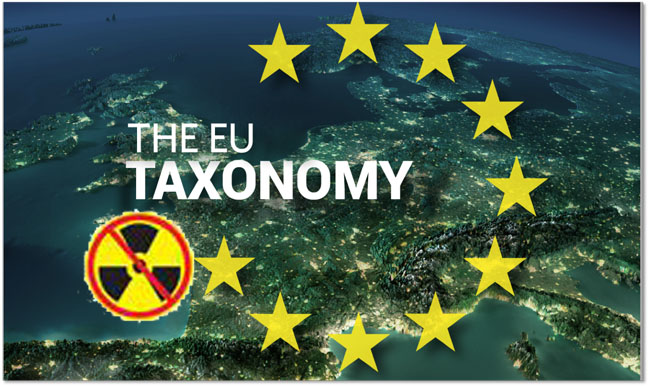
Will the European Commission buy into the lie that nuclear power is clean and green?

Just who will be making this decision? The global nuclear lobby is desperate to get tax-payer funding , to keep its expensive, dirty, dangerous product going.
Pro nuclear stooges, like Ursula von der Leyen (at left) are keen to get Europe to decide that nuclear power is necessary for climate change.
They keep calling nuclear “zero’ or ”low carbon” – ignoring the full chain of carbon-emiitting processes involved in nuclear structures and in fuelling rectors.
Also ignored , the delays in gettting the industry going – too late to be of any use.
nuclear: Fate of EU green taxonomy ‘now in the hands of von der Leyen’.
The taxonomy text will need approval from a majority of EU member states and members of the European Parliament.
Brussels proposes green label for nuclear and natural gas
European Commission paves way for investments despite concerns over waste and CO2 emissions , Ft.com, Mehreen Khan in Brussels, 1 January 2022.
Brussels wants to recognise nuclear power and forms of natural gas as “green” activity as part of a landmark EU classification scheme to help financial markets decide what counts as sustainable investment. In long-awaited plans, the European Commission has paved the way for investment in new nuclear power plants for at least the next two decades and natural gas for at least a decade, under a green labelling system known as the “taxonomy for sustainable finance”. The labelling system, which will cover industries that generate about 80 per cent of all greenhouse gas emissions in the EU, is the first attempt by a major global regulator to decide what counts as truly sustainable economic activity and help stamp out so-called greenwashing in the financial sector.
A draft legal text, seen by the Financial Times, says the EU’s green label should be awarded to controversial energy sources including nuclear power and natural gas under certain circumstances. The decision was taken after a vocal group of pro-nuclear countries, led by France, and pro-gas governments in southern and eastern Europe, demanded the taxonomy should not punish energy sources that provide a bulk of their power generation….
The draft taxonomy text says nuclear power should be considered a sustainable economic activity as long as EU countries that host power stations can safely dispose of toxic waste and meet a criteria to cause “no significant harm” to the environment. The construction of new nuclear plants will be recognised as green for permits granted until 2045, says the text. ……….
https://www.ft.com/content/7872a05f-9e38-4740-9b1b-4efc69ca316c
Germany aiming for far-reaching methods to reduce carbon emissions across all sectors
Germany is likely to fail to hit its carbon emissions reduction targets in
the coming two years, Economy and Climate Protection Minister Robert Habeck
told Die Zeit newspaper. The previous government set more ambitious CO2
reduction targets, including being carbon neutral by 2040, after a top
court ruled in April that Germany must tighten its climate protection law.
The new coalition government presented plans to step up climate protection
efforts entailing far-reaching reforms for the utility sector and across
manufacturing industries, buildings, transport and agriculture.”We will
probably miss our targets for 2022. … Even for 2023 it will be difficult
enough. We are starting with a drastic backlog,” said Habeck, co-leader of
the Greens who are part of the new ruling coalition. Germany aims to cut
emissions in industry, the biggest carbon emitting sector, to 177 million
CO2 tonnes in 2022, down 38% compared with 1990.
Independent 30th Dec 2021
https://www.independent.co.uk/climate-change/news/germany-carbon-targets-robert-habeck-b1984463.html
Nuclear power in the EU taxonomy and Germany’s position

Q&A: Why is Germany phasing-out nuclear power and why now? 28 Dec 2021, Kerstine Appunn ”……………………………..Nuclear power in the EU taxonomy and Germany’s position
Observers have called France’s push to include nuclear power projects in the EU taxonomy as a sustainable investment a “political nightmare” for Germany. Backed by a group of other European countries such as Bulgaria, Croatia, Czechia, Finland, Hungary, Poland and Romania, French President Emmanuel Macron tries to make nuclear power a pillar of the EU’s decarbonisation strategy, while Germany is betting heavily on wind and solar power. It is supported in its push for a nuclear-free taxonomy by Portugal, Austria, Luxembourg and Denmark. Germany’s new Chancellor Olaf Scholz, of the Social Democrats (SPD), has told Macron that he has always been opposed to nuclear power, much like his coalition partner, the Green Party.
If included in the taxonomy, nuclear power investments could be part of green funds, banks could declare loans to nuclear projects as sustainable investments – all in aid of getting more private investment to flow into climate friendly economic activities and businesses.
Agora Energiewende’s Müller says the German approach is still more future-proof. “The idea that nuclear power stations can be built at predictable costs and by a predictable schedule has not proven to be realistic. We also still have the unresolved problem of nuclear waste storage as well as the possibility of a major accident. Germany’s decision to focus on the expansion of renewables instead of nuclear is reflected also by the markets as renewables dominate electricity investments internationally.”
The European Commission is set to come out with a proposal for the taxonomy in January 2022, which EU member states will then decide on with a majority vote. Instead of an in-or-out decision on nuclear (and natural gas), the commission is likely to present a compromise that would classify nuclear as a temporary, transitional technology which has to be labelled and declared in funds so that consumers and investors have the choice between “entirely green” products, e.g. renewable energies, or second or third tier products that include nuclear or gas technology.
Whatever the decision, Müller says Germany and France should focus more on the common ground concerning the energy transition. “Recent French studies show – independently of the future of nuclear energy – that a massive expansion of renewables is needed to reach the climate targets. And there are also opportunities for cooperation between Germany and France on green hydrogen.”
Shouldn’t Germany – like other countries – embrace and support the use of new small modular reactors?
Using a large fleet of small modular reactors (SMR) to secure climate neutral electricity supply in the future – as proposed by billionaire and philanthropist Bill Gates – has been hailed as a climate change solution. In Belgium, which is set to shutter its two remaining nuclear power stations by 2025, the government agreed to invest 100 million euros in the research on SMR.
SMR proponents claim that, once produced in bulk, these small plants are cheaper and safer thanks to advanced reactor designs and can be operated with converted short-lived radioactive materials, solving the waste problem.

But two assessments commissioned by the Federal Office for the Safety of Nuclear Waste Management (BASE) have found that these tens of thousands of small reactors would carry enormous risks with regard to the proliferation of weapons-grade materials and will probably never be as cheap as their advocates say.
What is different in Germany compared to other countries in Europe which embrace nuclear as a CO2-free solution?
Germany not only has strong public support for, and a long history of, anti-nuclear sentiment, it also has only 11 percent of nuclear left in its power mix. Leaving it behind entirely is therefore a more obvious and easy decision than for other countries, such as France, where the share of nuclear power in domestic generation stands at 70.6 percent, but also in Bulgaria with 40.8 percent, in Sweden with 29.8 percent (in Spain: 22.2%, Russia at 20.%, United States at 19.7%, UK 16%, all in 2020).
Historians also explain the different attitude towards nuclear with the different reactions to the Chernobyl accident, which was felt much closer and more threatening to Germans compared to French or UK citizens. Another explanation for Germany’s sensitivity to nuclear power is that early on, the post-war critique of nuclear weapons was linked to the civilian use of nuclear fission. (A second wave of the German peace movement in the 1980s would also bolster a younger generation’s resistance to nuclear power.)
And even if there are people who make a case for nuclear for climate protection reasons, the exit has now proceeded too far to be reversed, and there is simply no influential political power that would consider re-opening the painful, decade-long debate on nuclear power that has finally been put to rest. https://www.cleanenergywire.org/news/qa-why-germany-phasing-out-nuclear-power-and-why-now
France to lead the European Council – a worrying situation as Macron cosies up to polluting corporations, especially nuclear.

In January, France will take on the rotating Presidency of the Council of
the EU for six months. This Presidency will have a particular resonance
both in France itself, coinciding as it does with Emmanuel Macron’s
re-election campaign, and at the European level, with many critical pieces
of legislation and policy on the line.
It is therefore worrying that this
Presidency has been prepared in close collaboration with the French
corporate sector, and is setting a policy agenda that strongly reflects
business demands.
In the name of climate action, the French Government is
pushing for more public support and funding for controversial industries,
including a renewed push for the nuclear sector. For the sake of nuclear
energy, the French Government appears willing to undermine the integrity of
the European Green Deal and other EU policies on the climate crisis, for
instance with the demand that gas is seen as ‘green’ in the Green
Taxonomy which will direct financial flows accordingly, and generally
through the prioritisation of industry-pushed ‘techno-fixes’ instead of
structural changes to make our lives more sustainable.
Corporate Europe 20th Dec 2021
https://corporateeurope.org/en/under-influence-distorted-priorities
Nuclear Twilight – the ”limited” nuclear war
‘Nuclear twilight’: Something else to worry about, Stuff Gwynne Dyer05:00, Dec 30 2021 ”………………… A different team of researchers discovered nuclear winter almost 40 years ago, and it helped to convince the great powers they must never fight a nuclear war.
The reason we don’t worry much about nuclear winter now is that we think they have finally learned that lesson.
True, there are now other countries with nuclear weapons that don’t seem immune to outbreaks of major war, like India and Pakistan. However, everybody assumed the damage would be confined to their own region.
If we don’t let it escalate into a superpower clash, the rest of the world should be all right.
Wrong.
The Indian and Pakistani nuclear arsenals each amount to about 150 warheads now. That’s a modest number compared to the thousands held by the superpowers, but it turns out to be quite enough to cause…let’s call it a nuclear twilight.
What makes this so worrisome is that India and Pakistan have already fought three full-scale wars and half a dozen major skirmishes since they got their independence.
Another is entirely possible, and the risk of escalation to nuclear weapons would be very high, for two reasons.
First, most of their nuclear-capable aircraft and missiles are vulnerable to being destroyed on the ground in a surprise attack.
Secondly, the two countries are so close together that only a very brief warning time is available. In these circumstances, a policy of ‘launch on warning’, with all the risk of mistakes that entails, is the only rational option for both sides
The first victims of such a war would be Pakistani and Indian civilians, because cities will be on the target lists: that’s where the major ports, airfields and critical infrastructure are.
Robock’s team calculated that those burning cities would loft enough ‘black carbon’ into the stratosphere to create a shroud of soot over the whole world within a few weeks.
t wouldn’t be the full-dress nuclear winter of superpower war, with ‘darkness at noon’. However, 300 nuclear explosions in the Indian subcontinent, most of them airbursts over cities, would dim the sun enough to drop temperatures and severely damage crop yields in the main food-producing regions of the planet.
The main effects would be a severe drop in the average global temperature and a comparable decline in global food production – with the worst-hit areas being in the Northern Hemisphere, north of latitude 30°N. (Almost all of India and Pakistan are south of that.)
It’s counter-intuitive, but that’s the way the climate system works.
The most important ‘breadbaskets’ of the planet – grain-growing areas that produce a big crop surplus for export – are the United States, Canada and Europe (including European Russia) – and they are all just north of 30.
The dimming effects of an Indo-Pak nuclear war in 2025, say, would drop the average global temperature by 5 °C over all the continents, but in the key regions of North America and Europe it could reach 10 °C colder.
That maximum cooling would be reached in the fourth year after the war, and would gradually return to ‘normal’ by around year 15.
Australia, Brazil and Argentina, the Southern Hemisphere’s bread-baskets, might still be able to export some grain, but they would not be remotely capable of compensating for the huge shortfalls of food in the Northern Hemisphere.
Tens, maybe hundreds of millions would starve in the poorer parts of the north, and scrabbling for food in the cold and the dark would certainly take our minds off our longer-term problem: global heating.
But when the effects of the local nuclear war in the Indian subcontinent finally faded, it would be right back to that bigger climate crisis.
And it would be bigger, for carbon dioxide would not have stopped accumulating during the hungry years. Indeed, the world might find that it was returning not to the average global temperature of +1.3 °C that prevailed when the Indo-Pak war started, but to a climate that was now hovering on the brink of +2.0 °C. https://www.stuff.co.nz/manawatu-standard/opinion/300487679/nuclear-twilight-something-else-to-worry-about
The science-based case for excluding Nuclear Fission Technologies from the EU Taxonomy

The question whether nuclear fission energy complies with the ‘do no significant harm’ (DNSH) criteria of the EU Taxonomy was the focus of the Technical Expert Group (TEG) DNSH assessment on nuclear fission technologies which recommended to the Commission that nuclear should not be included in the EU Taxonomy of environmentally sustainable activities.
The independent scientific evidence which the TEG presented to the European Commission, shows evidence of adverse impacts to the natural environment arising from the many processes involved in the nuclear power lifecycle (from uranium mining to waste disposal) that are operational today.
The Argument against Nuclear Power as Sustainable for FinancePetitions.net, 26 Dec 21, Europe’s ‘science-based’ Sustainable Finance Taxonomy is politicised to include nuclear power.
The Science-based case for excluding Nuclear Fission Technologies from the EU Taxonomy One of the most influential policy initiatives of the European Commission in the past years has been the “EU Taxonomy”, essentially a shopping list of investments that may be considered environmentally sustainable across six environmental objectives.
To be deemed EU Taxonomy aligned, the activity must demonstrate a substantial contribution to one environmental objective, such as climate change mitigation, whilst causing no significant harm to the remaining five environmental objectives (climate change adaptation, sustainable use and protection of water and marine resources, transition to a circular economy, pollution prevention and control, and protection and restoration of biodiversity and ecosystems).
All eligible activities are required to comply with technical screening criteria (TSC) for ‘substantial contribution’ and ‘do no significant harm’ and to demonstrate that social safeguards are in place.
The EU Taxonomy provides a common language for sustainability reporting, a foundation for green bond reporting and much more. It is intended to be used by international financial markets participants whose products are sold within the EU in order to evaluate the sustainability of their underlying investments. The use of the EU Taxonomy is furthermore compulsory for the EU and member states when introducing requirements and standards regarding environmental sustainability of financial products, such as an EU ecolabel for investment products or an EU Green Bond Standard.
It will also apply to 37% of activities earmarked as ‘climate-friendly’ financed by the EU COVID-19 recovery funding. Its science-based approach is designed to give confidence to a wide range of international stakeholders that environmental claims are not greenwashing.
The question whether nuclear fission energy complies with the ‘do no significant harm’ (DNSH) criteria of the EU Taxonomy was the focus of the Technical Expert Group (TEG) DNSH assessment on nuclear fission technologies which recommended to the Commission that nuclear should not be included in the EU Taxonomy of environmentally sustainable activities.
Taking into account the significant financial implications of adopting the TEG recommendations, it became the starting point of intense behind-door lobbying. France led a coalition of 10 EU Member States arguing that nuclear fission as well as gas-fired power plants should be included in the Taxonomy. Together with Finland (Olkiluoto-3), France is at present the only EU country constructing a new nuclear power plant (Flamanville-3). The Finnish and French construction sites were meant to be the industrial demonstration of an evolutionary nuclear technology (the “European Pressurised water Reactor” or EPR). Olkiluoto-3 was meant to start generating power in 2009, followed by Flamanville-3 in 2012. Instead, the projects turned out to have multiple engineering difficulties and financial constraints that resulted in significant delays culminating in missed deadlines for various production start dates and tripling unit cost……………………. the independent scientific evidence which the TEG presented to the European Commission, shows evidence of adverse impacts to the natural environment arising from the many processes involved in the nuclear power lifecycle (from uranium mining to waste disposal) that are operational today. …………
Does the present generation of nuclear fission power plants ‘do no significant harm’? To answer this question, two specific issues for nuclear power stand out: the risk of a catastrophic accident and the management of high-level nuclear waste (HLW)………………………………
Especially relevant for nuclear fission power is the fact that the liability of the operator in the case of a severe accident is limited and the remaining costs are (largely) taken on by the state (privatization of profits, socialization of risks).
The Taxonomy architecture is not designed to cater for such risks that carry an intergenerational impact lasting for thousands of years, making it an unsuitable instrument to decide on the sustainable nature of nuclear power. The characteristics and nature of HLW generated by the nuclear fission process presents long-term intergenerational risks and thereby challenge the principle of ‘do no significant harm’ to the extent that nuclear fission energy may not be considered eligible for the EU Taxonomy.
This was made abundantly clear to the Commission in the TEG’s recommendations, which were not published in their entirety. Independent, scientific, peer-reviewed evidence compiled by TEG provided confirmation of the risk of significant harm arising from nuclear waste. The back end of the fuel cycle is currently dominated by the containment of spent fuel rods and waste from nuclear power facilities. Safe and secure long-term storage of nuclear waste remains unresolved and has to be demonstrated in its operational complexity. ……….
The fact that a ‘solution’ has to be found for the existing quantities of waste (as well spent fuel as conditioned high level waste forms), and that geological disposal is the least bad solution for this, does not imply that nuclear power can suddenly be classified as a ‘green’ energy source.
Other concerns with regard to DNSH criteria Nuclear fission power plants require about three cubic metres of cooling water per megawatt hour (MWh) produced. A nuclear plants’ cooling water consumption is higher than that of fossil-fuel plants. Throughout the world, new nuclear plants and existing plants increasingly face cooling water scarcity induced by heat waves, a situation that is likely to be aggravated by climate change…..
For reasons of having access to enough cooling water, nuclear plants are mostly sited in coastal or estuarine locations, but this makes them vulnerable to flooding and extreme events that climate change may occasion. The siting of nuclear power plants along coastal zones presents adaptation risks associated with sea-level rise, water temperature rise, coastal erosion as well as natural catastrophes such as the Fukushima disaster demonstrates. ………………..
when major nuclear plant accidents occur significant land areas become unsuitable for human habitation (e.g. Chernobyl, Fukushima). …….
Surface or underground mining and the processing of uranium ore can substantially damage surrounding ecosystems and waterways. The huge volumes of associated mining waste in developing countries are normally not considered in life cycle waste inventories of nuclear energy producing countries. More critically, the adverse effects on local environmental conditions of routine discharging of nuclear isotopes to the air and water at reprocessing plants have not been considered thoroughly enough. A number of adverse impacts (of radiation) on soil/sediment, benthic flora and fauna and marine mammals has been demonstrated.
Should nuclear fission power be included in the taxonomy as a transition activity? According to Article 10 (2) of the Taxonomy Regulation, which is the law underpinning the EU Taxonomy, activities that are incompatible with climate neutrality but considered necessary in the transition to a climate-neutral economy can be labelled and supported as ‘transition activities’…………
A key principle of the EU Taxonomy is to avoid environmentally harmful ‘lock-in’ effects of activities. Lock-in describes the phenomenon whereby it is difficult to set a technical and political system on a new path once it has developed a momentum of its own and once it is ‘locked-in’ on a certain path. ……
Nuclear fission plants require at least 10 years to be built (with recent experience even pointing in the direction of 20 years for the EPR), while they have to remain operational for 50-60 years. Decommissioning will then take another 20-50 years. This means that a decision to build new nuclear power plants will lock in societies for some 80-130 years, not counting the years needed to store spent fuel or dispose of high-level waste. …
A decision to include nuclear fission into the energy mix of the EU Taxonomy sustainable activities will during this period therefore channel much needed capital away from renewable energy technologies, which do not present long-term and catastrophic risks to humans and the environment as nuclear fission does. ……………………………………..
Signed by EU Taxonomy subgroup DNSH TEG members and expert supporters:
Dawn Slevin, Dr. Erik Laes, Paolo Masoni, Jochen Krimphoff, Fabrizio Varriale, Andrea Di Turi, Dr. Ulrich Ofterdinger, Dr. Dolores Byrne, Dr. Petra Kuenkel, Ursula Hartenberger, Kosha Joubert
Link to PDF Version of the Statement of Concern sent to the Commission on 21 Dec 21:
https://www.petitions.net/the_argument_against_nuclear_power_as_sustainable_for_finance .petitions.net/the_argument_against_nuclear_power_as_sustainable_for_finance
European Commission experts call on EU not to label nuclear ‘green’.

Commission experts call on EU not to label nuclear ‘green’, https://euobserver.com/climate/153891, By WESTER VAN GAAL 22 Dec 21
BRUSSELS, Thirteen members of the EU Commission’s Technical Expert Group (TEG) put out a petition on Tuesday (21 December) calling on nuclear energy not to be labelled as ‘green’.
“We recommend that nuclear fission has no place on the EU taxonomy of sustainable activities,” the group, led by Dawn Slevin, a financial expert and core member of the commission’s financial stability TEG, wrote.
Dealing with the “do no significant harm” principle in the taxonomy, they concluded nuclear may damage the environment due to the need to store it in underground bunkers for thousands of years, and “because the risk of a severe nuclear accident cannot be excluded, even in the best commercially available nuclear power plants.”
They also warn against politicisation of the rules. “Proponents of nuclear energy use the taxonomy to put a ‘scientific’ stamp on what is primarily a political position on nuclear fission energy aiming to satisfy the few EU member states that wish to promote the associated technologies,” the petition states.
France is spearheading an alliance of 10 member states that argue that nuclear fission and gas-fired power plants should be included in the taxonomy.
The TEG members point out that France and Finland are currently the only EU countries actively building nuclear facilities.
The Finnish Olkiluoto-3 was meant to start generating power in 2009, followed by the French Flamanville-3 in 2012.
However, both are still not operational, tripling anticipated costs, the group wrote. The group includes Paolo Masoni, a nuclear engineer, and Eric Laes, a post-doctoral researcher specialising in atomic energy at the Technical University of Eindhoven.
Politicised debate
In recent months, the decision on whether to include nuclear and gas in the taxonomy has become politicised.
Last week, EU internal market commissioner Thierry Breton told five European newspapers, including Die Welt, that “it is a lie that the EU can become CO2-neutral without nuclear power.”
French president Emmanuel Macron said last week that France and Germany will try to find a compromise on whether the EU should label nuclear and gas as green investments.
But on Monday, the German Greens, part of the new ruling coalition, came out strongly against nuclear, reiterating their opposition to the inclusion of nuclear in the taxonomy.
“The German government’s stance is that nuclear power is not one of the sustainable forms of energy [that] remains,” environment minister Steffi Lemke told fellow EU environment ministers in Brussels on Monday.
German climate and economics minister Robert Habeck later echoed his colleague on German radio Deutschlandfunk, saying: “I do not think nuclear power is the right technology.”
However, chancellor Olaf Scholz (SPD) did not make such a clear statement at the last EU summit on Friday – and admitted Germany will probably not be able to stop the French push for nuclear.
“France is taking a different path [than Germany]. Other countries do as well,” he said.
“That is why it’s important that you can follow your paths and at the same time stay together across Europe,” he added.
The commission planned to present its decision on nuclear and gas on Wednesday, but this has been postponed until mid-January next year.
It now plans to consult a draft version of the taxonomy with member states before the end of the year or at the start of January 2022 – a process that will be clarified on Wednesday.
The Sustainable Finance Platform, a group of 57 NGOs, scientific and financial experts will also be consulted.
The commission has faced backlash in the past from some of its members, including one of the signatories of the petition, for allowing gas an nuclear to be considered in what was meant to be a science-led exercise.
European Commission facing a backlash from Greta Thunberg and environmentalists over plans to include nuclear and gas in the EU ”green” taxonomy.
The European Commission is facing a backlash from Greta Thunberg and
fellow climate activists over plans to include gas and nuclear energy in a
“green” investment guidebook
. Both energy sources are expected to
feature in the next part of the EU’s “taxonomy for sustainable
activities”, which is expected at the end of the year, following a period
of intense political bargaining between the commission president, Ursula
von der Leyen; the French president, Emmanuel Macron; and Germany’s new
chancellor, Olaf Scholz.
The EU taxonomy is a green classification system
that is intended to guide investors to projects that are in line with
Europe’s goal of net zero emissions by 2050 and better protection of
nature.
Guardian 21st Dec 2021
Rapid shrinking of glaciers in the Himalayas
Glaciers in the Himalayas are shrinking far more rapidly than glaciers in
other parts of the world, threatening the water supply of millions of
people in Asia, new research warns. The study, led by scientists at the
University of Leeds, found that in recent decades, Himalayan glaciers have
lost ice 10 times more quickly than they have on average since the Little
Ice Age, when glaciers expanded around 400-700 years ago.
Independent 21st Dec 2021
https://www.independent.co.uk/climate-change/news/himalayas-glaciers-melting-water-ice-b1979531.html
Costa Rica was the star at COP26 Climate Summit
If there had been a popularity contest at Cop26, the Costa Rican
president, Carlos Alvarado Quesada, would have been a clear winner.
Leonardo DiCaprio, Jeff Bezos, Boris Johnson and Prince William all wanted
to speak with the leader of the tiny Central American country, eager to
bask in its green glow.
The climate summit in Glasgow was, in effect, Costa
Rica’s Super Bowl, another chance to show off its impressive
environmental credentials. It is the only tropical country that has
successfully halted and reversed deforestation, a commitment dozens of
others made at Cop26 but are far from achieving. Costa Rica, which
celebrated its bicentenary in 2021, is aiming for total decarbonisation by
2050 – not just a net zero target – and is helping lead the world on
efforts to protect 30% of the Earth by the end of this decade.
From
Christiana Figueres, who was head of the UN climate convention that
achieved the Paris agreement in 2015, to Carlos Manuel Rodríguez, chief
executive of the Global Environment Facility, Costa Ricans are routinely
found in international leadership positions on the environment.
Guardian 22nd Dec 2021
European Commission will decide in 2022 if it considers nuclear energy as a ”climate friendly” investment.
The European Commission plans to finish next year its long-awaited rules
on whether to label gas and nuclear energy as climate-friendly investments
under EU green finance rules, its environment policy chief said on Monday.
The European Union’s executive Commission is considering whether to include
nuclear and natural gas in its “sustainable finance taxonomy”, a rulebook
that will restrict which activities can be labelled as climate-friendly
investments.
Reuters 20th Dec 2021
European Commission experts call on EU not to label nuclear ‘green’

Commission experts call on EU not to label nuclear ‘green’, https://euobserver.com/climate/153891, By WESTER VAN GAAL 22 Dec 21
BRUSSELS, Thirteen members of the EU Commission’s Technical Expert Group (TEG) put out a petition on Tuesday (21 December) calling on nuclear energy not to be labelled as ‘green’.
“We recommend that nuclear fission has no place on the EU taxonomy of sustainable activities,” the group, led by Dawn Slevin, a financial expert and core member of the commission’s financial stability TEG, wrote.
Dealing with the “do no significant harm” principle in the taxonomy, they concluded nuclear may damage the environment due to the need to store it in underground bunkers for thousands of years, and “because the risk of a severe nuclear accident cannot be excluded, even in the best commercially available nuclear power plants.”
They also warn against politicisation of the rules. “Proponents of nuclear energy use the taxonomy to put a ‘scientific’ stamp on what is primarily a political position on nuclear fission energy aiming to satisfy the few EU member states that wish to promote the associated technologies,” the petition states.
France is spearheading an alliance of 10 member states that argue that nuclear fission and gas-fired power plants should be included in the taxonomy.
The TEG members point out that France and Finland are currently the only EU countries actively building nuclear facilities.
The Finnish Olkiluoto-3 was meant to start generating power in 2009, followed by the French Flamanville-3 in 2012.
However, both are still not operational, tripling anticipated costs, the group wrote. The group includes Paolo Masoni, a nuclear engineer, and Eric Laes, a post-doctoral researcher specialising in atomic energy at the Technical University of Eindhoven.
Politicised debate
In recent months, the decision on whether to include nuclear and gas in the taxonomy has become politicised.
Last week, EU internal market commissioner Thierry Breton told five European newspapers, including Die Welt, that “it is a lie that the EU can become CO2-neutral without nuclear power.”
French president Emmanuel Macron said last week that France and Germany will try to find a compromise on whether the EU should label nuclear and gas as green investments.
But on Monday, the German Greens, part of the new ruling coalition, came out strongly against nuclear, reiterating their opposition to the inclusion of nuclear in the taxonomy.
“The German government’s stance is that nuclear power is not one of the sustainable forms of energy [that] remains,” environment minister Steffi Lemke told fellow EU environment ministers in Brussels on Monday.
German climate and economics minister Robert Habeck later echoed his colleague on German radio Deutschlandfunk, saying: “I do not think nuclear power is the right technology.”
However, chancellor Olaf Scholz (SPD) did not make such a clear statement at the last EU summit on Friday – and admitted Germany will probably not be able to stop the French push for nuclear.
“France is taking a different path [than Germany]. Other countries do as well,” he said.
“That is why it’s important that you can follow your paths and at the same time stay together across Europe,” he added.
The commission planned to present its decision on nuclear and gas on Wednesday, but this has been postponed until mid-January next year.
It now plans to consult a draft version of the taxonomy with member states before the end of the year or at the start of January 2022 – a process that will be clarified on Wednesday.
The Sustainable Finance Platform, a group of 57 NGOs, scientific and financial experts will also be consulted.
The commission has faced backlash in the past from some of its members, including one of the signatories of the petition, for allowing gas an nuclear to be considered in what was meant to be a science-led exercise.
Nuclear power has no business case and could make climate change worse
Nuclear power has no business case and could make climate change worse, https://thehill.com/opinion/energy-environment/586848-nuclear-power-has-no-business-case-and-will-make-climate-change BY TIM JUDSON AND LINDA PENTZ GUNTER, — 12/21/21 The climate crisis is upon us, and we have no time to lose. We cannot afford a single false step. Even as the UN COP26 climate conference failed to put us on the necessary path to keep the world within 1.5 degrees Celsius of increased warming, there are still important choices to be made as countries roll out their latest climate plans.
That is why the United States, in its pursuit of carbon reductions, must not allow itself to be misled by the false promises of nuclear power, both its continued use and illusory new programs. Either would be a mistake.

The push to develop new nuclear is focused on so-called advanced reactors and Small Modular Reactors (SMRs), designs whose cost and safety uncertainties have not been satisfactorily addressed.
Yet, Congress is already looking to award just two “advanced” fast reactor designs — the Terrapower Natrium reactor and X-energy Xe-100 reactor — an extravagant $3.2 billion in subsidies, even though the former is a project of billionaires Bill Gates and Warren Buffett.
SMRs, typically less than one-third the size of a traditional nuclear power reactor, would need to be brought on in their hundreds if not thousands to achieve the advertised cost savings, a factor that has left designs on the drawing board for decades and has not attracted buyers.
Even if these unproven designs work, such a program would never be achieved at a scale or in time to make a dent in carbon emissions.
This likely failure is reinforced by the recent experience of building new, traditional reactors. They consistently suffer massive delays and cost increases, which suggests commercializing new, untested reactor designs would not go faster or be any cheaper.
For example, another $1 billion was just added to the ever-escalating tab at the two Westinghouse reactors at Plant Vogtle in Georgia — underway since 2013, yet still unfinished — with costs ballooning to over $33 billion, and further delays likely pushing final completion into 2024 if ever.
The French-designed Evolutionary Power Reactor (EPR) is arguably a spectacular failure with massive cost-overruns, long delays and endless interruptions.
The French-designed Evolutionary Power Reactor (EPR) is arguably a spectacular failure with massive cost-overruns, long delays and endless technical flaws. It is still unfinished — with costs ballooning to over $33 billion, and further delays likely pushing final completion into 2024 if ever. Most recently, at the now-operating Taishan 1 EPR in China,vibrations damaged fuel rods, forcing its shutdown. The problem could be linked to a design flaw also found in the four still unfinished EPRs in Europe, causing a French nuclear lab to raise doubts about their safety.
However, the “zero-emission” mantra has been used to justify the inclusion of nuclear power plants in state and federal subsidies. If it had survived the machinations of Sen. Joe Manchin (D-W.Va.), the promising Build Back Better Act may have still shot itself in the foot by including a massive $35 billion subsidy for already-operating nuclear plants in its “Zero-Emissions Nuclear Energy Production Credit.” This subsidy would have funneled billions of dollars to corporations that own nuclear power plants, nearly all of which will continue operating with or without such support.
Subsidizing nuclear power siphons funds from real solutions, like renewables, just when these are needed most urgently, thereby making climate change worse.
Redirecting funds to old nuclear plants further misses the point that even were they carbon-free, this does not alone mean nuclear power is a good way to address the climate crisis because it ignores its two biggest climate drawbacks— time and cost.
As Stanford physicist Amory Lovins has pointed out, to address the climate crisis expeditiously and effectively, we must choose energy sources that can reduce the greatest amount of carbon emissions most quickly and at the least cost. This is where renewable energy, energy efficiency and conservation beat out nuclear power — as well as now gas and coal as well.
A recent Sussex University study showed that countries that have focused on nuclear power have not significantly reduced carbon emissions. Meanwhile, countries with strong renewable energy programs have.

Nuclear power has no business case and takes too long. That alone should rule it out as useful to climate protection, even before we look at other disqualifying factors such as the environmental justice and health impacts of long-lived lethal radioactive waste and potential meltdowns. Our future should not hinge on the nuclear industry’s false choice between climate chaos and cancer-causing pollution. We can and must do better.
Tim Judson is executive director of the Nuclear Information and Resource Service, a non-profit environmental organization founded in 1978 that works for a just and equitable transition to renewable energy and a nuclear-free, carbon-free world.
Linda Pentz Gunter is the international specialist at Beyond Nuclear, an anti-nuclear non-profit organization working for a world free from nuclear power and nuclear weapons.
Recognizing these challenges, the U.S. nuclear industry is focusing most of its energy on keeping its current fleet of 93 reactors running, arguing that they are carbon-free. This is patently false — and not true of any man-made energy source, including renewables, as long as mining, transportation and manufacturing of these technologies are so reliant on fossil fuels.
France and Germany – opposite attitudes to nuclear power
Is nuclear energy green? France and Germany lead opposing camps.
The French government wants to build reactors. The German government wants to shut them down. WP 19 Dec 21,
”………………….. France is leading a group of mostly central and eastern European countries that are pushing the European Union to add modern nuclear energy to a list of “environmentally sustainable economic activities.”
…………. The president of the surrounding Alsace region, Frédéric Bierry, has urged Macron to consider Fessenheim as a possible future site, calling the old plant’s closure a “financial,” “social” and “economic” scandal in the face of a warming climate.
But one of the biggest obstacles — for Fessenheim and for Macron’s broader plans — lies about half a mile to the east of the town’s old nuclear plant. That’s where France ends and Germany begins.
The new German economy and climate minister, Green party member Robert Habeck, was among the politicians who signed a statement celebrating the closure of the Fessenheim plant. The German government has argued that nuclear plants are too risky, and too slow and costly to build, to be a solution to the climate crisis. Germany’s outlook is influenced by nuclear accidents, such as the 2011 Fukushima meltdown in Japan. And Berlin points to reports like one this past week, of cracks in the pipes at a French nuclear reactor, as evidence that plant safety remains a problem.
Germany is among a group of skeptics, including Denmark and Austria, that wants Europe to shut down its remaining nuclear plants and that fiercely oppose a climate-friendly designation for nuclear power, which would signal to green investors that nuclear energy is worthy of financing.
The controversy may come to a head within days, with the European Commission expected to make a decision just before its Christmas break.
………………………………… Environmental activists in Germany acknowledge that continued reliance on coal is a problem even in the medium term. But they are optimistic about how quickly the country can ramp up alternative energy.
Germany’s Green party, in its position as part of the new ruling coalition, has vowed to increase spending significantly on renewables and to limit energy price spikes for consumers. It wants renewables to account for 80 percent of electricity by 2030, up from the present target of about 50 percent.
For German politicians and activists, the idea of nuclear power as green or sustainable is anathema. They talk about the potential for accidents with catastrophic environmental consequences. They note the problems associated with the long-term storage of deadly radioactive waste. They say they don’t want to draw investment away from wind and solar.
German anti-nuclear and environmental activist Stefan Auchter said his country’s path will be validated when the next Chernobyl or Fukushima comes. He compared the use of nuclear energy to playing Russian roulette………………………. https://www.washingtonpost.com/world/2021/12/18/nuclear-energy-climate-france-germany/
Nuclear Plants Masquerading as Climate-Friendly Shouldn’t Qualify for Green Finance

Nuclear Plants Masquerading as Climate-Friendly Shouldn’t Qualify for Green Finance
December 17, 2021 Gaye Taylor,
Bruce Power’s recent issuance of C$500 million in green bonds to help extend the life of Ontario’s biggest nuclear power plant is being touted as a critical step toward decarbonization. But it could also be seen as a dangerous and time wasting dead-end, a corruption of the very notion of green financing.
According to Jonathan Hackett, head of sustainable finance at BMO Capital Markets and co-lead green structuring agent for Bruce Power, nuclear is necessary to the net-zero transition, writes the Globe and Mail.
According to Hackett, the urgent need to green the energy and power sectors means nuclear power is a worthy recipient of green finance.
But confronting the notion that nuclear power is “green” are unresolved concerns about what to do with reactor waste products, as well as the acute dangers inherent in nuclear power plants, with the tragedy at Japan’s Fukushima plant the most recent example.

As for the claim that nuclear is essential to avoiding climate meltdown, independent experts say the world has neither the time, the funds, nor the expertise to bring the expensive and notoriously slow sector to bear in time to shift the climate crisis in any meaningful way.
And this reality doesn’t change as the hype around small modular nuclear reactors (SMRs) ramps up. “There is no SMR promoter suggesting a prototype could be licenced, built, and operating by the end of this decade,” said Mycle Schneider, author of the annual World Nuclear Industry Status Report, at a webinar hosted by University of British Columbia in October. “That means—if ever, likely not—a commercialization could start only in the second half of the 2030s.”

Noting that “the industry has never kept its promises on schedules and budgets,” Schneider added, “we have no time, money, and brainpower to waste on fantasy PowerPoint designs.”
Early this month, Ontario Power Generation and GE Hitachi triumphantly announced plans to bring an SMR into service at the Darlington nuclear generating station “as early as 2028”. But even if they managed to bring the project in on time and on budget—a practice that has never been the industry’s strong suit—the project would just be one expensive generation source in a decarbonizing economy that needs far more electricity, and vastly more energy efficiency, far faster than SMRs can deliver.
And this year’s WNISR report was only the latest to conclude that the nuclear industry outside China is already in decline, with its output in the United States dropping to its lowest level since 1995. In France, a former nuclear leader, atomic generation dropped to 1985 levels.
Faced with such an implosion in the prospects of its traditional reactors, the nuclear industry has seized upon SMRs as a ticket to a new revenue track. But SMRs will never be ready in time to shift the trajectory of the climate crisis. Even if they worked, “it would take centuries to build enough to make a difference,” Schneider said.

Schneider is not alone that view.
“Betting on nuclear as a climate solution is just sticking our heads in the sand because SMR technology is decades away, extremely expensive, and comes with a nasty pile of security and waste headaches,” Ontario Clean Air Alliance Chair Jack Gibbons wrote last year, responding to then-natural resources minister Seamus O’Regan’s full-throated endorsement of the SMR storyline.
“That our government would be this gullible is distressing, especially given the havoc already being wreaked by a changing climate,” he added.
Jonathan Porritt, founder of the UK’s Forum4theFuture, echoed Gibbons’ view in a March opinion piece for The Guardian. He warned of a nuclear sector now “straining every sinew to present itself as an invaluable ally” in the global push for net-zero by 2050.” Yet the problems that have long dogged the industry remain unchanged: “ever-higher costs, seemingly inevitable delays, no solutions to the nuclear waste challenge, security and proliferation risks.”
-
Archives
- April 2026 (300)
- March 2026 (251)
- February 2026 (268)
- January 2026 (308)
- December 2025 (358)
- November 2025 (359)
- October 2025 (376)
- September 2025 (257)
- August 2025 (319)
- July 2025 (230)
- June 2025 (348)
- May 2025 (261)
-
Categories
- 1
- 1 NUCLEAR ISSUES
- business and costs
- climate change
- culture and arts
- ENERGY
- environment
- health
- history
- indigenous issues
- Legal
- marketing of nuclear
- media
- opposition to nuclear
- PERSONAL STORIES
- politics
- politics international
- Religion and ethics
- safety
- secrets,lies and civil liberties
- spinbuster
- technology
- Uranium
- wastes
- weapons and war
- Women
- 2 WORLD
- ACTION
- AFRICA
- Atrocities
- AUSTRALIA
- Christina's notes
- Christina's themes
- culture and arts
- Events
- Fuk 2022
- Fuk 2023
- Fukushima 2017
- Fukushima 2018
- fukushima 2019
- Fukushima 2020
- Fukushima 2021
- general
- global warming
- Humour (God we need it)
- Nuclear
- RARE EARTHS
- Reference
- resources – print
- Resources -audiovicual
- Weekly Newsletter
- World
- World Nuclear
- YouTube
-
RSS
Entries RSS
Comments RSS