France’s EDF says hot summer could hit nuclear output, shares fall
PARIS, July 5 (Reuters) – France’s EDF (EDF.PA) might be forced to cut nuclear output further because of expected prolonged hot temperatures over the summer months, an executive told a briefing on Tuesday, prompting a sharp fall in the company’s shares.
EDF’s shares ended down 7.5% on the Paris stock market, underperforming the Stoxx Europe 600 Utilities (.SX6P) index, which lost 2.03%.
“We have a peculiar year due to the drought that has started early, especially in southeastern France. But there is generally a little bit less water available this year,” Catherine Laugier, Environment Director at EDF, told a news conference.
France is already grappling with reduced electricity generation because of unexpected maintenance at its aging nuclear reactors.
EDF faces the prospect of having to reduce output because of insufficient river water, which is often used for cooling nuclear reactors before being returned to the river at a higher temperature.
Regulations are in place to limit reactor production during times of exceptional heat and low water levels to prevent the process from damaging local wildlife.
“We’ve had some production cuts between end May and early June. That was indeed pretty early (…) And there are some global evaluations suggesting (…) this might be a very long summer and the levels could be impacted in September,” Laugier said.
Since the start of the year, EDF has lost 20.6% of its value, well below a 12.9% sector-wide decline……………. https://www.reuters.com/business/energy/frances-edf-says-hot-summer-could-hit-nuclear-output-shares-fall-2022-07-05/
Small modular nukes fall short on climate promises, new study suggests.

SMRs are inherently less efficient, hence the “higher volumes and greater complexity” of the waste, says the study. SMRs leak more neutrons, which impairs the self-sustaining nuclear reaction.
GreenBiz, By Clifford Maynes, 1 July 22, Small modular reactors (SMRs), seen by the beleaguered nuclear industry as a shining hope for a global revival, may have hit a serious snag. A new study finds that mini-nuclear power stations produce higher volumes of radioactive waste per unit of generation than larger-scale traditional ones.
The United States, the United Kingdom and Canada are among the countries investing in SMRs on the hope of a cheaper, faster way to build out nuclear capacity. In Canada, the federal government is leading and funding a “Team Canada” approach involving several provinces, industry players, and others, envisioning SMRs as “a source of safe, clean, affordable energy, opening opportunities for a resilient, low-carbon future and capturing benefits for Canada and Canadians.”
In Ontario, the Ford government selected GE Hitachi to build an SMR at the Darlington nuclear plant site, with a projected in-service date of 2028.
Now, however, the first independent assessment of radioactive waste from SMRs has modeled the waste from three SMR designs, Toshiba, NuScale and Terrestrial Energy. The conclusion: “SMRs could increase the volume of short-lived low and intermediate level wastes… by up to 35 times compared to a large conventional reactor,” New Scientist reports.

“For the long-lived equivalent waste, SMRs would produce up to 30 times more,” the story adds. For spent nuclear fuel, up to five times more.
Stanford University’s Lindsay Krall, who led the research, said information from the industry is “promotional,” echoing past criticisms that SMRs are still “PowerPoint reactors” with no detailed engineering to back up the concept. “SMR performed worse on nearly all of our metrics compared to standard commercial reactors,” Krall said.
SMRs are inherently less efficient, hence the “higher volumes and greater complexity” of the waste, says the study. SMRs leak more neutrons, which impairs the self-sustaining nuclear reaction.
“The study concludes that, overall, small modular designs are inferior to conventional reactors with respect to radioactive waste generation, management requirements, and disposal options,” Stanford News reports.
“The research team estimated that after 10,000 years, the radiotoxicity of plutonium in spent fuels discharged from the three study modules would be at least 50 percent higher than the plutonium in conventional spent fuel per unit energy extracted.”
……………………………………. Proponents hope SMRs will have “small is beautiful” appeal and focus on their potential to reduce greenhouse gas emissions. But critics say they sidestep public concerns about accidents, wastes, cost and other impacts, noting that SMRs aren’t small: the Darlington reactor will be rated at 300 megawatts, about a third the size of the existing Candu reactors on the site, and more than half the size of the units at the nearby Pickering station.
SMRs are also new and unproven, critics warn. They say there is no reason to think SMR construction will be exempt from the massive cost overruns and completion delays that typically plague reactor construction, and megaprojects in general. And there is no real-world experience to date to demonstrate that SMRs can be built on time and on budget.
The biggest concern is that SMRs will soak up investment dollars and grid capacity that should go to proven, successful renewables such as solar and wind, which can be rapidly deployed and have falling rather than escalating costs. Because of the time lag, nuclear is not expected to make a large contribution to meeting the immediate, global goal of reducing global greenhouse gas emissions by 45 percent by 2030. The Intergovernmental Panel on Climate Change noted in its sixth assessment that small-scale, distributed energy sources such as wind and solar had exceeded expectations, while large, centralized technologies such as nuclear had fallen short.
“It takes too long to site and build nuclear reactors, especially compared to solar and wind installations,” said MIT researcher Kate Brown. https://www.greenbiz.com/article/small-modular-nukes-fall-short-climate-promises-new-study-suggests
Greta Thunberg has warned that the world faces “total natural catastrophe” unless citizens take urgent action
Greta Thunberg has warned that the world faces “total natural
catastrophe” unless citizens take urgent action as she made a surprise
appearance at Glastonbury festival. The 19-year-old activist led chants of
“climate … justice” after delivering a rousing speech from the
Pyramid stage which painted an apocalyptic picture of the future of the
planet.
To cheers from thousands of festival-goers, Thunberg said: “We
are approaching the precipice and I would strongly suggest that all of
those who have not yet been greenwashed out of our senses to stand our
ground. “Do you not let them drag us another inch closer to the edge.
Right now is where we stand our ground.”
Guardian 25th June 2022
What happened at Santa Susana? — Beyond Nuclear International

A meltdown contaminated a community. A fire made it worse
What happened at Santa Susana? — Beyond Nuclear International A 1959 meltdown and a 2018 fire compounded a tragedy
By Carmi Orenstein
When the United Nations Human Rights Council officially recognized access to “a safe, clean, healthy and sustainable environment” as a basic human right earlier last October, it was an acknowledgement fifty years in the making. It was backed by an international grassroots effort, with the journey to the final vote including the voices of more than 100,000 children around the world and multiple generations of allies pushing against powerful corporate opposition.
Just about the time that this half-century-long campaign to enshrine the right to a safe environment kicked off, a story about the horrific violation of this same human right and its cover-up emerged in a community near my own childhood home in Southern California.
In 1979, a UCLA student named Michael Rose uncovered evidence of a partial nuclear meltdown at the Santa Susana Field Lab (SSFL) in the Simi Hills outside of Los Angeles. The SSFL, formerly known as Rocketdyne, played key government roles throughout the Cold War, developing and testing rocket engines and conducting experiments with nuclear reactors. Today, as the result of a recently published peer-reviewed study that represents the dogged efforts of both professional researchers and a team of specially trained citizens, we have solid evidence of the spread of dangerous contamination from that site.

Working with nuclear safety expert and then-UCLA professor Daniel Hirsch, Rose discovered documentation that the partial nuclear meltdown had occurred at SSFL twenty years earlier in 1959, releasing up to 459 times more radiation into the environment than the infamous meltdown at the Three Mile Island nuclear reactor in Pennsylvania. Unlike the Three Mile Island facility, the SSFL reactors lacked containment structures—those tell-tale concrete domes that surround commercial nuclear power plants to prevent radiation spread in case of a nuclear accident.
In addition to the 1959 meltdown, at least three of the site’s other nuclear reactors experienced accidents (in 1957, 1964 and 1969), and radioactive and chemical wastes burned in open-air pits as a matter of practice. A “hot lab,” which may have been the nation’s largest, was also located at SSFL, and, in 1957, it burned and was known to have spread radioactivity throughout the site. A progress report from the period states, “Because such massive contamination was not anticipated, the planned logistics of cleanup were not adequate for the situation.”
The rest of this story is an object lesson in what happens when the right to a safe environment is not universally acknowledged and when secretive, long-forgotten toxic legacies of the Cold War meet the unpredictable chaos of the current climate crisis. Real people are harmed in ways that are not easily remediable—including, perhaps, members of my family.
The radioactive contamination of the surrounding environment caused by the partial nuclear meltdown at the 2,849-acre SSFL site was not cleaned up by the time of Rose’s revelation. Nor was the extensive toxic chemical contamination on site. It is still not cleaned up. Thus, when the climate chaos-fueled Woolsey Fire erupted at, and burned through, the SSFL in 2018, the flames served to spread the contamination even further. The fire quickly burned 80 percent of the SSFL property, and onward, all the way to the ocean. Pushed by high winds and uncontained for nearly two weeks, the Woolsey Fire killed three people outright and destroyed over 1,600 structures.
Today, public knowledge of the original disaster and its continued radioactive and toxic legacy is still patchy. The silence that surrounded the catastrophe in 1959 gave way to intermittent waves of focused media attention, celebrity involvement, and inquiry and outcry on the part of elected officials in the years since the 1979 expose. These have been followed by whistleblower accounts from former workers, and various forms of citizen activism. While occasional news of confidential legal settlements addressing illness and contamination breaks through, the Santa Susana disaster is hardly a household name—including among those of us who grew up in its shadow.
The suburbs on either side of the SSFL, in Ventura County and a western edge of Los Angeles County, are still expanding. More than 500,000 people currently live within about ten miles of the site. Parents vs. SSFL is the dynamic, parent-led group currently at the helm of public monitoring of, and demand for, a comprehensive cleanup. On their social media sites, one often sees public comments from nearby residents along the lines of why were we not told?
To be sure, the history of site ownership and responsibility is complex and makes redress of grievance vexing. Although Rocketdyne owned the facility at the time of the meltdown, most of the site is now owned by Boeing. However, some of the property is owned by NASA, who in turn leases parts of its property as SSFL to the U.S. Department of Energy (DOE). California’s Department of Toxic Substances Control (DTSC), the lead regulatory agency for remediation, entered into a Consent Order with these “responsible parties,” in 2007. In 2010, stricter agreements were signed with DOE and NASA to clean up the properties for which they are responsible to “background levels.”
In 2017 a legally binding agreement deadline for completion of cleanup was blown by, with no meaningful cleanup begun. In 2018 the Woolsey Fire came roaring through. That fire is now documented to have redistributed radioactive materials and toxic chemicals in surrounding areas. Non-binding, confidential negotiations with Boeing were just announced early this year. It is a confounding and maddening journey to anyone attempting to follow.
As Melissa Bumstead, co-founder of Parents vs SSFL, said in a Physicians for Social Responsibility-Los Angeles press release about the new study: “The bottom line is, if SSFL had been cleaned up by 2017 as required by the cleanup agreements, the community wouldn’t have had to worry about contamination released by the Woolsey Fire.” …………………………………….
UCLA professor of Atmospheric and Oceanic Sciences Suzanne E. Paulson also weighed in. Speaking to a reporter the next year, Paulson explained,
Assuming that radioactive material was in the soil [and] vegetation burned, it is reasonable that it traveled 30 miles downwind, and some of it got deposited in downwind areas… When soil and vegetation burn, the material in them, including metals [and] soil minerals, end up in the aerosol particles that make smoke look dark and hazy. They are small enough that they can remain in the atmosphere for up to a week and as a result can be widely dispersed.
At the end of 2018, just weeks after the Woolsey Fire was finally extinguished, work commenced on the independent study that was ultimately published online in early October and would appear in the December 2021 issue of the Journal of Environmental Radioactivity. This paper represents the work of community-volunteer citizen scientists who were trained to collect dust and ash samples in a 9-mile radius throughout the rural, urban, suburban, and undeveloped mountainous area around the SSFL. Their data collection was followed by the slow and careful work of scientific analysis. In a society whose governmental structures and policies decidedly are not guided by the Precautionary Principle today, and where there are no efficient mechanisms by which to correct past regulatory errors—no matter how grave—these volunteers and their three research leaders have provided powerful, incriminating evidence with which the community and its allies will push forward for the cleanup.
…………………………. “Woolsey Fire ash did, in fact, spread SSFL-related radioactive microparticles.” The authors also wrote, “Excessive alpha radiation in small particles is of particular interest because of the relatively high risk of inhalation-related long-term biological damage from internal alpha emitters compared to external radiation.”……………………………………………..
How did the entities with knowledge and power continue to delay and obstruct while the population boomed and crept up the hillsides near the SSFL, knowing full well that powerful human health hazards were there to meet the communities, new and old? The statement by DTSC proclaiming that no contaminants were carried, while the Woolsey Fire was still burning, smacks of the most brazen regulatory capture. …………………………….. Carmi Orenstein is Program Director at Concerned Heath Professionals of New York. https://wordpress.com/read/feeds/72759838/posts/4098311628
Dispute among Members of European Parliament over move to classify nuclear energy as ”green”
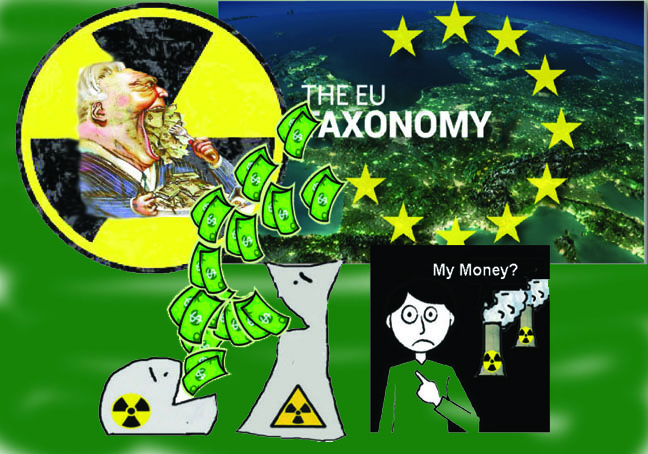
| THERE ARE DISAGREEMENTS between Government party MEPs on whether or not the EU should classify nuclear energy as green, as the European Parliament prepares to vote on the issue next month. The debate is being held after the European Commission sought changes to regulations to classify both nuclear power and gas as green energy until at least 2030. These regulations, known as ‘taxonomy’, are a set of multiple standards to help grow sustainable investment. The idea behind taxonomy is to encourage the financial sector to prioritise investing in eco-friendly and green initiatives. While MEPs within the European Parliament’s environment and economy committee voted down the proposals to add gas and nuclear power last week, a full vote is set to take place in Strasbourg in July. This has lead to significant debate between MEPs within the European Parliament, with some criticising the move by the Commission to add natural gas and nuclear power to the deal. The debate has also split Government MEPs, with some in Fianna Fáil and Fine Gael backing the change to taxonomy rules while the Green Party remain opposed to the Commission’s position. The Journal 25th June 2022 https://www.thejournal.ie/government-split-on-nuclear-power-5798800-Jun2022/ |
Burning planet: why are the world’s heatwaves getting more intense?
Burning planet: why are the world’s heatwaves getting more intense? When
the temperature readings started to come through from Antarctic weather
stations in early March, scientists at first thought there might have been
some mistake.
At the north pole, similarly unusual temperatures were also
being recorded, astonishing for the time of year when the Arctic should be
slowly emerging from its winter deep freeze. The region was more than 3C
warmer than its long-term average, researchers said. To induce a heatwave
at one pole may be regarded as a warning; heatwaves at both poles at once
start to look a lot like climate catastrophe.
Since then, weather stations
around the world have seen their mercury rising like a global Mexican wave.
A heatwave struck India and Pakistan in March, bringing the highest
temperatures in that month since records began 122 years ago.
Scientists have been able quickly to prove that these record-breaking temperatures are
no natural occurrence. A study published last month showed that the south
Asian heatwave was made 30 times more likely to happen by human influence
on the climate. This type of heat poses a serious threat to human health,
directly as it puts stress on our bodies, and indirectly as it damages
crops, causes wildfires and even harms our built environment, such as roads
and buildings.
Poor people suffer most, as they are the ones out in fields
or in factories, or on the street without shelter in the midst of the heat,
and they lack the luxury of air-conditioning when they get home. Katharine
Hayhoe, chief scientist for the Nature Conservancy, told the Observer.
“If we continue with business-as-usual greenhouse gas emissions, there is
no adaptation that is possible. You just can’t.”
Observer 18th June 2022
France’s nuclear output lowers, as climate change affects cooling water systems of reactors.
French Nuclear Outages Risk Making Europe’s Gas Crisis Worse, By Todd Gillespie and Rachel Morison, 17 June 2022,
The cost of electricity in France jumped, adding to Europe’s gas woes, as depressed nuclear output squeezes the market.
France’s nuclear reactors are operating at less than half their full capacity and this week have produced the least electricity at this time of year since at least 2008, according to data compiled by Bloomberg. The country, where warm weather is already making it tougher to cool the fleet of reactors, is importing power from neighboring countries like the UK, which historically has taken energy from France.
Electricity generation from state-run Electricite de France SA, the continent’s largest producer of atomic energy, is struggling under lengthy maintenance of its aging fleet and risks heightening the continent’s dependence on gas, which is in short supply. The company may now need to import power from neighbors in winter, straining wider European supply and burdening consumers with higher costs………………. https://www.bloomberg.com/news/articles/2022-06-17/french-nuclear-outages-risk-making-europe-s-gas-crisis-worse
Antarctic “doomsday glacier” melting at faster rate than in past 5,500 years

Two Antarctic glaciers are now losing ice at a faster rate than any time
over the past 5,500 years, with “potentially disastrous” implications for
sea level rise, new research has found. The Thwaites Glacier, known as the
“Doomsday glacier”, due to the grave risk its melting poses to the world,
is around the size of Great Britain, and its neighbour, the Pine Island
Glacier is only slightly smaller. The two glaciers form part of the Western
Antarctic Ice Sheet, which is being impacted by warming temperatures due to
the climate crisis, and are already contributing to global sea level rise.
Independent 16th June 2022
https://www.independent.co.uk/climate-change/news/antarctica-doomsday-glacier-ice-melt-b2102698.html
Two key committees of the European Parliament strike down EU plans to label nuclear and gas as green investment .

MEPs strike down EU plans to label nuclear and gas as green investment.
https://www.euronews.com/my-europe/2022/06/14/meps-strike-down-eu-plans-to-label-nuclear-and-gas-as-green-investment By Jorge Liboreiro & Alice Tidey • Updated: 14/06/2022
The European Commission’s highly controversial plan to label gas and nuclear as sustainable energy sources was on Tuesday struck down by two key parliamentary committees.
The Economic and Monetary Affairs Committee and the Environment, Public Health and Food Safety Committee rejected the proposal on Tuesday, with 76 MEPs voting to object and 62 voting in favour.
In a statement, MEPs on the committees said they “recognise the role of nuclear and fossil gas in guaranteeing stable energy supply during the transition to a sustainable economy.”
“But, they consider that the technical screening standards proposed by the Commission, in its delegated regulation, to support their inclusion do not respect the criteria for environmentally sustainable economic activities as set out in Article 3 of the Taxonomy Regulation,” the statement added.
They also requested that any new or amended delegated acts be subject to public consultation and impact assessments.
The objection will be put before the whole plenary in the first week of July. If the hemicycle replicates the outcome of the committees, the Commission’s plan will be officially scrapped.
The move pits lawmakers against a majority of member states, led by France, who had supported the inclusion of both gas and nuclear in the EU taxonomy.
A smaller group comprising Luxembourg, Spain, Austria and Denmark was vehemently opposed to the label, while Germany, which is highly dependent on gas, objected to the inclusion of nuclear as sustainable.
The committees’ rejection was welcomed by climate activists. Greenpeace EU sustainable finance campaigner Ariadna Rodrigo said in a statement that “MEPs stood with Ukraine today by voting to stop feeding Putin’s war machine with more money and inflaming the climate and nature crisis.”
“After more than 100 days of this devastating war, the European Parliament must now once and for all reject the greenwashing of fossil gas and nuclear energy in July. Do not give this shameful gift to Putin and his lobbyists,” she also said.
Mariana López Dávila, Programme Manager on Sustainable Finance, Environmental Coalition on Standards (ECOS) also commented, saying the vote “shows the Parliament’s willingness to stay true to science, and gives us hope that the EU can still lead the world into a truly sustainable future.”
“However, the veto is not yet a done deal. Members of the European Parliament stand a unique chance to walk the talk, and avoid greenwashing well-meaning investments into environmentally-harming projects,” she added.
Adopted in 2021, the taxonomy is a catalogue that helps private and public investors make informed choices about climate-conscious investments.
It covers a long list of projects that make a “substantial contribution” to at least one environmental objective of the EU’s climate policy while avoiding significant harm to any of the others.
Sectors already labelled as green under the taxonomy include solar energy, geothermal, hydrogen, wind power, hydropower and bioenergy.
The Commission later proposed to add gas and nuclear, arguing the two sources could be used as a temporary bridge to wean the EU off coal and achieve climate neutrality by 2050.
Many of UK’s coastal buildings may soon need to be abandoned due to sea level rise, – and what about the nuclear reactors?

Sea level rise threatens many coastal buildings in UK.
Is the UK government completely stupid? Not only are existing nuclear reactors at risk of flooding, but they plan new ones in the same threatened coastal areas?
Nearly 200,000 properties in England may have to be abandoned due to rising sea levels by 2050, a report says. It looks at where water will cause most damage and whether defences are technically and financially feasible.
There is consensus among scientists that decades of sea level rise are inevitable and the government has said that not all properties can be saved.
About a third of England’s coast will be put under pressure by sea level rise, the report says. “It just won’t be possible to hold the line all around the coast,” says the report’s author Paul Sayers, an expert on flood and coastal risks, adding that tough decisions will have to be made about what it is realistic to protect.
BBC 15th June 2022
https://www.bbc.co.uk/news/science-environment-61795783
The estimate of nearly 200,000 homes and businesses at risk of abandonment comes from researchers at the Tyndall Centre, in the University of East Anglia, published in the peer-review journal Oceans and Coastal Management.
Guardian 15th June 2022
”Climatenomics” – new book -climate crisis is the REAL economic worry
Forget Ukraine, coronavirus, corporate greed and “supply chain
issues”, when it comes to inflation the climate crisis is the real,
lasting, worry, according to a new book, and one that’s only likely to
get worse. Climatenomics, by former White House reporter and director of
Environmental Entrepreneurs (E2) Bob Keefe, is a narrative account of how
the climate crisis is fundamentally altering not just the US but global
economies. Within its pages, Keefe lays out what he sees as the false
choice between creating jobs and driving economic growth and protecting the
planet, and how “supply chain disruptions” has become a euphemism for
the effects of climate change.
Guardian 11th June 2022
https://www.theguardian.com/business/2022/jun/11/climate-crisis-inflation-economy-climatenomics-book
Climate action is going in the right direction, but what now? What is a realistic aim?

| The world’s 1.5°C climate goal is slipping out of reach – so now what? Scientists say it is still theoretically possible to limit global warming to 1.5°C, but realistically that now seems practically impossible. Should we admit our failure and double down on holding warming below 2°C? As scientists frequently point out, 1.5°C isn’t a cliff edge. It isn’t a precisely calculated moment at which we know we will hit tipping points that turn the Amazon into a savannah or commit Antarctica’s ice sheets to a rapid collapse. While most scientists maintain that 1.5°C is still technically possible, the majority of those New Scientist spoke to think the goal will be missed. The idea of conceding that prospects for hitting 1.5°C are dead might seem irredeemably gloomy. But it is worth remembering the path we were on before the world adopted the goal in 2015. Five years earlier, climate pledges globally had us on track for up to 5°C of warming by 2100, an apocalyptic level that would be almost impossible to adapt to, given that we are already struggling to do so after heating Earth by just over a degree. Humanity shifted the goalposts at Paris, prioritising 1.5°C over 2°C. We have made significant progress to even have a chance of landing somewhere between the two. History may yet judge failure on 1.5°C as a success, given how much the rallying cry has dragged societies in the right direction. New Scientist 7th June 2022 https://www.newscientist.com/article/2323175-the-worlds-1-5c-climate-goal-is-slipping-out-of-reach-so-now-what/ |
30 years on from Rio Earth Summit not that much has been achieved.
| Climate change: 30 years on from Rio Earth Summit, did it actually achieve anything? – Dr Richard Dixon. Thirty years ago tomorrow, the United Nations Conference on Environment and Development opened in Rio de Janeiro. Nearly 200 countries met for 11 days and four international agreements were signed. But has it made any difference? More familiarly known as the Earth Summit, the event was held 20 years on from the 1972 Human Environment Conference and followed the 1987 Brundtland report which cemented the concept of sustainable development. There was a great deal of optimism that humankind might finally be about to get really serious about the damage we were doing to the planet. Sadly the best we seem to be able to say about the Earth Summit and the subsequent 30 years is that things aren’t quite as bad as they would have been if we hadn’t bothered. Scotsman 2nd June 2022https://www.scotsman.com/news/opinion/columnists/climate-change-30-years-on-from-rio-earth-summit-did-it-actually-achieve-anything-dr-richard-dixon-3716466 |
Why nuclear power can’t solve climate crisis – in fact makes it worse.
Mark Jacobson, energy scientist and professor from Stanford University,
gives a brilliant synopsis of the reasons why nuclear power can’t help
solve the climate crisis and even makes the problem worse.
Mark Jacobson 24th May 2022
Global heating is affecting France’s nuclear reactors, as water temperatures rise in the rivers

Warming French rivers could take more nuclear supply offline, https://www.reuters.com/world/europe/warming-french-rivers-could-take-more-nuclear-supply-offline-2022-05-25/ 26 may 22, PARIS, May 25 (Reuters) – An unseasonably warm May has led to high water temperatures in several rivers throughout France, putting some nuclear plants’ output at risk during a period of historically high unavailability, Refinitiv Eikon data showed on Wednesday.
Reporting by Forrest Crellin Editing by David Goodman River water is often used for cooling reactors before being returned to the the river at a higher temperature.
Regulations are in place that limit reactor production during times of high heat to prevent the process from damaging local wildlife.
The exposed nuclear plants are the 1.8 gigawatt (GW) Bugey plant, the 2.6 GW Saint-Alban plant and the 3.6 GW Tricastin plant on the Rhone river in the south east, as well as the 3.6 GW Blayais plant on the Gironde river in the south west.
Because river temperature is closely correlated to air temperature, the recent heatwave in France would need to abate to reduce the risk of environmental outages.
Most rivers with power plants have an upper limit between 26 and 30 degrees Celsius for cooling, so critical supply losses would only take place if daily average temperatures are above the river’s maximum for at least a couple of weeks, the Refinitiv analysts said.
However, even with a spell of cooler weather, the situation is unlikely to simply disappear as we head into a warmer season, they added.
“The latest forecasts indicates that temperatures at Bugey and Tricastin will be below warning levels later this week, while Blayais will stay above warning levels and risk needing to down-regulate, if at nominal power,” said Refinitiv analyst Stefan Soderberg.
The current warning levels at the Blayais plant indicate that it is still lower than the maximum allowed temperature but above the level where supply reduction is needed to comply with regulations, he added.
The Blayais plant is operating at limited capacity, data from nuclear provider EDF (EDF.PA) showed.
French nuclear supply stood at a much reduced 50% of available capacity on Wednesday, with a slew of reactors having gone offline in recent months owing to issues with corrosion found in the welding of reactor safety circuits.
1 This Month



26 September – International Day for the Total Elimination of Nuclear Weapons


PLEASE OPPOSE HR 8255 AND S.3639 – bills would accelerate satellite deployment, with no environmental review or safeguards – https://ncstd5li.quorum.us/campaign/169331/
To see nuclear-related stories in greater depth and intensity – go to https://nuclearinformation.wordpress.com
-
Archives
- September 2026 (233)
- August 2026 (330)
- July 2026 (355)
- June 2026 (287)
- May 2026 (306)
- April 2026 (356)
- March 2026 (251)
- February 2026 (267)
- January 2026 (308)
- December 2025 (358)
- November 2025 (359)
- October 2025 (375)
-
Categories
- 1
- 1 NUCLEAR ISSUES
- business and costs
- climate change
- culture and arts
- ENERGY
- environment
- health
- history
- indigenous issues
- Legal
- marketing of nuclear
- media
- opposition to nuclear
- PERSONAL STORIES
- politics
- politics international
- Religion and ethics
- safety
- secrets,lies and civil liberties
- spinbuster
- technology
- Uranium
- wastes
- weapons and war
- Women
- 2 WORLD
- ACTION
- AFRICA
- Atrocities
- AUSTRALIA
- Christina's notes
- Christina's themes
- culture and arts
- Events
- Fuk 2022
- Fuk 2023
- Fukushima 2017
- Fukushima 2018
- fukushima 2019
- Fukushima 2020
- Fukushima 2021
- general
- global warming
- Humour (God we need it)
- Nuclear
- RARE EARTHS
- Reference
- resources – print
- Resources -audiovicual
- Weekly Newsletter
- World
- World Nuclear
- YouTube
-
RSS
Entries RSS
Comments RSS
 nuclear-news