At COP27 Climate Summit the International Atomic Energy Agency joins all those paid nuclear lobbyists in pushing the lie that “nuclear solves the climate problem”
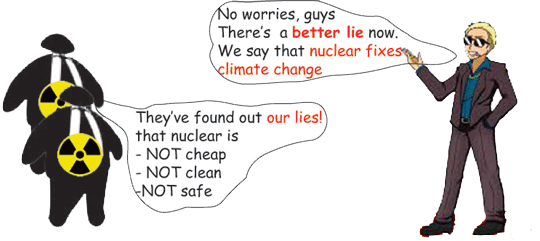
At COP27, nuclear power industry vies for bigger role in decarbonizing planet
https://www.reuters.com/business/cop/cop27-nuclear-power-industry-vies-role-decarbonizing-planet-2022-11-09/ By Richard Valdmanis, Sarah Mcfarlane and Valerie Volcovici
HARM EL-SHEIKH, Egypt, Nov 9 (Reuters) – Nuclear energy supporters including politicians and activists sought to polish the industry’s spotty image on Wednesday, using the COP27 climate summit in Egypt to argue that atomic power offers a safe and cost-efficient way to decarbonize the world.
Rising concerns about the swift pace of climate change and tight power supplies around the globe have softened some policy makers view of nuclear energy, an industry that has struggled for years to draw investment because of worries about safety, radioactive waste, and huge costs for building a reactor.
The International Atomic Energy Agency, an intergovernmental organization that seeks to promote nuclear power, opened an exhibit at the U.N. climate gathering of global leaders in Egypt – its first time doing so in 27 years of the annual international climate negotiations. The showcase expounded the technology’s potential in the fight against climate change.
When you talk about nuclear, you’re talking about a confirmed energy producer which is not part of the problem, but rather part of the solution,” IAEA Director General Rafael Mariano Grossi told Reuters in an interview.
“You will see that that nuclear energy has a really solid, very consistent safety record,” he added.
U.S. Special Climate Envoy John Kerry, meanwhile, pumped up the industry on Tuesday at a news conference at the summit announcing the U.S. Export-Import Bank (EXIM)’s formal interest in providing $3 billion in financial support for a nuclear plant in Romania.
“We have a viable alternative in nuclear … This is one of the ways in which we can achieve net-zero,” he told reporters, referring to an international target of cutting net greenhouse gas emissions to zero by 2050. “We don’t get to net zero by 2050 without nuclear power in the mix.”
The United States has already earmarked billions of dollars toward keeping existing nuclear power plants open as part of a broader strategy to decarbonize the economy and is hoping to encourage new projects.
The nuclear power industry has had trouble raising money in recent years, having taken a huge public relations hit following the 2011 reactor meltdown at the Fukushima power plant in Japan. Russia’s invasion of Ukraine has further raised concerns about nuclear safety with sporadic fighting and power cuts at the site of the Zaporizhzhia plant.
Oleksii Riabchyn, advisor to the Ukraine government on green energy, told Reuters at the summit that he thought the country’s reactors required a missile shield to protect them.
AEA’s Grossi said the security concerns in Ukraine should not dissuade countries from building nuclear plants: “The big problem is war, is not nuclear energy or any other industrial activity.”
He added he was in the midst of “very complex” negotiations with Russia and Ukraine over a proposed no-combat zone around the plant and hoped for an agreement soon.
Hannah Fenwick, the co-lead of Nuclear for Climate which represents a network of 150 associations advocating for governments to embrace nuclear power, said her organization was lobbying policy-makers at COP27 to consider nuclear energy investments and was getting decent feedback.
“We have been saying that nuclear is a solution for climate for many years and the geopolitical climate has changed and people are now listening,” she said.
Reporting by Richard Valdmanis, Sarah McFarlane and Valerie Volcovici; Editing by Katy Daigle, Frank Jack Daniel and Deepa Babington
Barbados PM launches blistering attack on rich nations at Cop27 climate talks
Mia Mottley, prime minister of Barbados, has criticised industrialised
nations for failing the developing world on the climate crisis, in a
blistering attack at the Cop27 UN climate talks.
She said the prosperity –
and high carbon emissions – of the rich world had been achieved at the
expense of the poor in times past, and now the poor were being forced to
pay again, as victims of climate breakdown that they did not cause.
“We were the ones whose blood, sweat and tears financed the industrial
revolution,” she said. “Are we now to face double jeopardy by having to
pay the cost as a result of those greenhouse gases from the industrial
revolution? That is fundamentally unfair.”
Guardian 7th Nov 2022
How likely is progress on climate at Cop27?

Meeting the target of limiting heating to 1.5C: At Cop26 in Glasgow, countries agreed to limit global
heating to 1.5C above pre-industrial levels. The pledges on emissions cuts
they came forward with were not enough to meet this goal, however, so they
agreed to return this year with strengthened commitments.
Few have done so
– only 24 submitted new national plans on emissions to the UN in advance of
Cop27. Fulfilling promise of $100bn a year on climate finance: Since 2009,
poor countries have been promised $100bn (£87bn) a year from 2020 to help
them cut greenhouse gas emissions and adapt to the impacts of extreme
weather. This target has not been met, and will not be met before next
year.
Guardian 9th Nov 2022
https://www.theguardian.com/environment/2022/nov/09/how-likely-is-progress-on-climate-at-cop27
The world is now deep into the climate crisis

The past eight years were the eight hottest ever recorded, a new UN report
has found, indicating the world is now deep into the climate crisis. The
internationally agreed 1.5C limit for global heating is now “barely
within reach”, it said.
The report, by the UN’s World Meteorological
Organization (WMO), sets out how record high greenhouse gases in the
atmosphere are driving sea level and ice melting to new highs and
supercharging extreme weather from Pakistan to Puerto Rico.
The stark assessment was published on the opening day of the UN’s Cop27 climate
summit in Egypt and as the UN secretary-general warned that “our planet
is on course to reach tipping points that will make climate chaos
irreversible”. The WMO estimates that the global average temperature in
2022 will be about 1.15C above the pre-industrial average (1850-1900),
meaning every year since 2016 has been one of the warmest on record.
Guardian 6th Nov 2022
Scientists now see the climate crisis as frightening

Why scientists are using the word scary over the climate crisis. The
former BBC environment analyst Roger Harrabin has spent his career talking
to scientists. Now they’re telling him they’re scared of what they’re
seeing.
Back in the 1980s, when climate research began to really take off,
scientists were desperate to retain their credibility as they unravelled
the potentially dire consequences of the “new” phenomenon of global
warming. Most journalists tiptoed round this topic because no one wanted to
lose their reputation by scaremongering. But as the science steadily became
overwhelming researchers pushed their conclusions in the face of
policymakers.
More and more scientists are now admitting publicly that they
are scared by the recent climate extremes, such as the floods in Pakistan
and west Africa, the droughts and heatwaves in Europe and east Africa, and
the rampant ice melt at the poles.
Guardian 7th Nov 2022
Revealed: US and UK fall billions short of ‘fair share’ of climate funding for developing countries.

The US, UK, Canada and Australia have fallen billions of dollars short of
their “fair share” of climate funding for developing countries,
analysis shows. The assessment, by Carbon Brief, compares the share of
international climate finance provided by rich countries with their share
of carbon emissions to date, a measure of their responsibility for the
climate crisis.
Rich countries pledged to provide US$100bn a year by 2020,
although this target has been missed. The US share of this, based on its
past emissions, would be $40bn yet it provided only $7.6bn in 2020, the
latest year for which data is available.
Australia and Canada gave only about a third of the funding indicated by the analysis, while the UK
supplied three-quarters but still fell $1.4bn short.
The issue of climate finance will be critical to progress at the Cop27 summit, which began on
Sunday in Egypt. Developing countries did little to cause the climate
emergency, making funding from rich countries vital to create the trust
needed for combined global action.
The rich countries accept vulnerable
countries face a “life or death situation” and need far more than
$100bn but delivery of the money has been contentious and slow. The $100bn
was intended to support the cutting of carbon emissions and work to adapt
communities to the increasingly extreme weather being driven by global
heating. However, a series of reports last week have laid bare how close
the planet is to climate catastrophe, with “no credible pathway [of
carbon cuts] to 1.5C in place”, the internationally agreed temperature
limit to avoid the worst of the climate crisis.
Guardian 7th Nov 2022
COP27 in Egypt. Will rich nations fulfil their promises to help poor countries to fight global heating?
Tens of thousands of people will be jetting to an Egyptian holiday resort
beside the Red Sea this weekend in an effort to tackle climate change. It
sounds like a joke, but this latest UN climate summit – COP27 – is reckoned
to be the world’s best hope of progress on the climate issue.
Progress is certainly needed. The global effort to cut emissions is “woefully
inadequate” and means the world is on track for “catastrophe”, the UN
warned last week.
But the meeting in Sharm El-Sheikh is shaping up to be a
prickly and confrontational affair. The Egyptian hosts have set themselves
a tough challenge. Last year’s UN climate conference in Glasgow delivered a
host of pledges on emissions cuts, finance, net zero, forest protection and
more. Egypt says their conference will be about implementing these pledges.
What that really means is it will be all about cash, and specifically
getting wealthy nations to come good on their promises of finance to help
the developing world tackle climate change. So expect the main battle lines
to be between the north and south, between rich and poor nations.
BBC 4th Nov 2022
Carbon-14: Another underestimated danger from nuclear power reactors
https://beyondnuclear.org/carbon-14-another-underestimated-danger-from-nuclear-power-reactors/ 1 Nov 22,
There are a number of radionuclides released from nuclear energy facilities. This paper highlights carbon-14 for a number of reasons:
- Carbon-14 is radioactive and is released into air as methane and carbon dioxide.
- Before 2010, carbon-14 releases from nuclear reactors were virtually ignored in the United States. Today only estimates are required and only under certain restrictive circumstances.
- There is no good accounting of releases to date, so its impact on our health, our children’s health, and that of our environment remains unknown, yet environmental measurement is possible, but can be challenging under certain conditions.
- Carbon-14 has a half-life of over 5700 years and the element carbon is a basic building block for life on earth. Therefore, “it constitutes a potential health hazard, whose additional production by anthropogenic sources of today will result in an increased radiation exposure to many future generations.”
- Like tritium, it can collect in the tissues of the fetus at twice the concentration of the tissues in the mother, pointing to its disproportionate impact on the most vulnerable human lifecycle: the developing child.
The climate crisis and the danger of nuclear war are deeply intertwined
A lesson from the TPNW. by beyondnuclearinternational
A Fossil-Fuel Non-ProliferationTreaty will save lives, By Ira Helfand and Marjaneh Moini
“…………………………………………………………………………The two overriding issues of our era—the climate crisis and the danger of nuclear war—are deeply intertwined. The climate crisis is leading to greater international conflict and stockpiling nuclear weapons redirects precious resources away from equitable climate actions while increasing risk of a nuclear conflict. A nuclear war, in addition to killing billions of people and disrupting all aspects of our economy, would also cause abrupt and catastrophic climate disruption.
How are the politicians running our governments on the global stage responding to these threats? The policies our governments are implementing will lead to fossil fuel production in 2030 that is double the cap we need to maintain to limit warming to 1.5 degrees. Carbon dioxide emissions in 2021 were 36.3 billion tonnes, the highest ever. They are also stockpiling nuclear weapons and will not even promise not to start a nuclear war in Ukraine.
How is our government responding? The United States continues to increase subsidies to fossil fuel operations and expands its investments in nuclear weapons, reinforcing the two existential threats faced by humanity today. In turn, fossil fuel companies and the military industrial complex use their profits in lobbying efforts…………………more https://beyondnuclearinternational.org/2022/10/31/a-lesson-from-the-tpnw/
Climate summit – window for avoiding catastrophe is closing fast

It has been an alarming time for climate scientists. One by one, the grim
scenarios they had outlined for the near future have been overtaken by
events: extreme storms, droughts, floods and ice-sheet collapses whose
sudden appearances have outstripped researchers’ worst predictions.
Catastrophic climate change is happening more rapidly and with greater
intensity than their grimmest warnings, it transpires. Examples include
this summer’s record high temperature of 40.3C in the UK, a massive jump of
1.6C on the previous hottest day; torrential rains that triggered the most
severe flooding in Pakistan’s recent history; and last year’s Hurricane
Ida, one of the most destructive storms to have struck the US.
It is not that global temperatures have risen faster than expected. The problem is
that the effect of this rise has been unexpectedly extreme.
Observer 30th Oct 2022
“The voices in this world which have the most power belong to those who are destroying it”, writes Greta Thunberg
“The voices in this world which have the most power belong to those who
are destroying it”, writes Greta Thunberg in the outro of her spectacular
new book. It is a sentence which encapsulates the skill with which she can
speak the blatant truths our society can scarcely acknowledge, but it is
also a damning conclusion and part of a revolutionary call to arms.

Her zero-tolerance level for bulls*** is the beacon which has not only won her
acclaim, but also lights the way through this collection of essays, evidence and potential solutions written by an astonishing list of experts,
scientists, activists and authors.
Independent 27th Oct 2022
Global heating levels threaten to destroy economies

Levels of warming threaten to ‘destroy economies’, says UN. The world
is already seeing increasing floods, storms, heatwaves and wildfires as a
result of climate change. The planet is heading for “climate
catastrophe”, with countries significantly behind in cutting global
warming pollution, the UN has warned. UN Secretary General Antonio Guterres
said countries are bracing for “economy-destroying levels of global
heating”.
Express 27th Oct 2022
https://www.express.co.uk/news/nature/1688646/climate-change-warming-environment-un-UNEP-CAP26
Rising Sea Levels Spell Disaster For America’s Coastal Nuclear Plants
By Haley Zaremba – Oct 25, 2022,
- The Biden administration is pushing for a revitalization of America’s nuclear industry.
- Seven of the country’s coastal nuclear plants are at risk as sea levels rise.
- Mitigation measures are needed to protect America’s aging nuclear infrastructure.
……………………………….. The Turkey Point nuclear power plant, located between the Florida Everglades and Biscayne National Park, has been active for fifty years. While mathematical modeling shows that the aging plant is still safe to operate, many local residents live in fear of what will happen when the next hurricane pummels the southern coast of Florida – and the one after that, and the one after that. After seeing what a natural disaster did to Japan’s Fukushima power plant in 2011, anxiety about storm surges crashing into nuclear plants – and very old ones, at that – are justified.
……………. The National Oceanic and Atmospheric Administration (NOAA) projects that the area where Turkey Point is located will experience a full foot of sea level rise by 2050 and three feet of annual flooding. This would mean that the plant’s cooling systems and access roads would flood as well. What’s more, according to a 2020 study by scientists from Johns Hopkins University, Turkey Point is just one of seven coastal nuclear facilities that are vulnerable to sea level rise.
Serious and swift mitigation plans are clearly needed to make sure that aging nuclear infrastructure can safely stand up to storm surges and extreme weather events, which are a matter of “when,” not “if.”……………………. https://oilprice.com/Alternative-Energy/Nuclear-Power/Rising-Sea-Levels-Spell-Disaster-For-Americas-Coastal-Nuclear-Plants.html
COP27 climate change summit: World leaders urged to act as report reveals 768 million are underfed
COP27 climate change summit: World leaders urged to act as report reveals
768 million are underfed. Institute for Economic and Peace says ‘existing
ecological challenges will only be amplified by climate change’ and
millions of vulnerable people are being failed by current efforts to tackle
it.
World leaders facing the threat of a global recession must not scrimp
on support for poorer nations with hundreds of millions of people at
increased risk of catastrophic ecological disasters, a leading think-tank
has warned. Threats posed by water scarcity, food stress, and natural
disasters mean that the number of undernourished people worldwide rose to
768 million last year, according to a report by the Institute for Economics
and Peace.
The think-tank’s Ecological Threat Report says that
“existing ecological challenges will only be amplified by climate
change” and millions of vulnerable people are being failed by current
efforts to tackle it. The report’s authors say negotiators at the UN
COP27 climate change conference, which starts in Egypt on 6 November, must
commit to finding a way to address these risks “quickly” or risk a
catastrophe.
iNews 23rd Oct 2022
Least Developed Countries want ‘concrete action’ from rich nations at COP27 Climate Summit
COP27: From loss and damage to updated NDCs, dividing lines are taking
shape. Least Developed Countries Group says it wants to see ‘concrete
action’ from richer nations to provide more finance to help the most
vulnerable people manage the loss and damage caused by climate change. The
world’s most climate vulnerable nations have confirmed that securing
dedicated ‘loss and damage’ funding is their top priority for next month’s
COP27 Climate Summit in Egypt.
Business Green 24th Oct 2022
1 This Month



26 September – International Day for the Total Elimination of Nuclear Weapons


PLEASE OPPOSE HR 8255 AND S.3639 – bills would accelerate satellite deployment, with no environmental review or safeguards – https://ncstd5li.quorum.us/campaign/169331/
To see nuclear-related stories in greater depth and intensity – go to https://nuclearinformation.wordpress.com
-
Archives
- September 2026 (219)
- August 2026 (330)
- July 2026 (355)
- June 2026 (287)
- May 2026 (306)
- April 2026 (356)
- March 2026 (251)
- February 2026 (267)
- January 2026 (308)
- December 2025 (358)
- November 2025 (359)
- October 2025 (375)
-
Categories
- 1
- 1 NUCLEAR ISSUES
- business and costs
- climate change
- culture and arts
- ENERGY
- environment
- health
- history
- indigenous issues
- Legal
- marketing of nuclear
- media
- opposition to nuclear
- PERSONAL STORIES
- politics
- politics international
- Religion and ethics
- safety
- secrets,lies and civil liberties
- spinbuster
- technology
- Uranium
- wastes
- weapons and war
- Women
- 2 WORLD
- ACTION
- AFRICA
- Atrocities
- AUSTRALIA
- Christina's notes
- Christina's themes
- culture and arts
- Events
- Fuk 2022
- Fuk 2023
- Fukushima 2017
- Fukushima 2018
- fukushima 2019
- Fukushima 2020
- Fukushima 2021
- general
- global warming
- Humour (God we need it)
- Nuclear
- RARE EARTHS
- Reference
- resources – print
- Resources -audiovicual
- Weekly Newsletter
- World
- World Nuclear
- YouTube
-
RSS
Entries RSS
Comments RSS
 nuclear-news