Ann Darling: Nuclear power is no answer to anything our ailing planet needs

VT Digger 6 Feb 23
This commentary is by Ann Darling of Easthampton, Massachusetts, a climate activist and retired social worker. She lived for 35 years in the Brattleboro area, but after getting her son through high school, she left to be farther away from the Vermont Yankee nuclear power plant. She is a member of the Citizens Awareness Network.
In a recent commentary, Tom Evslin outlines what he sees as hopeful approaches to addressing our energy needs and addressing climate change.
While I agree there are many things in development that appear promising, I don’t agree that nuclear power should be part of “the answer.”
The climate chaos we are already experiencing is just the beginning. We have already wasted a lot of time. The litmus test of what makes a good energy source to address climate change has at least four criteria.
In addition to using less energy, we need to focus on energy sources that are:
1) quickly built and brought to scale.
2) low-carbon, with minimal environmental impact, including non-carbon pollutants.
3) relatively inexpensive so we can make the biggest impact within our limited resources .
4) safe.
In addition, these need to be deployed in an environmentally just way, but that’s another commentary.
No matter the energy source, we always should consider its entire fuel chain or life-span cycle, from extraction to power generation to waste, not just its impact at the point of power generation. This is an incredibly important mind shift we all need to make.
There is no energy source that does not create problems somewhere in its fuel-chain life span. The issue is, how much and what kind? Can the earth heal from these harmful impacts, and how can people help that happen?
Solar, wind, geothermal, storage, etc., paired with efficiency and conservation come close to meeting these four tests. Yes, there are problems, like the pollution caused by lithium mining and how to safely recycle the components of solar panels. So the question with them is how we can use our intelligence and resources to mitigate these harms and make them affordable and easy to access.
On the other hand, nuclear fission and nuclear fusion do not come close to meeting these tests. Fission is what runs our current nuclear reactor fleet and the still-on-the-design-table small modular reactors. Harnessing nuclear fusion, which powers our sun, has been in the spotlight lately because of a recent advance in development, but it is still decades away from being useful as a power source, if it ever will be.
Nuclear fission reactors are far from carbon-free, contrary to what nuclear industry marketing would have us believe. Once we consider the process of getting the uranium out of the ground, milling and refining it, using it, and then dealing with the waste, nuclear is a net carbon emitter. Plus, the mining, milling and refining expose communities to highly toxic materials that cause cancer and other diseases. There is always risk of nuclear catastrophe (as in Fukushima).
Places where lower-level radioactive waste from reactors goes are leaking sacrifice-zones that despoil entire regions (think Hanford, Washington; Oak Ridge, Tennessee; or Barnwell, South Carolina).
And last but not least, there is no safe place for the deadly high-level waste (“spent” fuel) to go. Plus, reactors take a really long time to build, and small modular reactors are completely untested. Nuclear is the most expensive way to generate electricity there is, and it can exist only with huge subsidies and tax credits from the government. That’s your tax dollars underwriting private industry. (And then there’s the link to nuclear weapons; the civilian nuclear power industry creates the materials that make nuclear weapons.)
Fusion? I’m sorry, but no. According to Dr. Ian Fairlie, a UK expert on radioactivity in the environment, “Fusion reactors would … be subject to most of the major problems associated with fission reactors, including large-scale cooling demands, high construction and operational costs and lengthy construction times — stretching to decades. The structure, damaged by neutron bombardment, would need to be replaced regularly, resulting in large amounts of radioactive wastes for which there is no current solution.”
We simply do not have the time to fiddle around with something that will take decades and that is quite likely not to work and/or will create huge and dangerous problems for life on earth.
Let’s be practical in the face of climate-induced threats to life on earth. We have limited resources. Every dollar that goes into perpetuating nuclear power in any form is in essence being stolen from bringing less expensive, safer, less carbon-intensive, and more quickly built energy sources to bear on the climate emergency we have created.
Nuclear power never was and is not now an answer to anything our ailing planet needs.
Climate hypocrisy: UAE oil company employees given roles in office hosting Cop28

At least a dozen employees from the United Arab Emirate’s state-owned
oil company have apparently taken up roles with the office of the UAE’s
climate change special envoy, who will host this year’s Cop28 UN climate
summit. The revelation adds to growing concerns over the potential for
blurred lines between the team hosting this year’s crucial summit and the
oil-rich country’s influential fossil fuel industry.
Guardian 3rd Feb 2023
https://www.theguardian.com/world/2023/feb/03/uae-oil-company-cop28
Sea level rise will threaten UK coastal towns
A number of Somerset towns could be left underwater by 2090 if pollution
levels remain unchecked, according to a study. Climate Central’s map of the
county shows how the current coastline will change within a lifetime to
wash away settlements near the sea. Levels are predicted to rise by one
metre over the next 69 years, flooding Weston-super-Mare, Clevedon and
Avonmouth. However, it is not only seaside towns that will lose ground. A
huge stretch of the M5 between Burnham-on-Sea and Bridgwater will also be
underwater.
Somerset Live 31st Jan 2023
https://www.somersetlive.co.uk/news/somerset-news/somerset-towns-could-underwater-2090-8091726
The first breach of 1.5°C will be a temporary but devastating failure

The world has already warmed by about 1.2°C since pre-industrial times.
Within the next four years, there is a 48 per cent chance temperatures
could breach the 1.5°C threshold for the first time, according to the UK
Met Office.
At most, the world has nine years until breaching 1.5°C for at
least one year is inevitable, according to the Global Carbon Project. It
would be a totemic milestone. The 1.5°C target has become a guiding light
for the climate movement, after it was included as a “stretch goal” in
the 2015 Paris Agreement.
In the document, the world’s nations promise to
limit any global rise in average temperatures to “well below” 2°C and
to strive for warming of no more than 1.5°C. That inclusion of 1.5°C in
the agreement – fought for by campaigners and small island states at risk
of rising seas – focused scientific minds.
In 2018, the Intergovernmental
Panel on Climate Change published a report on the projected impact of
exceeding the 1.5°C target, which warned that warming beyond this level
would be far more damaging than first thought.
New Scientist 16th Jan 2023
The ‘all-of-the-above’ story used to sneak nuclear power in as a climate-action technology along with renewables .

“These claims are almost entirely misleading as you start looking at the facts”
Nuclear power gets another look in ‘all-of-the-above’ energy approach as climate worries mount
But critics cite safety concerns, costs and say widespread use of reactors is decades away.
Utility Dive. Jan. 20, 2023, Nuclear energy is increasingly getting another look by federal and state officials seeking to cut greenhouse gas emissions and bolster energy security………
A federal zero-emission nuclear power production credit, state legislation ending bans on nuclear plant construction and state policies easing development of small modular reactors, defined by the International Atomic Energy Agency as advanced nuclear reactors with a capacity of up to 300 MW, are among the recent developments spurring renewed interest in the industry.
Detractors cite safety risks, rising costs and other concerns. Critics also caution that a significant increase in nuclear generation in the U.S. is years, maybe even decades, away……….
In the U.S…..nuclear electricity generation declined for a second consecutive year in 2021, according to the U.S. Energy Information Administration. Output from nuclear power plants totaled 778 million MWh, or 1.5% less than in 2020. Nuclear’s share of U.S. electricity generation across all sectors in 2021 was similar to its average share in the previous decade: 19%.
As of November, seven units with a net summer capacity of 5,505 MW had retired since 2018, according to the EIA. The agency listed four Entergy plants: Palisades in Michigan; Indian Point 2 and Indian Point 3 in New York; and Pilgrim in Plymouth, Massachusetts. Also retired were two Exelon plants: Three Mile Island in Pennsylvania and Oyster Creek in New Jersey and NextEra Energy’s Duane Arnold facility in Iowa.
In addition, California’s Diablo Canyon, which is slated to retire a unit in 2024 and another in 2025, could remain open with funding conditionally approved by the U.S. Department of Energy.
Federal money, state policies induce nuclear investment
The Inflation Reduction Act, which commits $369 billion for climate efforts, includes a zero-emission nuclear power production credit. It provides up to $15 a MWh for electricity produced, assuming labor and wage requirements are met.
The credit will be available for plants in service in 2024 and would extend through 2032, according to the DOE.
However, the fiscal year 2023 omnibus spending measure enacted last month cut funding for the DOE’s Office of Nuclear Energy by $182 million from fiscal year 2022, to $1.47 billion. The FY 2023 spending includes $85 million for the Advanced Reactor Demonstration Program, $322 million for fuel cycle research and development, $114 million for accident tolerant fuels and $259 million for reactor research and development.
Maria Korsnick, president and CEO of the Nuclear Energy Institute, said the $1.7 trillion spending bill includes “robust funding” for public-private partnerships and support for nuclear energy education and research infrastructure. But she said it “fell short” of $2.1 billion needed to bolster the domestic nuclear fuel supply.
Federal spending to provide incentives for nuclear energy development began before Congress and President Joe Biden approved the omnibus spending bill last year.
The $1.2 trillion Infrastructure Investment and Jobs Act that Biden signed into law in November 2021 includes $62 billion for clean energy projects. Spending was directed at advanced nuclear projects, preventing the premature retirement of nuclear plants and considering how nuclear power may produce hydrogen for other energy applications.
In addition, states are looking to bolster nuclear power. Christine Csizmadia, senior director of state government affairs and advocacy at the NEI, said several states are broadening policies that aim to advance nuclear energy. Legislation supports studies of small modular reactors, providing tax incentives for nuclear power plant construction and ending moratoriums on new plants…………………………………………………………………………………..
The U.S. is not a ‘great market’ for new nuclear plants
Policies giving nuclear energy a boost have their limits.
Bret Kugelmass, CEO of Last Energy a manufacturer of what it calls micro modular reactors that generate about 20 MW, is active in European markets. It’s announced 10 projects in Poland, two in Romania and has “some activity” in the U.K. that has yet to be publicly detailed, he said in an interview……………………………………
Next nuclear technology is seen as a decade away
Avi Brenmiller, president and CEO of Brenmiller Energy, a thermal energy storage manufacturer, said the next nuclear technology is 10 years away “to be safe and clean, and I don’t see the move yet.”…………………………………………………………
Critics say nuclear power is potentially dangerous and that its promoters are overly optimistic about construction schedules.
Edwin Lyman, director of nuclear power safety at the Union of Concerned Scientists, said during the forum that nuclear power has the potential for a “catastrophic accident that could lead to large scale radiological contamination of the environment, massive economic damages and the potential for significant human health impacts.”
The industry cannot easily estimate the risks associated with storms, earthquakes and tidal waves as climate change makes weather more unpredictable, he said.
Even if a reactor is safe against accidents, it’s vulnerable to terrorists or military attacks as in Ukraine at the hands of Russia, Lyman said.
He questioned whether SMRs are easier to cool and are less radioactive than light water reactors “and therefore we don’t have to worry about it as much.”
“These claims are almost entirely misleading as you start looking at the facts,” he said.
Developers looking to reduce capital expenses and operating costs are cutting “rigorous requirements” for sites in or near populated urban centers or towns, Lyman said.
David Schlissel, director of resource planning analysis at the Institute for Energy Economics and Financial Analysis, cited cost overruns and schedule delays in the nuclear power industry.
“We don’t need a transition from coal to nuclear,” he said at the Dec. 15 forum. “We’re already pretty far along a transition from coal and natural gas to renewables.”……………………… https://www.utilitydive.com/news/nuclear-power-smr-climate-ira-omnibus-spending/639484/
Suffolk: Sizewell C ‘should not get licence’ due to erosion
Campaigners opposed to the new Sizewell C nuclear power station have
written to a nuclear industry regulator calling for it to reject the new
plant due to coastal erosion.
Together Against Sizewell C (TASC) has sent a
letter to the Office for Nuclear Regulation calling for Sizewell C’s
nuclear operating licence to be ruled out after photos emerged showing the
extent of coastal erosion near to where the new facility will be sited,
raising safety concerns.
Pete Wilkinson, from TASC, said: “This
generation’s inactivity on climate change has already compromised future
generations. To proceed with Sizewell C while being fully aware that it is
highly vulnerable to sea level rise, storm surges and flooding, only adds
to the inter-generational burden we pass on.” However, a spokesperson for
Sizewell C said: “The design of the power station, including its sea
defence and the raised platform it will be built on, will protect Sizewell
C from flooding. “Our plans take account of the effect of climate change
and the predicted rise in sea levels over the coming decades.”
East Anglian Daily Times 18th Jan 2023
https://www.eadt.co.uk/news/23257671.suffolk-sizewell-c-should-not-get-licence-due-erosion/
Extreme weather is pushing more people to flee their homes
Governments must get to grips with the links between the climate crisis
and the plight of migrants around the world, experts have said, as
increasingly extreme weather is a mounting danger to already vulnerable
displaced people, and is potentially pushing more people to flee their
homes.
Migrants and displaced people number more than 100 million around
the world, mainly in developing countries, and are among the populations
most at risk from extreme weather. However, little work has been done on
addressing the plight of migrants afflicted by climate breakdown, or on the
risk that more extremes of weather will push more people into moving. The
subject received little mention at the Cop27 UN climate summit in Egypt
late last year, and experts are hoping for greater focus in 2023.
Guardian 10th Jan 2023
From the fossil fuel frying pan into the fission fire

“Coal to Nuclear” plan is old thinking at its worst
From the fossil fuel frying pan into the fission fire — Beyond Nuclear International
Another smokescreen that obscures real climate solutions
By Linda Pentz Gunter
They’ve given it a snappy little acronym, one that is perhaps supposed to masquerade as a sort of scientific-sounding calculus — C2N. After the failure of the much-trumpeted “nuclear renaissance” that never was, the nuclear lobby and its federal lackeys have come up with another PR clunker — Coal 2 Nuclear (hence, C2N). In reality, this is less C2N than CPR for an ailing nuclear power industry.
Unfortunately, to arrive at this dangerously out-of-touch scheme, our tax dollars had to be wasted on yet another U.S. Department of Energy (DOE) report. Its conclusion was that, “hundreds of U.S. coal power plant sites could convert to nuclear power plant sites, adding new jobs, increasing economic benefit, and significantly improving environmental conditions.”
Notice the word “could” though. Not “will”. Because it’s more of the same aspirational irrationality that is driving the small modular reactor fantasy in the first place, the version of nuclear power that would supposedly dot the defunct coal plant landscapes.
The DOE study was conducted by Argonne National Laboratory, Idaho National Laboratory, and Oak Ridge National Laboratory. Their self-interested conclusions then, come as no surprise.
C2N is enough to make you despair — or confirm your pre-existing suspicions — that our leadership is blind and deaf to the reality of the climate emergency we are facing. They are truly mired in the mud of outdated thinking, clinging to failed and foolish energy plans that have long been supplanted by demonstrably better, faster, cheaper, safer and more workable options, ergo renewable energy, energy efficiency and conservation.
More than 3 million of the 7.8 million jobs in the US energy sector are in areas aligned to America’s goal of being carbon neutral by 2050”, reported the World Economic Forum in July 2022. “This means renewable energy jobs in 2021 accounted for around 40% of total energy jobs.”
But no, the DOE would rather spend decades dangling before depressed coal communities the false promise of “new jobs” and “economic benefits” in a phantom new nuclear sector. It’s a con and the worst form of betrayal and guess whose fingerprints are all over this?
With C2N, Senator Joe Manchin of West Virginia (Democrat in name only and with his pockets full of coal money), is throwing his most deprived constituents under a petroleum-powered bus. He is leading those who need work today down a long and winding road to C2N that will deliver little if anything and nothing anytime soon.
All of this is in line with a collective madness that appears to have taken over significant swaths of human society. In November, UN General Secretary, António Guterres, desperate to steer us away from our final precipice, issued his most strident and urgent warning yet:
“We are in the fight of our lives and we are losing … And our planet is fast approaching tipping points that will make climate chaos irreversible,” Guterres said. “We are on a highway to climate hell with our foot on the accelerator.”
He was speaking at the opening of the COP27 UN climate summit in Egypt, or the “COP-out” as some cynics prefer to call it, given the abject failure of these annual meetings to ensure enforcement of the pledges made, albeit most are still woefully inadequate.
The US DOE meanwhile, prefers to dwell in the dark ages of denial. “A coal to nuclear transition could significantly improve air quality,” the department alleged in its report. But this ignores the fact that nuclear power plants and the nuclear fuel chain routinely release radioactivity, especially dangerous to children. Among more than 60 epidemiological studies worldwide, most found increases in rates of leukemia among children under five living near nuclear power plants. The rates increased the closer children lived to the plant.
And it ignores the fact that air quality could be improved faster and more significantly by shifting from coal to renewables rather than to nuclear, thereby also avoiding the cancer-causing emissions delivered by nuclear power.
Of course, “air quality” would be rendered meaningless if/when one of the C2N plants suffers a serious accident. Such an event would release large amounts of fast-traveling radioactive iodine-131 gas, followed by clouds of heavier radioactive fallout such as cesium and strontium. A major disaster, such as those at Chernobyl in 1986 and Fukushima in 2011, even released “hot” particles such plutonium into the environment.
This outcome is made even more likely by virtue of the reactor choices for these C2N sites, which include small modular reactors, sodium-cooled fast reactors and very high temperature reactors, all designs vulnerable to fires, leaks, explosions and other major failures.
Needless to say, a C2R program (Coal to Renewables), the most obvious choice staring our federal government in the face, just wasn’t even on the cards. That would have meant relinquishing the stranglehold —and renouncing the pocket-lining dollars — of the big fossil fuel and nuclear corporations.
As M.V. Ramana and Cassandra Jeffery noted with such precision on these pages, the powers that be are “far more devoted to maintaining the current system for as long as it is feasible,” rather than exploring genuine climate solutions.
C2N preserves that status quo, operating inside a spectacularly failed system that, nevertheless, continues to enrich the already wealthy and preserve the monopoly enjoyed by large, inflexible and already obsolete forms of energy production such as nuclear power.
An argument made by these entrenched establishment forces is that moving from coal to nuclear allows for a continued electricity supply system that is “always on”, reinforcing the myth that base load energy is somehow beneficial.
Nuclear reactors “run uninterrupted,” Maria Korsnick, head of the industry lobbying group, Nuclear Energy Institute, told an audience of Purdue University students in October when stumping for C2N. “Every hour of every day, rain or shine.”
But, as George Harvey explained in CleanTechnica: “Base load power may supply the electricity in the middle of the night in many cases, but power from other sources could be used instead.” Clinging to base load is related to cost, not demand and efficiency.
Already back in 2017, the Brattle Group conducted an analysis for the Senate Energy and Natural Resources Committee — Advancing Past “Baseload” to a Flexible Grid, in which the group concluded that the base load concept was outdated. Base load, it said, has now been left behind by the economics of a changing electricity landscape that have rendered it “no longer very relevant”.
Much more efficient, said the report, is an electricity demand and supply met with high renewable generation. In their graph illustrating this, nuclear power is nowhere to be seen.
And of course, nuclear power invariably doesn’t “run uninterrupted.” It must power down or off during violent storms, droughts or heatwaves, or due to offsite grid instability, and shut down for extended periods during refueling and maintenance. And, as exemplified most recently by France, it can simply break down altogether for extended periods.
If the C2N reactors ever do happen, it will be decades in the future. By then, those who needed the work in the 2020s, falsely promised by C2N, will be retired or deceased. Our coastlines may well be underwater. If we did enough in time to save ourselves, we will be on smart grids using distributed generation.
“Nuclear energy is going to create incredible new career opportunities all over the country,” Korsnick told the Purdue students. According to the dictionary definition, “incredible” means “not credible; hard to believe”. That about sums it up.
Linda Pentz Gunter is the international specialist at Beyond Nuclear and writes for and curates Beyond Nuclear International.
Under present conditions, a huge loss of the planet’s glaciers will happen in the next 30 years
Half the planet’s glaciers will have melted by 2100 even if humanity sticks
to goals set out in the Paris climate agreement, according to research that
finds the scale and impacts of glacial loss are greater than previously
thought.
At least half of that loss will happen in the next 30 years.
Researchers found 49% of glaciers would disappear under the most optimistic
scenario of 1.5C of warming.
However, if global heating continued under the
current scenario of 2.7C of warming, losses would be more significant, with
68% of glaciers disappearing, according to the paper, published in Science.
There would be almost no glaciers left in central Europe, western Canada
and the US by the end of the next century if this happened.
This will significantly contribute to sea level rise, threaten the supply of water of
up to 2 billion people, and increase the risk of natural hazards such as
flooding. The study looked at all glacial land ice except for Greenland and
Antarctic ice sheets.
Guardian 5th Jan 2023
Writers protest against imprisonment of climate activists
Ben Okri, Simon Schama, Helen Pankhurst and AL Kennedy are among more than
100 writers who have signed a letter in solidarity with UK climate protest
prisoners.
“That the UK now has political prisoners, incarcerated for
defending sustainable life on Earth is yet another national disgrace,”
Kennedy said.
At least 13 environmental activists began the year behind
bars in UK jails, after a year of “civil resistance” against climate
policies led by the Just Stop Oil campaign. More than 100 spent time in
jail, either convicted or on remand, for environmental protest in 2022.
“We stand with all those who are trying to sound the alarm and to protect
our beautiful world,” said the letter, coordinated and published by the
group Writers Rebel.
Guardian 6th Jan 2023
Growing urgency and intensity — Weather extremes won’t be solved by nuclear power

Growing urgency and intensity — Beyond Nuclear International . By Antony Froggatt 1 Jan 2023, https://beyondnuclearinternational.org/2023/01/01/growing-urgency-and-intensity/
Urgent climate action is needed and nuclear power is not the answer
Just as Russia’s invasion of Ukraine has highlighted Europe’s dangerous dependence on fossil fuels, increasingly frequent and intense climate-driven weather events are highlighting the death and destruction that fossil-fuel dependence has wrought.
Understandably, political and public pressure to reduce greenhouse-gas emissions, move away from insecure primary energy supplies, and develop new, reliable, secure, and affordable energy sources is at an all-time high.
But rather than rushing ahead, we need to consider carefully which options are most realistic, and how they will be deployed and operate in the real world.
Consider nuclear power. With many countries and companies now giving this option a second (or even a third) look, the 2022 World Nuclear Industry Status Report (WNISR) offers valuable insights into how the sector is faring.
While the last 12 months may be remembered as a turning point for the broader energy sector, it won’t be because of the nuclear industry. Nuclear energy’s share of global commercial gross electricity generation in 2021 dropped to 9.8%, which is its first dip below 10% in four decades, barely more than half its peak of 17.5% in 1996.
Meanwhile, wind and solar surpassed nuclear for the first time in 2021, accounting for 10.2% of gross power generation.
These diverging trajectories can be seen clearly across every indicator of investment, deployment, and output. According to the International Atomic Energy Agency, operating reactors peaked in 2018, both in terms of their number (449) and total capacity (396.5 gigawatts). The IAEA reports that 437 reactors were “in operation” globally at the end of 2021, including 23 reactors that have not generated power for at least nine years, and which may never do so again.
In 2018, when installed nuclear power peaked below 400 GW, solar and wind capacity rose above 1,000 GW, on its way to reaching 1,660 GW by the end of 2021. In just three years, solar and wind added two-thirds more capacity than nuclear at its last peak. Even if nuclear plants usually generate more electricity per unit of installed capacity than wind and solar, the divergence in these numbers is staggering.
In 2021, total investments in non-hydro renewables hit a record $366 billion, adding an unprecedented 257 GW (on net) to electricity grids, whereas operating nuclear capacity decreased by 0.4 GW. Only six new reactors were connected to the grid that year, and half of these were in China. Then, in the first half of 2022, five new reactors went online, two of which were in China. But while China has the most reactors under construction (21, as of mid-2022), it is not building them abroad.
Until recently, that role was taken up by Russia, which is dominating the international market with 20 units under construction, including 17 in seven countries as of mid-2022. Sanctions and potential other geopolitical developments have cast doubt on many of these projects, with a Finnish consortium already canceling construction of a facility based on a Russian design.
Only 33 countries operate nuclear power plants today, and only three – Bangladesh, Egypt, and Turkey – are building reactors for the first time (all in partnership with the Russian nuclear industry). Twenty-six of the 53 construction projects around the world have suffered various delays, with at least 14 reporting increased delays, and two reporting new delays, just in the past year.
For the first time, the WNISR also assesses the risks of nuclear power and war. There has been significant international concern about Ukraine’s Zaporizhzhia nuclear power plant, which has been occupied by Russia forces since March 4, 2022. Owing to repeated shelling in and around the area, the plant has frequently lost external power, prompting warnings from the IAEA that the situation is “untenable.” Operating a nuclear facility requires motivated, rested, skilled staff; but Zaporizhzhia’s Ukrainian personnel are under severe stress.
The key challenge now is to maintain continuous cooling for the reactor core and the pool for spent fuel, even after the reactor is shut down. The failure to evacuate heat from residual decay would lead to a core meltdown within hours, or a spent-fuel fire within days or weeks, with potentially large releases of radioactivity.
World leaders should focus on the technologies that can be deployed rapidly and universally to replace fossil fuels. As consecutive editions of the WNISR have shown, nuclear power is too slow and too expensive to compete with energy-efficiency measures and renewable energy.
Antony Froggatt is a founding author of the World Nuclear Industry Status Report.
Growing climate, nuclear risks spark doomsday fears

Past year has prompted warnings of armageddon amid war in Ukraine and concerns over higher rate of warming, but has also seen COVID pandemic recede and other positive signs
https://www.timesofisrael.com/growing-climate-nuclear-risks-spark-doomsday-fears/ By SHAUN TANDON 29 Dec 22, WASHINGTON (AFP) — For thousands of years, predictions of apocalypse have come and gone. But with dangers rising from nuclear war and climate change, does the planet need to at least begin contemplating the worst?
When the world rang in 2022, few would have expected the year to feature the US president speaking of the risk of doomsday, following Russia’s threats to go nuclear in its invasion of Ukraine.
“We have not faced the prospect of Armageddon since Kennedy and the Cuban missile crisis” in 1962, Joe Biden said in October.
And on the year that humanity welcomed its eighth billion member, UN Secretary-General Antonio Guterres warned that the planet was on a “highway to climate hell.”
In extremes widely attributed to climate change, floods submerged one-third of Pakistan, China sweat under an unprecedented 70-day heatwave, and crops failed in the Horn of Africa — all while the world lagged behind on the UN-blessed goal of checking warming at 1.5 degrees Celsius (2.7 degrees Fahrenheit) above pre-industrial levels.
Biggest risk yet of nuclear war?
The Global Challenges Foundation, a Swedish group that assesses catastrophic risks, warned in an annual report that the threat of nuclear weapons use was the greatest since 1945 when the United States destroyed Hiroshima and Nagasaki in history’s only atomic attacks.
The report warned that an all-out exchange of nuclear weapons, besides causing an enormous loss of life, would trigger clouds of dust that would obscure the sun, reducing the capacity to grow food and ushering in “a period of chaos and violence, during which most of the surviving world population would die from hunger.”
Kennette Benedict, a lecturer at the University of Chicago who led the report’s nuclear section, said risks were even greater than during the Cuban Missile Crisis as Russian President Vladimir Putin appeared less restrained by advisors.
While any Russian nuclear strike would likely involve small “tactical” weapons, experts fear a quick escalation if the United States responds.
“Then we’re in a completely different ballgame,” said Benedict, a senior advisor to the Bulletin of the Atomic Scientists, which in January will unveil its latest assessment of the “doomsday clock” set since 2021 at 100 seconds to midnight.
Amid the focus on Ukraine, US intelligence believes North Korea is ready for a seventh nuclear test, Biden has effectively declared dead a deal on Iran’s contested nuclear work and tensions between India and Pakistan have remained at a low boil.
Benedict also faulted the Biden administration’s nuclear posture review which reserved the right for the United States to use nuclear weapons in “extreme circumstances.”
“I think there’s been a kind of steady erosion of the ability to manage nuclear weapons,” she said.
Charting worst-case climate risks
UN experts estimated ahead of November talks in Egypt that the world was on track to warming of 2.1 to 2.9 C — but some outside analysts put the figure well higher, with greenhouse gas emissions in 2021 again hitting a record despite pushes to renewable energy.
Luke Kemp, a Cambridge University expert on existential risks, said the possibility of higher warming was drawing insufficient attention, which he blamed on the consensus culture of the UN’s Intergovernmental Panel on Climate Change and scientists’ fears of being branded alarmist.
“There has been a strong incentive to err on the side of least drama,” he said.
“What we really need are more complex assessments of how risks would cascade around the world.”
Climate change could cause ripple effects on food, with multiple breadbasket regions failing, fueling hunger and eventually political unrest and conflict.
Kemp warned against extrapolating from a single year or event. But a research paper he co-authored noted that even a two-degree temperature rise would put the Earth in territory uncharted since the Ice Age.
Using a medium-high scenario on emissions and population growth, it found that two billion people by 2070 could live in areas with a mean temperature of 29 C (84.2 F), straining water resources — including between India and Pakistan.
Cases for optimism
The year, however, was not all grim. While China ended the year with a surge of COVID-19 deaths, vaccinations helped much of the world turn the page on virus, which the World Health Organization estimated in May contributed to the deaths of 14.9 million people in 2020 and 2021.
Greenland’s glaciers are melting 100 times faster than estimated
Greenland’s glaciers are melting 100 times faster than estimated according
to a new model that takes into account the unique interaction between ice
and water at the island’s fjords.
Live Science 19th Dec 2022
Despite the hype, we shouldn’t bank on nuclear fusion to save the world from climate catastrophe

Robin McKie, https://www.theguardian.com/commentisfree/2022/dec/17/dont-bank-on-nuclear-fusion-to-save-the-world-from-a-climate-catastrophe-i-have-seen-it-all-before
Last week’s experiment in the US is promising, but it’s not a magic bullet for our energy needs
“…….. For almost half a century, I have reported on scientific issues and no decade has been complete without two or three announcements by scientists claiming their work would soon allow science to recreate the processes that drive the sun. The end result would be the generation of clean, cheap nuclear fusion that would transform our lives.
Such announcements have been rare recently, so it gave me a warm glow to realise that standards may be returning to normal. By deploying a set of 192 lasers to bombard pellets of the hydrogen isotopes deuterium and tritium, researchers at the US National Ignition Facility (NIF) in Livermore, California, were able to generate temperatures only found in stars and thermonuclear bombs. The isotopes then fused into helium, releasing excess energy, they reported.
It was a milestone event but not a major one, although this did not stop the US government and swaths of the world’s media indulging in a widespread hyping jamboree over the laboratory’s accomplishment. Researchers had “overcome a major barrier” to reaching fusion, the BBC gushed, while the Wall Street Journal described the achievement as a breakthrough that could herald an era of clean, cheap energy.
It is certainly true that nuclear fusion would have a beneficial impact on our planet by liberating vast amounts of energy without generating high levels of carbon emissions and would be an undoubted boost in the battle against climate change.
The trouble is that we have been presented with such visions many times before. In 1958, Sir John Cockcroft claimed his Zeta fusion project would supply the world with “an inexhaustible supply of fuel”. It didn’t. In 1989, Martin Fleischmann and Stanley Pons announced they had achieved fusion using simple laboratory equipment, work that made global headlines but which has never been replicated.
To this list you can also add the International Thermonuclear Experimental Reactor (Iter), a huge facility being built in Saint-Paul-lès-Durance in Provence, France, that was supposed to achieve fusion by 2023 but which is over 10 years behind schedule and tens of billions of dollars over budget.
In each case, it was predicted that the construction of the first commercially viable nuclear fusion plants was only a decade or two away and would transform our lives. Those hopes never materialised and have led to a weary cynicism spreading among hacks and scientists. As they now joke: “Fusion is 30 years away – and always will be.”
It was odd for Jennifer Granholm, the US energy secretary, to argue that the NIF’s achievement was “one of the most impressive scientific feats of the 21st century”. This is a hard claim to justify for a century that has already witnessed the discovery of the Higgs boson, the creation of Covid-19 vaccines, the launch of the James Webb telescope and the unravelling of the human genome. By comparison, the ignition event at the NIF is second-division stuff.
Most scientists have been careful in their responses to the over-hyping of the NIF “breakthrough”. They accept that a key step has been taking towards commercial fusion power but insist such plants remain distant goals. They should not be seen as likely saviours that will extract us from the desperate energy crisis we now face – despite all the claims that were made last week.
Humanity has brought itself to a point where its terrible dependence on fossil fuels threatens to trigger a 2C jump in global temperatures compared with our pre-industrial past. The consequences will include flooding, fires, worsening storms, rising sea levels, spreading diseases and melting ice caps.
Here, scientists are clear. Fusion power will not arrive in time to save the world. “We are still a way off commercial fusion and it cannot help us with the climate crisis now,” said Aneeqa Khan, a research fellow in nuclear fusion at Manchester University. This view was backed by Tony Roulstone, a nuclear energy researcher at Cambridge University. “This result from NIF is a success for science, but it is still a long way from providing useful, abundant clean energy.”
At present, there are two main routes to nuclear fusion. One involves confining searing hot plasma in a powerful magnetic field. The Iter reactor follows such an approach. The other – adopted at the NIF facility – uses lasers to blast deuterium-tritium pellets causing them to collapse and fuse into helium. In both cases, reactions occur at more than 100 million C and involve major technological headaches in controlling them.
Fusion therefore remains a long-term technology, although many new investors and entrepreneurs – including Bill Gates and Jeff Bezos – have recently turned their attention to the field, raising hopes that a fresh commercial impetus could reinvigorate the development of commercial plants.
This input is to be welcomed but we should be emphatic: fusion will not arrive in time to save the planet from climate change. Electricity plants powered by renewable sources or nuclear fission offer the only short-term alternatives to those that burn fossil fuels. We need to pin our hopes on these power sources. Fusion may earn its place later in the century but it would be highly irresponsible to rely on an energy source that will take at least a further two decades to materialise – at best.
Climate change brings risk of flooding to the multi billion pound nuclear project Sizewell C.
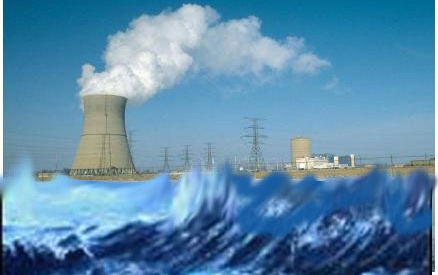
UK sent nuclear warning as new £20bn site facing risk from increased flooding: ‘Alarming!’
Earlier this week, the UK Government confirmed that £700million of public money will be invested in the Sizewell C nuclear power plant.
https://www.express.co.uk/news/science/1703570/energy-crisis-nuclear-edf-sizewell-c-increased-flooding-climate-change-suffolk By ANTONY ASHKENAZ Nov 30, 2022
Experts have issued a dire warning about the proposed Sizewell C nuclear power plant, as climate change induced flooding could mean that in future, the coastal nuclear site could turn into an island. Earlier this week, the Government confirmed that £700million of public money will be invested power plant, which once built will provide power to the equivalent of six million homes for more than 50 years. However, experts fear that the reactor, which will be built in Suffolk, could be at risk of climate change, as rising sea levels threaten to erode and swallow up the East coast of the UK, Express.co.uk was told.
Earlier this week, the UK’s former Chief Scientific Advisor Sir David King warned that the new £20billion power plant would be “very difficult to protect from flooding” due to rising sea levels on the Suffolk Coast.
Speaking to LBC, he said: “Part of the British coast that’s most at risk of rising sea level is the east coast and clearly this is very close to the oceans as is Sizewell B, and frankly that is the biggest risk.
“It would be very very useful if we could see published an analysis of sea level to the end of the lifespan of Sizewell C. It would take us to 2070 and beyond, possibly 2080.
“I do fear that it’s quite possible that we will have had a one-metre sea level rise by that time, by which time this would be very difficult to protect from flooding. I’m not saying it’s impossible, but I would love to see the safety analysis on the basis of rising sea levels.”
Dr Paul Dorfman, an associate fellow from the Science Policy Research Unit at the University of Sussex told Express.co.uk: “In 2008, the pro-nuclear group of the Institute of Mechanical Engineers published a report, which says that UK nuclear coastal installations, which specify Sizewell, will be subject to storm surge, climate-induced sea level rise, flooding and potential nuclear islanding.
“Perhaps alarmingly, IME point out that these UK coastal nuclear sites will need considerable investment to protect them against rising sea levels, and even relocation or abandonment.
“Our knowledge about climate now is that rare events then, become the norm today, so basically there are questions of Sizewell being at significant risk. So quite literally, Sizewell is at the frontline of climate change, and not in a good way.”
He also noted that very “reasonable models” of climate change showed that Sizewell within two decades, would be surrounded by flood water once a year.
He said: “If construction goes ahead, clearly they will build in defences. But the idea of a nuclear power plant within a couple of decades being almost entirely cut off by water, and what does that mean for the future.
“Because it’s not just the reactors, it’s also the high-level spent fuel points, and the hot intermediate-level waste stores that are also at risk.”
As part of its energy strategy unveiled in April, which heavily focused on a number of policies that could help weaken Russia’s grip on UK energy prices, the Government set a target of significantly scaling up nuclear so that it will account for 25 percent of the country’s projected electricity demand by 2040.
The strategy noted that Sizewell C is critically important for helping the UK reach its nuclear targets, and it has been engaging in negotiations regarding the project’s construction since January 2021.
However, Dr Dorfman added: “The other thing is, BEIS, in a statement to Parliament, state that nuclear construction can take 13-17 years. If Sizewell C gets the go-ahead next year at the earliest, we’re looking at first generation by 2040.
“Firstly, that’s much too late to help with our climate and energy problems. But by the time it’s constructed, it’s likely to be a climate risk.”
Meanwhile, Alison Downes, from the campaign group Stop Sizewell C told Express.co.uk: ““Future flood risk maps show the Sizewell site as an island, and we’re deeply concerned that planning assessments were not conservative enough in considering the potential for coastal erosion in Sizewell Bay.
“EDF is being forced to plan sea defences the height of 3 double-decker buses, but since this site will carry radioactive material for well over a century, is it a safe and sustainable approach to protecting our children’s future to locate a nuclear power station here? We say no.
1 This Month



26 September – International Day for the Total Elimination of Nuclear Weapons


PLEASE OPPOSE HR 8255 AND S.3639 – bills would accelerate satellite deployment, with no environmental review or safeguards – https://ncstd5li.quorum.us/campaign/169331/
To see nuclear-related stories in greater depth and intensity – go to https://nuclearinformation.wordpress.com
-
Archives
- September 2026 (219)
- August 2026 (330)
- July 2026 (355)
- June 2026 (287)
- May 2026 (306)
- April 2026 (356)
- March 2026 (251)
- February 2026 (267)
- January 2026 (308)
- December 2025 (358)
- November 2025 (359)
- October 2025 (375)
-
Categories
- 1
- 1 NUCLEAR ISSUES
- business and costs
- climate change
- culture and arts
- ENERGY
- environment
- health
- history
- indigenous issues
- Legal
- marketing of nuclear
- media
- opposition to nuclear
- PERSONAL STORIES
- politics
- politics international
- Religion and ethics
- safety
- secrets,lies and civil liberties
- spinbuster
- technology
- Uranium
- wastes
- weapons and war
- Women
- 2 WORLD
- ACTION
- AFRICA
- Atrocities
- AUSTRALIA
- Christina's notes
- Christina's themes
- culture and arts
- Events
- Fuk 2022
- Fuk 2023
- Fukushima 2017
- Fukushima 2018
- fukushima 2019
- Fukushima 2020
- Fukushima 2021
- general
- global warming
- Humour (God we need it)
- Nuclear
- RARE EARTHS
- Reference
- resources – print
- Resources -audiovicual
- Weekly Newsletter
- World
- World Nuclear
- YouTube
-
RSS
Entries RSS
Comments RSS
 nuclear-news