President Biden’s $6 billion effort to save distressed” nuclear power plants is misguided

We must think holistically about what constitutes “clean energy” when
we consider climate change investments and our energy future.
President Biden’s recent announcement of his $6 billion effort to save
“distressed” nuclear (fission) power plants is misguided and
short-sighted. Although reducing carbon emissions is critical to slowing
the pace of climate change, it must not be our only litmus test for moving
toward a “clean” energy future, similarly to how our overall health
cannot be measured solely by our blood pressure or weight.
In the case of nuclear power, we must consider its high cost compared to renewable energy
sources, such as wind and solar. According to Climate Nexus, the minimum
cost per megawatt hour to build a new nuclear plant is almost 3 times
higher than utility-scale solar ($112 vs. $46, respectively) and almost 4
times higher than wind power ($122 vs. $30, respectively).
That’s like paying $70,000 for a car when you could purchase an equivalent car, in
terms of its overall value, for one-third or one-quarter of the cost.
Contrary to public perception, nuclear power is a significant source of
greenhouse gas emissions when considering the amount of fossil fuels
required for mining, uranium enrichment, building and decommissioning of
power plants, and processing and storing radioactive waste. In fact,
nuclear power emits twice as much carbon as solar photovoltaics and six
times as much as onshore wind power, according to the nonprofit
organization Beyond Nuclear.
Counter Punch 18th July 2022
https://www.counterpunch.org/2022/07/18/nuclear-power-is-not-the-solution-to-climate-change/
Greencoat Capital UK to greenwash nuclear power?
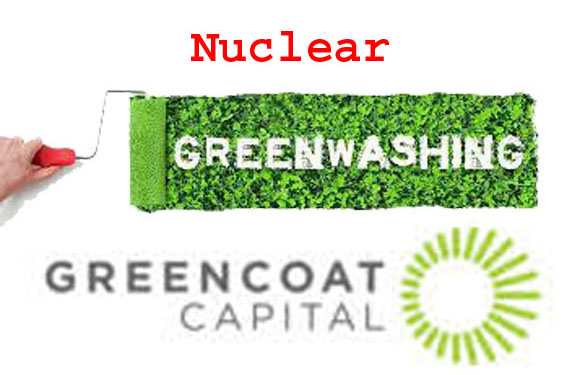
Greencoat Capital is considering creating a nuclear investment fund to take
a stake in EDF’s proposed Sizewell C plant in Suffolk. The renewables
investment manager is eyeing a move into nuclear that could lead to the
fund investing in Hinkley Point C, under construction in Somerset, and the
existing Sizewell B plant. Bankers working for EDF and the UK government
are seeking investors to join them in funding the construction of Sizewell
C, which could power 6 million homes and is expected to cost at least £20
billion. Richard Nourse, Greencoat Capital’s founder, said: “My feeling
is that there’s a huge amount of money required. When you need a huge
amount of money, you normally have to price it to go, and therefore it will
be potentially an interesting investment. Given nuclear will be a
fearsomely complex and technically demanding area for UK pension funds to
evaluate risk, we see an opportunity for Greencoat to be a trusted adviser
and manager of funds.”
Times 16th July 2022
https://www.thetimes.co.uk/article/investment-firm-readies-nuclear-fund-j7xtbdqxl
France’s nationalisation of nuclear energy corporation EDF raises more questions than it answers
Just as Europe attempts to move away from its dependence on Russian gas and grapples with soaring power prices, problems at some of EDF’s existing 56 reactors in France have caused shutdowns and sent its energy output to multi-decade lows.
At the site of France’s first new nuclear reactor in more than 20 years, robots are whirring away fixing faulty welding as developer EDF races to open the plant after a decade of delays that have damaged its reputation.
Ahead of it lies a challenge of a different order of magnitude: a construction program to build six more, just as the French government, which owns 84 per cent of the business already, plans to take full control.
The full nationalization of EDF, which was announced earlier this month, comes as a series of crises pile pressure on the group’s finances.
In theory this will provide it with some relief away from the glare of public markets. So far, however, the state buyout has raised more questions than it has answered, including how the government thinks it might do a better job at fixing long-running industrial problems that have plagued projects at EDF, some of them as basic as a lack of experienced welders. “It’s not because the government will now have 100 percent that it’s going to suddenly take three years less to build a reactor,” one person close to the company said. “Right now, we’re in symbolic territory with this nationalization. It does not resolve any of the main problems we know the group is facing – will it allow EDF to bolster the skills it needs?” said Cécile Maisonneuve, a senior adviser at the center for energy and climate at French think thank IFRI. “None of the industrial or regulatory issues were linked to its capital structure.”
Just as Europe attempts to move away from its dependence on Russian gas and grapples with soaring power prices, problems at some of EDF’s existing 56 reactors in France have caused shutdowns and sent its energy output to multi-decade lows.
FT 17th July 2022
https://www.ft.com/content/7d7225ad-dd3b-4b95-95a6-c270a0089277
Heatwave? No, it’s a national emergency, disrupting lives and threatening our health.

Will Hutton: Heatwave? No, it’s a national emergency, disrupting lives and
threatening our health. The idea of climate change as a distant problem
won’t survive the next stifling week. Tomorrow, as we seek shelter from a
burning sun, climate change will feel all too real.
Britain has suffered ever more vicious storms and floods over the past few years but the next
couple of days will drive home the menacing discontinuity with our idea of
normal, a step change in our collective awareness. The expected heat –
temperatures that may exceed 40C warns the Met Office – are not only a
record, but life-threatening.
Only some 70 parliamentarians turned up to last week’s presentation on climate change led by Sir Patrick Vallance and other scientific officials. None of the Tory leadership candidates was
among them.
The accepted Tory wisdom, driven by its right, is that, at
best, climate change commitments should be deferred until the cost of
living crisis is over – at worst, they should be scaled back indefinitely
or wholly reframed.
Finally, at Friday’s Channel 4 debate, three candidates
publicly committed to the legally enshrined target of net zero by 2050:
Rishi Sunak, Tom Tugendhat and Penny Mordaunt. The right’s frontrunner, Liz
Truss, offered a commitment, but carefully not to a date; and Kemi
Badenoch, the insurgent candidate from the right, wanted the whole issue
reframed.
If Badenoch and Truss were to watch Vallance’s presentation, they
would surely change their view. Global temperatures are rising. So is the
cumulative amount of carbon in the atmosphere. The polar ice caps are
melting at bewildering and accelerating speed. Sea levels are increasing.
So are extreme weather events. All are unambiguously the result of human
influence, says the Met Office.
A global commitment to net zero by 2050
could limit the temperature rise to 1.5C. The right is massively out of
step with science, evolving public opinion and the business opportunities –
a triple whammy of misalignment that will prove deadly.
The science is incontestable. So is our daily experience. What is less discussed is how
acting presents a massive opportunity. Already the best in business and
finance are committed to net zero by 2050. In the City, argument rages
whether it’s best to disinvest completely from fossil fuel companies or to
support them as they transition to a new business model; what is accepted
in a world far from rightwing thinktanks, columnists and chat rooms is that
the change must be made.
On climate change scepticism, the right is
unambiguously wrong – it might not even prove the route to the Tory
leadership. It is certainly not the route to winning general elections.
Observer 16th July 2022
Radioactive portents on a burning earth
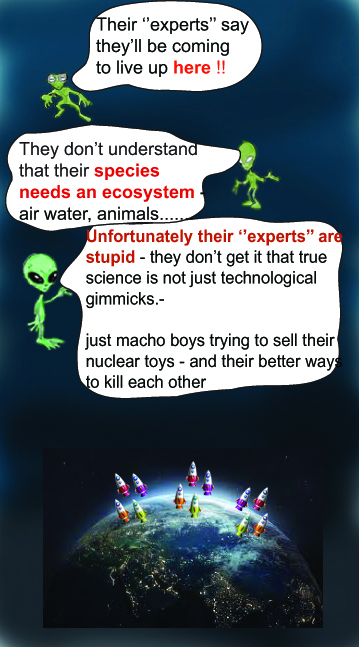
For an intelligent species to be able to explore the solar system but fail to protect its own home planet defies comprehension.
Pearls and Irritations, By Andrew GliksonJul 18, 2022 ”………………………………………………… If the history of the 21st century is ever written it would be reported that, while large parts of the planet were becoming uninhabitable, the extreme rate and scale of global warming and the migration of climate zones (>100 km per decade), the extent of polar ice melting, ocean warming and acidification and methane release from permafrost and sediments threaten to develop into one of the most extensive mass extinction events in the geological history of planet Earth. As total concentrations of atmospheric greenhouse gases approaches 500 ppm, CO₂-equivalents (Figure 1) (NOAA), approach double the pre-industrial age level of 280 ppm, consistent with global warming of more than >4°C, the threat of a near future atmospheric conditions as great as that of the great mass extinctions is growing.
To date, there is no evidence Homo “sapiens” is capable, or even willing to take a meaningful action of stemming the greatest danger posed to advanced life on Earth since 66 million years ago. This is while most communications use the term “climate change”, the greenhouse gas heating of Earth is rising at a rate at least an order of magnitude faster than any recorded from previous warming events. Climate scientists have either been silenced or replaced by an army of economists and politicians, many with good intentions though quantifying the cost-benefit economies of mitigation much like corner shop grocers, with limited understanding of the physics and chemistry of the atmosphere. Imagine such approach was taken in the case of medical epidemics, like COVID-19?
…….. At the same time as global heating is threatening the future of civilisation and of numerous species, nations keep proliferating nuclear weapons. With time the probability of a nuclear accident or war increases exponentially. At the root of the MAD (mutual assured destruction) policy, or omnicide, resides deep tribalism and herd mentality hinging on race, religion, ideology, territorial claims and the concept of an “enemy”, perpetrated by demagogues and warmongers, leading to an Orwellian 1984 world where “Oceania has always been at war with East-Asia”, as in the current “forever wars“. Promoters of war exist in every corner of the globe, while peace conferences are rarely in evidence.
As portrayed the consequences of even a “limited” nuclear war defy belief (Witze, 2020): Smoke from incinerated cities rise high into the atmosphere, wrapping the planet in a blanket of soot that blocks the Sun’s rays. The planet plunges into a deep chill.For years, crops wither from California to China. Famine sets in around the globe. This grim vision of a possible future comes from the latest studies about how nuclear war could alter world climate. They build on long-standing work about a ‘nuclear winter’ — severe global cooling that researchers predict would follow a major nuclear war, such as thousands of bombs flying between the United States and Russia. But much smaller nuclear conflicts, which are more likely to occur, could also have devastating effects around the world. ”
Prior to World War I social forces collided, fascism, socialism, free enterprise, but rather than ideological differences superpower conflicts constitute blind grab for power, often using hapless proxies, but increasingly backed by the global suicide machine.
Despite significant progress in reducing nuclear weapon arsenals since the last Cold War, the world’s combined inventory of warheads remains large enough to turn much of Earth into radioactive dust.…………………..
For an intelligent species to be able to explore the solar system but fail to protect its own home planet defies comprehension. https://johnmenadue.com/article-radioactive-portents-on-a-burning-earth/
Climate change hitting France’s nuclear power – the technology that’s supposed to solve climate change !
Electricity prices across Europe are expected to rise as the heatwave sweeping Europe has crippled nuclear power output in France. State-owned electricity provider EDF must reduce or halt nuclear output when river temperatures reach certain thresholds under French legislation.
This is to ensure that the water used to cool the plants won’t harm the environment when it is pumped back out. Climbing temperatures in the Garonne River mean that production will likely be slowed at the Golfech nuclear plant in the South of the country from Thursday, Electricite de France SA said.
Independent 12th July 2022
EU Labels Gas and Nuclear as ‘Sustainable,’ Betraying Climate Promises

the taxonomy is the result of a “Faustian pact”
Socialist Project, July 13, 2022 • Anna Maria Merlo
It is a “disgrace,” a “scandalous result,” but “the struggle continues.” Green, left-wing and environmental organizations have strongly criticized the result of last Wednesday’s vote in the European Parliament, which rejected, by 328 votes to 278 and 33 abstentions, the “objection” – which amounted to a veto – against the inclusion of gas and nuclear in the Renewable Energy Taxonomy, at least as a transition, that had been put to the European Parliament’s Environment (ENVI) committee on June 14.
As the veto failed, the Commission’s text presented in January was approved, which deems certain investments for energy production in CO2-neutral nuclear power plants built until 2030 (and adopting a protocol for greater safety from 2025 and plans for waste storage from 2050) as “sustainable.” Also accepted are gas-fired power plants, provided they use the latest technology and allow the closure of even more polluting coal-fired plants.
The story does not end there, however: Austria and Luxembourg intend to go to the European Court of Justice, a court case that will be joined by various oppositions. The European Council will need to approve the Commission’s line, but there is opposition from eight countries (not enough, however, for a qualified majority that would block the decision)
Environment Takes a Back Seat
The Commission on Wednesday assured that it “remains determined to use all available instruments to move the EU away from carbon-intensive energy sources.” In these hours, the focus of the Commission and member states is all on the Russian threat to turn off the gas tap, and ecological concerns are taking a back seat………………………
Greenpeace reminded on Wednesday that including gas in the taxonomy means giving a gift to Putin: that’s at least €4-billion a year for Moscow to finance the war in Ukraine, €32-billion until 2030. The strengthening of the dollar against the euro and rising energy prices also help to fill the Russian coffers………..
for the Greens, the taxonomy is the result of a “Faustian pact” between France and Germany: the latter, anti-nuclear, has traded Paris’s support for gas for support for French (and Eastern European) nuclear power. “By keeping gas and nuclear as sustainable in the taxonomy,” the S&D group says, the conservatives have shamefully betrayed the EU’s climate ambitions…………………………………. https://socialistproject.ca/2022/07/eu-labels-gas-and-nuclear-as-sustainable-betraying-climate-promises/
European Heatwave Risks Curbing French Nuclear Power Production
- Output from Golfech plant may be reduced from Thursday
- That comes as Europe needs France’s electricity more than ever
By Lars Paulsson July 12, 2022
The hot weather hitting Europe this week is set to reduce power output from France’s fleet of nuclear reactors, risking even higher electricity prices as the continent endures its worst energy crunch in decades.
Warm temperatures in the Garonne River mean that production restrictions are likely at the Golfech nuclear plant in the south of the country from Thursday, Electricite de France SA said in a filing with grid operator RTE. Temperatures in France and the Iberia region will be well above average over the next five days and even hotter next week, according to forecaster Maxar. ….. (subscribers only) https://www.bloomberg.com/news/articles/2022-07-12/french-nuclear-output-seen-curtailed-as-river-temperatures-rise#xj4y7vzkg
Europe divided over “greenwashing” gas and nuclear energy, but parliament ready to support the bill
For the European Parliament natural gas and nuclear power plants have been designated as climate-friendly investments. The European Commission released the proposal, formally called the EU taxonomy, in December as a list of economic activities that investors can label and market as green in the EU.
A motion to block the proposal received 278 votes in favor and 328 against, while 33 lawmakers abstained.
Unless 20 of the EU’s 27 member states oppose the proposal, it will be passed into law. The proposal was initially met with resistance among some EU member states, with one camp led by France strongly backing the green label for natural gas and nuclear energy, while Germany which has been phasing out its nuclear power plants — had opposed the plan.
Some environmental groups and EU lawmakers have also criticized the plan for “greenwashing” fossil fuel and nuclear energy.
Austria and Luxembourg have even pledged to sue the EU if the plan becomes law. Still, the proposal had the backing of the majority of the center-right European People’s Party, the European Parliament’s biggest lawmakers’ group.
Lawmakers of the centrist Renew Europe group were largely in favor of the proposal, while the Greens and Social Democrats mostly opposed it.
A total of 353 lawmakers — a majority of the Parliament’s 705 lawmakers — are needed to reject a plan for it to fail. The ongoing conflict over Russian gas supply to Europe has fueled opposition to the plan to label gas as environmentally friendly.
“It’s dirty politics and it’s an outrageous outcome to label gas and nuclear as green and keep more money flowing to Vladimir Putin’s war chest,” Greenpeace EU sustainable finance campaigner Ariadna Rodrigo said. “We will fight this in the courts,” she added.
Paul Tang, a Dutch EU lawmaker with the center-left Social Democrats, had criticized the plan as influenced by “the lobby from Gazprom and Rosneft,” both Russian state-owned energy companies.
Tang also slammed the move as “institutionalizing greenwashing.”
“It is now important to prevent this vote from setting a precedent for other countries to temper climate ambitions,” he wrote in a statement.
Bogdan Rzonca, a Polish member of the European Parliament (MEP) for the right-wing Law and Justice party (PiS), said less wealthy EU countries need private investments in gas and nuclear power to be able to move away from coal.
Gilles Boyer, a French MEP with the Renew group, said that meeting energy demand with renewable energy in the long-term “would be ideal, but it’s not possible right now.”
Czech Prime Minister Petr Fiala, whose country has just taken over the rotating EU presidency, said Wednesday’s vote was “excellent news” for Europe.
Nuclear myopia — Promoting nuclear power as a solution to climate change is short-sighted

Contrary to public perception, nuclear power is a significant source of greenhouse gas emissions when considering the amount of fossil fuels required for mining, uranium enrichment, building and decommissioning of power plants, and processing and storing radioactive waste. In fact, nuclear power emits twice as much carbon as solar photovoltaics and six times as much as onshore wind power, according to the nonprofit organization Beyond Nuclear.
If the potentially catastrophic risks to nuclear power plants posed by political instability and military conflict were not apparent prior to Russia’s recent invasion of Ukraine, they are abundantly clear now.
Bright future for clean energy must be holistic and long-term
Nuclear myopia — Beyond Nuclear International Promoting nuclear power as a solution to climate change is short-sighted
By Kim Friedman
We must think holistically about what constitutes “clean energy” when we consider climate change investments and our energy future. President Biden’s recent announcement of his $6 billion effort to save “distressed” nuclear (fission) power plants is misguided and short-sighted.
Although reducing carbon emissions is critical to slowing the pace of climate change, it must not be our only litmus test for moving toward a “clean” energy future, similarly to how our overall health cannot be measured solely by our blood pressure or weight.
In the case of nuclear power, we must consider its high cost compared to renewable energy sources, such as wind and solar. According to Climate Nexus, the minimum cost per megawatt hour to build a new nuclear plant is almost 3 times higher than utility-scale solar ($112 vs. $46, respectively) and almost 4 times higher than wind power ($122 vs. $30, respectively). That’s like paying $70,000 for a car when you could purchase an equivalent car, in terms of its overall value, for one-third or one-quarter of the cost.
There are also numerous environmental and community-based reasons to wean ourselves off of nuclear power. Intercontinental Cry, a non-profit newsroom that produces public-interest journalism centered on Indigenous Peoples, states that 75 percent of uranium mining worldwide occurs on Indigenous land, including in the United States. Furthermore, unlike solar and wind power, uranium reserves are not a renewable resource; eventually, we will run out of uranium.
We have spent over half a century trying to find a suitable storage option for spent fuel rods and have failed miserably. Consequently, these rods, which remain radioactive for as long as 10,000 years, are generally stored on site at active or shuttered plants all over this country. They are sitting ducks for domestic or international terrorists, and they pose a serious potential threat to surrounding communities’ drinking water supplies if radioactive water leaks and makes its way into the ground.
Contrary to public perception, nuclear power is a significant source of greenhouse gas emissions when considering the amount of fossil fuels required for mining, uranium enrichment, building and decommissioning of power plants, and processing and storing radioactive waste. In fact, nuclear power emits twice as much carbon as solar photovoltaics and six times as much as onshore wind power, according to the nonprofit organization Beyond Nuclear. …………………… more https://beyondnuclearinternational.org/2022/07/10/nuclear-myopia/
Is nuclear sustainable? Read the label
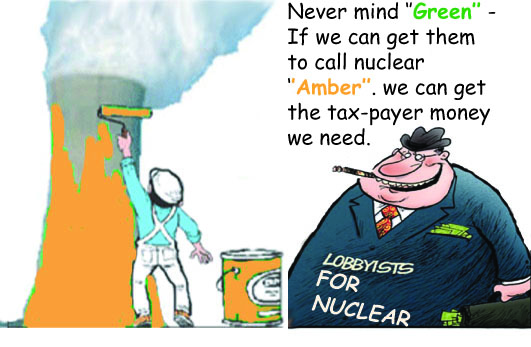
[Ed. For a while they tried calling nuclear ”amber”, but that didn’t work – they’ve settle for ”sort of green”]
By DEBRA KAHN , 07/08/2022, https://www.politico.com/newsletters/the-long-game/2022/07/08/is-nuclear-sustainable-read-the-label-00044684
SHADES OF GREEN — The European Union broadened its definition of sustainable energy this week to include things not everyone agrees on — and triggered a fight.
The vote to include natural gas and nuclear power in the list of activities the EU is trying to encourage private investors to support was billed as a “pragmatic approach.” It’s also backed by Ukrainian officials, who say it should help reduce reliance on Russian gas.
But it’s getting major pushback — from scientists, sustainable investor groups and the European Commission’s own finance advisers, who argue the rules will divert money from truly green projects to prop up legacy industries and allow emissions to rise further, as POLITICO’s America Hernandez reports.
Under the new rules, countries heavily reliant on coal and oil for electricity will be able to replace them with less-polluting gas-fired power through 2030 and advertise the switch as sustainable to investors, as long as the plants switch to a clean-burning fuel like hydrogen by 2035 and respect a 20-year cap on greenhouse gas emissions.
Existing nuclear plants, which produce CO2-free electricity, will also get to be called climate-friendly if operators draw up safety plans showing where their radioactive waste will be permanently stored by 2050 and switch to so-called accident-tolerant fuels by 2025.
Activist investor groups are warning that watering down the sustainable designation will backfire.
“Calling gas sustainable, even as a ‘transition’ fuel, will not convince climate-change conscious investors, and it will make the taxonomy lose its usefulness as a tool to orient capital flows towards sustainable economic activities,” said Thierry Philipponnat, chief economist at watchdog group Finance Watch.
The United Nations’ Principles for Responsible Investment, which represents more than 5,000 investors managing €167 trillion ($169 trillion right now — great time to go to Europe) in sustainable assets, warned that blindly trusting the EU’s green labels “could prompt fragmentation across the market and lead to potential greenwashing.”
NUCLEAR RENAISSANCE PT. II — U.S. environmentalists were similarly dismayed this week by Pacific Gas & Electric’s announcement that it will try to keep California’s remaining nuclear plant open past its planned retirement.
A PG&E spokesperson told the San Diego Union-Tribune that the utility plans to apply for an Energy Department grant aimed at helping keep nuclear plants open. Diablo Canyon accounts for almost 9 percent of the state’s electricity generation, and officials are worried about reliability this summer and in years to come.
The move follows support from Gov. Gavin Newsom and lawmakers in last week’s state budget to fund agency power purchases from Diablo Canyon and natural gas plants when supplies run low. It’s an about-face from 2016, when environmentalists and labor unions representing plant workers came to a state-approved agreement to shut down the plant starting in 2024.
(NB: Diablo would have stayed open had California decided to let nuclear count toward its green electricity requirements in 2015.)
“Instead of propping up outmoded nuclear plants, Newsom should instead be providing more resources and funding to deploy renewable energy infrastructure across California,” Sierra Club California director Brandon Dawson said in a statement.
Austria, Luxembourg and green groups have already said they’ll sue the European Commission over its new rules. California environmentalists may also try suing to enforce the closure agreement, the SDUT reports.
European parliamentarians vote nuclear and gas as ”green” – another step in the sinister lobbying process of the desperate nuclear industry.
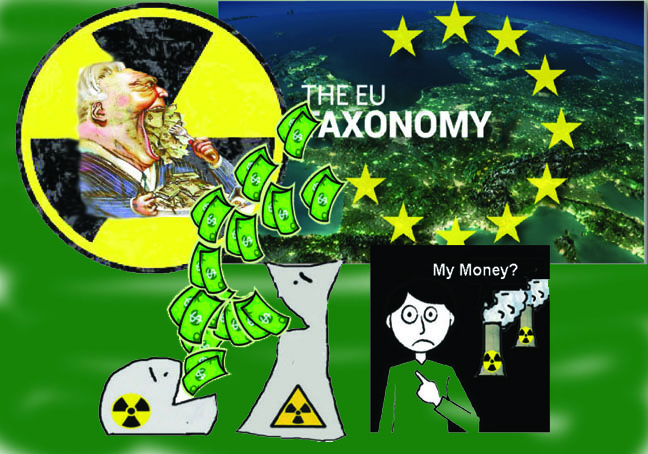
Réseau sortir du nucléaire. 7 July 22, It is a dark day for the environment and the climate. Meeting in plenary in Strasbourg, European parliamentarians validated by 328 votes against 278 the European Commission's proposal to include nuclear and gas in the green taxonomy. We strongly denounce the maneuvering lobbies and the major deleterious role played by France.

This vote marks the culmination of a sinister soap opera marked by unprecedented pressure from lobbies and pro-nuclear states. Bankrupt and ready for any maneuver to benefit from new money, the nuclear industry had laid siege to the European Commission and obtained the order of a report shamelessly minimizing the harmful effects caused by the atom.

Emmanuel Macron himself was famous for his duplicity, posing as a climate champion while pleading for the inclusion of fossil gas and allying himself with leaders who care little for human rights, such as Viktor Orban, provided that they support the atom. A few days before the vote, the Minister for Energy Transition, Agnès Pannier-Runacher, had again signed a pro-nuclear platform with ministers from other Member States far removed from ecological issues.

The European Parliament, which had initially come out against the inclusion of nuclear power and gas in this text, had the possibility of contesting the delegated act published at the beginning of 2022 by the European Commission, which classified these polluting energies among the technologies "of transition ". But while the "Environment" and "Economy and Finance" committees had refused this classification, the parliamentarians meeting in plenary seem to have finally yielded to the sirens of the lobbies. The elected French Macronists of “Renew” bear an overwhelming responsibility for this catastrophic decision.

To qualify nuclear and fossil gas as “transitional” energies is to make words lose all meaning and totally empty of its meaning a tool initially intended to fight against greenwashing. How can gas, a greenhouse gas emitter, fit into this category? Not to mention nuclear, which is dangerous, polluting even in regular operation, producing unmanageable waste, and too slow and too expensive to be a relevant tool in the face of the climate emergency! Any euro spent on the pursuit of nuclear power will be a wasted resource at the expense of the real solutions to climate change: sobriety, efficiency and renewable energies.
EU Votes to Label Gas and Nuclear Power Investments as ‘Green’
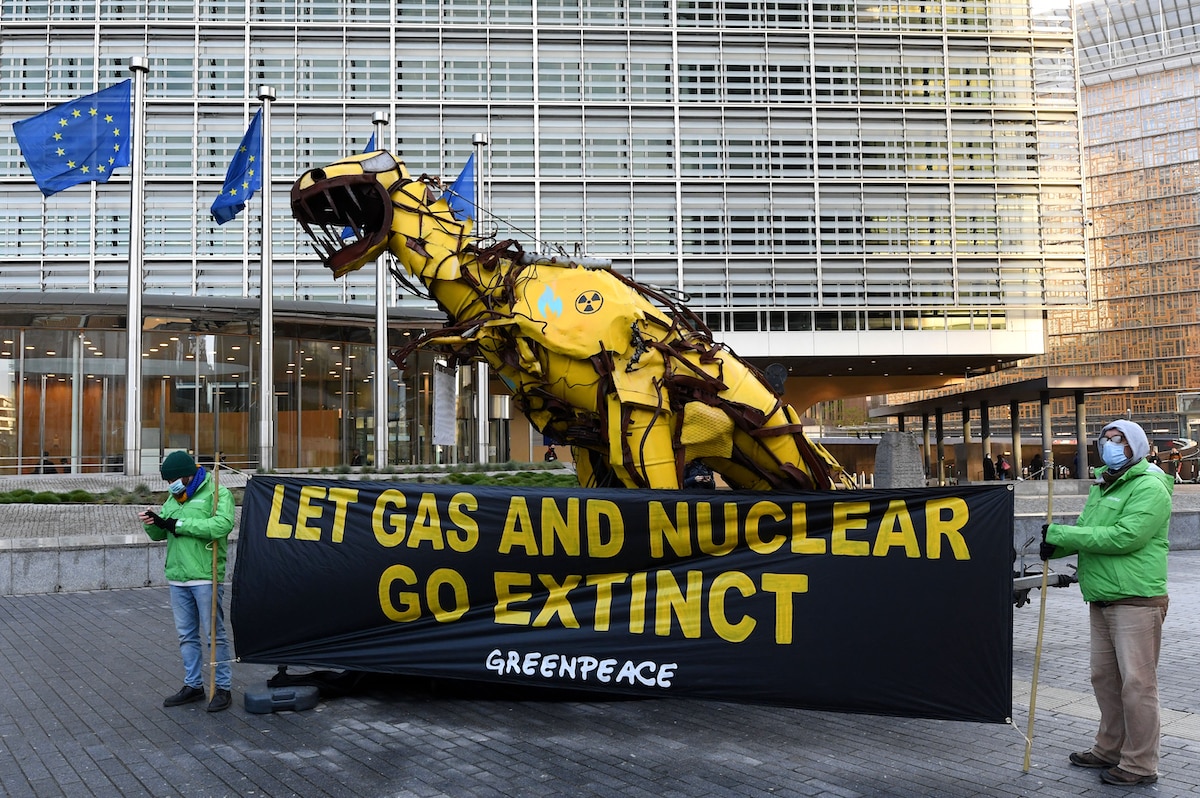
https://www.ecowatch.com/eu-gas-nuclear-investments-green.html— 6 July 22,
In a setback for the fight against climate change, 328 of 639 members of the European Parliament (MEPs) have voted in favor of plans to label investments in gas and nuclear power plants as “green,” reported Reuters. Unless 20 of the 27 European Union (EU) member states oppose the proposals adopted by the European Commission in the Complementary Delegated Act, they will pass it into law.
This means that some nuclear and gas projects would be added to the EU taxonomy of economic activities that are considered environmentally sustainable, with some conditions, The Guardian reported. Investors would then be able to label and market investments in the gas and nuclear projects as green, reported Reuters.
Experts said the vote sets a dangerous precedent for other countries, according to The Guardian. Ukraine, as well as climate activists, had appealed to parliament to reject the proposals, saying they would be beneficial to Russian president Vladimir Putin.
“This will delay a desperately needed real sustainable transition and deepen our dependency on Russian fuels,” said environmental and climate activist Greta Thunberg on Twitter.
The proposals allow investments in gas-powered projects to be designated as sustainable as long as “the same energy capacity cannot be generated with renewable sources” and there are plans to transition to renewable sources or gases that are considered “low-carbon,” The Guardian reported. Nuclear power can be classed as renewable if a project pledges to take care of its radioactive waste.
European Commissioner for Financial Stability, Financial Services and the Capital Markets Union Mairead McGuinness said the proposals adopted in the Complementary Delegated Act “ensure that private investments in gas and nuclear, needed for our energy transition, meet strict criteria,” as reported by The Guardian.
Some EU member states view gas — a fossil fuel that produces dangerous carbon dioxide emissions — as an interim substitute for coal during the transition to more sustainable power sources, Reuters reported. Nuclear power, while free of carbon dioxide emissions, results in hazardous radioactive waste.
“By clearing the way for this delegated act, the EU will have unreliable and greenwashed conditions for green investments in the energy sector,” said Dutch MEP Bas Eickhout, who is the vice-president of the European Parliament’s environment committee, as reported by The Guardian.
Austria and Luxembourg, which don’t support nuclear energy or putting a “green” label on gas, vowed to fight the law.
Greenpeace also said it would contest the law in court.
“I am in shock. Russia’s war against Ukraine is a war paid for by climate-heating fossil fuels and the European parliament just voted to boost billions of funding to fossil gas from Russia. How in the world is that in line with Europe’s stance to protect our planet and stand with Ukraine?” said Ukrainian climate scientist and member of the Intergovernmental Panel on Climate Change Svitlana Krakovska, as The Guardian reported.
Drought and hot weather this summer are adding to France’s nuclear power generation problems at the worst possible moment.
Drought and hot weather this summer are adding to France’s nuclear power
generation problems at the worst possible moment. As Europe grapples with
low Russian gas supply and the threat of no Russian supply at all,
non-Russian energy sources are more important than ever.
French power giant
Electricite de France (EDF) warned on Tuesday that it may have to reduce
nuclear power generation as the water levels of rivers are low and water
temperatures high. France has been experiencing outages at its nuclear
reactors in recent months, slashing power generation from nuclear power
plants. France’s nuclear power generation accounts for around 70 percent
of its electricity mix and when its reactors are fully operational it is a
net exporter of electricity to other European countries.
Prolonged
maintenance at several nuclear reactors this year, however, means that
France—and the rest of Europe—have less nuclear-generated power supply
now.
Oil Price 5th July 2022
France’s EDF says hot summer could hit nuclear output, shares fall
PARIS, July 5 (Reuters) – France’s EDF (EDF.PA) might be forced to cut nuclear output further because of expected prolonged hot temperatures over the summer months, an executive told a briefing on Tuesday, prompting a sharp fall in the company’s shares.
EDF’s shares ended down 7.5% on the Paris stock market, underperforming the Stoxx Europe 600 Utilities (.SX6P) index, which lost 2.03%.
“We have a peculiar year due to the drought that has started early, especially in southeastern France. But there is generally a little bit less water available this year,” Catherine Laugier, Environment Director at EDF, told a news conference.
France is already grappling with reduced electricity generation because of unexpected maintenance at its aging nuclear reactors.
EDF faces the prospect of having to reduce output because of insufficient river water, which is often used for cooling nuclear reactors before being returned to the river at a higher temperature.
Regulations are in place to limit reactor production during times of exceptional heat and low water levels to prevent the process from damaging local wildlife.
“We’ve had some production cuts between end May and early June. That was indeed pretty early (…) And there are some global evaluations suggesting (…) this might be a very long summer and the levels could be impacted in September,” Laugier said.
Since the start of the year, EDF has lost 20.6% of its value, well below a 12.9% sector-wide decline……………. https://www.reuters.com/business/energy/frances-edf-says-hot-summer-could-hit-nuclear-output-shares-fall-2022-07-05/
1 This Month
19 February – VIRTUAL EVENT-Decision Time: AI and Our Nuclear Arsenal
12:45 p.m. Central / 1:45 p.m. Eastern
To see nuclear-related stories in greater depth and intensity – go to https://nuclearinformation.wordpress.com
-
Archives
- February 2026 (161)
- January 2026 (308)
- December 2025 (358)
- November 2025 (359)
- October 2025 (376)
- September 2025 (258)
- August 2025 (319)
- July 2025 (230)
- June 2025 (348)
- May 2025 (261)
- April 2025 (305)
- March 2025 (319)
-
Categories
- 1
- 1 NUCLEAR ISSUES
- business and costs
- climate change
- culture and arts
- ENERGY
- environment
- health
- history
- indigenous issues
- Legal
- marketing of nuclear
- media
- opposition to nuclear
- PERSONAL STORIES
- politics
- politics international
- Religion and ethics
- safety
- secrets,lies and civil liberties
- spinbuster
- technology
- Uranium
- wastes
- weapons and war
- Women
- 2 WORLD
- ACTION
- AFRICA
- Atrocities
- AUSTRALIA
- Christina's notes
- Christina's themes
- culture and arts
- Events
- Fuk 2022
- Fuk 2023
- Fukushima 2017
- Fukushima 2018
- fukushima 2019
- Fukushima 2020
- Fukushima 2021
- general
- global warming
- Humour (God we need it)
- Nuclear
- RARE EARTHS
- Reference
- resources – print
- Resources -audiovicual
- Weekly Newsletter
- World
- World Nuclear
- YouTube
-
RSS
Entries RSS
Comments RSS
 nuclear-news