Climate breakdown is super-charging extreme weather

The devastating intensification of extreme weather is laid bare today in a
Guardian analysis that shows how people across the world are losing their
lives and livelihoods due to more deadly and more frequent heatwaves,
floods, wildfires and droughts brought by the climate crisis.
Guardian 4th Aug 2022
https://www.theguardian.com/environment/2022/aug/04/climate-breakdown-supercharging-extreme-weather
France importing power, as nuclear stations cut output because of global heating
EDF has warned it will be forced to cut power output from some of its
nuclear reactors as hot weather in France drives up river temperatures. It
leaves Europe facing even higher prices as the energy giant is unable to
use the Rhône and Garonne river to cool its plants.
The company’s S Alban plant’s output will be reduced, from 2.6 gigawatts to 700 megawatts
from Saturday, to adhere to environment regulations. Cutbacks are also
expected at the Tricastin plant, where two units will stay at a minimum
level of 400 megawatts.
EDF’s nuclear fleet is already operating below
capacity due to reactor faults that it is trying to fix, an issue that has
pushed up electricity prices and forced France to rely on power imported
from Britain.
Telegraph 3rd Aug 2022
https://www.telegraph.co.uk/business/2022/08/03/water-shortage-cripples-nuclear-reactors-france/
Drought may force nuclear power production cut
https://journalrecord.com/2022/08/05/drought-may-force-nuclear-power-production-cut/ Associated Press August 5, 2022 0
PARIS — French Prime Minister Elisabeth Borne warned that France is facing the “most severe drought” ever recorded in the country and announced the activation of a government crisis unit.
The crisis unit will be in charge of monitoring the situation in the hardest-hit areas and coordinate measures like bringing drinking water to some places. It will also monitor the impact of the drought on France’s energy production, transport infrastructure and agriculture.
The drought may force French energy giant EDF to cut power production at nuclear plants which use river water to cool reactors.
France now has 62 regions with restrictions on water usage due to the lack of rain.
Borne said many areas in France are going through a “historic situation” as the country endures its third heatwave this summer.
“The exceptional drought we are currently experiencing is depriving many municipalities of water and is a tragedy for our farmers, our ecosystems and biodiversity,” the statement said.
EDF cuts output at nuclear power plants as French rivers get too warm

The production cuts mean that France, traditionally an energy exporter, is relying on imports from countries such as Spain, Switzerland, Germany and the UK
Company says it is reducing production for few hours where possible as ability to cool plants is restricted https://www.theguardian.com/business/2022/aug/03/edf-to-reduce-nuclear-power-output-as-french-river-temperatures-rise Julia KolleweThu 4 Aug 2022
The French energy supplier EDF is temporarily reducing output at its nuclear power stations on the Rhône and Garonne rivers as heatwaves push up river temperatures, restricting its ability to use river water to cool the plants.
The majority-state-owned company, Europe’s biggest producer of nuclear energy, said it would extend output cuts at several power stations on the two rivers as the hot spell continues – but that a minimum level of output would be maintained to keep the grid steady.
EDF warned of potential output cuts at its nuclear power plants Tricastin, St Alban and Golfech in coming days due to high temperatures in the Rhône and Garonne rivers. It started imposing production restrictions in mid-July at Tricastin, St Alban and Bugey on the Rhône and Blayais at the mouth of the Garonne amid sweltering temperatures.
A spokesperson told the Guardian that the company was lowering production “for a few hours” where possible but not shutting the reactors completely.
After the 2003 heatwave, France’s nuclear safety authority (ASN) set temperature and river flow limits beyond which power stations must reduce their production, to ensure the water used to cool the plants will not harm wildlife when it is released back into the rivers.
Temperatures in southern France are expected to reach 40C over the next two days, according to the forecaster Météo-France.
Since 2000, production losses due to high river temperatures and low river flows have represented an average of 0.3% of annual production. However, half of EDF’s 56 nuclear reactors are offline due to planned maintenance and work to repair corrosion which was delayed by the pandemic, just as Europe faces an energy crunch following Russia’s invasion of Ukraine.
As a result of the maintenance work, EDF estimates its power output this year will be the lowest in more than three decades. The company issued its fourth profit warning of the year last Thursday when it reported a first-half loss of €5.3bn. The French government, which owns 84% of EDF, is in the process of buying out minority shareholders to take full control of the business.
The production cuts mean that France, traditionally an energy exporter, is relying on imports from countries such as Spain, Switzerland, Germany and the UK.
EDF is buying electricity at high market prices, after Russia’s war in Ukraine sparked an energy crisis, leaving European countries scrambling to find alternative supplies. Another strain on EDF’s finances comes from a power tariff cap imposed by the government to shield consumers from soaring energy prices.
The latest power cuts threaten to push energy prices even higher after they were sent spiralling by Russia’s invasion of Ukraine in late February.
Reduced electricity output from France’s nuclear reactors due to high temperatures.
French utility EDF warned on Wednesday of potential output cuts of up to
3.8 GW at its nuclear power plants Tricastin, St Alban and Golfech due to
high temperatures in the Rhone and Garonne rivers. The output curbs could
start tomorrow at Golfech (2.6 GW).
Montel 3rd Aug 2022
https://www.montelnews.com/news/1339940/edf-warns-of-up-to-38-gw-cuts-on-cooling-issues
‘Climate endgame’ warning: Scientists warn global warming could trigger nuclear war, financial crisis or an extinction-level pandemic
By SHIVALI BEST FOR MAILONLINE 2 August 2022
‘Climate endgame’ warning: Scientists warn global warming could trigger nuclear war, financial crisis or an extinction-level pandemic as soon as 2070
- Researchers used modelling to estimate the consequences of 3°C warming
- They suggest areas of extreme heat will cover two billion people by 2070
- These areas are some of the most politically fragile and most densely populated
With global temperatures continuing to rise, a new study has warned that we are inching dangerously close to a ‘climate endgame’.
Researchers from the University of Cambridge claim that global heating could trigger nuclear war, financial crisis or an extinction-level pandemic as soon as 2070.
Based on their findings, the researchers are calling for authorities to start preparing for such events.
‘There are plenty of reasons to believe climate change could become catastrophic, even at modest levels of warming,’ said Dr Luke Kemp, lead author of the study.
Climate change has played a role in every mass extinction event. It has helped fell empires and shaped history. Even the modern world seems adapted to a particular climate niche.
‘Paths to disaster are not limited to the direct impacts of high temperatures, such as extreme weather events.
Knock-on effects such as financial crises, conflict, and new disease outbreaks could trigger other calamities, and impede recovery from potential disasters such as nuclear war.’
In the study, the team used modelling to estimate the consequences of 3°C (5.4°F) warming and beyond.
Their estimations indicate that areas of extreme heat where annual average temperatures are over 29°C (84°F) will cover two billion people by 2070…………………….
The ‘four horsemen’ of the climate endgame
The researchers propose that research is needed in four key areas, which they call the ‘four horsemen’ of the climate endgame.
These are famine and malnutrition, extreme weather, conflict, and vector-borne diseases……………………. more https://www.dailymail.co.uk/sciencetech/article-11069613/Global-warming-trigger-nuclear-war-financial-crisis-extinction-level-pandemic-2070.html
The future of global catastrophic risk events from climate change
Increasing risks posed by climate change are causing rare extreme events that can kill more than 10 million people or lead to damages of $10 trillion-plus, posing threats of total societal collapse, a U.N. report finds.
Yale Climate Connections, by JEFF MASTERSJULY 28, 2022.
our times since 1900, human civilization has suffered global catastrophes with extreme impacts: World War I (40 million killed), the 1918-19 influenza pandemic (40-50 million killed), World War II (40-50 million killed), and the COVID-19 pandemic (an economic impact in the trillions, and a 2020-21 death toll of 14.9 million, according to the World Health Organization).
These are the only events since the beginning of the 20th century that meet the United Nations’s definition of global catastrophic risk (GCR): a catastrophe global in impact that kills over 10 million people or causes over $10 trillion (2022 USD) in damage.
But human activity is “creating greater and more dangerous risk” and increasing the odds of global catastrophic risk events, by increasingly pushing humans beyond nine “planetary boundaries” of environmental limits within which humanity can safely operate, warns a recent United Nations report, “Global Assessment Report on Disaster Risk Reduction – Our World at Risk: Transforming Governance for a Resilient Future” (GAR2022) and its companion paper, “Global catastrophic risk and planetary boundaries: The relationship to global targets and disaster risk reduction” (see July post, “Recklessness defined: breaking 6 of 9 planetary boundaries of safety“).
These reports, endorsed by United Nations Secretary-General António Guterres, make the case that the combined effects of disasters, economic vulnerabilities, and overtaxing of ecosystems are creating “a dangerous tendency for the world to tend toward the Global Collapse scenario. This scenario presents a world where planetary boundaries have been extensively crossed, and if GCR events have not already occurred or are in the process of occurring, then their likelihood of doing so in the future is extreme … and total societal collapse is a possibility.”
Global catastrophic risk (GCR) events
Human civilization has evolved during the Holocene Era, the stability of which is now threatened by human-caused climate change. As a result, global catastrophic risk events from climate change are growing increasingly likely, the U.N. May 2022 reports conclude. There are many other potential global catastrophic risk events, both natural and human-caused (Figure 2 on original), posing serious risks and warranting humanity’s careful consideration. But the report cautions of “large uncertainty both for the likelihood of such events occurring and for their wider impact.” …………….
Five types of GCR events with increasing likelihood in a warmer climate
1) Drought……………………….
2) War…………………………………..
3) Sea-level rise, combined with land subsidence………………………………….
4) Pandemics……………………..
…….. Note that in the case of the 1918-19 influenza GCR event, a separate GCR event helped trigger it: WWI, because of the mass movement of troops that spread the disease. The U.N. reports emphasize that one GCR event can trigger other GCR events, with climate change acting as a threat multiplier.
5) Ocean current changes………………………….
6) Ocean acidification
7) A punishing surprise
In 2004, Harvard climate scientists Paul Epstein and James McCarthy conclude in a paper titled “Assessing Climate Stability” that: “We are already observing signs of instability within the climate system……………… high impact weather events – “black swan” events – that no one anticipated…………………………………………..
Avoiding climate change-induced global catastrophic risk events is of urgent importance, and the UN report is filled with promising approaches that can help. For example, it explains how systemic risk in food systems from rainfall variability in the Middle East can be reduced using traditional and indigenous dryland management practices involving rotational grazing and access to reserves in the dry season. More generally, the encouraging clean energy revolution now under way globally needs to be accelerated. And humanity must do its utmost to pay back the loans taken from the Bank of Gaia, stop burning fossil fuels and polluting the environment, and restoring degraded ecosystems. If we do not, the planet that sustains us will no longer be able to. https://yaleclimateconnections.org/2022/07/the-future-of-global-catastrophic-risk-events-from-climate-change/
France should “rethink the temperature thresholds of rivers”,
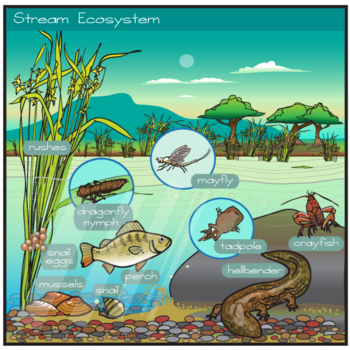
Nuclear: with the heat wave, “we should rethink the temperature thresholds of rivers”, says the ASN chief inspector. The news sparked heated controversy: faced with heat records, the Nuclear Safety Authority (ASN) and the Ministry for Energy Transition granted an environmental waiver for four nuclear power plants: Saint-Alban, Golfech, Le Blayais and Le Blayais. Bugey.
Until July 24, these sites will be authorized to exceed the regulatory levels of water temperature discharged into the rivers and rivers in which they feed, in order to be able to operate if necessary for
the electricity network. For La Tribune, the ASN chief inspector, Christophe Quintin, discusses the reasons for this derogation, its implications and the lessons to be drawn from it.
La Tribune 21st July 2022
Nuclear Power Plants Are Struggling to Stay Cool
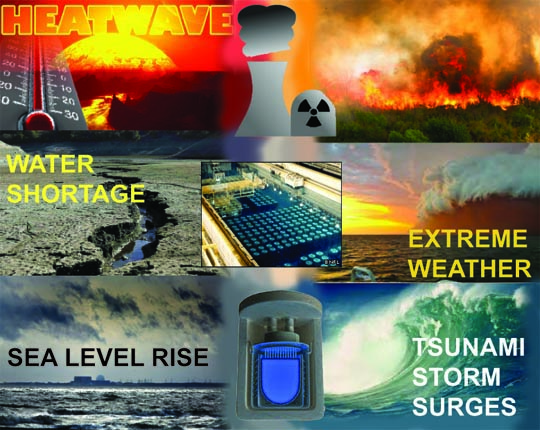
Wired, 22 July 22”……………………………. Amidst a slow-burning heat wave that has killed hundreds and sparked intense wildfires across Western Europe, and combined with already low water levels due to drought, the Rhône’s water has gotten too hot for the job. It’s no longer possible to cool reactors without expelling water downstream that’s so hot as to extinguish aquatic life. So a few weeks ago, Électricité de France (EDF) began powering down some reactors along the Rhône and a second major river in the south, the Garonne. That’s by now a familiar story: Similar shutdowns due to drought and heat occurred in 2018 and 2019. This summer’s cuts, combined with malfunctions and maintenance on other reactors, have helped reduce France’s nuclear power output by nearly 50 percent…………………
Nuclear technicians are known to refer to their craft as a very complicated way of boiling water, producing steam that spins turbines. But much more is usually required to keep the reactor cool. That’s why so many facilities are located by the sea and along big rivers like the Rhône.
Plenty of other industries are affected by hotter rivers, including big factories and power plants that run on coal and gas. But nuclear plants are unique because of their immense size and the central role they play in keeping energy grids online in places like France. And warming and dwindling rivers are not the only climate challenges they face. On the coasts, a combination of sea level rise and more frequent and intense storms means heightened flooding risks. Scientists have also pointed to other, more unusual challenges, like more frequent algal blooms and exploding jellyfish populations, which can clog up the water pipes.
……………………… The nuclear industry and environmental groups continue to disagree on whether existing regulations capture the latest science, particularly on the topic of sea level rise.
……………….. . In 2019, the NRC began approving 20-year extensions to some reactors—starting with the Turkey Point power plant in South Florida. Environmental groups filed interventions to halt the plan, arguing that a combination of more intense hurricanes and sea level rise would threaten the low-lying plant in ways that regulators had not adequately considered. In February, the NRC reversed the extension for Turkey Point and other plants pending a more extensive environmental review.
So far, most production cuts are due to warming waters—not just in the Rhône and Garonne, but in places like the Tennessee River in the US, and in the coastal seas where many more plants are sited. In recent years, nuclear plants across Northern Europe have been forced to shut down or reduce output because seawater became too warm to safely cool the reactor cores. Over the past decade, the Millstone power plant in Connecticut saw a series of shutdowns on hot summer days until regulators raised the temperature limit of its cooling waters by 5 degrees Fahrenheit.
………………………. the impact is growing as temperatures continue to rise. In an analysis published in Nature Energy last summer, a Stanford researcher found that there had been eight times the number of heat-related outages in the 2010s compared with the 1990s. In a 2011 study on the impact of warming on nuclear cooling systems, EDF scientists projected a 3 degree Celsius increase in the Rhône’s temperature by 2050, spelling more potential for shutdowns during heat waves.
,,,,,,,,,,,,,,,,,,,,,,, “The key issue is when we start building new plants, how can we take into account the impact of climate change for the full lifespan of the plant to 2080 or 2100,” Laconde says, noting that France’s new generation of reactors, recently announced by President Emmanuel Macron, are mostly being built by the coasts.
,,,,,,,,,,,,,,,,,,,,,,,,,, in France, regulators are expecting a long summer ahead. While the heat may pass, low water levels can persist, resulting in cutbacks that last for weeks or months. EDF recently told reporters that it expects more cuts in the coming months as water levels continue to fall—leaving the country hoping for the relief of cold, hard rains. https://www.wired.com/story/nuclear-power-plants-struggling-to-stay-cool/
La Hague is still threatened by wildfires Monday afternoon: firefighters mobilized on July 18 not far from the Orano nuclear site
by Christophe Meunier, After being mobilized all day Sunday July 17, 2022 on landage fires in Herquemoulin, the firefighters of the Channel had to fight against another fire this night, still in the sector of La Hague. The second fire regained strength during the afternoon on Monday. The nearby Orano La Hague site has significant means of protection if it were to be threatened by flames.
Up to 108 firefighters were mobilized this Sunday, July 17, 2022 on a landage fire in Herquemoulin, in the La Hague sector, which broke out around 3 a.m. It was only at the end of the evening, after 10 p.m., that the system was lightened. Thirty firefighters, three forest fire tanker trucks, a firefighters’ van, a water carrier and the command echelon remained on site to maintain surveillance of the site. This surveillance is maintained this Monday morning. But in the meantime, the means of the SDIS had to be mobilized on another fire……………….
It was shortly before midnight that a new brush fire broke out in the La Hague sector, this time in Vauville, at a place called Les Pierres-Poquelées. About sixty firefighters, from Saint-Lô, Carentan, La Haye, La Hague, Barneville, Granville, Cherbourg, Bricquebec, Canisy, St Pierre, Valognes but also from Calvados, were engaged in this new operation. Six tank trucks and a fire engine were deployed on site. A command post was set up in Beaumont-Hague at the RD 901/RD 403 roundabout. “The personnel faced unfavorable conditions linked to the topography, the night and the wind “, indicated the Departmental Service Channel Fire and Rescue……………………..
The two fires that have occurred since Sunday in the La Hague sector are both near the Orano waste reprocessing site. ………………………….
France3 18th July 2022
Macron facing NUCLEAR nightmare as scorching heatwave cripples SIX reactors.

THE RAGING heatwave that currently engulfing Europe has threatened to worsen France’s energy crisis, as six nuclear power plants have been crippled this month.
https://www.express.co.uk/news/science/1643201/emmanuel-macron-france-facing-energy-nightmare-six-nuclear-reactors-scorching-heatwave By ANTONY ASHKENAZ, Jul 20, 2022 , Experts have warned that parts of France are currently facing a “heat apocalypse” as temperatures reach record levels across Europe. Aside from triggering horrifying forest fires, these scorching temperatures are now also threatening to worsen France’s energy crisis. As a result of higher temperatures, rivers like the Rhone and Rhine, which are used by nuclear power plants for cooling, have become too warm to be used in the energy generation process.
Without cooler water supplies, six nuclear power plants in France have been forced to reduce their output drastically.
Without cooler water supplies, six nuclear power plants in France have been forced to reduce their output drastically.
EDF’s nuclear plants along these rivers use the waters to regulate the temperature of their reactors, discharging warm water back into the waterway.
Regulations are in place that limits reactor production during times of high heat to prevent the process from damaging local wildlife.
However, these rules could soon be scrapped at the cost of regional flora and fauna, as France’s nuclear safety authority green-lighted “temporary modification” of regulations for Blayais, Golfech and St Alban nuclear power plants.
Energy expert Thibault Laconde tweeted: “To state the obvious, it also highlights the vulnerability of #nuclear power to climate change, in particular the vulnerability of ‘French-style’ nuclear power, with its large reactors, large power plants and therefore large cooling needs.
“Climate change has to be factored in nuclear projects.
“Especially as France is preparing to renew its fleet, it would be unimaginable to build reactors if we cannot demonstrate that they will be able to operate with the #climate they will experience throughout their lifetime”
The heatwave crippling nuclear power plants could be devasting for Mr Macron, as France has already been suffering a major energy crisis after half of EDF’s ageing nuclear power plants were forced to shut down recently over safety concerns.
Experts have previously warned Mr Macron of significant corrosion safety problems in EDF nuclear power plants in France as cracks were detected in some nuclear reactors.
Speaking to Express.co.uk, Dr Bernard Laponche, the co-author of a recent study on EDF’s reactors warned that cracks in the cooling systems of many of these reactors could result in horrifying disasters that are only comparable to events like “Three Mile Island or Fukushima”.
As a result of these corrosion problems, four 1500 MW, seven 1300 MW and one 900 MW reactors are shut down.
As a result of these reactor shut downs, EDF has been forced to lower its power output this year, amidst fears of a disastrous winter where fears grow Vladimir Putin could cut Europe off its gas supply.
Dr Laponche also warned that more reactor shutdowns could happen in the future, as EDF power stations are currently under investigation for similar reactor flaws.
Evacuation of site in France , as wildfires rage near nuclear power plant being decommissioned
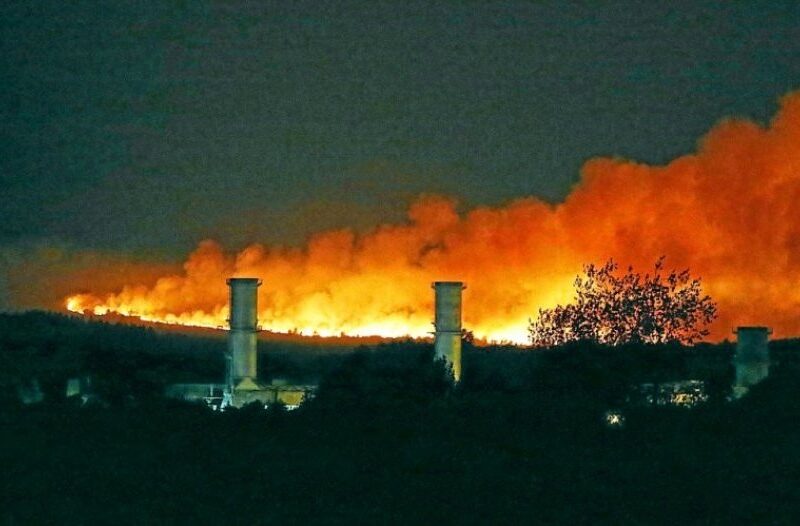
The EDF site in Brennilis, consisting of a nuclear power plant being deconstructed and a thermal power plant in operation, was evacuated around 1 p.m., due to the fumes stinking the air. It’s 10 a.m. on Tuesday morning.
The swirling fire, fanned by a wind blowing at 40 – 45 km/h, plays hide and seek with the firefighters. Claire Maynadier, sub-prefect of Châteaulin, has just hung up with the director of the Brennilis nuclear power plant . The evacuation of personnel is therefore not envisaged. “The fire front
is not near. Nevertheless, it remains uncontrolled. We remain vigilant,” she explains.
Le Telegramme 19th July 2022
Humanity faces collective suicide over climate crisis, warns UN chief.
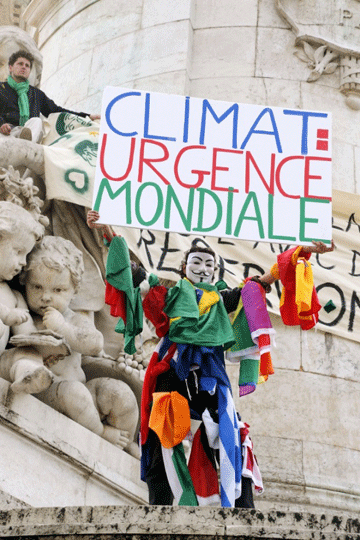
Wildfires and heatwaves wreaking havoc across swathes of the globe show
humanity facing “collective suicide”, the UN secretary general has
warned, as governments around the world scramble to protect people from the
impacts of extreme heat.
António Guterres told ministers from 40 countries
meeting to discuss the climate crisis on Monday: “Half of humanity is in
the danger zone, from floods, droughts, extreme storms and wildfires. No
nation is immune. Yet we continue to feed our fossil fuel addiction.” He
added:
“We have a choice. Collective action or collective suicide. It is
in our hands.”
Guardian 18th July 2022
4 French nuclear reactors authorized to discharge hotter water during heatwave, as 29 others remain offline
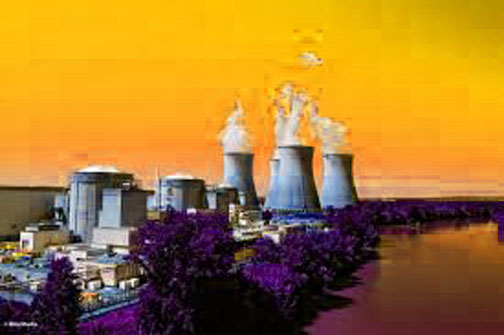
Heat wave: a fourth nuclear power plant authorized to release hotter water than normal to continue operating. Twenty-nine French reactors out of 56 are currently unavailable for various reasons. Hence these exemptions.
A temporary derogation from environmental rules has been granted to a new nuclear power plant, that of Bugey, in Ain, to allow it to continue to operate “at a minimum level of power” during the heat wave, according to a decree published on Sunday July 17. in the Official Journal .
“The reactors of the Bugey nuclear power plant discharging effluents into the Rhône may, during the fixed period (…), continue to practice these discharges as long as the heating after mixing of the effluents into the Rhône (.. .) does not exceed 3 ° C in average daily value” , specifies the decree of Sunday.
On Friday, a derogation had been granted to the nuclear power plants of Golfech (Tarn-et-Garonne), Blayais (Gironde) and Saint-Alban (Isère). For these three power stations and that of Bugey, the
authorization was granted until July 24th.
And this, while 29 French reactors out of 56 are currently unavailable for various reasons. Since
2006, each plant has had its own regulatory water discharge temperature limits that must not be exceeded. The power plants indeed pump water to cool the reactors, before rejecting it. The derogation device, which aims to guarantee the proper functioning of the electricity network, had so far only been used once, in 2018 for the Golfech power plant, for a period of 36 hours.
France Info 17th July 2022
Swiss nuclear power plant reduces output to protect fish during heatwave

One of Switzerland’s nuclear power stations has temporarily scaled back operations to avoid raising the temperature of its feeder river to levels that are dangerous for fish.
https://www.swissinfo.ch/eng/sci-tech/swiss-nuclear-power-plant-reduces-output-to-protect-fish-during-heatwave/47761010 , July 18, 2022
Beznau is Switzerland’s oldest nuclear plant and comprises two stations built on a small artificial island in the river Aare in the north of the country. Unlike two newer stations, Beznau was not built with a cooling tower but relies on water from the Aare to control temperatures.
Producing some 6,000 gigawatt hours of electricity per year typically raises the temperature of downstream water by between 0.7 and one degree Celsius.
Switzerland is experiencing a prolonged summer heatwave that has already raised the temperature of rivers, including the Aare. Freshwater fish species living in the river cannot tolerate water temperatures much above 25 degrees Celsius.
As a result, Beznau operator Axpo has been forced to reduce output to meet its legal environmental commitments.
The plant would be forced to shut down completely if water temperatures rise above 25 degrees for three consecutive days, reports Swiss public broadcaster SRFExternal link.
Switzerland is already facing up to the impact of rising energy costs and potential shortagesExternal link in the coming months, driven in part by meteorological conditions but also disruptions caused by the Ukraine war.
But this danger is expected to strike in the winter months when Switzerland’s hydro-power dams are less productive. At this time of year, the river temperature issue will be less of a problem.
Switzerland produces around 30% of its electricity from its three nuclear power plants. The government decided in 2011 to phase out nuclear power following the Fukushima disaster in Japan.
The initial idea was to stop nuclear power production by 2034. The Mühleberg plant is currently being dismantledExternal link.
Uncertainties about securing long-term power supplies led to the fixed deadline of 2034 being scrapped and replaced with a more vague commitment to only keeping the remaining power stations running as long as it is safe.
1 This Month
19 February – VIRTUAL EVENT-Decision Time: AI and Our Nuclear Arsenal
12:45 p.m. Central / 1:45 p.m. Eastern
To see nuclear-related stories in greater depth and intensity – go to https://nuclearinformation.wordpress.com
-
Archives
- February 2026 (161)
- January 2026 (308)
- December 2025 (358)
- November 2025 (359)
- October 2025 (376)
- September 2025 (258)
- August 2025 (319)
- July 2025 (230)
- June 2025 (348)
- May 2025 (261)
- April 2025 (305)
- March 2025 (319)
-
Categories
- 1
- 1 NUCLEAR ISSUES
- business and costs
- climate change
- culture and arts
- ENERGY
- environment
- health
- history
- indigenous issues
- Legal
- marketing of nuclear
- media
- opposition to nuclear
- PERSONAL STORIES
- politics
- politics international
- Religion and ethics
- safety
- secrets,lies and civil liberties
- spinbuster
- technology
- Uranium
- wastes
- weapons and war
- Women
- 2 WORLD
- ACTION
- AFRICA
- Atrocities
- AUSTRALIA
- Christina's notes
- Christina's themes
- culture and arts
- Events
- Fuk 2022
- Fuk 2023
- Fukushima 2017
- Fukushima 2018
- fukushima 2019
- Fukushima 2020
- Fukushima 2021
- general
- global warming
- Humour (God we need it)
- Nuclear
- RARE EARTHS
- Reference
- resources – print
- Resources -audiovicual
- Weekly Newsletter
- World
- World Nuclear
- YouTube
-
RSS
Entries RSS
Comments RSS
 nuclear-news