Nuclear disasters could leave a lasting legacy of contaminants in glaciers
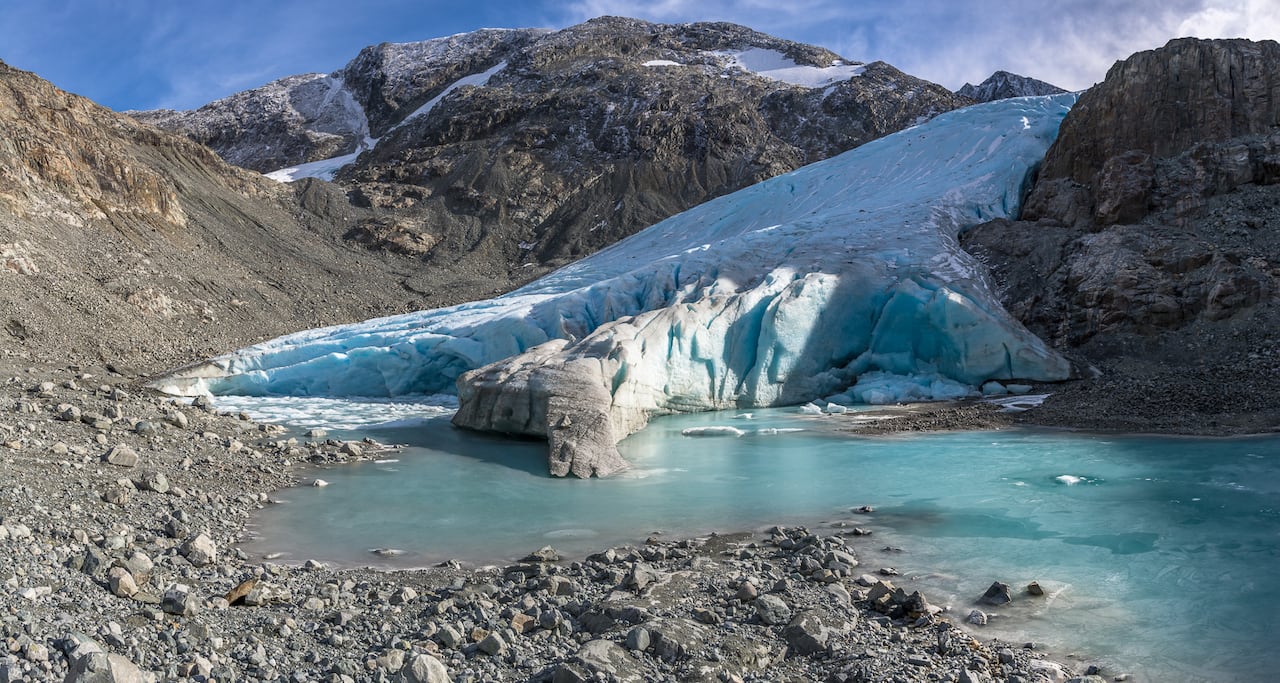
Emerging research is suggesting that radioactive particles are being stored within glaciers
University of Plymouth Alan Williams, April 2019
Nuclear disasters such as Chernobyl and Fukushima are known to have had an immediate impact on their surrounding environments and the people living within them.
But emerging research is suggesting the legacy of these events and international weapons testing could be felt for much longer as radioactive particles are being stored within glaciers.
The first results from this collaborative international research project were presented at the 2019 General Assembly of the European Geosciences Union (EGU), taking place in Vienna from April 7-12, 2019………………………………………
The EGU presentation combined studies into the presence of fallout radionuclides (FRNs), a product of nuclear accidents and weapons testing, within ice surface sediments – or cryoconite – across multiple sites in the Arctic (Sweden, Greenland and Svalbard), Iceland, the European Alps, the Caucasus, British Columbia, and Antarctica.
The levels of some FRNs found in these sites are orders of magnitude higher than those detected in many other (non-glaciated) environments, raising important questions around the role of glaciers, and specifically cryoconite and its interaction with meltwater, in the accumulation of anthropogenic atmospheric contaminants.
The research also demonstrates that the presence of FRNs in cryoconite is not restricted to sites closest to large source areas such as Chernobyl, highlighting the global reach of nuclear events and other sources of atmospherically-transported contaminants.
The widespread occurrence of concentrated FRNs in glacier catchments, and the impacts on downstream water and environmental quality, including uptake of FRNs into flora and fauna, are the focus of current and future research efforts.
Dr Clason said:
“Research into the impact of nuclear accidents has previously focussed on their effects on human and ecosystem health in non-glaciated areas. But evidence is mounting that cryoconite on glaciers can efficiently accumulate radionuclides to potentially hazardous levels. Very high concentrations of radionuclides have been found in several recent field studies, but their precise impact is yet to be established. Our collaborative work is beginning to address this because it is clearly important for the pro-glacial environment and downstream communities to understand any unseen threats they might face in the future.”
France’s riverside reactor build plans “irresponsible” – expert.

MURIEL BOSELLI, Paris, 07 Apr 2023, https://www.montelnews.com/news/1477431/edfs-riverside-reactor-build-plans-irresponsible–expert
(Montel) France’s plan to build two riverside reactors is “irresponsible”, given the acceleration of global warming-related water strain, nuclear expert and critic Yves Marignac told Montel.
Climate change has raised fears of extreme temperatures and droughts that will cause more outages at EDF’s 44 nuclear reactors – out of 56 – that are located along rivers and use water for cooling.
The average summer flow of the Rhone, on which 22% of France’s nuclear capacity is installed, could fall by 20% within 30 years, according to a recent study by the Rhone-Mediterranean-Corsica Water Agency.
However, EDF plans to build two additional reactors along the Rhone.
“We can always adapt the reactors to cool themselves by reducing their water withdrawal, as some reactors do in the desert,” said Marignac, but added that these costly developments “remove the interest of placing installations along rivers”.
Higher water use
He said he also feared a “considerable increase” in competition between water-intensive sectors such as agriculture, industry, energy and tourism.
EDF plans to build three pairs of European pressurised reactors (EPRs) by 2042-43 – one at Penly, a second at Gravelines (both on the coast), and a third at Bugey or Tricastin, on the Rhone.
The decision would be made by the end of the year, Joel Barre, inter-ministerial delegate for new nuclear power plants, told Montel.
Last week, president Emmanuel Macron announced a vast investment plan to adapt nuclear power plants to climate change, notably by equipping riverside units with air-cooling towers to make them less dependent on the temperature of waterways.
Although this system allows reactors to continue producing power during hot periods, it consumes much more water as a significant part of the volume withdrawn evaporates through the towers during cooling.
French energy minister Agnes Pannier-Runacher said earlier this week that scenarios established by the international group of climate experts Giec had shown “very limited losses [of production]”.
“Critical” risk
However, a recent report by France’s auditors’ court warned the impact of global warming on the French nuclear fleet could become “critical” by 2050, with three to four times more unavailability than today.
Last summer, France’s nuclear safety authority ASN authorised EDF to exceed temperature limits for some riverside plants to enable units to continue producing power during the drought.
Thibault Laconde, founder of climate risk assessment start-up Callendar, said EDF’s Tricastin site in southeastern France was a better choice than Bugey for cooling because it was near a section of the Rhone that had cool water inflow from the Isere river.
Melting ice caps
Building reactors by the sea also raised questions, experts said, because of uncertainties about the rising sea levels during the EPRs’ lifespan, which EDF has set at a minimum of 60 years.
The auditors’ court has called on EDF to anticipate “the low probability” of an acceleration in ice cap melting, which would lead to a rise in the average sea level of nearly 2 metres by 2100 and 5m by 2150.
However, EDF has only incorporated a sea level rise of around 1.2m into the design of its EPR reactors, said Barre.
EDF did not respond to Montel’s requests to comment.
Three consecutive years of rapidly increasing carbon dioxide emissions.

Record temperatures, devastating floods and superstorms are causing death
and destruction across the planet but humans are failing to cut greenhouse
gas emissions fueling the climate emergency, new US data shows. Atmospheric
levels of carbon dioxide (CO2), methane and nitrous oxide – the
greenhouse gases emitted by human activity that are the most significant
contributors to global heating – continued to increase rapidly during
2022, according to the National Oceanic and Atmospheric Administration
(Noaa).
Carbon dioxide levels rose by more than two parts per million (ppm)
for the 11th consecutive year: the highest sustained rate of CO2 increases
since monitoring began 65 years ago. Before 2013, scientists had never
recorded three consecutive years of such high CO2 growth.
Guardian 6th April 2023
https://www.theguardian.com/environment/2023/apr/06/greenhouse-gas-emissions-noaa-report-us-data
The temperature of the world’s ocean surface has hit an all-time high.

The temperature of the world’s ocean surface has hit an all-time high
since satellite records began, leading to marine heatwaves around the
globe, according to US government data. Climate scientists said preliminary
data from the National Oceanic and Atmospheric Administration (Noaa) showed
the average temperature at the ocean’s surface has been at 21.1C since
the start of April – beating the previous high of 21C set in 2016.
Three years of La Niña conditions across the vast tropical Pacific have helped
suppress temperatures and dampened the effect of rising greenhouse gas
emissions. But scientists said heat was now rising to the ocean surface,
pointing to a potential El Niño pattern in the tropical Pacific later this
year that can increase the risk of extreme weather conditions and further
challenge global heat records.
Guardian 8th April 2023
Antarctica’s melting ice sheet could retreat much faster than previously thought

Antarctica’s melting ice sheet could retreat much faster than previously
thought, new research suggests. The evidence comes from markings on the
seafloor off Norway that record the pull-back of a melting European ice
sheet thousands of years ago.
Today, the fastest withdrawing glaciers in
Antarctica are seen to retreat by up to 30m a day. But if they sped up, the
extra melt water would have big implications for sea-level rises around the
globe. Ice losses from Antarctica caused by climate change have already
pushed up the surface of the world’s oceans by nearly 1cm since the 1990s.
The researchers found that with the Norwegian sheet, the maximum retreat
was more than 600m a day.
BBC 5th April 2023
Intergovernmental Panel on Climate Change (IPCC) report fails to mention military or conflict emissions.

The IPCC’s failure to mention military or conflict emissions in its
recent synthesis report points to a deeper problem. Ellie Kinney explains
why solving it will require a concerted effort from states, researchers and
civil society. As the IPCC has made clear, the stakes couldn’t be higher.
Conflict & Environment Observatory 3rd April 2023
TODAY. The China bogey-man distraction from the REAL threat OF GLOBAL HEATING

The global military-industrial-corporate-political-media complex has done a damn good job of taking attention away from the world’s genuinely serious danger – climate change.
Sometimes it takes a military man to tell us the truth.
As Australia gets ready to be USA’s proxy fighter in war against China, former Defence Force chief Admiral Chris Barrie said climate change posed a bigger risk to Australia than China’s rapid military build-up. Other Defence experts agreed on “climate change as an existential threat. It’s a much bigger threat to our national security than a potential fight with China “
The Defence expert went on to say – “This is about transparency and keeping people informed.”
There’s the problem.
Big business – the fossil fuel industries, the weapons industry, the bought politicians, the craven, subservient media (media often owned by fossil fuel interests anyway,) the frightened national media like BBC and ABC – all of them tout the myth about China planning to militarily attack other countries.
All of them, parrot-like, recite the mantra of the “global rules-based order” – what a beautiful invention of the global military-industrial-corporate-political-media complex. ( no doubt the fossil fuel and weapons industries in Russia and China promote the same kind of propaganda to boost themselves)
Does Admiral Barrie have a hope in hell of the Australian government being transparent about the genuine peril to Australia of global heating, the melting Antarctica, and all that is already ensuing from this?
I doubt that he will be heard, along with how many other intelligent military leaders world-wide, who would rather see action on climate change, than another pointless and wasteful war?
Elon Musk is remaking Twitter into a climate denier sanctuary
by ketanjoshi85 [very good graphs]
As I wrote recently here on my site, Elon Musk’s reputation as a ‘climate hero’ has been badly exaggerated. Every good thing he’s contributed to sits alongside a collection of actively counter-productive things. One of those things is killing a space that climate activists, communicators and experts used regularly – that is, Twitter. Still my core social media space, but a broken, burning one……………………………………………………………………….
The gradual rebirth of climate denier Twitter
It feels like something more fundamental in site dynamic has changed – particularly around which accounts and tweets get boosted and promoted.
I recently noticed that climate deniers, or climate delayers (who argue for no or slow climate action) have had massive increases in their followings, whereas pro-climate accounts have either lost followers, or gained very few of them. Musk has himself been cosying up with climate deniers, boosting, for instance, a conspiracy theory video from Australian climate denier and member of far-right xenophobic party One Nation, Senator Malcolm Roberts. “[Musk is] doing a marvellous job of rekindling freedom of speech,” Roberts told the SMH. “That alone is worthy of high praise.”
Berlin-based researcher Travis Brown has been tracking various changes at Twitter under Musk’s rule; particularly how the roll-out of the paid service ‘Twitter Blue’ has been going (I did an ad-hoc data snapshot of climate denial among Blue accounts, and…it’s bad). Being able to pay a tiny fee to simulate trustworthiness and get boosted into prominence in both algorithmic feeds and the sorting of replies on Twitter is invaluable for climate deniers.
It is, of course, very relevant given that Musk has just announced that the only tweets appearing in the algorithmic ‘For You’ feed will be those who’ve paid to subscribe to Twitter. Musk think he’s onto a solid grift here; offering prominence to those who are so deeply shit in their speech that they’ve failed to earn it.
Another recent analysis by ISD found that “fringe climate denialist websites have gained a foothold in online conversation with thousands of daily mentions on Twitter by highly followed climate-denying actors, pundits and outlets”. They also found that “some actors identified as ‘super-spreaders’ of climate misinformation by ISD and CAAD linked to the fringe websites”, including notorious denier accounts Patrick Moore, Steve Milloy and Peter Clack…………………………………………………………………..
Though my account selection method was somewhat ad-hoc, there’s basically no denying how significantly Musk-Twitter has caused a massive audience boost for climate deniers and delayers. To some degree, this had already kicked off around mid 2022, prior to Musk’s official purchase, but whatever dials Musk turned has accelerated this phenomenon significantly…………………………………………………………………
The change of ownership has had both direct and indirect influence in denier prominence on Twitter, accelerating this pre-existing problem. There’s been a general emboldening of the worst, most cruel right-wing accounts. There’s a spring in their step – their man is in the top job. And climate is a big focus for them.
A specific change to the algorithm to boost tweets ‘outside’ of one’s political sphere has resulted in far, far more eyeballs on right-wing content (in addition to being the core reason I get ferociously racist responses to innocuous things I post). And Twitter Blue subscriptions are helping grant legitimacy and prominence to the worst, pro-fossil deniers, as shown by journalist David Vetter. “As a platform, Twitter is now fully weaponized to undermine science, climate action and global sustainable development”, he wrote.
Some of the reason pro-climate accounts have lost followers has been people leaving Twitter. Musk has been publicly endorsing far-right and right-wing views,……………………………………………………………….. more https://ketanjoshi.co/2023/03/28/musk-is-remaking-twitter-into-a-climate-denier-sanctuary/
Climate change amplifies existing threats to national security
We need to stop thinking of climate change as future hazard. It is
happening right now, and it is damaging our national security as well as
our way of life.
Global warming has not yet reached the Paris-agreed limit
of 1.5C, and already the shocks to global weather are ravaging communities
around the world.
Speaking as the IPCC delivered their latest assessment,
UN secretary general Antonio Guterres called it a “ticking climate time
bomb”. In a troubled world, with real concerns about cost of living, the
creeping dangers posed by climate change are too easily ignored. But we do
so at our peril.
Borders are no protection against its effects and, as
authoritarian states mount a challenge to the entire international system,
climate change further amplifies existing threats to UK national security.
Heat, drought, water shortages, food scarcity and fuel conflict drive huge
numbers of people from their homes.
Changes in the climate are having a
devastating social and economic effect, putting severe pressure on many of
the most vulnerable countries. This can exacerbate unrest and play a role
in the outbreak of war. Ethnic tensions in Sudan in 2003 were inflamed when
drought and hunger took hold. As then UN secretary general Ban Ki-moon
warned at the time: “The Darfur conflict began as an ecological crisis,
arising at least in part from climate change.” For decades before clashes
erupted, the Sahara Desert had advanced a mile a year into Sudan.
Independent 26th March 2023
https://www.independent.co.uk/voices/britain-climate-change-threat-national-security-b2308198.html
Burning down the house — Climate options are available now. Nuclear power isn’t one of them

Our climate needs a fire hose. Our government is bringing buckets
Burning down the house — Beyond Nuclear International
Climate options are available now. Nuclear power isn’t one of them
By Linda Pentz Gunter
In 2019 at the Davos World Economic Forum, youth climate leader, Greta Thunberg, then only 16, warned the audience in a quiet and measured voice that addressing the climate crisis involved a solution “so simple that even a small child can understand it. We have to stop the emissions of greenhouse gases.”
In closing, she said: “Adults keep saying we owe it to the young people to give them hope. But I don’t want your hope. I don’t want you to be hopeful. I want you to panic. I want you to feel the fear I feel every day. And then I want you to act. I want you to act as you would in a crisis. I want you to act as if the house was on fire. Because it is.”
On March 12, 2023, the Biden administration announced that it had approved oil and gas drilling in Arctic Alaska, retaining the United States’s vaunted position, alongside China and India, as one of the world’s leading arsonists.
As the UK daily, The Guardian reported of that decision: “The ConocoPhillips Willow project will be one of the largest of its kind on US soil, involving drilling for oil and gas at three sites for multiple decades on the 23m-acre National Petroleum Reserve which is owned by the federal government and is the largest tract of undisturbed public land in the US.”
The US government’s lame excuse for approving the drilling project was that it had few legal options, given Conoco-Phillips holds lease rites to the land dating back decades.
So sue. The house is on fire. Tying the project up in the law courts would have bought us time. Green-lighting new oil and gas drilling is tone deafness to a crisis that has gone beyond the tipping point.
This was confirmed, yet again, days later, when the Intergovernmental Panel on Climate Change (IPCC) published its AR6 Synthesis Report: Climate Change 2023, the final part of its mammoth Sixth Assessment Report. It came replete with even more dire warnings than in previous AR6 reports, which should already have been panic-inducing enough for the world to wake up and understand that we cannot drill for a single more drop of oil. Ever. Period.
This time, the scientists who co-authored the AR6 Synthesis Report called it their “final warning.” However, in their press release announcing the report, the authors tried to take the high road, insisting that “There are multiple, feasible and effective options to reduce greenhouse gas emissions and adapt to human-caused climate change, and they are available now”.
None of those options includes nuclear power, according to the IPCC scientists, which never mentions ‘nuclear’ once in the report narrative. It appears only in a single graph (below on original)) to illustrate its lack of applicability to addressing the climate crisis…………………………………………..
IPCC Chair, Hoesung Lee, said: “This Synthesis Report underscores the urgency of taking more ambitious action and shows that, if we act now, we can still secure a liveable sustainable future for all.”
If we act now. Like we didn’t after Thunberg’s words of warning in 2019. Like the Biden administration didn’t last week. What’s left is the largely empty rhetoric of hope, but no signs of panic.
This lack of urgency is compounded by a failure in the media to put the climate emergency on the front page with regularity. The given reason is that it’s not what their readers are interested in, a complete abdication of responsibility to inform, educate, and in the case of the climate crisis, to inflame passion and a demand for action. And there is also, in the US at least, and as we wrote last week, a lamentable adherence to an outdated formula that relegates the voices of right and reason to the back of the quote queue.
This was no better (or should that be worse) exemplified than by the two days of coverage about the Alaskan Willow project in The Washington Post, which never once in either story quoted anyone from the Indigenous Alaskan population bitterly opposed to the drilling.
…………………………………………………… we still aren’t seeing the outrage where it really matters. We are still confronting deniers. And our governments are not taking the climate crisis nearly seriously enough. Instead of rushing for the fire hoses, they are bringing buckets.
Linda Pentz Gunter is the international specialist at Beyond Nuclear and writes for and curates Beyond Nuclear International. https://beyondnuclearinternational.org/2023/03/26/burning-down-the-house/
Climate change may pose key risk to French reactors – said the country’s Court of Auditors

Each year, the volume of water withdrawn to cover the needs of the French population amounts to 33.5bcm, half of which is used to cool nuclear power plants.
Some 98% of this water is released back into rivers but at a higher temperature, which is regulated on a plant-by-plant basis.
MURIEL BOSELLI, Paris, 22 Mar 2023 https://www.montelnews.com/news/1466974/climate-change-may-pose-key-risk-to-french-reactors–court
The impact of global warming on France’s nuclear fleet could become “critical” by 2050, with three to four times more outages than today, said the country’s Court of Auditors in a report published late on Tuesday.
“These outages are concentrated, admittedly on short summer periods, but are increasingly long and can prove critical by increasing the risks of pressure on the grid,” said Annie Podeur, president of the second chamber of the court, during a hearing at the Senate.
These outages and capacity cuts led to “losses amounting to several TWh per year”, Podeur said, citing the record unavailability in 2003 of 6 GW of nuclear power, or 10% of France’s installed nuclear capacity.
Extreme heat
Increased risk of extreme heat and droughts amid climate change could impact nuclear plants, which use water to cool down.
Combined with this, the report pointed to the expected significant increase in power demand in the years to come, which would strain the grid.
Each year, the volume of water withdrawn to cover the needs of the French population amounts to 33.5bcm, half of which is used to cool nuclear power plants.
Some 98% of this water is released back into rivers but at a higher temperature, which is regulated on a plant-by-plant basis.
The reduced availability of water resources amid drought could exacerbate conflicts about usage with agriculture, tourism and other industries, said Podeur.
Predicting river flows
Climate models should be updated to include river flow levels for the coming years, recommended the report, adding that EDF needed greater storage capacity for water to cool reactors during periods of low flows.
Last summer, which was particularly hot and dry, France’s nuclear safety authority ASN authorised EDF to exceed temperature limits for certain plants to continue producing power.
This decision was taken after the utility stopped a record number of reactors for maintenance and corrosion probes.
The court urged EDF to quantify the total costs of adapting its fleet to deal with climate change.
The utility spent EUR 1bn on currently operational reactors from 2006-2021 and plans to invest only EUR 612m from 2023-2038, added Podeur.
EDF has estimated that outages related to heat and drought result in a loss of annual nuclear production of around 1%.
Briefing Paper on Nuclear Weapons, the Environment, and the Climate Crisis.
This briefing paper provides an overview of the effects of nuclear
weapons on the environment as well their exacerbated impacts as a result of
the climate crisis. This paper provides recommendations for environmental
remediation based on the Treaty on the Prohibition of Nuclear Weapons
(TPNW). This briefing note addresses the twin crises of nuclear weapons and
their impacts along with the climate crisis. Production, testing, the
potential of nuclear war, and the additional risks of the climate crisis
are all essential to understand the impacts nuclear weapons have on the
environment which this paper explores.
ICAN 1st March 2023
World on ‘thin ice’ as UN climate report gives stark warning
By Associated Press, CNN Mar 21, 2023, https://www.9news.com.au/world/climate-change-ipcc-report-antonio-guterres-says-world-on-thin-ice-as-un-climate-report-gives-stark-warning/fd6c84d9-6139-40a9-a971-866da5233ca1—
Humanity still has a chance, close to the last one, to prevent the worst of climate change‘s future harms, a top United Nations panel of scientists says.
But doing so requires quickly slashing carbon pollution and fossil fuel use by nearly two-thirds by 2035, the Intergovernmental Panel on Climate Change said.
The United Nations chief said it more bluntly, calling for an end to new fossil fuel exploration and rich countries quitting coal, oil and gas by 2040.
“Humanity is on thin ice — and that ice is melting fast,” United Nations Secretary-General Antonio Guterres said.
“Our world needs climate action on all fronts — everything, everywhere, all at once.”
Stepping up his pleas for action on fossil fuels, Guterres not only called for “no new coal” but also for eliminating its use in rich countries by 2030 and poor countries by 2040.
He urged carbon-free electricity generation in the developed world by 2035, meaning no gas-fired power plants too.
That date is key because nations soon have to come up with goals for pollution reduction by 2035, according to the Paris climate agreement.
“The climate time-bomb is ticking,” Guterres said, describing the IPCC report as a “a how-to guide to defuse” it.
The report draws on the findings of hundreds of scientists to provide a comprehensive assessment of how the climate crisis is unfolding.
After contentious debate, the UN science panel calculated and reported that to stay under the warming limit set in Paris the world needs to cut 60 per cent of its greenhouse gas emissions by 2035, compared with 2019, adding a new target not previously mentioned in the six reports issued since 2018.
“The choices and actions implemented in this decade will have impacts for thousands of years,” the report, said calling climate change “a threat to human well-being and planetary health”.
“We are not on the right track but it’s not too late,” said report co-author and water scientist Aditi Mukherji.
“Our intention is really a message of hope, and not that of doomsday.”
With the world only a few tenths of a degree away from the globally accepted goal of limiting warming to 1.5 degrees since pre-industrial times, scientists stressed a sense of urgency. The goal was adopted as part of the 2015 Paris climate agreement and the world has already warmed 1.1 degrees.
This is likely the last warning the Nobel Peace Prize-winning collection of scientists will be able to make about the 1.5 mark because their next set of reports will likely come after Earth has either breached the mark or locked into exceeding it soon, several scientists, including report authors, told The Associated Press.
‘We are pretty much locked into 1.5’
After 1.5 degrees “the risks are starting to pile on,” said report co-author Francis X Johnson, a climate, land and policy scientist at the Stockholm Environment Institute.
The report mentions “tipping points” around that temperature of species extinction, including coral reefs, irreversible melting of ice sheets and sea level rise on the order of several metres.
“The window is closing if emissions are not reduced as quickly as possible,” Johnson said in an interview.
“Scientists are rather alarmed.”
“1.5 is a critical critical limit, particularly for small islands and mountain (communities) which depend on glaciers,” said Mukherji, who’s also the climate change impact platform director at the research institute CGIAR.
Many scientists, including at least three co-authors, said hitting 1.5 degrees is inevitable.
“We are pretty much locked into 1.5,” said report co-author Malte Meinshausen, a climate scientist at the University of Melbourne in Australia.
“There’s very little way we will be able to avoid crossing 1.5 C sometime in the 2030s” but the big issue is whether the temperature keeps rising from there or stabilises.
Guterres insisted “the 1.5-degree limit is achievable”. Science panel chief Hoesung Lee said so far the world is far off course
“This report confirms that if the current trends, current patterns of consumption and production continues, then … the global average 1.5 degrees temperature increase will be seen sometime in this decade,” Lee said.
Scientists emphasise that the world, civilisation or humanity won’t end if and when Earth hits and passes the 1.5 degree mark. Mukherji said “it’s not as if it’s a cliff that we all fall off”. But an earlier IPCC report detailed how the harms – from coral reef extinction to Arctic sea ice absent summers to even nastier extreme weather – are much worse beyond 1.5 degrees of warming.
“It is certainly prudent to be planning for a future that’s warmer than 1.5 degrees,” said IPCC report review editor Steven Rose, an economist at the Electric Power Research Institute in the United States.
Threats from fossil fuels
If the world continues to use all the fossil fuel-powered infrastructure either existing now or proposed Earth will warm at least 2 degrees Celsius since pre-industrial times, blowing past the 1.5 mark, the report said.
Because the report is based on data from a few years ago, the calculations about fossil fuel projects already in the pipeline do not include the increase in coal and natural gas use after Russia’s invasion of Ukraine, said report co-author Dipak Dasgupta, a climate economist at The Energy and Resources Institute in India.
The report comes a week after the Biden Administration in the United States approved the huge Willow oil-drilling project in Alaska, which could produce up to 180,000 barrels of oil a day.
The rich vs poor divide
The report and the underlying discussions also touch on the disparity between rich nations, which caused much of the problem because carbon dioxide emissions from industrialisation stay in the air for more than a century, and poorer countries that get hit harder by extreme weather.
If the world is to achieve its climate goals, poorer countries need a “many-fold” increase in financial help to adapt to a warmer world and switch to non-polluting energy. Countries have made financial pledges and promises of a damage compensation fund.
If rich countries don’t cut emissions quicker and better help victim nations adapt to future harms, “the world is relegating the least developed countries to poverty”, said Madeline Diouf Sarr, chair of a coalition of the poorest nations.
Despite the risk, ‘a message of hope’
The report offers hope if action is taken, using the word “opportunity” nine times in a 27-page summary. Though opportunity is overshadowed by 94 uses of the word “risk.”
The head of the IPCC said the report contains “a message of hope in addition to those various scientific findings about the tremendous damages and also the losses that climate change has imposed on us and on the planet”.
“There is a pathway that we can resolve these problems, and this report provides a comprehensive overview of what actions we can take to lead us into a much better, liveable future,” Lee told The Associated Press.
Lee was at pains to stress that it’s not the panel’s job to tell countries what they should or shouldn’t do to cap global temperature rise at 1.5 Celsius.
“It’s up to each government to find the best solution,” he said, adding that scientists hope those solutions will stabilise the globe’s temperature around 1.5 degrees.
Asked whether this would be the last report to describe ways in which 1.5 degrees can be achieved, Lee said it was impossible to predict what advances might be made that could keep that target alive.
“The possibility is still there,” he said.
“It depends upon, again I want to emphasise that, the political will to achieve that goal.”
Activists also found grains of hope in the reports.
“The findings of these reports can make us feel disheartened about the slow pace of emissions reductions, the limited transition to renewable energy and the growing, daily impact of the climate crisis on children,” said youth climate activist Vanessa Nakate, a goodwill ambassador for UNICEF.
“But those children need us to read this report and take action, not lose hope.”
Climate News. What is the IPCC AR6 synthesis report and why does it matter?

The fourth and final instalment of the sixth assessment report (AR6) by the
Intergovernmental Panel on Climate Change, the body of the world’s leading
climate scientists, is the synthesis report, so called because it draws
together the key findings of the preceding three main sections.
Together, they make a comprehensive review of global knowledge of the climate. The
first three sections covered the physical science of the climate crisis,
including observations and projections of global heating, the impacts of
the climate crisis and how to adapt to them, and ways of reducing
greenhouse gas emissions. They were published in August 2021, February and
April 2022 respectively.
The synthesis report also includes three other
shorter IPCC reports published since 2018, on the impacts of global heating
of more than 1.5C above pre-industrial levels, climate change and land, and
climate change and the oceans and cryosphere (the ice caps and glaciers).
Guardian 19th March 2023
Samoa’s desperate plea for world climate action
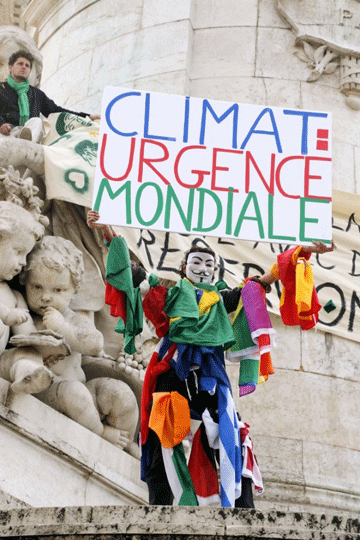
Samoa PM urges world to save Pacific people from climate crisis
obliteration. The world must step back from the brink of climate disaster
to save the people of the Pacific from obliteration, the prime minister of
Samoa has urged.
On the eve of a landmark report by the Intergovernmental
Panel on Climate Change, which is expected to deliver a scientific “final
warning” on the climate emergency, Fiame Naomi Mata’afa, Samoa’s prime
minister, issued a desperate plea for action. “We’re all impacted, but
the degree of the impact is in the particular circumstance of countries. So
our low-lying atoll countries, it’s right there, we’re living with it,”
said Mata’afa. “There are already examples in the Pacific of communities,
whole communities, that have relocated to different countries,” she said.
“They’re really having to address issues of sovereignty through loss of
land.”
Guardian 19th March 2023
1 This Month



26 September – International Day for the Total Elimination of Nuclear Weapons


PLEASE OPPOSE HR 8255 AND S.3639 – bills would accelerate satellite deployment, with no environmental review or safeguards – https://ncstd5li.quorum.us/campaign/169331/
To see nuclear-related stories in greater depth and intensity – go to https://nuclearinformation.wordpress.com
-
Archives
- September 2026 (219)
- August 2026 (330)
- July 2026 (355)
- June 2026 (287)
- May 2026 (306)
- April 2026 (356)
- March 2026 (251)
- February 2026 (267)
- January 2026 (308)
- December 2025 (358)
- November 2025 (359)
- October 2025 (375)
-
Categories
- 1
- 1 NUCLEAR ISSUES
- business and costs
- climate change
- culture and arts
- ENERGY
- environment
- health
- history
- indigenous issues
- Legal
- marketing of nuclear
- media
- opposition to nuclear
- PERSONAL STORIES
- politics
- politics international
- Religion and ethics
- safety
- secrets,lies and civil liberties
- spinbuster
- technology
- Uranium
- wastes
- weapons and war
- Women
- 2 WORLD
- ACTION
- AFRICA
- Atrocities
- AUSTRALIA
- Christina's notes
- Christina's themes
- culture and arts
- Events
- Fuk 2022
- Fuk 2023
- Fukushima 2017
- Fukushima 2018
- fukushima 2019
- Fukushima 2020
- Fukushima 2021
- general
- global warming
- Humour (God we need it)
- Nuclear
- RARE EARTHS
- Reference
- resources – print
- Resources -audiovicual
- Weekly Newsletter
- World
- World Nuclear
- YouTube
-
RSS
Entries RSS
Comments RSS
 nuclear-news