Why small modular reactors are a climate liability, not a solution, (but good for nuclear weapons development)
Touted as a solution to global heating – small nuclear reactors have zero usefulness
Beyond Nuclear International, By Linda Pentz Gunter, 27 Nov 22
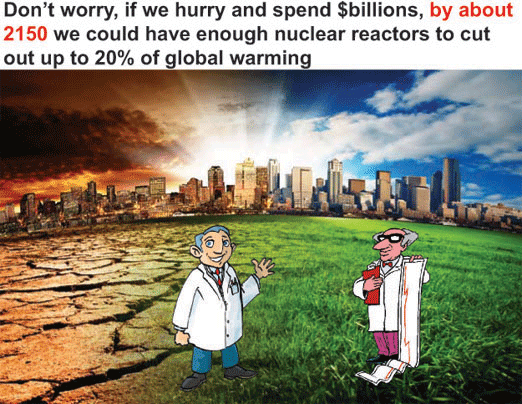
“……………………………………………………. SMRs will be needed in their hundreds if not thousands, requiring up front investment in factories and a known source of readily available fuel. None of this is in place. The typical timeframe for even a known reactor design is more than a decade — sometimes several decades. We don’t have that kind of time.
.

Small modular reactors would deliver electricity that is more expensive than that provided by traditional large reactors today

SMRs will actually produce more radioactive waste per unit of electricity generated than today’s reactors, waste for which there is still no safe and permanent solution.
Every dollar sunk into new small modular reactor plans could have reduced more carbon faster if invested instead in renewable energy and energy efficiency. It’s a no-brainer simple equation that an elementary school kid could work out. But not, apparently, our leaders. Why not?
See above (follow the money) and then there’s the weapons link.
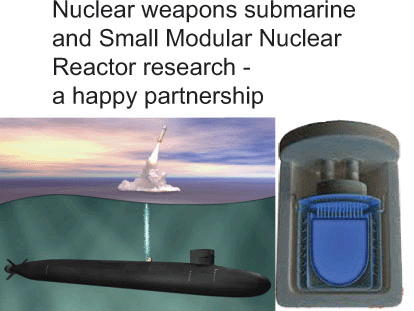
“A strong domestic supply chain is needed to provide for nuclear Navy requirements,” said the Energy Futures Initiative in its report — The U.S. Nuclear Energy Enterprise: A Key National Security Enabler. “This supply chain has an inherent and very strong overlap with the commercial nuclear energy sector and has a strong presence in states with commercial nuclear power plants.”
SMRs would keep that supply chain — and the civil nuclear sector — alive. A 2019 Atlantic Council report — The Value of the US Nuclear Power Complex to US National Security — agrees. “Civil nuclear underpins military nuclear,” it said. “The lack of a civilian nuclear sector would present an immediate and significant economic shock (and impact on the labor force) — which, in turn, would have immediate and longer-term budgetary implications for the US government.”
At least two of the companies striving to develop SMRs in the US have direct links to the nuclear weapons sector. Bill Gates’s TerraPower — whose reactor can be modified to “dual purpose” for weapons and power — has research and development partnerships with Los Alamos National Laboratory and the Y-12 National Security Complex, both of which design and test nuclear weapons. NuScale is majority owned by Fluor Corporation, which operates the U.S. Pantex and Y-12 nuclear weapons complexes.
Furthermore, SMRs are largely destined for export, and hardly for any domestic use at all. That hands proliferation-friendly materials, technology and know-how to countries not presently in possession of this relatively straightforward pathway to nuclear weapons.
If we are to understand the blind obsession with SMRs, the weapons connection offers one of the only plausible explanations. The stranglehold in the halls of power is the other — sound science, economics and our future be damned.
Only we can change this. Please use this latest edition of our Talking Points [Our newest edition — Unfounded Promises: Small Modular Reactors (SMRs) solve none of the challenges of nuclear power and make climate change and proliferation worse ] to contribute to a tsunami of our own — decrying the reckless waste of precious time and taxpayer money that would favor an elusive SMR program. These funds must urgently be directed to renewable energy, an industry that is here now, growing fast and one that can both reduce carbon emissions and provide good, long-term jobs into the future.
Note: In the interest of brevity, the Talking Points do not include footnotes. However, the sources and references used for the SMR Talking Points can be found in a separate document here. https://beyondnuclearinternational.org/2022/11/27/no-use-in-the-climate-crisis/
It’s high time to defuse the military carbon bomb
We cannot tackle climate change, and save our collective future, while increasing military spending.
the richest countries spent $9.45 trillion on their militaries between 2013 and 2021 compared with an estimated $234bn on climate finance – in other words, they have spent 30 times as much on the military as climate finance.
- https://www.aljazeera.com/opinions/2022/11/25/military-carbon-bomb Nick Buxton, Researcher at the Transnational Institute, 25 Nov 202225 Nov 2022,
The annual United Nations climate talks, known as the Conference of Parties (COP), have traditionally promised much but delivered little. This year’s COP27 was no different, with most observers noting that it even backtracked on commitments made at COP26 in Glasgow.
What was less observed was that the summit faced a major additional obstacle in 2022. This year, the climate crisis was overshadowed by the war in Ukraine which has been the foreign policy priority of the United States and the European Union since the beginning of Russia’s invasion in February.
The difference between the way the world’s richest countries responded to the Ukraine war and the carbon war on our whole planet is undoubtedly stark.
Since the beginning of Russia’s invasion, the US and its NATO allies provided Ukraine with military assistance worth more than $25bn, welcomed nearly seven million refugees, and willingly absorbed severe economic shocks caused by energy price increases triggered by the war.
Despite a global recession looming on the horizon, these countries did not hesitate to increase their military expenditure. Germany allocated 100 billion euros ($104bn) of its 2022 budget for the armed forces, for example, and the US House of Representatives approved a record $840bn military spending.
Yet at COP27, these same wealthiest nations were not even able to deliver the $100bn in climate finance that had been promised as far back as 2009 to the world’s most climate-vulnerable countries. A recent report co-published by the organisation I work for, the Transnational Institute, found that the richest countries spent $9.45 trillion on their militaries between 2013 and 2021 compared with an estimated $234bn on climate finance – in other words, they have spent 30 times as much on the military as climate finance.
After many years of pressure, at COP27, nations finally agreed to create a loss and damage mechanism to provide funds to impoverished countries suffering severe climate impacts, but it is so far just an empty pot. The accelerated arms race that has emerged since the Russian invasion and rising US-China tensions signal that filling that pot will not be a priority for most wealthy nations in the near future.
These spending choices matter not just because they are diverting resources from urgently needed climate action, but also because every dollar spent on the military is worsening the climate crisis. Most militaries consume significant amounts of fossil fuels. One estimate calculates that military emissions may make up 5.5 percent of global emissions. If the global military were a country, it would be the fourth biggest emitter in the world, ahead of Russia.
Furthermore, most of the world’s military spending goes towards the purchase of equipment and vehicles that are among the worst offenders when it comes to carbon emissions. In 2022 alone, for example, 475 new F-35 fighter jets, which use a whopping 5,600 litres (1,480 gallons) of oil per hour of flight, have been ordered. These fuel-guzzling planes could be flying for the next 30 years.
The emissions increase even further when war breaks out. The Ukrainian government at COP27 presented research showing that the first eight months of war had already led to 33 million tonnes of greenhouse gas emissions, equivalent to adding 16 million cars to the United Kingdom’s roads for two years.
US and UK military chiefs argue that they are committed to reducing military emissions, but their plans so far remain undetailed, opaque and unconvincing. Adding solar panels to a military base is easy to do, but does nothing to tackle the main challenge, which is fossil fuel consumption by military jets, ships and tanks. For now, there is no alternative, green fuel that can be produced at the scale needed and without triggering unacceptable social and environmental consequences, such as increased deforestation and the dispossession of Indigenous peoples.
The uncomfortable truth is that there is no way of ensuring that our planet remains habitable in the long term while continuing to increase military spending. In the midst of an intense and brutal war in Ukraine, this fact is too easily lost as governments are able to justify any increases in military spending to deal with the new immediate “threats”.
Moreover, the military spending of many rich countries is already way out of proportion to any real or perceived threat. NATO member states, for example, already spend 17 times as much on the military as Russia. The US spends more on its military than the next nine countries combined.
Meanwhile, the world has an ever smaller window to tackle climate change – the most pressing threat to our collective future. The Intergovernmental Panel on Climate Change says the world must cut emissions by 45 percent by 2030 to have any chance at keeping global average temperature increases below 1.5 degrees Celsius (2.7 degrees Fahrenheit). When every month counts, embarking on an accelerated arms race is the worst path the world’s most powerful nations can take. It diverts money and attention from urgent climate action, it increases emissions and it fuels conflicts at a time of increased climate instability.
Climate change can teach us a critical lesson about security. Carbon emissions do not recognise borders. It is not possible for any nation to shield itself from the effects of climate change using tanks or fighter jets. The only way to tackle the climate emergency is through global cooperation. Demilitarisation and peace are the best and perhaps the only ways to ensure that humanity has the capacity and resilience to respond to this crisis.
Only if the world’s leaders recognise that uniting to confront the threat of global heating is more important than any imperialist strategy or narrow economic interest, may we have a chance to avoid climate catastrophe. A secure nation in the end depends on a secure planet.
Take it from the soup throwers, COP’s a cop-out
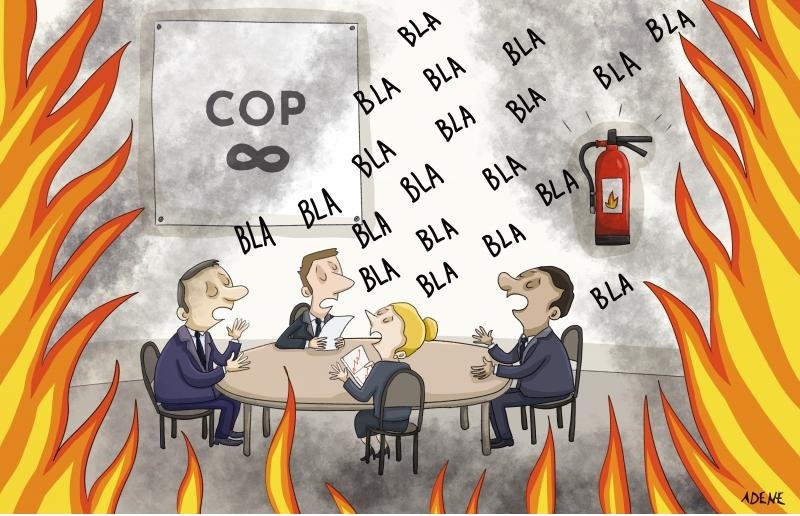
Holding the next climate conference in the oil-rich UAE shows how wealthy nations hide behind smug green nimbyism
If you’re enjoying the many hypocrisies flushed to the surface by the
World Cup in Qatar, then allow me to go one better. Next year’s United
Nations Climate Change Conference is to be held in Dubai. Yep, lovely,
green Dubai. A place so committed to environmental stewardship that I once
heard a resident describe the slick, viscous sea between the fronds of the
man-made Palm peninsula as “a bit athlete’s foot-ish”.
The same Dubai that, despite having little oil of its own, is also found within the UAE,
the world’s seventh-largest oil producer and third-largest per capita.
Forget the UAE, though, and come back to Britain. Probably, like me,
you’ve been fuming at environmental protesters these past months, as
they’ve thrown food over artworks, shut down roads and had annoying
names, like “Indigo”. Yet perhaps you’ve also had a latent sense of
guilt nagging at the back of your mind. On a global level, inaction is
still what we get.
Egypt’s Cop27, which finished this weekend, made zero
progress towards keeping the global temperature rise below 1.5C, despite
basically every country on the planet agreeing that we’re in trouble if
we don’t. Instead, discussions focused on the extent to which the richer,
more developed world should be paying “loss and damage” compensation to
the places that climate change affects the most.
Protesters talk often about the grim impacts of warming on “the global south”, and they’re
right. Recent floods in Pakistan, for example, displaced millions of people
and cost the country so many billions of pounds that they might as well
have had Liz Truss as PM for six weeks. Yet it’s also true that the same
poorer countries have the most to lose from future rises too. In effect,
they’re blackmailing the richer world by pointing a gun at their own
heads.
From Dubai onwards, this raises the prospect of Cop becoming a forum
that exists not to prevent climate change but rather to argue over who pays
for the damage while it rampages on. This, even while virtually every
individual government that is a part of it has a commitment to keeping the
rise down. Which, in the end, can only lead to a sort of environmental
nimbyism.
As in, you sort out your own backyard, if you can afford it,
while also not quite thinking about the effect your consumption or your
exports might have elsewhere. Much like the UAE. Much like us. If this
seems hopeless, that’s because it is. Sorry, but you know it, I know it
and the pink-haired soup-throwers know it too. Indeed, over the past couple
of months I’ve often worried that our swift rage at the imbecility of
Jocasta and Moonstar sticking themselves to a flyover, or whatever, is a
form of very basic displacement activity. It’s so much easier for us all
to condemn them for everything they’re doing wrong than it is for us to
grapple with the big thing they’re entirely right about. Which is that
the governments of the world are bodging this.
Times 22nd Nov 2022
https://www.thetimes.co.uk/article/take-it-from-the-soup-throwers-cops-a-cop-out-j5026mxsw
Fears that oil exporters will control the next COP climate summit

Fears are growing among climate experts and campaigners over the influence
of fossil fuel producers on global climate talks, as a key Gulf petro-state
gears up to take control of the negotiations. The United Arab Emirates, one
of the world’s biggest oil exporters, will hold the presidency of Cop28,
the next round of UN climate talks that will begin in late November next
year. Decisions taken at the Cop27 climate summit in Egypt, which finished
on Sunday, showed the clear imprint of fossil fuel influence, according to
people inside the negotiations. They said Saudi Arabia – an ally of Egypt
outside the talks – played a key role in preventing a strong commitment
to limiting temperature increases to 1.5C above pre-industrial levels. Many
countries, including the UK and the EU, were bitterly disappointed. Alok
Sharma, the UK president of last year’s Cop26 summit, said in visible
anger at the conclusion of Cop27 on Sunday morning: “Those of us who came
to Egypt to keep 1.5C alive, and to respect what every single one of us
agreed to in Glasgow, have had to fight relentlessly to hold the line.”
Guardian 22nd Nov 2022
At the close of COP27 Summit, some progress on climate justice.
The COP27 Climate Summit closed early on Sunday morning with the adoption
of an historic new accord that for the first time commits countries to
providing funding to the most vulnerable nations to help them cope with the
loss and damage inflicted by escalating climate impacts.
But the final accord failed to deliver much progress on global efforts to curb greenhouse
gas emissions, with those countries seeking a more ambitious deal accusing
a number of petrostates and their allies of seeking to backslide on
previous agreements.
The deal came after 48 hours of round the clock
negotiations as countries sought to finalise an agreement that built on
last year’s Glasgow Climate Pact by delivering a boost to flows of climate
finance and further action to accelerate decarbonisation efforts worldwide.
On Saturday afternoon, the Egyptian hosts confirmed that after several days
of deadlock the negotiations appeared to have secured a major breakthrough
following an agreement between the EU and the G77 group of developing
economies, including China, which saw them back plans for a new Loss and
Damage financing mechanism that could be operationalised at next year’s
COP28 Climate Summit in Dubai.
Business Green 20th Nov 2022
‘On The Highway To Climate Hell’ – The Climate Crisis, Activism And Broken Politics
Scientists are now admitting more often that they are ‘scared’ about
the climate crisis. Record high temperatures this summer in the UK alone
prompted Professor Hannah Cloke, from Reading University, to say: ‘This
sort of thing is really scary. It’s just one statistic amongst an
avalanche of extreme weather events that used to be known as “natural
disasters”.’
Aaron Theirry, co-founder of Scientists for Extinction
Rebellion, recently pointed out that: ‘The world’s largest oil and gas
companies are set to invest $930 billion over this decade in new fossil
fuel projects. Whilst the largest investment banks such as J.P. Morgan,
Citigroup, etc. have continued to pour hundreds of billions into the sector
since the Paris agreement.’
He added: ‘It was recently calculated that
fossil fuel companies already own seven times more reserves than can be
burned if we are to stay below 1.5C of global warming – yet they continue
to explore for more, with government backing!
Mark Campanale, CEO of Carbon
Tracker points out that if we look at current investment strategies then
“we are heading way beyond 3C degrees”. In other words, the global
political and financial elites are still marching us towards
catastrophe.’
In a recent interview with Aaron Bastani of Novara Media,
wildlife television presenter and conservationist Chris Packham made highly
articulate comments about the climate crisis, grassroots protest and the
destructive nature of the private media.
It is well worth quoting him at
length. As Bastani noted, Packham is a genuine national treasure, highly
regarded by much of the British public for his knowledge and passion about
the natural world and the environment, and for his keen ability to
communicate these issues effectively. Bastani asked him: ‘Do you think
politics in this country is capable of addressing the climate crisis?’
Packham answered: ‘No. No, I think the people will have to force our
politicians to address it. That’s why I continue to support those
activists [referring to Extinction Rebellion and Just Stop Oil] who are
making a noise about this, and trying to bring it to the forefront of
public attention, and express and articulate the urgency [of the situation]
that we now find ourselves in. ‘It’s not only that I don’t trust them
[politicians], it’s that even if they were trustworthy people, I don’t
think the system’s there to make it work.’
Media Lens 14th Nov 2022
“Everywhere you look at Egypt’s COP27 you can see and hear the influence of the fossil fuel industry” – Greenpeace .
Yeb Saño, Executive Director, Greenpeace Southeast Asia and Head of the
Greenpeace delegation attending the COP said: “While this is merely a
skeleton of the Egyptian Presidency’s draft of a COP cover note
Greenpeace is shocked that it has no backbone. It is scarcely credible that
they have forgotten all about fossil fuels especially with the level of
carbon cartel capture present here in Sharm el-Sheikh.”
“Everywhere you
look in Sharm el-Sheikh you can see and hear the influence of the fossil
fuel industry. They have shown up in record numbers to try and decouple
climate action from a fossil fuel phase out.”
“India clearly put all
fossil fuels on the phase down negotiating table. The EU could not have
been simpler in calling for a phase out. And, Tuvalu powerfully connected
transitioning away from fossil fuels with staying below 1.5C as a human
right. T
The ever present COP chroniclers of the Egyptian Presidency somehow
seem to have failed to record any of it.” The cover note must make it
clear that limiting temperature rise to 1.5C by 2100 is the only acceptable
interpretation of the Paris Agreement and acknowledge the 1.5°C aligned
global phase out dates for the production and consumption of coal, gas and
oil.”
Greenpeace International 15th Nov 2022
Nuclear Power Is Not the Answer

As world leaders convene at COP27 to discuss the global decarbonization agenda, they should focus on the technologies that can be deployed rapidly and universally to replace fossil fuels.
As consecutive editions of the WNISR have shown, nuclear power is too slow and too expensive to compete with energy-efficiency measures and renewable energy.
Project Syndicate, Nov 14, 2022 ANTONY FROGGATT
As world leaders convene at COP27 to discuss the global decarbonization agenda, they should focus on the technologies that can be deployed rapidly and universally. That means de-emphasizing nuclear power, which was no longer competitive with solar and wind even before this year’s geopolitical turmoil.
PARIS – Just as Russia’s invasion of Ukraine has highlighted Europe’s dangerous dependence on fossil fuels, increasingly frequent and intense climate-driven weather events are highlighting the death and destruction that fossil-fuel dependence has wrought. Understandably, political and public pressure to reduce greenhouse-gas emissions, move away from insecure primary energy supplies, and develop new, reliable, secure, and affordable energy sources is at an all-time high. But rather than rushing ahead, we need to consider carefully which options are most realistic, and how they will be deployed and operate in the real world.
Consider nuclear power. With many countries and companies now giving this option a second (or even a third) look, the 2022 World Nuclear Industry Status Report (WNISR) offers valuable insights into how the sector is faring.
While the last 12 months may be remembered as a turning point for the broader energy sector, it won’t be because of the nuclear industry. Nuclear energy’s share of global commercial gross electricity generation in 2021 dropped to 9.8%, which is its first dip below 10% in four decades, barely more than half its peak of 17.5% in 1996. Meanwhile, wind and solar surpassed nuclear for the first time in 2021, accounting for 10.2% of gross power generation.
These diverging trajectories can be seen clearly across every indicator of investment, deployment, and output. According to the International Atomic Energy Agency, operating reactors peaked in 2018, both in terms of their number (449) and total capacity (396.5 gigawatts). The IAEA reports that 437 reactors were “in operation” globally at the end of 2021, including 23 reactors that have not generated power for at least nine years, and which may never do so again.
In 2018, when installed nuclear power peaked below 400 GW, solar and wind capacity rose above 1,000 GW, on its way to reaching 1,660 GW by the end of 2021. In just three years, solar and wind added two-thirds more capacity than nuclear at its last peak. Even if nuclear plants usually generate more electricity per unit of installed capacity than wind and solar, the divergence in these numbers is staggering.
In 2021, total investments in non-hydro renewables hit a record $366 billion, adding an unprecedented 257 GW (on net) to electricity grids, whereas operating nuclear capacity decreased by 0.4 GW. Only six new reactors were connected to the grid that year, and half of these were in China. Then, in the first half of 2022, five new reactors went online, two of which were in China. But while China has the most reactors under construction (21, as of mid-2022), it is not building them abroad.
Until recently, that role was taken up by Russia, which is dominating the international market with 20 units under construction, including 17 in seven countries as of mid-2022. Sanctions and potential other geopolitical developments have cast doubt on many of these projects, with a Finnish consortium already canceling construction of a facility based on a Russian design.
Only 33 countries operate nuclear power plants today, and only three – Bangladesh, Egypt, and Turkey – are building reactors for the first time (all in partnership with the Russian nuclear industry). Twenty-six of the 53 construction projects around the world have suffered various delays, with at least 14 reporting increased delays, and two reporting new delays, just in the past year.
For the first time, the WNISR also assesses the risks of nuclear power and war. There has been significant international concern about Ukraine’s Zaporizhzhia nuclear power plant, which has been occupied by Russia forces since March 4, 2022. Owing to repeated shelling in and around the area, the plant has frequently lost external power, prompting warnings from the IAEA that the situation is “untenable.” Operating a nuclear facility requires motivated, rested, skilled staff; but Zaporizhzhia’s Ukrainian personnel are under severe stress.
The key challenge now is to maintain continuous cooling for the reactor core and the pool for spent fuel, even after the reactor is shut down. The failure to evacuate heat from residual decay would lead to a core meltdown within hours, or a spent-fuel fire within days or weeks, with potentially large releases of radioactivity.
As world leaders convene at COP27 to discuss the global decarbonization agenda, they should focus on the technologies that can be deployed rapidly and universally to replace fossil fuels. As consecutive editions of the WNISR have shown, nuclear power is too slow and too expensive to compete with energy-efficiency measures and renewable energy.
The USA’s “climate” envoy at COP27 John Kerry is just another nuclear shill

John Kerry, ostensibly the US Special Climate Envoy, but actually yet another nuclear industry shill, used the occasion of the COP first to hold a special press conference to trumpet a $3 billion US nuclear deal with Romania and then announced a small modular reactor partnership with, incredibly, Ukraine.
“We have a viable alternative in nuclear,” Kerry told reporters. Viable? This was duly lapped up by the press without challenge.
John Kerry uses last-chance climate summit to tout nuclear power, https://beyondnuclearinternational.org/2022/11/13/the-kerry-copout/
By Linda Pentz Gunter, 14 Nov 22
“Russia’s seizure earlier this year of Ukraine’s Zaporizhzhia nuclear energy facility is shining a new light on the safety and security risks of the atomic export policies of the United States and other technologically advanced countries,” began a promising November 8 article in Roll Call.
However, that light seems to have blinded those in power to any common sense.
What has the alarm over the vulnerabilities of Ukraine’s reactors caught in a war zone actually taught any of them? Let’s start with the International Atomic Energy Agency.
“The problem is not nuclear energy,” IAEA Director General Rafael Grossi told the BBC recently. Nuclear power, Grossi said,“can provide a safe, clean source of energy and this is why many countries in Africa and in other places are turning to nuclear.” It’s just war that’s the trouble, Grossi said.
That’s like the gun lobby claiming it’s bad guys, not guns, that do the killing. Sorry, but no. Bad guys without guns can’t shoot people. Broken solar panels and fallen wind turbines can’t release massive amounts of radioactivity. The problem here very definitely IS nuclear energy. Period.
The IAEA position isn’t disingenuous of course. It’s a necessity borne of the agency’s massive conflict of interest, bound, as it is, to further and expand the use of nuclear power across the world. And then enforce safety at plants that are inherently dangerous.
“You will see that nuclear energy has a really solid, very consistent safety record,” said Grossi as the COP27 climate summit got underway in Egypt.
Except of course when there is a war, a prolonged loss of power, a natural disaster, a major human error or a catastrophic technical failure. Then, all of a sudden, having nuclear power plants is, according to Grossi, “playing with fire.”
Will US elected (or appointed) officials take heed of the obvious obstacles presented by nuclear power plants to achieving lasting peace and safety? Of course not. As we wrote here last week, US vice president, Kamala Harris, crowed about selling three Westinghouse reactors to Poland, tweeting that “We can address the climate crisis, strengthen European energy security, and deepen the US-Poland strategic relationship.”
Only the third part is true and is, of course, the basis for the contract in the first place, given Poland’s shared Eastern borders with Russia, Lithuania, Belarus, and Ukraine.
John Kerry, ostensibly the US Special Climate Envoy, but actually yet another nuclear industry shill, used the occasion of the COP first to hold a special press conference to trumpet a $3 billion US nuclear deal with Romania and then announced a small modular reactor partnership with, incredibly, Ukraine.
“We have a viable alternative in nuclear,” Kerry told reporters. Viable? This was duly lapped up by the press without challenge.
The Romanian debacle-to-be will be funded by the US Export-Import Bank. The Ukraine announcement read:
“Special Presidential Envoy for Climate John Kerry and Ukraine Minister of Energy German Galushchenko announced a Ukraine Clean Fuels from SMRs Pilot project that will demonstrate production of clean hydrogen and ammonia using secure and safe small modular nuclear reactor (SMR) and cutting-edge electrolysis technologies in Ukraine.”
Then they used the word “clean” again four times in the next paragraph. Which speaks volumes and definitely falls into the “doth protest too much” category.
Meanwhile, some experts in the field are warning against exporting nuclear technology to countries that might become embroiled in a war. Surely that would rule out Ukraine? And most if not all of Grossi’s beloved Africa? And what about Poland and Romania? How can we ever be sure which countries might suddenly find themselves at war? Another world war in Europe seemed unthinkable until February 24, 2022.
“An air raid siren sounded for the first time this morning in the nuclear city of Sosnovy Bor on the southern coast of the Gulf of Finland in the Baltic,” wrote Russian activist, Oleg Bodrov, a member of the Public Council of the Southern Coast of the Gulf of Finland (PCSCGF) in a November 8 email.
“A similar siren would have been heard by 2 million residents of the Leningrad Region,” said Bodrov. “It was a drill in case of war, which was carried out by decision of the authorities of the region.”
The term “nuclear football” is traditionally applied to the black bags containing the “nuclear button” that accompany the US president and vice president at all times. (The third is kept at the White House.) But nuclear power plants are also now proverbial nuclear footballs, being used to deliver a false sense of security but actually putting the countries on whose soil they sit in far greater danger.
Selling US reactors to Eastern European countries clearly has nothing whatever to do with climate or energy needs. “We don’t get to net zero by 2050 without nuclear power in the mix,” Kerry said at his COP press conference. Actually, yes, doing without slow, expensive and dangerous nuclear power is essential if we have any chance whatsoever of achieving net zero (2050 is already too late).
It is ever more apparent that most of our “mediocre politicians,” as Bodrov rightly characterizes them, are not interested in net zero. They are interested in using nuclear power as a nuclear weapons surrogate; in bolstering alliances with Russia’s neighbors in a dangerous move to drive Russia into ever greater political isolation; in propping up failing nuclear corporations like Westinghouse; and in answering their nuclear paymasters in Washington by wasting time and our money on foolish new nuclear plants that are irrelevant to addressing the climate peril we are already in.
Linda Pentz Gunter is the international specialist at Beyond Nuclear and writes for and curates Beyond Nuclear International.
Nuclear Industry’s big lobbying push pays off at COP27, as politicians spout pro nuclear propaganda

The nuclear-military-industrial-government-complex must be paying up very big bucks for the lobbying effort at the climate conference – selling the lie that nuclear is clean and renewable.
Glowing pro nuclear recommendations from US presidential climate envoy John Kerry, Egypt’s oil minister Tarek el-Molla, French President Emmanuel Macron – it all sounds so good, doesn’t it?
IEA executive director Fatih Birol could hardly control his enthusiasm for nuclear – “nuclear is making a comeback”, with countries like the Netherlands, Poland and developing countries in Asia-Pacific finding a renewed appetite for new nuclear deals.“
And yet, and yet, if you listen carefully, they cover their backs with the recognition that nuclear is really unaffordable, – “budget constraints” – they call it
Cop 27: Nuclear energy in focus,
https://www.argusmedia.com/en/news/2389700-cop-27-nuclear-energy-in-focus 10 Nov 22
Finance day at the Cop 27 UN climate conference in Sharm el-Sheikh this week saw more focus put on developing nuclear energy, which has been touted in some quarters as the fuel for a carbon-free system and energy security.
IEA executive director Fatih Birol said on the sidelines of the summit that “nuclear is making a comeback”, with countries like the Netherlands, Poland and developing countries in Asia-Pacific finding a renewed appetite for new nuclear deals. The IEA, which had predicted an atomic comeback in November last year, was no longer alone in “trying to show the world that nuclear has its place when it comes to addressing energy security and climate change”, Birol said.
But he lamented delays in delivery and budget constraints associated with the nuclear industry. He said international financial institutions have “failed” to aid developing countries with clean energy financing, and said: “I wouldn’t give them a passing grade”.
At Cop 27 there have been some signs of progress. The US Export-Import (Exim) Bank said it would provide a $3bn loan to Romania for construction of two units at the country’s 1.4GW Cernavoda nuclear power plant. The bank handed two letters of interest to Romania’s energy minister Virgil Popescu at the summit, outlining an initial $50mn loan to support development of a second phase of the new units, and a subsequent loan of $3bn that will cover the bank’s total contribution to the project.
US presidential climate envoy John Kerry called this financing a “bolster” for energy security and said it will help “expand carbon-free energy” in Romania.
Egypt’s oil minister Tarek el-Molla said at Cop 27 that the country is on track to achieve its goal of increasing the share of renewables in the energy mix, and that nuclear energy should be included in this. Construction at the country’s first nuclear power plant at El-Dabaa, northwest of Cairo, started in July.
Earlier in the week, French President Emmanuel Macron said nuclear energy, alongside renewables, was an important pillar for countries such as South Africa to move away from coal, and said Paris would invest €1bn in helping South Africa achieve that goal.
Countries like Romania, South Africa and Egypt adopting or increasing their nuclear generating capacity are essential if the IEA is to be proven right that there will be a doubling of capacity between 2020-50, as it estimated in its global pathway to net zero emissions by 2050.
“When we look at the world, electricity demand growth comes from emerging countries,” Birol said in Egypt. “And for these emerging countries to build large scale nuclear power plants may be a bit challenging for many reasons, including financial, in the first down payment and the technology.” He stressed the need for small modular reactors to be commercially available before or around 2030, which he said would give a “very good chance” for emerging economies to meet growing power demand.
By Florence Schmit, Nader Itayim and Rithika Krishna
Climate change, not China, is Australia’s real security danger

The definitive case against nuclear subs The Saturday Paper, Albert Palazzo -adjunct professor at UNSW Canberra. He was a former director of war studies for the Australian Army. November 12, 2022 “……………………………………………………………. Too many security officials hold to the mistaken belief that China is the most significant threat Australia faces. In fact, climate change deserves the top spot. Climate scientists, United Nations officials and military commanders themselves, including current US Secretary of Defense Lloyd Austin, consider climate change an existential threat to survival. Any threat posed by China is much more limited. At worst, China’s challenge to the US-led world order could result in America’s withdrawal from the Western Pacific. Climate change could lead to the end of the human project and take countless other species down with us.
China represents, at most, a second-order threat, but it is China that draws the obsessive focus of much of the current generation of security thinkers. It does not make sense for Australia to invest so much in a weapon system that has no utility against the nation’s most dangerous threat, yet this is what is happening.
Advocates of nuclear-powered submarines also propose that constructing these vessels in Adelaide will help sustain a sovereign shipbuilding industry. In fact, the opposite is the likely result. Once in service these vessels will actually increase Australia’s dependence on the US and foreign contractors. This is because many of the sub’s critical components, weapons and systems will be made by foreign parties. Australian sailors might even need shadow US sailors to co-staff technical positions until Australia generates enough nuclear-savvy personnel of its own.
The government has announced it will invest between $168 billion and $183 billion in what it has called a national naval shipbuilding enterprise, with the goal of sustaining and growing a domestic shipbuilding capability and securing Australian jobs for the future. Such a capability is a noble goal, but what has been left unexplained is why it should be such a priority compared with foreign-dominated industries that are more critical to the nation’s future wellbeing.
Last summer, for example, Australian transport risked grinding to a halt as a result of the urea crisis, which led to a serious shortage of AdBlue, a vital diesel fuel additive. Without AdBlue, the nation’s fleet of long-haul trucks would have stopped moving, resulting in supermarkets running out of food, farmers not harvesting their crops and the mining industry coming to a halt. Yet there has been no talk of taxpayer-supported AdBlue production in Australia. Similarly, many medicines are imported, as are a host of important everyday items, such as baking powder and matches. Unlike shipbuilding, these industries apparently warrant no support.
If one wanted a truly sovereign defence industry, then the product that might mandate the level of support proposed for the subs is microchips. Virtually all military and civilian technology contains chips, yet Australia is happy to remain fully reliant on overseas suppliers for this most important of components. Establishing a domestic industry would require a huge subsidy, as well as additional investment in tertiary education and precursor manufacturing processes. Without these chips, however, no weapon system is truly sovereign.
So why the nuclear-powered subs, if they make so little sense? The obvious answer is to support the alliance. Instead of aiming for self-reliance, Australia has always preferred to seek the protection of a great power. But there is another reason: like a kid in a lolly shop, Australia has been given permission to buy the biggest treat on display. Nuclear-powered subs are one of America’s most closely guarded technologies. If Australia gets them, it will be a clear sign that, like Britain, we have been admitted to a very exclusive club, the inner sanctum of US security. What is missed, however, is that being in the inner sanctum generates a massive obligation – and some day that bill may fall due. https://www.thesaturdaypaper.com.au/opinion/topic/2022/11/12/the-definitive-case-against-nuclear-subs
A bigger-than-ever pack of fossil fuel lobbyists at COP27.
New research from CEO, Corporate Accountability and Global Witness shows
there were over 100 more fossil fuel lobbyists registered to attend the
COP27 climate talks in Sharm El-Sheik, Egypt, than last year in Glasgow,
UK. Data analysis of the UN’s provisional list of named attendees
identified at least 636 fossil fuel lobbyists, affiliated with some of the
world’s biggest polluting oil and gas giants such as Shell, Chevron and BP.
This is an increase of over 25% from COP26, showing a rise in the influence
of the fossil fuel industry at the climate talks that are already rife with
accusations of civil society censorship and corporate influence.
Corporate Europe 10th Nov 2022
https://corporateeurope.org/en/2022/11/cop27-100-more-fossil-fuel-lobbyists-last-year
There are more than 600 fossil fuel lobbyists at the Cop27 climate
conference, a rise of more than 25% from last year and outnumbering any one
frontline community affected by the climate crisis.
Guardian 10th Nov 2022
Gas producers and their financial backers see Cop27 as an opportunity for
discussions about rebranding natural gas as a transition fuel rather than a
fossil fuel, experts have said. The push is coming from the host Egypt and
its gas-producing allies amid a global energy crisis compounded by
Russia’s invasion of Ukraine.
Guardian 11th Nov 2022
Sea level rise as Greenland ice thaws faster than expected
Sea levels might rise much faster than thought, data from Greenland
suggest. Greenland’s largest ice sheet is thawing at a much higher rate
than expected, a new study has revealed, suggesting it will add six times
more water to the rising sea levels than previously thought. And the trend
may not be limited to Greenland, scientists worry.
Space.com 10th Nov 2022
https://www.space.com/greenland-ice-melting-satellite-data-climate-change
TODAY. The Times got it right about 5 reasons for hope on climate action, but very wrong on one

I wonder why journalists do this? Presumably, this Times writer is not ignorant, not stupid. And yet, slipped in amongst some genuine factors about clean energy sources and energy efficiency, – we come to his uncritical admiration for nuclear fusion and small nuclear reactors.
The writer does mention the “prototype nuclear fusion” planned for 2040. A fat lot of good that would be – we need action now – not promises for the nebulous far-off future!
As always – I am stunned at the corporate journalists’ complacency – in trotting out the military-industrial-corporate-government line on matters nuclear.
The connection here is that small nuclear reactors have only one genuine use – to assist and promote the nuclear weapons industry
Six reasons to be cheerful about the climate’s future. Times 9th Nov 2022
Growth in emissions is slowing, clean energy is cheaper and electric cars are denting oil, Adam
Vaughan writes.
Between warnings from the Cop27 climate conference in Egypt
that the world is on a “highway to climate hell” and “the planet has
become a world of suffering”, it can be easy to think that no absolutely
no progress has been made on curbing global warming.
It is certainly true
that the world is falling wildly short of its 1.5C climate goal target. But
it is simultaneously true that great strides are being made in the world of
science, business and technology, as the following six examples show.
(1) Global carbon emissions growth has slowed; The emissions from humanity’s
cars, factories and power stations are still going up, when scientists say
they need to have fallen 45 per cent by the end of this decade if the world
is to rein in warming to 1.5C. The silver lining is there are signs that
emissions are hitting a plateau.
(2) Renewable energy is rapidly getting
cheaper. Most authorities, including the International Energy Agency (IEA)
and leading scientists, think that wind and solar power will be the two key
technologies for decarbonising the world’s electricity supplies. Between
2010 and 2019, the costs for solar energy fell by 85 per cent. Wind energy
fell costs fell by 55 per cent. Investment is pouring into renewable energy
at a record rate, with $226 billion invested in the first half of 2022
according to Bloomberg New Energy Finance, which tracks clean energy
spending.
Global energy demand growth will now “almost entirely be met by
renewables, the IEA said recently. In the UK, the cost of offshore wind and
solar has fallen by 80 to 90 per cent over the past decade. “Wind and
solar are now the cheapest way to generate electricity in most of the world
and, in the UK, we get as much electricity from renewables as we do from
gas,” said Evans. In July, five new offshore wind farms due online from
2026 won a government auction to deliver power to consumers at £37.35 per
megawatt hour, a fraction of the cost of gas-fired power plants now.
(3) High gas prices have made cutting emissions cheaper. The UK’s Climate
Change Committee, an independent body which advises the government on how
to meet its carbon targets, said in June that soaring gas prices meant that
meeting net zero would flip from a 0.5 per cent cost to GDP by 2035, to a
0.5 per cent saving by 2035.
(4) Technology can be seen as a breath of
fresh air. Energy efficiency improvements have delivered huge gains, with
better appliances and LED bulbs saving the average UK household £290 a year
between 2008 and 2017. Typical household energy bills today would have been
£40 a year lower if David Cameron hadn’t cut insulation programmes in 2013.
(5) Other countries are passing climate laws: President Biden came to Cop26
in Glasgow with a promise of halving his country’s emissions by 2030, but
no domestic plan to deliver the cuts. This time John Kerry, his special
climate envoy, can boast that America recently passed legislation that
commits the country to spending £318 billion on clean energy. The package,
which largely consists of incentives for key technologies such as wind and
solar power, electric cars and hydrogen, is expected to deliver a 40 per
cent emissions cut by 2030, not far off Biden’s target.
(6) Innovative new
technology is gaining traction: Previously far-off ideas are nearing
commercial reality, and the UK is pioneering many of them. The UK is
planning to build the world’s first prototype nuclear fusion power station
by 2040. A new generation of new nuclear power stations backed by
Rolls-Royce, much smaller and hopefully easier to build than conventional
ones, are working their way through the UK’s nuclear regulatory approval
process. Giant electrolysers are being built next to an offshore wind farm
in northeast England to split water and produce a clean supply of hydrogen.
The UK government is even taking seriously the prospect of space-based
solar power, where solar panels in Earth’s orbit beam a steady stream of
electricity back to the planet’s surface.
https://www.thetimes.co.uk/article/six-reasons-to-be-cheerful-about-the-climate-s-future-9s0wgddkq
At COP27 Climate Summit the International Atomic Energy Agency joins all those paid nuclear lobbyists in pushing the lie that “nuclear solves the climate problem”
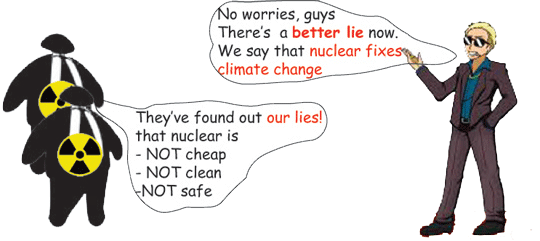
At COP27, nuclear power industry vies for bigger role in decarbonizing planet
https://www.reuters.com/business/cop/cop27-nuclear-power-industry-vies-role-decarbonizing-planet-2022-11-09/ By Richard Valdmanis, Sarah Mcfarlane and Valerie Volcovici
HARM EL-SHEIKH, Egypt, Nov 9 (Reuters) – Nuclear energy supporters including politicians and activists sought to polish the industry’s spotty image on Wednesday, using the COP27 climate summit in Egypt to argue that atomic power offers a safe and cost-efficient way to decarbonize the world.
Rising concerns about the swift pace of climate change and tight power supplies around the globe have softened some policy makers view of nuclear energy, an industry that has struggled for years to draw investment because of worries about safety, radioactive waste, and huge costs for building a reactor.
The International Atomic Energy Agency, an intergovernmental organization that seeks to promote nuclear power, opened an exhibit at the U.N. climate gathering of global leaders in Egypt – its first time doing so in 27 years of the annual international climate negotiations. The showcase expounded the technology’s potential in the fight against climate change.
When you talk about nuclear, you’re talking about a confirmed energy producer which is not part of the problem, but rather part of the solution,” IAEA Director General Rafael Mariano Grossi told Reuters in an interview.
“You will see that that nuclear energy has a really solid, very consistent safety record,” he added.
U.S. Special Climate Envoy John Kerry, meanwhile, pumped up the industry on Tuesday at a news conference at the summit announcing the U.S. Export-Import Bank (EXIM)’s formal interest in providing $3 billion in financial support for a nuclear plant in Romania.
“We have a viable alternative in nuclear … This is one of the ways in which we can achieve net-zero,” he told reporters, referring to an international target of cutting net greenhouse gas emissions to zero by 2050. “We don’t get to net zero by 2050 without nuclear power in the mix.”
The United States has already earmarked billions of dollars toward keeping existing nuclear power plants open as part of a broader strategy to decarbonize the economy and is hoping to encourage new projects.
The nuclear power industry has had trouble raising money in recent years, having taken a huge public relations hit following the 2011 reactor meltdown at the Fukushima power plant in Japan. Russia’s invasion of Ukraine has further raised concerns about nuclear safety with sporadic fighting and power cuts at the site of the Zaporizhzhia plant.
Oleksii Riabchyn, advisor to the Ukraine government on green energy, told Reuters at the summit that he thought the country’s reactors required a missile shield to protect them.
AEA’s Grossi said the security concerns in Ukraine should not dissuade countries from building nuclear plants: “The big problem is war, is not nuclear energy or any other industrial activity.”
He added he was in the midst of “very complex” negotiations with Russia and Ukraine over a proposed no-combat zone around the plant and hoped for an agreement soon.
Hannah Fenwick, the co-lead of Nuclear for Climate which represents a network of 150 associations advocating for governments to embrace nuclear power, said her organization was lobbying policy-makers at COP27 to consider nuclear energy investments and was getting decent feedback.
“We have been saying that nuclear is a solution for climate for many years and the geopolitical climate has changed and people are now listening,” she said.
Reporting by Richard Valdmanis, Sarah McFarlane and Valerie Volcovici; Editing by Katy Daigle, Frank Jack Daniel and Deepa Babington
1 This Month
19 February – VIRTUAL EVENT-Decision Time: AI and Our Nuclear Arsenal
12:45 p.m. Central / 1:45 p.m. Eastern
To see nuclear-related stories in greater depth and intensity – go to https://nuclearinformation.wordpress.com

-
Archives
- February 2026 (141)
- January 2026 (308)
- December 2025 (358)
- November 2025 (359)
- October 2025 (376)
- September 2025 (258)
- August 2025 (319)
- July 2025 (230)
- June 2025 (348)
- May 2025 (261)
- April 2025 (305)
- March 2025 (319)
-
Categories
- 1
- 1 NUCLEAR ISSUES
- business and costs
- climate change
- culture and arts
- ENERGY
- environment
- health
- history
- indigenous issues
- Legal
- marketing of nuclear
- media
- opposition to nuclear
- PERSONAL STORIES
- politics
- politics international
- Religion and ethics
- safety
- secrets,lies and civil liberties
- spinbuster
- technology
- Uranium
- wastes
- weapons and war
- Women
- 2 WORLD
- ACTION
- AFRICA
- Atrocities
- AUSTRALIA
- Christina's notes
- Christina's themes
- culture and arts
- Events
- Fuk 2022
- Fuk 2023
- Fukushima 2017
- Fukushima 2018
- fukushima 2019
- Fukushima 2020
- Fukushima 2021
- general
- global warming
- Humour (God we need it)
- Nuclear
- RARE EARTHS
- Reference
- resources – print
- Resources -audiovicual
- Weekly Newsletter
- World
- World Nuclear
- YouTube
-
RSS
Entries RSS
Comments RSS
 nuclear-news