How “Dumb Money” Nukes Boil & Bankrupt The Earth
So today’s real reactor battle is not over new ones, which essentially don’t exist.
It’s about the risks posed by the old ones, all of which lack comprehensive liability insurance.
Harvey Wasserman 10 Oct 23 https://www.downwithtyranny.com/post/how-dumb-money-nukes-boil-bankrupt-the-earth
No new U.S. reactors, big or small, fission or fusion will be built here within at least the next five years…more like ten. Those that try will do nothing but divert resources away from the Solartopian technologies needed to save the Earth.
They’ll also lose big money for their billionaire backers and the taxpayers who’ll be forced to bail them out.
There are now 93 large uninsured light-water reactors licensed for operation in the US. One more– Georgia’s Vogtle #4– may open within the next year or so.
All of them emit radioactive Carbon-14. They release additional greenhouse gasses through the process of mining, milling and enriching uranium-based fuel, as well as attempting to store it once it’s become radioactive waste.
All commercial reactors burn at ~570 degrees Fahrenheit, warming the planet on their own.
Meanwhile, there are zero such commercial nukes in the pipeline. None are under construction.
No credible observer– pro-nuke or no nuke– contends that any large new reactor could be ordered, built, licensed, insured and brought on line in the United States within the next decade or two… well beyond whatever window we might have to solve our worsening climate crisis.
The whole industry, which is inseparable from the nuclear weapons complex, was sold to the public on the premise that its electricity would come “too cheap to meter.”
But consider the last eight major reactor projects in the US and Europe:

Finland’s Olkiluoto3 opened last year, billions of Euros over budget and more than a decade behind its original 2009 promise date. Though brand new, it’s already been forced to scale back operations at least once due to a massive influx of far cheaper solar/wind/hydro-generated electricity.

France’s Flamanville remains under construction, also years late and billions over budget.

Two reactors at England’s Hinckley, again years late, have soared beyond E35 billion. Odds on them ever opening are up for grabs. Odds on them ever cost competing with wind or solar are less than zero.

Two huge reactors at VC Summer are stillborn. Their $9 billion in construction costs have stuck South Carolina with a dusty mausoleum that will never generate power.

After fifteen years, Georgia’s Vogtle #3 has finally gone critical. Unit #4 may open next year. Projected in 2008 at $14 billion, the pair together may yet exceed $40 billion. They’ll certainly be the last big light water reactors built in the U.S.
Together Summer and Vogtle bankrupted Westinghouse. The European projects have bankrupted Electricite de France.
Thus Wall Street’s unwillingness to fund big new nukes is likely to deepen.
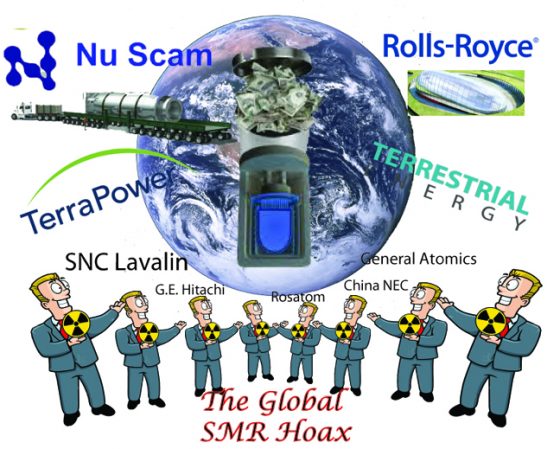
So now we hear instead about “Small Modular Reactors.” With backing from the likes of Bill Gates and Oliver Stone, the idea of mass producing small, simple nukes claims major media fandom. The critiques of SMRs are widespread and varied.

But there’s no more hilarious proviso than one coming from the industry itself, in the form of a sort of disclaimer from NuScale in a recent announcement. The list of “warnings” resembles one we hear on the air for various prescription drugs, but stretches in length to resemble a documentary film, practically matching this article in length. Take a look by scrolling down to the section that begins “Forward Looking Statements.” You may want to settle in with a cup of coffee.
At this point, there are currently no proven SMR prototypes. Cost projections again recall that 1950s “too cheap to meter” lie told by Atomic Energy Commission Chair Lewis Strauss (the villain in the film Oppenheimer).
NuScale’s promised delivery date has already slipped from 2026 to 2029. Independent assessments put that well into the 2030s. The billions squandered on such projects divert capital that should otherwise fund renewables.
Likewise much-hyped thorium reactors, which remain untested, unproven, and of uncertain costs.

As for fusion, its operations would concentrate temperatures of 100 million degrees Fahrenheit on an increasingly fragile planet. And that despite decades of intense research, and gargantuan expenditures, its future availability, ecological impacts and financial costs remain naggingly uncertain.
Thus, in the vital window from now until decade’s end, no new nukes, large or small, fission or fusion, will be ready to tangibly replace the burning of fossil fuels. The once-beloved nuclear genie can’t cure global boiling. There’s simply no there there.
Which makes our current fleet of atomic elders even more dangerous. Thoroughly decayed reactors like California’s Diablo Canyon and Michigan’s Palisades soak up billions in public funds to keep operating. But they’ve yet to secure comprehensive liability insurance. At a current average age of more than forty (Diablo opened in 1985) they cost far more to operate than proven, readily available wind, solar, battery and efficiency technologies.
Diablo in particular is plagued by deadly flaws such as embrittlement, cracked pipes, seismic vulnerability, an aging workforce and much more.
So today’s real reactor battle is not over new ones, which essentially don’t exist.
It’s about the risks posed by the old ones, all of which lack comprehensive liability insurance.
And about how quickly we can bury at last the immensely powerful fossil fuel industry that threatens us all.
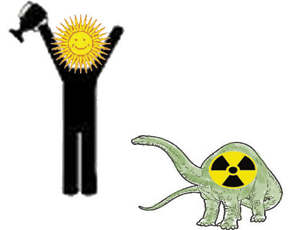
For that, the only clear solution comes with a fast-as-possible shift to safer, cleaner, cheaper truly green Solartopian renewables that actually do exist. That are constantly evolving.
They may not be too cheap to meter (except in rare cases, like nighttime wind power in west Texas).
But they comprise today’s last, best hope to cool our boiling Earth…while creating jobs and profit for those wise enough to see it now. #nuclear #antinuclear #NuclearFree #NoNukes
World breaches key 1.5C warming mark for record number of days
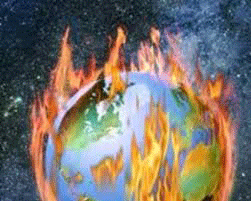
The world is breaching a key warming threshold at a rate that has
scientists concerned, a BBC analysis has found. On about a third of days in
2023, the average global temperature was at least 1.5C higher than
pre-industrial levels. Staying below that marker long-term is widely
considered crucial to avoid the most damaging impacts of climate change.
But 2023 is “on track” to be the hottest year on record, and 2024 could be
hotter. “It is a sign that we’re reaching levels we haven’t been before,”
says Dr Melissa Lazenby, from the University of Sussex.
BBC 7th Oct 2023
Reconciling With Truth Requires Listening… what about nuclear waste?
September 30, 2023 https://mailchi.mp/preventcancernow/reconciling-with-truth-requires-listening?e=ba8ce79145 #nuclear #antinuclear #nuclear-free #NoNukes
As Canadians look back and Remember the Children who suffered at residential schools, we wish to highlight Algonquin First Nations’ important work to protect the health of children, and the Kitchi Sibi (Ottawa) River watershed from pollution.
The First Nations oppose a hillside nuclear waste Near-Surface Disposal Facility (NSDF) proposed on unceded Algonquin territory at the Chalk River Nuclear Laboratories. In a remarkable turn of events, rainfall during the final hearing on the NSDF demonstrated that the Canadian Nuclear Safety Commission (CNSC) is unlikely to meet its goal to keep nuclear waste secure for hundreds of years.
At Chalk River Nuclear Laboratories scientists first worked on the atomic bomb in the 1940s; ongoing nuclear research ever since has resulted in voluminous waste, that will remain toxic longer than planning horizons. People oppose transportation of nuclear waste through their communities, so the CNSC concluded that it had to deal with waste onsite. A federal Environmental Impact Statement (EIS) was published for a nuclear waste NSDF.
Disturbingly, assessment of the natural environment is absent from the federal EIS, so the Algonquin First Nations retained experts and published Assessment of the CNSC NSDF and Legacy Contamination in June 2023.
The federal assessment found that the top risk for stability of hillside waste disposal was severe rainfall. Too much rain could sweep the nuclear waste down the hill and into Perch Lake, polluting Perch Creek and the Kitchi Sibi River a kilometre away. This could pollute the ecosystem and food sources, as well as drinking water for millions of people downstream in smaller towns, Ottawa and cities.
On Aug. 10, 2023, at the sacred site where the Rideau, Kitchi Sibi and Gatineau rivers tumble together, Chiefs of Kebaowek, Kitigan Zibi Anishinabeg and Mitchibikonik Inik First Nations, Elders and other experts, made final submissions to the CNSC. As witnesses spoke, attendees heard a roar of rain drumming on the roof.
This rain flooded Ottawa streets and basements, stopped traffic, took out power, and backed up sewers. Five centimetres of rain fell in an hour, and more than 300 million litres of untreated water flowed into the Ottawa River.
The EIS vastly under-estimates future weather severity, defining “heavy rainfall” as over only 0.7 cm per hour. The EIS also cites a 2013 estimate of low tornado risks—an insult to fresh memories of catastrophic tornadoes and derechos in Eastern Ontario.
The acceleration of climate disasters is boggling Canada’s long-term predictions of the scale of extreme weather. The nuclear waste disposal facility was designed to withstand end-of-the-century estimates of less than five cm of precipitation in a day for Deep River, and over five cm in a day—not an hour—for Ottawa.
Ottawa’s not alone in breaking rainfall records and disproving future estimates. July 2023 brought rainfall disasters to Nova Scotia, with rainfall up to 50 cm per hour measured in one location. Much of the province experienced 20 cm in a day, causing widespread damage. Canadian federal climate predictions call for much less—up to 9 cm in a day by the end of the century.
If an Environmental Impact Assessment for a bridge was discovered to be this flawed—that the bridge would not withstand a storm as severe as what just occurred—it would be a good reason to reconsider the plans. The Canadian Nuclear Safety Commission should heed the warning from Mother Nature and deny the present proposal.
2
World could be heading for hottest October on record – after hottest July, August and September ever

2023 is on track to be the hottest year on record as an emerging El Niño adds to the impact of climate change
World could be heading for hottest October on record – after hottest July,
August and September ever. 2023 is on track to be the hottest year on
record as an emerging El Niño adds to the impact of climate change.
iNews 5th Oct 2023
https://inews.co.uk/news/world-hottest-october-record-uk-autumn-heatwave-2666877
The Pope speaks out against climate deniers
The Pope has warned the world is “collapsing” in a stark new document
about the perils of climate change in which he takes aim at deniers and
backs “radicalised” environmental protesters.
Times 4th Oct 2023
https://www.thetimes.co.uk/article/pope-francis-synod-2023-environment-nature-28p9swmmk
A “New Cold War” on an Ever-Hotter Planet
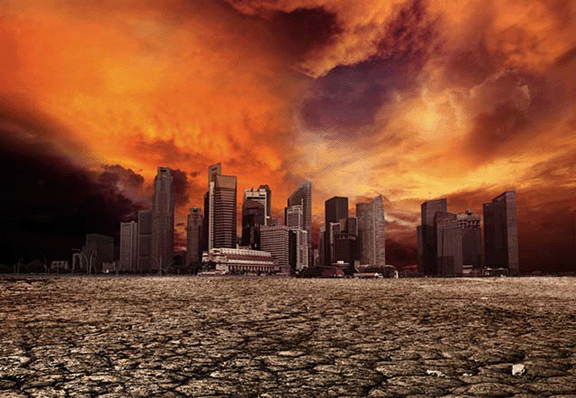
The Slow-Motion Equivalent of a Nuclear War?
Tom Dispatch BY TOM ENGELHARDT, 1 Oct 23
Tell me, what planet are we actually on? All these decades later, are we really involved in a “second” or “new” Cold War? It’s certainly true that, as late as the 1980s, the superpowers (or so they then liked to think of themselves), the United States and the Soviet Union, were still engaged in just such a Cold War, something that might have seemed almost positive at the time. After all, a “hot” one could have involved the use of the planet’s two great nuclear arsenals and the potential obliteration of just about everything.
But today? In case you haven’t noticed, the phrase “new Cold War” or “second Cold War” has indeed crept into our media vocabulary. ………………………………………
let’s stop and think about just what planet we’re actually on. In the wake of August 6 and August 9, 1945, when two atomic bombs destroyed the Japanese cities of Hiroshima and Nagasaki, there was little doubt about how “hot” a war between future nuclear-armed powers might get. And today, of course, we know that, if such a word can even be used in this context, a relatively modest nuclear conflict between, say, India and Pakistan might actually obliterate billions of us, in part by creating a — yes, brrr — “nuclear winter,” that would give the very phrase “cold” war a distinctly new meaning.
These days, despite an all too “hot” war in Ukraine in which the U.S. has, at least indirectly, faced off against the crew that replaced those Soviet cold warriors of yore, the new Cold War references are largely aimed at this country’s increasingly tense, ever more militarized relationship with China.
Its focus is both the island of Taiwan and much of the rest of Asia. Worse yet, both countries seem driven to intensify that struggle.
In case you hadn’t noticed, Joe Biden made a symbolic and much-publicized stop in Vietnam (yes, Vietnam!) while returning from the September G20 summit meeting in India. There, he insisted that he didn’t “want to contain China” or halt its rise. He also demanded that it play by “the rules of the game” (and you know just whose rules and game that was). In the process, he functionally publicized his administration’s ongoing attempt to create an anti-China coalition extending from Japan and South Korea (only recently absorbed into a far deeper military relationship with this country), all the way to, yes, India itself.
And (yes, as well!) the Biden administration has upped military aid to Japan, Taiwan (including $85 million previously meant for Egypt), Australia (including a promise to supply it with its own nuclear attack submarines), and beyond. In the process, it’s also been reinforcing the American military position in the Pacific from Okinawa, Guam, and the Philippines to — yes again — Australia. Meanwhile, one four-star American general has even quite publicly predicted that a war between the U.S. and China is likely to break out by 2025, while urging his commanders to prepare for “the China fight”! Similarly, Director of National Intelligence Avril Haines has called China the “leading and most consequential threat to U.S. national security” and the Biden foreign policy team has been hard at work encircling — the Cold War phrase would have been “containing” — China, both diplomatically and militarily.
On the Chinese side, that country’s military has been similarly ramping up its air and naval activities around and ever closer to the island of Taiwan in an ominous fashion, even as it increases its military presence in places like the South China Sea (as has the U.S.). Oh, and just in case you hadn’t noticed, with a helping hand from Russia, Beijing is also putting more money and effort into expanding its already sizable nuclear arsenal.
Yes, this latest version of a Cold War is (to my mind at least) already a little too hot to handle. And yet, despite that reality, it couldn’t be more inappropriate to use the term “new Cold War” right now on a globe where a previously unimagined version of a hot war is staring us all, including most distinctly the United States and China, in the face.
As a start, keep in mind that the two great powers facing off so ominously against each other have long faced off no less ominously against the planet itself. After all, the United States remains the historically greatest greenhouse gas emitter of all time, while China is the greatest of the present moment (with the U.S. still in second place and Americans individually responsible for significantly more emissions than their Chinese counterparts). The results have been telling in both countries.
In 2023, the United States has already experienced a record 23 billion-dollar weather disasters from Hawaii to Florida with the year still months from ending. Meanwhile, China has been clobbered by staggering heat waves and stunning flooding, the heaviest rains in 1,000 years, displacing 1.2 million people in areas around its capital, Beijing. Given the past summer, this planet and all its inhabitants are no longer in anything that could pass for a cold war state.
The Freedom to Fuel?
As it happens, industrializing countries first began to, in essence, make war on our world in the late eighteenth century, but had no idea they were doing so until deep into the twentieth century. These days, however, it should be anything but a secret that humanity is all too knowingly at war — and there’s nothing “cold” about it — with and on our very own world. ……………………………………………………………….
In 2022, those major G20 nations that met in India recently poured a record $1.4 trillion (yes, that is not a misprint!) into subsidizing fossil fuels in various ways, more than double the figure for 2019………………………………………………………
The results of such a — yes, warlike — approach to the planet have been painfully obvious this year. After all, the northern hemisphere just broiled through its hottest summer in recorded history and the southern hemisphere the hottest winter. Each summer month — June, July, and August — also broke its own previous global record for heat and 2023 is almost guaranteed to be the hottest year ever recorded.
In addition, in the last five months, the world’s ocean waters also broke temperature records, heating up if not literally to the boiling point, then at least to stunning levels……………………………………………………………………………….
it hardly matters where you look. Even Australia just experienced its hottest winter ever and already potentially “catastrophic” spring fire conditions are developing there. Evidence also suggests that, whatever the extremes of the present moment, the future holds far worse in store.
In that context, think about the fact that the planet’s two greatest carbon emitters, China and the United States, now fully knowledgeable about what they’re doing, can’t seem to imagine working together in any fashion to deal with a catastrophe that may prove, in the decades to come, the slow-motion equivalent of a nuclear war.
The New Hot War
So, a new Cold War? Don’t count on it. I mean honestly, how can anyone anywhere talk about a new cold war with a straight face on a planet where nature’s increasingly hot war is the order of the day — and where far too little is being done. Meanwhile, as of this moment, the distinctly hot war in Ukraine is only worsening, as the Russian and Ukrainian militaries emit ever more carbon, which, it turns out, is what militaries do. After all, the U.S. military is the largest institutional greenhouse emitter on the planet, larger than some countries.
………………………………………………………………………. On a planet burning up ahead of schedule — and where, no matter how you look at it, humanity is reaching beyond some of the boundaries set for life itself — isn’t it time to refocus in a major way on the new Hot War (and not the one in Ukraine) that has this planet in its grip? Isn’t it time for the American and Chinese leaderships to cut the war-like posturing and together face a world in desperate danger, for the sake, if nothing else, of all our children and grandchildren who don’t deserve the planet we’re heating up for them in such a devastatingly rapid fashion? https://tomdispatch.com/the-slow-motion-equivalent-of-a-nuclear-war/
The solar world we might have had

#nuclear #antinuclear #nuclear-free #NoNukes The Commission concluded that: “Nuclear fuels, for various technical reasons, are unlikely ever to bear more than about one-fifth of the load. We must look to solar energy.”
Instead, Truman’s presidency ended in January 1953, and the next president, Dwight Eisenhower, effectively tossed the Paley Commission report in the bin. It was replaced with the now infamous Atoms for Peace. Which of course was a lie. Because it was never about atoms for peace. It was really about atoms for war
by beyondnuclearinternational, By Linda Pentz Gunter, https://beyondnuclearinternational.org/2023/10/01/the-solar-world-we-might-have-had/—
Nuclear power has long stifled renewables. Now it needs to go extinct
We needn’t have had Fukushima at all, now 12 years old and still emitting radiation, still not “cleaned up”, still responsible for forbidden zones where no one can live, play, work, grow crops. We needn’t have had Chornobyl either, or Three Mile Island, or Church Rock. We needn’t have almost lost Detroit.
We could have avoided climate change as well. Not just by responding promptly to the early recognition of the damage fossil fuels were doing. But also by heeding one sensible plan that, if it had been acted upon, would have removed the nuclear power elephant from the energy solutions room and possibly also saved us from plunging into the climate catastrophe abyss in which we now find ourselves.
Right from the beginning, nuclear power made a significant contribution to the climate crisis we now face.
And unfortunately, as is often the case, the United States played the starring role.
Nuclear power was never the answer to climate change and it’s only pretending to be now as a desperate, last-ditch survival tactic. Renewables were always the answer and we’ve known this for decades.
Since the 1950s, nuclear power has been on the table for one reason only and it has nothing to do with reducing carbon footprints or sound science or strong economics.
What the nuclear power choice has always been about is the misguided caché given to nuclear weapons, to which nuclear power is inextricably linked. That caché prevented an early, rapid and widespread implementation of renewable energy. And that, in turn, has resulted in the climate crisis we have now.
There is growing recognition and acceptance of the role fossil fuels have played in our downfall and the imperative to eliminate their use. But there is little to no recognition of the impediment nuclear power has always been —and continues to be —when it comes to prioritizing renewable energy, along with energy efficiency and conservation.
Studies today clearly show that the choice of nuclear power over renewable energy impedes progress on carbon reductions, and of course costs far more. But nuclear power was always in the way. Arguably, nuclear power is far more a contributor to climate change than it could ever be a solution to it. How can that be so? Surely, using nuclear power all these years has spared us carbon emissions?
That would be true if the competition had been between nuclear and coal or nuclear and gas. But when nuclear power got started in the US, it was part of a very different agenda and what it supplanted was solar energy.
On July 2, 1952, President Harry Truman sent a report to Congress that had been completed a month earlier. It was called the President’s Materials Policy Commission “Resources for Freedom”. The Commission was chaired by William S. Paley, so it is commonly referred to as the Paley Commission.
Chapter 15 was entitled “The Possibilities of Solar Energy”. It went through many technical and economic scenarios, showing great potential and also flagging some stumbling blocks, most of which have since been solved. Here is what it concluded. In 1952.
“If we are to avoid the risk of seriously increased real unit costs of energy in the United States, then new low-cost sources should be made ready to pick up some of the load by 1975.”
Even at that early date, the Paley Commission’s authors recognized the abundance offered by solar energy, observing that, “the United States supply of solar energy is about 1,500 times the present requirement.”
But here is what they were not looking to for when it came to a “new low-cost source” of energy.
The Commission concluded that: “Nuclear fuels, for various technical reasons, are unlikely ever to bear more than about one-fifth of the load. We must look to solar energy.”
“We must look to solar energy.” Those words must surely give one pause.
And then the big what-might-have-been:
“Efforts made to date to harness solar energy economically are infinitesimal. It is time for aggressive research in the whole field of solar energy — an effort in which the United States could make an immense contribution to the welfare of the free world.” [my emphases]
Instead, Truman’s presidency ended in January 1953, and the next president, Dwight Eisenhower, effectively tossed the Paley Commission report in the bin. It was replaced with the now infamous Atoms for Peace. Which of course was a lie. Because it was never about atoms for peace. It was really about atoms for war.
The arguments for using nuclear power to address climate change are specious as we know. It’s too slow, too expensive, unsuited to distributed generation and the coming smart grids, as well as completely impractical for rural Third World environments. It can do nothing to reduce emissions from the transportation sector or agriculture, not to mention its show-stopping liabilities — safety, security and radioactive waste.
What nuclear power can boast is that is has slowed progress on achieving a low-carbon economy; wasted precious time on fruitless promises of a “renaissance”; stolen funds from renewable energy; and captured sectors of the energy market at our expense and for no other reason than to claim continued legitimacy.
I love elephants. We must do everything we can to save them. But the nuclear power elephant in the room really does need to go extinct in a hurry. Otherwise, that is the fate that will instead befall all of us.
‘We’re not doomed yet’: climate scientist Michael Mann on our last chance to save human civilisation.

‘We’re not doomed yet’: climate scientist Michael Mann on our last
chance to save human civilisation. The renowned US scientist’s new book
examines 4bn years of climate history to conclude we are in a ‘fragile
moment’ but there is still time to act.
“We haven’t yet exceeded the
bounds of viable human civilisation, but we’re getting close,” says
Prof Michael Mann. “If we keep going [with carbon emissions], then all
bets are off.”
The climate crisis, already bringing devastating extreme
weather around the world, has delivered a “fragile moment”, says the
eminent climate scientist and communicator in his latest book, titled Our
Fragile Moment. Taming the climate crisis still remains possible, but faces
huge political obstacles, he says. Mann, at Penn State university in the
US, has been among the most high-profile climate scientists since
publishing the famous hockey stick chart in 1999, showing how global
temperatures rocketed over the last century.
Guardian 30th Sept 2023
Portuguese youths sue UK and 32 others for climate change failure.
Britain and 32 other countries are in the dock in Strasbourg today for
failing to tackle global warming as a group of Portuguese children and
young people claim political inaction is damaging their human rights. The
group of six, aged between 11 and 24, will argue at the European Court of
Human Rights (ECHR) “that the forest fires that have occurred in Portugal
each year since 2017 are a direct result of global warming”.
Times 27th Sept 2023
Antarctic sea ice at lowest winter level ever
Antarctic sea ice has reached a record low, with an area about seven times
the size of the UK effectively missing. The sea ice surrounding the
continent expands during the southern hemisphere’s winter, on average
peaking at almost 19 million sq km by September before beginning to melt
again.
This year, however, the ice reached 16.96 million sq km. Scientists
at the National Snow and Ice Data Center in the United States confirmed the
winter maximum. The new low is more than 1 million sq km below the previous
record set in 1986. “It is shocking to see, as a sea ice physicist,” Dr
Jeremy Wilkinson, from the survey, said.
Times 25th Sept 2023
https://www.thetimes.co.uk/article/antarctic-sea-ice-lowest-winter-level-ever-record-z9pbvxjvg
Kings Bay nuclear submarine hub dodged a bullet named Hurricane Idalia
By Jamie Kwong | September 15, 2023
Last month, Hurricane Idalia slammed parts of Florida, Georgia, and the Carolinas. It also threatened to devastate one of only two US bases that host nuclear-powered ballistic missile submarines.
Located in Camden County, Georgia—just north of the Florida border—Naval Submarine Base Kings Bay is the Atlantic hub of the US nuclear submarine fleet. It’s tasked with maintaining and servicing these billion dollar systems and their nuclear missiles, which the United States relies on to assure its capacity to launch a nuclear strike “anywhere, anytime.”
Hurricane Idalia put this key nuclear mission at risk………………………………………………………………………………………
Kings Bay seems to have dodged the worst. Reports indicate the installation experienced minimal damage and resumed normal operations the morning after the storm passed.
But the base may not be so lucky next time. Hurricanes are only expected to get worse as global temperatures rise. A warmer ocean and atmosphere fuel the evaporation-condensation cycle that powers hurricanes, causing more rain, stronger winds, and so, more powerful storms. Idalia’s rapid intensification amid unseasonably warm ocean temperatures in the Gulf suggest this phenomenon may well already be underway………………………………….more https://thebulletin.org/2023/09/kings-bay-nuclear-submarine-hub-dodged-a-bullet-named-hurricane-idalia/
Fossil fuel industries have captured global UN negotiations on climate change
Former US vice-president and climate campaigner Al Gore has hit out at the
fossil fuel industry’s “capture” of global UN negotiations on climate
change “to a disturbing degree”.
It was “time to abandon the mistaken
assumption” that oil and gas companies and petrostates were “good faith
participants” during the UN process that culminates in a summit to be
held in the United Arab Emirates this year.
Most in the sector wanted to
“block and delay and prevent anything that would reduce the sale and
burning of fossil fuels”, Gore added. “It’s simply not realistic to
believe that they are going to take the lead in solving this crisis,” he
said, ahead of a new report on sustainable investing by Generation
Investment Management, where he is co-founder and chair.
FT 14th Sept 2023
https://www.ft.com/content/65423811-7c7e-4ae5-876d-ffbed29cefcf
Don’t underestimate ravages of climate crisis when storing nuclear waste:
Meg Sears, 11 Sept 23, https://preventcancernow.ca/dont-underestimate-ravages-of-climate-crisis-when-storing-nuclear-waste/
The Canadian Nuclear Safety Commission should heed Mother Nature’s warning and deny the present proposal. In today’s weather, much less the future, the commission is unlikely to meet its goal to keep nuclear waste secure for hundreds of years.
What happens when a federal Environmental Impact Assessment is fundamentally flawed? Will authorities pause for a rethink when a key assumption and design limitation of the assessment is wrong, risking catastrophic failure?
The Canadian Nuclear Safety Commission is facing this late-day reality test as it is poised to rule whether the Chalk River can go ahead as planned.
The 2021 Environmental Impact Statement for near-surface nuclear waste disposal lists severe rainfall as the top risk for stability of the hillside site. Excessive rain could result in the nuclear waste being swept down the hill and into Perch Lake, Perch Creek, and the Ottawa River a kilometre away. Chemicals would pollute the ecosystem and food sources, as well as drinking water for millions of people in smaller towns, as well as in Ottawa and cities downstream.
On Aug. 10, 2023, where the Rideau, Ottawa and Gatineau rivers tumble together, chiefs of Kebaowek, Kitigan Zibi Anishinabeg and Mitchibikonik Inik First Nations, elders and other experts, made final submissions to the Canadian Nuclear Safety Commission. As they spoke against the nuclear waste disposal site at Chalk River, attendees heard the roar of rain drumming on the roof.
During this event, Ottawa streets and basements flooded, traffic stopped, power failed, sewers backed up, and more than 300 million litres of untreated water flowed into the Ottawa River. At least, unlike nuclear waste, untreated sewer water degrades within weeks—not years or generations.
The Environmental Impact Statement weather severity estimates are out of date. It defines “heavy rainfall” to be more than 0.7 cm per hour—one seventh of what fell during the hearing. The statement also cites a 2013 estimate of low tornado risks—an insult to fresh memories of catastrophic tornadoes and derechos in Eastern Ontario.
The acceleration of climate disasters is boggling Canada’s long-term predictions of the scale of extreme weather. The nuclear waste disposal facility was designed to withstand end-of-the century estimates of less than five cm of precipitation in a day for Deep River, and over five cm in a day—not an hour—for Ottawa.
Ottawa’s not alone in breaking rainfall records. July 2023 brought rainfall disasters to Nova Scotia, with rainfall up to 50 cm per hour measured in one location. Much of the province experienced 20 cm in a day, causing widespread damage. The climate predictions from the federal government call for much less—up to 9 cm in a day by the end of the century.
If an Environmental Impact Assessment for a bridge was discovered to be flawed—that the bridge would not withstand a storm as severe as what occurred just last month—it would be pause for thought and a good reason to reconsider the plans. The Canadian Nuclear Safety Commission should heed the warning from Mother Nature and deny the present proposal. In today’s weather, much less the coming years’, the Commission is unlikely to meet its objective to keep nuclear waste secure for hundreds of years.
Global stocktake UN urges radical changes in climate policy plans at Cop28.

The UN has published its first global stocktake of climate pledges and
actions made by governments, stating that there is only a chance of keeping
1.5C alive with ‘radical decarbonisation’ and ‘system transformation’.
Edie 8th Sept 2023 https://www.edie.net/global-stocktake-un-urges-radical-changes-in-climate-policy-plans-at-cop28/
The Pentagon is the Elephant In the Climate Activist Room
By Melissa Garriga and Tim Biondo, World BEYOND War, September 7, 2023
With nearly 10,000 people expected to take to the streets of New York City on September 17 for the March to End Fossil Fuels, the climate justice movement seems more organized than ever. But, there’s a big elephant in the room, and it has the Pentagon written all over it.
The U.S. military is the world’s largest institutional oil consumer. It causes more greenhouse gas emissions than 140 nations and accounts for about one-third of America’s total fossil fuel consumption. The Department of Defense (DoD) also uses huge amounts of natural gas and coal, as well as nuclear power plants at its bases around the country. How can we demand the U.S. be part of a movement that aims to end the use of fossil fuels and protect our planet when their own institution is wreaking havoc without accountability? The answer: you can’t.
As long as we ignore the Pentagon’s role in perpetuating climate change, our fight to protect the planet is incomplete. We also risk undermining our own effectiveness by not taking into account how the nearly trillion dollar military budget takes away from people’s access to resources that not only affect their capacity to fight for climate justice but also to live under extreme economic inequality.
While United States officials want the consumer public to be responsible for their personal carbon footprint, such as making motorists switch to electric vehicles or banning incandescent light bulbs they are avoiding responsibility for the large carbon “bootprint” the military is leaving across the globe. From burn pits in Iraq, or the use of depleted uranium and cluster munitions in Ukraine, to the ever-expanding list of domestic and oversea military bases – the United States military is not only destroying its own country but devastating indigenous communities and sovereign nations through extreme environmental degradation.
According to the Environmental Working Group, “more than 700 military installations are likely contaminated with the “forever chemicals” known as PFAS.” But the problem goes far beyond drinking water. In Japan, the indigenous Ryukyuan is pushing back against yet another military base being built on the island of Okinawa. The new base is a major threat to the fragile ecosystem the Ryukyuans work hard to maintain. The damage to their marine ecosystem of course coincides with the poisoning of their drinking water – a fight both Hawaii and Guam are all too familiar with.
All of these contributing factors of climate destruction are happening in “conflict free” zones,but what impact does the U.S. military have on active warzones? Well, take a look at the Russian/Ukraine war – a war that the U.S. is helping to sustain to the tune of over a hundred billion dollars. CNN recently reported that “a total of 120 million metric tons of planet-heating pollution can be attributed to the first 12 months of the war.”
…………………………….. We need to stop spending billions on weapons systems designed to fight imaginary enemies . Instead we should use that money for domestic priorities like health care, education and infrastructure projects here at home.
We need to work side by side with all nations to address climate issues. This includes those we have deemed as enemies as well as the Global South – who are bearing the brunt of the climate crisis.
We need to make sure that our tax dollars are being spent on the things that matter most to us–and that means an end to endless war and environmental degradation. We need a Green New Deal which redirects federal funds from military spending towards domestic priorities like health care, education and infrastructure projects.
When it comes to the fight for climate justice, the Pentagon is the elephant in the room. We can’t keep ignoring its enormous “bootprint.”. It’s simple – to defend earth we must end war and we must end it now. Peace is no longer something that should be looked at as an utopian idea – it is a necessity. Our survival depends on it. https://worldbeyondwar.org/the-pentagon-is-the-elephant-in-the-climate-activist-room/
1 This Month



26 September – International Day for the Total Elimination of Nuclear Weapons


PLEASE OPPOSE HR 8255 AND S.3639 – bills would accelerate satellite deployment, with no environmental review or safeguards – https://ncstd5li.quorum.us/campaign/169331/
To see nuclear-related stories in greater depth and intensity – go to https://nuclearinformation.wordpress.com
-
Archives
- September 2026 (219)
- August 2026 (330)
- July 2026 (355)
- June 2026 (287)
- May 2026 (306)
- April 2026 (356)
- March 2026 (251)
- February 2026 (267)
- January 2026 (308)
- December 2025 (358)
- November 2025 (359)
- October 2025 (375)
-
Categories
- 1
- 1 NUCLEAR ISSUES
- business and costs
- climate change
- culture and arts
- ENERGY
- environment
- health
- history
- indigenous issues
- Legal
- marketing of nuclear
- media
- opposition to nuclear
- PERSONAL STORIES
- politics
- politics international
- Religion and ethics
- safety
- secrets,lies and civil liberties
- spinbuster
- technology
- Uranium
- wastes
- weapons and war
- Women
- 2 WORLD
- ACTION
- AFRICA
- Atrocities
- AUSTRALIA
- Christina's notes
- Christina's themes
- culture and arts
- Events
- Fuk 2022
- Fuk 2023
- Fukushima 2017
- Fukushima 2018
- fukushima 2019
- Fukushima 2020
- Fukushima 2021
- general
- global warming
- Humour (God we need it)
- Nuclear
- RARE EARTHS
- Reference
- resources – print
- Resources -audiovicual
- Weekly Newsletter
- World
- World Nuclear
- YouTube
-
RSS
Entries RSS
Comments RSS
 nuclear-news