We’ve underestimated the ‘Doomsday’ glacier – and the consequences could be devastating

The Thwaites Glacier, dubbed ‘Doomsday’, could trigger a two-foot rise in global sea levels if it melts completely
Katie Hawkinson, 22 May 24, https://www.independent.co.uk/climate-change/news/thwaites-doomsday-glacier-melting-study-b2548765.html
A vast Antarcticglacier is more vulnerable to melting than previously thought, according to new research, with potentially devastating consequences for billions of people.
The Thwaites Glacier — dubbed the “Doomsday” glacier because of the grave impacts for global sea level rise if it melts — is breaking down “much faster” than expected, according to a peer-reviewed study published Monday in the academic journal, Proceedings of the National Academy of Sciences.
Using satellite imagery, scientists determined that widespread contact between the glacier and warm ocean water is speeding up the melting process. The climate crisis is interrupting natural processes across large parts of the continent, according to the Antarctic and Southern Ocean Coalition.
The glacier, roughly the size of the United Kingdom, could cause global sea levels to rise more than 2 feet if it melts completely, according to the study.
“Thwaites is the most unstable place in the Antarctic and contains the equivalent of 60 centimeters of sea level rise,” study co-author Christine Dow said in a statement.
“The worry is that we are underestimating the speed that the glacier is changing, which would be devastating for coastal communities around the world,” she continued.
Record rising sea levels have already had severe consequences for coastal and island communities. In February, 1,200 residents of the island, Gardi Sugdub, began to relocate to mainland Panama as the rising Caribbean Sea overtake their home, according to the BBC.
As a result, the indigenous Guna people have become some of the first climate refugees in the Americas.
United Nations Secretary-General Antonio Guterres said last year that more than 900million people face extreme danger from rising sea levels — a projection made even before this week’s discovery about the rapidly-melting glacier.
Mr Guterres said cities across the globe including Mumbai, Shanghai, London, New York, and Buenoes Aires will face “serious impacts”
“The consequences of all of this are unthinkable,” he said. “Low-lying communities and entire countries could disappear forever. We would witness a mass exodus of entire populations on a biblical scale. And we would see ever-fiercer competition for fresh water, land and other resources.”
“Picking losers:” Choosing nuclear over renewables and efficiency will make climate crisis worse

Giles Parkinson, May 15, 2024, https://reneweconomy.com.au/picking-losers-choosing-nuclear-over-renewables-and-efficiency-will-make-climate-crisis-worse/
One of the world’s leading energy experts, and the man dubbed the “Einstein of energy efficiency” has debunked the claims that nuclear energy is essential to meet climate goals, saying that choosing nuclear over renewables and energy efficiency will make the climate crisis worse.
“Carbon-free power is necessary but not sufficient; we also need cheap and fast,” says Lovins, the co-founder of the Rocky Mountain Institute, now known as RMI, and who has been advising governments and companies on energy efficiency for half a century.
“We therefore need to count carbon and cost and speed. At actual market prices and deployment speeds, new nuclear plants would save manyfold less carbon per dollar and per year than cheaper, faster efficiency or modern renewables, thus making climate change worse
“The more urgent you think climate change is, the more vital it is to buy cheap, fast, proven solutions—not costly, slow, speculative ones.”
The comments by Lovins, made in a keynote presentation at the annual Energy Efficiency Summit in Sydney on Wednesday, are particularly relevant in Australia, where one side of politics is threatening to stop wind, solar and storage, and tear up Commonwealth contracts, and keep coal generators open until such time that nuclear can be built.
The federal Coalition, and its conservative boosters in the media and so called think tanks, argue that nuclear is the best way to get to net zero by 2050, ignoring the pleas and warnings from climate scientists who say that unless emissions cuts are accelerated, then the planet has little chance of keeping average global warming below 2.0° or even 2.5°c.
A common refrain from the Coalition, and conservative parties across the world for that matter, is that nuclear should be included as part of an “all of the above” strategy. To be fair, it is also used by Labor when justifying their infatuation with fossil gas and its proposed future beyond 2050.
“When someone says climate change is so urgent that we need “all of the above,” remember Peter Bradford’s reply: “We’re not picking and backing winners. They don’t need it. We’re picking and backing losers.”
“That makes climate change worse,” Lovins says,. No proposed changes in size, technology, or fuel cycle would change these conclusions: they’re intrinsic to all nuclear technologies.”
He noted that renewables add as much capacity every few days as global nuclear power adds in a whole year. “Nuclear is a climate non-solution (that) isn’t worth paying for, let alone extra.
“Nuclear power has no business case or operational need. It offers no benefits for grid reliability or resilience justifying special treatment. In fact, its inflexibility and ungraceful failures complicate modern grid operations, and it hogs grid and market space that cheaper renewables are barred from contesting.”
Lovins says that grids in Europe have shown that renewable dominated grids can be run with great reliability “like a conductor with a symphony orchestra” with comparatively little storage, and little is needed if politicians and grid operators embraced the full potential of energy efficient and demand site incentives.
Giles Parkinson Giles Parkinson is founder and editor of Renew Economy, and is also the founder of One Step Off The Grid and founder/editor of the EV-focused The Driven. He is the co-host of the weekly Energy Insiders Podcast. Giles has been a journalist for 40 years and is a former business and deputy editor of the Australian Financial Review.
Mycle Schneider: Nuclear power is not an option
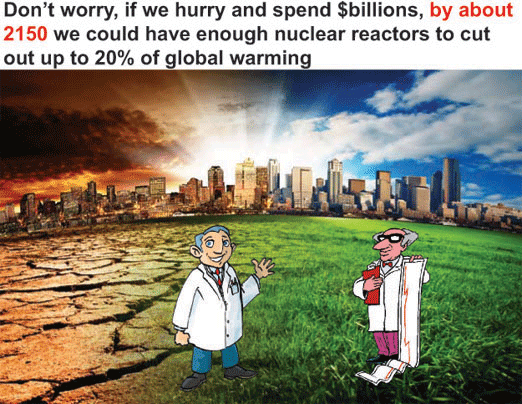
“The idea that we could go from zero to 10 reactors in 10 or even 20 years is a completely distorted idea of the feasibility of nuclear programmes,” said Schneider. “I think that’s probably the worst part of the nuclear myths currently.”
Instead, he said, it is well established that a single nuclear project, from conceptual idea to grid connection, can take up to 25 years to finalise. It’s precisely this timeline that makes nuclear energy an unfeasible solution to the climate emergency—a crisis on which we cannot afford to wait.
https://rightlivelihood.org/news/mycle-schneider-nuclear-power-is-not-an-option/— 14 May 24
Independent energy policy and nuclear analyst Mycle Schneider, recipient of the 1997 Right Livelihood Award for educating the public on the unparalleled risks of nuclear materials, has released the World Nuclear Industry Status Report annually since 2007.
Recently, he visited Stockholm to engage with the Swedish press, academics and politicians on the findings of the 2023 Report. In an interview with Right Livelihood, Schneider busts the Swedish right wing’s assertion that nuclear energy is an indispensable tool for overcoming the climate crisis.
Since Sweden’s right-wing parliamentary faction took power in October 2022, a national debate on the role of nuclear energy in balancing the energy mix and combating the climate crisis has taken centre stage.
This debate came to a head late last year when the Swedish parliament passed a bill removing the country’s 10 nuclear reactor cap and announced its plan to build and start up two new reactors by 2035.
In response to whether nuclear energy has a place in balancing Sweden’s energy mix and combating the climate crisis, Schneider’s answer is resoundingly clear: absolutely not.
But, it’s not for the reasons you may think. Arguing that any debate on nuclear’s environmental or economic costs or benefits is useless, Schneider insists that expanding nuclear energy under the given time constraints is simply not possible.
“The idea that we could go from zero to 10 reactors in 10 or even 20 years is a completely distorted idea of the feasibility of nuclear programmes,” said Schneider. “I think that’s probably the worst part of the nuclear myths currently.”
Instead, he said, it is well established that a single nuclear project, from conceptual idea to grid connection, can take up to 25 years to finalise. It’s precisely this timeline that makes nuclear energy an unfeasible solution to the climate emergency—a crisis on which we cannot afford to wait.
Nuclear energy’s costliness is another barrier that prevents it from being a means of tackling the climate crisis.
“It’s the combination of money and time,” said Schneider. “In order to respond to this challenge, nuclear power is not an option. It’s not a bad or a good option. It’s not an option. It’s too expensive and, above all, it’s too slow to be eligible as an effective instrument to deal with the climate emergency.”
Afghanistan flash floods kill more than 300 as torrents of water and mud crash through villages

More than 300 people were killed in flash floods that ripped through
multiple provinces in Afghanistan, the UN’s World Food Programme said, as
authorities declared a state of emergency and rushed to rescue the injured.
Many people remained missing after heavy rains on Friday sent roaring
rivers of water and mud crashing through villages and across agricultural
land in several provinces, causing what one aid group described as a
“major humanitarian emergency”.
Guardian 12th May 2024
Fixation on UK nuclear power may not help to solve climate crisis

Waste and cost among drawbacks, as researchers say renewables could power UK entirely
Paul Brown 10 May 24, https://www.theguardian.com/environment/article/2024/may/10/fixation-on-nuclear-power-in-uk-may-not-help-to-solve-climate-crisis
In the battle to prevent the climate overheating, wind and solar are making impressive inroads into the once dominant market share of coal. Even investors in gas plants are increasingly seen as taking a gamble.
With researchers at Oxford and elsewhere agreeing that the UK could easily become entirely powered by wind and solar – with no fossil fuels required – it seems an anomaly that nuclear power is still getting the lion’s share of taxpayer subsidies to keep the ailing industry alive.
Politicians on both sides of the Atlantic are backing as yet unproven small modular reactors (SMRs) as an indispensable part of the answer to the climate crisis and are running competitions to get this industry started. These reactors, from tiny ones of the type that power nuclear submarines, to scaled-up versions that can, in theory, be factory produced and built in relays to provide steady power, are all still in the design stage.
As the Union of Concerned Scientists in the United States points out, whichever model is chosen they have all the drawbacks of existing nuclear power stations; expensive, even without cost overruns, and the still unsolved waste problem. The biggest disadvantage, the group says, is that even if the technology worked it would be too little, too late, to keep the climate safe.
Venezuela may be first nation to lose all its glaciers
10 May 24, Aleks Phillips, BBC News
Venezuela may be the first nation in modern history to lose all its glaciers after climate scientists downgraded its last one to an ice field.
The International Cryosphere Climate Initiative (ICCI), a scientific advocacy organisation, said on X that the South American nation’s only remaining glacier – the Humboldt, or La Corona, in the Andes – had become “too small to be classed as a glacier”.
Venezuela has lost at least six other glaciers in the last century.
With global average temperatures rising due to climate change, ice loss is increasing, helping to raise sea levels around the world…………………………………………………………………………………………………………………………… https://www.bbc.com/news/articles/cx8qv1nvdppo
‘The stakes could not be higher’: world is on edge of climate abyss, UN warns.
Top climate figures respond to Guardian survey of scientists who expect temperatures to soar, saying leaders must act radically
Damian Carrington Environment editorFri 10 May 2024 00.00 AESTShare
The world is on the verge of a climate abyss, the UN has warned, in response to a Guardian survey that found that hundreds of the world’s foremost climate experts expect global heating to soar past the international target of 1.5C.
A series of leading climate figures have reacted to the findings, saying the deep despair voiced by the scientists must be a renewed wake-up call for urgent and radical action to stop burning fossil fuels and save millions of lives and livelihoods. Some said the 1.5C target was hanging by a thread, but it was not yet inevitable that it would be passed, if an extraordinary change in the pace of climate action could be achieved.
The Guardian got the views of almost 400 senior authors of reports by the authoritative Intergovernmental Panel on Climate Change. Almost 80% expected a rise of at least 2.5C above preindustrial levels, a catastrophic level of heating, while only 6% thought it would stay within the 1.5C limit. Many expressed their personal anguish at the lack of climate action.
“The goal of limiting global warming to 1.5C is hanging by a thread,” said the official spokesperson for António Guterres, the UN secretary general. “The battle to keep 1.5C alive will be won or lost in the 2020s – under the watch of political and industry leaders today. They need to realise we are on the verge of the abyss. The science is clear and so are the world’s scientists: the stakes for all humanity could not be higher.”…………………………………………………………………………………………………………………………………………. more https://www.theguardian.com/environment/article/2024/may/09/world-is-on-verge-of-climate-abyss-un-warns
Venezuela loses its last glacier as it shrinks down to an ice field
Scientists reclassify Humboldt glacier, also known as La Corona, after it melted faster than expected
Neelima Vallangi, 8 May 24
Venezuela has lost its last remaining glacier after it shrunk so much that
scientists reclassified it as an ice field. It is thought Venezuela is the
first country to have lost all its glaciers in modern times. The country
had been home to six glaciers in the Sierra Nevada de Mérida mountain
range, which lies at about 5,000m above sea level. Five of the glaciers had
disappeared by 2011, leaving just the Humboldt glacier, also known as La
Corona, close to the country’s second highest mountain, Pico Humboldt.
Ghent students occupy university building in climate and Gaza protest
More than 200 expected to join protest calling for climate action and to cut ties with Israeli institutions
Arthur Neslen, Tue 7 May 24 https://www.theguardian.com/world/article/2024/may/06/ghent-students-occupy-university-building-in-climate-and-gaza-protest
More than 100 students have occupied Ghent University in the first European protest to fuse demands about Gaza and the climate crisis.
Ghent’s centrepiece UFO building was peacefully taken over by students calling for concrete action to meet the university’s 2030 climate plans, and asking the university to cut ties with institutions connected to the Israeli military.
Tents were erected inside the building, which contains all of the university’s administrative functions. Its 1,000-seater “guillotine wall” lecture hall was given over to an impromptu workshop on “how we can find hope in a world full of genocide and global warming”.
More than 200 Ghent students were expected to join the three-day protest as anger rose ahead of an expected Israeli assault on Rafah, while students at Amsterdam University also staged an occupation.
A spokesperson for the Ghent students who gave her name as Joelle said their action had grown out of an occupation last year by End Fossil Gent, and student rage over events in Gaza. A joint mobilising leaflet with Gent Students for Palestine used the theme of “free Palestine is a climate justice issue”.
“We realised that both our struggles were against the university’s failure to commit to values they claim to hold,” Joelle said.
“We can see that the struggle for Palestine is also a struggle for climate justice. The Israeli occupation force is committing an ecocide in Gaza, destroying all elements of life and nature.
“Israel’s settler ‘green colonialism’ destroys indigenous land and plants non-indigenous trees over ethnically cleansed villages.
“There are also issues of toxic pollution by settlers and the allocation of water and land. The two struggles are interconnected so climate activists are in solidarity with us on Palestine, and we realise that this is also a climate issue. Our demands go hand in hand.”
An open letter from the students says they want the university to publish a time-linked action plan for cutting ties with what they call “Israeli institutions complicit in the ongoing ethnic cleansing of Palestinians”.
Ghent University has links to a number of Israeli institutions that are said to provide “material” support to the war in Gaza or Israel’s occupation of the West Bank.
Tel Aviv University, with which Ghent has most partnerships, has drawn particular ire from students due to its role in Israel’s defence against genocide charges at the international court of justice in The Hague, and its academic support for soldiers in Gaza.
Equally, the students want “effective and binding action” to urgently implement the university’s 2030 climate transition plans, which they say would mean putting sustainability goals at the heart of budgetary and educational decisions.
Ghent University is committed to becoming progressively fossil fuel free, cutting its energy consumption by 2.5% each year and becoming climate neutral by 2050.
It also has a policy to achieve 80% “sustainable mobility” by 2030, in part by boosting bicycle infrastructure on campus. But students say that too little has been done.
The university did not respond to a request for comment but its director, Rick Van de Walle, posted a statement saying it had decided that its ethical policies would not change and that “no deviation from the existing human rights policy will be used with regard to one particular country, in this case Israel”
Climate change: World’s oceans suffer from record-breaking year of heat
Fuelled by climate change, the world’s oceans have broken temperature
records every single day over the past year, a BBC analysis finds. Nearly
50 days have smashed existing highs for the time of year by the largest
margin in the satellite era. Planet-warming gasses are mostly to blame, but
the natural weather event El Niño has also helped warm the seas. The
super-heated oceans have hit marine life hard and driven a new wave of
coral bleaching. The analysis is based on data from the EU’s Copernicus
Climate Service. Copernicus also confirmed that last month was the warmest
April on record in terms of air temperatures, extending that sequence of
month-specific records to 11 in a row.
BBC 8th May 2024
Brutal 48C heatwave takes its toll on east Asia

East Asia is in the throes of an intense heatwave that is causing deadly
heatstroke, damaging crops, and has exposed an old town at the bottom of a
dried-up reservoir in the Philippines. The record temperatures are the
result of climate change, made worse by the El Niño weather phenomenon.
The town of Chauk in Myanmar recorded a temperature on Monday of 48.2C —
the highest ever measured there, and one of numerous records set across the
region. In the capital of the Philippines, Manila, a new high of 38.8C was
recorded. Some 48,000 state schools across the Philippines were closed all
week, as the authorities advised people to avoid going outside. The
increased use of air conditioning is putting pressure on the electricity
grid in the nation’s largest island, Luzon.
Times 3rd May 2024
https://www.thetimes.co.uk/article/brutal-48c-heatwave-takes-its-toll-on-east-asia-ct70rrg0p
‘Inside an oven’: sweltering heat ravages crops and takes lives in south-east Asia
Governments issue health warnings as schools shut and crops fail, with fears that worse is to come as heatwave tightens grip
Extreme heat has gripped much of south and south-east Asia over recent weeks, killing dozens of people, forcing millions of students to miss school and destroying crops.
Both the Philippines and Bangladesh shut schools due to the unbearable heat last month, while governments across the region have issued health warnings. In Thailand, at least 30 people have died from heatstroke since the start of the year.
The extreme weather has seen durian fruit burst on trees in Thailand, destroyed rice crops and caused eggs to shrink, according to local media. The heat has even been cited as a factor that led to an ammunition blast in Cambodia that killed 20 soldiers at an army base last weekend.
Records have been broken across the region. Bangladesh experienced its hottest April ever recorded, with daily maximum temperatures between 2C and 8C hotter than the 33.2C average daily high for the month. In Myanmar, 48.2C was reached in the town of Chauk, in central Magway region – the hottest April temperature since records began……………………………………………………………………………………………….. more https://www.theguardian.com/environment/article/2024/may/04/inside-an-oven-how-life-in-south-east-asia-is-a-struggle-amid-sweltering-heat
Heatwave in India: TV host faints during live broadcast as swaths of country reel from sweltering temperatures
India’s federal weather agency
has issued “severe heatwave” alerts for parts of India with
temperatures soaring to 42-44C. India witnessed the early onset of an
intense heatwave in March and April, leading to a huge impact on
agriculture production. A heatwave alert has been issued for Odisha and
West Bengal till 22 April with temperature peaking above 40C.
Independent 22nd April 2024
Europe baked in ‘extreme heat stress’ pushing temperatures to record highs
Scorching weather has baked Europe in more days of “extreme heat
stress” than its scientists have ever seen. Heat-trapping pollutants that
clog the atmosphere helped push temperatures in Europe last year to the
highest or second-highest levels ever recorded, according to the EU’s
Earth-watching service Copernicus and the World Meteorological Organization
(WMO).
Europeans are suffering with unprecedented heat during the day and
are stressed by uncomfortable warmth at night. The death rate from hot
weather has risen 30% in Europe in two decades, the joint State of the
Climate report from the two organisations found. “The cost of climate
action may seem high,” said WMO secretary-general Celeste Saulo, “but
the cost of inaction is much higher”.
The report found that temperatures
across Europe were above average for 11 months of 2023, including the
warmest September since records began. The hot and dry weather fuelled
large fires that ravaged villages and spewed smoke that choked far-off
cities. The blazes that firefighters battled were particularly fierce in
drought-stricken southern countries such as Portugal, Spain and Italy.
Guardian 22nd April 2024
Tens of thousands evacuated from massive China floods
Authorities have evacuated nearly 60,000 people from their homes in
Guangdong, as days of heavy rain caused massive flooding in China’s most
populous province. Eleven people have gone missing, while no casualties
have been reported so far.
Footage on state media and online show large
swathes of land inundated by the floods and rescuers ferrying people on
lifeboats in waist-deep water. Several major rivers have burst their banks,
and authorities are closely monitoring “dangerously high” water levels.
They had warned that the level of a river in northern Guangdong could hit a
“once in 100 years” peak on Monday morning, though this had yet to
materialise by noon.
BBC 22nd April 2024
1 This Month



26 September – International Day for the Total Elimination of Nuclear Weapons


PLEASE OPPOSE HR 8255 AND S.3639 – bills would accelerate satellite deployment, with no environmental review or safeguards – https://ncstd5li.quorum.us/campaign/169331/
To see nuclear-related stories in greater depth and intensity – go to https://nuclearinformation.wordpress.com
-
Archives
- September 2026 (206)
- August 2026 (330)
- July 2026 (355)
- June 2026 (287)
- May 2026 (306)
- April 2026 (356)
- March 2026 (251)
- February 2026 (267)
- January 2026 (308)
- December 2025 (358)
- November 2025 (359)
- October 2025 (375)
-
Categories
- 1
- 1 NUCLEAR ISSUES
- business and costs
- climate change
- culture and arts
- ENERGY
- environment
- health
- history
- indigenous issues
- Legal
- marketing of nuclear
- media
- opposition to nuclear
- PERSONAL STORIES
- politics
- politics international
- Religion and ethics
- safety
- secrets,lies and civil liberties
- spinbuster
- technology
- Uranium
- wastes
- weapons and war
- Women
- 2 WORLD
- ACTION
- AFRICA
- Atrocities
- AUSTRALIA
- Christina's notes
- Christina's themes
- culture and arts
- Events
- Fuk 2022
- Fuk 2023
- Fukushima 2017
- Fukushima 2018
- fukushima 2019
- Fukushima 2020
- Fukushima 2021
- general
- global warming
- Humour (God we need it)
- Nuclear
- RARE EARTHS
- Reference
- resources – print
- Resources -audiovicual
- Weekly Newsletter
- World
- World Nuclear
- YouTube
-
RSS
Entries RSS
Comments RSS
 nuclear-news