The president of the Cop28 climate summit will continue with his oil company’s record investment in oil and gas production, despite coordinating a global deal to “transition away” from fossil fuels. Sultan Al Jaber, who is also the chief executive of the United Arab Emirates’ national oil and gas company, Adnoc, told the Guardian the company had to satisfy demand for fossil fuels.
I too wish that the things that the nuclear industry says about itself were true—I wish it was green and renewable. I wish that there weren’t multiple uranium mining sites around the world with thousands of tons of uranium tailings abandoned and open to the elements, continuing to harm the health of generations born long after mining ceased.
I wish that it didn’t take immense, carbon-intensive mining projects to extract uranium from the Earth, and then again to “deposit” the spent nuclear fuel from reactors back half a kilometer underground.
BY ROBERT JACOBS 9 July 21, Bhaskar Sunkara’s recent opinion piece extoling the virtues of nuclear power and castigating its opponents as paranoid and ill-informed, is clearly motivated by his deep concerns over the dire impacts of global warming, which loom closer by the hour. Unfortunately, his arguments amount to little more than regurgitated industry talking points, in their traditional form of a Jeremiad.
First, Sunkara poses the decline of the nuclear industry in the West as an achievement of progressive political movements. Specifically, he cites the decline of nuclear power in Germany as attributable to a “Green party-spearheaded campaign.” This decline has been more reasonably ascribed to both market conditions and missteps by nuclear industry giants such as Westinghouse and AREVA. From its inception, nuclear power has been heavily dependent on government subsidies to appear economically viable (subsidies such as insurance and the disposal of waste largely configured as taxpayer burdens).
Rather than succumbing to its political opponents on the left, the industry has been sunk by its structural economic dysfunctions. In the US, this has sparked schemes to secure additional taxpayer subsidies in legislative fixes such as guaranteed returns for nuclear utilities, and outright bribery of legislators for taxpayer bailouts of failing companies.
The most simplistic recitation of nuclear industry talking points is when Sunkara dismisses concerns about nuclear waste, and extolls the mythic separation between “civilian” and “military” nuclear technologies. He asserts that most nuclear waste “can be recycled to generate more electricity,” an assertion that goes back more than half a century and has been ritualistically recited by an army of nuclear industry PR professionals before him…yet here we are 50 years later and very little spent nuclear fuel has actually been recycled. The most successful nuclear recycling nation is France which, nevertheless, is experiencing a “nuclear exit” and is unlikely to ever use this recycled fuel. AREVA, the French nuclear giant, has gone bankrupt. Reprocessing facilities like the Rokkasho plant here in Japan have never functioned properly, unless you consider their role enabling the stockpiling of plutonium by Japan to hedge against future weapon needs to be an elemental goal.
There is a difference between what can be done, and what actually happens. Rather than being recycled, hundreds of thousands of metric tons of spent nuclear fuel await “final disposal” in deep geological repositories. Some have been waiting for over 70 years. Just last week, a panel advising the EU on categorizing nuclear plant as “green” energy, and thus eligible to receive EU funding as a “sustainable investment,” concluded that the problems of nuclear waste preclude that designation.
I would point out that even though plastics manufacturers assure us that most plastic can be recycled, we still seem to be living a world with ever increasing amounts of plastic waste. Their greenwashing has not eventuated in a world full of plastics made from recycled materials. The market reality is that it is cheaper to manufacture new plastic than it is to manufacture plastic from recycled materials. Similarly, it is cheaper to discard spent nuclear fuel than it is to reprocess it.
Sunkara dismisses the irrevocable link between military and civilian nuclear technologies as imaginary. First, let’s consider the present imbrication. A 2019 Atlantic Council study places the value of the US civilian nuclear complex to the US national security apparatus at $26 billion annually simply in terms of the human capital assets: “In terms of nuclear technology innovation, export capacity, and geopolitics, a vibrant civilian nuclear energy sector is a critically important national security asset.”
However, the civilian operation of nuclear power plants also places future generations at military risk. I have written that, historically, nuclear reactors were “born violent.” That is to say, they were invented by the Manhattan Project in the early 1940s to manufacture plutonium for use in nuclear weapons, and were instrumental in killing almost 100,000 people in 1945. The “first” American commercial atomic plant in Shippingport, PA that went critical in 1958, was actually the 14th industrial nuclear reactor built in the United States, the other 13 only manufactured plutonium, which by then formed the fissile cores of thousands of nuclear weapons.
In nuclear reactors used to make electricity, this plutonium is not separated out for use in weapons. However, all nuclear power plants remain plutonium production factories. The fact that most of those tons of plutonium remain in the spent fuel rods does not mean they will stay there forever. Thousands of years from now, some government or military may dig up the spent fuel in our deep geological repositories and separate that plutonium out to build nuclear weaponry. All it would take is the technology (technology we currently possess) and the will. We continue to manufacture that plutonium—perhaps for them to weaponize. Every nuclear power plant that operates adds to that inventory; more than 99% of existing plutonium was manufactured in nuclear reactors. In 1962, the US successfully detonated a nuclear weapon assembled with just such “reactor-grade” plutonium. Our generation’s use of nuclear power silently stockpiles fissile material that will remain militarily viable for millennia.
I too wish that the things that the nuclear industry says about itself were true—I wish it was green and renewable. I wish that there weren’t multiple uranium mining sites around the world with thousands of tons of uranium tailings abandoned and open to the elements, continuing to harm the health of generations born long after mining ceased. I wish that it didn’t take immense, carbon-intensive mining projects to extract uranium from the Earth, and then again to “deposit” the spent nuclear fuel from reactors back half a kilometer underground. Estimates before construction began at Onkalo spent fuel repository in Finland were that the site would entail a “half-billion-euro construction project will generate some 2,500 person years of employment,” and would take 100 years to complete. That is just to contain the spent fuel from five nuclear power plants. The United States, by contrast, has 94 commercial nuclear power plants. There is still no actual plan for the astonishingly large and carbon-intensive site it will take to bury the more than 140,000 metric tons of spent nuclear fuel, with some hope of containing it for thousands of generations of future human beings. This doesn’t include the thousands of tons of spent nuclear fuel from the nuclear reactors operated by the US military to provide the fissile cores of more than 70,000 nuclear weapons during the Cold War.
The panic-inducing impacts of anthropic climate change spark a desperate need for immediate reassurance and calming: we want to fix it now. We long to turn some corner that will change the situation. It is unlikely that the same short-sighted military-industrial technophilia that brought us to this climate crisis will flip over and provide us the urgent path to its resolution. Technological evangelists have been auditioning for the part of Climate Change Savior to anyone who will listen. Some proffer a Reagan-era Star Wars pitch: they will fill the skies with material to block the enemy (in this case sunlight rather than Soviet ICBMs). These geoengineering quick-fix schemes are more likely to cause unplanned outcomes than to achieve their missions.
At one time nuclear weapon producers imagined they too could geoengineer the planet to shape it to human desires. They tested the use of nuclear weapons to sculpt harbors into coastlines, and to release natural gas trapped in rock formations. These experiments led to some of the most significant radiological distributions and contaminated sites in the wide panoply of nuclear testing. Still, hyper-capitalist techno utopians like Elon Musk envision the key to human habitation on Mars is the detonation of a massive arsenals of thermonuclear weapons to shape it to our needs.
The nuclear industry will ignore its market dilemmas as long as taxpayers continue to backstop its investors. However, to believe that this massive, for-profit, military-based industry has concern for the welfare of the Earth and its inhabitants is akin to believing the plastic industry is actually beavering away to make the plastic waste disappear. Repackaging their talking points out of a genuine concern for living creatures is a resource they will continue to tap so long as it flows freely. Sunkara would do better to advocate for the mass social movements that have shifted giant industries towards social welfare in the past rather than preaching that the industries themselves are saviors. Time is obviously short, wrong turns are catastrophic.
Yes. More than what people expect. [Ref. 2 – Year 2021]
Quote:
“How climate-friendly is nuclear compared to other energies?
If the entire life cycle of a nuclear plant is included in the calculation, nuclear energy certainly comes out ahead of fossil fuels like coal or natural gas. But the picture is drastically different when compared with renewable energy.”
“According to new but still unpublished data from the state-run German Environment Agency (UBA) as well as the WISE figures, nuclear power releases 3.5 times more CO2 per kilowatt-hour than photovoltaic solar panel systems. Compared with onshore wind power, that figure jumps to 13 times more CO2. When up against electricity from hydropower installations, nuclear generates 29 times more carbon.”
Why does the IAEA state otherwise? It’s convenient, as simple as that.
IAEA statement at COP28: on Dec. 1st, 2023 [Ref. 1]
Fact check: Is nuclear energy good for the climate? NATURE AND ENVIRONMENTGLOBAL ISSUES. Joscha Weber. November 29, 2021. Supporters of nuclear energy say it can help us wean our economies off polluting fossil fuels. No surprise, it’s a heated issue. But what about the facts? Can nuclear power really help save the climate?
No. Nuclear energy is also responsible for greenhouse gas emissions. In fact, no energy source is completely free of emissions, but more on that later.
“When it comes to nuclear, uranium extraction, transport and processing produces emissions. The long and complex construction process of nuclear power plants also releases CO2, as does the demolition of decommissioned sites. And, last but not least, nuclear waste also has to be transported and stored under strict conditions — here, too, emissions must be taken into account.”
“How much CO2 does nuclear power produce?
Results vary significantly, depending on whether we only consider the process of electricity generation, or take into account the entire life cycle of a nuclear power plant. A report released in 2014 by the UN’s Intergovernmental Panel on Climate Change (IPCC), for example, estimated a range of 3.7 to 110 grams of CO2 equivalent per kilowatt-hour (kWh).
“It’s long been assumed that nuclear plants generate an average of 66 grams of CO2/kWh — though Wealer believes the actual figure is much higher. New power plants, for example, generate more CO2 during construction than those built in previous decades, due to stricter safety regulations.”
Studies that include the entire life cycle of nuclear power plants, from uranium extraction to nuclear waste storage, are rare, with some researchers pointing out that data is still lacking. In one life cycle study, the Netherlands-based World Information Service on Energy (WISE) calculated that nuclear plants produce 117 grams of CO2 emissions per kilowatt-hour
“Could we rely on nuclear energy to help stop global warming?
Around the world, nuclear energy representatives, as well as some politicians, have called for the expansion of atomic power. In Germany, for example, the right-wing populist AfD party has backed nuclear power plants, calling them “modern and clean.” The AfD has called for a return to the energy source, which Germany has pledged to phase out completely by the end of 2022.
Other countries have also supported plans to build new nuclear plants, arguing that the energy sector will be even more damaging for the climate without it. But Wealer from Berlin’s Technical University, along with numerous other energy experts, sees takes a different view.
“The contribution of nuclear energy is viewed too optimistically,” he said. “In reality, [power plant] construction times are too long and the costs too high to have a noticeable effect on climate change. It takes too long for nuclear energy to become available.”
“Nuclear power plants are about four times as expensive as wind or solar, and take five times as long to build,” he said. “When you factor it all in, you’re looking at 15-to-20 years of lead time for a new nuclear plant.””
“He pointed out that the world needed to get greenhouse gases under control within a decade. “And in the next 10 years, nuclear power won’t be able to make a significant contribution,” added Schneider.
“Nuclear power is not being considered at the current time as one of the key global solutions to climate change,” said Antony Froggatt, deputy director of the environment and society program at the international affairs think tank Chatham House in London.
He said a combination of excessive costs, environmental consequences and lack of public support were all arguments against nuclear power.”
COP28 fossil fuel pledges will not limit global warming to 1.5C, says IEA. Summit president Sultan al-Jaber’s plans to reduce climate goals’ gap ‘not good enough’, warns energy agency’s chief.
Emissions-cutting pledges made by about 130 countries and 50 fossil fuel companies at the start of the UN climate summit will still leave the world far off track in limiting global warming to 1.5C above pre-industrial levels, according to an analysis from the International Energy Agency.
Together, the countries account for more than half of the world’s gross domestic product, the agency said. The IEA has calculated that full implementation of a set of measures that are part of a new global decarbonisation alliance would only reduce the energy-related emissions gap between the current trajectory and a 1.5°C scenario by about a third by 2030.
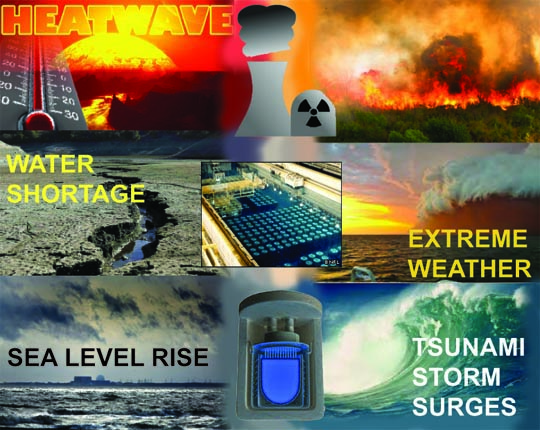
Changing ambient temperatures are already posing serious risks to nuclear plants across the world. Nuclear regulators cannot wait until sea-level rise coupled with storm surges begin impacting operational safety of their plants—they must act now.
Note: This is part two of a two-part blog series on the impacts of climate change on nuclear power plants. Check out our first blog post on the impact of increasing ambient temperatures.
Climate action isn’t simply about reducing emissions—it’s also about addressing local environmental concerns and minimizing risks to human health and safety. With that in mind, if nuclear power is going to have a role in addressing climate change, stronger safety and environmental regulations will be needed.
Unfortunately, this approach is missing from the U.S. Nuclear Regulatory Commission (NRC), which in January voted in a 3-to-2 decision to water down recommendations from its own staff to reevaluate seismic and flooding hazards at nuclear sites. “This decision is nonsensical,” Commissioner Jeff Baran wrote in his dissent, “Instead of requiring nuclear power plants to be prepared for the actual flooding and earthquake hazards that could occur at their sites, NRC will allow them to be prepared only for the old, outdated hazards typically calculated decades ago when the science of seismology and hydrology was far less advanced than it is today.”
The January ruling came almost eight years after staff scientists released a list of recommendations in direct response to the 2011 Fukushima nuclear meltdown. With the approval (and pending approvals) this year to rollback multiple safety regulations , the U.S. nuclear fleet, the oldest in the world, cannot afford to wait another decade to strengthen safety and environmental regulations in preparation of climate change–in this case, rising sea levels.
What are the Risks?
Nuclear power plants require huge amounts of water to prevent fission products in the core and spent nuclear fuel from overheating (incidentally making nuclear the most water intensive energy source in terms of consumption and withdrawal per unit of energy delivered). That’s why over 40 percent of the world’s nuclear plants are built along the coasts, with that number rising to 66 percent for just plants under construction. Unable to run on the electricity it generates itself to power the pumps that provide cooling water to the core and to the spent nuclear fuel stored onsite, a nuclear plant must rely on the grid or backup generators to ensure cooling water circulation. Any hazard that cuts off access to those sources of power restricts access to cooling water, ultimately risking a nuclear meltdown and off-site release of radiation, as happened during the flooding of Fukushima.
Flooding evaluations conducted by the NRC concluded that 55 of the 61 evaluated U.S. nuclear sites experienced flooding hazards beyond what they were designed to handle. Even more alarming, in 2014, the flood barriers at Florida Power & Light’s St. Lucie Nuclear Plant–one of the few plants reported to be prepared for disaster but which had been missing proper seals for decades–gave way to 50,000 gallons of water after heavy rainfall.
Storm surges like the one at St. Lucie Nuclear plant and extreme weather events, as witnessed in Fukushima, pose very real risks to both operational and decommissioned plants, almost all of which (in the US) will continue to store nuclear waste onsite for decades until a permanent storage solution is found. Coupled with increasingly rising sea-levels, these risks will continue to grow. Even under a very low scenario of 1°C warming by midcentury, the 2018 U.S. National Climate Assessment reports that the “frequency, depth, and extent of both high tide and more severe, damaging coastal flooding will increase rapidly in the coming decades.” And the Intergovernmental Panel on Climate Change concluded that 1.5°C of warming could be reached in as little as 11 years.
While all energy technologies will be impacted in some way by the increasing severity of natural disasters and sea level rise, the failure of nuclear power plants can result in irreversible health and environmental consequences on top of social and economic damages, including worst of all the release of radiation that can remain lethal for thousands of years. Under government estimates, the Fukushima meltdown resulted in the displacement of 165,000 people, cleanup and compensation costs of up to $200 billion, and a timeline of 30 to 40 years. Experts say, however, that true costs could reach $500 billion and decontamination timelines could be underestimated by decades.
Nuclear in East Asia
Despite initial vocal opposition from the public in many East Asian countries that have slowed down nuclear buildout after Fukushima, the direction of government policies for nuclear development in East Asia remain mostly unchanged, and have simply resulted in rather a more conservative, moderate pace. In fact, this pace has sustained much of nuclear development in East Asia, home to many countries that have found nuclear power as an attractive solution to addressing the dilemma between achieving energy security for an increasing population and decarbonizing to mitigate global climate change.
Of the 56 nuclear power plants currently in construction around the world, 33 of them are in Asia; 16 in China alone. As observed in the graph below, [on original] if all nuclear units that are currently under construction reach completion, East Asia is slated to become the region with the largest number of operating nuclear power plants, 93 percent of which will reside along the coast.
What is alarming is that East Asia and the Pacific region is uniquely vulnerable to sea-level rise. A 2015 report by Climate Central found that of the top 10 countries most likely to be affected sea level rise for 4°C warming, seven are in Asia. Similarly, in a study by the World Bank, China and Indonesia will be the most vulnerable to permanent inundation. Given the heightened flooding risks in Asia, strengthening the authority of regulatory structures that oversee the safety of nuclear build out will be increasingly important.
What’s the Plan?
Fukushima was a lesson to the global community that even one of the world’s most technologically advanced and experienced countries can fail to prevent a nuclear meltdown. To prepare for the realities of rising sea levels that pose unique risks to different nuclear plants, regulators must require climate adaptation plans and heightened safety oversight. Nonetheless, at the international scale, not much work is being done to address these sea-level rise concerns.
The Nuclear Energy Agency (NEA), in recognizing that the “world is ill-prepared for the risks from a changing climate,” conducted a study on the vulnerability of nuclear power plants to climate change, which is not yet available to the public. Since 2014, the International Atomic Energy Agency (IAEA) has begun to include a section about the impacts of climate change on nuclear energy in its annual Climate and Nuclear Power Report. Yet even as these international organizations detail the many hazards changing climate poses to nuclear reactors, preventative and/or adaptation measures do not seem to be prioritized or encouraged, especially for existing nuclear plants.
“Outside of their Scope” at Home
Similar attitudes are held here in the U.S. Perched at the southern tip of Florida, the Turkey Point Nuclear Generating Station is seeking to be the first U.S. nuclear plant permitted to run for 80 years. Initially refusing to consider sea-level rise in the environmental review of the license extension, the Nuclear Regulatory Commission (NRC) released a revised draft this year, only to come to the following conclusion: It’s outside of the scope of the agency.
If new information about changing environmental conditions (such as rising sea levels that threaten safe operating conditions or challenge compliance with the plant’s technical specifications) becomes available, the NRC will evaluate the new information to determine if any safety-related changes are needed at licensed nuclear power plants,” the NRC report said.
The report arrives at this conclusion by utilizing lower-bound sea level rise estimates from the 2018 U.S. Climate Change assessment, rationalizing that the report “assigns very high confidence to the lower bounds of these projections and medium confidence to the upper bounds.” As highlighted by this Bloomberg analysis released this year, nuclear plant operators are not only allowed to perform their own flood risk estimates but are also able to decide what assumptions are made, with review from the NRC.
The uncertainty that comes with sea-level rise projections obviously exists. In securing the safety of such critical infrastructure, however, using the highest sea-level rise estimates is the only way to ensure that all actions that can be taken against a potential threat are taken. On the other hand, relying on the lowest storm surge estimates is akin to receiving a warning about a potential threat, and taking the bare minimum actions to prepare for it.
Changing ambient temperatures are already posing serious risks to nuclear plants across the world. Nuclear regulators cannot wait until sea-level rise coupled with storm surges begin impacting operational safety of their plants—they must act now. With the world’s scientists calling attention to the climate crisis ahead of us, action must be taken to ensure nuclear plants are part of the solution, not the problem.
This factsheet analyzes the role of nuclear energy in global climate scenarios. It shows that a global tripling of nuclear capacity until 2050 is neither realistic nor is it needed to achieve climate targets according to the Paris agreement.
The factsheet presents an analysis of nine global climate scenarios that achieve climate targets according to the Paris agreement as well as two non-target scenarios with an emphasis on the role of nuclear energy.
In order to assess how realistic these top-down scenarios are, it compares these figures with the plans and programs of governments for the expansion (or phase out) of nuclear power.
A tripling of today’s nuclear capacity of 370 GW would require 1.110 GW net electrical capacity to be operational in 2050. If we assume a very high sixty year lifetime for all nuclear reactors in operation and under construction today, roughly 210 GW of the current nuclear fleet would still be online in 2050.
Thus, a total of nearly 900 GW would have to be constructed additionally between 2024 and 2050. Assuming a linear increase in the rate of new construction up to 2050, starting with the amount of new nuclear connected to the grid in 2023, in 2050 more than 60 GW would need to be connected to the grid to meet the tripling nuclear target, compare Figure 10.
This would be approximately twice the maximum historic capacity connected to the grid in a single year. On average, more new capacity would have to be added every year over 25 years as was the case at the historical maximum in 1985. From these numbers, it is evident, that a tripling of nuclear capacity until 2050 is neither realistic nor is it needed to achieve climate targets according to the Paris agreement.
Negotiations on how the world can slash greenhouse gas emissions and stave off the worst impacts of the climate crisis will reach a fresh intensity over the next few days, with nations wrangling over whether to phase out or phase down fossil fuels.
For the remaining five negotiating days of the Cop28 UN climate summit in Dubai ministers will hold a series of meetings to try to break the impasse and present a text that sets out a roadmap for staying within a rise of 1.5C of global heating above preindustrial levels.
Simon Stiell, the UN climate chief, told countries: “Now all governments must give their negotiators clear marching orders – we need highest ambition, not point-scoring or lowest common denominator politics. Good intentions won’t halve emissions this decade or save lives right now.”
At COP28, many major players are banding together to plan a big ramp-up of nuclear power. But without China’s help, is the target realistic?
COP28 might be remembered as the “nuclear COP.”
More than 20 countries including the U.S., France, Japan and the United Kingdom have pledged to triple global nuclear energy generation by 2050 at the launch of COP28 in Dubai in the United Arab Emirates, the world’s annual climate summit.
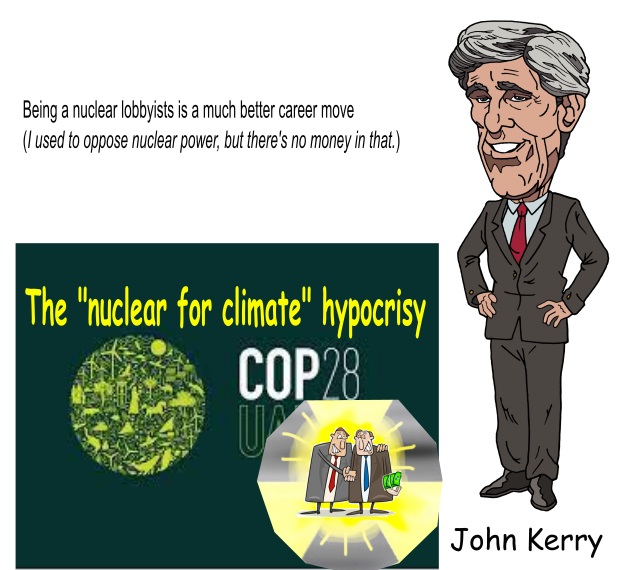
John Kerry, former U.S. secretary of state and President Biden’s climate envoy, made the case for nuclear energy during the event’s launch ceremonies, saying that the science has proven “you can’t get to net-zero 2050 without some nuclear.”
While there are important methane, climate-finance and environmental-justice initiatives being hammered out at the conference, the nuclear goal stands out as a bit of a policy departure compared to previous COP meetings. Nuclear has received little attention at past COPs due to its cost challenges and lingering controversies surrounding its safety and other issues.
There’s another reason for this being considered the nuclear COP: The United Arab Emirates, COP28’s host, is on the verge of completing the second nuclear facility in the Middle East, which will provide one-quarter of the country’s electricity. Construction on the power plant began in 2012, and the last of its four 1.4-gigawatt reactors at the Barakah Nuclear Energy Plant has just received its operating license from regulators.
The leaders spearheading COP28’s ramped-up nuclear targets are heeding the prescriptions set forth in many major climate-change models, including the International Energy Agency’s, which call for massive growth in global nuclear energy capacity in order to have a chance of meeting net-zero goals and keeping global warming in check. (However, there are certainly opposing models showing a path to zero emissions without a significant scale-up of nuclear power.)
Today’s global fleet of approximately 440 nuclear reactors has a combined capacity of around 400 gigawatts — enough that nuclear energy provides about 10 percent of the world’s power. But less than a paltry 4 gigawatts of nuclear energy has been connected to the grid in 2023. The global solar industry is forecast to install more than 400 gigawatts of capacity in 2023 alone.
The goal of tripling the world’s nuclear output would require deploying an average of 40 gigawatts of nuclear power every year through 2050, according to the World Nuclear Association. (My back-of-the-envelope calculations point to an even higher number if replacing existing aged-out equipment is included in the mix.)
The COP28 declaration includes language about nuclear’s contribution in keeping a 1.5°C limit on temperature rise within reach and its energy-security benefits, as well as the claim that paring down the world’s nuclear power would make reaching net zero more difficult and costly. Nuclear’s potential role in hard-to-abate sectors such as hydrogen production and petrochemical processing is also highlighted.
The pledge also asks the signees to consider smaller and more innovative reactor designs in their grid planning and makes an appeal that they continue to maintain the existing reactor fleet, extending its lifetime if feasible and safe.
Over the past few decades, the hefty price tag of building nuclear plants has been the industry’s Achilles’ heel. This poses particular challenges in market-based economies, where periods of high interest rates and inflation threaten the viability of mega projects, be they offshore wind, high-speed rail — or nuclear reactors.
Importantly, the COP28 declaration looks to address some of these financial flaws and invites the World Bank and other regional and international banks to include nuclear energy in their lending policies.
Ironically absent from the pool of signees is China, the only country with any real chance of meeting the COP goal. China aims to double its nuclear energy capacity by 2035 and is well on its way; as of this year, 22 nuclear plants are under construction in China with more than 70 planned.
But while the U.S. saw its first newly built nuclear reactor in decades reach commercial operation this year in Vogtle 3 and could see Vogtle 4 go online next year, you’d be hard-pressed to find an American nuclear expert willing to predict when the next reactor will be up and running.
Confronting climate change requires bold, large-scale action — and tripling nuclear generation certainly qualifies in that regard. But before overestimating the influence or significance of the COP28 nuclear pledge, I would challenge you to name COP27’s or COP26’s theme.
Still, government agencies such as the U.S. Office of Nuclear Energy and a growingteam of younginfluencers are understandably enthusiastic about nuclear’s spotlight and the aspirational growth targets unveiled at COP28. Perhaps the emphasis on nuclear at this year’s meeting reinforces the idea that we’re in the midst of a generational shift in sentiment about atomic power.
With five days left at COP28, the jury is still out on whether this year’s UN climate talks will achieve real progress to address climate change. But one thing is clear: the spotlight is on nuclear power. The (so-called) low-carbon fuel has received an unprecedented amount of attention at this year’s gathering, with nearly two dozen countries including the US, UK, and United Arab Emirates signing a declaration over the weekend to triple nuclear energy by mid-century.
Whether the world can deliver on these nuclear promises is questionable — the sector is notorious for high construction costs and lengthy project timelines, not to mention hazardous waste. Despite the hype around the fuel in recent years, global nuclear power generation declined 4 per cent year over year in 2022 to its lowest level in four decades, according to a new World Nuclear Industry report, calling the COP28 target “highly unrealistic”.
COP stands for Conference of the Parties, annual gatherings under the United Nations Framework Convention on Climate Change. The 28 is for this being the 28th session. It began on November 30th and is to end on December 12.
When it started, there was a stir over the conference president being Sultan Al Jaber who just happens to head the UAE’s state-owned oil company, Abu Dhabi National Oil Company, (ADNOC). Time magazine splashed a photo of Al Jaber on its cover with the caption: “Oil executive Sultan Al Jaber is at the center of a global climate fight. MAN IN THE MIDDLE.”
The UAE “has the world’s largest oil reserves and has historically worked to protest its fossil-fuel economy in climate negotiations,” noted Time.
And it soon became clear that the sultan was not just in “the middle” as reports emerged in media about how in an online event in November “he cast doubt on whether eliminating fossil fuels would help limit global warning,” as Rolling Stone reported.
Here was documentation of a chief executive of an oil company who was leading the climate change conference minimizing the role of fossil fuels in climate change when the burning of fossil fuels has long been determined by scientists to be its leading cause. “There is no science out there, or no scenario out there, that says that the phase-out of fossil fuel is what’s going to achieve 1.5C,” he was quoted as saying. He added that phasing out fossil fuels would “take the world back into caves.”
Al Jaber’s vested interest was focused upon.
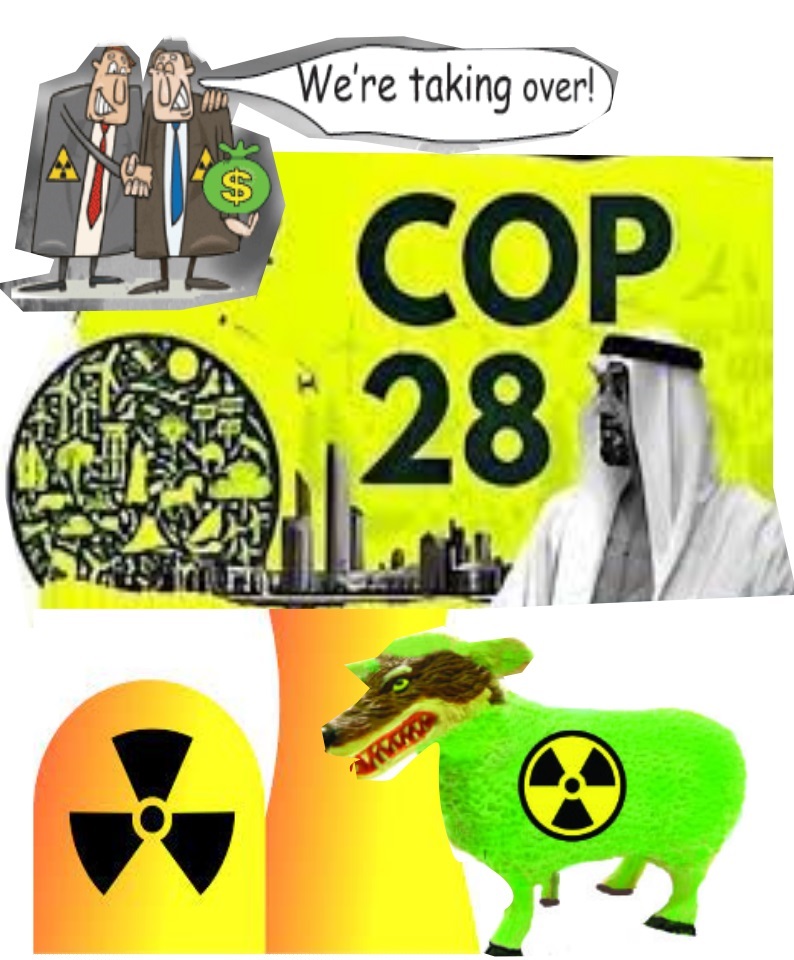
But then, in the way of a vested interest, nuclear interests, corporate and governmental, moved in on COP28.
As the CNBC piece related, at COP28 “the “U.S. and more than 20 other countries pledged to triple nuclear power to achieve net-zero carbon emissions and limit climate change. The declaration is the most concrete step taken yet by major nations to place nuclear power at the center of the push to transition to clean energy. Interest in nuclear is booming worldwide amid growing recognition that a dependable source of clean electricity will be needed to support the rapidly growing role of wind and solar in power grids.”
Nations signing on to what was titled a “Declaration to Triple Nuclear Energy” which was presented at COP28 on December 2 included, beyond the U.S., the United Kingdom, Canada, France, Japan, Hungary, Sweden, Netherlands, Ukraine, Czech Republic, Finland, Ghana, Hungary, Bulgaria, Moldova, Mongolia, Morocco, Netherlands, Poland, Romania, Slovakia, Slovenia and, yes, United Arab Emirates.
It begins: “Recognizing the key role of nuclear energy in achieving global net-zero greenhouse gas emissions/carbon neutrality by or around and mid-century and in keeping a 1.5C limit on temperature rise within reaching and achieving Sustainable Development Goal”—and then begins a series of paragraphs starting with “Recognizing.”
This includes: “Recognizing that nuclear energy is already the second-largest source of clean dispatchable baseload power” and “Recognizing the IAEA’s activities in supporting its members states”—referring to the International Atomic Energy Agency set up by the UN with a mission to promote nuclear power—and “Recognizing the importance of financing for the additional nuclear power capacity needed to keep a 1.5C limit on temperature rise within reach” and “Recognizing the need for high-level political engagement to spur further action on nuclear power,” the “Participants in this pledge” agree to a series of commitments.
These include committing to “invite shareholders of the World Bank, international financial institutions, and regional development banks to encourage the inclusion of nuclear energy in their organizations’ energy lending policies” and to “recognize the importance, where technically feasible and economically efficient, of extending the lifetimes of nuclear power plants” and committing “to support responsible nations looking to explore new civil nuclear deployment” and to “welcome and encourage complementary commitments from the private sector, non-governmental organizations, development banks, and financial institutions” and “to review progress toward these commitments on an annual basis on the margin of the COP.”
Further, it calls “on other countries to join this declaration.”
Commenting on the declaration, Harvey Wasserman, author of the books Killing Our Own: The Disaster of America’s Experience with Atomic Radiation and Solartopia, called it “beyond insane.” Promoters of nuclear power are making, he told me, a “full court press” to push it, trying to use climate change as a new reason while attempting “to kill” renewable energy technologies led by solar and wind, skyrocketing in adoption and efficiency and plummeting in cost.
Dr. Mark Z. Jacobson, director of the Atmosphere/Energy Program and professor of civil and environmental engineering at Stanford University, called the declaration the “stupidest policy proposal I’ve ever seen.” Jacobson’s most recent books are No Miracles Needed: How Today’s Technology Can Save Our Climate and Clean Our Air and before that 100% Clean, Renewable Energy and Storage for Everything. He says: “The world needs to switch away from using fossil fuels to using clean, renewable sources of energy as soon as possible.” In his books he details the use of existing technologies to produce, store and transmit energy from wind, water and solar sources. As to nuclear power, it is “not needed” to deal with climate change.
Beyond its danger and multi-billion dollar cost, nuclear power is not an antidote for climate change—it’s not “carbon emissions-free,” its opponents say. Michel Lee, chair of the Council on Intelligent Energy & Conservation Policy, stresses how the nuclear fuel cycle—including uranium mining, enrichment and fabrication of nuclear fuel—is “carbon intensive.”
And, nuclear power plants themselves emit carbon-14, a radioactive form of carbon.
Moreover, spending money on new nuclear power diverts funding to provide for implementation of truly carbon emissions-free energy technologies, they say.
Last year, the former heads of nuclear regulation in the U.S., Germany and France, along with the former secretary of the U.K.’s radiation protection committee, issued a joint statement that said: “Nuclear is just not part of any feasible strategy that could counter climate change.”
The former leaders were Dr. Greg Jaczko, who had been chairman of the U.S. Nuclear Regulatory Commission; Wolfgang Renneberg, ex-head of Reactor Safety, Radiation Project and Nuclear Waste for the German government; Dr. Bernard Laponche who had been director general of the French Agency for Energy Management; and Dr. Paul Dorfman, who had been secretary of the U.K.’s Government’s Committee Examining Radiation Risk from Internal Emitters.
They wrote: “The central message, repeated again and again, that a new generation of nuclear will be clean, safe, smart and cheap, is fiction. The reality is nuclear is neither clean, safe or smart but a very complex technology with the potential to cause significant harm.”
Their statement continued that “nuclear as strategy against climate change is: Too costly in absolute terms to make a relevant contribution to global power production; More expensive than renewable energy in terms of energy production…; Too costly and risky for financial market investment and therefore dependent on very large public subsidies and local guarantees; Unsustainable due to the unresolved problem of very long-lived radioactive waste; Financially unsustainable as no economic institution is prepared to insure against the full potential cost, environmental and human impacts of accidental radiation release—with a majority of those very significant costs borne by the public; Militarily hazardous since newly promoted reactor designs increase the risk of nuclear weapons proliferation;
Further, their statement said nuclear power is not suitable to counter climate change because it is: “Inherently risky due to unavoidable cascading accidents from human error, internal faults and external impacts, vulnerability to climate-driven sea-level rise, storm, storm surge, inundation and flooding hazard…; Subject to many unresolved technical and safety problems associated with newer unproven concepts including ‘Advanced’ and Small Modular Reactors; Too unwieldly and complex to create an efficient industrial regime for reactor construction and operation processes within the intended build-time and scope needed for climate change mitigation; Unlikely to make a relevant contribution to necessary climate change mitigation needed by the 2030s due to nuclear’s impracticably lengthy development and construction time-lines and the overwhelming construction costs of the very great volume of reactors that would be needed to make a difference.”
A presentation by Pope Francis was read at COP28. “Are we working for a culture of life or a culture of death?” asked the pope. “Let us choose life! Let us choose the future! May we be attentive to the cry of the earth….Climate change signals the need for political change. Let us emerge from the narrowness of self-interest….Now there is a need to set out anew. May this COP prove to be a turning point demonstrating a clear and tangible political will that can lead to a decisive acceleration of ecological transition…achieved in four sectors: energy efficiency; renewable sources; the elimination of fossil fuels; and education in lifestyles that are less dependent on the latter.”
With the vested interest and self-interest shown so far at it, COP28 has far to go.
The sequence of COP meetings, ostensibly a United Nations forum to discuss dramatic climate change measures in the face of galloping emissions, has now been shown for what it is: a luxurious, pampered bazaar for the very industries that fear a dip in their profits and ultimate obsolescence. Call it a drugs summit for narcotics distributors promoting clean-living; a convention for casino moguls promising to aid problem gamblers. The list of wicked analogies is endless.
Reading the material from the gathering that is known in its longer form as the United Nations Climate Change Conference, one could be forgiven for falling for the sweetened agitprop. We find, on theUN website explaining the role of COP28, that the forum is “where the world comes together to agree on ways to address the climate crisis, such as limiting global temperature rise to 1.5 degrees Celsius, helping vulnerable communities adapt to the effects of climate change, and achieving net-zero emissions by 2050.”
Then comes the boggling figure: 70,000 delegates will be mingling and haggling, including the parties of the UN Framework Convention on Climate Change (UNFCCC). “Business leaders, young people, climate scientists, Indigenous Peoples, journalists, and various other experts and stakeholders are also among the participants.”
The view from outside the conference is a matter of night and day. Fernando Racimo, evolutionary biologist and member of the activist group Scientist Rebellion, sums up the progress of ever bloating summitry in this field since 1995: “Almost 30 years of promises, of pledges,” he toldNature, “and yet carbon emissions continue to go up to even higher levels. As scientists, we’re recognizing this failure.”
In Dubai, where COP28 is being held, representatives from the coal, oil and gas industries have come out in numbers to talk about climate change. They, it would seem, are the business leaders and stakeholders who matter. And such representatives have every reason to be encouraged by the rich mockery of it all: the United Arab Emirates is a top league oil producer and member of the Organisation of Petroleum Exporting Countries.
According to an analysisfrom the environmental Kick Big Polluters Out (KBPO) coalition, 2,456 fossil fuel lobbyists were granted access to the summit. “In a year when global temperatures and greenhouse gas emissions shattered records, there has been an explosion of fossil fuel lobbyists heading to UN talks, with nearly four times more than were granted last year.”
The breakdown of the attendee figures makes for grim reading. In the first place, fossil fuel lobbyists have outdone the number delegates from climate vulnerable nations: the number there comes to a mere 1,509. In terms of country delegations, the fossil fuel group of participants is only outdone by Brazil, with 3,081 people.
In contrast, the numbers of scientist presents are minimal to the point of being invisible. Climate change activists, the young, and journalists serve in decorative and performative roles, the moralising priests who give the last rites before the execution.
-ADVERTISEMENT-
The theme of the conference had already been set by COP president Sultan al-Jaber, who felt, in his vast wisdom, that he could simultaneously host the conference with high principle and still conduct his duties as CEO of the Abu Dhabi National Oil Company (Adnoc).
This, after all, presented a wonderful chance to gossip about climate goals in hazy terms while striking genuine fossil fuel deals with participating countries. This much was shown by leaked briefing documents to the BBC and the Centre for Climate Reporting (CCR).
The documents in question involve over 150 pages of briefings prepared by the COP28 team for meetings with Jaber and various interested parties held between July and October this year. They point to plans to raise matters of commercial interest with as many as 30 countries. The CCR confirms“that on at least one occasion a nation followed up on commercial discussions brought up in a meeting with Al Jaber; a source with knowledge of discussions also told CCR that Adnoc’s business interests were allegedly raised during a meeting with another country.”
The COP28 team did not deny using bilateral meetings related to the summit to discuss business matters. A spokesperson for the team was mightily indifferent in remarkingthat Jaber “holds a number of positions alongside his role as COP28 President-Designate. That is public knowledge. Private meetings are private, and we do not comment on them.”
The Sultan proved to be more direct, telling a news conferencethat such “allegations are false, not true, incorrect, are not accurate. And it’s an attempt to undermine the work of the COP28 presidency.” Jaber went on to promise that he had never seen “these talking points that they refer to or that I ever even used such talking points in my discussions.” No need for notes, then, when advancing the fossil fuel interests of country and industry.
Concerned parties are attempting to find various ways of protesting against a summit that has all the hallmarks of gross failure. Scientists and environmentalists are choosing to voice their disagreement in their respective countries, thereby avoiding any addition to the increasingly vast carbon footprint being left by COP28. As well they should: Dubai is, essentially, hosting an event that could be best described as a museum piece of human failings.
Currently, delegates are poring over a draft of the final agreementthat proposes “an orderly and just phase-out of fossil fuels.” What is just here is a fascinating question, given the lobbying by the fossil fuel advocates who have a rather eccentric notion of fairness. As Jean Paul Prates, CEO of Brazil’s state-run oil company Petrobras declared, “The energy transition will only be valid if it’s a fair transition.” The prospects for an even more grandiose, stage-managed failure, helped along by oil and gas, is in the offing.
With the figures of science essentially excluded from these hot air gatherings in favour of industries that see them as troubling nuisances best ignored, the prospect for local and domestic reform through informed activism becomes the only sensible approach. There are even heartening studiessuggesting that climate protest can warm frigid public opinion, the only measure that really interests the vote getting politician. Unfortunate that this seems a last throw for much of humanity and the earth’s ecosystem.
U.S. special climate envoy John Kerry on Tuesday launched an international engagement plan to boost nuclear fusion, saying the emissions-free technology could become a vital tool in the fight against climate change. Kerry said the plan involved 35 nations and would focus on research and development, supply chain issues, and regulation, and safety. “There is potential in fusion to revolutionize our world,” Kerry told the COP28 climate summit in Dubai.
Triggered by dramatic floods across the entire Midwest, the disaster at Offutt Air Force Base, home to U.S. Strategic Command, destroyed 137 structures and covered a large portion of the runway. Although the flooding itself only lasted a short time, black mold quickly engulfed the base and surrounding housing, and inflicted serious hardship to residents, who were largely left to deal with it on their own.
One resident, whose husband worked at Offutt, told the Omaha World Herald that she began suffering from “joint pain, headaches, shortness of breath, muscle twitches, brain fog and panic attacks within a few weeks,” and that it “almost ruined my life and put my family in serious financial burden.”
Latest estimates predict that complete recovery of the base will cost over $1 billion and will take at least five years––and what’s worse, the Pentagon had apparently been made aware of the flood risks since 2011, but simply didn’t act in time.
It is increasingly evident that the U.S. nuclear enterprise is ill-equipped to deal with the inevitable onslaught of climate catastrophes that will devastate nuclear bases and their employees in the coming months and years.
And, by the Pentagon’s own admission, incidents like the flooding at Offutt are going to happen more frequently––and are going to get worse.
In 2019, the Department of Defense delivered a report to Congress listing the top military facilities vulnerable to climate catastrophe. Of the 79 installations listed, 23 of them are related to the nuclear mission, and seven actually store nuclear weapons onsite.
Those seven bases include both ballistic missile submarine bases at Kings Bay, Georgia, and Kitsap, Washington; the three ICBM bases in Montana, North Dakota, and Wyoming; Whiteman Air Force Base in Missouri, which houses 100 warheads for deployment aboard B-2 nuclear bombers; and the Kirtland Underground Munitions and Maintenance Storage Complex in Albuquerque––the largest nuclear weapons storage site within the United States. Collectively, these seven facilities are home to nearly 6,000 nuclear warheads––almost the entirety of the U.S. nuclear arsenal––and all are will be increasingly threatened by extreme weather events.
According to the Pentagon report, all of these facilities are currently affected by some combination of flooding, drought, desertification, and wildfires, and the devastation will only increase in the years to come. This is highly dangerous, as nuclear warheads and their delivery systems are relatively delicate: stored warheads need to be cooled, missile silos need to be kept clean and dry, runways can’t be underwater, and shipyards can’t be flooded.
In addition to those installations that actually store nukes onsite, other mission-critical facilities like strategic radar stations, nuclear command centers, missile test ranges, and ballistic missile defense sites are also at risk.
A 2018 study found that many Pacific atolls––including Kwajalein Atoll, home to the Ronald Reagan Ballistic Missile Defense Test Site and approximately 13,500 Marshall Islanders––will likely be uninhabitable by 2030, as rising tides will eventually ruin groundwater supplies and damage crops beyond recovery.
Despite the inevitable, the Air Force is still spending over a billion dollars to build a new radar installation on the island, amid reports that neither the Pentagon nor the primary contractor, Lockheed Martin, “gave serious consideration to that threat when designing the installation and choosing a site.”
In addition to its missile defense test range, both of the United States’ interceptor launch facilities at Fort Greely, Alaska, and Vandenberg Air Force Base, California are expected to experience an uptick in serious climate incidents. By the Pentagon’s own admission, Fort Greely is dealing with melting permafrost, and Vandenberg is subject to periodic wildfires. In 2017, a wildfire burned 380 acres of the Vandenberg base and triggered an evacuation, and in 2016, the Canyon Wildfire burned over 10,000 acres and “came very close to two Space Launch Complexes,” delaying a scheduled rocket launch. Other nuclear-related facilities like Clear Air Force Station, Barksdale Air Force Base, Andersen Air Force Base, and the White Sands Missile Range are also at risk of climate catastrophe.
There is little evidence that military leadership is taking the climate-nuclear threat seriously. Not only was the Pentagon’s first attempt at writing its 2019 report sent back for not meeting the legal requirements, but its revised report included no consideration of other types of extreme weather events like hurricanes and tornadoes; it also did not list a single overseas base. Meanwhile, the Navy quietly disbanded its climate change task force in March 2019, ridiculously claiming that it was “no longer needed.” The former commander of the task force subsequently remarked that he saw “little evidence” that the task force’s recommendations had been implemented by the Pentagon.
All the while, U.S. emissions are increasing: a recent study by the Costs of War Project revealed that the Pentagon is the single largest institutional carbon emitter on the planet. If it were a sovereign nation, its greenhouse gas emissions would be greater than the output of entire industrialized countries like Sweden or Denmark.
The United States is trending in the wrong direction. While barely acknowledging the climate risks, Congress has continuously voted in favor of needless nuclear initiatives, such as a like-for-like replacement of the entire ICBM arsenal. Not only will this cost anywhere between $85 and $150 billion to complete, but by the Air Force’s own admission, its Midwestern silos are highly vulnerable to flooding.
In 2009, the Air Force was forced to physically remove and inspect a nuclear-tipped intercontinental ballistic missile from its silo in North Dakota after a record snowfall caused water to penetrate the permanent berm surrounding the site and leak into the silo. According to the Air Force, 40 additional silos in North Dakota alone are located in similarly vulnerable locations that are prone to drainage problems.
Congress cannot continue blindly underwriting a nuclear force posture that is ill-suited to the inevitability of climate change. What is the point of re-capitalizing on outdated pieces of the nuclear arsenal that are likely to be rendered ineffective by flooding, when some of that money could be put towards more essential priorities––like offering free COVID-19 testing and treatment to all Americans?
It is expected that the Pentagon will revise its climate report sometime in early 2020. If its drafters are thinking proactively, they will include a blunt assessment of how the U.S. nuclear complex in particular will be affected by climate catastrophe. This will give Congress, policymakers, and the public a highly useful tool with which to assess the best direction for the future of U.S. nuclear force posture.
Following the launch of a programme aimed at leveraging its experience in successfully delivering a nuclear power plant project, the UAE’s Emirates Nuclear Energy Corporation (ENEC) has signed a number of agreements with small modular reactor and micro-reactor vendors to explore opportunities for the commercialisation and global deployment of their designs.










 nuclear-news