Australia – now a world pariah with its anti climate action
Australia turns into ‘anti-climate’ force at Warsaw REneweconomy, By Giles Parkinson on 19 November 2013It has taken just 7 days, but already the reputation of Australia as a constructive force in international climate policy has been completely trashed – both in terms of its domestic actions and in the wrecking ball tactics it has sent to Warsaw.
Australia is now seen as an “anti-climate” nation that is actively working against any consensus at these talks, as its domestic policies are translated onto the international stage.
Australia has – many times over the 20-plus years of UN-led climate talks – been seen as an outlier, courtesy of its huge reliance on coal power and exports. But its actions in Warsaw have come as a shock to negotiators who are dealing with familiar faces who had been constructive, if not progressive, at previous conferences.
As mentioned in our report yesterday, the most common refrain being heard by Australian representatives is: What is going on down there? Continue reading
In 2013 the world’s carbon emissions reach a new record high
 Carbon emissions most in history http://www.smh.com.au/national/carbon-emissions–most-in-history-20131119-2xtnh.html#ixzz2lDChdy76 November 20, 2013 Larissa Nicholson Journalist at The Canberra Times. The world will release more carbon dioxide through the burning of fossil fuels in 2013 than any other year in human history, putting it on track to reach 2C above pre-industrial times in 30 years.
That is the verdict of the Global Carbon Project’s annual carbon budget, a report card on carbon for the world, released on Wednesday.The report, put together by leading scientists, says worldwide carbon emissions caused by burning fossil fuels will reach 36billion tonnes in 2013, an unprecedented level.
It says worldwide carbon emissions caused by fossil fuels are set to grow 2.1 per cent this year, slightly less than the average 3.1 per cent since 2000. The Global Carbon Project is based in Canberra and led by CSIRO marine and atmospheric research scientist Josep Canadell.
It brings together experts from around the world to collaborate in measuring greenhouse gasses in the atmosphere.The scientists consider worldwide energy consumption and the resulting carbon emissions, and the impact of changing land use and deforestation. They also take into account how much carbon gets taken up by plants and trees and how much ends up in the ocean,
then use the information to report on how much carbon dioxide humans are emitting and how much is ending up in the atmosphere.
Report co-author Michael Raupach, a CSIRO fellow, said if worldwide emissions continued to grow as they had since 2000, the Earth’s climate would warm by 2C, a temperature international policymakers have agreed should not be exceeded.
”Worldwide, emissions have not peaked and started to decline,” he said The countries and regions responsible for the largest portion of worldwide emissions in 2012 were China, at 27 per cent, the USA, 14 per cent, the European Union, 10 per cent and India, 6 per cent.
The USA and European Union managed to reduce their greenhouse gas emissions between 2011 and 2012 by 3.7 per cent and 1.3 per cent respectively, but China and India increased their emissions by 5.9 per cent and 7.7 per cent each.In 2012, China was responsible for the largest increase in emissions at 71 per cent and the USA for the largest decrease of 26 per cent.
Australia contributed a 6 per cent decrease in overall emissions.
In 2012, burning coal was the biggest producer of greenhouse gas emissions. Dr Raupach said a particularly large amount of carbon had been absorbed by the land in 2011, because a lot of rain and indirect radiation from the sun meant plants grew strongly and absorbed CO2. ”The land sink was amazingly strong, an all-time record in that year, and in 2012 it was a lot weaker … and came back something close to the trend over the last decade,” he said.
At UN Climate Summit – the call for 100% renewable energy strategies
100% renewables ‘key to CO2 fight http://renews.biz/54420/call-for-100-renewables-targets/ re News, 19 Nov 13, The Global 100% Renewable Energy Coalition has called on governments to commit to 100% renewable energy targets and strategies.
A joint statement at the UN climate summit today asserted that “communicating and proving the urgency and feasibility of 100% renewable energy is key to breaking the climate deadlock”.
Members of the coalition including the World Wind Energy Association, World Bioenergy Association and the Fraunhofer ISE Institute also criticised “the ongoing stagnancy of the climate negotiations and their struggle to agree upon and implement measures that effectively combat the crisis”.
World Wind Energy Association secretary general Stefan Gsänger said: “The growing global movement shows that making the transition to 100% renewable energy is primarily a political, not technical, challenge. The necessary technologies and knowledge already exist.”
In Germany, 74 regions and municipalities have already reached 100% renewable energy. Entire nations like Denmark, Iceland, Scotland, Costa Rica, Maldives Islands, Cook Islands, Tuvalu, and Tokelau “have set and already partly achieved this ambitious target”, the group said.
“Climate change debates have become all too often associated with failing political negotiations and inadequate actions. There is an urgent need to change this,” added World Bioenergy Association president Heinz Kopetz.
Nuclear power has no role in addressing climate change: it’s just an expensive distraction
 Nuclear vs Climate Nuclear News No.56, November 2013, http://www.no2nuclearpower.org.uk/nuclearnews/NuClearNewsNo56.pdf
Nuclear power is back in the climate headlines after climate scientist James Hansen was joined by three others in posting a public letter in which they jointly urge environmental organizations to stop opposing nuclear power. In the letter they say that more nuclear energy is urgently needed and essential in the fight against global warming -because, in their opinion, wind and solar “cannot scale up fast enough to deliver cheap and reliable power at the scale the global economy requires.” (1)
Mark Jacobson a professor at Stanford in the Department of Civil and Environmental Engineering finds that perspective to be “without foundation or factual support.” Research by Jacobson paints a completely opposite picture and says that wind, water, and solar can replace fossil fuels quickly, without nuclear. He said that nuclear power actually takes “10-19 years to plan, permit, and install, compared with 2-5 years for a solar or wind farm.” Regarding next generation nuclear power, Jacobson said that it “does not even exist, except in theory and in the lab, and there is no guarantee it will ever exist at the commercial scale.” (2)
Dr Daniel Kammen, co-director of the Berkeley Institute of the Environment at the University of California says:“Nuclear power is certainly low-carbon in the use phase, but the problems with the nuclear fuel cycle, as managed today, are of: cost and extreme accidents. Today, nuclear power plants can cost as much as $10 billion for a 1500 MW plant and take a decade to construct … The climate crisis demands significant low-carbon deployment today, and it is not clear if nuclear can meet that immediate challenge.” (3) Continue reading
Climate change and the significance of Pacific Ocean’s tiny islands
Tiny islands with big climate change problems http://www.enn.com/wildlife/article/46672 Tiny island states that speck the vast swathe of the Pacific Ocean have a far greater importance in understanding global climate change than their tiny populations would suggest. This was the message given to delegates during a side event of the UN Framework Convention on Climate Change’s 19th annual meeting in Warsaw today
The delegates from Fiji and Samoa believe their nations do not get the support they need to conduct vital climate observations in the region.
“In terms of climate change, up to 90 per cent of heat is absorbed by oceans, so understanding how the oceans behave is critical to understanding how the atmosphere will change,” says Neville Koop, a climatology advisor with the Samoan delegation.
Considering the huge marine areas that Pacific nations cover — Kiribati consists of 800 square kilometres of coral atolls spread over an area half the size of Europe — the poor observational capacity of island states creates a large gap in the global climate data set, he says.
Better oceanic and high altitude measurements, as well as more rudimentary metrics such as rainfall and atmospheric pressure are vital for producing more accurate climate models, Koop adds.
Furthermore, as the birthplace of the El Niño Southern Oscillation weather system that periodically warms the waters of the Pacific Ocean, this patch of ocean influences climates across Asia, Africa and the Americas, and so accurate observations are necessary to predict future changes, he says.
But with populations often in the tens of thousands, these states’ meteorological agencies can never hope to fulfill this vital task alone, Koop says.
Some governments, such as the United Kingdom’s, are already working to increase the observational capacity in the Pacific, but a concerted international effort is needed to fully plug the data gaps, he says.
Philippines delegate at UN climate talks pleads for action

(Also, as pointed out previously – it’s lucky that the Bataan Nuclear Power Plant was never fully activated. )
“It’s time to stop this madness” – Philippines plea at UN climate talks RTCC 11 November 2013, Yeb Sano tells UN summit in Warsaw “colossal devastation” from Typhoon Haiyan should serve as warning to planet Philippines lead negotiator Yeb Sano has just addressed the opening session of the UN climate summit in Warsaw – calling for urgent action to prevent a repeat of the devastating storm that hit parts of his country at the weekend. A full transcript of his speech is below………
The science has given us a picture that has become much more in focus. The IPCC report on climate change and extreme events underscored the risks associated with changes in the patterns as well as frequency of extreme weather events. Science tells us that simply, climate change will mean more intense tropical storms. As the Earth warms up, that would include the oceans. The energy that is stored in the waters off the Philippines will increase the intensity of typhoons and the trend we now see is that more destructive storms will be the new norm.
This will have profound implications on many of our communities, especially who struggle against the twin challenges of the development crisis and the climate change crisis. Typhoons such as Yolanda (Haiyan) and its impacts represent a sobering reminder to the international community that we cannot afford to procrastinate on climate action. Warsaw must deliver on enhancing ambition and should muster the political will to address climate change…..
What my country is going through as a result of this extreme climate event is madness. The climate crisis is madness. ………. :http://www.rtcc.org/2013/11/11/its-time-to-stop-this-madness-philippines-plea-at-un-climate-talks/#sthash.XNwbM2xW.OYYJsoyC.dpuf
Environmental groups scorn the idea of nuclear power as a fix for climate change
Greens dispute climate scientists on nuclear power http://thehill.com/blogs/e2-wire/189258-greens-dispute-climate-scientists-on-nuclear-power By Ben Geman, 7 Nov 13 Environmentalists are pushing back against four prominent climate scientists who say the green movement should embrace nuclear power plant construction to help fight climate change.
E2-Wire wrote about the open letter from the four scientists to environmentalists on Sunday.
Several anti-nuclear environmental groups said Tuesday that it didn’t change their minds. Greenpeace wasn’t swayed by the letter from scientists James Hansen, Ken Caldeira, Tom Wigley and Kerry Emanuel.
“While we respect Dr. Hansen and his advocacy to raise the alarm about catastrophic climate change, we thoroughly disagree that nuclear power has any role to play in addressing the threat posed by global warming. If we are to abate the worst impacts of climate change we need solutions that are fast, affordable, and safe. Nuclear is none of these,” said Jim Riccio, nuclear power analyst with Greenpeace USA. Continue reading
Greenland Sea has warmed 10 times faster than global ocean
“We have to keep in mind, that 90 per cent of all this warming that we are generating is accumulated in the ocean.”..
Study to focus on Arctic after Greenland Sea found to have warmed 10 times faster than global ocean ABC News, By Phoebe McDonald Sat 2 Nov 2013,Scientists have revealed plans to examine temperature changes in the Arctic Ocean after a long-term study found the Greenland Sea is warming 10 times faster than the global ocean.
Scientists from Germany’s Alfred Wegener Institute (AWI) analysed temperature data from the Greenland Sea between 1950 and 2010.
Their results show that during the past 30 years water temperatures between two kilometres deep and the ocean floor have risen by 0.3 degrees Celsius.
Dr Raquel Somavilla Cabrillo, AWI scientist and lead author of the study, says researchers are surprised by the results. Continue reading
Climaye change denial specialists – the American Tea Party Republicans
 Tea party Republicans are biggest climate change deniers, new Pew poll finds WP, BY JULIET EILPERIN AND SCOTT CLEMENT November 1 Tea party Republicans are now the only group of Americans who think the Earth is not warming, according to a new poll by the Pew Research Center, with just 25 percent of tea party Republicans saying global warming is happening. By contrast, 67 percent of all Americans say there is evidence climate change is underway, including 61 percent of non-tea party Republicans.
Democrats and independents are more confident about global warming: 88 percent of Democrats and 62 percent of independents say there is solid evidence climate change has taken place over the past few decades.
Despite broad belief in warming overall, fewer than half the public believes human activity is to blame (44 percent), a number hardly changed from last year (42 percent). That’s despite a significant rise in the share of Americans who believe scientists generally agree the Earth is getting warmer because of human activity, from 45 percent last year to 54 percent now…….http://www.washingtonpost.com/blogs/the-fix/wp/2013/11/01/only-tea-party-members-believe-climate-change-is-not-happening-new-pew-poll-finds/?tid=hpModule_ba0d4c2a-86a2-11e2-9d71-f0feafdd1394
Geoengineering – a risky way to approach climate change problem
Should we give the green light to geoengineers?http://www.newscientist.com/article/mg22029412.200-should-we-give-the-green-light-to-geoengineers.html#.UngInHBwo7p 02 November 2013YOU might think that giving people free rein to experiment with technologies that could cool the planet is a recipe for chaos. But as things stand, pretty much anyone could carry out field tests at will. Most geoengineering exists in a legal void (see “Geoengineers are free to legally hack the climate“).
Should we let tests go ahead? Our copious emissions of carbon dioxide, among other things, mean we are already carrying out huge, unplanned experiments with the climate. Letting a few more proceed, particularly ones intended to improve matters, might be more pragmatic than waiting the decades it might well take to agree international treaties that set out what is acceptable.
But such tests are likely to have unintended consequences, maybe including damage to health or ecosystems across international boundaries. They could even be weaponised – by creating acid rain, say, or killing fish stocks.
So some degree of oversight is desirable. It would be good to notify the neighbours when tests are about to begin. And some monitoring, perhaps through the UN or its Framework Convention on Climate Change, would be well advised. Vigilance, after all, is the price of freedom.
West Coast of USA and Canada lead the charge on climate change action
Climate change pact sends a message SF Gate, , October 29, 2013 Climate change may still be a taboo topic in Congress. But the West Coast of the United States – and Canada – is leading the charge to tackle the issue. The landmark climate change pact signed by the governors of California, Oregon and Washington, along with a representative of the premier of the province of British Columbia, may matter more as a political statement than hard policy statement.
But it’s an important statement nonetheless, and it lays the groundwork for the region to create the kind of tough policy that we’ll need to create in order to have an impact on global warming.
Crucially, it also lays the groundwork for regional policy – the kind of coordinated effort in which the U.S. has proved unwilling to join at the global level. This region is no slouch at the global level, either – combined, these three states and British Columbia represent the fifth largest economy in the world, with 53 million people and a combined annual GDP of $2.8 trillion. Under the Pacific Coast Action Plan on Climate and Energy, the four governments have agreed to put a price on carbon dioxide emissions. They’ve also agreed to use similar rules for encouraging the adoption of electric cars and the development of alternative fuels. Sea acidification, another symptom of rising carbon dioxide levels, will also be studied and addressed……… If the region is successful in overcoming political obstacles and making a serious, sustained effort against climate change, that will inspire others to do the same. The impact of this plan would then become exponentially greater. http://www.sfgate.com/opinion/editorials/article/Climate-change-pact-sends-a-message-4937510.php
Public opinion misled on global warming, by biased mainstream media
Media false balance as illustrated in the IPCC reporting by outlets like the BBC, Wall Street Journal, and Fox News is largely to blame for this “consensus gap.” This practice of false balance misinforms the public and does us all a disservice.
 Conservative media outlets found guilty of biased global warming coverage http://www.theguardian.com/environment/climate-consensus-97-per-cent/2013/oct/11/climate-change-political-media-ipcc-coverage by John Abraham and Dana Nuccitelli
New studies show conservative and politically neutral media outlets are creating false balance in climate change reporting There’s a 97 percent consensus on human-caused global warmingin the peer-reviewed climate science literature and among climate experts. There’s a 96 percent consensus in the climate research that humans are responsible for most of the current global warming. The 2013 IPCC report agrees with this position with 95 percent confidence, and states that humans are most likely responsible for 100 percent of the global warming since 1951.
Yet a new study conducted by Media Matters for America shows that in stories about the 2013 IPCC report, rather than accurately reflect this expert consensus, certain media outlets have created a false perception of discord amongst climate scientists.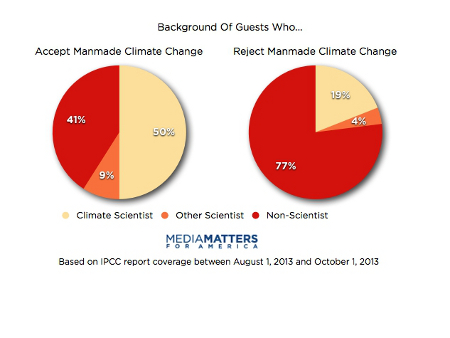
Background of guests who accept and reject human-caused global warming in IPCC media stories, courtesy of Media Matters.
The 19 percent of guests classified as ‘climate scientists’ in the above graphic is also very generous to the conservative American media outlets. Continue reading
The slow poisoning of our oceans
 We could act radioactive pollution to this” deadly trio”
The oceans are heating, acidifying and choking New Scientist, 04 October 2013 by Fred Pearce We know the oceans are warming. We know they are acidifying. And now, to cap it all, it turns out they are suffocating, too. A new health check on the state of the oceans warns that they will have lost as much as 7 per cent of their oxygen by the end of the century.
The cascade of chemical and biological changes now under way could see coral reefs irreversibly destroyed in 50 to 100 years, with marine ecosystems increasingly taken over by jellyfish and toxic algal blooms.The review is a repeat of a study two years ago by the International Programme on the State of the Ocean (IPSO), a coalition of scientists. It concludes that things have become worse since the first study.
“The health of the oceans is spiralling downwards far more rapidly than we had thought, exposing organisms to intolerable and unpredictable evolutionary pressure,” says Alex Rogers at the University of Oxford, the scientific director of IPSO.
Deadly trio
Rogers describes a “deadly trio” of linked global threats. The first is global warming: surface sea water has been warming almost as fast as the atmosphere. The second is acidification – a result of the water absorbing ever more CO2 from the atmosphere. The third is deoxygenation…….http://www.newscientist.com/article/dn24351-the-oceans-are-heating-acidifying-and-choking.html#.UlByOdJwonE
Climate Change – what the Insurance Industry thinks
For his own part, Muir-Wood puts his money where his mouth is. “I personally wouldn’t invest in beachfront property anymore,” he says, noting the steady increase in sea level we’re expecting to see worldwide in the coming century, on top of more extreme storms. “And if you’re thinking about it, I’d calculate quite carefully how far back you’d have to be in the event of a hurricane.”
How the Insurance Industry Is Dealing With Climate Change Smithsonian 25 Sept 13 When it comes to the calculating the likelihood of catastrophic weather, one group has an obvious and immediate financial stake in the game: the insurance industry. And in recent years, the industry researchers who attempt to determine the annual odds of catastrophic weather-related disasters—including floods and wind storms—say they’re seeing something new.
“Our business depends on us being neutral. We simply try to make the best possible assessment of risk today, with no vested interest,” says Robert Muir-Wood, the chief scientist of Risk Management Solutions (RMS), a company that creates software models to allow insurance companies to calculate risk. “In the past, when making these assessments, we looked to history.
But in fact, we’ve now realized that that’s no longer a safe assumption—we can see, with certain phenomena in certain parts of the world, that the activity today is not simply the average of history.”This pronounced shift can be seen in extreme rainfall events, heat waves and wind storms. The underlying reason, he says, is climate change, driven by rising greenhouse gas emissions. Muir-Wood’s company is responsible for figuring out just how much more risk the world’s insurance companies face as a result of climate change when homeowners buy policies to protect their property………
The fact that the frequency of some catastrophic weather events may be changing due to climate change makes the problem even more complex. Continue reading
Big corporate money funding climate sceptics
The Competitive Enterprise Institute has in the past received funding from Exxon Mobil, the oil company, and the American Petroleum Institute, Texaco, General Motors and the Koch Family Foundations, controlled by the Koch brothers who made their fortune from fossil fuels.
Big business funds effort to discredit climate science, warns UN official http://www.theguardian.com/science/2013/sep/20/big-business-funding-climate-change-sceptics Climate change summit braced for counterblast from sceptics as report warns greenhouse gas emissions still increasing Fiona Harvey and Graham Readfern The Guardian, Saturday 21 September 2013 Big companies are paying contrarians to undermine the work of climate scientists, according to a top UN official speaking before the release of a landmark review of climate science this weekby international researchers next Friday.
Halldór Thorgeirsson, a director who reports to the head of the UN body that governs the on-going high level international climate negotiations, said that scientists would need to be prepared for a counter-blast from sceptics.
“Vested interests are paying for the discrediting of scientists all the time. We need to be ready for that,” he said……..
His outspoken views will set the tone for a fractious meeting of the world’s leading climate scientists, kicking off on Monday in Stockholm, that will set out the evidence that the world’s governments use when formulating policies to deal with global warming for decades to come. More than 800 scientists have contributed to the report, the final details of which will be hammered out in a gruelling four-day session next week.
According to a draft of the “Summary for Policy Makers” dated June , seen by the Guardian– the most important part of the document – the scientists will argue that the evidence points to 95% certainty that climate change is occurring and is caused mainly by greenhouse gases released by humans – up from 90% certainty in the previous 2007 report. Continue reading
1 This Month





PLEASE OPPOSE HR 8255 AND S.3639 – bills would accelerate satellite deployment, with no environmental review or safeguards – https://ncstd5li.quorum.us/campaign/169331/
To see nuclear-related stories in greater depth and intensity – go to https://nuclearinformation.wordpress.com
-
Archives
- October 2026 (29)
- September 2026 (339)
- August 2026 (330)
- July 2026 (355)
- June 2026 (287)
- May 2026 (306)
- April 2026 (356)
- March 2026 (251)
- February 2026 (267)
- January 2026 (308)
- December 2025 (358)
- November 2025 (359)
-
Categories
- 1
- 1 NUCLEAR ISSUES
- business and costs
- climate change
- culture and arts
- ENERGY
- environment
- health
- history
- indigenous issues
- Legal
- marketing of nuclear
- media
- opposition to nuclear
- PERSONAL STORIES
- politics
- politics international
- Religion and ethics
- safety
- secrets,lies and civil liberties
- spinbuster
- technology
- Uranium
- wastes
- weapons and war
- Women
- 2 WORLD
- ACTION
- AFRICA
- Atrocities
- AUSTRALIA
- Christina's notes
- Christina's themes
- culture and arts
- Events
- Fuk 2022
- Fuk 2023
- Fukushima 2017
- Fukushima 2018
- fukushima 2019
- Fukushima 2020
- Fukushima 2021
- general
- global warming
- Humour (God we need it)
- Nuclear
- RARE EARTHS
- Reference
- resources – print
- Resources -audiovicual
- Weekly Newsletter
- World
- World Nuclear
- YouTube
-
RSS
Entries RSS
Comments RSS

