Exploding the lie that nuclear power is “low-carbon”
Nuclear Is NOT a Low-Carbon Source of Energy April 14, 2013 by WashingtonsBlog Why Do People Claim that Nuclear Power is a Low-Carbon Source of Energy?…. some scientists are under the mistaken impression that nuclear power is virtually carbon-free, and thus must be pushed to prevent runaway global warming. …But this is a myth.
Amory Lovins …… Nuclear plants are so slow and costly to build that they reduce and retard climate protection.
Here’s how. Each dollar spent on a new reactor buys about 2-10 times less carbon savings, 20-40 times slower, than spending that dollar on the cheaper, faster, safer solutions that make nuclear power unnecessary and uneconomic: efficient use of electricity, making heat and power together in factories or buildings (“cogeneration”), and renewable energy. The last two made 18% of the world’s 2009 electricity, nuclear 13%, reversing their 2000 shares–and made over 90% of the world’s additional electricity in 2008.

Those smarter choices are sweeping the global energy market. Half the world’s new generating capacity in 2008 and 2009 was renewable. In 2010, renewables except big hydro dams won $151 billion of private investment and added over 50 billion watts (70% the total capacity of all 23 Fukushima-style U.S. reactors) while nuclear got zero private investment and kept losing capacity. Supposedly unreliable windpower made 43-52% of four German states’ total 2010 electricity. Non-nuclear Denmark, 21% wind-powered, plans to get entirely off fossil fuels. Hawai’i plans 70% renewables by 2025.
In contrast, of the 66 nuclear units worldwide officially listed as “under construction” at the end of 2010, 12 had been so listed for over 20 years, 45 had no official startup date, half were late, all 66 were in centrally planned power systems–50 of those in just four (China, India, Russia, South Korea)–and zero were free-market purchases. Since 2007,nuclear growth has added less annual output than just the costliest renewable–solar power –and will probably never catch up. While inherently safe renewable competitors are walloping both nuclear and coal plants in the marketplace and keep getting dramatically cheaper, nuclear costs keep soaring, and with greater safety precautions would go even higher. Tokyo Electric Co., just recovering from $10-20 billion in 2007 earthquake costs at its other big nuclear complex, now faces an even more ruinous Fukushima bill………
An International Forum on Globalization report – written by environmental luminaries Ernest Callenback, Gar Smith and Jerry Mander – have slammed nuclear power as catastrophic for the environment:
Nuclear energy is not the “clean” energy its backers proclaim. For more than 50 years, nuclear energy has been quietly polluting our air, land, water and bodies—while alsocontributing to Global Warming through the CO2 emissions from its construction, mining, and manufacturing operations. Every aspect of the nuclear fuel cycle—mining, milling, shipping, processing, power generation, waste disposal and storage—releases greenhouse gases, radioactive particles and toxic materials that poison the air, water and land. Nuclear power plants routinely expel low-level radionuclides into the air in the course of daily operations. While exposure to high levels of radiation can kill within a matter of days or weeks, exposure to low levels on a prolonged basis can damage bones and tissue and result in genetic damage, crippling long-term injuries, disease and death.
See this excellent photographic depiction of the huge amounts of fossil fuel which goes into building and operating a nuclear power plant……….
The bottom line – as discussed above – is that scientists pushing nuclear to combat global warming are misinformed. (True, nuclear industry lobbyists may be largely responsible for the claim that nuclear fights climate change. Indeed, Dick Cheney – whose Halliburton company builds nuclear power plants, and which sold nuclear secrets to Iran – falsely claimed that nuclear power is carbon-free in a 2004 appearance on C-Span. But there are also sincere environmental scientists who are pushing nuclear because they have only studied a small part of the picture, and don’t understand that there are better alternatives. http://www.washingtonsblog.com/2013/04/nuclear-is-not-a-low-carbon-source-of-energy.html
A Clear and Present Danger – new US report on Climate Change
 Climate change is clear and present danger, says landmark US report National Climate Assessment, to be launched at White House on Tuesday, says effects of climate change are now being felt Suzanne Goldenberg US environment correspondent theguardian.com , Monday 5 May 2014 On Sunday the UN secretary-general, Ban Ki-moon, said the world needed to try harder to combat climate change. At a meeting of UN member states in Abu Dhabi before a climate change summit in New York on 23 September, Ban said: “I am asking them to announce bold commitments and actions that will catalyse the transformative change we need. If we do not take urgent action, all our plans for increased global prosperity and security will be undone.”
- Gary Yohe, an economist at Wesleyan University and vice-chair of the NCA advisory committee, said the US report would be unequivocal that the effects of climate change were occurring in real-time and were evident in every region of the country.
- “One major take-home message is that just about every place in the country has observed that the climate has changed,” he told the Guardian. “It is here and happening, and we are not cherrypicking or fearmongering.”
- The draft report notes that average temperature in the US has increased by about 1.5F (0.8C) since 1895, with more than 80% of that rise since 1980. The last decade was the hottest on record in the US.
- Temperatures are projected to rise another 2F over the next few decades, the report says. In northern latitudes such as Alaska, temperatures are rising even faster.
- “There is no question our climate is changing,” said Don Wuebbles, a climate scientist at the University of Illinois and a lead author of the assessment. “It is changing at a factor of 10 times more than naturally.”
- Record-breaking heat – even at night – is expected to produce more drought and fuel larger and more frequent wildfires in the south-west, the report says. The north-east, midwest and Great Plains states will see an increase in heavy downpours and a greater risk of flooding.
- “Parts of the country are getting wetter, parts are getting drier. All areas are getting hotter,” said Virginia Burkett, chief scientist for global change at the US Geological Survey. “The changes are not the same everywhere.”……..
The assessments are the American equivalent of the UN’s Intergovernmental Panel on Climate Change (IPCC) reports. This year’s report for the first time looks at what America has done to fight climate change or protect people from its consequences in the future.
Under an act of Congress the reports were supposed to be produced every four years, but no report was produced during George W Bush’s presidency.http://www.theguardian.com/environment/2014/may/04/climate-change-present-us-national-assessment
Censorship of science writer on Fox News- mustn’t mention climate change
A 2013 study also found that the more time viewers spend watching conservative media, the more skeptical they become of climate science.
 Science Editor: Fox News Told Me Not To Talk About Climate Change The Huffington Post | by Dominique Mosbergen 04/30/2014 This week, a science writer was asked to appear on Fox News to discuss the future of science and technology. However, he says there was one caveat: The issue of climate change would be off-limits.
On Wednesday, Michael Moyer, an editor at Scientific American, described his experience with the news outlet this way:
Fox & Friends producer wanted to talk about future trends. I said #1 will be impacts of climate change. I was told to pick something else.In a blog post on Scientific American, Moyer explained that he had offered to discuss what he foresees as the “trends for the future” on “Fox & Friends.” In a blog post on Scientific American, Moyer explained that he had offered to discuss what he foresees as the “trends for the future” on “Fox & Friends.”
“About the only interesting thing that the scientific community is sure will happen in the next 50 years is that climate change is going to get worse, and that we’re going to have to deal with the impacts. So I put that as one of my talking points,” he wrote.
But Moyer says a producer of the show soon reached out to him to tell him explicitly to not discuss climate change during the segment. Not wanting to back out of an opportunity to “share cool science with whomever will listen,” Moyer agreed to still appear on “Fox & Friends” Wednesday.
That, however, will likely be the last time Moyer will appear on the show.
“I found the tone and topics of coverage while I was sitting in the green room this morning to be not something that I wanted to be a part of in the future,” he told Talking Points Memo of his “Fox & Friends” experience. “I didn’t realize that the drumbeat of conservative propaganda was so ubiquitous on the show.”……
Moyer, however, insists that the Fox producer wrote this in an email: “[C]an we replace the climate change with something else?”
This wouldn’t be the first time that Fox News’ coverage of climate change has beencalled into question. A recent study by the Union of Concerned Scientists found the conservative news outlet covers climate change inaccurately 72 percent of the time.
A 2013 study also found that the more time viewers spend watching conservative media, the more skeptical they become of climate science.
“There are some things that in science and scientific discourse are not controversial at all,” Moyer told Talking Points Memo in light of his Fox News experience. “I hope that we can all as a society agree to at least discuss them and come up with good solutions. Just because you don’t want something to be true doesn’t make it not true.”
According to a recent Associated Press-GfK poll, about four in 10 Americans said “they are not too confident or outright disbelieve that the earth is warming, mostly a result of man-made heat-trapping gases,” per the AP. That’s in stark contrast to the97 percent of climate scientists who say global warming in the last 100 years has very likely been caused by human activity. http://linkis.com/zite.to/eoXrO
Australia’s Prime Minister gets his climate policies from Creation Science
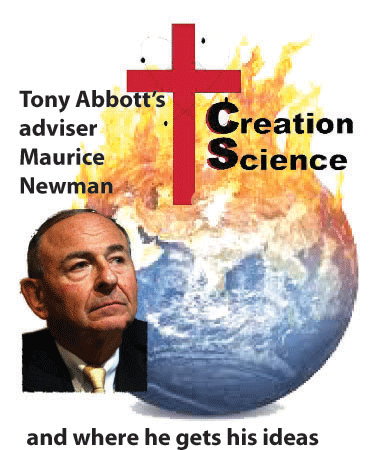
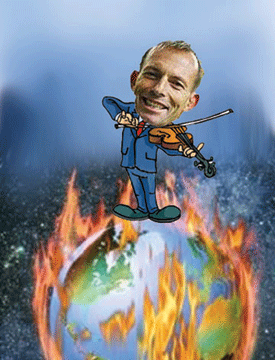 Maurice Newman Rejects Climate Change, Because God. In Other Words, by Tom Cummings, 24 April 14 “…….Newman rejects the findings of thousands of scientists from hundreds of organisations scattered across 195 countries, because of the analysis of one man: Roy Spencer.
at left, Australia’s Prime Minister, Tony Abbott.
UV radiation an important component of climate change
UV-radiation data to help ecological research, Eureka Alert 22April 14 Many research projects study the effects of temperature and precipitation on the global distribution of plant and animal species. However, an important component of climate research, the UV-B radiation, is often neglected. The landscape ecologists from UFZ in collaboration with their colleagues from the Universities in Olomouc (Czechia), Halle and Lüneburg have processed UV-B data from the U.S. NASA space agency in such a way that they can be used to study the influence of UV-B radiation on organisms. Continue reading
UK’s Drigg nuclear trash dump will be washed away by climate change’s sea level rise
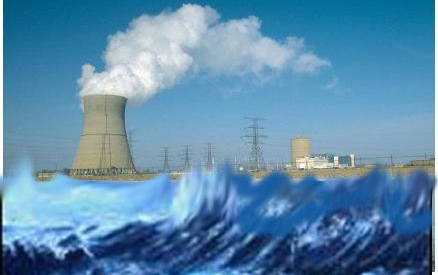 This Huge Nuclear Waste Dump Will Be Washed Away By Rising Sea Levels http://gizmodo.com/uk-nuclear-waste-dump-will-be-washed-away-by-rising-sea-1565513267 21 April 14, Geoff Manaugh A dumping ground for nuclear waste located near the British coast is “virtually certain” to be washed away by rising sea levels, a new
  report warns. The UK Environment Agency has admitted that constructing the Drigg Low-Level Waste Repository so near the coast was a mistake, and that one million cubic meters of nuclear waste will begin leaking into the ocean “a few hundred to a few thousand years from now.”
Sounds bad? Pay no attention, then, to current plans to increase the site’s capacity by another 800,000 cubic meters over the next century, adding new waste that will include “radioactive debris from Britain’s nuclear power stations, nuclear submarines, nuclear weapons, hospitals and universities,” the Guardian reports.
It’s interesting to note that, while the site officially contains only low-level waste, there is suspicion that higher-level wastes with correspondingly higher levels of radioactivity could have been dumped there in the past. Recall the incredible tale of Sellafield nuclear power station—the site from which much of the waste now stored at Drigg originates—where records of previous dumping had been thrown away or lost. This led to the terrifying need to advertise in the local newspaper, saying: “We need your help.” Why? Because they had no idea what was buried there.
“Did you work at Sellafield in the 1960s, 1970s or 1980s?” the ad asked with false calm. “Were you by chance in the job of disposing of radioactive material? If so, the owners of Britain’s nuclear waste dump would very much like to hear from you: they want you to tell them what you dumped—and where you put it.”
In any case, the coastal tomb at Drigg is all but guaranteed to break apart in the waves and wash its mysterious and harmful contents into the sea. “A few hundred to a few thousand years from now” sounds like a long time, of course, but think of that as potentially little more than the time between us and Shakespeare (400 years), and the terrifying urgency of this becomes more clear. [Guardian]
Nuclear Regulatory relaxes rule for hot water discharge from nuclear plant
Connecticut’s nuclear plant can use warmer water WSJ, 21 Apr 14 HARTFORD, Conn. — Connecticut’s nuclear power plant won permission to use warmer water from Long Island Sound for cooling at one of its two units in Waterford, the Nuclear Regulatory Commission announced Monday.
The Millstone 2 plant may use water as warm as 80 degrees Fahrenheit, up from 75 degrees, said the Nuclear Regulatory Commission, which is considering a similar request for Millstone 3.
Millstone 2 shut down for nearly two weeks in August 2012 because the water was warmer than the 75-degree limit. It was the first shutdown of a nuclear power plant on an open body of water. Water is used to cool key components of the plant and is discharged back into the Sound……http://online.wsj.com/article/AP66936a3af568444f9afefe577df90c23.html
Climate Change: coastal properties already threatened by sea level rise
Rising tides threaten communities on the beach — and far from it, too USA Today, Matt Alderton, Green Living April 19, 2014 The mud in Folsom Lake, near Sacramento, Calif., is dry and chapped, like cracked heels. The bottom of the reservoir, once under water, now is largely barren, save for its shallow center and a smattering of stray puddles.
That’s because California is in the midst of one of the worst droughts in state history. Conditions are so bad that
Gov. Jerry Browndeclared a state emergency in January. He urged state residents to voluntarily reduce personal water consumption by 20 percent.
In the context of having so little water, it might seem strange to worry about having too much. And yet, that’s exactly the dilemma facing California today. Even as it reels from drought, it must begin planning for floods. And make no mistake: Floods are coming. Not only to California, but to coastal cities across the country and around the world, which face a certain influx of water as oceans rise under the specter of climate change.
“We analyzed 55 different water level stations throughout the United States and found that for about two-thirds of them, sea level rise from climate change has already more than doubled the risk of extreme flooding,” says Dr. Ben Strauss, director of the Program on Sea Level Rise at Climate Central, a nonprofit organization dedicated to communicating the science and effects of climate change.
Based on the analysis, Climate Central developed Surging Seas, an interactive website (sealevel.climatecentral.org) that maps the flood threats from sea level rise and storm surges. The map shows how more than 3,000 coastal communities in the contiguous United States would be affected if sea levels were to rise from 1 to 10 feet.
“Sea level rise is already happening, and its continuation is inevitable,” Strauss says. “At some point it will be obvious to every family living in a coastal area, and every community will be looking to protect itself.”
A scary proposition
Multiple forces are colluding to make the oceans swell.
One is warming oceans. “Because of that, you have an expansion of ocean waters, and the only place they can go is up,” says Rachel Cleetus, a senior economist in the Climate and Energy Program at the Union of Concerned Scientists, an alliance of citizens and scientists who collaborate on solutions to global problems.
Another is melting land-based ice forms such as glaciers and ice sheets. “You’re adding volume to the world’s oceans, and that’s causing them to rise,” Cleetus says.
Because the rate of ice loss is accelerating, oceans are rising faster than ever before. Cleetus says sea level could rise anywhere from 8 inches to 6.5 feet by the end of the century. Some scientists put estimates as high as 10 or 15 feet. That’s on top of approximately 8 inches of sea level rise already logged in the last century.
“Those 8 inches of sea level rise from climate change are already making every single coastal flood bigger, deeper and more damaging,” Strauss says.
Although scientists typically project sea level rise through the year 2100, communities likely will be impacted much sooner than that. The culprit? Incremental storm surges……….
Ultimately, then, the best solution might be the hardest to swallow: retreat.
“We need to pull back, in essence, from the shore,” says environmental and land-use planning consultant Barry Chalofsky. “If you live (in a coastal floodplain) and you’re counting on your house to be your nest egg when you retire, or you want to pass it on to your children, I would strongly think about elevating your property, then selling it over the next five to 10 years.” http://www.usatoday.com/story/life/2014/04/19/green-living-coastal-communities/7871349/
Renewable energy an effective, relatively cheap, weapon against global warming
UN Touts Ambitious (But Cheap) Investment in Renewable Energy Epoch Times, By Jeremy Hance, news.mongabay.com | April 15, 2014 The world is warming rapidly due to greenhouse gas emissions, threatening everything from our food supply to our ecosystems, but the solution may be surprisingly cheap, according to the third and final reportfrom the Intergovernmental Panel on Climate Change (IPCC). The report recommends a rapid and aggressive switch from fossil fuel-based energy to renewables. While this isn’t exactly surprising, the new report finds that an ambitious green revolution would shave only 2-4 percent off total economic growth over the century, a figure that doesn’t take into account the economic benefits of shifting to clean energies.
“There is a clear message from science: To avoid dangerous interference with the climate system, we need to move away from business as usual,” Ottmar Edenhofer, a co-chair of the IPCC’s Working Group III, said. The IPCC’s Working Group III was responsible for the new report, which focuses on climate change mitigation; the first report explored the science behind current warming, while the second reported on the impacts.
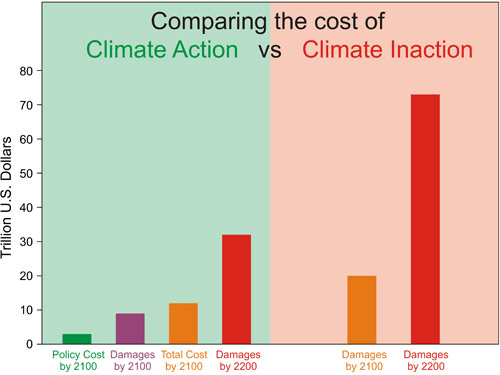
The new report finds that global society must more than triple investment in green energies by 2050 in order to have a reasonable chance of keeping temperatures from rising more than two degrees Celsius above pre-industrial levels, a goal agreed on by the world’s governments. However such a revolution–which would need to cut emissions to near zero by 2100–need not break the bank as some critics of climate change action have warned in the past.
“It is actually affordable to do it and people are not going to have to sacrifice their aspirations about improved standards of living,” co-chair Jim Skea told the Guardian. “It is not a hair-shirt change of lifestyle at all that is being envisaged and there is space for poorer countries to develop too.” According to the report, ambitious mitigation of climate change would reduce global economic growth–set at around 1.6 to 3 percent–by just 0.06 percent over the century. Moreover this analysis doesn’t take into effect the economic pluses of clean energy, such as reduced air and water pollution, new jobs, increased efficiency, and greater stability for energy prices.
“The loss in consumption is relatively modest,” the chairman of the IPCC, Rajendra Pachauri, told the Associated Press.
The report finds that this shift would reduce profits for the coal and oil industries, though may not hurt gas in the near-term; in fact, fossil fuel investments would need to drop by around $30 billion annually. Not surprisingly, lobbying from the powerful fossil fuel industry has proven one of the largest obstacles to governments taking bolder action on greenhouse gas emissions……..
according to the IPCC, the bulk of emissions reductions must come from a sped-up and scaled-up clean energy revolution and a phase-out of fossil fuels.
The IPCC, the world’s global authority on the science of climate change, releases new reports every six years meant to guide current negotiations over the global crisis. Nations are set to sign a new treaty on tackling global climate change in 2015….http://www.theepochtimes.com/n3/621996-un-touts-ambitious-but-cheap-investment-in-renewable-energy/?photo=2
Business community has best hope of promoting action on climate change and renewable energy
Can Business Break Impasse on Climate Action? http://www.kitsapsun.com/news/2014/apr/09/can-business-break-impasse-on-climate-action/
bmagill (AP) April 9, 2014 The Intergovernmental Panel on Climate Change urged immediate action on adapting to human-caused climate change in the second part of its fifth assessment report, released in March. But it may be that governments and the media are poorly equipped to deliver that dire message to the public.
That was the consensus among experts speaking about the evolution of the public debate over climate change and clean energy at Bloomberg’s Future of Energy Summit in New York City.
Andy Hoffman, director of the Institute for Global Sustainable Enterprise at the University of Michigan, said that climate change and renewable energy are caught in a cultural schism in which both, regardless of the science, are seen as products of radical environmentalists and big government.
“What we find is that when people start to discuss these issues, they’re questioning your motives and (trying) to find out whether you’re a member of their tribe,” he said.
Of all the institutions that deliver the message to the public about how climate change will affect them, the media, the government and energy companies are the least trusted, according to surveys conducted by public relations firm Edelman, Jessica Lennard, the firm’s director of energy public affairs said.
The public has a great trust in the business community to deliver that message, however, she said. Continue reading
Common Cause Failure – in Climate Change and in Nuclear Power
 Fukushima Earth, Bulletin of the Atomic Scientists, 4 April 14 DAWN STOVER Stover is a science writer based in the Pacific Northwest and is a contributing editor at theBulletin.
Sudden nuclear disasters of the kind that occurred at the Fukushima Daiichi Nuclear Power Station three years ago may not at first glance seem to have much in common with the slow-motion planetary destruction of global warming. The two phenomena, though, are alike—and not just because they are dangerous to humankind. They unfold in similar fashion, starting with a single event which then leads to and interacts with many others. Both are also easy to foresee—but unprofitable to avert. Continue reading
Climate deniers use legalistic bullying to shut down a journal article
 The journal that gave in to climate deniers’ intimidation The Conversation, Elaine McKewon, Research Associate, Australian Centre for Independent Journalism at University of Technology, Sydney 1 April 14,
In February 2013, the journal Frontiers in Psychology published a peer-reviewed paper which found that people who reject climate science are more likely to believe in conspiracy theories. Predictably enough, those people didn’t like it.The paper, which I helped to peer-review, is called “Recursive fury: Conspiracist ideation in the blogosphere in response to research on conspiracist ideation”. In it, cognitive scientist Stephan Lewandowsky and his colleagues survey and analyse the outcry generated on climate skeptic blogs to their earlier work on climate denial.
The earlier study had also linked climate denial with conspiracist thinking. And so by reacting with yet more conspiracy theorising, the bloggers rather proved the researchers’ point.
Yet soon after Recursive Fury was published, threats of litigation started to roll in, and the journal took the paper down (it survives on the website of the University of Western Australia, where Lewandowsky carried out the study).
A lengthy investigation ensued, which eventually found the paper to be scientifically and ethically sound. Yet on March 21 this year, Frontiers retracted the paper because of the legal threats.
The episode offers some of the clearest evidence yet that threats of libel lawsuits have a chilling effect on scientific research………
the journal’s management and editors were clearly intimidated by climate deniers who threatened to sue. So Frontiers bowed to their demands, retracted the paper, damaged its own reputation, and ultimately gave a free kick to aggressive climate deniers.
I would have expected a scientific journal to have more backbone, certainly when it comes to the crucially important issue of academic freedom. http://theconversation.com/the-journal-that-gave-in-to-climate-deniers-intimidation-25085
Carbon tax works to reduce greenhouse emissions and benefit economy
 How British Columbia Enacted the Most Effective Carbon Tax in North America, the Atlantic Cities, CHRIS MOONEY, 26 MARCH 14, Suppose that you live in Vancouver and you drive a car to work.
  Naturally, you have to get gas regularly. When you stop at the pump, you may see a notice like the one below, explaining that part of the price you’re paying
is, in effect, due to the cost of carbon. That’s because in 2008, the government of British Columbia decided to impose a tax on greenhouse gas emissionsfrom fossil fuels, enacting what has been called ”the most significant carbon tax in the Western Hemisphere by far.”
- A carbon tax is just what it sounds like: The BC government levies a fee, currently 30 Canadian dollars, for every metric ton of carbon dioxide equivalent emissions resulting from the burning of various fuels, including gasoline, diesel, natural gas, and, of course, coal. That amount is then included in the price you pay at the pump—for gasoline, it’s 6.67 cents per liter (about 25 cents per gallon)—or on your home heating bill, or wherever else the tax applies. (Canadian dollars are currently worth about 89 American cents).
-
If the goal was to reduce global warming pollution, then the BC carbon tax totally works. Since its passage, gasoline use in British Columbia has plummeted, declining seven times as much as might be expected from an equivalent rise in the market price of gas, according to arecent study by two researchers at the University of Ottawa. That’s apparently because the tax hasn’t just had an economic effect: It has also helped change the culture of energy use in BC. “I think it really increased the awareness about climate change and the need for carbon reduction, just because it was a daily, weekly thing that you saw,” says Merran Smith, the head of Clean Energy Canada. “It made climate action real to people.”
It also saved many of them a lot of money. Sure, the tax may cost you if you drive your car a great deal, or if you have high home gas heating costs. But it also gives you the opportunity to save a lot of money if you change your habits, for instance by driving less or buying a more fuel-efficient vehicle. That’s because the tax is designed to be “revenue neutral”—the money it raises goes right back to citizens in the form of tax breaks. Overall, the tax has brought in some $5 billion in revenue so far, and more than $3 billion has then been returned in the form of business tax cuts, along with over $1 billion in personal tax breaks, and nearly $1 billion inlow-income tax credits (to protect those for whom rising fuel costs could mean the greatest economic hardship). According to the BC Ministry of Finance, for individuals who earn up to $122,000, income tax rates in the province are now Canada’s lowest.
So what’s the downside? Well, there really isn’t one for most British Columbians, unless they drive their gas-guzzling cars a lot. (But then, the whole point of taxing carbon is to use market forces to discourage such behavior.) The far bigger downside is for Canadians in other provinces who lack such a sensible policy—and especially for Americans. In the United States, the idea of doing anything about global warming is currently anathema, even though addressing the problem in the way that British Columbia has done would help the environment and could also put money back in many people’s pockets. Such is the depth of our dysfunction; but by looking closely at British Columbia, at least we can see that it doesn’t have to be that way……….
- The tax has actually become quite popular. “Polls have shown anywhere from 55 to 65 percent support for the tax,” says Stewart Elgie, director of the University of Ottawa’s Institute of the Environment. “And it would be hard to find any tax that the majority of people say they like, but the majority of people say they like this tax.”It certainly doesn’t hurt that the tax, well, worked. That’s clear on at least three fronts: Major reductions in fuel usage in BC, a corresponding decline in greenhouse gas emissions, and the lack of a negative impact on the BC economy……..
- The bottom line, then, is that BC’s experience provides an exclamation point at the end of the long list of reasons to like a carbon tax. Perhaps the leading one, in the end, is that it’s a far simpler policy option than a cap and trade scheme, and is, as Harvard economist and Bush administration Council of Economic Advisers chair N. Gregory Mankiw has put it, “more effective and less invasive” than the sort of regulatory approaches that the government tends to implement.Indeed, economists tend to adore carbon taxes. When the IGM forum asked a group of 51 prominent economists whether a carbon tax would be “a less expensive way to reduce carbon dioxide emissions than would be a collection of policies such as ‘corporate average fuel economy’ requirements for automobiles,” assent was extremely high: 90 percent either agreed or strongly agreed. Yale economist Christopher Udry commented, “This is as clear as economics gets; provides incentives to find minimally costly ways to reduce emissions.”
“Totally basic economics!” added Stanford’s Robert Hall.
Since 2012, British Columbia has not raised the carbon tax further. Instead, the government agreed to freeze the rate as it is for five years. And no wonder: BC is now far ahead of most of its neighbors, and most of North America, in taking action to curtail global warming………
- In the meantime, BC can boast of the crown jewel of North American climate policy. “BC now has the lowest fuel use in Canada, the lowest tax rates in Canada, and a pretty healthy economy,” says the University of Ottawa’s Stewart Elgie. “It works.”http://www.theatlanticcities.com/jobs-and-economy/2014/03/how-british-columbia-enacted-most-effective-carbon-tax-north-america/8732/
Climate Change is now upon us, and it’s going to get worse
Panel’s Warning on Climate Risk: Worst Is Yet to Come NYT, By JUSTIN GILLISMARCH 30, 2014 YOKOHAMA, Japan — Climate change is already having sweeping effects on every continent and throughout the world’s oceans, scientists reported Monday, and they warned that the problem is likely to grow substantially worse unless greenhouse emissions are brought under control.
The report by the Intergovernmental Panel on Climate Change, a United Nations group that periodically summarizes climate science, concluded that ice caps are melting, sea ice in the Arctic is collapsing, water supplies are coming under stress, heat waves and heavy rains are intensifying, coral reefs are dying, and fish and many other creatures are migrating toward the poles or in some cases going extinct.
The oceans are rising at a pace that threatens coastal communities and are becoming more acidic as they absorb some of the carbon dioxide given off by cars and power plants, which is killing some creatures or stunting their growth, the report found.
Organic matter frozen in Arctic soils since before civilization began is now melting, allowing it to decay into greenhouse gases that will cause further warming, the scientists said.
And the worst is yet to come, the scientists said in the second of three reports that are expected to carry considerable weight next year as
 nations try to agree on a new global climate treaty. In particular, the report emphasized that the world’s food supply is at considerable risk — a threat that could have serious consequences for the poorest nations.
“Nobody on this planet is going to be untouched by the impacts of climate change,” Rajendra K. Pachauri, chairman of the intergovernmental panel, said at a news conference here on Monday…….. Timothy Gore, an analyst for Oxfam, the anti-hunger charity that sent observers to the proceedings, praised the new report for painting a clear picture. But he warned that without greater efforts to limit global warming and to adapt to the changes that have become inevitable, “the goal we have in Oxfam of ensuring that every person has enough food to eat could be lost forever.” http://www.nytimes.com/2014/03/31/science/earth/panels-warning-on-climate-risk-worst-is-yet-to-come.html?hp&_r=0
IPCC cautiously tells us that climate change is already very serious indeed
As grim as the Working Group 2 report on impacts is, it explicitly has very little to say about the catastrophic impacts and vulnerability in the business as usual case where the Earth warms 4°C to 5°C [7°F-9°F] — and it has nothing to say about even higher warming, which the latest science suggests we are headed toward.
Conservative Climate Panel Warns World Faces ‘Breakdown Of Food Systems’ And More Violent Conflict THINK PROGRESS, BY JOE ROMM ON MARCH 30, 2014 THE U.N. INTERGOVERNMENTAL PANEL ON CLIMATE CHANGE (IPCC) HAS ISSUED ITS SECOND OF FOUR PLANNED REPORTS EXAMINING THE STATE OF CLIMATE SCIENCE. THIS ONE SUMMARIZES WHAT THE SCIENTIFIC LITERATURE SAYS ABOUT “IMPACTS, ADAPTATION, AND VULNERABILITY” (BIG PDF HERE). AS WITH EVERY RECENT IPCC REPORT, IT IS SUPER-CAUTIOUS TO A FAULT AND YET STILL INCREDIBLY ALARMING.
It warns that we are doing a bad job of dealing with the climate change we’ve experienced to date: “Impacts from recent climate-related extremes, such as heat waves, droughts, floods, cyclones, and wildfires, reveal significant vulnerability and exposure of some ecosystems and many human systems to current climate variability.”
It warns of the dreaded RFCs (“reasons for concern” — I’m not making this acronym up), such as “breakdown of food systems linked to warming, drought, flooding, and precipitation variability and extremes.” You might call them RFAs (“reasons for alarm” or “reasons for action”). Indeed, in recent years, “several periods of rapid food and cereal price increases following climate extremes in key producing regions indicate a sensitivity of current markets to climate extremes among other factors.” So warming-driven drought and extreme weather have already begun to reduce food security. Now imagine adding another 2 billion people to feed while we are experiencing five times as much warming this century as we did last century!
No surprise, then, that climate change will “prolong existing, and create new, poverty traps, the latter particularly in urban areas and emerging hotspots of hunger.” And it will “increase risks of violent conflicts in the form of civil war and inter-group violence” — though for some reason that doesn’t make the list of RFCs.
In short, “We’re all sitting ducks,” as IPCC author and Princeton Prof. Michael Oppenheimer put it to the AP. AN OVERLY CAUTIOUS REPORT
As grim as the Working Group 2 report on impacts is, it explicitly has very little to say about the catastrophic impacts and vulnerability in the business as usual case where the Earth warms 4°C to 5°C [7°F-9°F] — and it has nothing to say about even higher warming, which the latest science suggests we are headed toward.
The report states:
- “Relatively few studies have considered impacts on cropping systems for scenarios where global mean temperatures increase by 4°C [7°F] or more.
- “… few quantitative estimates [of global annual economic losses] have been completed for additional warming around 3°C [5.4°F] or above.”………
THE HIGH COST OF INACTION
The IPCC’s discussion of economic costs is equally muddled:
“… the incomplete estimates of global annual economic losses for additional temperature increases of ~2°C are between 0.2 and 2.0% of income. Losses are more likely than not to be greater, rather than smaller, than this range…. Losses accelerate with greater warming, but few quantitative estimates have been completed for additional warming around 3°C or above.”
It would have been nice if the IPCC had mentioned at this point that keeping additional temperature increases to ~2°C requires very aggressive efforts to slash carbon pollution starting now. As it is, the deniers, confusionists, and easily confused can (incorrectly) assert that this first sentence means global economic losses from climate change will be low. Again, that’s only if we act now.
As Climate Science Watch noted Saturday, “Other estimates suggest the high impacts on global GDP with warming of 4ºC (For example the Stern Review found impacts of 5-20% of global GDP).”
The costs of even higher warming, which, again, would be nothing more than business as usual, rise exponentially. Indeed, we’ve known for years that traditional climate cost-benefit analyses are “unusually misleading” — as Harvard economist Martin Weitzman warned colleagues, “we may be deluding ourselves and others.” Again, that’s because the IPCC is basically a best case analysis — while it largely ignores the business-as-usual case and completely ignores the worst case……http://thinkprogress.org/climate/2014/03/30/3420723/climate-breakdown-of-food-systems/
1 This Month





PLEASE OPPOSE HR 8255 AND S.3639 – bills would accelerate satellite deployment, with no environmental review or safeguards – https://ncstd5li.quorum.us/campaign/169331/
To see nuclear-related stories in greater depth and intensity – go to https://nuclearinformation.wordpress.com
-
Archives
- October 2026 (29)
- September 2026 (339)
- August 2026 (330)
- July 2026 (355)
- June 2026 (287)
- May 2026 (306)
- April 2026 (356)
- March 2026 (251)
- February 2026 (267)
- January 2026 (308)
- December 2025 (358)
- November 2025 (359)
-
Categories
- 1
- 1 NUCLEAR ISSUES
- business and costs
- climate change
- culture and arts
- ENERGY
- environment
- health
- history
- indigenous issues
- Legal
- marketing of nuclear
- media
- opposition to nuclear
- PERSONAL STORIES
- politics
- politics international
- Religion and ethics
- safety
- secrets,lies and civil liberties
- spinbuster
- technology
- Uranium
- wastes
- weapons and war
- Women
- 2 WORLD
- ACTION
- AFRICA
- Atrocities
- AUSTRALIA
- Christina's notes
- Christina's themes
- culture and arts
- Events
- Fuk 2022
- Fuk 2023
- Fukushima 2017
- Fukushima 2018
- fukushima 2019
- Fukushima 2020
- Fukushima 2021
- general
- global warming
- Humour (God we need it)
- Nuclear
- RARE EARTHS
- Reference
- resources – print
- Resources -audiovicual
- Weekly Newsletter
- World
- World Nuclear
- YouTube
-
RSS
Entries RSS
Comments RSS

