Global carbon emissions to hit record high in 2014
 Global carbon report: emissions will hit new heights in 2014, The Conversation, Pep Canadell Executive director, Global Carbon Project at CSIRO Michael Raupach Director of the Climate Change Institute at Australian National University, 22 September 2014,
As heads of state gather in New York for tomorrow’s United Nations climate summit, a new report on the state of the world’s carbon budget tells them that greenhouse emissions hit a new record last year, and are still growing.
The Global Carbon Project has released its annual report card on the global and national trends in carbon dioxide (CO2) emissions.
It shows that global emissions from burning fossil fuels and cement production reached a new record of 36 billion tonnes of CO2 in 2013, and are predicted to grow by a further 2.5% in 2014, bringing the total CO2 emissions from all sources to more than 40 billion tonnes. This is about 65% more fossil-fuel emission than in 1990, when international negotiations to reduce emissions to address climate change began……..
Is it too late to tame the climate?
Our estimates (see here and here) show that, at current emissions levels, average global warming will hit 2C in about 30 years.
Despite this apparently imminent event, economic models can still come up with scenarios in which global warming is kept within 2C by 2100, while both population and per capita wealth continue to grow. Are these models playing tricks on us?…
http://theconversation.com/global-carbon-report-emissions-will-hit-new-heights-in-2014-31834?utm_medium=email&utm_campaign=Latest+from+The+Conversation+for+21+September+2014+-+1934&utm_content=Latest+from+The+Conversation+for+21+September+2014+-+1934+CID_cc30f6107f0d3fcd110e8e0dd6549531&utm_source=campaign_monitor&utm_term=Global%20carbon%20report%20emissions%20will%20hit%20new%20heights%20in%20201
Obama to press for climate action, at UN Climate Summit
 At UN, Obama to urge nations to go big on climate SF Gate, By JOSH LEDERMAN, Associated Press , September 18, 2014 WASHINGTON (AP) — Having spent political capital fighting climate change at home, President Barack Obama will turn his sights overseas next week, urging fellow heads of state to be as ambitious as possible as they negotiate a make-or-break global treaty to be finalized in Paris next year.
Obama will attend a United Nations climate summit where he will announce new U.S. commitments, aiming to ramp up the pressure on other major polluters like India and China to demonstrate they’re not laggards in the global campaign against climate change.
White House officials said the U.S. will offer tangible contributions such as American technology to help vulnerable populations deal with food security, sea level rise and other negative effects of climate change.
“Our hope is that others will do the same and that can build momentum toward an agreement in Paris,” Dan Utech, Obama’s top adviser on climate and energy issues, said in an interview…….
By taking time out at the U.N. for climate change, Obama is working to keep the issue at the top of the global agenda even after the crises of the day recede from memory. More than 100 heads of state will join Obama at the summit, which U.N. Secretary-General Ban Ki-moon is hosting…….http://www.sfgate.com/news/science/article/At-UN-Obama-to-urge-nations-to-go-big-on-climate-5765158.php
Amazon to guzzle fossil fuelled electricity in new “server farm”
 Maybe we should all be concerned at the absurdity of this idea of all our data “in the cloud”. It’s not up in the clouds – it’s in dirty great computers taking up acres of space, and using up ever more electricity. In this sense, we are all complicit in pollutting the planet. Why on Earth can’t the IT ndustry grow up, and learn to chuck out unwanted stuff – instead of this mindless, endles storage of DIGITAL STUFF!
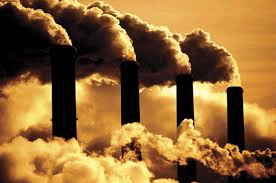 Amazon’s cloud is about to get dirtier http://grist.org/news/amazons-cloud-is-about-to-get-dirtier/By Sam Bliss17 Sep 2014 In the latest effort to satisfy our desire to save every photo, thought, and fragment of information in cyberspace, Amazon plans to build a fat new server farm that will offer “cloud” storage for such companies as Yelp, Netflix, Pinterest, Dropbox, Spotify, Soundcloud, Tumblr, and Vine, to name more than a few.
According to the Seattle Times, the $1.1 billion server farm will be located in Dublin, Ohio. The city is served by an electric utility that gets two-thirds of its juice from coal-fired power plants, and has a history of lobbying for the coal industry.
As a Greenpeace report from earlier this year shows, not all energy-hogging data centers warm the climate equally, and Amazon’s are among the worst of the worst. Fossil fuel burning provides over half the energy used by Amazon’s colossal digital network — and nuclear power supplies another quarter. Here’s the breakdown: (diagram)
By contrast, the Greenpeace report raves that Apple powers the iCloud with 100 percent renewables; Facebook put a data center in Iowa to spark the world’s largest purchase of wind turbines; and Google is signing long-term contracts to buy cleaner power for some of its centers. What’s more, these three web giants teamed up in North Carolina to pressure Duke Energy, the largest U.S. utility and one of the country’s biggest emitters, to offer customers — including their data warehouses — the choice to buy greener electricity.
(Before heaping too much praise on all that progress, recall that these companiesand their founders don’t have perfect track records when it comes to caring for the climate.)
To avoid adding to Amazon’s dirty energy use (and supporting its labor-abusing,writer-exploiting, bookstore-bullying, and publisher-extorting ways) we can host our websites and store our digital stuff elsewhere until the company cleans up its act — and maybe even shop in a real store like back in the old days.
Yet given Amazon’s’s dominion over many of the apps and sites we use for fun, entertainment, information, and procrastination, we’d basically have to give up our computers and all other devices to steer clear of its sovereign realm.
If all the less desirable impacts of the internet were as palpable as the gratification we get from instantly streaming the last five Parks and Recreation episodes (made possible by Amazon’s web infrastructure), it would be a lot easier to make an informed decision about how much digital property we really want.
Maybe we need an app that’ll kick a could of smoke out of the back of our laptops every time we order a bag of groceries from Amazon Fresh.
Pacific Islanders face need to eventually migrate, due to rising sea levels
 Pacific Islanders reject ‘climate refugee’ status, want to ‘migrate with dignity’, SIDS conference hears ABC News 4 Sept 14 They have long been described as climate refugees: the hundreds of thousands of people living on low-lying Pacific islands who may be forced to migrate if rising sea levels leave their homes uninhabitable.
But it is a term Pacific leaders say is loaded with political connotations and does not reflect the true dimensions of the problem.
“They see [refugee] as a negative term that connotes victimhood and people in need of protection by the international community,” Professor Jane McAdam, director of the Andrew & Renata Kaldor Centre for International Refugee Law at UNSW, told the ABC.
“For them it signifies that they’ve become people who don’t have any agency or aren’t able to contribute.
They can be worthwhile citizens when we relocate them as a community, not as refugees.
Kiribati’s president Anote Tong
“What Pacific Islanders have told me is that, ‘we want to be seen as active economic and social contributors to any country to which we might need to move. We would like to have opportunities to migrate with dignity rather than have to wait until the situation becomes so dire that we are forcibly displaced’.”
The sentiment was echoed at the International Conference on Small Island Developing States (SIDS) which wrapped up in Apia, Samoa, on Thursday………
Australia has joined the steering group of the Nansen Initiative on Disaster-Induced Cross-Border Displacement, which aims to “build consensus on the development of a protection agenda” for those forced to flee natural disasters and the effects of climate change.
“We do need to enable people to have opportunities to migrate … but we also need to combine that with disaster risk reduction strategies, with adaptation strategies and with good development practices so that we have a holistic approach to the issue,” said Professor McAdam, who sits on the Nansen Initiative’s consultative committee.
She said the Nansen Initiative will put forward “a comprehensive framework of solutions” next year.http://www.abc.net.au/news/2014-09-05/pacific-islanders-reject-calls-for-27climate-refugee27-status/5723078
China to start huge carbon trading scheme
China’s national carbon market to start in 2016, official says SMH, September 1, 2014 China plans to roll out its national market for carbon permit trading in 2016, an official said Sunday, adding that the government is close to finalising rules for what will be the world’s biggest emissions trading scheme.
The world’s biggest-emitting nation, accounting for nearly 30 per cent of global greenhouse gas emissions, plans to use the market to slow its rapid growth in climate-changing emissions.
China has pledged to reduce the amount of carbon it emits per unit of GDP to 40-45 per cent below 2005 levels by 2020.
It has already launched seven regional pilot markets in a bid to gain experience ahead of a nationwide scheme…….The Chinese market, when fully functional, would dwarf the European emissions trading system, which is currently the world’s biggest.
It would be the main carbon trading hub in Asia and the Pacific, where Kazakhstan and New Zealand already operate similar markets. South Korea will launch a national scheme on Jan. 1, 2015, while Indonesia, Thailand and Vietnam are drawing up plans for markets of their own. http://www.smh.com.au/business/carbon-economy/chinas-national-carbon-market-to-start-in-2016-official-says-20140901-10arz1.html#ixzz3CDBKLO8u
UN’s latest report – global warming might now be irreversible
Global warming is already here and could be irreversible, UN panel sayshttp://www.theguardian.com/environment/2014/aug/26/global-warming-irreversible-un-panel-report A 127-page draft report by the UN Intergovernmental Panel on Climate Change describes what can be done about it
Global warming is here, human-caused and probably already dangerous – and it’s increasingly likely that the heating trend could be irreversible, a draft of a new international science report says.
The United Nations’ Intergovernmental Panel on Climate Change on Monday sent governments a final draft of its synthesis report, which combines three earlier, gigantic documents by the Nobel Prize-winning group. There is little in the report that wasn’t in the other more-detailed versions, but the language is more stark and the report attempts to connect the different scientific disciplines studying problems caused by the burning of fossil fuels, such as coal, oil and gas.
The 127-page draft, obtained by The Associated Press, paints a harsh warning of what’s causing global warming and what it will do to humans and the environment. It also describes what can be done about it.
“Continued emission of greenhouse gases will cause further warming and long-lasting changes in all components of the climate system, increasing the likelihood of severe, pervasive and irreversible impacts for people and ecosystems,” the report says. The final report will be issued after governments and scientists go over the draft line by line in an October conference in Copenhagen.
Depending on circumstances and values, “currently observed impacts might already be considered dangerous,” the report says. It mentions extreme weather and rising sea levels, such as heat waves, flooding and droughts. It even raises, as an earlier report did, the idea that climate change will worsen violent conflicts and refugee problems and could hinder efforts to grow more food. And ocean acidification, which comes from the added carbon absorbed by oceans, will harm marine life, it says.
Without changes in greenhouse gas emissions, “climate change risks are likely to be high or very high by the end of the 21st century,” the report says.
In 2009, countries across the globe set a goal of limiting global warming to about another 2 degrees Fahrenheit (-16.67C) above current levels. But the report says that it is looking more likely that the world will shoot past that point. Limiting warming to that much is possible but would require dramatic and immediate cuts in carbon dioxide pollution.
The report says if the world continues to spew greenhouse gases at its accelerating rate, it’s likely that by mid-century temperatures will increase by about another 3.6 degrees Fahrenheit (2 degrees Celsius) compared to temperatures from 1986 to 2005. And by the end of the century, that scenario will bring temperatures that are about 6.7 degrees Fahrenheit warmer (3.7 degrees Celsius).
Looks like global warming is stopping nuclear power, rather than the other way round
 Heavy Rain in South Korea Kills Five, Shuts Nuclear Plant Officials Say Five People Still Missing WSJ, By
JEYUP S. KWAAK 25 Aug 14, SEOUL-Heavy rainfall on Monday killed at least five people and shut down a nuclear reactor in South Korea, pushing the country’s populous southeast region to a near-standstill. …… A 650-megawatt nuclear reactor in Busan, about 330 kilometers (204 miles) southeast of Seoul, was also suspended on Monday after rising water flowed into the facilities, the national nuclear-power-plant operator Korea Hydro & Nuclear Power Co. Ltd said. The reactor remained shut down as of Tuesday morning…….http://online.wsj.com/articles/heavy-rain-in-south-korea-kills-five-shuts-nuclear-plant-1409023982
Nuclear power would come in far too late to affect global warming
Ten top PR firms refuse to work with climate chnage deniers
 World’s top PR companies rule out working with climate deniers
Ten firms say they will not represent clients that deny man-made climate change or seek to block emisson-reducing regulations Suzanne Goldenberg and Nishad Karim theguardian.com, Monday 4 August 2014 Some of the world’s top PR companies have for the first time publicly ruled out working with climate change deniers, marking a fundamental shift in the multi-billion dollar industry that has grown up around the issue of global warming.
Public relations firms have played a critical role over the years in framing the debate on climate change and its solutions – as well as the extensive disinformation campaigns launched to block those initiatives.
Now a number of the top 25 global PR firms have told the Guardian they will not represent clients who deny man-made climate change, or take campaigns seeking to block regulations limiting carbon pollution. Companies include WPP, Waggener Edstrom (WE) Worldwide, Weber Shandwick, Text100, and Finn Partners.
“We would not knowingly partner with a client who denies the existence of climate change,” said Rhian Rotz, spokesman for WE.
Weber Shandwick would also not take any campaign to block regulations cutting carbon emissions or promoting renewable energy. “We would not support a campaign that denies the existence and the threat posed by climate change, or efforts to obstruct regulations cutting greenhouse gas emissions and/or renewable energy standards,” spokeswoman Michelle Selesky said…… http://www.theguardian.com/environment/2014/aug/04/worlds-top-pr-companies-rule-out-working-with-climate-deniers
For mitigation of climate change, wind power leaves nuclear and carbon capture way behind
Wind Energy Beats Nuclear & Carbon Capture For Global Warming Mitigation Clean Technica July 29th, 2014 by Mike Barnard There’s an enduring myth related to wind energy and nuclear energy that needs to be put to bed. That myth is that only nuclear can be scaled to sufficient capacity to reduce the impacts of global warming, and that wind energy is much less scalable so it should be ignored.
Most recently, this appeared as a broad generalization without any supporting evidence in a pro-carbon capture series by a CCS researcher on the Siemens-sponsored Energy Collective, which features this particular myth regularly, being a bit of an echo chamber for it. Of course the nuclear industry’s PR professionals love this line as well.
And there’s another myth related to carbon capture and sequestration being more significant than renewables that has to be assessed as well.
China is the true test bed for maximum scalability of nuclear vs wind. It has a tremendous gap between demand and generation. It can mostly ignore lack of social license for nuclear. It is building both wind and nuclear as rapidly as possible. It has been on a crash course for both for about the same period of time. It has bypassed most of the regulatory red tape for nuclear which sensibly exists elsewhere given concerns about economic fallout of Fukushima-scale disasters, nuclear proliferation and terrorism. And in four years it has built significantly less nuclear generation capacity than it built of wind generation capacity in 2013 alone…….
Where does this leave the claims about nuclear and CCS?
Nuclear isn’t more scalable than wind or other renewables, in fact it’s going in reverse while renewables are being expanded rapidly. And CCS won’t dodge more climate change than renewables because wind and solar are being built in production rapidly and CCS isn’t and won’t be in comparable scales because the economics don’t support it. Both are busted myths.
Wind energy isn’t the only answer. It is likely to reach a maximum of 30% to 40% of supply in a century worldwide. That’s impressive and amazing, but far from the only tool necessary to deal with climate change. Solar will be in the same range. Storage will likely be necessary somewhere from 15% to 20% and grid interconnections will improve substantially. Biomass and geothermal will add their bits, as will tidal possibly. And demand for electricity will go up a lot as countries become richer and transportation and other forms of energy usage become electrified. It’s a complex space, and CCS has an important if smaller and only bridging role to play in it. Nuclear is useful as well, although diminishing as a percentage of total worldwide generation.
But the heavy lifting will be done by displacing fossil fuel generation with renewables, not trying to mitigate the extraordinary problems with burning fossil fuels or building nuclear generation. That’s what the empirical data tells us………. http://cleantechnica.com/2014/07/29/wind-energy-beats-nuclear-carbon-capture-global-warming-mitigation/
Hot weather forcing Sweden to cut nuclear reactors’ output

 Sweden’s nuclear plants forced to cut output due to warm weather Planet Ark, 24-Jul-14 Balazs Koranyi Sweden’s top nuclear power generators have been forced to cut output because of exceptionally warm weather in Scandinavia, and their output could be reduced for over a week, their operators said on Wednesday.
Oskarshamn, part of Germany’s E.ON and Forsmark, operated by Swedish utility Vattenfall have both cut output because warm sea water temperatures are limiting their ability to cool down.
“For each degree above 23 decrees Celsius in the cooling water, each unit has to decrease power by 3 percent,” Forsmark said in a market message. “It is uncertain how long this will last, but according to meteorologists, the warm weather will last for at least 11 more days.”
Temperatures exceeded 30 degrees in the southern part of Scandinavia this week, hitting their highest level in years…….http://planetark.org/enviro-news/item/71927
Shut down Indian point nuclear plant for summer – say environmental regulators
 New York environment regulators seek summer shutdown at Indian Point Planet Ark, : 22-Jul-14 Scott DiSavino New York state environmental regulators are proposing shutting the giant Indian Point nuclear power plant to protect fish in the Hudson River during summer months, when demand for electricity for air-conditioning is greatest…………The DEC said in an email that the proposal, which will be discussed in a public meeting on Tuesday, is similar to what Consolidated Edison Inc did when it owned the reactors and is consistent with the practice of other facilities on the Hudson……
The DEC proposal is the latest salvo in a lengthy battle between Entergy Corp, which owns Indian Point and wants to keep the plant operating for another 20 years, and state environmental regulators, who are seeking to protect fish and other aquatic life.
Indian Point withdraws up to 2.5 billion gallons of water per day from the Hudson to cool equipment, and then discharges that water back into the river warmer than before.
Environmental groups and the DEC have long argued that Indian Point’s water intake system kills about a billion fish, fish eggs and larvae each year, and the plant should install cooling towers to reduce the use of river water by recycling it…….Before the NRC can grant new licenses, the state must approve water permits. http://planetark.org/enviro-news/item/71913
Nuclear power bad for climate: Climate Change bad for nuclear power
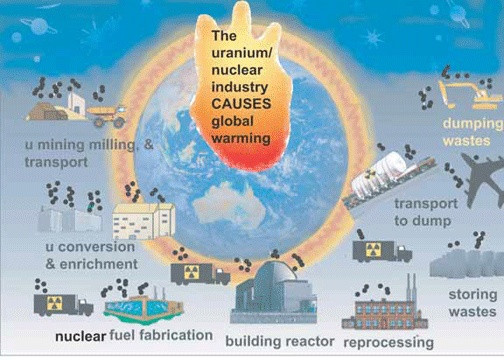
 How Nuclear Worsens Climate Change, Sierra Club, Dave Andrews May 28, 2014 The nuclear industry has been selling the world a story that nuclear power is a solution to climate change because it does not generate carbon dioxide (CO2), a major greenhouse gas. While this is true of the nuclear chain reaction itself, the front and back ends of nuclear power generate a large volume of CO2 and leave a trail of endlessly dangerous radioactivity along the way.
☢ Nuclear power has a big carbon footprint. At the front end of nuclear power, carbon energy is used for uranium mining, milling, processing, conversion, and enrichment, as well as for transportation, formulation of rods and construction of nuclear reactors (power plants). At the back end, there is the task of isolation of highly radioactive nuclear waste for millennia—a task which science has so far not been able to address. Large amounts of water are also used, first in mining and then in cooling the reactors.
All along the nuclear fuel chain, radioactive contamination of air, land and water occurs. Uranium mine and mill cleanup demands large amounts of fossil fuel. Each year 2,000 metric tons of high-level radioactive waste and twelve million cubic-feet of low-level radioactive waste are generated in the U.S. alone. None of this will magically disappear. Vast amounts of energy will be needed to isolate these dangerous wastes for generations to come.
☢ Nuclear power takes too long to deploy. Construction of the 1500 new reactors that the nuclear industry claims are needed to address global warming would mean opening a new reactor once every 2 weeks for the next 60 years. Reactors can take 10-15 years to build with an estimated cost of $12-15 billion each. In the past, cost and time needed for construction have each more than doubled from original estimates. We need to supply low-carbon energy sources NOW.
☢ Nuclear power is not suited for warming climates. Nuclear reactors need enormous amounts of cool water to continually remove heat from their cores. Reactors have been forced to close during heat waves due to warmth of sea, lake or river water — just when electricity is being used most. Low water levels during heat and drought have also forced reactors to shut down. In addition, cooling causes serious damage to aquatic life, killing millions of fish and untold numbers of macroinvertebrates, aquatic eggs and larvae.
☢ Six times as much carbon can be saved with efficiency or wind. Benjamin Sovacool from the Institute for Energy and Environment at Vermont Law School averaged the high and low estimates of carbon pollution from nuclear power. His study revealed that nuclear power’s carbon emissions are well below scrubbed coal-fired plants, natural gas-fired plants and oil. However, nuclear emits twice as much carbon as solar photovoltaic and six times as much as onshore wind farms. Energy efficiency and some of the other renewables also beat nuclear by sixfold or more.
☢ Nuclear power is not flexible. Nuclear is all-or-nothing power. A reactor can’t be geared to produce less power when electricity from renewables (like wind and solar) increases on the grid. This can make it challenging to increase renewables past a certain point. (continued on page 2)
When a reactor shuts down due to accident, planned upgrade or permanent closure, a large amount of power has to be found elsewhere. And nuclear plants are being closed, not opened — some because they no longer are making a profit. It’s important to develop renewablesNOW to be able to replace the electricity when utilities announce plans to close reactors.
☢ Nuclear subsidies rob research on renewables. Nuclear power has been subsidized throughout most of its fuel chain. In 2011 the Union of Concerned Scientists published Nuclear Power, Still Not Viable without Subsidies. This report shows that in some cases subsidies were greater than the value of the electricity produced. Subsidies are supposed to be for new innovations — not for propping up outdated technologies like fossil fuels and nuclear. Nuclear is also a dirty extractive industry – and like coal, oil and gas, nuclear depends on a limited supply of natural resources (uranium) in the ground.
☢ Cost of nuclear is going up, while cost of renewables is going down.Estimates for new reactors are, on average, four times higher than estimates from just eight years ago. Estimates for new reactors are invariably far less than the final cost, with the final cost often doubling. Sometimes, as in the cases of the Columbia Generating Station, Cherokee, and Perry, billions were spent while the reactors were never finished. Costs of renewables continue going down while their efficiency increases. ……. http://content.sierraclub.org/grassrootsnetwork/sites/content.sierraclub.org.activistnetwork/files/teams/documents/SierraNuclearClimate%20%284%29.pdf

A global record – hot temperatures in June this year
June a global scorcher as records melt, The Age July 22, 2014 Peter Hannam Environment Editor, The Sydney Morning Herald Last month was a scorcher for global temperatures with warmth over land and sea breaking records for June while sea-surface temperatures posted their largest departure from long-term averages for any month.
Combined average temperatures over land and sea were 0.72 degrees above the 20th century average of 15.5 degrees, making it the hottest June and adding to the record May and equal record April, according to the US National Oceanic and Atmospheric Administration (NOAA).
More striking for climatologists, though, were the sea-surface temperatures. These came in 0.64 degrees above the 20th century average of 16.4 degrees – the first time any month had exceeded the long-run norm by more than 0.6 degrees.
Parts of all major ocean basins notched their warmest June, with almost all the Indian Ocean and regions off south-eastern Australia the hottest on record.
An El Nino event remains about a 70 per cent chance of forming during the northern summer, which could see more records tumble. The weather pattern sees the central and eastern equatorial Pacific Ocean becoming relatively warm compared with western regions, and typically brings hotter, drier than usual conditions to south-east Asia and Australia.
Australia posted its hottest 12 months on record in the year to June, while 2013 was the hottest calendar year in more than a century of records, according to the Bureau of Meteorology.
While June was another month of above-average temperatures, Western Australia and the Northern Territory were cooler than normal – breaking a sequence begun in February in which every state or territory had above-average warmth, NOAA noted.
June was the 352nd month when global temperatures were above the 20th century average – with the last below-average month in February 1985……….
Climate Change challenge to Koch brothers – and from other billionaires!
The Billionaire War Heats Up Slate.com 17 July 14 The richest people in America are turning on one another—over climate change.By Eric Holthaus Move over, Al Gore. There’s a new wealthy environmentalist whom conservatives love to hate. If you haven’t heard of him yet, meet Tom Steyer…….In a biographical post on his super PAC’s website labeled “accountability,” Steyer says “climate change has not always been on my radar.” In 2012, after founding Farallon Capital Management and running it for more than 25 years (amassing a billion-dollar fortune in the process), he left his post to work on global warming full time.
As the Washington Post reported last year, to reduce his footprint (which is probably still pretty big), Steyer chooses to take the red eye. He doesn’t shy away from the occasional environmental campaign rally, but he’s not about to guilt trip you for not switching out your light bulbs, either. His target is much bigger: the American political process itself.
In response to his efforts to make global warming a major political issue in the runup to the 2014 midterm elections,
 Climate change challenge tSteyer is fast drawing the ire of the political landscape’s resident oil-money billionaires, the Koch brothers. Their talking point is simple: Tom Steyer is one of us, so lefties should demonize him, too. As Slate’s David Weigel wrote, “Republicans are trying to Koch-ify Tom Steyer in just five or six months.”
Ever since February, when Steyer announced a $100 million campaign to fight climate change, critics have been eager to pick at anything that may tarnish his green label. Steyer’s campaign—$50 million of his own, and $50 million from his super PAC, NextGen Climate—is primarily meant to encourage action on global warming……….
teyer doesn’t dispute that he “was for coal before he was against it.” In an op-ed in Politico on Monday, Steyer explained his about-face from hedge fund capitalist to environmental crusader, in an attempt to set the record straight:
[I]t’s true—Farallon did make fossil fuel investments under my watch. But the more I learned about the energy and climate problems we currently face, the more I realized I had to change my life. I concluded that the best way to align my work with my beliefs was to make a real change—leaving my role managing a firm with investments across the industrial spectrum, and instead joining in the global effort to find a solution to climate change once and for all.
Steyer says that he’s completely divested his personal holdings from the fossil fuel industry as of June 30 though certainly that won’t stop the right from claiming that he’s being hypocritical. But that’s missing the point. It’s not Steyer’s dollars (or even the source of those dollars) that will make the biggest difference but his example of putting his money where his mouth is. In his Politico piece, he offers an incredibly personal description of his epiphany and his decision to dedicate himself to tackling global warming on behalf of his children’s generation. Steyer has done something that’s still far too unusual: He’s admitting he was wrong on climate change and that he wants to rectify it. It’s that kind of honesty that we’ll all need to embrace if we’re to face the steep climb of remaking the global economy into one that isn’t tied to carbon with a full head of steam (or, electrons, as the case may be).
Meanwhile, in a world where money defines political clout, most billionaires aren’t as eager to ruffle the status quo. The few who are stand out. Last month, Steyer joined billionaire former New York City Mayor Michael Bloomberg and near-billionaire former Goldman Sachs CEO and Treasury Secretary Henry Paulson to release a high-profile report on the economic effects of climate change in the United States. That report called for the leaders of the business community to address the growing specter of climate change out of their own self-interest: to avoid economic risk. With their billions in annual revenue as part of the fossil fuel industry, the Koch brothers may want to take note……….http://www.slate.com/articles/technology/future_tense/2014/07/tom_steyer_koch_brothers_billionaires_are_battling_over_climate_change.html
1 This Month





PLEASE OPPOSE HR 8255 AND S.3639 – bills would accelerate satellite deployment, with no environmental review or safeguards – https://ncstd5li.quorum.us/campaign/169331/
To see nuclear-related stories in greater depth and intensity – go to https://nuclearinformation.wordpress.com
-
Archives
- October 2026 (29)
- September 2026 (339)
- August 2026 (330)
- July 2026 (355)
- June 2026 (287)
- May 2026 (306)
- April 2026 (356)
- March 2026 (251)
- February 2026 (267)
- January 2026 (308)
- December 2025 (358)
- November 2025 (359)
-
Categories
- 1
- 1 NUCLEAR ISSUES
- business and costs
- climate change
- culture and arts
- ENERGY
- environment
- health
- history
- indigenous issues
- Legal
- marketing of nuclear
- media
- opposition to nuclear
- PERSONAL STORIES
- politics
- politics international
- Religion and ethics
- safety
- secrets,lies and civil liberties
- spinbuster
- technology
- Uranium
- wastes
- weapons and war
- Women
- 2 WORLD
- ACTION
- AFRICA
- Atrocities
- AUSTRALIA
- Christina's notes
- Christina's themes
- culture and arts
- Events
- Fuk 2022
- Fuk 2023
- Fukushima 2017
- Fukushima 2018
- fukushima 2019
- Fukushima 2020
- Fukushima 2021
- general
- global warming
- Humour (God we need it)
- Nuclear
- RARE EARTHS
- Reference
- resources – print
- Resources -audiovicual
- Weekly Newsletter
- World
- World Nuclear
- YouTube
-
RSS
Entries RSS
Comments RSS

